This site is operated by a business or businesses owned by Informa PLC and all copyright resides with them. Informa PLC's registered office is 5 Howick Place, London SW1P 1WG. Registered in England and Wales. Number 8860726.
Finovate Blog
Tracking fintech, banking & financial services innovations since 1994
Increase has launched Increase Bank, combining an FDIC-member institution with its API-first banking core and direct connections to the Federal Reserve, The Clearing House, and Visa.
The company entered banking through its 2025 acquisition of Washington-based Twin City Bank, which continues serving existing community customers under the Twin City Bank name.
By operating its own bank while continuing to work with partner banks, Increase is integrating more of the embedded-finance stack and gaining greater control over product development, compliance, payments, and economics.
API-first banking fintech Increase is launching Increase Bank to bring its modern bank core to help businesses build and launch financial products.
With today’s launch, Increase now includes Increase Bank, an FDIC-member institution, plus its built-from-scratch banking core with direct connections to the Federal Reserve, The Clearing House, and Visa.
“This is a bank built by a team of product-obsessed operators for ambitious companies that are just as obsessed with building the best possible products for their customers,” said Increase Founder Darragh Buckley. “It is programmable at scale and designed for reliability, speed, and flexibility.”
Rather than pursuing a new bank charter from scratch, Increase acquired Washington-based Twin City Bank in 2025, giving it a regulated banking institution to complement its API-first infrastructure platform. The single-branch bank now operates as Increase Bank while continuing to serve Twin City Bank’s existing community banking customers under the Twin City name.
While the bank expands Increase’s role in the financial stack, the technology remains central to its strategy. Instead of serving exclusively as middleware between fintechs and sponsor banks, the company is integrating more of the stack by operating its own bank while continuing to partner with others. The move gives Increase greater control over product development, compliance, and payment operations, while positioning it to capture a larger share of the economics behind embedded finance.
“A fintech company’s ability to scale often comes down to whether they have a banking partner that can move at their pace, build solutions to the edge cases they are solving, and give them direct access to payment rails,” said Stripe Head of International Diede van Lamoen. “Increase was built by people who have first-hand experience with these challenges and a drive to support users from the first payment to their billionth.”
Founded in 2020, Increase provides the banking infrastructure behind companies including Gusto, Ramp, and Stripe. Its API-first platform enables developers to build products for money movement, deposit accounts, and card issuing using programmable banking components.
Ramp has officially launched in Canada, marking the spend management platform’s first expansion outside the US and bringing its corporate cards, expense management, bill pay, and accounting tools to Canadian businesses.
The Canadian platform includes localized features such as CAD and USD spending without FX markup, automatic GST/HST/PST/QST tax coding, Canadian-dollar accounting integrations, and cards issued through Peoples Trust.
Ramp’s expansion comes as competition in business banking intensifies, following Expensify’s UK and EU corporate card launch and Intuit’s introduction of a QuickBooks-connected corporate credit card.
Corporate card and expense management platform Ramp is moving across international borders this week. The New York-based company is now available to businesses in Canada.
Today’s launch comes after Ramp piloted its Canadian operations with a select few Canada-based small businesses. With the broad launch, businesses headquartered in Canada can now use Ramp’s capabilities for managing spend, paying bills, and closing their books. Notably, Ramp is still not available to businesses based in Quebec or Saskatchewan.
Ramp’s new Canadian operation is built for Canadian businesses, allowing businesses to spend in CAD and USD without additional FX markup. Additionally, the platform is designed to accommodate Canada’s tax system by automatically coding transactions with the appropriate GST, HST, PST, or QST, helping finance teams streamline expense management and tax compliance.
The Canadian offering brings the same capabilities as the US platform, including corporate cards, expense management, reimbursements, bill pay, and accounting sync. However, Canadian businesses make payments in CAD and cards are issued through Peoples Trust. Card transactions sync natively with QuickBooks Online, Xero, Microsoft Business Central, NetSuite, and Sage Intacct in Canadian dollars.
To support its Canadian expansion, Ramp will open its first office in Toronto, where it will build a local team to provide sales, implementation, and customer support for Canadian businesses. The local presence underscores Ramp’s longer-term investment in the Canadian market as it expands beyond the US.
Ramp, which is used by over 70,000 businesses, was founded in 2019 and has experienced notable growth, most recently fueled by a $300 million financing round that valued it at $32 billion. The company powers over $100 billion in purchases annually. Interestingly, Ramp’s launch into Canada comes before the company’s expansion into the UK and EU, which Ramp announced would happen “this summer” after its March acquisition of Billhop, a Stockholm- and London-based payments platform.
Today’s announcement comes at a time when competition in business banking is heating up. Just last week, Expensifylaunched its corporate card across the UK and EU, while five days ago, Intuit launched its own corporate credit card that will be connected to QuickBooks. Together, the moves underscore how providers are racing to expand both geographically and across the business finance stack, giving small and midsize businesses more integrated options for managing spending, payments, and accounting.
Digital banking and client lifecycle management solutions provider Fenergo has launchedFen-AI, an agentic AI orchestration platform for banks. The Ireland-based company built Fen-AI to enable banks to automate routine client onboarding, due diligence, and ongoing compliance tasks while keeping human reviewers in control and maintaining an audit trail.
“Risk moves in real time and regulation evolves continuously,” said Fenergo CEO Marc Murphy. “Yet the work of compliance still depends on review cycles built for a slower world. Fen-AI changes that. We’re enabling institutions to move from periodic control to continuous control, delivering faster client onboarding, greater operational efficiency, and stronger compliance without increasing risk or headcount.”
Fen-AI uses an Agent-to-Agent (A2A) Interoperability Framework that allows banks to connect to Fenergo and third-party agents through a single interface. The platform authenticates requests, preserves context across handoffs, and attributes each completed action. Each outcome, along with its audit trail, is captured using the Fen-X Legal Entity System of Record.
In addition to the audit trail, Fen-AI also reports on the value created by agentic capabilities. The reports enables teams to monitor the tasks completed by agents, the number of analyst hours saved, the amount of manual activity avoided, and more to identify where more automation or controls may be beneficial.
Fen-AI powers Fenergo’s KYRA, an agentic workforce that coordinates banks’ internal AI-driven activity. With KYRA, every action, source, decision, and rationale is recorded as agents complete tasks. By automating processes using an agentic workforce while keeping a record of decisions and rationales, banks can increase the speed and scale of their CLM and KYC operations.
“AI in financial institutions will succeed only if it’s built on trust. Regulators will not accept ‘the AI decided’ as an answer,” said Fenergo President and COO Hishaam Caramanli. “That is why we built governance into the foundation of Fen-AI from day one. Every action is attributable. Every decision is explainable. Every outcome is anchored to a trusted system of record. We are creating a new category for regulated industries: the governed agentic workforce.”
Founded in 2009, Fenergo showcased its client onboarding tool at FinovateEurope 2012. The company provides client lifecycle management, know your customer, onboarding, transaction monitoring, anti-money laundering, sanctions screening, and regulatory compliance tools to more than 40% of the world’s top 50 banks and over 110 financial institutions.
While today’s release includes six automation agents, Fenergo noted that additional Fen-AI capabilities will be introduced in the coming quarters.
For banks, Fen-AI can help make their AI agents more useful in a regulated environment. Banks have been cautious about deploying agentic AI in compliance because they must be able to explain how decisions were made, identify which system or agent took an action, and produce evidence for regulators. With Fen-AI, banks can use agents to onboard more agents and implement continuous oversight without adding staff.
The platform could also make it easier for banks to adopt AI from multiple vendors without losing control over how agents share information or complete tasks. Ultimately, however, Fen-AI’s impact will depend on how reliably the agents perform, how smoothly Fen-AI integrates with banks’ existing systems, and whether institutions can demonstrate measurable efficiency gains without weakening compliance controls.
Agentic financial intelligence platform Kiro Money has teamed up with Houston, Texas-based Heritage Hub Federal Credit Union.
Heritage Hub FCU, founded in 2025, will leverage Kiro Money’s technology to power its new Heritage Hub AI Money Coach, which provides members with personalized, expert-informed financial guidance.
Headquartered in San Francisco, Kiro Money made its Finovate debut at FinovateSpring 2026 in San Diego.
Kiro Money, an embedded agentic financial intelligence layer for digital platforms, has announced a partnership with Heritage Hub Federal Credit Union. The Houston, Texas-based financial institution has teamed up with Kiro to deploy its new branded AI financial tool, the Heritage Hub AI Money Coach. Accessible directly from the Financial Literacy page of the credit union’s website and powered by Kiro’s AI, the new offering gives Heritage Hub FCU members access to personalized, expert-informed financial guidance—without requiring additional staff or scheduled appointments.
“144.7 million Americans are credit union members, not customers, served by institutions built on ‘people helping people,’ not quarterly earnings,” Kiro Money CEO Alisha Chowdhury wrote on the company’s LinkedIn page. “They show up for the communities big banks overlook. But even the most mission-driven credit union can’t sit a coach next to every member, 24/7. That’s the gap Kiro Money closes.”
The new offering is scheduled to launch on August 1 as a free resource for members. The AI money coach tracks member finances in real time, aggregating data across linked accounts to monitor multiple categories simultaneously. The solution tracks real-time bank account balances, integration data across institutions, historical spending patterns, cash flow, tax records, and investment portfolio information, including total asset holdings and performance returns. The AI money coach also tracks the user’s progress toward financial goals, such as buying a home, saving for retirement, and building an emergency fund. This enables the solution to provide accurate, contextual responses to a range of both common and complex financial queries.
In a post on the Heritage Hub FCU’s LinkedIn page, the institution’s President and CEO Bolaji Ajimotokan discussed the current affordability challenges faced by many households and explained how this context helped convince him of the value of partnering with Kiro Money. “For many households … housing costs and insurance premiums, in particular, remain well above pre-pandemic levels, even as the rate of increase slows. That distinction matters. A slower rate of increase is not the same as relief, and for a lot of our members, the everyday questions haven’t gone away: How do I build a buffer for rising insurance costs? Is this the right time to lock in savings at a fixed rate? How do I budget when my fixed costs keep shifting? This is part of why we partnered with Kiro Money to launch the Heritage Hub AI Money Coach … to help members work through exactly these kinds of questions, grounded in our own products and expertise, whenever they come up.”
Launched in October 2025 to serve underbanked African-American and Latino communities in the Houston area, Heritage Hub FCU offers free checking, competitive auto loans, high-interest money market accounts, and tax preparation services. Deposits are protected up to $250,000 by the National Credit Union Administration (NCUA) and the financial institution is Kiro’s first credit union partner.
Founded in 2024 and headquartered in San Francisco, California, Kiro Money made its Finovate debut at FinovateSpring 2026 in San Diego. At the conference, the company demonstrated its financial intelligence technology that routes financial queries from individuals to specialized agents capable of providing answers to complex financial questions, offering product recommendations, enabling account opening and portfolio adjustment, and more. Kiro’s AI chat agents also leverage real-time user context to identify “moments of intent” when customers need guidance. The white-label offering can be deployed securely via API or embedded code and features enterprise-grade security.
Interested in companies developing solutions for credit unions? Our Credit Union Spotlight at FinovateFall is a unique opportunity for credit union executives to connect and network with a curated selection of fintechs with targeted solutions for credit unions. Find out more about this invite-only event.
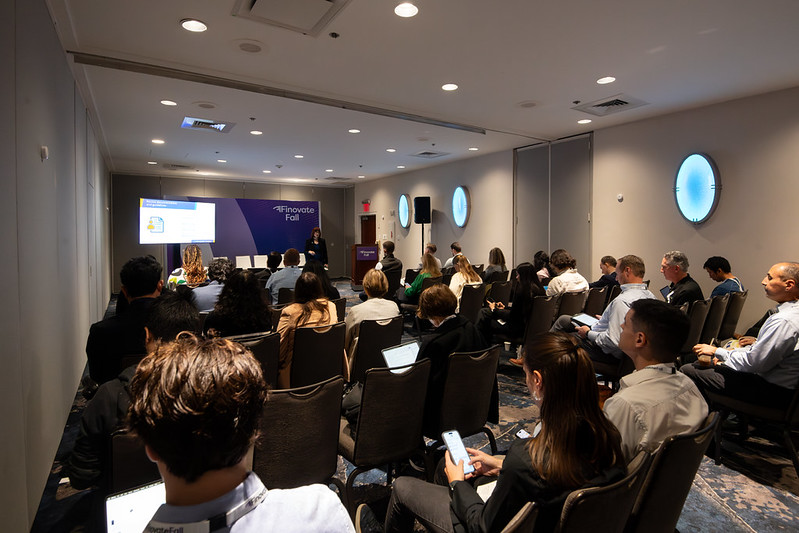
It may feel like peak summer now, but the fall is right around the corner. That means our flagship fintech conference—FinovateFall 2026—is only weeks away!
Don’t worry—you’ve got plenty of time to buy your ticket (taking advantage of early-bird savings) and book your room. You’ve also got all the time in the world to learn more about what we’ve got in store for you this year. We’ll be introducing many of the event’s top attractions over the coming days and weeks here on the Finovate blog. For now, to whet your appetite for our autumn event, here’s a look at the recently released FinovateFall 2026 agenda.
Day One—September 9
FinovateFall 2026 starts strong with a battery of live, fintech demos featuring companies innovating in AI-enabled back-office automation, financial literacy, lending, transaction intelligence, embedded finance, and wealth management. The morning will also feature special addresses on topics such as AI and e-commerce and the global economic and geopolitical landscape. We will also present our Breaking News session featuring top fintech analysts discussing the latest headlines that everyone at FinovateFall will be talking about. Heading into the lunch break, we’ll showcase another round of demos from companies offering solutions to automate payments, enhance customer communications, fight fraud, and help institutions meet regulatory requirements.
The demo sessions after the lunch break will feature a range of innovators demonstrating their solutions for financial advisors building out their wealth management offerings, banks seeking to benefit from advanced payment technologies, and small businesses looking for affordable, flexible financing. The day’s content ends with a keynote address on stablecoins and tokenized deposits and our power panel on the opportunities that agentic AI is bringing to financial institutions featuring panelists from Prudential, University of Michigan Credit Union, and Gradient Labs.
Day Two—September 10
The second day of FinovateFall starts with a Finovate favorite: our Analyst All Stars presentations, which borrow our seven-minute format from our demoing companies to present recent research on fintech trends ranging from the relationship between banks and fintechs to AI visibility to adaptive customer onboarding. The morning will also include a special address from Macabacus CEO Charlie Schilling on why trust, not caution, is what unlocks AI’s full value in finance.
Our demoing companies return to the stage on Day Two, with technologies that are enabling lenders to streamline mortgage processing, helping advisors boost customer engagement, and bringing voice security solutions to banks and other financial institutions. The day will feature a total of four demo sessions with fintech innovators delivering rapid-fire demonstrations of their solutions for lending and underwriting, fraud prevention and dispute resolution, authentication and identity verification, payments, and more.
The final content presentations of the day will include a Special Address from Jawwad Rasheed of Camunda, a Quick Fire Keynote from J.D. Power Senior Director Jennifer White, and a Power Panel on financial crime risk moderated by StrategyBRIX CEO and Managing Partner Jas Randhawa. Our Best of Show awards will be held at the end of the day on Day Two during the drinks and networking reception.
Day Three—September 11
With the demos done and Best of Show trophies awarded, Day Three of FinovateFall is all about content: this is true for both our invite-only opportunities such as our Community Bank Spotlight & Breakfast and our IMPACT Funders & Founders event, as well as for our general session and industry stage presentations.
In the plenary, FinovateFall attendees will enjoy a pair of special addresses including an out-of-the-box keynote from AI expert Jon Lakefish on AI-enhanced CX to create trust and loyalty. The morning will also feature a Power Panel on the customer experience as a profit engine, moderated by Beyond the Arc’s Steven Ramirez.
Following a morning break, it’s time for our industry stages—conferences within the conference that allow for deeper examinations and discussions on topics such as AI & Innovation, Customer Experience & Trust, and The Future of Money.
Back in the general session after the lunch break, Day Three of FinovateFall resumes with a pair of Power Panels: one on embedded finance and platform economics and another on bank-fintech partnerships and the transition from competition to collaboration and co-creation. The day concludes with our Fireside Chat on the current US administration and its approach to financial services and fintech regulation, followed by our Investor All-Stars roundtable featuring investors from across the country talking about where the smart money is investing in fintech and why.
This is just a quick overview. There’s so much more to FinovateFall this year—from our pre-event exclusives for banks and credit unions on September 8 to our Executive Briefings on Women in Fintech, Community Banking, Embedded Finance, and more. To learn more about everything FinovateFall 2026 has to offer, check out the agenda, now available at our FinovateFall hub.
Cross River Bank will provide the regulated banking infrastructure behind X Money, X’s new embedded financial services offering.
X Money will bring FDIC-insured, interest-bearing accounts, a Visa debit card, and peer-to-peer payment capabilities directly into the social media platform.
The launch advances Elon Musk’s “everything app” vision and will test whether US consumers are willing to use a social platform as a primary financial interface.
Cross River Bank, a bank and banking-as-a-service (BaaS) provider, announced today that it will power X Money, the financial services capability in X (formerly Twitter).
Through the partnership, X will embed FDIC-insured, interest-bearing accounts, a Visa debit card, and broader payment capabilities directly into its social media platform. Cross River will power the financial capabilities through its regulated infrastructure and access to payment rails.
“With Cross River providing the banking backbone and X connecting users across the United States, the collaboration represents a new standard for money movement, combining compliance, speed, and scale in a way that meets the needs of today’s digital-first consumers,” the company said in a statement. “By enabling seamless, in-app finance, this will unlock a future where financial services live within the platforms that consumers already use every day.”
Founded in 2008, Cross River offers scalable, embedded payments, cards, lending, and crypto solutions to businesses and consumers. The bank is known for its API-driven banking core and regulatory expertise. Because it owns its infrastructure, Cross River eliminates the risk and compliance gaps that come with bringing on third-party systems.
X selected Cross River because of its ability to handle payments quickly and at scale, enabling it to support new financial products and features.
This follows years of promises from X owner Elon Musk to turn X into “the everything app.” Adding embedded accounts, debit cards, and peer-to-peer payments moves that ambition beyond social media content and into financial services. It also gives X a way to deepen engagement by allowing users to store, spend, and transfer money without leaving the platform.
The launch of X Money will be a good test of whether US consumers are ready to treat a social media app as a primary financial interface. If it is successful and its users willingly adopt it as a payments platform, X will have access to valuable transaction data and can create new opportunities around commerce, creator payouts, subscriptions, and other financial products such as lending. It would also put the platform in more direct competition with digital wallets and challenger banks. Cross River’s role is critical because it gives X the regulated banking and payments infrastructure needed to pursue that vision without becoming a bank itself.
Agentic wealth platform Goodfin has introduced its Goodfin QSBS Venture Fund. The new offering gives accredited investors access to high-growth startups while taking advantage of Qualified Small Business Stock tax benefits.
Expanded as part of the Trump administration’s One Big Beautiful Bill Act (OBBBA), QSBS enables eligible holders to exclude up to 100% of federal capital gains on qualifying startup equity.
Headquartered in San Francisco and founded in 2022, Goodfin made its Finovate debut at FinovateSpring 2026 in San Diego. Anna Joo Fee is Founder and CEO.
Agentic wealth platform Goodfin has announced the launch of its Goodfin QSBS Venture Fund. The new fund is designed to help accredited investors access high-growth startups while optimizing for Qualified Small Business Stock (QSBS) tax benefits. The fund gives investors exposure to venture and Y Combinator-backed companies that have been vetted for IRC Section 1202 / QSBS eligibility, and the opportunity to take advantage of major federal capital gains tax savings.
“QSBS is one of the most under-used advantages in venture investing, but also one of the most complex to get right,” Goodfin Founder and CEO Anna Joo Fee said. “Goodfin built this fund to remove that friction.”
Intended to encourage investment in small businesses and startups, QSBS are shares in eligible small businesses that qualify for significant federal tax advantages under Section 1202 of the Internal Revenue Code. These benefits include a capital gains tax exclusion of up to 100% when investors sell QSBS. This is a substantial potential savings insofar as long-term capital gains are typically taxed at up to 20%. Factor in the net investment income tax of nearly 4% and the QSBS exclusion can save investors nearly 24% in federal taxes.
The QSBS tax incentive has been available to founders, early employees, and investors since 1993. The policy was given a major upgrade last year as part of the Trump administration’s One Big Beautiful Bill Act (OBBBA). This added a new, more flexible tiered exclusion schedule, a higher exclusion cap, and an expansion in the universe of eligible companies to cover more growth-stage startups. These new rules only apply to QSBS issued or acquired after July 4, 2025.
The Goodfin QSBS Venture Fund offers a curated portfolio of early-stage startups backed by Tier 1 investors and Y Combinator. Typically at Seed through Series C level, these firms are chosen based on investment merit and are evaluated and verified for Section 1202 eligibility before investment and monitored throughout the duration of the holding. Investors can invest directly through the Goodfin QSBS Venture Fund or roll over current gains from a previous investment, taking advantage of built-in optimization from day one.
“The idea behind the fund is simple: the best tax advantage in venture shouldn’t be the one investors and founders discover too late,” Goodfin Head of Memberships and Partnerships Mika Arai wrote on the company blog. “QSBS allows eligible holders to exclude up to 100% of federal capital gains on qualifying startup equity—potentially millions of dollars per investment. Yet it remains one of the most underused benefits in the market, largely because it’s one of the hardest to get right.”
What makes it difficult to bring this opportunity to investors? One major factor is that QSBS eligibility has to be both established and maintained during the entire holding period and companies can inadvertently compromise their QSBS status by making otherwise innocuous structuring decisions. Goodfin has teamed up with CapGains, a tax optimization platform, to ensure that every company in the fund is analyzed and vetted for Section 1202 and then monitored throughout its holding period.
The new fund is an opportunity for accredited investors to pursue private market returns and secure a targeted tax outcome in a single, professionally-managed investment vehicle. It can also give founders a competitive edge when it comes to fundraising and attracting talent. Investors are becoming increasingly interested in QSBS-eligible companies and because QSBS offers such significant tax advantages at exit, QSBS-eligible companies give investors a tangible reason to invest early.
“Whether you’re investing in the next great startup or building one, QSBS can transform your financial outcome—and the post-OBBBA rules make the opportunity larger than it has ever been,” Arai wrote. “The Goodfin QSBS Venture Fund is designed to help you capture the full benefit you can earn, with eligibility verified and monitored from day one.”
Founded in 2022 and headquartered in San Francisco, California, Goodfin made its Finovate debut at FinovateSpring 2026 in San Diego. At the conference, the company demonstrated its Goodfin Go solution, which provides sophisticated investors in pre-IPO companies with guided, hyper-personalized, end-to-end investing capabilities. Goodfin Go conducts deep research, portfolio analysis, and real-time investment execution, leveraging a purpose-built agentic orchestration system that uses vetted data sources, multiple AI models, and proprietary insights from the Goodfin platform. Advisor-vetted, Goodfin Go meets the standards of the CFA Level III exam.
If you’re interested in pre-IPO companies and promising startups, Finovate’s IMPACT Funders & Founders event is for you. Co-located with FinovateFall, IMPACT serves as a dedicated funding marketplace where breakthrough fintechs meet active investors across the investment spectrum.
We’re down to one week left in July, and I have a feeling August will bring a wave of news releases and updates as organizations rush to polish off objectives on their 2026 goal list. For now, here’s a look at the top news headlines for this week. We’ll continue to add more announcements as the week progresses.
This week’s edition of Finovate Global looks at recent fintech news and developments from Singapore.
Ant International Raises $1.2 billion in Series A funding
Ant International, the Singapore-based business arm of Chinese fintech giant Ant Group, has secured $1.2 billion in Series A funding. Existing supporters Ant Group and Alibaba Group Holding participated in the equity round along with a number of unnamed international institutional investors.
The capital will be used to accelerate Ant International’s global growth plans and fuel continued innovation in a number of areas including merchant payments, account management, and more inclusive financial services for businesses of all sizes. With its main operations in Asia, Europe, the Middle East, and Latin America, Ant International offers a partnership network of banks, card companies, mobile payment firms, and technology platforms that connects 150 million merchants around the world with more than two billion user accounts.
Spun off as an independent entity in 2024 and headquartered in Singapore, Ant International operates four main businesses: its digital consumer payments platform, Alipay+; its payment processing technology and infrastructure provider, Antom; its cross-border payments and foreign exchange service for businesses, WorldFirst; and its digital banking and financial services platform, Bettr. The company supports more than 300 payment methods in 220+ markets. This includes 50 mobile payment partners and 10+ national QR code systems.
Ant International’s funding news comes as the company announces new partnerships with Freedom Holding Corporation to streamline online shopping from China to customers in Kazakhstan via its Antom division and with QI Tech to expand credit access for e-commerce merchants and consumers in Brazil through its Bettr division.
Alipay+ partners with Hong Kong’s Hang Seng Bank
Ant International’s payment gateway, Alipay+, has announced a number of new bank partners in recent weeks, adding to its network of more than 50 digital wallets, banks, and financial institutions. The latest firm to team up with Alipay+ is Hong Kong-based Hang Seng Bank. Alipay+’s first banking partner in Hong Kong, Hang Seng Bank will be able to offer users of its mobile app the ability to make payments via QR code scans. The payment option works both in the Chinese mainland as well as overseas at 100+ million merchants in more than 55 countries and regions.
“Customers increasingly expect seamless payment solutions when traveling overseas,” Hang Seng Bank Head of Retail Banking and Wealth Rannie Lee said. “By partnering with Alipay+, we’re enhancing customer experience by bringing a simple QR payment service within our mobile app—combining broad merchant acceptance with the simplicity of paying and tracking spending in just one place. This is a strategic step in strengthening our payments proposition and expanding our cross-border connectivity, as we continue to build a digital ecosystem that keeps banking simple, safe, and smart.”
Alipay+ empowers banks to offer cross-border payment services via a single integration. The company also works with more than 10 national QR systems, including Malaysia’s DuitNow, Thailand’s PromptPay, and Uzbekistan’s HUMO. This enables banks to scale their mobile payments usage more efficiently instead of having to rely on individual agreements between banks and merchants in multiple markets. The announcement comes at a time when demand for outbound cross-border payments from the Asia Pacific region is expected to increase faster than the international average. Forecasts from FXC Intelligence suggest that this volume could reach $20.1 trillion by 2032, more than double its 2024 levels.
A wholly owned subsidiary of the HSBC Group, Hang Seng Bank Limited is a Hong Kong-based banking and financial services company. Founded in 1933, the institution serves nearly four million customers and counts retail banking and wealth management, commercial banking, insurance manufacturing and asset management, and markets and securities services among its core business activities.
Singapore and Thailand team up to fight digital fraud
The Monetary Authority of Singapore (MAS) has inked a Memorandum of Understanding (MoU) with the Bank of Thailand (BOT) designed to enhance cooperation in the fight against digital fraud. The pact formalizes and expands on an existing collaboration between MAS and BOT to bolster cybersecurity defenses across their respective financial ecosystems.
“Cyber risks and digital fraud are key transnational threats confronting our region and call for closer collaboration to combat these risks,” MAS Managing Director Chia Der Jiun said.
The agreement calls for the two regulators to share information on cybersecurity and digital fraud, including changes to cybersecurity regulations and threat intelligence relevant to the financial sector. MAS and BOT will also focus on skill development via joint staff training, research exchanges, and policy discussions. Lastly, the regulators will conduct joint cross-border cybersecurity and crisis management exercises to boost operational readiness.
“As cyber threats and digital fraud continue to evolve rapidly amidst growing financial connectivity and technological advancement, closer collaboration between MAS and BOT will help deepen mutual capabilities and achieve seamless cross-border intelligence exchange to counter emerging threats,” BOT Governor Vitai Ratanakorn said.
The Memorandum of Understanding was signed during the 31st Executives’ Meeting of East Asia-Pacific Central Banks Governors in Singapore earlier this week. Among the topics discussed were increased uncertainty in the global economy and the impact of AI on the economies and financial systems of countries in East Asia. The governors talked about the potential financial risks from large-scale AI investment, updates on regional developments in AI and digitalization, and the possibility of using AI to enhance the work of central banks.
Here is our look at fintech innovation around the world.
Central and Eastern Europe
Lithuanian identity verification, compliance, and fraud prevention solutions provider iDenfy unveiled its new bank card verification platform.
Ábaco, a fintech startup based in San Salvador, El Salvador, raised $53 million in combined venture equity and institutional debt to expand lending to small businesses in Central America
The OCC conditionally approved Upstart to establish a branchless, full-service national bank just four months after the company applied.
The charter would let Upstart originate loans nationwide, accept FDIC-insured deposits, and reduce its reliance on third-party banking partners while preserving its existing loan-purchaser network.
The approval reflects growing fintech interest in bank charters, but the OCC’s rejection of Wise’s application shows that regulatory approval is still far from guaranteed.
Lending marketplace Upstart has been granted conditional approval from the US Office of the Comptroller of the Currency (OCC) to establish Upstart Bank. The news comes four months after Upstart submitted its initial application.
Upstart is pursuing a de novo bank charter—a license to establish a newly formed, full-service national bank—and will accept the accompanying bank holding company oversight. The charter will allow Upstart to reduce operational complexity as well as reliance on third party partners.
“Conditional approval from the OCC is an important milestone for Upstart Bank and we will continue to work with the OCC, the FDIC, and the Federal Reserve on the remaining steps,” said Upstart Co-Founder and CEO Paul Gu. “Upstart Bank will allow us to lower the cost of lending and bring our full product offering to all 50 states, advancing our mission to radically reduce the cost and complexity of credit for all Americans.”
While the newly formed bank will be headquartered in Delaware, it will not have any physical branches. The new charter will allow it to originate loans to all US consumers and accept FDIC insured deposits. Upstart emphasized that the new bank is intended to complement its existing funding model instead of replace it. Banks, credit unions, and institutional investors are expected to continue purchasing the vast majority of loans originated on the Upstart platform.
California-based Upstart was founded in 2012 and leverages AI to price credit and automate the borrowing process. The company closed its IPO in 2020 and is currently traded on the NASDAQ under the ticker UPST with a market capitalization of $2.67 billion.
Upstart’s conditional approval comes as bank charter activity is accelerating under a more fintech-friendly regulatory environment. At the same time, regulators are demonstrating that approvals are far from automatic. Just one day after Upstart’s announcement, the OCC rejectedWise’s application for a national trust bank charter, underscoring that applicants must still satisfy supervisory and compliance expectations.
Intuit launched a QuickBooks-native business credit card that combines spending, expense management, and accounting in a single platform.
The move puts Intuit in more direct competition with spend management fintechs like Ramp, Brex, and Expensify by eliminating the need for multiple corporate spend tools.
With native access to QuickBooks data and nearly 100 million customers across its ecosystem, Intuit enters the market with significant underwriting, distribution, and cross-selling advantages.
Intuit has unveiled the Intuit Business Credit Card, a new Mastercard to help small businesses manage spending, access credit, and understand their financial health in one place. With the launch of the new card, QuickBooks is moving upstream in the small business services space from bookkeeping into the moment a business expense is authorized.
The new card syncs natively with QuickBooks to automatically match receipts to transactions, which offers visibility into spending and cash flow. Additionally, cardholders benefit from unlimited 2% cash back on purchases and 5% cash back on Intuit products and services, unlimited employee cards, customizable spend controls, and real-time transaction notifications.
“The Intuit Business Credit Card gives businesses something they have never had before: a single, connected solution for spending, cash flow, and credit that is built around how their business actually performs,” said Intuit EVP and General Manager, Services Group David Hahn. “We know businesses don’t have a one-size-fits-all need for capital, which is why we’re building a range of capital solutions on the Intuit platform. The Intuit Business Credit Card introduces a smarter way to power business growth with critical controls and value on every dollar spent. This is an important part of Intuit’s broader commitment to building the capital solutions small businesses need to grow with confidence.”
For businesses, bringing a familiar accounting tool like QuickBooks and a credit card in one place eliminates the need to manually reconcile line items or fix a broken account connection. Additionally, the WebBank-issued credit card automatically matches receipt photos to the corresponding transaction in QuickBooks, reducing manual entries and potential errors.
From a competitive standpoint, Intuit has been adjacent to Ramp, Brex, and Expensify for years. The launch places the company in more direct competition with the integrated corporate card and spend management model these fintechs helped popularize. Until now, a typical small business might have relied on four separate providers to manage corporate spending: a bank-issued credit card, Ramp or Brex for employee cards and spending controls, Expensify for expense reporting and reimbursements, and QuickBooks as the accounting system of record. Intuit is now collapsing much of that workflow into a single platform, reducing the number of tools businesses need to issue cards, manage spending, and reconcile transactions.
While Intuit is now competing directly with Ramp, Brex, and other spend management providers, it also enters the market with an advantage those companies cannot easily replicate. Because the card is native to QuickBooks, Intuit already has access to customers’ accounting data, giving it a richer understanding of business cash flow and financial health. That could enable faster underwriting, reduce application friction, improve credit decisions, and create opportunities to expand relationships through lending, payments, and other financial services.
Beyond its underwriting advantage, Intuit also brings unmatched distribution. The company serves nearly 100 million customers worldwide across TurboTax, Credit Karma, QuickBooks, Mailchimp, and Intuit Enterprise Suite, giving it an enormous installed base from which to market new financial products. It also benefits from decades of brand recognition and customer trust. For many small businesses, applying for a business credit card through a platform they already use every day may be a far easier decision than establishing a relationship with another fintech.
More and more credit unions and community banks are weighing the challenges and opportunities of deploying AI-powered solutions for their members and customers. Yet, while there is much attention paid to the technical details of integrating AI-based technologies into banking operations, there is often less focus on the critical issues of AI governance: the rules, policies, and processes that ensure that a given use of AI is safe, non-discriminatory, and transparent.
With this in mind, this week Finovate First-Timers interviews Lisa Pent, Founder and CEO of PentEdge. Founded in 2025 and headquartered in Albany, New York, PentEdge is the company behind AIMS (AI Monitoring & Governance System), a purpose-built SaaS platform that enables credit unions and community banks to govern AI operations confidently.
AIMS provides financial institutions with “AI with Guardrails”, a framework that automates AI inventory, vendor risk assessment, regulatory mapping, and board-ready reporting, transforming complex compliance requirements into a streamlined process. PentEdge made its Finovate debut earlier this year at FinovateSpring 2026 in San Diego, demonstrating this technology.
In this conversation, Pent talks about the predicament that many financial institutions find themselves in when deploying AI solutions without recognizing the myriad risks involved and how to mitigate them. She also discusses the unique challenges that credit unions, community banks, and other smaller firms face when embracing AI compared to their larger rivals. Last, Pent explains how PentEdge’s technology helps these companies manage AI vendor relationships better and more accurately assess risk.
What problem does PentEdge solve and who does it solve it for?
Lisa Pent: Most community banks and credit unions are already using AI. Very few of them know where, how much, or who owns the risk.
That is because AI almost never arrives through a deliberate build decision at an institution this size. It arrives through vendors. The core processor adds an intelligent feature. The fraud platform turns on a model. Marketing signs up for a writing assistant on a corporate card. Nobody stood up an AI program, and yet the institution now carries the risk and the examination exposure.
The consequences are not hypothetical. Earlier this year, a publicly traded community bank disclosed in a securities filing that an employee had uploaded customer information to an AI tool the institution had not authorized. That gap, between what an institution believes it is using and what its people are using, is exactly what we built PentEdge to close.
Our customers are community banks, credit unions, and adjacent regulated firms such as insurers, RIAs, and asset managers. Their supervisory expectations are similar to those on the largest banks. Specific requirements often scale with asset size, but the expectation that you know what AI you are running, and can show how you govern it, does not. AIMS™, our AI Monitoring and Governance platform, gives them a defensible AI inventory, a risk score for every tool, and reporting their board and their examiners can rely on.
How does PentEdge solve this problem better than other companies?
Pent: Two things set us apart: the catalog and the scoring model.
The catalog is the asset. We maintain a research catalog of AI tools and the vendors that supply them, built around the technology community financial institutions genuinely use. When an institution tells us which vendors it works with, we can identify the AI inside those relationships rather than asking a compliance officer to figure it out from vendor marketing pages. And because vendors turn AI features on continuously, we monitor the catalog for change, so the inventory does not go stale.
The scoring model is the second piece, and it is aligned to the NIST AI Risk Management Framework, which is the closest thing this industry has to a common language for AI risk. Our AI Risk Score™ separates what we know from what only the institution knows. PentEdge supplies the inherent risk score, combining a tool’s exposure profile with the nature of the AI itself. The institution scores its own controls and mitigants. The result is a residual score that reflects that specific institution rather than an industry average.
The alternatives fall into two camps: enterprise governance platforms scoped and priced for the largest banks, and consultants who deliver a thoughtful, point-in-time document that is out of date within a quarter. Neither serves the roughly 9,000 institutions that make up most American banks and credit unions.
Who are PentEdge’s primary customers? How do you reach them?
Pent: Our market is every US bank outside the top 25 and every US credit union, roughly 9,000 institutions, plus adjacent regulated firms in insurance and asset management. Within those institutions, our buyers are chief risk officers, chief compliance officers, CIOs, and, in smaller shops, the CEO directly. The common thread is not asset size. It is that nobody in the building has “AI risk” in their job description.
We reach them four ways. First, direct outreach to named institutions, which is still the most productive channel we have. Second, associations, which remain the trusted intermediary in this market in a way they are not in most other industries. Third, in-person events, where community bankers and credit union executives compare notes candidly. We were at FinovateSpring and IBANYS this year, and we will be exhibiting at GoWest MAXX in Denver in October. Fourth, education. I publish a weekly newsletter, At the Helm, along with white papers and practical guidance on AI governance for institutions of this size.
Most engagements start with our 48-Hour AI Risk Assessment, a short, concrete look at what AI an institution is already exposed to. It is a low-friction way to see the problem clearly before committing to the full platform.
Can you tell us about a favorite implementation, deployment, or partnership experience? What made it special?
Pent: My honest answer is that every implementation is my favorite, and that is not a dodge. It is the point.
We decided early that AIMS™ would not require integration with the core. We do not touch endpoints. There is no agent to install, no data pipeline, and no security review of a connection into their environment, because there is no connection. The institution gives us a list of its vendors, an Excel file is perfectly fine, and the platform generates a scored AI inventory automatically.
And the output is not a raw list. From day one, that same inventory produces examiner-ready and board-ready reports at the click of a button, so nobody must rebuild it in a spreadsheet the night before a meeting.
So, the moment I look forward to is the same every time, and it comes within days or hours rather than months. We put an institution’s own scored inventory in front of the people responsible for it, and the conversation stops being abstract. They are looking at their own list, sorted by risk, deciding what to handle first.
What in your background gave you the confidence to respond to this challenge?
Pent: Thirty years of standing on both sides of this problem.
I started in community banking and spent the first half of my career in credit risk on Wall Street, including building a credit risk business from scratch at Helaba that grew past $12 billion in assets, and running a group at Fuji Bank. That work taught me what regulators are looking for, and more usefully, what they are looking for when they ask a question that sounds like it is about something else.
The second half was technology. I spent a decade at Thomson Reuters building SaaS products for financial institutions, then moved into senior leadership at Cognizant. That is where I learned how software gets adopted inside a bank, which is a different discipline entirely from knowing what the software should do.
Alongside that, I have served on boards, and I founded WomenExecs on Boards (WEoB), which put me in the room for a lot of oversight conversations. Board members are being asked about AI right now and most of them have no instrument to answer with.
So when community institutions started telling me they had no idea what AI they were running, I recognized all three problems at once: the risk problem, the product problem, and the governance problem. That combination is uncommon, and it is what gave me the confidence to build PentEdge.
Does AI governance bring unique challenges for smaller, community financial institutions, above and beyond the challenges of deploying AI in general?
Pent: Yes, and the difference is structural rather than a matter of degree. It starts with vendor management.
Community institutions run on vendors, and the volume is enormous relative to headcount. It is not unusual to find one vendor relationship for every one or two employees. Every one carries a contract, a due diligence file, a risk rating, and an annual review. That workload already outstrips the people assigned to it, before AI enters the conversation.
Then AI arrives, and the instinct is to treat it as one more vendor category. It cannot be managed that way. Traditional vendor management is periodic by design: you onboard, you diligence, you review once a year. AI does not hold still for a year. A vendor can turn on an AI feature in a routine release with no contract amendment and no meaningful notice, so the tool you assessed in January can carry a different risk profile by June. An annual questionnaire will never catch that.
The nature of the risk is different too. A traditional vendor review asks about uptime, financial condition, and business continuity. AI raises questions about what data leaves the institution, how decisions affecting members and customers are made, and whether anyone can explain them afterward.
What we hope to do is broader than AI alone. If an institution can see its full vendor stack clearly, with the AI inside it identified and scored, it gains something it has never had: efficiency in that stack (cost efficiency included) and transparency into where the risk truly sits.
You demoed at FinovateSpring in May of this year. How was the experience?
Pent: It has been our highlight of 2026 so far.
The format does something for a founder that no internal exercise can replicate. A few minutes, live, on stage, with nothing to hide behind. You either show what the product does, or you do not, and preparing for that clarified our own thinking about AIMS™ more than any planning session had.
What I did not fully anticipate was the momentum. The interest was tremendous on the day itself, and it did not stop when we left the stage. The conversations continued through the rest of the event and then kept going in the weeks afterward, and a meaningful part of what we are working on now traces back to that room.
What struck me most was the consistency of the reaction. Nobody argued the premise. Not one person suggested that AI governance is a large-institution problem or a future problem. The questions were all operational: where do we start, what does the inventory look like, how do I explain this to my board. For a founder, that is the best possible signal. You would far rather spend your time answering how than defending why.
I would recommend it to any founder selling into this market, both for the discipline the stage imposes and for the honest, unfiltered feedback you get in the hallway afterward.
What are your goals for PentEdge over the balance of 2026 and into next year?
Pent: Three priorities.
First, make the entry point easier. We recently introduced AIMS™ Manifest, a self-serve tier that gives an institution full access to our AI tool catalog with its own holdings flagged inside it, along with continuous change monitoring. No institution should have to buy the whole platform to answer the first question: what is our AI risk profile?
Second, deepen the catalog. It is the core of what we sell and the reason a subscription earns its renewal. Through the rest of this year, we are expanding coverage and keeping the mapping between tools and governance expectations current as both sides move.
Third, and this is where we are heading next, we want to be the go-to firm helping community financial institutions optimize their vendor stack, creating both cost efficiency and operational efficiency. That is above and beyond what most consulting firms do in this space, which is renegotiate contracts. Renegotiation is worth doing, but it treats the stack as fixed. Once an institution can see every vendor, every tool inside those vendors, and the risk attached to each, it can ask sharper questions: what is redundant, what is unused, and what is carrying risk out of proportion to the value it delivers.
Into 2027, the goal is straightforward. When an examiner asks a credit union what AI it uses, or a board asks its CEO, the answer should be a one-click report rather than a research project. And when that same CEO asks whether the institution is getting full value from everything it buys, and what risk it is carrying to get it, that should come from the same place.