This site is operated by a business or businesses owned by Informa PLC and all copyright resides with them. Informa PLC's registered office is 5 Howick Place, London SW1P 1WG. Registered in England and Wales. Number 8860726.
Finovate Blog
Tracking fintech, banking & financial services innovations since 1994
AI transformation specialist Tavant is integrating its TOUCHLESS AI mortgage automation platform with the Empower loan origination solution (LOS) from Dark Matter Technologies.
The integration is designed to reduce workflow fragmentation and manual handoffs, support faster decision-making, and a more connected loan manufacturing process.
Headquartered in Santa Clara, California, and founded in 2000, Tavant most recently demoed its technology on the Finovate stage at FinovateSpring 2025 in San Diego.
AI transformation specialist Tavantannounced the integration of its TOUCHLESS AI mortgage automation platform with Dark Matter Technologies’ Empower loan origination solution (LOS). The integration brings Tavant’s AI-driven automation capabilities to the Empower ecosystem, enabling lenders to streamline underwriting, accelerate cycle times, boost loan quality, and deliver Tavant’s exception-based, data-driven, loan decisioning technology to Empower LOS users.
“Tavant is focused on helping lenders transform mortgage operations with classical, generative, and agentic AI-based automation that delivers measurable efficiency, higher levels of operational productivity, and a far better borrower experience,” Tavant Head of Fintech Products Mohammad Rashid said. “Our integration with Dark Matter extends that vision by augmenting the Empower LOS with TOUCHLESS automation capabilities, making it easier for lenders to adopt agentic workflows, exception-based processing, and automated underwriting and decisioning.”
The integration enables lenders to automate key stages of the mortgage lifecycle, including loan setup, document classification, data extraction and intelligent comprehension, processing, underwriting, conditions management, and pre-close quality checks. The solution provides lenders reduced cost per loan, automation of repetitive and time-intensive tasks, improved data accuracy and consistency. This is thanks to standardized, AI-powered automation and the ability to scale loan production without significant increases in headcount.
The partnership between Tavant and Dark Matter will also be a boon for borrowers, who will benefit from faster approvals, fewer requests for documentation, and a more predictable and transparent lending timeline.
“We designed Empower as an open platform so partners can connect their best ideas directly to our lenders,” Dark Matter CEO Vikas Rao explained. “Tavant’s TOUCHLESS integration is a strong example of the innovation an open platform makes possible, giving lenders more ways to automate and close faster.”
Headquartered in Jacksonville, Florida, and founded in 2023, Dark Matter offers an integrated platform for modern mortgage operations that combines its Empower LOS, next-generation automation, and powerful servicing capabilities to streamline and simplify the lending lifecycle. In addition to Empower LOS and its loan servicing solution Elevate, Dark Matter also offers Exchange: a connected partner marketplace for compliant, secure integrated access to a range of service providers, and Aiva, which provides AI-powered automation for documents, income, asset, and post-close quality control.
Tavant made its Finovate debut at FinovateSpring 2017 and most recently demoed its technology on the Finovate stage at FinovateSpring 2025 in San Diego. At the conference, the Santa Clara, California-based company demonstrated its LO.ai solution, an AI-powered platform that enhances loan officer productivity and borrower empowerment. LO.ai integrates generative AI, voice-enabled conversational AI, and advanced data security measures to lower costs, increase lead conversion, and guarantee compliance with industry regulations.
FinovateFall 2026 is just over a month away. Coming to New York’s Marriott Marquis Times Square, from September 9 through 11, this year’s FinovateFall conference will feature both the familiar—in the form of our signature, seven-minute live fintech demos and standout keynote addresses—and the new, as represented by initiatives ranging from our Credit Union Spotlight to our Executive Debates to our special IMPACT Funders and Founders event.
With so much on offer, it can be easy to miss or overlook a session, panel, or address. To this end, we’re going to spend the next few weeks highlighting some of the presentations we think you won’t want to miss. Today, we look at some of the mainstage addresses on the agenda across all three days of the conference.
Special Address: If You Already Own the AI, Then Why Are You Still Shopping
Featuring Melissa Solis, CEO of Inbenta, this presentation will discuss why most customer experience AI fails on the basics and how to tell apart a vendor that actually delivers from one that just demos. Solis also will offer a framework for auditing your customer experience against what you actually need rather than simply what you are being sold.
Headquartered in Texas, Inbenta offers an agentic AI platform, Encore, that serves financial services, e-commerce, healthcare, and travel with more than 98% accuracy, near-zero hallucinations, full auditability, and more than 850 integrations to help avoid vendor lock-in.
Special Address: Introducing Madison—Agentic Workbench for Banks
This session, led by Siva Surendira, Founder and CEO of Lyzr AI, will show how Architect by Lyzr enables business users to describe a problem and get a working, governed AI agent in minutes. Surendira will also explain how thousands of those AI agents provide leadership with a live, crowdsourced view of where automation ROI truly lives.
Lyzr is a category leader in agentic AI infrastructure. The company’s technology powers the internal AI platforms of firms including Accenture and Prophet.
In this special address, Charlie Schilling, CEO of Macabacus, explains why trust rather than caution is what unlocks AI’s full value in finance: trust that the model being built is accurate, trust that the data is consistent across the pitch, and trust that every piece of content is on brand.
Based in New York, Macabacus is a productivity and brand compliance suite for investment banks, private equity, venture capital, financial planning and analysis (FP&A) teams, and consulting firms.
Quick Fire Keynote: Fraud in the Age of AI. How to Respond When the Attacker Has Better Tools Than You
Senior Director, Global Banking and Payments Intelligence for JD Power, Jennifer White, will share her insights on the challenges faced by banks, credit unions, financial services providers, their members and customers when it comes to the rise of AI-powered fraud and financial crime. White will discuss how fraud and financial crime are being increasingly globalized and industrialized, and how defenses against these threats must evolve in order to keep individuals and systems safe.
JD Power is a leader in business-critical data and intelligence that supports automated decision-making. The company’s proprietary data, advanced analytics, and deep industry expertise supply lenders, insurers, original equipment manufacturers, and other firms with guidance and intelligence about customer interactions with their brands, products, and services.
Out of the Box Keynote Address: AI-Enhanced CX to Create Trust and Loyalty
Jon Lakefish, Founder of the Lakefish Group, will deliver a practical guide to all the AI tools currently available to help enhance the customer experience and how to make the most of them. Lakefish will also host a special hands-on, interactive session in the afternoon (1:10 pm—2:00 pm) in which he will walk participants through real scenarios so they can experience firsthand how AI can save time and money, while enhancing decision-making.
Lakefish Group provides speaking and hands-on workshops, as well as consulting and training, to help businesses take advantage of modern, practical AI tools to enhance their marketing and branding initiatives.
Lending has always depended on a financial institution’s ability to assess risk, make informed decisions, and deliver capital efficiently. But many of the systems supporting that process remain slow, fragmented, and heavily manual. Commercial lenders still spend days gathering documents and spreading financials, while consumers and small businesses increasingly expect faster decisions, flexible payment options, and seamless digital experiences.
The companies demoing at FinovateFall 2026, taking place on September 9 through 11 in New York, are approaching these challenges from several angles. Some are using AI to accelerate underwriting and automate operational work. Others are embedding financing and flexible payment options directly into digital banking, helping institutions identify household opportunities, or rebuilding commercial lending around borrower self-service. Together, these six companies demonstrate how smarter technology can help financial institutions improve speed, efficiency, and access to financing.
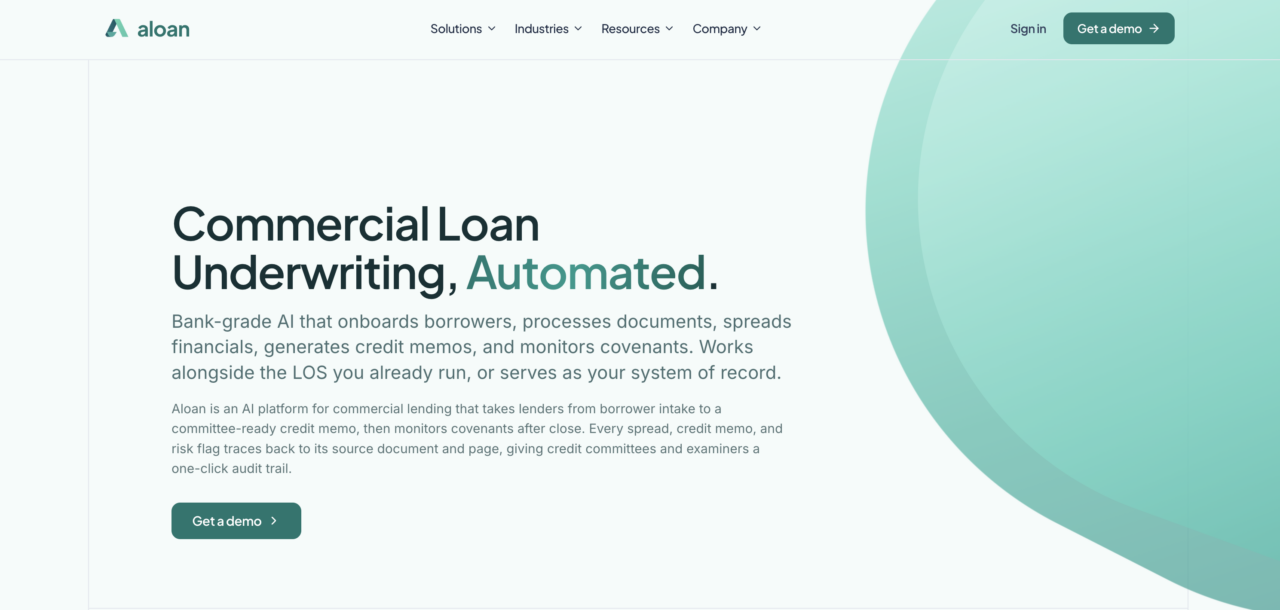
ALoan uses AI to automate commercial underwriting and help lenders move from borrower documents to a completed credit memo in less than 30 minutes. The platform spreads financial information from tax returns, bank statements, and borrower financials, applies the lender’s credit policies, and links each figure and conclusion back to its original source. By automating document collection, financial spreading, and credit memo preparation, ALoan enables commercial lending teams to increase throughput and reach term sheets faster without adding staff or replacing existing systems.
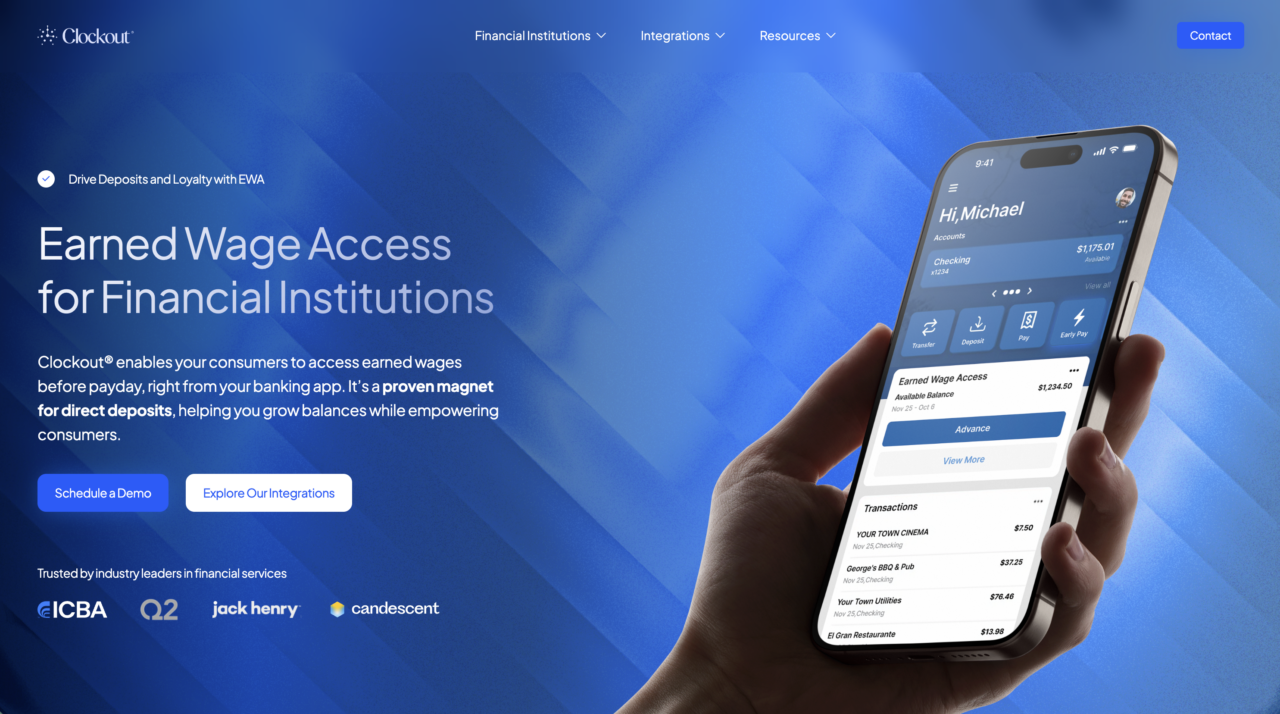
Clockout helps banks and credit unions embed financial wellness and liquidity tools into their customer experiences. The platform is designed to increase direct deposit relationships, generate new fee revenue, and strengthen customer engagement by providing users with more ways to manage short-term financial needs. For financial institutions seeking to deepen primary account relationships, Clockout offers a way to combine financing access with broader financial wellness.
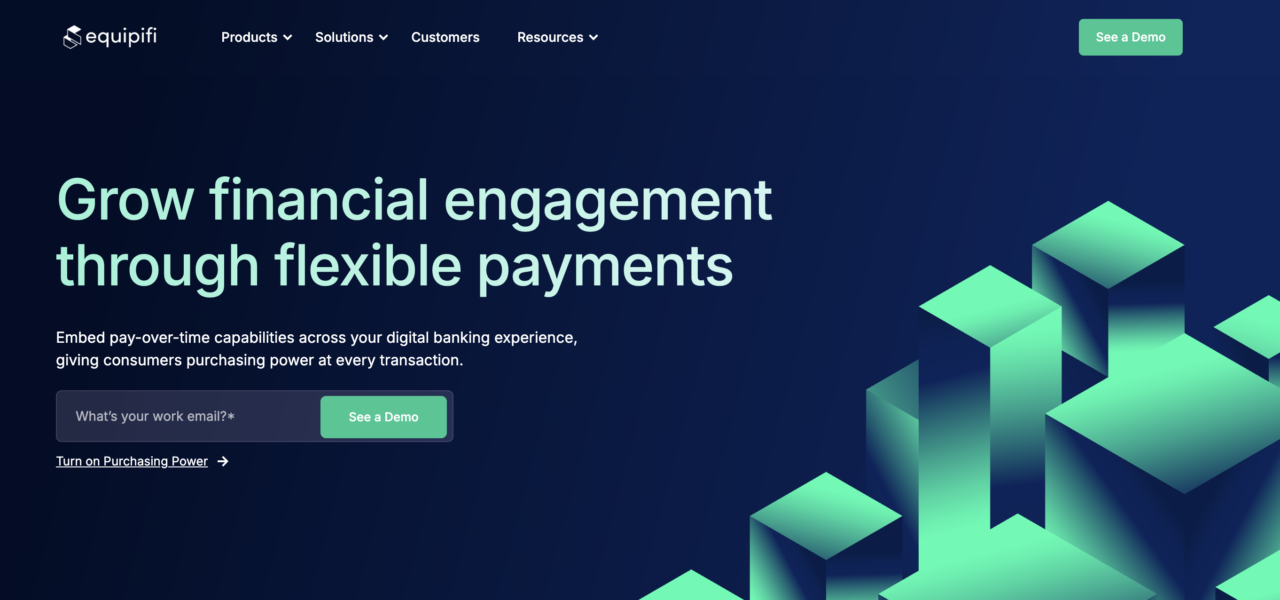
equipifi enables banks and credit unions to offer Buy Now, Pay Later (BNPL) and flexible payment options directly within their digital banking platforms. Its technology allows financial institutions to present personalized purchasing power and financing offers based on customer behavior and purchase intent, including through real-time mobile notifications. By bringing BNPL inside the banking relationship, equipifi helps financial institutions participate more directly at the point of sale rather than ceding that interaction to third-party providers.
OptimaFI’s Household Insights platform gives community banks and credit unions a household-level view of customer accounts and performance. The platform benchmarks institutional data against more than 14 billion private peer data points and provides segment-level recommendations related to growth and risk. Because it does not require a core integration, financial institutions can begin using the platform in a matter of days to identify opportunities across deposits, lending, and broader household relationships.
QuickFi offers an end-to-end digital platform for commercial equipment financing that allows borrowers to self-serve from application through final payment. The company replaces manual, paper-heavy lending processes with a digital experience that can deliver financing decisions and documentation in minutes, 24 hours a day. QuickFi helps banks and equipment manufacturers serve small business borrowers more efficiently while reducing the staffing and operating costs associated with traditional commercial lending models.
Voyager AI brings personalization and intelligence to complex commercial lending workflows. The platform unifies document collection, financial spreading, underwriting, compliance, and credit memo preparation while learning an institution’s specific lending policies and standards. By automating manual steps and identifying missing information earlier in the process, Voyager AI helps lenders deliver faster, more consistent experiences while allowing employees to spend more of their time on borrower relationships, structuring, and credit judgment.
Why banks should care
Speed has become a competitive advantage in lending. Borrowers are less willing to wait weeks for a credit decision when another provider can deliver an answer in hours or minutes. At the same time, banks and credit unions are under pressure to grow loan portfolios without proportionally increasing headcount or operational expense. Technologies that automate underwriting, document collection, reconciliation, and servicing can help institutions make faster decisions while preserving the judgment and oversight required for responsible lending.
The definition of lending is also expanding. Flexible payments, embedded financing, household intelligence, and digital self-service are blurring the lines between traditional loans, payments, and financial wellness. Financial institutions that treat these capabilities as part of a broader customer relationship may be better positioned to capture more borrowing activity, deepen engagement, and compete with nonbank providers. The companies demonstrating at FinovateFall 2026 show how institutions can modernize both the front-end borrower experience and the operational infrastructure that supports the lending process.
Core banking platform 10x Banking has raised £40 million ($53.8 million) in funding from AshGrove Capital. The UK-based fintech will use the capital to drive sales and go-to-market activity.
The investment comes in the wake of the pair of major announcements from 10x Banking: becoming EBITDA-positive and topping the 10 million live account milestone.
Based in London, 10x Banking won Best of Show in its Finovate debut at FinovateEurope 2023. Antony Jenkins is Founder, Chair, and CEO.
SaaS core banking platform 10x Banking has secured £40 million ($53.8 million) from AshGrove Capital. The funding will fuel the UK-based fintech’s sales and go-to-market efforts and comes as the company reports becoming EBITDA-positive and surpassing the 10 million live account milestone. Additionally, in the last 12 months, 10x Banking has onboarded 10+ new financial institutions and boosted annual recurring revenue (ARR) by more than 30%.
In the company’s statement, the firm underscored that its recent positive financial outcomes are the result of growing demand from financial institutions seeking to modernize legacy infrastructure, drive continuous product innovation, or develop the data and flexibility necessary to support AI-enabled banking.
“Financial institutions have a clear ambition to innovate, but many remain constrained by infrastructure that was not built for real-time, digital banking,” 10x Banking Founder, Chair, and CEO Antony Jenkins said. “We created 10x to remove those constraints, enabling financial institutions to launch products faster, serve customers in real time, and compete more effectively. Our platform is now proving its value at significant scale. AshGrove’s investment is a strong endorsement of the progress we have made and will help us meet growing demand from banks around the world.”
10x Banking offers a cloud-native, core banking platform that enables banks to deliver new hyper-personalized products, services, and experiences to both retail and corporate customers faster, more efficiently, and more cost-effectively. The platform processes more than 10,000 transactions per second and runs at 99.99% uptime. Leveraging fourth-generation core banking, 10x Banking features a microservices architecture, real-time data screening, an API-first design, and a managed core that allows banks to configure rather than rebuild for each new offering.
“10x Banking has built one of the most compelling technology platforms in core banking today,” AshGrove Capital Co-founder and Managing Partner Phil Fretwell said. “Delivering a cloud-native platform at enterprise scale is exceptionally difficult, yet 10x has already proven its capabilities across millions of live accounts and with some of the world’s leading financial institutions. We believe the company is well positioned to benefit from powerful industry tailwinds as banks continue replacing legacy systems with more flexible, real-time, and AI-ready infrastructure.”
10x Banking won Best of Show in its Finovate debut at FinovateEurope 2023 in London. At the event, the company demonstrated its 10x SuperCore Cards solution that enables banks to create a card proposition in minutes using the 10x Bank Manager interface. The technology empowers financial institutions to build and launch an enterprise-grade, full-stack, functional cards business solution in as little as 12 weeks. Founded in 2016, 10x Banking counts leading financial institutions such as Westpac and Chase UK among its customers.
Credit union members and community banking customers readily trust their credit unions and community banks with their capital when it comes to saving and borrowing. But what about investing? In most instances, those same members and customers will seek out other institutions and businesses when it comes to investing for the future and managing their wealth.
What if credit unions and community banks instead could keep those members and customers by catering to their investing and wealth management needs? How might this positively impact customer and member relationships and deepen engagement?
This week, our Finovate First-Timers series features Ariel Leachman, Co-founder and Chief Operating Officer at Bluum Finance. Headquartered in Los Angeles, California and founded in 2025, Bluum Finance offers a unified platform for embedded wealth management and investing, providing brokerage and AI-powered advisory infrastructure via APIs. The company combines multi-asset, multi-market brokerage, custody, and reporting in a single integration, enabling credit unions, banks, and fintechs to offer seamless investing experiences for their members and customers. Bluum Finance made its Finovate debut at FinovateSpring 2026 in San Diego. Co-founder Ope Sonusi is CEO.
In our conversation, Leachman discusses the opportunity that credit unions and community banks have by integrating investing and wealth management capabilities directly into their existing platforms. Leachman also explains how Bluum Finance streamlines the process for smaller financial institutions, delivering access to a range of asset classes and international markets via a single API. Finally, she shares her thoughts on what it will take to make cross-border investing as easy and commonplace as cross-border payments.
What problem does Bluum Finance solve and who does it solve it for?
Ariel Leachman: Credit unions, community financial institutions, and consumer fintechs have built strong relationships with their customers. The challenge is that when those customers are ready to start investing and building wealth, they often have to leave for another platform. Bluum enables fintechs and financial institutions to launch investing and wealth management directly within their existing platform, enabling them to expand their offering, generate new revenue, and strengthen customer relationships.
How does Bluum solve this problem better than other companies?
Leachman: Many embedded investing platforms focus primarily on trade execution. We take a broader approach by combining multi-asset investing, AI-powered wealth management, and the underlying brokerage infrastructure in a single platform. Rather than having to stitch together brokerage, custody, compliance, reporting, and portfolio guidance from multiple providers, our partners can launch through one API while we manage much of the complexity behind the scenes. Our platform also supports a range of asset classes and international markets, giving financial institutions a single platform to help their customers build diversified investment portfolios.
Who are Bluum’s primary customers and how do you reach them?
Leachman: Our primary customers are consumer fintechs, community banks, and credit unions that want to add investing and wealth management to their existing product offering without the high cost and operational lift of building a brokerage platform from scratch. Most of these institutions already have strong customer relationships and are looking for practical ways to expand their offering while keeping the experience simple for both their teams and customers. We primarily reach them through direct relationships, strategic partnerships, and industry events like Finovate.
Can you tell us about a favorite implementation or deployment of your technology, or a particularly valuable partnership experience?
Leachman: One of the most rewarding parts of building Bluum has been working with financial institutions that genuinely want to help their customers build long-term wealth. Credit unions, in particular, have earned a tremendous amount of trust within their communities. Helping them extend that relationship beyond everyday banking into investing feels especially meaningful because it allows more people to access wealth-building tools through an institution they already know and trust.
What in your background gave you the confidence to respond to this challenge?
Leachman: As co-founders, we’ve spent years working in financial services and technology before launching Bluum. My co-founder, Ope Sonusi, spent his career building fintech platforms for US and international markets, and I spent my career in investment banking and private equity, building deep expertise in capital markets, investment products, and financial institutions. As we spent more time speaking with financial institutions and fintechs, one thing became clear: many wanted to offer investing, but the infrastructure required to do it was too costly and complex. That insight became the foundation for building a platform like Bluum Finance.
You demoed at FinovateSpring in May of this year. How was the experience?
Leachman: FinovateSpring was a great experience. It gave us the opportunity to demo the Bluum platform and engage directly with credit unions, community financial institutions, fintechs, and industry leaders to better understand their priorities around investing, wealth management, and member engagement. The event reinforced our view that embedded investing and wealth management are becoming essential components of the modern digital banking experience, and that financial institutions are looking for simple, compliant solutions they can bring to market quickly.
You have talked about the opportunities in frontier and emerging markets and how the challenge is making cross-border investing as seamless as cross-border payments. Can you elaborate on this idea?
Leachman: Cross-border payments have become dramatically easier over the past decade. Today, a financial institution can enable cross-border payments through a single integration without having to build the underlying infrastructure. Cross-border investing hasn’t evolved in the same way. Offering investment access across markets still requires coordinating brokers, custody providers, regulatory requirements, and reporting, which creates a lot of complexity.
Our goal is to simplify that experience so financial institutions can offer access to both US and international markets without having to manage the high cost and onerous operational lift themselves. We believe the next evolution of financial services will make cross-border investing as seamless and accessible across global markets.
What are your goals for Bluum Finance over the balance of 2026 and into next year?
Leachman: We are focused on growing our partnerships with financial institutions, consumer fintechs, and credit unions. We’ve seen strong interest from institutions that want to offer investing but don’t want to build and operate the infrastructure themselves, so we’re focused on helping more partners bring those capabilities to market. We’re also excited about expanding the range of investment opportunities available through Bluum, including private markets and digital assets.
Connect Credit Union, a Florida-based financial institution with $103 million in assets, has partnered with smart financial calculator builder, Appli.
Appli’s AI-powered calculators are designed to turn passive visitors into active financial consumers by enabling them to assess loan opportunities, calculate property values in real-time, plan for retirement, and more.
Founded in 2024 and headquartered in Cedar Hills, Utah, Appli made its Finovate debut at FinovateFall 2025 in New York.
Florida-based Connect Credit Union has teamed up with Appli, builder of AI-powered smart financial calculators, to provide members with a new, interactive way to learn about their lending options, assess how best to save for future goals, and identify optimal savings instruments.
“Connect’s members are digitally savvy, and they expect that from every part of their credit union experience now, not just online banking,” Appli CEO Tim Pranger said. “Rolling this out right after their website relaunch means members will see it as part of one connected upgrade, not a separate tool bolted on later.”
Appli’s AI-powered smart financial calculators are designed to convert passive visitors into active financial consumers. Embedded in websites, mobile banking apps, and across marketing campaigns, Appli’s solutions deliver real-time, personalized experiences that boost consumer confidence and drive conversions, giving financial institutions the ability to guide customers and members through major loan and savings decisions.
The credit union will use Appli’s calculators for auto loans, personal loans, mortgages, and balance transfers. Scheduled to go live with the new offering in September, Connect Credit Union anticipates introducing smart calculators for other products over time. The partnership comes in the wake of the credit union’s website relaunch of its website, making the calculators part of the institution’s brand refresh.
“Financial decisions can feel overwhelming, particularly when members are trying to determine what fits comfortably within their budgets,” Connect Credit Union EVP/COO Cynthia Ryan said. “Appli gives our members an easy, interactive way to explore financial scenarios, better understand their options, and make decisions with greater confidence. This partnership allows us to combine the convenience of technology with the personal service and trusted guidance our members expect from Connect Credit Union.”
Connect Credit Union serves employees of the State of Florida, retirees of the Florida Department of Transportation, and those who live and work in Martin, St. Lucie, Indian River, De Soto, Glades, Okeechobee, and Charlotte counties in south and central Florida. Founded in 1962, the financial institution has $103 million in assets and offers services and products including auto loans, mortgages, home equity and personal loans, debit and credit cards, as well as savings, checking, and money market accounts.
Founded in 2024 and headquartered in Cedar Hills, Utah, Appli made its Finovate debut at FinovateFall 2025. At the conference, the company demonstrated its Smart Financial Calculators and its newest loan lead generation platform. Appli’s technology is designed to capture high-intent shoppers, convert interest into action, and provide financial institutions with data-driven insights to help them grow deposits, increase loan volume, and secure long-term revenue growth.
Interested in companies that are developing innovative solutions for credit unions and their members?FinovateFall 2026 will feature a special credit union spotlight and networking session on Tuesday, September 8. Learn more about this unique, invite-only opportunity.
When we announced IMPACT Funders & Founders, we described it as a new kind of event designed to bring together fintech founders and the investors backing the next generation of fintech in a setting built for meaningful conversations, targeted networking, and real fundraising opportunities.
The inaugural IMPACT event, taking place alongside FinovateFall on September 11 in New York City, features venture capitalists, startup founders, corporate investors, accelerators, and ecosystem builders who are actively shaping fintech’s next chapter. Rather than focusing on broad industry trends alone, these speakers will tackle the practical questions founders and investors face every day, such as raising capital, scaling a company, navigating exits, leveraging AI, embedded finance, and the changing venture landscape.
Learn from investors writing today’s checks
Whether you’re raising your first institutional round or preparing for growth-stage funding, one of the biggest advantages of IMPACT is direct access to active investors.
The speaker roster includes partners from venture capital firms, private equity firms, and strategic investors who are evaluating fintech opportunities every day. They’ll discuss what they’re looking for in founders, how investment priorities are evolving, and where they see the greatest opportunities in today’s market.
Hear from founders who’ve been there
Building a fintech company is about far more than securing funding. IMPACT speakers include founders who have navigated product launches, customer acquisition, regulatory hurdles, hiring, scaling, and fundraising firsthand.
Expect candid conversations about the realities of building a fintech company, including the lessons learned from both successes and setbacks.
Gain practical insights from fintech operators
Alongside founders and investors, the program features experienced executives from banks, fintechs, and industry organizations who understand what it takes to bring new financial products to market.
Sessions will explore topics including:
AI and emerging technologies
Go-to-market strategy
Customer acquisition and growth
Bank partnerships
Regulatory considerations
Fundraising strategy
Scaling operations
Explore the full speaker lineup
The IMPACT speaker roster continues to grow as additional investors, founders, and industry leaders are announced, but here is a taste of who you can expect to see on stage.
Digital payments giant Visa has agreed to acquire fraud and financial crime prevention platform BioCatch for $2.4 billion in cash.
The acquisition will add to Visa’s existing cyber, fraud, risk, and security solutions and provide greater defense against newer threats including account takeover and money mule fraud.
BioCatch was founded in 2011. The company made its Finovate debut at FinovateFall 2014 in New York.
Visa has inked a definitive agreement to acquire behavioral and device intelligence innovator BioCatch. Visa will purchase the company from funds advised by Permira and other shareholders for $2.4 billion in cash. The move will add to Visa’s current array of cyber, fraud, risk, and security solutions and is expected to be especially helpful in managing threats such as account takeovers, scams, money mules, and application fraud.
Subject to customary closing conditions, including receipt of all relevant regulatory approvals, the acquisition is expected to close by the end of Visa’s fiscal Q2 of 2027.
“Real-time insights into customer intent continue to grow increasingly essential for institutions to establish trust within digital banking sessions,” BioCatch CEO Gadi Mazor said. “For more than a decade, we’ve demonstrated behavior’s unique ability to distinguish the criminal from the legitimate. In the last couple of years, we’ve shown how real-time intelligence-sharing networks between our customers can amplify the power of our behavioral intelligence further still. Together with Visa, we’re even better positioned to advance our mission of making the world a safer place to transact and protect consumers from financial crime.”
BioCatch offers AI and machine learning-based solutions that analyze thousands of application, behavioral, device, and network signals such as keystrokes and mouse activity, touch gestures, and device handling. This enables BioCatch’s technology to detect fraud and distinguish between legitimate and fraudulent users in real time. BioCatch’s models provide continuous monitoring to assess user intent and identify signs of potential coercion or manipulation throughout the digital banking session. More than 350 financial institutions around the world leverage BioCatch’s technology to protect 760+ million users from fraud and financial crime.
Visa’s acquisition of BioCatch comes at a time when AI, biometrics, identity, cyber defense, and fraud prevention are converging. To this point, in addition to this week’s transaction, Visa has launched its Visa Vulnerability Agentic Harness solution, an open-source, AI security tool to help customers spot and mitigate vulnerabilities at scale. Visa noted in a statement that, over the last five years, the company has invested more than $13 billion in technology and infrastructure to secure its payments ecosystem and drive fraud rates lower.
“Account takeovers and scams cost the global economy over $1 trillion annually and AI is enabling these attacks at unprecedented scale,” Visa’s president of value-added services Andrew Torre said. “BioCatch will help our clients stop fraud before it reaches the point of payment. This acquisition is part of our strategy to help clients prevent cyber threats upstream, building trust into every transaction.”
Founded in 2011 and headquartered in New York, BioCatch made its Finovate debut at FinovateFall 2014. In the years since then, the company has grown into a major financial crime prevention platform analyzing 18 billion user sessions per month and protecting 1.7 billion devices. In 2025 alone, BioCatch assessed more than $17 trillion in transactions and prevented $4 billion in fraud.
August is off to an auspicious start in the fintech world, with news of acquisitions in behavioral biometrics and regtech, and good news for a pair of firms seeking approval to initiate digital asset operations in New York and the UK, respectively. Be sure to swing by Finovate’s Fintech Rundown all week long for the latest updates and fintech headlines!
Wealth management
Asset and wealth management software specialist ZILOlaunches its digital transfer agency platform, integration mutual fund administration with digital asset capabilities.
Payments
London-based financial services provider Teyaunveils new payments card machine.
Robinhoodreceives authorization from the UK’s Financial Conduct Authority (FCA) to offer cryptocurrency services in the country.
Capital markets tokenization platform Licuidoannounces strategic investment from Ripple.
Unlimit Crypto, a division of financial infrastructure company Unlimit, secures a Crypto-Asset Service Provider license from the Cyprus Securities and Exchange Commission.
Regtech
Enterprise financial controls and reconciliation automation company AutoRekacquires UK-based compliance platform Grath.
Credit unions
Appli, maker of AI-powered smart financial calculators, inks partnership with Florida-based Connect Credit Union.
InvestiFi raised $20 million in a strategic funding round led largely by credit unions and fintech investors to expand its embedded investing platform for community financial institutions.
Community banks and credit unions are increasingly competing with fintechs like Robinhood, Wealthfront, Betterment, and Coinbase for the primary customer relationship, making embedded investing a key retention strategy.
The investor lineup signals strong industry confidence that integrated wealth management tools will be critical for smaller financial institutions to remain competitive with digital-first providers.
Credit Union Service Organization (CUSO) InvestiFi has landed $20 million in a funding round led by Vibe Credit Union, with participation from BankTech Ventures, ICCU (Idaho Central Credit Union), Navari (formerly CUSG), United Financial Credit Union, Coastal Credit Union, Mid Minnesota Credit Union, Truity Credit Union, and Southpoint Credit Union.
“What makes this raise especially meaningful is that so much of it comes directly from the consumer-focused financial institutions and strategic partners who use our platform every day,” said InvestiFi CEO and Founder Kian Sarreshteh. “They aren’t just customers — they’re believers in our mission to democratize investing and to make sure community financial institutions can compete and win in this space.”
InvestiFi plans to use today’s funds to scale its platform and increase adoption among credit union members and community bank customers. Specifically, the organization’s goal is to help these smaller financial institutions retain and gain back deposits from the 43% of Millennial and Gen Z users who have transitioned to third-party investment platforms because they felt that their credit union or community bank didn’t offer adequate investing options.
While community banks and credit unions used to compete against each other and larger banks, this is no longer the case. Fintechs like Robinhood, Wealthfront, Betterment, and Coinbase have become commonplace among users. And because these fintech options are increasingly offering savings tools, checking accounts, and even credit cards, there is also increased competition for the primary customer relationship. InvestiFi’s tools that allow community banks and credit unions to embed investing tools directly within their website or app will help retain primacy.
The makeup of the investor base is perhaps as noteworthy as its size. With many of InvestiFi’s own credit union customers participating, the raise shows how community financial institutions are increasingly investing in fintech infrastructure they view as essential to remaining competitive with larger banks and digital-first financial providers.
“For generations, credit unions have earned trust by helping members save, borrow, and achieve their financial goals,” said Vibe Credit Union Chief Operations and Strategy Officer Jeff Pascoe. “The next chapter is helping them build wealth through that same trusted partnership. As a credit union, we believe we have a responsibility to invest in innovations that strengthen not only our own members’ experience, but the future of the credit union movement itself. InvestiFi helps make that future possible.”
InvestiFi, which enables credit unions and community banks to offer digital investing directly within online banking, was founded in 2020. The organization helps its 60 financial institution clients offer tools like fractional investing, guided investing, IRAs, cryptocurrency trading, and stablecoins.
Interested in hearing more about specialized tools for community banks or credit unions? Register for FinovateFall and enroll in the Credit Union Spotlight or the Community Bank Spotlight to get a dedicated networking space where you can share best practices, talk through common challenges, and discover innovative solutions designed for you.
In the run-up to FinovateFall, which takes place on September 9 through 11 in New York, we asked several speakers for their perspectives on technologies shaping financial services, the biggest challenges facing banks, and why they keep coming back to Finovate.
Below is a preview of what nine speakers had to say ahead of this year’s event.
Michael Reynolds, Business Technology Executive at KeyBank
Michael Reynolds leads intelligent automation at KeyBank, where he oversees robotic process automation, intelligent document processing, low-code development, and generative AI initiatives. Under his leadership, KeyBank’s digital workforce now performs the equivalent of more than 500 employees’ worth of work.
Why Finovate?
“Finovate is one of the few conferences where you can see real, working technology, not concept slides. The live demo format lets banks quickly assess what is production-ready, identify emerging fintech partners, and compare innovation across multiple categories in just a few days. Finovate highlights hundreds of fintech demos and attracts a large audience of banking decision-makers, making it a highly practical venue for both learning and networking.”
What will banks need to prioritize over the next 18 months?
“Banks will need to prioritize AI-powered productivity and agentic automation. The winners will be institutions that combine AI with strong governance, security, and operational integration, not those simply deploying chatbots.”
Where is AI making the biggest impact today?
“Inside our organization, the most immediate impact is in operations and employee productivity: automating manual processes, accelerating knowledge retrieval, improving service delivery, and helping teams focus more time on higher value work while maintaining appropriate controls and oversight.”
Sam Kilmer, Managing Director at Cornerstone Advisors
Sam Kilmer leads Cornerstone Advisors’ work with fintechs, financial institutions, and private equity firms. A longtime banking executive and host of the Fintech Hustle podcast, he spends much of his time helping organizations navigate innovation and partnerships.
Why Finovate?
“Finovate is fast-paced, so likes hit fast and dislikes are over quickly. It exposes me to a lot of earlier stage companies.”
What should the industry focus on next?
“Banks will need to improve showing outcomes and storytelling authentically to stand out from increasingly AI-generated content and claims.”
Andrew Endicott, CoFounder at Gilgamesh Ventures
Andrew Endicott is Co-Founder of Gilgamesh Ventures, an early-stage fintech venture capital firm investing globally in companies from pre-seed through Series A. Before becoming an investor, he co-founded credit card fintech Petal and recently authored the book Is Finance Technology?
Why Finovate?
“Great mix of financial institutions and fintechs all in one place. Really excited to be part of it.”
What financial services problem still needs solving?
“There are many problems in finance that are unsolved, but I feel that wire transfers are a big one.”
Katherine Avery, Founder at Chimayo Consulting
Katherine Avery is founder of Chimayo Consulting and a veteran enterprise risk executive with more than two decades of experience spanning banking, capital markets, commodities, digital assets, and AI governance. She helps financial institutions build governance frameworks that keep pace with rapidly evolving technology.
Why Finovate?
“Finovate earns its place because it’s practitioner driven rather than vendor theater. The demos are live and unscripted, judged by people who actually implement this technology, which forces a level of rigor other conferences don’t demand.”
What should banks prioritize over the next 18 months?
“Banks need to operationalize AI governance now, not after deployment. The institutions that treat model risk management, explainability, and third party AI oversight as foundational, rather than bolted on post-launch, will be the ones still standing when regulators catch up to the pace of adoption, which they will within this window.”
What is one change you believe will fundamentally reshape fintech in the next five years?
“The change I believe will fundamentally reshape fintech in the next five years is the shift from AI as a discrete tool to AI as an embedded decision maker across underwriting, monitoring, and customer interaction. That shift collapses the old boundary between innovation and risk functions. Governance can no longer sit downstream of deployment.”
What is one fintech trend you believe will accelerate in the final quarter of 2026?
“One trend I expect to accelerate in Q4 2026 is the move toward agentic AI in back office and compliance functions. Institutions are getting more comfortable letting AI take bounded, delegated actions in monitoring and control testing, and that comfort will keep building through year end.”
What is one problem in financial services that fintech still hasn’t solved well enough yet?
“The problem fintech still hasn’t solved well enough is third party risk visibility. Banks are stitching together more vendors and platforms than ever, and most risk frameworks still can’t see deep enough into that supply chain to catch concentration or contagion risk before it becomes a real event, not just a checkbox on an assessment.”
Vivek Valecha, SVP of Intelligent Automation at Xebia
Vivek is Senior Vice President of Intelligent Automation at digital engineering company Xebia, where he leads the charge on Agentic AI to help enterprises move beyond automation into autonomous, intelligent decision-making that reimagines customer experience and unlock new levels of employee productivity.
Why Finovate?
“Finovate stands apart because it’s built for demos, not just discussions. It’s one of the few conferences where banks and fintechs see technology in action rather than in slide decks — that hands-on, no-fluff format is exactly where real partnerships and practical ideas take shape.”
What should banks prioritize over the next 18 months?
“Banks should prioritize agentic AI. Banks have spent the last few years automating discrete tasks — the next wave is about deploying AI agents that can reason, make decisions, and orchestrate multi-step processes with minimal human intervention. Institutions that move from “AI-assisted” to “AI-agentic” will have a real competitive edge in speed, cost, and customer experience.”
What is one change you believe will fundamentally reshape fintech in the next five years?
“In five years, autonomous AI agents will handle entire workflows—from underwriting to fraud investigation to customer servicing—with humans stepping in only for exceptions. That shift won’t just improve efficiency; it will fundamentally redefine what “operations” even means inside a bank.”
Jalak Jobanputra, Founder and Managing Partner at Future Perfect Ventures
Why Finovate?
Finovate offers founders an unmatched feedback loop by putting live product demos in front of banks, investors, and potential distribution partners. With only minutes to present, founders quickly discover whether their product solves a real problem.
What is one fintech trend you believe will accelerate in the final quarter of 2026?
One of the biggest fintech trends through late 2026 will be the rise of agent-initiated payments, as AI agents begin making transactions on users’ behalf. This will require merchants, payment processors, and banks to develop secure authorization frameworks. At the same time, stablecoin settlement is moving from pilot programs into real treasury and B2B use, making machine-speed transactions practical.
What is one problem in financial services that fintech still hasn’t solved well?
The industry’s biggest unresolved challenge remains digital identity. Customers still repeatedly verify themselves, share excessive personal data, and rely on fragmented systems that are increasingly vulnerable to AI-powered fraud. Secure, portable, user-controlled identity has existed technically for years, and the growth of AI agents may finally create the commercial incentive needed for widespread adoption.
Courtney Rowan, Chief Digital & Transformation Officer at Citadel Credit Union
Why Finovate?
Finovate is unique because you don’t watch presentations, you watch products. There are no slide decks, no marketing pitches, and nowhere to hide. Every company has seven minutes to demonstrate a real product solving a real problem.
What is one technology or capability that banks should prioritize in the next 18 months?
The biggest opportunity for banks over the next 18 months is embedding AI into everyday work and member experiences. At Citadel, we’re already seeing meaningful impact through employee productivity and operational efficiency, and that’s creating the foundation for even bigger gains in personalization and growth. Longer term, the greatest opportunity is combining those operational gains with personalized member experiences and growth.
What is one change you believe will fundamentally reshape fintech in the next five years?
The biggest change will be the move from AI as a feature to AI as an operating model. Every financial institution will have access to the technology, but the winners will be those that fundamentally redesign how they work. That’s the challenge we’re tackling at Citadel because we believe AI should make banking more personal, more efficient, and more accessible, not less human.
What is one fintech trend you believe will accelerate in the final quarter of 2026?
The biggest trend heading into Q4 is the move from AI pilots to AI at scale. The institutions that can prove measurable business value will pull ahead quickly. At the same time, fintech still hasn’t fully solved proactive financial guidance. We’ve digitized banking, but we haven’t yet personalized financial wellness and advice at scale.
Patricia Montesi, EVP Qolo
Why Finovate?
Finovate rewards the working product over the best narrative. B2B payments infrastructure also gets little stage time elsewhere, and the treasury leaders and platform CTOs who care about it are hard to find in one room.
What is one fintech trend you believe will accelerate in the final quarter of 2026?
In Q4, faster payments stop being a capability and become a product line. The rails are live. The commercial layer is not: pricing, liquidity management, exception handling. Banks that spent two years connecting to instant rails are now being asked what revenue those rails produce.
What is one problem in financial services that fintech still hasn’t solved well enough yet?
This points to what fintech still has not solved: exceptions. We are excellent at the happy path. A payment that is returned, disputed, partially funded, or stuck between two systems is still handled with spreadsheets and email threads. That is where cost hides and where examiners look first. It requires one source of truth across issuing, money movement, and accounts, and most stacks were assembled rather than designed.
Katherine Avery, Founder of Chimayo Consulting
Why Finovate?
Finovate earns its place because it’s built around live demonstrations, not theoretical panels. In a space full of overpromised roadmaps, seeing what a tool actually does gives me a much sharper read on whether a vendor understands the governance burden they’re creating for bank clients.
What is one technology or capability that banks will need to prioritize in the next 18 months to stay competitive?
For the next 18 months, the priority isn’t a new capability, it’s governance infrastructure catching up to adoption. Banks have moved fast deploying AI across operations and risk, but many still lack a proper model inventory, defined testing cadences, and clear escalation paths when a model drifts or fails. That gap is where examiner scrutiny is heading.
Where are you seeing the most practical impact from AI inside your organization?
The most practical impact I’m seeing today is in operational risk and compliance, particularly transaction monitoring and third-party due diligence, where AI is triaging volume that used to require manual review. Unglamorous compared to customer-facing AI, but it’s where governance frameworks are being tested in real time.
What is one change you believe will fundamentally reshape fintech in the next five years?
The change I believe will fundamentally reshape fintech over the next five years is the shift from AI as a standalone product feature to AI as embedded infrastructure across risk, compliance, and operations. Once model decisions are woven into core processes rather than bolted on, governance stops being optional and becomes the determining factor in which institutions can scale these tools safely and which get sidelined by regulatory exposure.
What is one fintech trend you believe will accelerate in the final quarter of 2026?
The trend I expect to accelerate in Q4 2026 is embedded AI governance tooling, fintechs building compliance and model risk controls directly into their platforms rather than treating them as an afterthought their bank partners have to solve. Firms are getting more disciplined about vendor due diligence, and fintechs that can demonstrate governance maturity out of the gate will close deals faster.
What is one problem in financial services that fintech still hasn’t solved well enough yet?
The problem fintech still hasn’t solved well enough is third-party risk transparency at scale. Organizations are expected to maintain oversight of increasingly complex vendor and subcontractor chains, but most fintechs still can’t give their bank partners real-time visibility into where data actually flows or which fourth parties are involved. That gap creates real regulatory exposure on both sides.
Matan Gavish, Founder of Factify
What will banks need to prioritize in the next 18 months to stay competitive?
Over the next 18 months, banks will need to prioritize the infrastructure that allows AI to move from experimentation into production safely. The challenge is no longer whether AI can perform a task. It is whether a bank can ensure that an AI system is operating on the right information, following the right rules, and escalating when it should.
Where are you seeing the most practical impact from AI inside your organization today?
Today, I see the most practical impact in operations, particularly workflows that are repetitive but still require judgment, policy interpretation, and human review. That is where AI can create significant efficiency, provided banks can make its decisions reliable, governed, and provable.
What is one fintech trend you believe will accelerate in the final quarter of 2026?
The trend I expect to accelerate through the end of 2026 is the move from copilots to agents. Financial institutions will increasingly expect AI not just to answer questions, but to complete workflows and make decisions.
What is one problem in financial services that fintech still hasn’t solved well enough yet?
The problem fintech still has not solved well enough is reliability at that level of autonomy. We have become very good at giving AI access to more data and more tools. We are much less effective at guaranteeing that it uses the correct information, follows the organization’s actual rules, and can prove why it took a particular action.
See them on stage at FinovateFall
These are just a few of the perspectives you’ll hear at FinovateFall this September. From AI governance and intelligent automation to venture investing and emerging fintech trends, our speakers bring firsthand experience from the institutions building—and funding—the future of financial services.
Browse the full agenda and register today to hear these experts, watch live fintech demos, and connect with leaders from across the banking and fintech ecosystem.
MoonPay launched PayBox, enabling ChatGPT and Claude users to authorize AI agents to make purchases, trade tokens, interact with DeFi, and move assets using natural language.
The platform combines Visa’s agentic commerce protocol, x402, and cryptographic security to let AI transact while keeping users’ card details and wallet keys protected.
PayBox reflects the growing shift toward agentic commerce, as companies build the payment infrastructure that will enable AI agents to transact safely on users’ behalf.
Stablecoin infrastructure provider MoonPaylaunchedPayBox this week. The new payment vault allows users’ AI agents to trade tokens, bridge assets, interact with DeFi, and transact online without leaving the conversation.
The new capability enables Claude and ChatGPT users with a PayBox connector to offer their AI the ability to transact by describing what they want in natural language. In addition to requesting their AI to make purchases like booking a flight, customers can also ask things like, “Maximize yield using Aave” or “Onramp $100 into PYUSD.”
After the user installs PayBox on Claude or ChatGPT, the AI prepares the transaction, then the user approves the transaction with a passkey and PayBox moves the money without having to involve a developer tool or third party. MoonPay is using x402, an open protocol that enables AI agents and web services to initiate and settle payments programmatically across the internet, to allow AI to pay any service on the consumer’s behalf.
PayBox works with two payment methods, cards and wallets, both of which are kept secure. MoonPay leverages Visa’s agentic commerce protocol to avoid seeing or storing full payment details, while wallet keys are protected by threshold cryptography and secure enclaves. These protections never offer MoonPay or the agent access the full private key or allow the agent to sign transactions without user approval.
Users can choose between an approval mode, in which every transaction requires passkey confirmation, or an autonomous mode that lets AI agents complete transactions within user-defined spending limits and policies. Even in autonomous mode, the agent never gains access to users’ card credentials or wallet private keys.
“The card hid the cash. The phone hid the card. This is the era where money disappears into conversation,” said MoonPay CEO and Founder Ivan Soto-Wright. “Billions of AI agents are coming online, and every one of them will need to hold, move, and spend money safely. Someone had to build the trust layer for that world. We just did. PayBox is the product that MoonPay was built to make.”
Agentic commerce is moving beyond experimentation as AI assistants are starting to complete transactions on users’ behalf. To capture this opportunity, companies are racing to provide the payment layer for AI agents, especially as stablecoin infrastructure, payment networks such as Visa, and emerging standards like x402 continue to converge.
PayBox is launching with support for Solana, Ethereum, Hyperliquid, Tempo, Base, Robinhood Chain, Arbitrum, and Polygon, with plans to add more chains. The first PayBox integrations are already live, and MoonPay expects to introduce additional use cases every week. Additionally, MoonPay noted that support for AI platforms beyond Claude and ChatGPT is coming soon.