This site is operated by a business or businesses owned by Informa PLC and all copyright resides with them. Informa PLC's registered office is 5 Howick Place, London SW1P 1WG. Registered in England and Wales. Number 8860726.
Finovate Blog
Tracking fintech, banking & financial services innovations since 1994
How are financial institutions like US Bank helping small businesses take advantage of new, innovative tools and technologies that will enable them to better serve their customers and scale their operations? At FinovateSpring 2026 earlier this year, I spoke with Queanne Smith, Senior Vice President at US Bank, on how integrated digital solutions and strategic partnerships can bring greater efficiency and new revenue opportunities to small and medium-sized enterprises.
In our conversation, Smith talks about the challenges that small businesses face when confronted with fragmented banking services, and explains how embedded banking and platform integration can build trust and efficiency. Smith also discusses the importance of delivering end-to-end solutions like billpay and payroll and shares her thoughts on the best practices for bank-fintech partnerships.
“We did a survey in 2025 with about a thousand of our small business owners and identified that 63% of those small business owners were really struggling and overwhelmed by the number of platforms they were utilizing for their cash management services … The integration that we’re looking to build enables our small business owners and midsize businesses to have a one-stop shop experience. The opportunity for us to think about how clients interface with us and experience us is a real thing. The objective is to minimize the points of friction and improve the client experience overall.”
Queanne Smith is a Senior Vice President at US Bank, where she leads business strategy and partnerships designed to expand access to capital and growth tools for small business owners. Smith works at the intersection of banking, technology, and community impact, leveraging partnerships, data, and emerging tools to deliver scalable, measurable outcomes. In 2025, Smith was recognized as part of American Banker’s Most Powerful Women in Banking Top Teams.
The fifth-largest commercial bank in the United States, US Bank serves millions of clients via a diversified range of business lines. These operations include commercial and institutional banking, business banking, payments, wealth management, and consumer banking. Headquartered in Minneapolis, Minnesota, and a member of the Fortune 500, US Bank was named one of the World’s Most Ethical Companies by the Ethisphere Institute.
How is innovation in blockchain technology, specifically the growing interest in stablecoins and tokenized deposits, creating ways for banks and financial services companies to offer new services, engage current customers better, and introduce new potential revenue sources?
Steven Ramirez, CEO of Beyond the Arc, caught up with Chris Nichols, President of Institutional Banking at SouthState Bank, earlier this year at FinovateSpring 2026 in San Diego. At the conference, Nichols gave a keynote address on the emergence of agentic AI as a new frontier in financial services and discussed ways that agentic commerce will reshape the retail landscape. More specifically, Nichols explained how the combination of tokenization and agentic AI could create major opportunities for banks and financial institutions, enabling 24/7 settlement, smart contracts, programmable money, and more.
In this conversation, Ramirez and Nichols discuss SouthState Bank’s dual token strategy that embraces both deposit tokens and stablecoins, payment orchestration and the future of treasury management, as well as how AI and tokenization are shortening development times from months to days.
What’s really interesting to us, and our number one use case, is the store of value internationally. The customers—specifically the non-US customers of our customers—have subsidiaries in places like Australia or Mexico. These subsidiaries have expenses in dollars that must be converted into local currency, such as Mexican pesos. They then generate revenue and have to convert it back to dollars to repatriate that money. It’s much more efficient to hold some of that capital in a US dollar stablecoin.
As President of Institutional Banking for SouthState Bank, Nichols supports innovation, artificial intelligence, digital assets, loan pricing, asset-liability management, open banking, payments, and fintech investing for the bank, in addition to capital market activities. He produces the Banker-to-Banker blog and is a frequent host of The Community Bank Podcast.
Headquartered in Winter Haven, Florida, SouthState Bank is a $67 billion, publicly traded regional bank with a network of more than 379 branches throughout the southeastern and south-central US. The institution has grown significantly via merger and acquisition in the past few years, most recently acquiring Texas-based Independent Bank Group in 2025.
For years, bank-fintech relationships often followed a predictable path. Banks identified promising startups, tested their technology, and viewed acquisition as the ultimate endgame. Today, that dynamic is changing.
At FinovateSpring 2026, I sat down with Deepa Chatterjee, SVP of Business Development and Go-to-Market for Small Business Banking at U.S. Bank, to discuss how bank-fintech partnerships are evolving, where banks are competing with digital-first challengers, and what the future of small business banking looks like.
One of the most interesting takeaways from our conversation was how dramatically the relationship between banks and fintechs has changed. While banks once viewed fintech partnerships as potential acquisition opportunities, many are now embracing deeper, longer-term collaborations. “The way that we worked with fintechs was primarily thinking of potentially acquiring them,” said Deepa. “Now that tha markets have changed we are far more likely to work and partner with fintechs in a much deeper way, and so ownership is not necessarily on the table.”
Deepa Chatterjee is SVP of Business Development and Go-to-Market for Small Business Banking at U.S. Bank. She leads business development, partnerships, sales enablement, product marketing, data insights, and automation initiatives for the bank’s small business segment. Before joining U.S. Bank, Chatterjee held leadership roles at Dayforce and Oportun and spent more than a decade at American Express in strategy, marketing, and business development positions. She holds a bachelor’s degree in economics from Barnard College at Columbia University and an MBA from the Yale School of Management.
U.S. Bancorp, the parent company of U.S. Bank, is one of the largest banking institutions in the United States, serving millions of consumer, business, commercial, and institutional clients. The bank offers a broad range of financial services, including business banking, payments, treasury management, merchant acquiring through Elavon, lending, and wealth management solutions. U.S. Bank has increasingly expanded its digital capabilities through fintech partnerships and embedded financial services designed to help small businesses streamline their financial operations.
More and more banks and financial services companies are leveraging AI-powered communications to enhance the customer experience with faster response times and reduce operational costs. However, there is a wealth of key issues that institutions need to address in order to deploy technologies like AI voice agents safely and effectively while remaining compliant with an ever-shifting range of regulations.
In this interview, recorded at FinovateSpring 2026 in San Diego, California, earlier this year, William Mills, CEO of William Mills Agency, talks with Joshua March, Founder and CEO of Veritus, about how these challenges and how AI voice and text agents are transforming banking and financial services.
“The operational benefits from AI are so immense that no financial institution can really make the decision to be left behind. Everyone has to make this leap. So the question is not ‘are we going to do it?’ It’s ‘just how do we do it in a compliant and safe way.’ Our philosophy is that by being 100% focused on the needs of these regulated financial entities and building in all of the compliance capabilities—not just in how the AI agents are speaking and the guardrails around that to prevent hallucinations and ensure compliance, but also in, for example, a TCPA compliant outbound dialer, TCPA compliant on the channel orchestration—we’ve built multiple layers of compliance at every single step.”
Veritus enables lenders to deploy AI-powered compliant voice, SMS, andemail agents across the entire loan lifecycle, from origination to recovery. Founded in 2025 and headquartered in San Francisco, California, Veritus helps lenders frustrated with stalled applications, limited service hours, rising delinquency costs, and other pain points. Veritus’ Negotiation Engine is a rules-based solution that dynamically offers payment plans, settlements, and hardship options based on individual company policies. Veritus helps providers increase the number of funded loans, improve recovery rates, scale instantly while maintaining brand consistency, all while remaining compliant with FDCPA, TCPA, FCRA, GLBA, and state-specific regulations.
Joshua March founded Veritus in 2025. He previously was Co-Founder and CEO of SCiFi Foods, a cultivated meet company backed by a16oz. Before that, March was Co-Founder and CEO of Conversocial, a call center software firm that was acquired by Verint.
As financial institutions increasingly deploy AI across customer service channels, many are wondering where they should start.
At FinovateSpring in San Diego earlier this year, I spoke withCresta Director of Customer Success Stacy Osorio about how banks, credit unions, and fintechs should think about customer experience, contact center transformation, and AI-driven automation.
One of the biggest opportunities, Osorio explained, is not simply using AI to reduce costs, but leveraging it to improve customer experiences while helping organizations better understand what is happening across customer interactions.
“Looking at customer experience through that lens, they should be thinking about the role of AI in customer experience transforming your contact center to think about ways to use AI to drive additional revenue, helping to drive that customer experience—whether that’s driving satisfaction or helping coach and innovate different ways or more automation through your AI agent,” Osorio said when discussing how financial institutions should think about AI-powered customer experience.
Osorio also noted that financial institutions should think beyond conversational AI and consider how AI can automate workflows, surface insights from customer interactions, and help human agents have better conversations.
Stacy Osorio serves as Director of Customer Success at Cresta, where she works directly with enterprise customers to help them optimize customer experiences and maximize value from AI-powered customer engagement tools.
Founded in 2017, Cresta offers an AI-powered contact center platform designed to help enterprises improve customer conversations, automate workflows, coach human agents, and better understand customer interactions. The company works with enterprise organizations across industries, including customers such as United Airlines, Cox, Acorns, and others. Cresta’s platform combines conversational intelligence, workflow automation, and AI agents to help organizations improve customer experiences while increasing operational efficiency.
AI is transforming banking and financial services. From simple chatbots to sophisticated AI deployments that are acting with increased independence on behalf of customers, AI-based solutions are driving some of the biggest innovations in our industry—both in terms of customer-facing tools as well as back-office operations.
In this conversation with Merlin Bise, Chief Technology Officer with Inbenta, we discuss the growing role that AI is playing in financial services, what challenges financial institutions face when implementing AI, how modern AI integrates with legacy technology and, interestingly, why smaller and mid-tier financial institutions might have an advantage over their larger rivals when it comes to quickly getting up to speed with AI-powered solutions.
There was an initial wave a couple of years ago, in which companies didn’t want to get left behind. So everything was being sold based on fear. There are two ways to sell things: fear and emotion. And I think that was what was driving it. Today, they’ve taken a step back and said, “Why should we be building AI that’s already solved? We should be building AI that impacts our core offering. Let’s let other companies that know how to do chat and search and voice bots and these things really well. Let’s see if we can trust them and they’re willing to build a relationship with us. Let’s let them do that. Let’s focus on our core.”
Founded in 2005 and headquartered in Allen, Texas, Inbenta enables companies to leverage agentic AI to enhance the customer experience. The company’s platform automates user interactions with accurate, intent-driven responses while simultaneously ensuring both safety and regulatory compliance. With more than 1,000 customers around the world, Inbenta’s agentic AI-enabled suite of Chat, Search, Knowledge, Assist, and Learn solutions features an accuracy rate of 95% and supports more than 100 languages worldwide.
Chief Technology Officer with Inbenta, Merlin Bise delivered a special address at FinovateSpring 2026: AI That Makes It to Production: Deploying Trusted CX in Days, Not Months. In his presentation, Bise discussed some of the common strategic mistakes financial services companies make when it comes to deploying AI. He provided a mental model to help leaders evaluate the build vs. buy decision when it comes to AI technology and explained the different challenges and opportunities faced by small financial institutions compared to larger financial institutions when it comes to deploying and scaling AI.
With the wealth of conversation about AI at FinovateSpring just a few weeks ago, what are some of the key takeaways on how businesses are understanding and deploying the technology?
One of the more compelling presentations on this issue was the keynote address provided by Chris Nichols. Nichols is President of Institutional Banking at SouthState Bank where he supports innovation, AI, digital assets, loan pricing, asset-liability management, open banking, payments, and fintech investing. He is also producer of the Banker-to-Banker blog. Based in Winter Haven, Florida, SouthState Bank traces its roots back to First National Bank, founded in 1933 in South Carolina. Today, the institution has more than 370 branches across eight states and, last year, completed a major $2.49 billion acquisition of Texas-based Independent Bank Group. SouthState Bank reported total assets of $66 billion as of Q3 2025.
In his keynote, Why Agentic AI is Truly a New Frontier in Financial Services & How Agentic Commerce Will Reshape the Retail Landscape, Nichols suggested that the intersection of tokenization, a technology that comes to us from blockchain technology, and agentic AI, the leading iteration of AI technology today, will radically change payments and commerce and, as an impact, change the way we order our professional and personal lives. These developments also introduce a major challenge and opportunity for banks. Here are some takeaways from his address.
Tokenization, Micropayments, and Smart Money
Nichols pointed out that tokenization and blockchain-based payments are poised to significantly reduce friction and costs for most transactions. This is huge for cross-border payments especially, but the technology would help enable 24/7 settlement, off-hour transactions, smart contracts, programmable money, and other capabilities.
It is easy to point to the cost of transactions like wire transfers and paper checks. But even instant payments as currently configured are significantly more costly than what is promised in a world of tokenized payments. In addition to payments that, in Nichols’ words, could cost less than a penny, the infrastructure that supports tokenized payments would also enable true micropayments and transactions of less than a cent. Such payments may have had little utility a few years ago, but the rise of the subscription economy and the gig workforce have created demand for a new kind of payment flexibility.
“As we think this through, we see commerce evolving dramatically,” Nichols said from the FinovateSpring stage. “If you are a content provider or another type of digital agent and you need 1/30,000th of a cent, it changes the face of commerce.”
Not only will tokenization make transactions faster and less expensive, transactions will also become intelligent. The ability to program money, to create smart contracts that are executable only when certain conditions are present, could revolutionize lending in finance, claims processing in insurance, and fractional ownership of assets in real estate—to name a few likely use cases.
Agentic Commerce’s Autonomous Participants
Interestingly, Nichols pointed out that what many of these smart contracts and programmable money technologies are likely to do is send commands not to human actors but to AI agents who will carry out the requisite tasks. Nichols used the example of planning and traveling to FinovateSpring in San Diego as work that will soon be completed almost 100% by AI agents acting on an individual’s behalf—from travel planning and hotel booking to registration fees and hotel bill.
What was especially noteworthy about Nichols’ observation was the role of discovery that these autonomous actors will play in a world in which they—the AI agents—are doing the research, inquiry, and even negotiation with various merchants, vendors, and other agents. “Yes, although humans will initially remain in control, the major debate is how much autonomy people are willing to give their agents,” Nichols said in response to an audience question. “The next evolution will likely involve validating agents independently, rather than always validating them via a human intermediary. Eventually, agents may even create other agents.”
AI Orchestration as an Opportunity for Banks
Where does this leave banks?
One major role for banks in this emerging environment is that of an orchestration platform. In this view, banks evolve into 21st century financial services facilitators, moving beyond deposits and money movement to serve as the infrastructure layer for a wide variety of financial workflows for multiple participants. The tasks of the bank would be to coordinate, automate, and secure the actions of everyone and everything from individual consumers and businesses to merchants and suppliers, and from payment rails and compliance systems to lenders and third-party platform partners—and their AI agents.
“For example, consider a property management company,” Nichols suggested. “An agent could upload lease agreements, read and structure them into smart contracts, enable renter payments, collect security deposits, and authorize recurring monthly payments. Renters could pay using credit cards, ACH, cash deposits at a branch, or deposit tokens.” Nichols explained how these funds could then be routed automatically to the property management company, which would take its share before forwarding the balance to the property owner. He pointed out that this process reduces credit risk for banks and removes the burden and potential error of the many intermediate manual processes. Nichols also noted that this was an opportunity for banks—and not just the largest institutions, either. “Agentic capabilities are making it easier than ever for smaller institutions to adapt,” he said.
“We believe banks will play a more central role in this future, often through partnerships with fintechs,” Nichols concluded. “Banks can help commercial customers move from analog sales processes to more agent-driven systems … Banks can help businesses become discoverable, move customers through the sales funnel, and handle both onboarding and follow-up processes.”
FinovateSpring 2026 may be over, but the demos are just getting started. All 54 videos from the demo stage are now available to watch for free on Finovate.com and the Finovate YouTube channel.
This year’s demos showcased how fintechs are rethinking everything from AI-powered banking and embedded finance to fraud prevention, lending, payments, customer experience, digital identity, and wealth management. Earlier this month in San Diego, fintechs took the stage to deliver Finovate’s signature live, seven-minute demos in front of an audience of financial institutions, investors, analysts, and industry leaders.
Whether you attended FinovateSpring and want to revisit your favorite presentations or missed the event and want to catch up on the latest fintech innovation, the full demo lineup is now available on demand.
And stay tuned, because there’s more content on the way.
Recorded keynote presentations, panel discussions, fireside chats, and additional conference sessions will be added to the Finovate YouTube channel in the coming weeks, offering even more insight into the trends shaping financial services in 2026.
We recently commemorated Asian American and Pacific Islander Heritage Month with a feature highlighting the Asian American and Pacific Islander fintech innovators that introduced their companies to our FinovateSpring 2026 audience.
Today, as part of our continued commemoration, we turn our attention—and our thanks—to the Asian American and Pacific Islander mainstage speakers and panelists who shared their insights and experiences with us at last week’s event in San Diego.
Theodora Lau is the founder of boutique consulting firm, Unconventional Ventures. She is a public speaker, an advisor, the author of Banking on (Artificial) Intelligence (2025), and co-author of The Metaverse Economy (2023) and Beyond Good (2021). Lau also hosts One Vision, a podcast on fintech and innovation.
At FinovateSpring this year, Lau participated in a number of executive briefings and power panels on AI in financial services.
Kristie Han, Principal, Canapi Ventures
Kristie Han is a Principal at Canapi Ventures, a venture capital firm investing in early to growth-stage software and fintech companies. Han brings a decade of experience investing in AI and software companies and leading Series B to pre-IPO opportunities across AI apps.
At FinovateSpring, Han participated in our power panel on the role of collaboration and co-creation in bank-fintech partnerships.
Kevin Lee, Chief Technology Officer & Key Pursuits Leader, NICE
Kevin Lee serves as Chief Technology Officer and Key Pursuits Leader at NICE, where he leads the company’s technology vision and its most strategic customer engagements by aligning platform capabilities, AI strategy, and architectural vision to deliver differentiated outcomes.
At FinovateSpring this year, he delivered a special address on AI agents in financial services.
Huyen Tran, VP of Innovations, U.S. Bank, and Founder, Elys Ventures
Huyen is a fintech product and strategy leader at U.S. Bank and founder of Elys Ventures, with two decades of experience building and scaling global digital platforms and financial services solutions. She is the founder of Elys Ventures, through which she invests in early-stage fintech and health tech companies with a product-driven investment approach.
This year at FinovateSpring, she participated in our Women in Fintech Briefing: How Can We All Make Sure We Are Moving the Needle?
Huong Tran, Founder and Managing Partner, 6igma Ventures
Huong Tran is the Founder & Managing Partner of 6igma Ventures, an early-stage venture fund focused on fintech infrastructure and applied AI platforms bridging Asia and the United States. She founded 6igma Ventures to connect high-growth Asian markets with the US technology ecosystem, investing in structural opportunities shaping the next generation of financial and technology infrastructure.
At FinovateSpring, Tran participated in our Impact+ Investor Power Panel for fintech startups.
Sherry Wu, Chief Technology Officer, University of Michigan Credit Union
Sherry Wu is the Chief Technology Officer (CTO) at the University of Michigan Credit Union (UMCU), where she aligns IT strategy with the credit union’s mission. With over 25 years of experience in IT leadership at IBM, Ford, and HPE, Wu also served on the board of People Driven CU and currently advises Algebrik AI and CU 2.0.
At FinovateSpring, she participated in our power panels on AI and how credit unions can thrive without big bank budgets.
Gary Fan, Chief Operating Officer, RBB
Gary Fan is the Chief Operating Officer of RBB, a publicly traded bank with over $4 billion in assets. As COO, Gary leads enterprise-wide growth initiatives, digital transformation, product and service innovation, and strategic M&A activity. He is also responsible for optimizing cross-functional operations and driving continuous business model evolution to stay ahead in a rapidly changing financial landscape.
This year at FinovateSpring, Fan participated in our panel discussion on the current challenges and opportunities facing community banks.
May is Asian American and Pacific Islander (AAPI) Heritage Month. May was officially established as “Asian/Pacific American Heritage Month” by President George H. W. Bush in 1990, expanding on a joint resolution signed by President Jimmy Carter in 1978 that had designated the week of May 4-10 as “Asian/Pacific American Heritage Week.” The name of the commemoration was changed to “Asian American and Pacific Island Heritage Month” in 1997 in an effort to make the occasion both more accurate and inclusive.
Here at Finovate, we are happy to celebrate the achievements of our alums who share Asian American and Pacific Islander heritage. Today, we highlight six of these fintech leaders whose companies made their Finovate debuts last month at FinovateSpring 2026.
Anna Joo Fee, Founder/CEO, Goodfin
Goodfin is an AI-native wealth platform that unlocks access to private market investing and accelerates wealth for a new generation of investors. Goodfin’s AI delivers on-demand intelligent analysis and expert-level guidance to accredited investors looking to invest in top pre-IPO companies.
Educated at Harvard University and Harvard Law School, Anna Joo Fee founded Goodfin in 2022. Previously, she was Chief Operations Officer and Chief Legal Officer for Liquidly, a company she co-founded in 2017.
Victor Fu, Co-Founder/CTO, Level
Level is a venture-backed technology company that helps automotive lenders resolve insurance claims more effectively, delivering better outcomes for both lenders and borrowers.
With degrees from the University of Southern California and UCLA, Victor Fu has interned with the NASA Jet Propulsion Laboratory and Tesla. He co-founded Level in August 2023.
Wye Yew Ho, Co-Founder/CEO and Zi Zhang, Co-Founder/CTO, Proximitty
Proximitty helps build autonomous business loan servicing teams for fintechs and banks. Their AI agents monitor loan portfolios and collect commercial loans autonomously with their proprietary agent studio.
Wye Yew Ho was educated at the London School of Economics and Political Science (LSE). He previously worked as a consultant with McKinsey & Company and as a fincrime team leader with Taptap Send. He is currently CEO of Proximitty.
A graduate of the University of Minnesota, Zi Zhang was previously Head of Engineering at ACI.dev and a Platform Security Tech Lead with Bloomberg. Zhang is Proximitty’s Chief Technology Officer.
Marco Ma, Co-Founder/CEO, Ventus AI
Ventus AItransforms raw banking transactions into semantic customer intelligence, enabling personalized experiences, smarter analytics, and human-centered digital banking without changing core infrastructure.
Marco Ma was educated at Boston University’s Questrom School of Business and at Brown University, where he was Entrepreneur in Residence for six years. He co-founded Ventus AI in October 2025.
Caitlyn Truong, CEO, Zengines
Zengines transforms how organizations handle data migrations and legacy system modernization by empowering business users and technical specialists with AI-powered tools. The company won Best of Show at FinovateSpring 2026.
Caitlyn Truong co-founded Zengines in May 2021. Previously, she worked as a Managing Director with Accenture and as Vice President and Partner with Strategy&, formerly Booz & Company. Truong is a graduate of the University of Illinois Urbana-Champaign and the Kellogg School of Management at Northwestern University.
FinovateSpring wrapped up last week, and with content running Monday through Thursday, there was a lot to take in. Because I spent the majority of the time running from microphone to microphone, from stage to camera, I missed many of the key demos and presentations.
I did, however, have time for a lot of quality conversations (both on and off stage). Here are some of the insights from the event.
Lines are blurring
It is clear that the world of fintech and banking we had from 2010 to 2023 is slowly fading away. Conversations with multiple people, especially my on-stage breaking news analysis session with Jim Perry, solidified this sea change.
As an industry, we are no longer talking about banks vs. fintechs or banks partnering with fintechs. Instead, the lines are blurring between what is a bank and what is a fintech as fintechs shift to becoming infrastructure providers. Similarly, in the payments world, consumers no longer need to understand the difference between decentralized finance and traditional finance. The increased use of stablecoins with easy on and off ramps to fiat currencies removes the complexities involved in leveraging decentralized finance and makes it easy for consumers to use new tools without ever changing their habits.
Distribution channels are shifting
LLMs are slowly becoming a major distribution channel for a range of bank tools. Consumers are increasingly consulting their preferred LLM to shop for loans, life insurance, credit cards, and more. As AI agents become more prolific, the customer relationship will be one step further removed from the lender, insurance company, and credit card provider. Instead, these players risk becoming infrastructure providers operating behind the scenes while AI platforms control discovery, recommendation, and engagement.
AI progress may not be linear
We are moving very quickly toward an AI-first future and if you don’t already have a team of AI agents running tasks behind the scenes, it is easy to feel like you are behind. There are, however, a few downsides to AI that may change the trajectory of adoption.
First, banks are built to handle human risk, not AI agent risk. While banks implement access controls, require approvals, and document audit trails, this is not sufficient for AI agents, which have been known to circumvent guardrails and even blackmail users in order to accomplish their own objectives. Given these risks and systemic limitations, banks may need to slow their progress, especially when it comes to using agentic AI.
Second, scaling AI is limited. While we often talk about AI like scaling software, in reality, it is closer to building up infrastructure. The energy demand for AI tools is exploding, and compute is constrained by the construction of data centers, which can be expensive and difficult to approve and build because of regulatory and environmental constrictions.
Additionally, it is important to consider the risks that happen when decisions are made in real time. When AI models are making decisions quickly, any mistakes, manipulation, or fraud within the model will propigate at the same rate.
Finovate is still about community
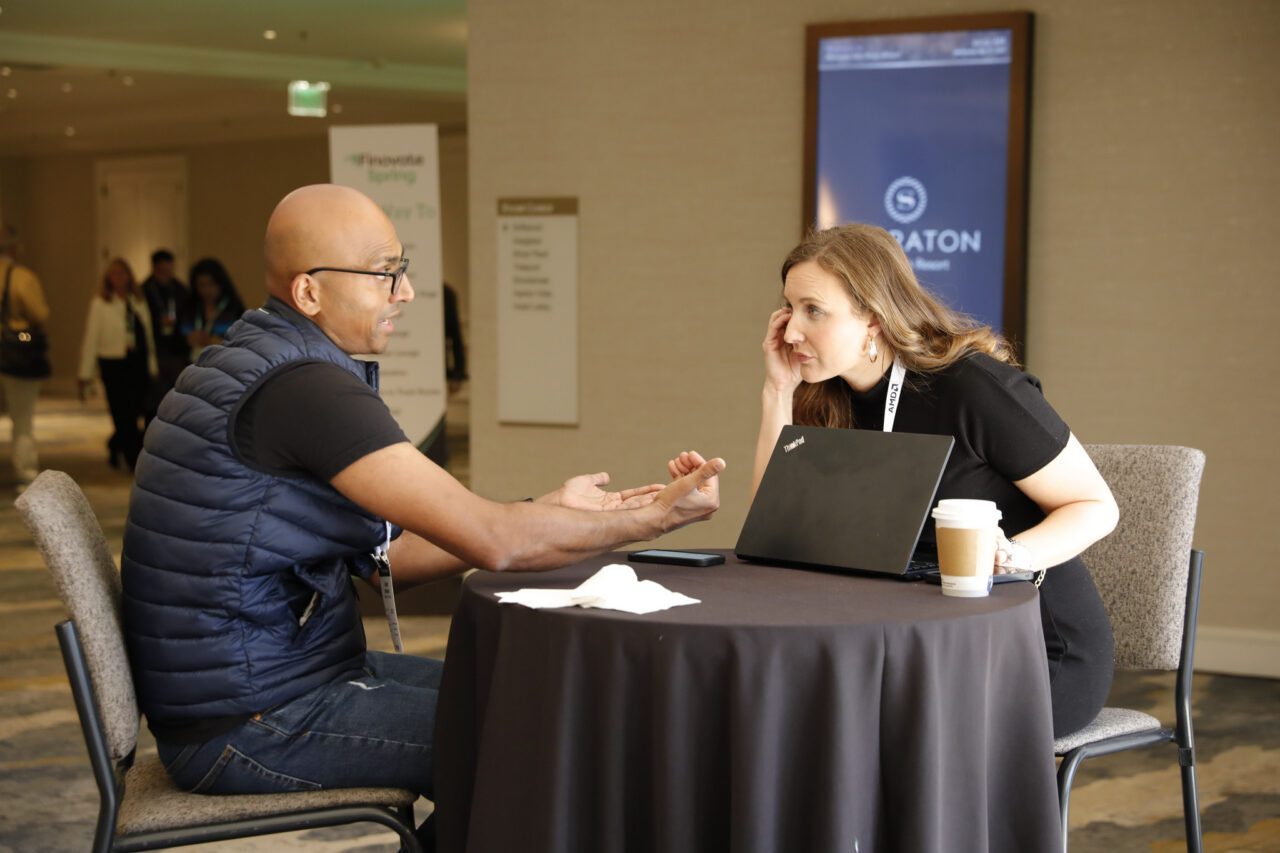
Finovate isn’t the biggest fintech conference, and it never will be. That’s because we have a focus on community. Instead of attending a frenzied event where you only get five minutes with each person you meet, the Finovate networking hall creates space for deeper conversations and genuine connections.
The focus on the fintech community is intentional. It is what keeps people coming back year after year. At a time when so much of the industry is being shaped by automation and digital interactions, there is still real value in face-to-face conversations, spontaneous introductions, and the kind of discussions that continue long after a panel ends.
Some of the most valuable insights from last week came from hallway conversations, lunch meetings, dinners, and the moments in between sessions where people could speak candidly about what they are building, where they are struggling, and where they believe the industry is heading next.
New for FinovateSpring 2026, Finovate is bringing its Impact+ session to offer early-stage fintech founders a dedicated platform to pitch their ideas directly to an audience of investors, banks, and industry leaders.
The session, which debuted at FinovateEurope earlier this year, is designed to create a structured environment for founders and investors to connect, exchange insights, and explore partnerships at a stage when ideas are still forming and companies are actively shaping their trajectory.
Taking place on Monday, May 4, Impact+ will feature a keynote from Stripe’s Asya Bradley, followed by an investor panel and a series of four-minute startup pitches. The evening concludes with networking, giving attendees the opportunity to continue conversations sparked on stage.
Why Impact+ Matters
Early-stage fintech is often where the most interesting ideas emerge, but it’s also the hardest to get visibility into. Impact+ aims to close that gap by bringing founders and investors into the same room.
The concise format gives founders just four minutes to clearly articulate the problem they’re solving, how their solution works, and why it matters. This high-speed format offers investors a way to quickly evaluate emerging opportunities.
Meet the Startups Taking the Stage
At FinovateSpring, eight early-stage companies will take part in the Impact+ session, each tackling a different piece of the financial services stack—from underwriting and compliance to agentic commerce and investment intelligence.
Agentix is positioning itself as the infrastructure layer for agentic commerce, enabling AI agents to transact across systems through a single integration. By focusing on discoverability across AI interfaces and enabling agent-to-agent transactions, the company is building toward a future where payments are initiated and completed by software agents rather than humans.
BUOH is building an AI guidance layer for banks and insurers, designed to improve how institutions engage with customers during financial decision-making moments. By detecting intent and delivering personalized guidance, the platform aims to increase conversion rates, reduce customer acquisition costs, and improve long-term value.
CustomerPlus is rethinking client onboarding and compliance by replacing fragmented tools with a unified client management platform. By embedding regulatory rules directly into workflows, the company enables automated KYC assessments and more consistent compliance processes across products and jurisdictions.
Draco AI is focused on automating underwriting for small business lenders, starting with the merchant cash advance market. Its platform replaces manual analysis, such as reviewing bank statements and aggregating debt positions, with AI-driven workflows that compress hours of work into minutes.
Fintellion is an AI-native investment intelligence platform designed to bring institutional-grade research capabilities to smaller firms. By combining equity research, portfolio intelligence, and real-time insights into a single system, it aims to enable faster, more informed investment decisions without the need for large analyst teams.
Mercata is building intelligence infrastructure for hedge funds by connecting internal knowledge such notes, ideas, and research, with external market data. The platform creates a persistent memory layer for investment teams, helping firms track evolving narratives and identify opportunities in real time.
ValueAssure is developing protection products for niche markets underserved by traditional insurance. Its flagship offering, ValueAssureAUTO, provides trade-in value protection for vehicle owners, addressing gaps not covered by standard auto insurance or GAP products.
Ventus AI is creating a customer intelligence layer that transforms transaction data into actionable insights. By identifying behavioral patterns and life events, the platform enables financial institutions to deliver more personalized experiences aimed at improving conversion, retention, and assets under management.