This site is operated by a business or businesses owned by Informa PLC and all copyright resides with them. Informa PLC's registered office is 5 Howick Place, London SW1P 1WG. Registered in England and Wales. Number 8860726.
Finovate Blog
Tracking fintech, banking & financial services innovations since 1994
Visa has teamed up with crypto payments network Mesh to enable customers to spend their crypto and stablecoin balances as they would fiat currency. The two are combining Visa’s global acceptance network with Mesh’s orchestration infrastructure to allow consumers to pay in-store and online from the crypto and stablecoin balances in their wallet apps.
Mesh was founded in 2020 to enable easy payment across hundreds of exchanges, wallets, and providers. Today, the fintech has more than 200 enterprises using its network. According to Crypto.com, there are 774 million crypto owners across the globe, but they spend hardly any of the crypto they hold because of the friction involved to convert it to fiat currency. That’s because customers have traditionally had to cash out their crypto to a bank account and wait or sign up for a payment card tied to a single platform. Among Mesh’s customers are Kalshi, Tools for Humanity, Félix Pago, Majority, and KAST.
“Crypto never had a spending problem—it has a last-mile problem, and until now, closing it meant getting a separate card,” said Mesh CEO and Co-founder Bam Azizi. “Mesh handles the funding and conversion, so a balance becomes purchasing power at the moment of payment, with nothing for the user to move and nothing for the merchant to change. We think your money should be spendable right where it already lives. With Visa and Mesh, it is.”
Visa’s payment network exceeds 175 million merchant locations across more than 200 countries and territories, creating a large footprint where consumers can spend funds that were previously difficult to spend. In 2025, the payment network processed $14.2 trillion in payments volume. The company most recently demoed at FinovateFall 2025 in New York.
“Consumers increasingly expect to use their money however and wherever they choose,” said Visa Global Head of Growth Rubail Birwadker. “Working with Mesh helps expand how digital asset balances can connect to the trusted payment experiences consumers and merchants rely on every day.”
Customers can use funds held across eligible digital wallets and platforms that enable them to pay from their balance for in-person and online purchases wherever Visa is accepted. Meanwhile, Visa provisions a credential in the background that will allow the shopper to make a purchase without having to sell, transfer, or preload funds. Merchants receive a payment in the standard way, without having to install new hardware or make changes to their checkout flow.
Mesh and Visa will announce availability, supported devices, and participating platforms as rollout details are finalized.
In the future, Mesh plans to extend beyond crypto and stablecoins to help consumers spend funds from “wherever consumers hold value.” This could eventually include other forms of digital assets and stored value, further reducing the barriers between where consumers hold their money and where they can spend it.
Ocrolus, a vertical AI workflow and analytics platform for lenders, has announced that its document fraud detection solution, Ocrolus Detect, will now be included at no additional cost for all its mortgage customers. Ocrolus Detect reviews bank statements, pay stubs, and tax forms for tampering. Underwriters see the results of the review in the Ocrolus platform or the Encompass embedded viewer where they already review the file.
Ocrolus has leveraged its integration with Resistant AI to enable Detect to spot documents that are created or edited by generative AI. Unfortunately, Generative AI makes it easy and inexpensive to produce false financial documents across different types of lending. Ocrolus has determined that 12% of loan applications processed via its platform contain suspicious activity. Detect determines both what a document says and how it was created, and gives each document an authenticity score with reason codes to indicate to the underwriter where the issue was located and why it was flagged.
This latter point is key. Detect identifies specific issues in flagged documents and gives lenders an explainable result. This can help lenders meet new AI governance requirements from Freddie Mac and Fannie Mae that went into effect earlier this year. To this end, Ocrolus has also integrated with Fannie Mae’s Income Calculator and Freddie Mac’s AIM Check, and maintains a formal AI governance program with controls mapped to both frameworks. The controls are audited every year by independent third parties and through application security testing.
Lenders using Detect have already reported positive results. JMAC Lending, a wholesale lender based in Costa Mesa, California, analyzes every file in its Encompass pipeline with Detect. In doing so, JMAC prevented nearly $2 million in fraudulent loan volume in the first months of use. The lender reported that in one instance, Detect uncovered a bank statement showing a $300,000 deposit in an account that held only $1,200.
“The conversation with lenders has moved from ‘Can AI do this?’ to ‘Can I trust it enough to put it into production?'” Ocrolus General Manager of Mortgage Nadia Aziz said. “Fraudulent bank statements and income documents can now be created in minutes and are becoming harder to distinguish from the real thing. Fraud screening should be built in, not an added expense for lenders. Detect shows underwriters exactly why a document was flagged, and the underwriter makes the call.”
Founded in 2014 and headquartered in New York, Ocrolus won Best of Show in its FinovateFall appearance in 2021 and most recently demoed its technology on the Finovate stage at FinovateFall 2023. At the conference, the company showed how its AI-driven document automation platform optimizes credit decisions in small business, mortgage, and consumer lending, enabling firms to automate financial analysis and help borrowers access the financing they need faster and on the best possible terms. Ocrolus’ platform analyzes 750,000 credit applications a month, and its technology powers digital lending experiences for more than 500 customers, including SoFi, PayPal, Square, and Zillow. Sam Bobley is co-founder and CEO.
Financial services software provider Finastra announced a pair of new offerings this week.
Finastra Supply Chain Finance (SCF) will help banks scale working capital programs faster and stimulate growth. SCF is integrated with Finastra’s Trade Innovation and Loan IQ platforms via the Nexus API suite and allows banks to offer connected trade, lending, and supply chain finance services.
SCF supports buyer and supplier acquisition, onboarding, fulfillment, servicing, risk management, and secondary market distribution. The technology provides straight-through processing and connects with ERP systems and trade ecosystem partners through the Nexus API suite. SCF also offers a rich data foundation for decisioning and portfolio management. The solution is built on a cloud-native architecture and is available via a variety of deployment models, from on-premises to SaaS.
“Banks are looking for ways to bring new working capital solutions to market faster to capture new revenue streams delivered through STP journeys, and lower costs, while addressing operational risks and regulatory complexity,” Vinay Mendonca, Finastra’s Head of Product, Trade Supply Chain Finance and Corporate Channels, said. “By combining new supply chain finance capabilities with Trade Innovation and Loan IQ, we’re enabling banks to take a more connected approach to working capital. This launch marks an important milestone in the evolution of our Trade Innovation platform as we look to bring more API, AI, and cloud-led innovation to the market, leveraging our deep expertise in the trade domain, to help institutions innovate and grow.”
SCF will help banks accelerate product launches, provide holistic working capital management, automate risk distribution, enhance risk management, and scale efficiently thanks to straight-through processing, real-time servicing, and high-performance architecture. Finastra noted that it plans to expand the capabilities of SCF to include purchase order (PO) finance, pre- to post-shipment finance, inventory finance, distributor finance, as well as other working capital solutions.
The release of SCF is the company’s latest investment in its Trade Innovation and Loan IQ offerings. Trade Innovation is Finastra’s digital trade finance platform that enables institutions to automate workflows, reduce risk, and improve working capital efficiency. Loan IQ is the company’s commercial and corporate loan management and servicing software. SCF extends Finastra’s goal of offering institutions a connected working capital ecosystem through a unified commercial and risk management framework.
Finastra also unveiled a new AI-powered capability within its OperatorAssist solution. Repair Recommendations, announced this week, will enable banks to respond faster to rising payment volumes by bringing better decision-making into their existing workflows. The new offering is designed to help banks avoid the kind of errors and disruptions that can hinder traditional payment processing by enabling teams to resolve issues faster, manage higher volumes more efficiently, and boost success rates without introducing additional complexity.
Repair Recommendations simplifies complex repair scenarios, identifies payment discrepancies and underlying causes, decreases dependence on specialized expertise, and reduces the amount of time and effort required by payment operations teams to manage and resolve payment exceptions. This allows banks to manage higher payment volumes more efficiently as demand from real-time cross-border activity, infrastructure modernization, and digital commerce continues to grow.
“With Repair Recommendations, we’re empowering banks to upgrade their payment operations—reducing resolution times and minimizing errors,” Barry Rodrigues, Finastra EVP, Payments, said. “As payment volumes increase, AI can help deliver immediate value by accelerating repairs, streamlining onboarding, and strengthening resilience. We’re helping banks to scale their operations and deliver faster, more reliable services to their customers.”
Headquartered in London, Finastra was formed in 2017 through the combination of Finovate alum Misys and D+H. In addition to its loan servicing and trade innovation platforms, Finastra offers solutions for payments (Global PAYplus and Payments to Go), core banking (Essence), mortgages (Mortgagebot), and more.
Payments expert ACI Worldwideannounced it now offers intelligent payments routing for Swift ledger transactions. The capabilities are available using ACI Connetic, the company’s cloud-native payments hub.
Swift’s blockchain-based ledger was announced last year to help banks move tokenized deposits across borders beyond traditional operating hours. While the 17 banks involved stand to benefit from the infrastructure, many have not fit tokenized deposit payments into their day-to-day operations.
Using ACI Connetic, banks will be able to process tokenized deposit payments, as well as traditional payment types, into the same payments environment banks already use to route, monitor, control and reconcile payments at scale. Because banks can use the same operational controls, workflows, and infrastructure for tokenized payments as they do with traditional payments, it eliminates the need for separate digital-asset payment operations.
“Digital assets should extend a bank’s payment capabilities, not force it to build a second payment operation,” said ACI Worldwide SVP, Head of Account-to-Account Payments, Craig Ramsey. “Banks need a practical way to operationalize tokenized deposits at scale using the people, controls and processes they already trust. With ACI Connetic, payments orchestrated through Swift’s ledger can be managed alongside other payment flows within a common operational framework.”
Swift’s ledger may provide the infrastructure to move tokenized value across borders, but banks still need a way to incorporate those transactions into their existing payment operations. By routing Swift ledger transactions alongside traditional payments, ACI Connetic could lower one of the barriers to adoption by allowing banks to experiment with and scale tokenized deposits without building a parallel payments stack. As tokenized deposits move from pilots toward production, that ability to integrate new rails into existing infrastructure will become increasingly important.
ACI Worldwide’s ACI Connetic works by unifying payment types, payment rails, and controls in a single platform that uses bank- and customer-defined rules to automatically select the best clearing and settlement path. This automatic routing gives banks flexibility while maintaining consistent controls and visibility and allowing for scale without relying on a separate operation.
Founded in 1975, ACI Worldwide’s solutions power intelligent payments orchestration in real time to allow banks, billers, and merchants to modernize their payment infrastructure. The company combines a global footprint with local expertise to help its clients manage evolving payment methods and infrastructure. ACI Worldwide, which presented at our developer’s conference at FinDEVr Silicon Valley 2016, is publicly traded on the Nasdaq under the ticker ACIW.
With PayNearMe’s acquisition of Marr Labs and Envestnet’s acquisition of Vestmark, we continue to see evidence that fintechs are conducting M&A at a faster pace than banks in 2026.
Payment experience management company PayNearMe has acquired Marr Labs’ technology and hired its ‘key employees.’ Founded in 2023 and headquartered in San Francisco, Marr Labs builds AI agents that provide compliant voice automation, document intelligence, intelligent workflow orchestration, and real-time compliance enforcement. The acquisition will enhance PayNearMe’s ability to deliver agentic AI automation to its clients, leveraging Marr Labs’ expertise in building and operating sophisticated AI systems at scale.
“PayNearMe has always focused on understanding and continuously improving the entire payment journey,” PayNearMe CEO and Founder Danny Shader said. “AI provides powerful opportunities to further improve the experience delivered by our PayXM platform. The Marr Labs team has proven its ability to build and deploy sophisticated AI systems at massive scale. Combining that expertise with PayNearMe’s deep understanding of our clients’ needs and challenges makes this combination so exciting.”
PayNearMe’s PayXM platform is designed to manage the payment experience from payment request through reconciliation. The company’s end-to-end approach accelerates the payment process and lowers the total cost of payment acceptance. By embedding agentic AI into the payment experience, and providing these agents with access to the right data, business rules, and workflows, PayNearMe is able to enhance every touchpoint in the payment journey. This enables the company to deliver highly configurable and specialized payment capabilities to credit unions, lenders, mortgage servicing firms, and more.
“We’ve spent years building AI that can work reliably at scale, and wanted to put that experience to work where it could have the greatest impact,” Marr Labs Co-Founder and CEO Dave Grannan said. “PayNearMe has built a trusted platform serving thousands of businesses and has a deep understanding of the payment problems they need to solve. Joining PayNearMe gives our team the opportunity to bring what we’ve learned to a much broader market and help shape the future of payments.”
PayNearMe offers a payments platform that facilitates self-service, reduces manual intervention, and lowers the cost of acceptance. The company’s Payment Experience Management platform powers payments for thousands of businesses around the world, and supports all major payment types and channels, including PayPal, Venmo, Cash App, Apple Pay, Google Pay, cards, and ACH to cash at 62,000+ US retail locations. Named to CNBC’s “World’s Top Fintech Companies for 2026” list and a three-time Finovate Best of Show winner, PayNearMe processes more than $50 billion a year.
Meanwhile, in the wealth management space, wealthtech firm Envestnet has agreed to acquire portfolio management technology provider Vestmark. AI may not be the headline here, but executives from both companies highlighted its role in the combined offering.
“For 25 years, Vestmark has focused on helping wealth management firms navigate increasingly complex portfolios with greater scale, personalization, and efficiency,” Roessner said. “Envestnet and Vestmark bring complementary capabilities and expertise to the market, and together we can create something neither company could deliver on its own.”
Founded in 2001 and headquartered in Wakefield, Massachusetts, Vestmark provides portfolio management solutions and outsourced services for financial institutions and their advisors. The company helps wealth management firms efficiently manage customized client portfolios via an enterprise-grade platform. With more than $2 trillion in assets and more than five million investor accounts, its clients include BlackRock, Invesco, and Vanguard.
The acquisition will enable Envestnet to support its clients across a broader range of products and services, from financial advice and planning through portfolio construction, personalization, trading, tax management, and ongoing portfolio management. The addition will give Envestnet enhanced capabilities and the modularity to serve sophisticated wealth management workflows in a single adaptive ecosystem with no forced migration. Post-acquisition, both companies will continue to invest in and develop their existing product lines. This includes VestmarkOne, VAST, Envestnet Enterprise, Tamarac, and MoneyGuide, as well as incremental investments in AI-powered workflows and automation.
“Wealth management offerings have been siloed for too long, with advisors, traders, and portfolio managers each locked into their own piece of the puzzle,” Envestnet CEO Chris Todd said. “Bringing Vestmark into the Envestnet ecosystem changes that. Wherever a firm sits today, and wherever they’re headed next, they’ll have a platform that can grow with them. We’re not slowing down to make this happen—we’re speeding up, protecting what makes each company great and putting even more behind the roadmap our clients are counting on. Our AI strategy unifies, orchestrates, and personalizes the advisor experience at Envestnet, and will extend across Vestmark’s workflows too. That’s a real reimagining of how advisors do their jobs.”
Envestnet serves more than a third of all advisors across its platforms and has $8 trillion in platform assets. Founded in 1999, the company most recently demoed its technology on the Finovate stage at FinovateFall 2021. Envestnet’s acquisition news arrives amid a flurry of announcements from the Pennsylvania-based fintech, including enhancements to its wealth management, portfolio reporting, and financial planning platforms.
Envestnet’s acquisition of Vestmark is expected to close in Q4 2026. Financial terms of the transaction were not immediately available.
UK-based lending technology provider Lenvi has unveiled its new automated loan verification software, ALVIN, designed to combat fraud risks such as double pledging. The launch follows a series of high-profile fraud cases involving MFS, Tricolor, and First Brands Group.
Double pledging takes place when a borrower uses the same asset as collateral to secure multiple loans from different lenders simultaneously—without informing the lenders that the collateral has already been pledged as security for other loans. This fraud tactic drew significant public attention this year when a number of high-profile fraud cases involved double pledging.
For example, Market Financial Solutions was a UK property lending company that collapsed in February 2026 as a result of a £1.3 billion fraud and double pledging scandal. Executives at Tricolor Holdings were accused of running a massive fraud scheme—also using double pledging—around subprime automobile loans and were charged by the SEC in August in connection with the firm’s $1.9 billion collapse. First Brands Group was another case of multibillion-dollar fraud involving fake collateral and not just double pledging, but triple pledging.
Historically, lenders have defended themselves against double pledging via collateral registries, UCC (Uniform Commercial Code) filings and searches, regular and AUP audits, and even blockchain-based and digital registry solutions. Unfortunately, many of these methods fall short due to the lack of centralization among registry systems, the prevalence of manual and periodic verification processes, and increasingly sophisticated fraud strategies, including document forgery and digital manipulation—both accelerated by AI—as well as the use of shell companies and jurisdictional arbitrage.
In response, Lenvi’s ALVIN provides continuous, automated loan verification across the entire lending portfolio. Built on agentic AI, ALVIN operates alongside Lenvi’s existing AUP (Agreed-Upon Procedures) and compliance services to deliver robust, end-to-end protection for capital markets investments. ALVIN can analyze data tapes or connect directly to loan management systems via APIs, consuming data at the source to provide visibility across all funding lines. ALVIN verifies every loan document, every customer, and every pledged asset. This empowers funders to monitor processes on an ongoing basis instead of using periodic or smaller-sample checks alone.
Additionally, to help guard against double pledging, each loan is tokenized with a unique digital fingerprint. If ALVIN encounters another loan with a similar fingerprint or other matching characteristics, the software instantly alerts the funder, enabling them to investigate the matter further. ALVIN also delivers real-time visibility of cash movements, monitoring transactions from origination through repayment to ensure the funds reach the correct recipients.
“Developing ALVIN was all about helping investors to confirm that what’s on paper matches reality,” Lenvi Director of Capital Markets Owain Chambers said. “The recent cases with MFS, Tricolor, and First Brands Group have naturally shaken the market and increased scrutiny of loan verification, particularly around the risk of double pledging. This software responds directly to that nervousness and helps detect any irregularities before they cause lasting damage.”
Founded in 1988 and headquartered in Leeds, UK, Lenvi made its Finovate debut at FinovateEurope 2023. At the conference, the company demonstrated how its technology delivers rich and mature lending functionality and broad, extensible, first-party API support. This facilitates feature toggling alongside fully automated online deployments, while a React user interface and API support an endlessly configurable workflow engine in an environment that is compliant and secure. Richard Carter is Lenvi’s Chief Executive.
Digital payments and data security company Bluefinannounced it has partnered with Visa on a new card-present acceptance tool. The new offering combines Bluefin’s PCI-validated point-to-point encryption (P2PE) solution with Visa Acceptance Solutions to bring increased security to in-person payment acceptance.
The in-store payment acceptance tool offers merchants, software providers, and enterprises a unified approach to accepting payments by combining payment acceptance, PCI-validated security, tokenization, device lifecycle management, and enterprise payment infrastructure into a single solution. Bluefin will power the P2PE piece, while Visa’s Visa Acceptance Solutions is taking on the payment processing, tokenization, and global payment services elements.
“Enterprise organizations are no longer looking for individual payment technologies—they’re looking for infrastructure that enables secure commerce across every channel,” said Bluefin Founder and Chief Strategy Officer Ruston Miles. “Our collaboration with Visa Acceptance Solutions reflects a shared vision that secure payment acceptance should be delivered as an integrated platform rather than a collection of independent components.”
Bluefin was founded in 2007 to bring security to payments by developing technology to devalue sensitive data at the point of entry. Since then, the company has expanded to focus on broader data security infrastructure that protects sensitive data in motion across systems, platforms, and environments. Combining P2PE, vaultless tokenization, and orchestration powers Bluefin’s new model for securing transactions.
The new tool will bring Bluefin clients simplified deployment, centralized device management, developer APIs and SDKs, and reduced PCI compliance scope. While Bluefin is launching the payment acceptance tool with select Ingenico Lane series devices, the tool is capable of expanding to additional ecosystems.
“By combining Visa Acceptance Solutions with Bluefin’s card-present security infrastructure, we’re helping organizations simplify deployment, reduce complexity, and build a stronger foundation for the future of enterprise commerce,” added Miles.
Teaming up with Visa helps Bluefin consolidate traditional, fragmented technology stacks. Rather than separately integrating payment acceptance, processing, encryption, tokenization, and device management, it offers merchants the option to access those capabilities through a unified platform. This raises the bar from offering an individual piece of the payments stack to helping businesses abstract the complexity of managing payments across channels.
Bluefin works with more than 300 partners and 40,000 businesses and protects more than $350 billion in transactions annually. The Atlanta, Georgia-based company showcased its payment technology at FinDEVr 2014 under the name Bluefin Payment Systems.
OmniAI, an agentic AI firm that made its Finovate debut at FinovateFall 2025 last year in New York, has rebranded as Monumint.
“This is more than a new name. It’s the next chapter of our company,” the firm began its LinkedIn post discussing the rebranding. “As financial services enters the era of AI, every customer should still receive a personal, high-touch experience,” the post continued. “We believe conversational AI is the foundation that makes that possible. That’s why we’re becoming Monumint.” The new name of the firm was inspired by the strength and endurance of monuments, “structures that have been built to last … just like the relationships financial institutions build with their customers.”
Monumint offers a conversational AI platform for financial institutions. The company’s technology leverages agentic AI to manage the entire borrower lifecycle across email, SMS, and voice. Monumint’s AI agents support account opening, loan origination, servicing, and collections, verifying and pre-qualifying applicants, collecting documents, responding instantly to balance, payment, and account queries, and, when necessary, providing empathetic, policy-guided outreach to enhance the collections process. This includes routing hardship signals directly to human agents.
The company’s rebrand comes at a time when a growing number of banks and credit unions that have built their businesses around relationship banking are facing challenges from technology-enabled rivals who are making it easier for customers to open accounts, secure the assistance and advice they need, and move money quickly without requiring a branch visit or dealing with a call center. The instant access that consumers increasingly expect in other aspects of life is quickly becoming an expectation among consumers of banking and financial services. Enabling community banks, credit unions, and lenders to deliver this access through innovative technologies like agentic AI will empower these firms to compete more effectively for the engagement—and deposits—of the financial services consumers in their communities and beyond.
“The next generation of financial services will be built around personal relationships at massive scale,” the company noted in a rebrand announcement on its website. “The winners will not be the institutions with the biggest balance sheets, but the ones that can give every customer a banker in their pocket, available across every channel, with the context to help and the judgment to know when a human should step in.”
As OmniAI, Monumint made its Finovate debut at FinovateFall 2025 in New York. The company showed how its AI agents for lending accelerate borrower onboarding, delivering faster responses and fewer delays for borrowers, as well as fewer drop-offs and cleaner data to enable lenders to make faster, smarter credit decisions. Each agent is trained on the financial institution’s workflow, guiding applicants from intake through to underwriting-readiness, gathering documents, verifying data in real time, asking contextual questions, and escalating issues as needed to human professionals.
Monumint is a Y Combinator alum, joining the accelerator as a member of the Winter 2024 cohort. Tyler Maran (CEO) and Anna Pojawais (CTO) are the company’s co-founders.
Credit union members and community banking customers readily trust their credit unions and community banks with their capital when it comes to saving and borrowing. But what about investing? In most instances, those same members and customers will seek out other institutions and businesses when it comes to investing for the future and managing their wealth.
What if credit unions and community banks instead could keep those members and customers by catering to their investing and wealth management needs? How might this positively impact customer and member relationships and deepen engagement?
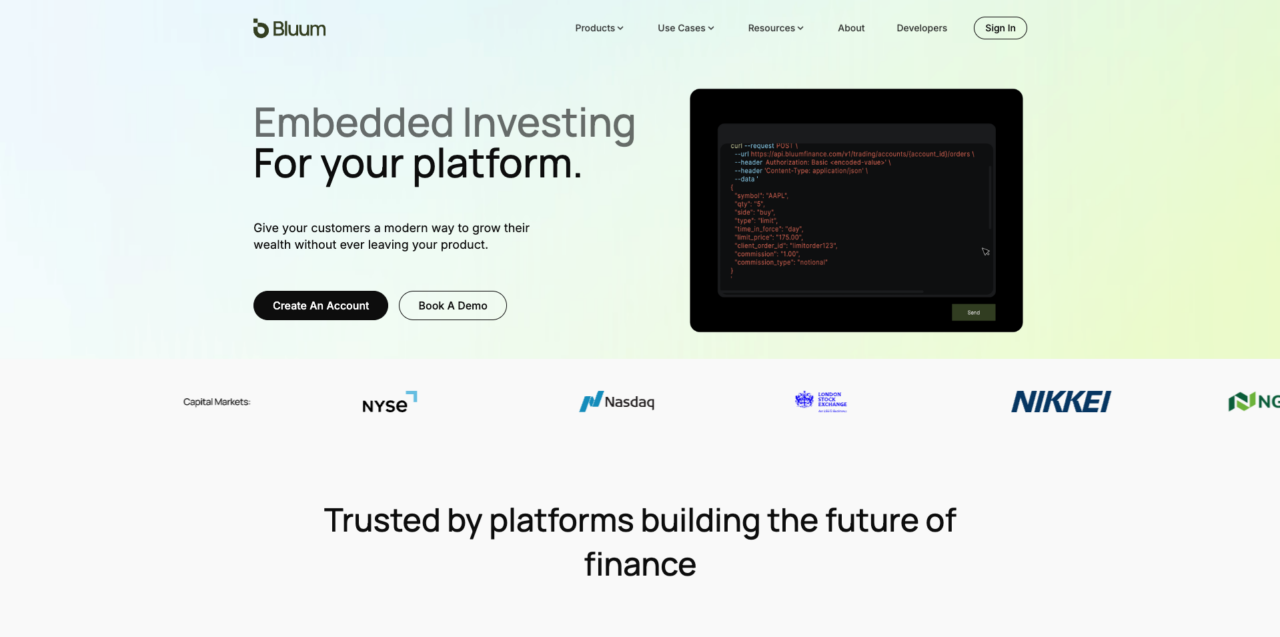
This week, our Finovate First-Timers series features Ariel Leachman, Co-founder and Chief Operating Officer at Bluum Finance. Headquartered in Los Angeles, California and founded in 2025, Bluum Finance offers a unified platform for embedded wealth management and investing, providing brokerage and AI-powered advisory infrastructure via APIs. The company combines multi-asset, multi-market brokerage, custody, and reporting in a single integration, enabling credit unions, banks, and fintechs to offer seamless investing experiences for their members and customers. Bluum Finance made its Finovate debut at FinovateSpring 2026 in San Diego. Co-founder Ope Sonusi is CEO.
In our conversation, Leachman discusses the opportunity that credit unions and community banks have by integrating investing and wealth management capabilities directly into their existing platforms. Leachman also explains how Bluum Finance streamlines the process for smaller financial institutions, delivering access to a range of asset classes and international markets via a single API. Finally, she shares her thoughts on what it will take to make cross-border investing as easy and commonplace as cross-border payments.
What problem does Bluum Finance solve and who does it solve it for?
Ariel Leachman: Credit unions, community financial institutions, and consumer fintechs have built strong relationships with their customers. The challenge is that when those customers are ready to start investing and building wealth, they often have to leave for another platform. Bluum enables fintechs and financial institutions to launch investing and wealth management directly within their existing platform, enabling them to expand their offering, generate new revenue, and strengthen customer relationships.
How does Bluum solve this problem better than other companies?
Leachman: Many embedded investing platforms focus primarily on trade execution. We take a broader approach by combining multi-asset investing, AI-powered wealth management, and the underlying brokerage infrastructure in a single platform. Rather than having to stitch together brokerage, custody, compliance, reporting, and portfolio guidance from multiple providers, our partners can launch through one API while we manage much of the complexity behind the scenes. Our platform also supports a range of asset classes and international markets, giving financial institutions a single platform to help their customers build diversified investment portfolios.
Who are Bluum’s primary customers and how do you reach them?
Leachman: Our primary customers are consumer fintechs, community banks, and credit unions that want to add investing and wealth management to their existing product offering without the high cost and operational lift of building a brokerage platform from scratch. Most of these institutions already have strong customer relationships and are looking for practical ways to expand their offering while keeping the experience simple for both their teams and customers. We primarily reach them through direct relationships, strategic partnerships, and industry events like Finovate.
Can you tell us about a favorite implementation or deployment of your technology, or a particularly valuable partnership experience?
Leachman: One of the most rewarding parts of building Bluum has been working with financial institutions that genuinely want to help their customers build long-term wealth. Credit unions, in particular, have earned a tremendous amount of trust within their communities. Helping them extend that relationship beyond everyday banking into investing feels especially meaningful because it allows more people to access wealth-building tools through an institution they already know and trust.
What in your background gave you the confidence to respond to this challenge?
Leachman: As co-founders, we’ve spent years working in financial services and technology before launching Bluum. My co-founder, Ope Sonusi, spent his career building fintech platforms for US and international markets, and I spent my career in investment banking and private equity, building deep expertise in capital markets, investment products, and financial institutions. As we spent more time speaking with financial institutions and fintechs, one thing became clear: many wanted to offer investing, but the infrastructure required to do it was too costly and complex. That insight became the foundation for building a platform like Bluum Finance.
You demoed at FinovateSpring in May of this year. How was the experience?
Leachman: FinovateSpring was a great experience. It gave us the opportunity to demo the Bluum platform and engage directly with credit unions, community financial institutions, fintechs, and industry leaders to better understand their priorities around investing, wealth management, and member engagement. The event reinforced our view that embedded investing and wealth management are becoming essential components of the modern digital banking experience, and that financial institutions are looking for simple, compliant solutions they can bring to market quickly.
You have talked about the opportunities in frontier and emerging markets and how the challenge is making cross-border investing as seamless as cross-border payments. Can you elaborate on this idea?
Leachman: Cross-border payments have become dramatically easier over the past decade. Today, a financial institution can enable cross-border payments through a single integration without having to build the underlying infrastructure. Cross-border investing hasn’t evolved in the same way. Offering investment access across markets still requires coordinating brokers, custody providers, regulatory requirements, and reporting, which creates a lot of complexity.
Our goal is to simplify that experience so financial institutions can offer access to both US and international markets without having to manage the high cost and onerous operational lift themselves. We believe the next evolution of financial services will make cross-border investing as seamless and accessible across global markets.
What are your goals for Bluum Finance over the balance of 2026 and into next year?
Leachman: We are focused on growing our partnerships with financial institutions, consumer fintechs, and credit unions. We’ve seen strong interest from institutions that want to offer investing but don’t want to build and operate the infrastructure themselves, so we’re focused on helping more partners bring those capabilities to market. We’re also excited about expanding the range of investment opportunities available through Bluum, including private markets and digital assets.
Digital banking and client lifecycle management solutions provider Fenergo has launchedFen-AI, an agentic AI orchestration platform for banks. The Ireland-based company built Fen-AI to enable banks to automate routine client onboarding, due diligence, and ongoing compliance tasks while keeping human reviewers in control and maintaining an audit trail.
“Risk moves in real time and regulation evolves continuously,” said Fenergo CEO Marc Murphy. “Yet the work of compliance still depends on review cycles built for a slower world. Fen-AI changes that. We’re enabling institutions to move from periodic control to continuous control, delivering faster client onboarding, greater operational efficiency, and stronger compliance without increasing risk or headcount.”
Fen-AI uses an Agent-to-Agent (A2A) Interoperability Framework that allows banks to connect to Fenergo and third-party agents through a single interface. The platform authenticates requests, preserves context across handoffs, and attributes each completed action. Each outcome, along with its audit trail, is captured using the Fen-X Legal Entity System of Record.
In addition to the audit trail, Fen-AI also reports on the value created by agentic capabilities. The reports enables teams to monitor the tasks completed by agents, the number of analyst hours saved, the amount of manual activity avoided, and more to identify where more automation or controls may be beneficial.
Fen-AI powers Fenergo’s KYRA, an agentic workforce that coordinates banks’ internal AI-driven activity. With KYRA, every action, source, decision, and rationale is recorded as agents complete tasks. By automating processes using an agentic workforce while keeping a record of decisions and rationales, banks can increase the speed and scale of their CLM and KYC operations.
“AI in financial institutions will succeed only if it’s built on trust. Regulators will not accept ‘the AI decided’ as an answer,” said Fenergo President and COO Hishaam Caramanli. “That is why we built governance into the foundation of Fen-AI from day one. Every action is attributable. Every decision is explainable. Every outcome is anchored to a trusted system of record. We are creating a new category for regulated industries: the governed agentic workforce.”
Founded in 2009, Fenergo showcased its client onboarding tool at FinovateEurope 2012. The company provides client lifecycle management, know your customer, onboarding, transaction monitoring, anti-money laundering, sanctions screening, and regulatory compliance tools to more than 40% of the world’s top 50 banks and over 110 financial institutions.
While today’s release includes six automation agents, Fenergo noted that additional Fen-AI capabilities will be introduced in the coming quarters.
For banks, Fen-AI can help make their AI agents more useful in a regulated environment. Banks have been cautious about deploying agentic AI in compliance because they must be able to explain how decisions were made, identify which system or agent took an action, and produce evidence for regulators. With Fen-AI, banks can use agents to onboard more agents and implement continuous oversight without adding staff.
The platform could also make it easier for banks to adopt AI from multiple vendors without losing control over how agents share information or complete tasks. Ultimately, however, Fen-AI’s impact will depend on how reliably the agents perform, how smoothly Fen-AI integrates with banks’ existing systems, and whether institutions can demonstrate measurable efficiency gains without weakening compliance controls.
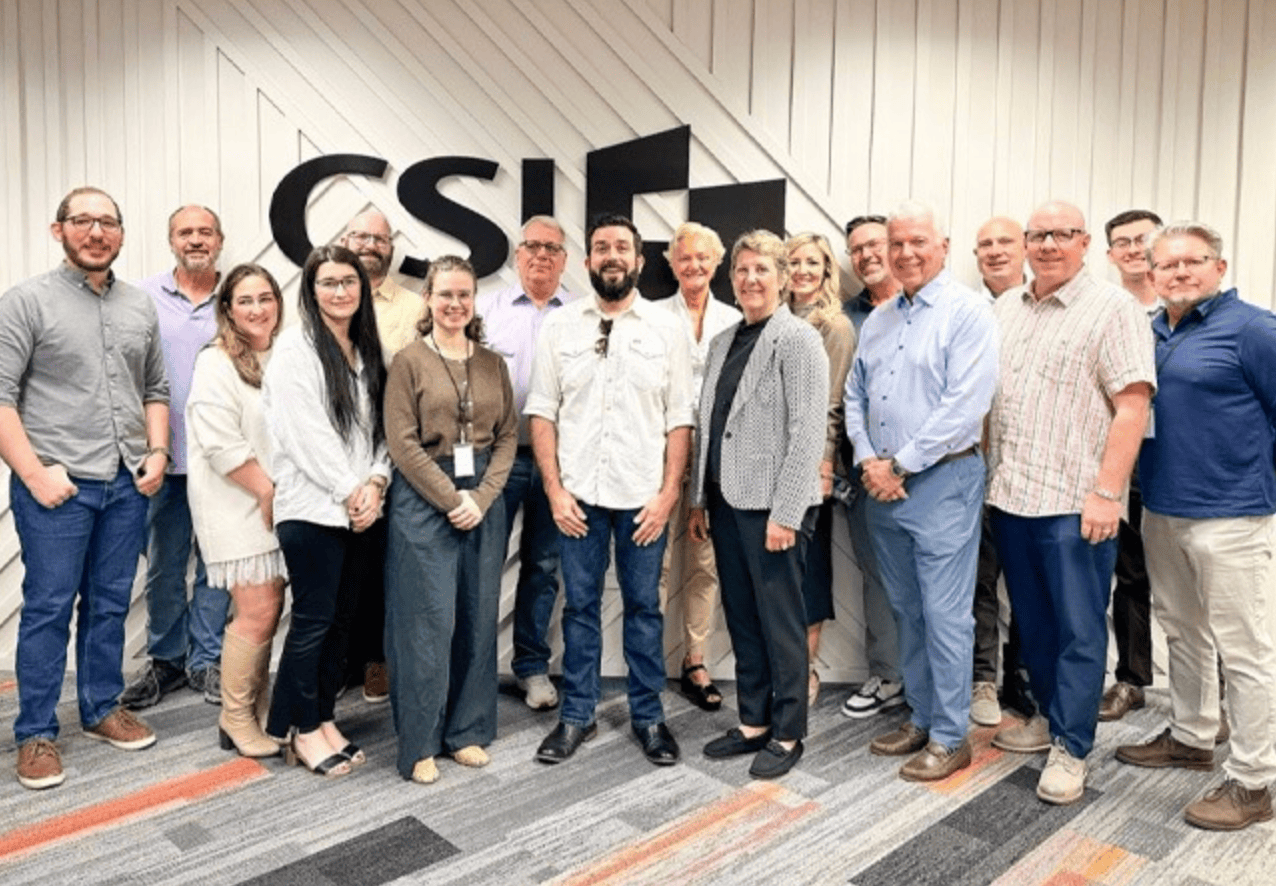
Fintech solutions provider CSI has acquired payments infrastructure and treasury solutions provider Qolo for an undisclosed amount.
CSI anticipates that the acquisition will strengthen its commercial banking solutions by offering its community financial institution clients more flexible deposit structures and expanded commercial card programs. Adding Qolo’s existing clients to its own roster will also extend CSI’s geographical reach.
More specifically, CSI will use Qolo’s technology to serve as the orchestration layer across payments, accounts, and workflows. The Kentucky-based company will integrate with CSI’s core banking platform, digital banking solution, and broader API capabilities to bring community financial institutions prepackaged, pre-integrated commercial banking solutions, including:
A real-time account ledger that gives banks and businesses instant visibility into balances, transactions, and authorizations.
Multi-rail payment orchestration that offers a unified payment engine to orchestrate domestic and international money movement across multiple payment rails and business workflows.
Enhanced card capabilities that expand integrated issuing and processing across debit, prepaid, virtual, and secured corporate credit card programs.
Qolo, which demoed at FinovateFall 2022, was founded in 2018 with the aim of simplifying payments through a unified infrastructure layer. Its platform combines an embedded ledger, card issuing, money movement, real-time reconciliation, and cross-rail connectivity into a single API. Rather than requiring banks to replace legacy cores, Qolo overlays its technology on top of existing systems, enabling institutions to deploy new payment capabilities in months, not years.
CSI said that the combined company will remain focused on serving community financial institutions with new ways to attract, retain, and grow customer relationships by offering modern commercial banking capabilities typically found at large banks. Keeping up with current, constantly changing technology can help small community banks compete more effectively with banks that have large R&D budgets.
“Community financial institutions are built on trusted relationships, local expertise, and deep knowledge of their markets,” said CSI President and CEO Nancy Langer. “But businesses in their communities also need sophisticated banking capabilities that simplify and fit more naturally into their day-to-day financial operations. With Qolo, CSI is helping community banks bring those capabilities to market in ways that help them grow commercial relationships and become more central to how businesses operate. At the same time, it expands our ability to support fintechs and B2B payments providers as demand grows for financial services embedded directly into everyday business workflows.”
For community banks, the acquisition is less about adding another payments tool and more about simplifying how commercial banking services are delivered. As businesses increasingly expect real-time payments and integrated treasury capabilities, banks are looking for unified platforms that reduce technology complexity while enabling them to embed financial services more naturally into their customers’ day-to-day operations.
“The line between traditional banking and embedded finance is becoming increasingly blurred,” said Qolo Co-founder and CEO Patricia Montesi. “Whether you’re a community bank modernizing your commercial offering or a fintech building embedded finance products, you’re often running into the same challenges: fragmented vendors, disconnected payment rails, and manual workarounds that limit growth. By joining CSI, we can invest more deeply in the infrastructure that powers modern financial experiences and help our customers become a more seamless part of how businesses manage and move money every day.”
In an interview at FinovateFall last year, I sat down with Montesi to discuss how the company helps modernize payments infrastructure. “We set out to build an entire, comprehensive payments stack that includes ledger, card, payments, virtual account management—everything all available through a single API served up to you so that you can then focus on your customers,” said Montesi.
Rather than replacing legacy cores outright, banks are increasingly layering modern payments, ledger, and treasury capabilities on top of existing infrastructure. Qolo built its platform around that philosophy, making it a natural fit for CSI’s strategy of helping community financial institutions modernize without undertaking large-scale core replacements.
Personal finance solutions fintech Meniga launched a new product called Fini, an MCP server that enables banks to bring agentic AI into their existing platforms.
Fini, which was built with the input of five large banks, serves as the bridge between a bank’s preferred large language model (LLM) and Meniga’s personal finance, enrichment, and insights capabilities. Rather than building its own AI model, Meniga enables banks to pair Claude, GPT, Gemini, or another LLM with the company’s financial intelligence platform, allowing customers to ask questions about their finances in natural language within the bank’s website or mobile app.
Founded in 2009, Meniga serves over 100 million banking customers across 30 countries. The UK-based company’s clients include UniCredit, Groupe BPCE, UOB, Swedbank, SAB, Tangerine, and Riyad Bank. Meniga’s intelligence and personalization layer helps banks turn financial data into insights and proactively anticipate customer needs, promoting engagement.
Meniga anticipates that this conversational interface will benefit banks by engaging with consumers on a deeper level, increase satisfaction, lower support costs, and offer insights into customers’ individual needs. The new tool also meets consumers where they are, especially as their preferences shift away from features and towards conversational interfaces that offer instant, personalized answers.
“The banks that win agentic banking will be the ones that ground their conversational layer in real financial context. Not a generic chatbot, but an assistant that actually knows a customer’s spending patterns, their goals, and their upcoming bills, and is able to act on them,” said Meniga CEO Raj Soni.“With Fini, banks can enter the AI-agent era on the platform they already trust, without rebuilding what’s underneath, and without their data ever leaving the bank.”
Beyond answering questions, Fini supports agentic AI workflows that allow customers to complete certain banking tasks, like opening new accounts or setting up automatic transfers, directly within the conversation. This eliminates the need to navigate to separate screens.
Because Fini is model-agnostic, banks can build their AI assistants on Claude, GPT, Gemini, or their own proprietary model while relying on Meniga to provide the underlying financial context. Banks also retain control over their own guardrails, identity and access controls, and customer data, which never leaves the bank.
Meniga’s launch is similar to those of other fintechs racing to capture the LLM opportunity for consumer financial management. Rather than developing proprietary large language models, banks are increasingly viewing AI as a layered architecture. Foundation models such as Claude, GPT, or Gemini provide the conversational interface, while companies like Meniga provide the financial intelligence needed to ground those conversations in a customer’s actual spending patterns, cash flow, subscriptions, and financial goals. This approach enables banks to adopt new AI models as they emerge without rebuilding the personal financial management capabilities that differentiate their customer experience.