Stripe Agrees to Acquire Embedded Finance Platform Parafin

Stripe Agrees to Acquire Embedded Finance Platform Parafin
  • Stripe has agreed to acquire embedded finance platform Parafin, marking its third acquisition of 2026 and 24th overall.
  • Parafin brings embedded credit and risk capabilities that have helped more than 60,000 small businesses access capital through platforms including DoorDash, Gusto, Jobber, and Mindbody.
  • The acquisition advances Stripe beyond its payments roots, expanding the infrastructure platforms can use to become more comprehensive financial hubs for their business customers.

Payment infrastructure fintech Stripe has agreed to acquire embedded finance platform Parafin. The move comes about a month after the California-based company acquired legal infrastructure startup Clerky, marking Stripe’s third acquisition this year and its 24th overall. Financial terms of the agreement were undisclosed.

Founded in 2020, Parafin offers platforms like DoorDash, Gusto, Jobber, and Mindbody provide credit offerings for their small business customers. Since launch, the company has helped more than 60,000 businesses gain access to capital. In addition to its capital offering, Parafin also offers two credit products, Pay Over Time and Spend, that give businesses flexibility in managing their cash flow. Stripe plans to leverage Parafin to support small businesses by offering them the credit they need to grow.

“We started Parafin to give small businesses access to the modern credit products that were only available to large companies,” said Parafin Cofounder and CEO, Sahill Poddar. “Stripe’s financial infrastructure and global reach will help us move faster and serve millions more businesses through the platforms they rely on.”

Stripe has more than 18,000 clients leveraging its platform to build, manage, and grow their businesses. While it is best known for its payment processing tools, the company also offers tools such as Stripe Capital to help small businesses generate new revenue opportunities. Stripe reports that, in the second quarter of 2026, new businesses launching on Stripe increased 86% year-over-year while only 41% of small business loan applications were approved in the US in 2025.

“Platforms power millions of small businesses throughout the world and are central to Stripe’s mission,” said Stripe Business Lead Neetika Bansal. “Sahill, Vineet, and the Parafin team bring acute expertise and leadership in credit, risk, and embedded financial products. Together, we’ll be able to offer a wider range of credit products to a larger ecosystem and increase credit access for high-growth businesses.”

Stripe’s acquisition of Parafin shows Stripe’s ambitions to move beyond its roots in payments. Rather than simply adding another financial product, Stripe is building out the infrastructure that platforms need to serve as comprehensive financial hubs for their business customers. Parafin’s credit and risk capabilities, combined with Stripe’s existing payments, treasury, issuing, and lending tools give businesses another reason to consolidate more of their financial stack with Stripe.


Photo by Vladimir Srajber

Banks Know What You Spend. AI Knows Why.

Banks Know What You Spend. AI Knows Why.

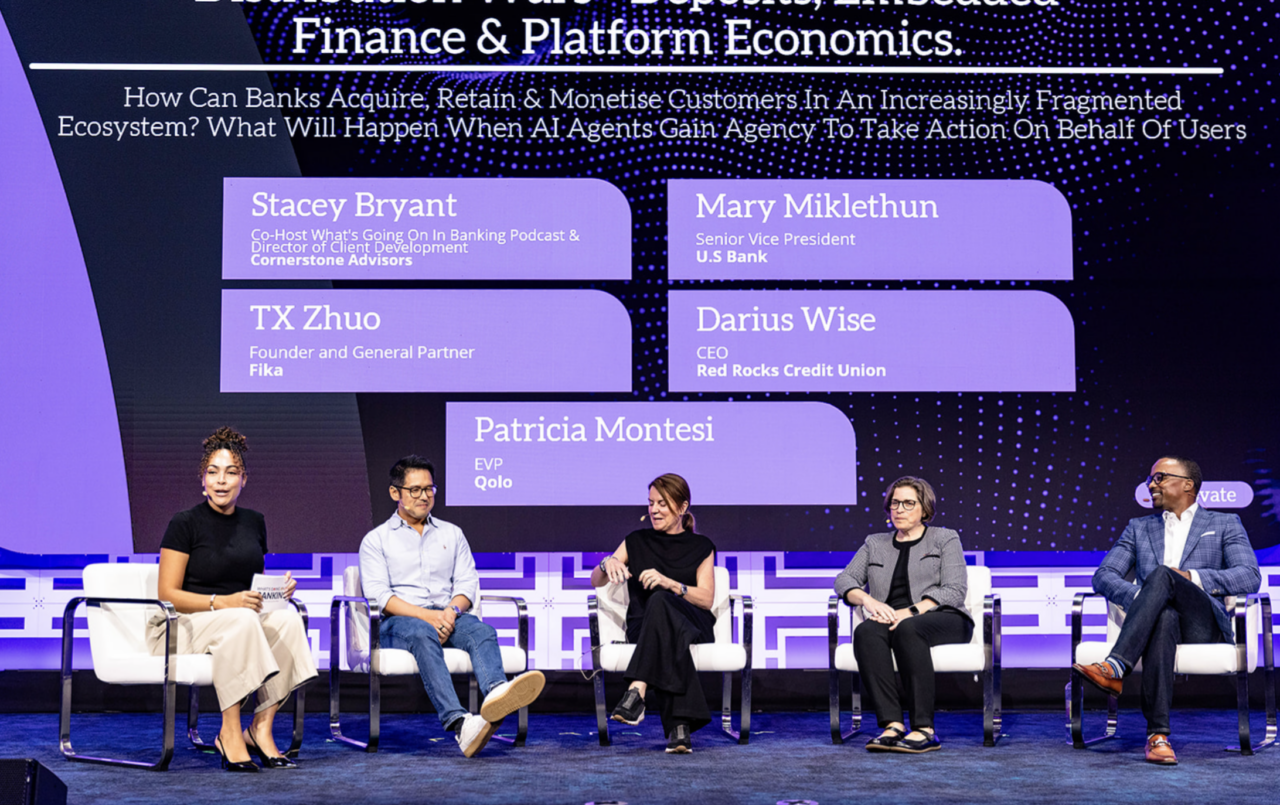
At FinovateFall earlier this month, there was one question brought up in multiple panel conversations and on the networking floor: in the age of AI, who owns the customer?

Historically, banks have had an obvious, structural advantage. They hold the checking account, receive the direct deposit from the paycheck, see transactions, and often serve as the place consumers turn when they need to dispute a payment, borrow for a home, finance a major life event, start investing, etc.

The LLM’s role

However, what happens when the place consumers go first with their financial questions isn’t their bank or even a fintech? With LLMs offering increasingly powerful financial capabilities and reliable bank account connections, a customer’s first stop for financial information may be their preferred LLM.

In 2026, consumers have become comfortable using LLMs for a vast array of tasks. People are using LLMs to research questions, plan vacations, manage work projects, interpret health and fitness data, meal-plan, get parenting and school help, navigate relationships, make purchases, and increasingly analyze financial information.

The retailer’s role

Before taking a deeper look at LLM’s relationship with consumers, let’s examine another stakeholder in this equation, the retailer. Retailers, especially big box retailers like Walmart, Costco, and Target, have always held a more intimate level of information about consumers than banks have. They not only see how much the consumer is spending, but they also see each individual item the consumer is purchasing.

So while banks have valuable data regarding their consumers’ financial lives, and retailers see the exact items in customer’s basket, LLMs get to form a picture of customers through their actual lives. Oftentimes, consumers will consult their preferred LLM about details before large purchases and events such as a move, vacation, wedding, new baby, home renovation, or job change. Because of this, the LLM has the data about the consumer before the resulting transactions even appear on their bank statement.

As an example, a bank may see the consumer spent $2,389 at Costco, while Costco sees a consumer who purchased patio furniture, kids’ clothes, hummus, and carrots. That item-level data gives retailers context banks traditionally haven’t had. Retailers can distinguish grocery spending from clothing or home improvement even when everything happened at the same merchant. To summarize, the bank sees the transaction, the retailer sees the purchase, and the LLM sees the person.

The steakhouse that got me thinking

The LLM introduces another layer to this because it understands the rationale behind the purchase. To offer up a personal example, I recently planned my in-laws’ 50th wedding anniversary celebration in Colorado. Because I am not local to the area, I used ChatGPT to help plan details such as photography, celebration locations, a restaurant, and logistics. Ultimately, after using ChatGPT to compare the options, we chose Twin Owls Steakhouse in Estes Park and it was fabulous.

Weeks later, I was reviewing my finances that are connected to ChatGPT via Plaid. On a monthly basis, ChatGPT offers a written overview of my finances with red flags and suggestions. In this report, ChatGPT identified that my restaurant spending for the previous month was higher than normal and exceeded my monthly stated budget. Unprompted, it went one step further. It recognized the Twin Owls Steakhouse charge as the anniversary dinner I had previously planned using ChatGPT. Instead of simply flagging the category as overspending, the LLM distinguished an intentional, one-time celebration from a potentially concerning spending trend.

My bank knew I spent money at Twin Owls. ChatGPT not only knew why I was there, it knew I had planned to spend the money before I even spent it, and crucially, it helped inform the decision of where I ultimately spent the money.

Banks’ new role

So where does this leave banks? When operating alongside LLMs, banks have three options:

  • Build: Banks can create AI experiences that sit within their app or website that develop meaningful customer context that extends beyond answering questions about the customers’ transactions.
  • Join: Banks can make bank data, products, and execution available within the existing LLMs and AI ecosystems where customers already go to make decisions.
  • Differentiate: Banks can double down on what external LLMs cannot independently provide, such as regulated custody, trusted execution, credit, identity, fraud protection and dispute resolution. These services are hard to replicate in an LLM setting and banks retain a significant advantage in these areas.

For years, banks have invested in creating a 360-degree view of the customer. But the next battle for primacy will be won by the company with the most comprehensive view of the customer’s life first.

FedNow Announces Support for Cross-Border Payments

FedNow Announces Support for Cross-Border Payments
  • The Federal Reserve is adding cross-border capabilities to FedNow, allowing banks to use the instant payments network for the US leg of international transactions.
  • Initial use cases include international payroll, corporate payments, insurance claims, and treasury management, with correspondent banks handling the international portion.
  • The expansion strengthens FedNow’s position as stablecoins gain traction in cross-border payments, giving banks a faster, 24/7 option within established banking infrastructure.

The US Federal Reserve is improving its FedNow real time payment scheme this week. The organization is building out cross-border transaction support to allow financial institutions to meet needs of clients who conduct business across geographic borders.

Cross-border payment capabilities will allow institutions to support customers whose transactions involve sending and/or receiving funds to parties outside of the US for international payroll, corporate payments for global businesses, international insurance claims, and global treasury management. While FedNow is covering the US leg of the transaction, the organization is leveraging correspondent banking relationships to move funds on the international portion of the transaction, similar to how the Fedwire Funds Service operates.

“Cross-border transaction capabilities will give financial institutions powerful new ways to serve internationally active customers. After several years focused on growing the domestic instant payments market, this is an important first step toward meeting the global needs emerging across our ecosystem,” said FedNow Chief Executive, Nick Stanescu. “Participants have consistently told us that enabling cross-border use cases is a priority, and this milestone reflects our commitment to delivering on that feedback. It’s a meaningful step forward—and just the beginning of what’s to come.”

While the service is not currently live, a group of organizations will soon begin testing FedNow to send and receive the US domestic leg of cross-border payments. The organization said that all FedNow participants can adopt these new messages to support cross-border capabilities “soon.”

“Our upcoming integration with cross-border functionality supported by the FedNow Service reflects our commitment to providing financial institutions with a faster, more transparent solution for the US leg of international transactions, while elevating safety by un-nesting complex payments, screening each party instantly, and digitizing every risk and compliance process to deliver the highest standards our industry requires,” said Payall President and CEO, Gary Palmer. “As commerce increasingly demands instant execution across borders, we’re proud to support the infrastructure that makes this possible for our clients and their customers.”

FedNow went live in July of 2023 and now reaches 1,900 participating financial institutions, up from more than 1,500 at the end of 2025. While participation continues to expand, the Federal Reserve is still working to encourage institutions to activate and increase their use of both send and receive capabilities. Earlier this month, Federal Reserve Financial Services announced a new discount program launching in 2027 that will offer financial institutions incentives of up to $80,000 for enabling and scaling FedNow payments.

FedNow’s expansion into cross-border payments is strategic. While the network was built to give banks an always-on, real-time alternative for domestic payments, stablecoins increasingly offer many of those same benefits across borders. Stablecoins can move value around the clock without relying on the operating hours and intermediaries that have traditionally made international payments slower and more expensive. The Federal Reserve itself has acknowledged that stablecoins have the potential to become a faster, lower-cost alternative for cross-border payments.

That makes international functionality an increasingly important piece of FedNow’s value proposition. By allowing banks to use FedNow for the US leg of a cross-border transaction while correspondent institutions handle the international portion, the Federal Reserve is extending the speed and 24/7 availability of its instant-payment rail to more global use cases. It doesn’t eliminate the correspondent banking infrastructure the way some stablecoin-based payment models seek to, but it gives banks another way to deliver faster international payments while keeping settlement within familiar regulated banking infrastructure.


Photo by Alexas Fotos

LoanPro Launches New Payments, Disbursement, and AI Servicing Tools

LoanPro Launches New Payments, Disbursement, and AI Servicing Tools
  • LoanPro launched three new products spanning payments, card-based loan disbursement, and AI-assisted servicing: LoanPro DirectPay, Beyond Credit, and LoanPro MCP.
  • The launches bring more of the lending lifecycle onto LoanPro’s platform, helping lenders reduce reliance on separate vendors and integrations for payments, disbursements, and servicing.
  • LoanPro MCP allows lenders to connect AI agents to servicing workflows while applying the same permissions, compliance guardrails, and audit trails used for human employees.

Lending and credit platform LoanPro revealed its three newest launches this week. The Utah-based company unveiled multiple new products covering payments, card-based loan disbursement and AI-assisted servicing.

Among today’s launches are LoanPro DirectPay, Beyond Credit, and the LoanPro MCP (Model Context Protocol). The company also announced RiskRadar delinquency prediction, ongoing compliance monitoring, LoanPro Connect, full support for secured cards, and added two new payment partners, Moov and CheckAlt.

“Lenders have asked us for years to handle more of this for them, with one contract and one team to call,” said LoanPro CEO and co-founder, Rhett Roberts. “Payment processing, real-time card disbursement and AI guardrails are now built into LoanPro’s core, and all of it is live today. A lender can now get funds to a borrower on a Friday night or have an AI agent help service an account, and all of it stays inside LoanPro.”

LoanPro is rebranding its payments suite to LoanPro Payments, which centers around LoanPro DirectPay, the company’s payment processing service that moves about $4 billion per month in loan repayments and disbursements. Because LoanPro holds the loan and processing data in-house, loan officers can view the entire lifecycle of a payment, see why a payment failed, and process a dispute all on the same platform.

Beyond Credit is a virtual Mastercard through which lenders can disburse installment loan funds that borrowers can access via Apple Pay or Google Pay wallet. Lenders have control over where funds from the fee-free card are spent, and can limit card usage by merchant name, merchant ID, location, or merchant category code.

The company’s new MCP powers its Intelligence Suite, which gives loan servicing agents a summary of health indicators, recent activity, and suggested next steps for each account. Lenders can use the MCP to connect AI agents and models of their choice to LoanPro. Each action is also recorded in the audit trail under the name of the employee using the agent, giving lenders a way to introduce agentic AI into servicing while maintaining oversight and accountability.

Taken together, LoanPro’s new product launches show a push to consolidate more of the lending lifecycle onto a single platform. Bringing payment processing, real-time loan disbursement, servicing, and AI capabilities into the same environment will help LoanPro reduce the number of vendors and integrations lenders need to manage while giving them a more complete view of the borrower and loan lifecycle.

The MCP launch adds another dimension to LoanPro’s strategy to minimize third party partners because it allows AI agents to operate within the same permissions, compliance guardrails, and audit trails already used for human employees. As lenders move from using AI to summarize information toward allowing agents to actually take actions on accounts, that governance layer could become just as important as the AI models themselves.

“You will only ever drive as fast as you trust your brakes to stop you,” said LoanPro Chief Product Officer Colin Terry. “Lenders have spent years building controls around their human agents, and the LoanPro MCP runs through those same role-based access controls and compliance guardrails. We bring the context, the action and the trust. You bring the thinking, and you have an AI strategy in a box.”

Founded in 2015, LoanPro helps banks, auto lenders, and credit providers automate workflows, process payments, underwrite applications and manage collections. The company has participated in our developers conference, FinDEVr 2021, and demoed its loan management system at FinovateSpring 2021.

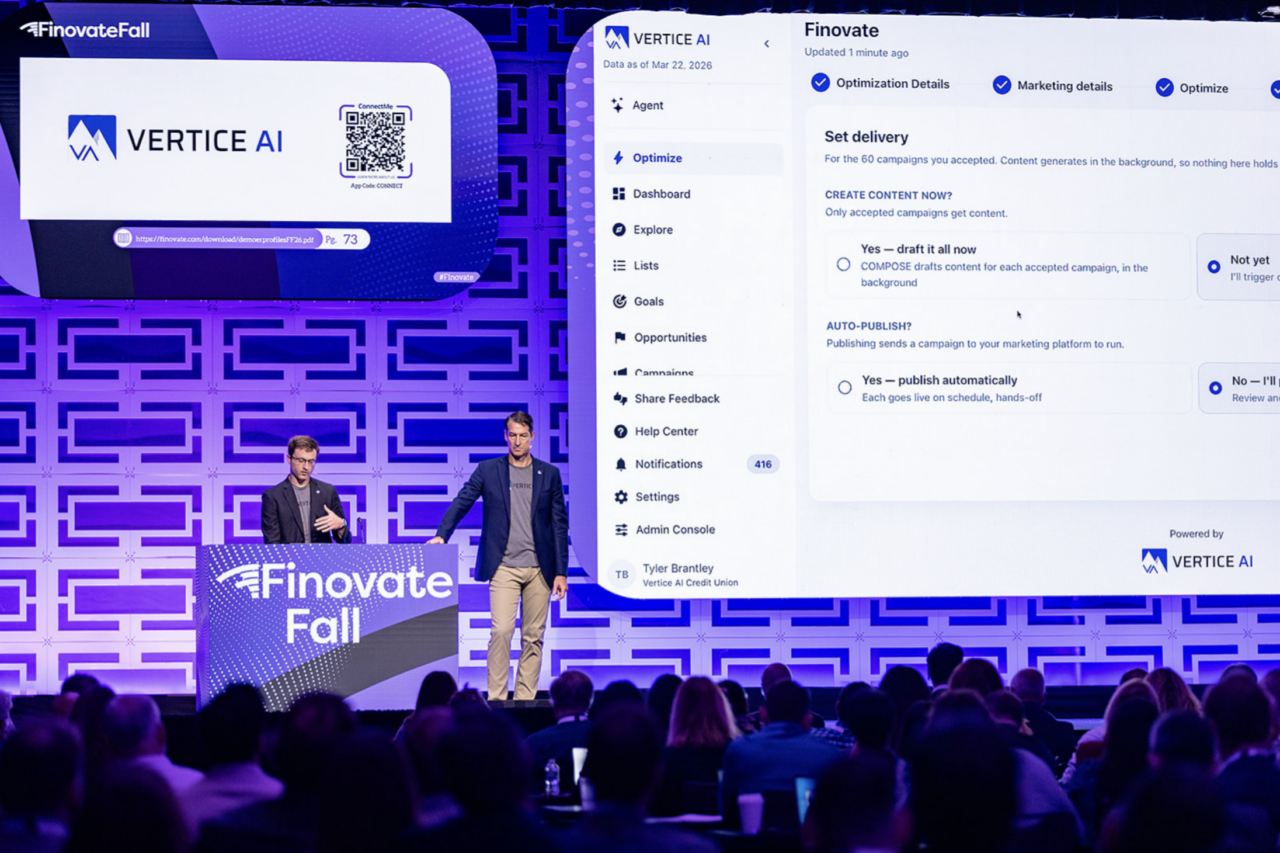
FinovateFall 2026 in Photos

FinovateFall 2026 in Photos

Whether you missed out on FinovateFall in New York earlier this month or you were there in person, it’s worth checking out the massive number of photos that came out of the three-plus day event.

The event was full of meaningful conversations, fast-paced demos, a reunion of familiar faces, and new connections. And while speakers and attendees were busy talking and learning about all things fintech and banking, Finovate’s photographer was capturing the event in more than 1,000 photos.

The photos are broken down into 31 categories, including demos, industry stage sessions, and networking drinks. New this year, you can search for photos that you appear in by uploading a selfie. Here is a sampling of a few photos to help summarize FinovateFall 2026.

Networking

Sessions

Demos

Book signing

The experience

You can view all of the photos on the FinovateFall gallery page.

Numeral Raises $100 Million for Sales Tax Solution

Numeral Raises $100 Million for Sales Tax Solution
  • Numeral raised $100 million in Series C funding, bringing the tax compliance platform’s total funding to $157.5 million since its 2023 founding.
  • The company will use the capital to accelerate product development, expand into additional industries, and grow its team, while launching a new accounting partner program.
  • Numeral is using agentic AI to automate more of the tax compliance workload while keeping humans in the loop, as businesses face growing complexity across markets and jurisdictions.

Sales tax compliance platform Numeral has raised $100 million in Series C funding, boosting its total raised to $157.5 million since it was founded in 2023.

Insight Partners led the round, which saw participation from Salesforce Ventures, Geodesic, Benchmark, Mayfield, FCVC, Y Combinator, and Uncork.

San Francisco-based Numeral aims to simplify sales tax compliance details such as nexus tracking, registrations, filing, rate calculation, remittance, exemption certificate management, and virtual mailbox services. In addition to sales tax, the company works with VAT and GST compliance in more than 90 countries. Numeral has recently recorded a 327% year-over-year increase in total transaction volume and expects to process more than 80 million transactions via its tax engine.

“Sales tax has become a much bigger operational challenge as companies grow across markets, systems and business models,” said Numeral Co-Founder and CEO, Sam Ross. “Businesses need infrastructure that can keep pace as rules and requirements change across jurisdictions, without adding more manual work for their teams. We’re building Numeral to provide that foundation, backed by tax expertise and service that customers can rely on.”

Numeral will use today’s funding to accelerate product development, expand its offering for industries, and grow its team. The company is also launching its accounting partner program that will allow partnering firms to refer clients, resell the platform, use it to deliver their own services, or advise clients through implementation to stay closely involved in their clients’ tax decisions. Overall, Numeral’s technology leverages agentic AI while keeping humans in the loop.

“Our customers want to know that their tax obligations are being handled accurately while still having access to a person when a complex issue comes up,” said Ross. “That expectation shapes how we build the platform and how we support each customer. As Numeral moves into additional industries and serves larger businesses, we’ll continue investing in both the technology and the tax expertise behind it.”

As tax compliance is becoming more complex for businesses operating across multiple markets, Numeral is using AI to automate more of the work traditionally handled by internal tax teams and accounting firms. Rather than simply using AI to help employees complete compliance tasks, Numeral’s technology aims to take on more of the operational burden itself, while keeping tax professionals available for complex cases.


Photo by Tara Winstead

J.P. Morgan Payments Selects Thunes to Power Global Payout Solution

J.P. Morgan Payments Selects Thunes to Power Global Payout Solution
  • J.P. Morgan Payments selected Thunes to expand Xpedite Remit, combining its payments infrastructure with Thunes’ Direct Global Network for faster, more transparent cross-border payments.
  • The partnership gives J.P. Morgan access to 12 billion bank accounts and mobile wallets across 100+ corridors, reducing the need to establish local connectivity market by market.
  • Chase’s 94 million consumer and small business customers will also benefit, including through faster, real-time inbound payments into the US.

J.P. Morgan Payments has selected Thunes to expand its cross-border capabilities through the bank’s Xpedite Remit solutions suite.

The new suite of tools combines J.P. Morgan Payments’ connectivity with local, real-time payments rails and Thunes’ Direct Global Network to offer a reliable cross-border payments tool. The bank’s Xpedite Remit tool offers protection, end-to-end traceability, and faster payouts, regardless of whether the payment takes place in the same currency or uses a foreign exchange conversion.

The cross-border capabilities offer access to 12 billion local bank accounts and mobile wallets across more than 100 corridors around the clock. Cross-border payments have traditionally required financial institutions to navigate multiple correspondent banking relationships, local payment rails, currencies, and regulatory requirements. Combining J.P. Morgan Payments’ infrastructure with Thunes’ network will enable the bank to extend its reach into local bank accounts and mobile wallets without having to establish that connectivity market-by-market.

“Our clients want simpler, faster ways to move money across borders and to reach people through the payment methods they prefer,” said J.P. Morgan Payments Global Head of High Value Payments & FX, Gayathri Vasudev. “That’s why we are continuing to enhance our cross-border capabilities and further expanding our solution through the collaboration with Thunes. Building on milestones, like our recent progress with Swift’s retail payments scheme, we’re helping clients grow in new markets while delivering the faster, more seamless experiences they have come to expect.”

JPMorgan Chase’s Consumer and Community Bank will also benefit from Xpedite Remit’s expanded cross-border capabilities. The bank’s 94 million consumer and small business customers will receive faster payout experiences with real-time inbound payments into the US. 

“As customers increasingly move money across borders as part of their everyday lives, they expect the experience to be fast, intuitive, and reliable,” said Chase Head of Banking Payments, Ashish Ajmera. “These enhancements mark an important step in our efforts to modernize cross-border payments and expand the capabilities available through our broader suite of products and services, helping customers send money internationally with greater speed, transparency and confidence.”

Thunes was founded in 2016 as TransferTo and rebranded to Thunes in 2019. The company offers a cross-border payments and collection network that supports 80 currencies, enables payments to 130 countries, and offers 320+ payment acceptance methods. Unlike traditional cross-border payments providers that often rely on correspondent banking networks, Thunes offers a direct, proprietary global network. This direct network delivers faster, cheaper, and more transparent transactions and allows it to compete against players like Wise and Airwallex.


Photo by Tim Mossholder

ACI Worldwide to Support Payments Orchestrated Through Swift

ACI Worldwide to Support Payments Orchestrated Through Swift

Payments expert ACI Worldwide announced it now offers intelligent payments routing for Swift ledger transactions. The capabilities are available using ACI Connetic, the company’s cloud-native payments hub. 

Swift’s blockchain-based ledger was announced last year to help banks move tokenized deposits across borders beyond traditional operating hours. While the 17 banks involved stand to benefit from the infrastructure, many have not fit tokenized deposit payments into their day-to-day operations.

Using ACI Connetic, banks will be able to process tokenized deposit payments, as well as traditional payment types, into the same payments environment banks already use to route, monitor, control and reconcile payments at scale. Because banks can use the same operational controls, workflows, and infrastructure for tokenized payments as they do with traditional payments, it eliminates the need for separate digital-asset payment operations.

“Digital assets should extend a bank’s payment capabilities, not force it to build a second payment operation,” said ACI Worldwide SVP, Head of Account-to-Account Payments, Craig Ramsey. “Banks need a practical way to operationalize tokenized deposits at scale using the people, controls and processes they already trust. With ACI Connetic, payments orchestrated through Swift’s ledger can be managed alongside other payment flows within a common operational framework.”

Swift’s ledger may provide the infrastructure to move tokenized value across borders, but banks still need a way to incorporate those transactions into their existing payment operations. By routing Swift ledger transactions alongside traditional payments, ACI Connetic could lower one of the barriers to adoption by allowing banks to experiment with and scale tokenized deposits without building a parallel payments stack. As tokenized deposits move from pilots toward production, that ability to integrate new rails into existing infrastructure will become increasingly important.

ACI Worldwide’s ACI Connetic works by unifying payment types, payment rails, and controls in a single platform that uses bank- and customer-defined rules to automatically select the best clearing and settlement path. This automatic routing gives banks flexibility while maintaining consistent controls and visibility and allowing for scale without relying on a separate operation.

Founded in 1975, ACI Worldwide’s solutions power intelligent payments orchestration in real time to allow banks, billers, and merchants to modernize their payment infrastructure. The company combines a global footprint with local expertise to help its clients manage evolving payment methods and infrastructure. ACI Worldwide, which presented at our developer’s conference at FinDEVr Silicon Valley 2016, is publicly traded on the Nasdaq under the ticker ACIW.


Photo by Athena Sandrini

FintechOS Raises $28 Million in Combined Debt and Equity

FintechOS Raises $28 Million in Combined Debt and Equity
  • FintechOS raised $28 million in combined debt and equity, bringing its total funding since 2017 to $178.9 million.
  • The capital will support US expansion, deeper European client relationships, and team growth as the company shifts from efficiency mode back toward faster expansion.
  • FintechOS enters that growth phase from a stronger financial base, having reached profitability while growing recurring revenue 40%, operational EBITDA more than 102%, and its U.S. business 130% in 2026.

Fintech enablement platform FintechOS has closed $28 million in combined debt and equity. The funding, when added to the company’s previous rounds, boosts FintechOS’s total funding to $178.9 million since it was founded in 2017.

Today’s equity funds come from existing investors Bek Ventures, IFC, Cipio Partners, and Molten Ventures. The debt facility comes from Santander CIB. FintechOS will use the investment to fund its US expansion, deepen its European client relationships, and grow its team.

“Santander CIB’s support, alongside other investors that trust us, is a strong vote of confidence in the path we’re on, and it gives us the capital to go after the extraordinary potential we see ahead, particularly in the US, without compromising the discipline that got us to profitability in the first place,” said FintechOS Founder and CEO Teo Blidarus.

FintechOS aims to help banks launch new technologies by offering them low-code solutions that facilitate fast and inexpensive deployment of new products and services. The company’s Unified Origination tool is an AI-first, cross-product origination solution to help retail and commercial banks accelerate time-to-market. It also offers a composable core product for insurers.

2026 has been a strong year for FintechOS. The company became profitable, boosted its recurring revenue by 40% and grew its operational EBITDA by more than 102% year-over-year, and grew its US business by 130%. Also this year, FintechOS expects to set a new record of client acquisistion, adding more than 20 banks to its client list for FintechOS 8.

“Reaching profitability was not an accident, it was the outcome of a deliberate, multi-year effort to get our cost base, our margins and our delivery practice right before we pushed harder on growth again,” said FintechOS CFO Cyril Desouza. “Now that discipline is paying off twice over: the business has reached profitability, and we’ve already made the shift back into high growth, which is exactly the combination that lets us take on a round like this one.”

The funding comes at an interesting inflection point for FintechOS. After spending the past few years prioritizing efficiency and profitability, the company is now using that stronger financial footing to accelerate growth, particularly in the US.

The mix of debt and equity indicates that instead of relying solely on another dilutive venture round, FintechOS is adding debt capital as it scales, a financing option that is more accessible as it has moved into profitability. For banks, FintechOS’s expansion adds another well-capitalized competitor to the growing field of providers promising to modernize product origination and core infrastructure without requiring them to rip and replace their existing technology stacks.


Photo by Jonathan Borba

Fintech Rundown: A Rapid Review of Weekly News

Fintech Rundown: A Rapid Review of Weekly News

It’s the last full week of September, which means that the calendar is ready to flip to the final quarter of 2026. Check out what fintechs are up to in this week’s look at the top fintech news. We’ll continue to update this post with news throughout the week.


DeFi

Aracore and Teiza to work on institutional stablecoin settlement model between South Korea and Malaysia.

Prediction markets

Yahoo Finance and Polymarket end prediction market partnership.

Digital banking

Centreville Bank turns to Jack Henry for its core upgrade.

Avant files application with OCC to establish Avant Bank.

Aegis Trace and InterSystems partner to strengthen AI decision traceability for regulated organizations.

Mortgages

Sprive raises $10 million for mortgage prepayment tool.

Credit and analytics

Nationwide Building Society partners with Equifax UK to give customers free access to their credit score.

Agentic commerce

GoCardless announces that it has processed the UK’s first agentic account-to-account transaction in the UK.

Wealth management

UK-based, Sharia-compliant, cross-border digital banking platform Nomo teams up with investment service provider AllFunds to establish a fully digital Sharia-compliant investment product.

Lending

Kastle secures $24 million in Series A funding to support its AI workforce platform for consumer lending.


Photo by olia danilevich

Plaid Taps ID.me to Help Government Agencies Verify Financial Beneficiaries and their Accounts

Plaid Taps ID.me to Help Government Agencies Verify Financial Beneficiaries and their Accounts
  • Plaid and ID.me are teaming up to help US government agencies verify both benefit recipients’ identities and ownership of the financial accounts receiving payments.
  • The partnership combines identity and account verification into a single flow, helping agencies reduce manual processes, duplicate payments, and the risk of funds being diverted.
  • Connecting identity with payment destination could help modernize government benefits, enabling legitimate recipients to receive funds faster while strengthening fraud prevention and auditability.

Plaid has selected digital identity network ID.me to enable US government agencies to verify both the person requesting a benefit and the associated financial account receiving it.

Plaid is leveraging ID.me’s digital identity wallet to solve the identity piece and is using its own financial account verification tools to help state and federal agencies verify that the account receiving a benefit payment belongs to the recipient before funds move.

“Identity verification tells an agency who is asking to be paid, but it does not tell them where the money is going,” said ID.me CEO and Founder Blake Hall. “That gap is where benefits go missing, and it’s costing our government and everyday Americans billions of dollars. Through our partnership with Plaid, agencies would be able to confirm the account belongs to the verified person before a dollar moves, and eligible people get paid faster.”

For beneficiaries, the partnership allows users to verify their identity using ID.me and securely link their bank account, eliminating the need to upload bank statements or wait for manual verification. For agencies, account ownership information is sourced directly from the recipient’s financial institution and matched with their verified identity before funds are released. The solution creates a dated record linking the verified recipient with the account that received the payment, while limiting the financial information shared with the government.

The partnership will help agencies consolidate legacy capabilities, reduce the possibility of duplicating payments in error, and make it easier for beneficiaries to receive funds they are entitled to.

“For too long, getting benefits to the people who qualify for them has meant a slow, manual process that fraudsters have learned to exploit. Agencies have gotten very good at confirming who someone is. What’s been missing is the same confidence about where the money actually lands,” said Plaid COO Eric Sager. “By partnering with ID.me, we’re closing that gap so eligible people get paid in minutes, and every dollar reaches the person it was meant for.”

Fraud prevention in government payments has long relied on multiple, often disconnected layers of verification. Identity verification alone is not enough if agencies cannot also verify the destination of the funds. By connecting those two layers, Plaid and ID.me are helping government agencies modernize benefit delivery in a way that could make payments both faster for legitimate recipients and harder to divert fraudulently.


Photo by Melisa Uygun

Coinbase Partners with Stablecore to Help Banks Offer Digital Asset Services

Coinbase Partners with Stablecore to Help Banks Offer Digital Asset Services
  • Coinbase and Stablecore are teaming up to help community and regional banks and credit unions offer digital asset services, including trading, custody, and stablecoin payments.
  • The partnership reflects the broader rebundling of financial services, bringing capabilities that once required separate crypto platforms back inside customers’ existing banking relationships.
  • Coinbase is positioning itself to benefit either way; it can either own the customer relationship, or it can provide the infrastructure that allows banks to retain it.

Crypto exchange platform Coinbase is teaming up with crypto and DeFi banking infrastructure company Stablecore to help banks and credit unions offer digital asset services through their existing banking platforms.

Under the agreement, Coinbase will tap Stablecore’s expertise to bring digital asset services such as trading, custody, and stablecoin payments to Stablecore’s 3,000+ bank and credit union partners. The goal of the solution is to help traditional financial institutions offer regulated digital asset products without rebuilding their infrastructure. Crucially, the new launch also allows bank customers and credit union members to participate in the decentralized economy without having to leave their existing banking platform.

“Community banks and credit unions shouldn’t have to choose between staying local and staying current,” said Coinbase Head of Infrastructure Business Alec Lovett. “Together with Stablecore we are helping put them on the cutting edge of payments technology—cheaper, faster money movement, and the tools they need to stay strong for the communities they serve.”

Founded in 2025, Stablecore exclusively serves community and regional banks and credit unions. The Texas-based fintech offers white-labeled solutions that integrate into existing banking technology to bring together all of the necessary components so financial institutions can offer tokenized deposits, stablecoins, and digital asset products.

Among the financial institutions piloting the digital asset offering is Amarillo National Bank. Leveraging the new tool, the Texas-based bank can offer digital asset services under its own brand and on its own terms, while keeping deposit and lending relationships within local institutions. 

“Banks and credit unions should not have to move to completely new technology platforms to support digital assets for their clients,” said Stablecore Co-Founder and CEO Alex Treece. “We built Stablecore to bring together all of the pieces so they don’t have to.”

The partnership is another example of how firms are rebundling financial services across the industry. Digital assets initially developed largely outside the traditional banking ecosystem, requiring consumers to establish separate relationships with crypto exchanges and wallets. Infrastructure providers like Stablecore are helping reverse that fragmentation by bringing those capabilities back inside the bank. The rebundling will offer community financial institutions an opportunity to remain the primary financial relationship by incorporating new products, especially as customer expectations evolve.

What’s interesting here is who is offering banks access to crypto. As a third-party fintech, Coinbase competes directly with this product. Consumers could go directly to Coinbase for digital assets, but the fintech is also making its capabilities available through banks so that the bank can retain the interface and relationship. In that sense, Coinbase is positioning itself to benefit from the rebundling trend rather than fight it. If consumers increasingly prefer to access digital assets alongside their other financial products, Coinbase doesn’t necessarily need to own the customer relationship; it can own the infrastructure powering it. For banks, the partnership offers another way to defend their position as the place where customers manage their broader financial lives.