Six Fintechs Creating Smarter Lending, Credit, and Financing Tools

Six Fintechs Creating Smarter Lending, Credit, and Financing Tools

Lending has always depended on a financial institution’s ability to assess risk, make informed decisions, and deliver capital efficiently. But many of the systems supporting that process remain slow, fragmented, and heavily manual. Commercial lenders still spend days gathering documents and spreading financials, while consumers and small businesses increasingly expect faster decisions, flexible payment options, and seamless digital experiences.

The companies demoing at FinovateFall 2026, taking place on September 9 through 11 in New York, are approaching these challenges from several angles. Some are using AI to accelerate underwriting and automate operational work. Others are embedding financing and flexible payment options directly into digital banking, helping institutions identify household opportunities, or rebuilding commercial lending around borrower self-service. Together, these six companies demonstrate how smarter technology can help financial institutions improve speed, efficiency, and access to financing.


ALoan

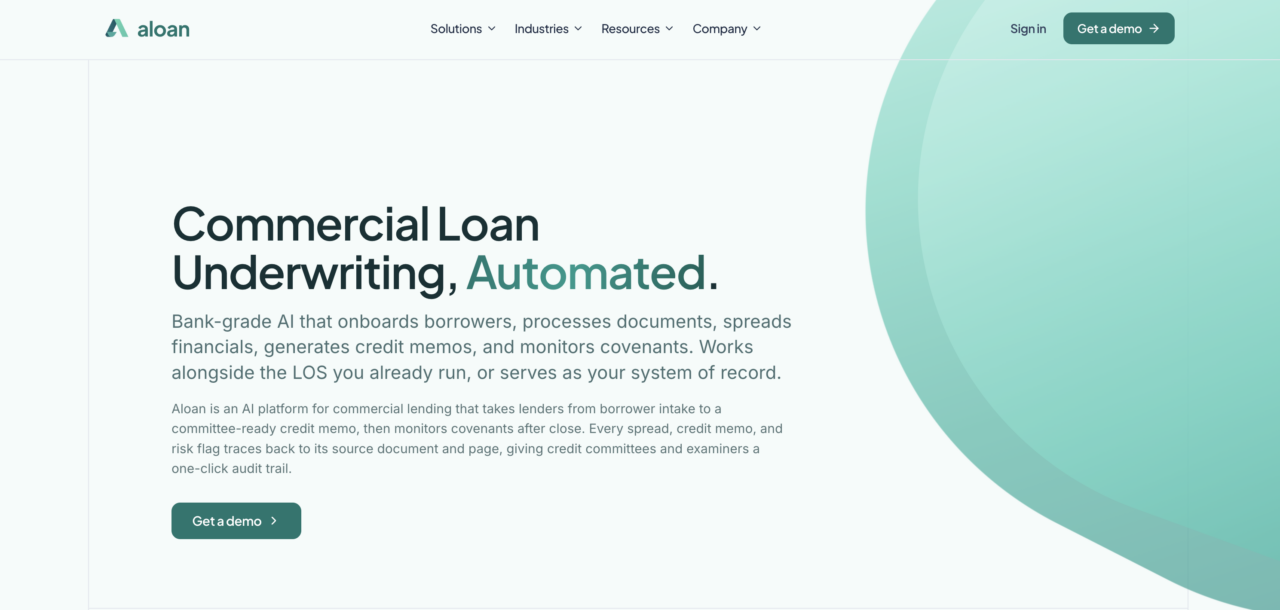
ALoan uses AI to automate commercial underwriting and help lenders move from borrower documents to a completed credit memo in less than 30 minutes. The platform spreads financial information from tax returns, bank statements, and borrower financials, applies the lender’s credit policies, and links each figure and conclusion back to its original source. By automating document collection, financial spreading, and credit memo preparation, ALoan enables commercial lending teams to increase throughput and reach term sheets faster without adding staff or replacing existing systems.


Clockout

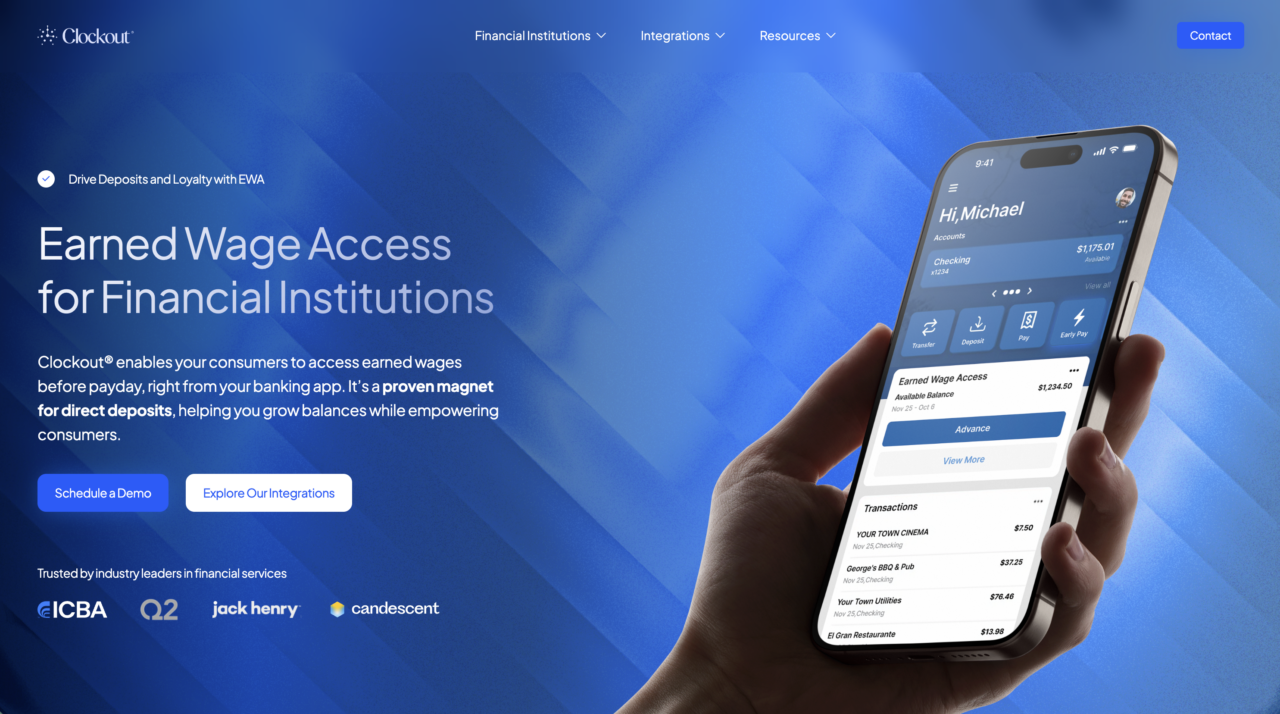
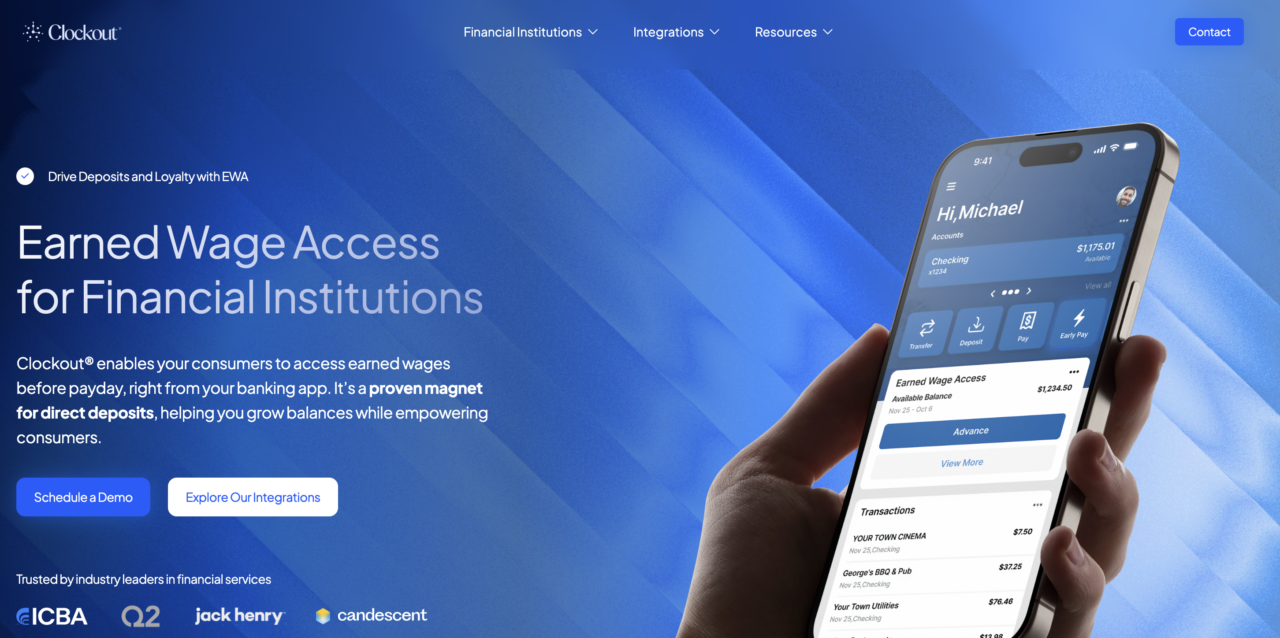
Clockout helps banks and credit unions embed financial wellness and liquidity tools into their customer experiences. The platform is designed to increase direct deposit relationships, generate new fee revenue, and strengthen customer engagement by providing users with more ways to manage short-term financial needs. For financial institutions seeking to deepen primary account relationships, Clockout offers a way to combine financing access with broader financial wellness.


equipifi

equipifi enables banks and credit unions to offer Buy Now, Pay Later (BNPL) and flexible payment options directly within their digital banking platforms. Its technology allows financial institutions to present personalized purchasing power and financing offers based on customer behavior and purchase intent, including through real-time mobile notifications. By bringing BNPL inside the banking relationship, equipifi helps financial institutions participate more directly at the point of sale rather than ceding that interaction to third-party providers.


OptimaFI

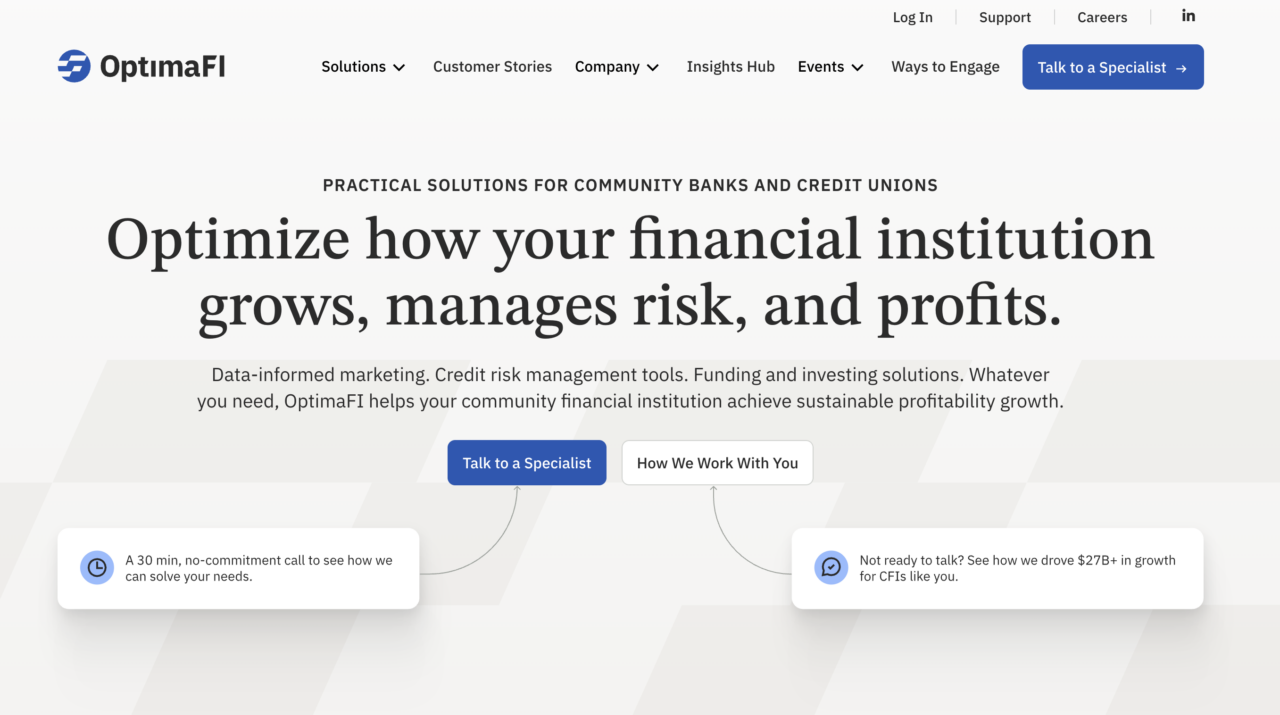
OptimaFI’s Household Insights platform gives community banks and credit unions a household-level view of customer accounts and performance. The platform benchmarks institutional data against more than 14 billion private peer data points and provides segment-level recommendations related to growth and risk. Because it does not require a core integration, financial institutions can begin using the platform in a matter of days to identify opportunities across deposits, lending, and broader household relationships.


QuickFi

QuickFi offers an end-to-end digital platform for commercial equipment financing that allows borrowers to self-serve from application through final payment. The company replaces manual, paper-heavy lending processes with a digital experience that can deliver financing decisions and documentation in minutes, 24 hours a day. QuickFi helps banks and equipment manufacturers serve small business borrowers more efficiently while reducing the staffing and operating costs associated with traditional commercial lending models.


Voyager AI

Voyager AI brings personalization and intelligence to complex commercial lending workflows. The platform unifies document collection, financial spreading, underwriting, compliance, and credit memo preparation while learning an institution’s specific lending policies and standards. By automating manual steps and identifying missing information earlier in the process, Voyager AI helps lenders deliver faster, more consistent experiences while allowing employees to spend more of their time on borrower relationships, structuring, and credit judgment.


Why banks should care

Speed has become a competitive advantage in lending. Borrowers are less willing to wait weeks for a credit decision when another provider can deliver an answer in hours or minutes. At the same time, banks and credit unions are under pressure to grow loan portfolios without proportionally increasing headcount or operational expense. Technologies that automate underwriting, document collection, reconciliation, and servicing can help institutions make faster decisions while preserving the judgment and oversight required for responsible lending.

The definition of lending is also expanding. Flexible payments, embedded financing, household intelligence, and digital self-service are blurring the lines between traditional loans, payments, and financial wellness. Financial institutions that treat these capabilities as part of a broader customer relationship may be better positioned to capture more borrowing activity, deepen engagement, and compete with nonbank providers. The companies demonstrating at FinovateFall 2026 show how institutions can modernize both the front-end borrower experience and the operational infrastructure that supports the lending process.


Photo by Monstera Production

Finovate Podcast Features the Five Best of Show Winners from FinovateSpring 2026

Finovate Podcast Features the Five Best of Show Winners from FinovateSpring 2026

Finovate Podcast host Greg Palmer showcases the winners of Best of Show from FinovateSpring 2026 in his latest series of podcast conversations.

The five companies that won Best of Show represent many of the top trends in fintech today, from embedded finance and stablecoin-powered payments to mainframe modernization and AI-enabled personalization. In these interviews, we learn about the inspiration behind the founding of these innovative companies and the problems they are solving for banks, credit unions, other financial institutions, and their customers.


Finovate podcast host Greg Palmer talks with Caitlyn Truong, CEO and Co-Founder of Zengines.

Palmer and Truong discuss how Zengines addresses the challenge of managing legacy core banking applications written in older programming languages like COBOL, RPG, and PL1. Truong explains how her company is modernizing legacy mainframe applications without losing critical logic, satisfying auditors faster, and making legacy systems searchable so transformation and compliance do not stall.

EP 299: Caitlyn Truong, Zengines


Juan Jurado-Blanco and Armando Quintana, CEO and Chief Revenue Officer of Clockout, respectively, sit down with Greg Palmer in this Finovate podcast conversation.

The trio discuss the benefits of earned wage access as an offering for community banks and credit unions. Clockout’s technology enables users to access their earned wages the same day they work, rather than waiting for traditional biweekly or even monthly pay cycles. The solution embeds seamlessly into existing bank experiences.

EP 298: Juan Jurado-Blanco and Armando Quintana, Clockout


Oren Buskila, CEO and Co-Founder of Cobalt, talks with Finovate podcast host Greg Palmer about the challenge of financial institution system dependencies.

Cobalt offers a technology that automatically maps real system dependencies across complex banking environments, enabling agentic AI, real-time visibility, safer changes, reduced risk, and confident operations. Cobalt enables technical teams to anticipate the consequences of modifications before implementation, preventing failures and ensuring safer deployments.

EP 297: Oren Buskila, Cobalt


Podcast host Greg Palmer catches up with Craig McLaughlin (CEO) and Baron Conway (Chief Strategy Officer) of Finalytics.AI in the wake of the company’s second consecutive Best of Show win at FinovateSpring (2025 and 2026).

Palmer, McLaughlin, and Conway discuss how Finalytics.AI enables community financial institutions to deliver personalized, high-touch experiences through digital channels while leveraging the wealth of customer data these banks and credit unions possess.

EP 296: Craig McLaughlin and Baron Conway, Finalytics.AI


Host Greg Palmer interviews Crebit co-founders Jensen Coonradt (CEO) and Simmi Sen (Chief Product Officer).

In this podcast conversation, Coonradt and Sen explain how their company is modernizing international money transfers by leveraging stablecoin technology to send money across borders as easily as sending a text message. Crebit’s “stablecoin sandwich” approach enables users to on-ramp funds using local payment methods before settling into virtually any currency worldwide in minutes.

EP 295: Jensen Coonradt and Simmi Sen, Crebit

FinovateSpring 2026 Best of Show Winners Announced!

FinovateSpring 2026 Best of Show Winners Announced!

Congratulations to the winners of FinovateSpring 2026’s Best of Show awards!

From solutions that help banks, credit unions, and other financial institutions deliver new, innovative products and services to their customers and members to novel uses of enabling technologies like AI and stablecoins, the companies that won Best of Show at this year’s FinovateSpring reflect many of the most important trends in fintech and financial services today.

This week marks the second time that we’ve brought our annual spring fintech conference to sunny San Diego. And given the success we’ve had, we’re looking forward to bringing the show back to the city affectionately known by some as “Silicon Beach” next year. We want to thank our demoing companies, our sponsors and partners, our outstanding AV team, our staff of conference day assistants, and—of course—our wonderful attendees for their enthusiasm and support.

Next stop? FinovateFall 2026 in Times Square, New York. And tickets are already on sale!


Clockout for its solution that drives member and customer growth, increases direct deposits by 10-25%, generates $16-$50 monthly per-user revenue, and creates competitive differentiation through embedded financial wellness. Demo video.

Cobalt for its technology that automatically maps real system dependencies across complex banking environments, enabling agentic AI, real-time visibility, safer changes, reduced risk, and confident operations. Demo video.

Crebit Pay for its stablecoin-powered FX platform enabling low-cost, near-instant global payments for students, while helping credit unions onboard and serve international members. Demo video.

Finalytics.ai for its technology that enables financial institutions to instantly unleash the power of AI by offering segment-of-one digital experiences for visitors informed by behavioral, transactional, and third-party data. Demo video.

Zengines for its solution that modernizes off mainframes without losing critical logic, satisfying auditors faster, and making legacy systems searchable so transformation and compliance don’t stall. Demo video.


Notes on methodology:
1. Only audience members NOT associated with demoing companies were eligible to vote. Finovate employees did not vote.
2. Attendees were encouraged to note their favorites during each day. At the end of the last demo, they chose their three favorites.
3. The exact written instructions given to attendees: “Please rate (the companies) on the basis of demo quality and potential impact of the innovation demoed.”
4. The five companies appearing on the highest percentage of submitted ballots were named “Best of Show.”
5. Go here for a list of previous Best of Show winners through 2014. Best of Show winners from our 2015 through 2026 conferences are below:
FinovateEurope 2015
FinovateSpring 2015
FinovateFall 2015
FinovateEurope 2016
FinovateSpring 2016
FinovateFall 2016
FinovateAsia 2016
FinovateEurope 2017
FinovateSpring 2017
FinovateFall 2017
FinovateAsia 2017
FinovateMiddleEast 2018
FinovateEurope 2018
FinovateSpring 2018
FinovateFall 2018
FinovateAsia 2018
FinovateAfrica 2018
FinovateEurope 2019
FinovateSpring 2019
FinovateFall 2019
FinovateAsia 2019
FinovateMiddleEast 2019
FinovateEurope 2020
FinovateFall 2020
FinovateWest 2020
FinovateEurope 2021
FinovateSpring 2021
FinovateFall 2021
FinovateEurope 2022
FinovateSpring 2022
FinovateFall 2022
FinovateEurope 2023
FinovateSpring 2023
FinovateFall 2023
FinovateEurope 2024
FinovateSpring 2024
FinovateFall 2024
FinovateEurope 2025
FinovateSpring 2025
FinovateFall 2025
FinovateEurope 2026

Photo by Erwan Hesry on Unsplash

Four Fintechs Driving Payments, Infrastructure, and Embedded Finance

Four Fintechs Driving Payments, Infrastructure, and Embedded Finance

Financial infrastructure is becoming increasingly valuable as it powers payments and financial products. Instead of operating within closed systems, banks are now operating within broader ecosystems in which customers expect seamless integrations, faster money movement, and financial services experiences that become invisible within the customer journey.

Fintechs are working to satisfy the demand for this infrastructure using API-driven tools that can support real-time payments, cross-border transactions, and embedded finance use cases. At FinovateSpring 2026, we’re hosting a group of fresh fintechs that will showcase their solutions designed to simplify payments, modernize infrastructure, and unlock new revenue opportunities. From digital asset infrastructure to cross-border payments and operational platforms, these four companies leading the way.


AlphaPoint

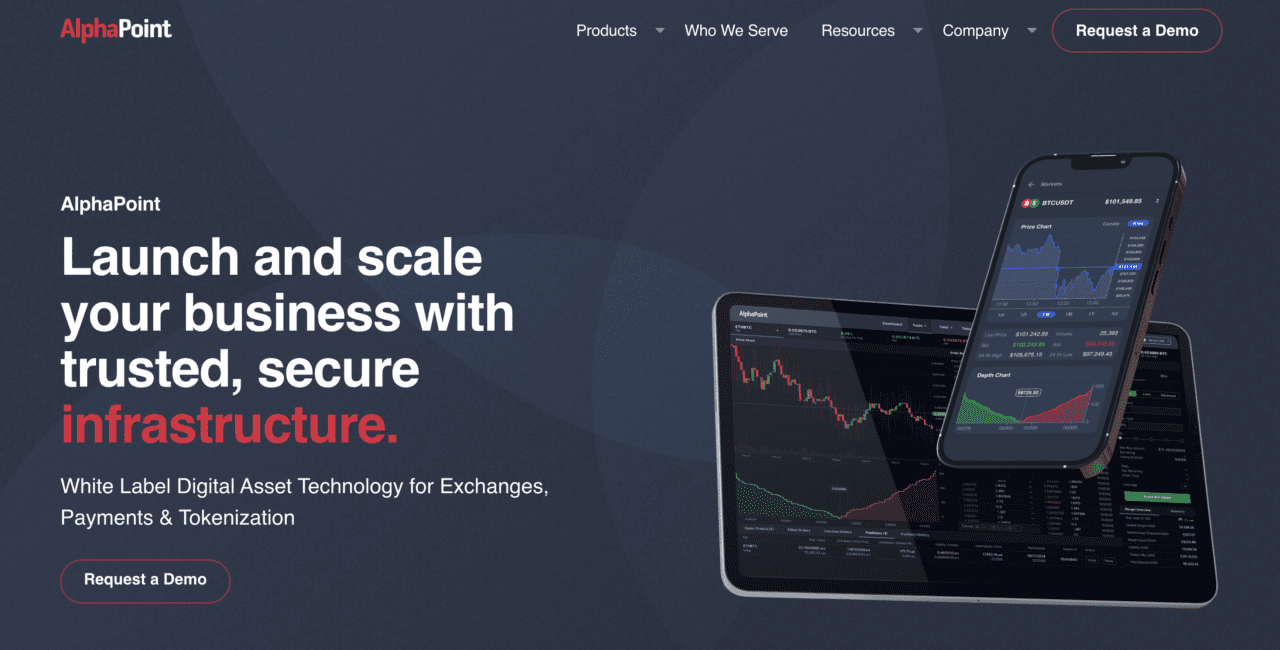
AlphaPoint enables smaller financial institutions to adopt stablecoin payments and treasury capabilities without the cost and complexity of building in-house infrastructure. Its platform provides the tools banks need to support digital asset transactions, helping them modernize payments and compete with larger, more technologically advanced players.

Founded in 2013 and headquartered in New York, AlphaPoint gives banks a faster path to integrating blockchain-based financial services, positioning them to participate in real-time, programmable money.


Quanto

Quanto helps businesses reduce operational friction across financial workflows by streamlining back-office processes, allowing companies to focus on growth.

Founded in 2025 and headquartered in Chicago, Quanto helps organizations scale more efficiently, reduce complexity, and accelerate time to scale.


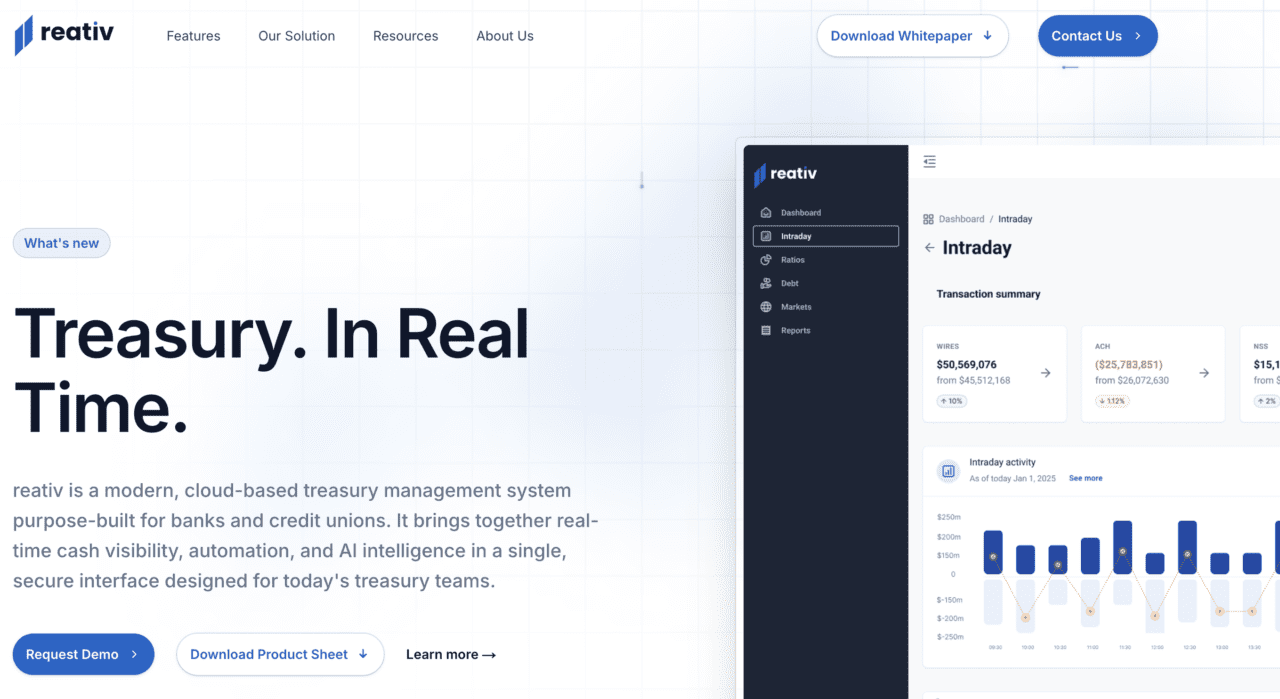
Reativ

Reativ’s cloud-based treasury management system offers financial institutions real-time visibility into cash positions, liquidity, and risk. Its platform combines automation and AI-driven insights to help banks optimize cash usage, reduce operational costs, and improve decision-making.

Designed for regional and community banks as well as credit unions, Reativ can reduce operational expenses by up to 50% while enhancing regulatory readiness. Founded in 2026 and headquartered in Portland, Oregon, the company offers a modern, centralized approach to treasury management.


Clockout

Clockout helps financial institutions drive deposit growth and customer engagement through embedded financial wellness tools. Its platform is designed to increase direct deposits, boost per-user revenue, and differentiate banks and credit unions in competitive markets.

Founded in 2022 and headquartered in Tennessee, Clockout enables institutions to deepen relationships with their customers while creating new revenue opportunities tied to everyday financial activity.

Why banks should care

Banks are under pressure to offer faster money movement, integrate with third-party platforms, and meet rising customer expectations. At the same time, firms need to manage costs and are constrained by legacy systems.

Fintechs are helping bridge this gap with solutions that simplify treasury management, enable stablecoin and real-time payments, and streamline operational workflows that allow institutions to modernize without large-scale overhauls. At the same time, embedded finance and deposit-driving tools create new opportunities to grow balances, increase revenue per customer, and stay competitive in an increasingly platform-driven financial ecosystem.


Photo by Artur Łuczka on Unsplash