Ripple Payments Now Handles More of the Payments Lifecycle

Ripple Payments Now Handles More of the Payments Lifecycle

Digital asset company Ripple is expanding its digital payments platform, Ripple Payments, to create a single, end-to-end platform that consolidates the payments stack.

The California-based company aims to speed up settlement and reduce friction with a full payments infrastructure platform that allows fintechs to operate in the onchain economy by supporting payments made on both fiat and onchain rails. Using the new platform, organizations can collect money, hold it, convert it from fiat to stablecoin and back, manage liquidity, and pay it out.

Bringing all of these capabilities into a single place allows fintechs to manage their entire payments operation. Instead of using one provider for wallets, another for custody, another for FX, and another for payouts, fintechs can now do all of this through Ripple Payments.

Prompting this change are two acquisitions made in 2025. In November of last year, Ripple acquired digital asset custody company Palisade for an undisclosed amount. In August, the company purchased stablecoin-powered global payments platform Rail for $200 million. The added capabilities offer the ability to provision named virtual accounts and wallets, automate collection flows, and exchange and settle funds into operational accounts. Overall, Ripple Payments has processed more than $100 billion in total volume, with Rail adding another $10 billion annually.

“For the global financial system to evolve, fintechs and financial institutions need infrastructure that treats digital assets with the same rigor as traditional finance,” said Ripple President Monica Long. “Success in this space requires enterprise-grade infrastructure, extensive licensing, and deep liquidity—capabilities few can match. Ripple has built the blueprint for blockchain-based enterprise solutions designed to operate at global scale for regulated finance.”

By adding these new capabilities, Ripple can now handle the entire payment lifecycle. The company is positioning itself as more of a regulated global payments infrastructure provider that supports both fiat and stablecoins instead of simply a crypto rails provider. This new role places Ripple in competition with traditional cross-border payment processors and infrastructure vendors such as SWIFT, Visa Direct, Mastercard Cross-Border Services, and large correspondent banking networks, as well as fintech infrastructure players like Stripe, Adyen, and Airwallex.

By combining custody, liquidity management, FX, and payout orchestration into a single platform that supports both fiat and stablecoins, Ripple is positioning itself as a direct challenger to well-established incumbents.

Founded under the name OpenCoin in 2012, Ripple debuted at FinovateSpring the following year. The company provides blockchain-based solutions across traditional and digital finance. Its solutions span global payments, custody, liquidity, prime brokerage, and treasury management tools for banks, fintechs, payment service providers, and crypto businesses.

Ripple offers a stablecoin, RLUSD, that is designed to be used for settlement, liquidity management, and digital dollar transactions within its platform. RLUSD has surpassed $1 billion in market cap since launching in December 2024. Ripple’s cryptocurrency, XRP, is often used as a bridge asset to move value between currencies in cross-border payments.


Photo by Dan Cristian Pădureț

80% of Demos Locked In for FinovateSpring 2026

80% of Demos Locked In for FinovateSpring 2026

FinovateSpring 2026 takes place in sunny San Diego on May 5-7. Register to attend by March 20 and save $400.

With just two months to go, the excitement for FinovateSpring 2026 is building as our demo lineup fills up fast.

On May 5 and 6, more than 50 fintech and financial services companies will take the stage to showcase their latest innovations, giving attendees a front-row seat to the cutting edge of fintech.

Every demo is handpicked to highlight fresh, impactful technologies that solve real-world challenges and drive efficiency. This is the place to be to see where the industry is headed and discover solutions that can transform your business.

Here’s a sneak peek at what our 2026 demo lineup will help you achieve:

  • Revolutionize payments: Enable low-cost, near-instant global transactions with stablecoin-powered FX.
  • Empower financial wellness: Offer integrated Earned Wage Access solutions to retain customers.
  • Boost deposits: Add digital business savings accounts to your strategy.
  • Approve smarter loans: Use AI-driven underwriting to reduce costs and expand SME market share.
  • Gain cash visibility: Automate treasury management with real-time insights.
  • Simplify compliance: Reduce back-office work and save money with tailored, attorney-reviewed solutions.
  • and more!

And that’s just the beginning!

Stay tuned as we reveal the full lineup in the coming weeks. Whether you’re looking to solve a specific challenge or simply want to stay ahead of the curve, FinovateSpring 2026 is where innovation meets opportunity.

_________________________________________________________________________________________

Celebrate Cinco de Mayo with us!
FinovateSpring kicks off on May 5, but the festivities start early in San Diego. Explore vibrant Cinco de Mayo celebrations the weekend before and on the day itself in iconic neighborhoods like the Gaslamp Quarter and Old Town.

On May 5, we’ll bring the holiday spirit to FinovateSpring with themed lunches, special drinks, and more!

Stay tuned for more details, and get ready to enjoy San Diego while discovering the latest in fintech innovation.

Eltropy Unveils Agentic AI Platform for Credit Unions

Eltropy Unveils Agentic AI Platform for Credit Unions
  • Eltropy is introducing a governed agentic AI platform built specifically for credit unions.
  • The new platform enables credit unions to create, deploy, and supervise AI agents within defined operational and compliance guardrails.
  • By centralizing agent deployment and governance, Eltropy positions credit unions to scale AI safely and competitively, narrowing the innovation gap between smaller institutions and large banks with larger technology budgets.

Member communications platform Eltropy is launching an agentic AI platform specifically for credit unions this week. The tool offers a single location for credit unions, fintechs, and core banking providers to work collaboratively on an agentic AI project.

The platform allows users to create, govern, integrate, and deploy AI agents. The tool offers credit unions visibility into what an AI agent did, why it did it, what data it used, and how it reached its decision. Every AI agent is subject to standard operating procedures and authentication protocols, so the agents are unable to take actions outside of the procedures or data boundaries.

Additionally, Eltropy’s agentic AI platform offers organizations control over which employees are able to access and control the agents. “This ensures Agentic AI is innovative but controlled, powerful but predictable, open but always safe,” said Eltropy CEO and Co-Founder Ashish Garg.

Offering credit unions the ability to build and govern AI agents in-house reduces vendor sprawl and creates a structured distribution channel for fintech partners. Rather than layering solutions across consumer touchpoints, credit unions can centralize automation under a governed agent framework.

Crucially, Eltropy’s agentic AI platform positions credit unions to compete more effectively with large banks that have significantly larger IT and R&D budgets. By embedding auditability, authentication protocols, and role-based controls, the platform lowers the regulatory and operational risk that often prevents smaller institutions from deploying advanced AI tools.

“This is just the beginning,” said Abhishek Tiwari, Chief Product Officer, Eltropy. “For us, agentic AI is not about automation for its own sake, it’s about delivering measurable business outcomes. Our AI agents already authenticate members and provide account information, and we’re rapidly expanding into payments, loan system updates, collections workflows, and more. The goal is simple—drive real operational impact across the credit union. This is how agentic AI becomes real.”

Eltropy’s Agentic AI platform helps shift agentic AI from experimental chatbot deployments to core operational infrastructure. With AI advancements moving rapidly and traditional financial institutions struggling to keep up, agentic AI platforms like Eltropy’s will be crucial fintech infrastructure as the industry continues to evolve.

If you’re a credit union, check out opportunities in our Credit Union Spotlight Program at FinovateSpring, taking place March 5 through 7 in San Diego, California.


Photo by Google DeepMind

Quavo Enhances Fraud Dispute Operations for Apple FCU

Quavo Enhances Fraud Dispute Operations for Apple FCU
  • Fraud dispute management specialist Quavo Fraud & Disputes has teamed up with Virginia-based Apple Federal Credit Union (Apple FCU).
  • Apple FCU will implement Quavo’s QFD platform, which delivers greater efficiency, faster fraud claim resolutions, and a better overall experience for credit union members.
  • Quavo Fraud & Disputes most recently demoed its technology at FinovateFall 2025 in New York. Joseph McLean is Co-Founder and CEO.

A technology partner and strategic advisor specializing in fraud dispute management, Quavo Fraud & Disputes announced a new partnership with Apple Federal Credit Union (Apple FCU). The partnership will transform the credit union’s dispute management operations via the implementation of Quavo’s QFD platform, bringing greater efficiency, faster claim resolutions, and a frictionless experience for Apple FCU members.

“Apple FCU shares our vision for creating smarter, more member-centric dispute processes,” Quavo CEO and Co-Founder Joseph McLean said. “Together, we’re replacing outdated workflows with intelligent automation that meets members where they are—online, mobile, and ready for faster results.”

Quavo’s QFD platform is an AI-powered solution that automates the dispute process from intake through to recovery and resolution. The platform was developed specifically for financial institutions and technology companies, enabling them to reduce manual workloads, accelerate fraud and dispute resolution times, and ensure regulatory compliance. Trained on 20+ million real-world cases, QFD helps financial institutions scale their operations as they grow. Apple FCU will benefit from a streamlined self-service portal accessible via online and mobile banking, real-time visibility into claims and status updates, reduced reliance on call centers and branch offices, as well as faster, fairer dispute outcomes.

With nearly 270,000 members and $5.4 billion in assets, Apple Federal Credit Union serves the communities of Fairfax, Frederick, and Prince William counties in Virginia. Established in 1956, Apple FCU is a not-for-profit, membership-owned institution dedicated not only to providing financial services to the local community, but also to promoting community involvement, financial literacy, and charitable giving.

Headquartered in Wilmington, Delaware, Quavo most recently demoed its technology at FinovateFall 2025. At the conference, the company demonstrated its latest innovation, Investigation AI, that leverages an 18-point detection framework to resolve fraud claims faster with greater accuracy. The combination of Investigation AI with Advanced Intake Deflection, which helps combat so-called “friendly” or first-party fraud, enables QFD to deliver real-time decisioning, cost reductions, and superior customer experiences.

Quavo’s partnership news comes a month after the company announced a pair of major C-suite additions. In January, Quavo announced that David Oldershaw and Tony DiGiorgio had been appointed as Chief Operating Officer and Chief Technology Officer, respectively. Oldershaw joins Quavo after most recently serving as the Chief Operating Officer for OfficeRnD, where he led go-to-market functions, partnerships, corporate development, and operations. DiGiorgio was formerly Chief Architect at healthcare operations platform provider symplr, where he helped grow the company from $200 million to $500 million in annual recurring revenue.


Photo by Praswin Prakashan on Unsplash

What the OCC’s 2026 Rulemaking Means for Stablecoin Issuers

What the OCC’s 2026 Rulemaking Means for Stablecoin Issuers

In July of 2025, the GENIUS Act, the first comprehensive federal framework for stablecoins, became law. Last week, the US Office of the Comptroller of the Currency (OCC) issued a notice of proposed rulemaking (NPRM) to implement the GENIUS Act’s requirements for payment stablecoin issuance and related activities.

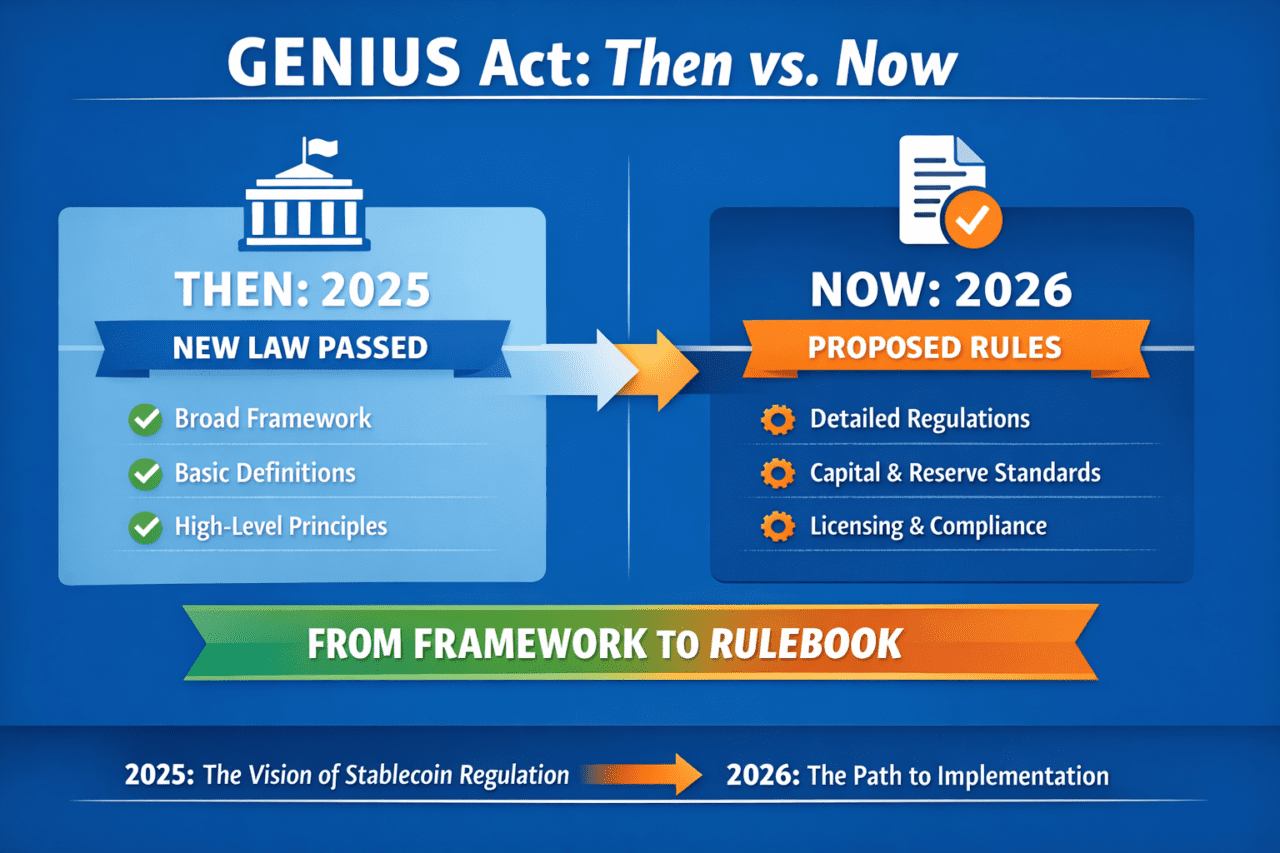
While the new proposed rulemaking makes the GENIUS Act a reality instead of just a statute, it doesn’t change the intent of the GENIUS Act. It operationalizes the GENIUS Act by creating a dedicated regulatory section for issuers, establishing the licensing mechanics and timelines, forming the capital and operational requirements, and stipulating foreign issuer treatment.

2025 GENIUS Act

The 2025 GENIUS Act had a crucial role in setting the stage for the legality of stablecoin payments. It defined what a payment stablecoin is and who is allowed to issue stablecoins. It stipulated that stablecoins require full reserve backing with liquid assets, prohibited interest-bearing stablecoins, and created a federal and state regulatory structure. Overall, the purpose of the 2025 Act was to set guardrails. With this year’s notice of proposed rulemaking, the OCC is bringing a more procedure-focused approach.

New dedicated regulation

As mentioned above, the OCC is operationalizing the GENIUS Act in four major ways, the first of which creates a dedicated regulatory section (12 CFR Part 15) that establishes standards and requirements for stablecoin issuers. Creating the new part in the CFR changes the GENIUS Act from a written requirement into more enforceable supervisory standards.

New licensing

Additionally, new licensing mechanics come into play that create a defined pathway for entering the stablecoin market. Under the OCC’s proposal, prospective permitted payment stablecoin issuers (PPSIs) must submit a formal application outlining their business model, governance structure, reserve management approach, technology infrastructure, and risk controls. The proposal establishes what constitutes a “substantially complete” application and outlines supervisory review expectations. The new licensing process makes stablecoin issuance similar to applying for a bank charter, rather than launching a new product.

New capital and operational requirements

Similarly, the 2026 capital and operational requirements make stablecoin issuance look more like running a regulated financial institution than launching a new product. While the 2025 GENIUS Act focused primarily on reserve backing, the OCC’s 2026 proposal stipulates minimum capital thresholds, liquidity buffers beyond token redemption obligations, formal governance structures, internal control standards, and explicit third-party risk management expectations.

Established banks already have these processes embedded into their operating procedures. For fintechs, however, the new requirements may call for meaningful investment in governance, compliance documentation, and risk oversight infrastructure. These new formalities raise the cost of entry into the stablecoin issuance market.

New foreign issuer treatment

The OCC’s 2026 proposal incorporates foreign issuer rules directly into the scope of the plan, meaning that non-US players can no longer rely on regulatory ambiguity as a strategy to enter the market.

Just as the proposed framework requires US issuers, foreign issuers serving US users would still be required to apply for OCC registration, provide evidence of Treasury’s comparability determination, consent to US jurisdiction and OCC access to records, and meet requirements around US-available reserves (subject to any reciprocal arrangement).

This limits offshore entities operating in regulatory gray zones while marketing to US customers. The new rulemaking makes clear that global stablecoin players will need to align with US supervisory expectations, creating a more demanding roadmap for cross-border participation.

What this means for banks and fintechs

The proposed rulemaking makes clear that stablecoins are moving closer to the core of regulated banking activity and are increasingly being treated as part of the financial infrastructure rather than as a crypto experiment. As stablecoin issuance begins to resemble supervised activity, banks enter the conversation from a position of structural advantage. With governance frameworks, capital planning, risk management, and compliance processes already embedded in their operating models, traditional financial institutions may be better positioned than fintechs to comply with the regulatory demands of stablecoin issuance.

As compliance costs associated with stablecoin issuance rise, so does the barrier to entry. Not every fintech will have the appetite or resources to meet capital, liquidity, and supervisory expectations. The increased friction, however, brings institutional credibility to a payment type once considered adjacent to Bitcoin. This credibility lowers the risk for issuers as well as for end consumers and will ultimately transform stablecoins into an everyday tool.


Photo by Moose Photos

Fintech Rundown: A Rapid Review of Weekly News

Fintech Rundown: A Rapid Review of Weekly News

Welcome to March! Women’s History Month, Holi (the Hindu “Festival of Colors”), the start of spring, St. Patrick’s Day, Eid al-Fith, Cesar Chavez Day … there’s a lot to celebrate and look forward to over the next few weeks.

Here on Finovate’s Fintech Rundown, we’re looking forward to the rush of industry news and announcements that typical comes with the seasonal thaw.


Payments

Private equity firm Incore Invest completes its acquisition of CoreOrchestration AB from Worldline.

Apple is in conversation with banks in India to bring Apple Pay to the country later this year.

Embedded finance

Confido, an embedded financial infrastructure platform for law firms and legaltechs, raises $9 million in funding.

Fraud prevention

ThetaRay and Matrix USA team up to help financial institutions modernize their transaction monitoring programs.

Stablecoins

MoonPay builds infrastructure platform for PYUSD-backed stablecoins.

Agentic AI

Colt Technology Services announces proof of concept for an agentic AI engine developed in partnership with Microsoft.

Banco Santander and Mastercard complete Europe’s first live agentic AI payments transaction.

DeFi

US-based FundBank acquires Irish blockchain startup Trrue.

The Hong Kong Monetary Authority (HKMA), the Shanghai Data Bureau (SDB), and the National Technology Innovation Center for Blockchain ink a Memorandum of Understanding between Shanghai and Hong Kong to apply blockchain technology to develop a cross-border platform to facilitate trade finance.

Open finance

Promoteo teams up with Fiskil to help implement Open Finance across Latin America.

Digital banking

10x Banking teams up with Validata in a strategic partnership designed to help banks accelerate innovation.

Wealthtech

OneVest launches its Agentic Wealth Operating System to help automate middle office operations for advisors.


Photo by Pixabay

Cash Handling Company Brink’s to Acquire NCR Atleos

Cash Handling Company Brink’s to Acquire NCR Atleos

Virginia-based cash handling company The Brink’s Company (Brink’s), has agreed to acquire NCR Atleos in a deal valued at around $6.6 billion.

The deal will combine Brink’s global cash management expertise with NCR Atleos’ ATM management and services as well as its ATM network and ATM-as-a-Service (ATMaaS) solutions. Adding NCR Atleos’ capabilities will allow Brink’s to offer complementary products, services, and software that provide banks and retail customers with an even broader variety of cash management solutions.

“This acquisition further supports Brink’s ability to deliver enhanced customer solutions and accelerates our value creation strategy,” said Brink’s President and Chief Executive Officer Mark Eubanks. “NCR Atleos is a partner we know well, and our business cultures are closely aligned around customer success, continuous improvement, and managing the interface between physical to digital payments to enable ease of cash acceptance and use. By combining our organizations, we gain critical scale and complementary, integrated capabilities to drive our ambitious growth strategy and provide new levels of service to our global customer base.”

Founded as NCR Corporation in 1881, the firm spun out NCR Atleos in October of 2023 to run as an independent company focused on ATMs. Today, NCR Atleos has an installed base of approximately 600,000 ATMs, 78,000 of which it owns and operates in high traffic retail locations. Headquartered in Atlanta, Georgia, NCR Atleos employs 20,000 people across the globe to facilitate hardware, software, and service for its line of ATM-related technology.

This is a massive win for Brink’s, and not simply because it is buying up one of the oldest firms in financial services. The acquisition offers the company a greater geographic footprint, tapping NCR Atleos’ client base located across more than 140 countries. Adding NCR Atleos’ ATM software, services, and installed ATMs to its own armored transport services will enable Brink’s to offer a more holistic and vertically integrated set of services and products.

Once combined, Brink’s anticipates it will generate approximately $10 billion in total revenue.

“This transaction represents a strategic opportunity for NCR Atleos,” said NCR Atleos CEO Tim Oliver. “The extraordinary efforts of the NCR Atleos team over the two years since our separation from legacy NCR have strengthened our leading ATM installed base, sustained best-in-class service levels and introduced innovative products. Combining the complementary service-led businesses of Brink’s and NCR Atleos will enable us to enhance offerings to financial institutions and retailers, and create more opportunities for our employees.”


Photo by WoodysMedia

DriveWealth to Integrate Kalshi’s Event Contracts into its Brokerage Platform

DriveWealth to Integrate Kalshi’s Event Contracts into its Brokerage Platform
  • DriveWealth will integrate Kalshi’s regulated prediction markets into its brokerage-as-a-service platform, enabling fintechs to offer event contracts alongside stocks and ETFs.
  • Kalshi, which processes over $100 billion in annualized volume, is expanding distribution through DriveWealth’s brokerage infrastructure.
  • As prediction markets move into the financial mainstream, event contracts are emerging as a new tradable asset class that could follow the adoption path of options and crypto.

Digital trading and brokerage company DriveWealth is teaming up with prediction market platform Kalshi in a move to capitalize on the growing interest in events contracts. The New Jersey-based company plans to integrate Kalshi’s event contracts into its brokerage platform.

The integration allows clients using DriveWealth’s brokerage-as-a-service platform to offer event-driven markets alongside more traditional equities, ETFs, and other traditional asset classes within the same interface.

Kalshi allows users to trade on the outcome of real-world events such as elections, economic indicators, weather, sports, and more in a fully regulated environment. Because it offers investment opportunities based on highly publicized events such as sporting and political events, Kalshi brings an approachable new asset class that has quickly become mainstream. Kalshi currently attracts over $100 billion in annualized volume.

Rather than operating purely as a standalone trading venue, Kalshi has increasingly positioned itself as infrastructure for fintech platforms seeking to add regulated event contracts to their product mix. “DriveWealth’s global reach and embedded brokerage infrastructure make them an ideal partner to Kalshi,” said Kalshi Co-founder and CEO Tarek Mansour. “Our goal is to provide leading fintech platforms with more access to regulated prediction markets.”

The new integration also places DriveWealth in the footsteps of Robinhood, which began integrating Kalshi’s prediction market platform into its investing app in August of last year. Other investment platforms leveraging Kalshi include WeBull and PrizePicks.

Offering an increasingly popular asset class like prediction markets enables DriveWealth clients to attract new users while deepening engagement with existing investors who may currently trade on external platforms. For end users, consolidating multiple investment opportunities within a single platform simplifies portfolio tracking and performance monitoring across markets. For DriveWealth clients, the addition modernizes their product offering while strengthening customer retention and growth.

As prediction markets gain regulatory clarity and mainstream traction, DriveWealth sees the Kalshi integration as a way to future-proof its brokerage infrastructure. “Our integration with Kalshi strengthens our ability to deliver cutting-edge market opportunities to our partners,” said DriveWealth CEO Naureen Hassan. “DriveWealth was built to power the future of global investing through scalable, API-driven technology, and Kalshi’s forward-thinking approach to market design makes for a natural fit. Together, we’re uniquely positioned to equip our partners with the latest financial innovations and next-generation market access for their clients.”

Overall, prediction markets are on a major growth trajectory this year. Prediction markets have evolved from niche academic tools and offshore betting platforms into regulated investing tools with growing institutional backing.

As retail investors increasingly seek alternative ways to grow their funds, prediction markets create a new category of tradable risk exposure. If distribution partnerships like those with Robinhood and DriveWealth continue to scale, event contracts could follow a trajectory similar to options or crypto that were once fringe, but are now embedded into modern product stacks.


Photo by Amit Lahav on Unsplash

Videos from the 22 Demos at FinovateEurope 2026 are Live

Videos from the 22 Demos at FinovateEurope 2026 are Live

If you missed out on FinovateEurope earlier this month, you don’t have to feel left out any longer. The 22 demo videos are now live (and free to watch!) on the Finovate website and on Finovate’s YouTube channel.

Each seven-minute video offers a fast and efficient way to catch up on the latest new launches in fintech. We’ve highlighted the three Best of Show-winning demos below to get you started.


R34DY’s ABLEMENTS platform


Serene


Tweezr.io

For more coverage of on-stage content at FinovateEurope, check out our post-show analysis. And if you don’t want to miss out on the live action next time around, be sure to register for FinovateSpring, taking place on May 5 through 7 in San Diego, California. We’ll see you there!

Mambu Expands its Payments Hub Beyond Europe into Asia and Latin America

Mambu Expands its Payments Hub Beyond Europe into Asia and Latin America
  • Mambu is expanding its payments hub globally, launching in new markets across EMEA, Latin America, and Asia Pacific.
  • The global move comes in response to growing demand from banks and fintechs operating across multiple payment schemes and jurisdictions.
  • Mambu’s API-first payments hub extends the company’s composable core banking offering to help institutions modernize and scale payments alongside lending and deposits.

Cloud banking platform Mambu is expanding its payments hub into new global markets this year, with plans to launch in additional markets in EMEA, Latin America, and Asia Pacific.

Mambu said demand from global banks and fintechs operating across multiple payment schemes and jurisdictions drove this week’s expansion.

Mambu was founded in 2011 and emerged as one of the pioneering players to move banking software to the cloud. The company’s composable banking approach offers a plug-and-play approach to core banking that helps firms shift away from legacy platforms and build to scale.

As payments become a more central part of Mambu’s long-term platform strategy, the company is positioning its payments hub as a natural extension of its core banking business. “For years, Mambu’s core banking platform has long been the engine behind hundreds of the world’s most innovative financial players. Payments are now a cornerstone of our strategy as we help institutions navigate the industry’s growing complexity,” said Mambu VP of EMEA Leon Stevens. “We are poised to help modernize core infrastructure and accelerate innovation across the entire banking stack—from lending and deposits to payments and beyond.”

Launched in 2025 and fueled by the acquisition of payment gateway company and Finovate alum Numeral, Mambu’s payments hub aims to help firms modernize their entire payments stack with an API-first payments hub. With native straight-through processing, orchestration, liquidity, reconciliation, fully-managed connectivity to local and global payment schemes, and composable payment workflows, Mambu’s payments hub facilitates a faster, lower cost approach that can easily be scaled.

From an execution standpoint, Mambu sees growing complexity across global payment ecosystems as a key driver behind the expansion. “Payments are becoming more global and more local, more interconnected and more fragmented, and now move in real-time,” said Mambu VP Payments Edouard Mandon. “This complexity makes scaling payments across multiple markets challenging. To solve this, we have expanded our payments hub to give institutions access to local schemes while maintaining a consistent integration and operational experience. This continues our investment in connectivity at scale, which increasingly includes next-generation rails, to deliver payment solutions truly built for the future.”

Since launching, Mambu’s payments hub processed seven times as many payments in 2025 than what it did in 2024 when it was under the Numeral brand. Also in the nine months since launch, the company added European and global financial institutions, including Western Union, BCB Group, Flowe, and Spendesk.

As payments become increasingly global, the subsector is becoming a strategic battleground for banks as they seek to grow and modernize their technology stacks, especially as payments mix real-time, legacy, and new payment rails across multiple regions. Offering the ability to standardize integration while natively embedding payments into its composable banking platform will ultimately help Mambu’s clients scale faster while limiting complexity.

Mambu plans to continue expanding connectivity to major payment rails worldwide in an effort to help banks support payment schemes through a single platform. The company notes that its geographical expansion marks the next phase of its international growth, especially as it further builds out global core banking and payments infrastructure.


Photo by Marina Leonova

Regtech Copla Raises €6 Million in Series A Funding

Regtech Copla Raises €6 Million in Series A Funding
  • Lithuanian regtech Copla has raised €6 million ($7.1 million USD) in Series A funding for its AI-powered compliance automation platform.
  • Iron Wolf Capital led the round, which featured participation from Operator Stack and existing investors Specialist VC, SuperHero Capital, FirstPick, NGL Ventures, and Loggerhead Partners.
  • Founded in 2023, Copla made its Finovate debut at FinovateEurope 2025 in London.

Copla, a regtech headquartered in Lithuania that offers an AI-powered compliance automation platform, has secured €6 million in Series A funding. The round was led by Iron Wolf Capital. Operator Stack and existing investors Specialist VC, SuperHero Capital, FirstPick, NGL Ventures, and Loggerhead Partners also participated in the funding. Copla, which made its Finovate debut at FinovateEurope 2025, will use the capital to further build out its product, add talent to its team, and expand into markets beyond the European Union.

In a statement, the company noted that regulations are becoming increasingly complicated and operational. From the Digital Operational Resilience Act (DORA) to the EU Artificial Intelligence Act (EU AI Act) to the Cyber Resilience Act, there are a range of new compliance obligations that regulated firms throughout the European Union will have to deal with starting this year. Copla’s platform specializes in Information and Communication Technology (ICT) compliance, transforming the mandates of regulations like DORA and the EU AI Act into guided, evidence-based workflows. The technology converts regulatory requirements into specific tasks, tracks execution on a continuous basis, and automatically records all evidence to ensure that the operations are audit-ready. In a recognition that not all regulatory processes are best automated, Copla also offers hands-on support via in-house and fractional CISO services, as well as a network of partner providers across Europe to assist with audits, risk decisions, and interactions with regulators.

“Regulation is getting sharper, but most compliance is still stuck in spreadsheets,” Copla Co-founder and CEO Aurimas Bakas said. “We built Copla so compliance stays current by default, and so companies can grow with confidence instead of audit anxiety. This round gives us the momentum to make Copla the default compliance execution layer for regulated finance in Europe and beyond.”

To this end, one initiative announced along with the company’s funding was Copla Bridge, a new platform layer that will help partners, consultants, and multi-entity organizations manage compliance issues across companies from a single, unified view. Copla Bridge is designed to help organizations that must centralize compliance across subsidiaries, regulated entities, or a group structure, a major challenge for most organizations that do not have the requisite tooling and infrastructure.

Founded in 2023 and headquartered in Vilnius, Lithuania, Copla made its Finovate debut at FinovateEurope 2025. At the conference, the company showed how it combines three of its solutions—CoreGuardian, an AI-driven CoPilot, and VendorGuard—to provide comprehensive cybersecurity and compliance. CoreGuardian ensures compliance with key frameworks such as DORA. Copla’s CoPilot engages users individually via Slack and Teams to provide real-time education, assessments, and alerts. VendorGuard streamlines vendor management, providing risk assessments, incident planning, and prioritization.


Photo by Maksim Shutov on Unsplash

Finovate Celebrates Black and African-American History Month

Finovate Celebrates Black and African-American History Month

February is Black and African-American History Month. As the month draws to a close, we wanted to take a moment to recognize and celebrate the Black and African-American executives, founders, and analysts who have shared their ideas, insights, and experiences with Finovate audiences in 2025.

From the keynote podium to the demo stage, these Black and African-American fintech, banking, and financial services professionals are a reflection of the growing diversity and inclusion that continues to shape and transform our industry today.


Erin Estelle—SVP, Chief Marketing Officer—Valley Strong Credit Union

Estelle participated in FinovateSpring 2025, sharing her insights as part of our Power Panel on the Customer Experience Revolution.

Estelle brings more than 15 years of experience in strategic marketing and brand management, leveraging innovative data-driven strategies to drive growth, engagement, and retention. At Valley Strong Credit Union, Estelle oversees digital marketing, consumer insights, communications, public relations, field marketing, and community outreach.

Based in Bakersfield, California, Valley Strong Credit Union offers checking and savings accounts, credit cards, personal and auto loans, mortgage and home loans, investing and retirement services, and more to 35,000+ members.


Nate Gibbons—Chief Experience Officer—QuickFi

Gibbons co-led the live demonstration of QuickFi’s self-service, embedded finance platform for business equipment financing at FinovateSpring 2025 in San Diego. The demo showed how QuickFi can enable borrowers to quickly complete onboarding, authentication, credit underwriting, and document signing on a highly secure lending platform.

A regular conference speaker and strategist as well as Chief Experience Officer at QuickFi, Gibbons was previously an executive with First American Equipment Finance. He has an MBA from the Simon Business School at the University of Rochester, and earned the Blue Ladder Award for extraordinary achievement from the City National Bank.

A Finovate alum since 2021, QuickFi has won Best of Show on three separate occasions, most recently at FinovateSpring 2024. The company offers an embedded finance platform for secured commercial equipment financing, enabling business borrowers to initiate and complete equipment financing in minutes.


Deola Habeeb—Head of Global Tech Operations—Vanguard

Habeeb joined Finovate at FinovateEurope 2025 to share her thoughts and experiences as part of our Women in Fintech panel.

Head of Global Tech Operations for Vanguard, Habeeb is a technology leader, entrepreneur, investor, and strategist with more than two decades of experience building enterprise operations and driving business growth. Habeeb combines technical acumen and business acuity across professional services, engineering, and business operations.

Vanguard is one of the largest investment management companies in the world. The firm offers investments, advice, and retirement services to tens of millions of individual investors directly, through workplace programs, and via financial intermediaries.


Christopher Hollins—Head of Global Product Sales and Delivery—SVB, a Division of First Citizens Bank

Hollins most recently spoke at FinovateSpring 2025 as part of our Power Panel on balancing the balance sheet and winning the battle for deposits.

Head of Global Product Sales and Delivery at SVB, a division of First Citizens Bank, Hollins is instrumental in transforming the platform’s solution delivery model to ensure that SVB’s Commercial Bank innovation economy clients can access the best partners and solutions to solve their business challenges.

Based in Santa Clara, California, SVB provides commercial and private banking services to founders, entrepreneurs, and companies in the technology, life science, private equity, venture capital, and related industries. The bank specializes in serving the unique needs of clients in dynamic, transformative businesses, providing deep sector expertise, insights, and connections.


Priscilla O-Iyari—Regional Marketing and Communications Outreach Officer—FACE Coalition

O-Iyari, in her recent capacity with FACE Coalition, joined FinovateSpring 2025 as part of our Executive Briefing on Financial Inclusion: “How can banks capture the huge growth opportunity offered by this new customer base?”

With more than 14 years of experience developing and executing strategies that have built successful brands in industries ranging from financial services to healthcare, O-Iyari came to Finovate via her role at FACE Coalition where she connected Black entrepreneurs with funding sources, human resources, and other support to help them scale their businesses and facilitate generational wealth creation.

O-Iyari is currently Associate Marketing Manager with TD where she is responsible for global brand management, education, and governance for the TD enterprise across countries and lines of business.


Mary Joseph—Senior Vice President, Strategic Investments, Treasury & Trade Solutions—Citi

Joseph participated in our Investor All Stars panel at FinovateFall 2025, discussing the current outlook for the market, valuations, and the future of financial services.

Focusing on opportunities that enhance Treasury and Trade Solutions and expand Citi’s technology ecosystem, Joseph leads the bank’s global investments in fintech and B2B SaaS startups. She brings expertise from her tenure in fintech and M&A advisory from within Citi’s Investment Banking group and as an investor at venture capital firm, GreenHouse Capital.

Citi provides financial services that enable growth and economic progress, safeguarding assets, lending money, making payments, and ensuring access to the capital markets. The institution does business in more than 180 countries and jurisdictions, serving corporations, governments, investors, institutions, and individuals.


Tobiloba Oyetoke—Chief Executive Officer—Bitpowr Technologies

Oyetoke introduced his company, Bitpowr Technologies, to Finovate audiences a year ago as part of FinovateEurope 2025 in London.

Founded in 2021 and headquartered in Delaware, Bitpowr Technologies helps businesses and developers manage digital asset operations and build financial products. The company provides modular, critical infrastructure to issue digital wallets and process global payments safely and securely, while meeting regulatory requirements.

At the conference, Oyetoke demonstrated Bitpowr’s latest solution, Powr Finance, which enables fintechs and companies to offer embedded stablecoin banking, payments, digital wallets, and card products in a safe and compliant way.


Photo by Monstera Production