This site is operated by a business or businesses owned by Informa PLC and all copyright resides with them. Informa PLC's registered office is 5 Howick Place, London SW1P 1WG. Registered in England and Wales. Number 8860726.
Finovate Blog
Tracking fintech, banking & financial services innovations since 1994
Adyen is acquiring Talon.One for $879 million to add enterprise loyalty, promotions, and incentive infrastructure used by 300+ brands.
Adding Talon.One’s loyalty infrastructure moves Adyen beyond payments into real-time decisioning to enable merchants to connect identity, pricing, and promotions and act during the transaction.
The new infrastructure can dynamically deliver offers during AI-driven shopping experiences to help shape purchases.
Payments platform Adyen is acquiring loyalty solutions company Talon.One in a deal valued at $879 million (€750 million). The deal is expected to close in the second half of 2026.
Germany-based Talon.One serves as the loyalty infrastructure for 300 enterprises, including large brands such as Nordstrom and H&M. Founded in 2015, the company offers tools for enterprise loyalty management, personalized promotions, and incentive optimization. Earlier this year, Talon.One released Unified Incentives Protocol (UIP), a new set of standards that shows available promotions and loyalty incentive offers within AI agent-based shopping experiences.
“Joining Adyen allows us to embed real-time decisioning at the core of every transaction,” said Talon.One Co-founders Christoph Gerber and Sebastian Haas. “Together, we enable merchants to connect customer identity with pricing and promotions in real time, in-store and online, driving better outcomes for our customers.”
Adyen anticipates that bringing in Talon.One will help connect online and in-store shopper interactions, enabling merchants to act on the insights in real-time. Combining Adyen’s payments infrastructure and transaction data with Talon.One’s real-time decisioning capabilities will allow merchants to establish a consistent customer identity across channels. Merchants can use this information to dynamically adjust promotions and pricing based on aspects of the customer identity.
“Our merchants ask us every day how they can better connect their online and in-store customer data and act on that in real time,” said Adyen Co-CEO Ingo Uytdehaage. “Many have tried to build a solution themselves but struggle to turn insights into action. With Talon.One, a merchant can recognize a shopper and apply a relevant offer instantly, before the payment is completed, ultimately driving higher revenue.”
Adyen considers the acquisition a “natural next step” in its investment in unified commerce and data products. Talon.One will enable it to link customer identity directly to SKU-level promotions and incentives within the flow of payments to improve conversion, fraud, and customer lifetime value.
Ultimately, the deal elevates Adyen beyond payment rails into a real-time decisioning layer within the transaction itself. By combining payments data with loyalty and promotion logic, Adyen is acting on the fact that transaction data is only valuable if it can be operationalized at the moment the purchase decision is still being made.
As the move toward agentic commerce accelerates, acting in the moment of the purchase becomes even more critical. AI-driven shopping experiences will increasingly surface and execute offers on behalf of consumers, making infrastructure that can dynamically deliver pricing, incentives, and identity-aware promotions a competitive differentiator.
Moomoo launches API Skills to connect personal AI agents to trading and allow investors to use natural language to build and execute strategies without coding.
The new tools include strategy validation, intent-to-execution translation, and 24/7 market monitoring inside a pro trading environment.
Moomoo enables external AI agents via APIs, giving users control, flexibility, and local data security.
Online investment and trading platform Moomoo is launching agentic investing tools this week. The California-based company has launchedAPI Skills to allow retail investors to connect their personal AI agents directly to Moomoo’s infrastructure.
With API Skills, investors can use natural language commands to create structured, executable investment strategies without coding. The tool integrates with multiple AI agent frameworks, enabling always-on agents that act as 24/7 trading assistants that continuously interpret market data, monitor conditions, and prepare trades based on a user’s goals within a professional-grade trading environment.
“With Moomoo API Skills, we are reducing the technical barriers that once stood between an idea and its execution, enabling clients’ personal AI agents to connect directly with our platform while ensuring investors retain full control of every decision,” said Moomoo Canada CEO Michael Arbus.
The new tool not only helps non-technical users automate their trading decisions, but it also helps investors save time by streamlining more complex workflows. Included in the API Skills are: automated strategy validation that allows users to review, refine, and validate their strategies before deploying them; intent-driven development that translates natural language commands into structured logic to execute the move in the market; and a volatility monitor that detects market shifts 24/7.
With Moomoo’s API Skills, all trading credentials and sensitive account data remain within the user’s local environment instead of passing through third-party AI servers. The new capability also allows users to test and explore their agent’s logic using virtual funds before moving the logic into the wild.
Moomoo isn’t the only trading platform empowering users with agentic trading. Last month, brokerage platform Public introduced AI agents to automate their portfolio strategies with AI. The two approaches are slightly different, however. While Public’s agents are native, consumer-facing agents geared toward retail investors, Moomoo is an API layer for builders that lets external AI agents plug into trading.
Founded in 2018, Moomoo has 29 million investors across Singapore, Australia, Japan, Canada, Malaysia, and New Zealand.
LendingClub, a pioneer in online lending, is rebranding to Happen Bank.
Expected to launch in the summer of 2026, Happen Bank combines LendingClub’s track record as a personal lender with an embrace of digital banking supported by LendingClub’s acquisition of Radius Bank, completed in 2021.
Headquartered in San Francisco, California, LendingClub made its Finovate debut in 2007. The company was founded by Renaud Laplanche.
Pioneering online lender LendingClub announced this week that it is rebranding to Happen Bank. The rebrand signals the company’s evolution beyond personal loans and into the world of full-service digital banking, leveraging LendingClub’s acquisition of Radius Bank.
“The LendingClub name no longer fits with everything we offer today,” CEO Scott Sanborn said. “The Happen Bank brand reflects both our expanded banking capabilities and our core mission: to clear the way for people going places. Our members are goal-oriented and know what they want to achieve. They’re not looking for marketing fluff; they want products that deliver reliable value, are easy to understand, and are effortless to use. That’s exactly what we’re built to deliver—and how we help them make it happen.”
The new brand is expected to launch this summer. The name of the bank was chosen to reflect “action, progress, and forward momentum,” the company noted in a statement, pledging that while the name and visual identity of the company will change, “there is no change to our award-winning products and services.”
“Our members don’t want banking to slow them down,” Chief Customer Officer Mark Elliott said. “The Happen Bank brand reflects how we show up for them—clear, human, and action-oriented. It’s about making financial products feel intuitive and supportive, so people can spend less time navigating banking and more time moving their lives forward.”
The company’s rebrand comes six years after it acquired online-only Radius Bank for $185 million. At the time, the acquisition was seen as an embrace of digital banking that would help LendingClub not only grow its membership base, but also better engage with its existing customers. The rebrand positions the business to compete more directly with rivals such as SoFi, Ally Financial, and Capital One in areas including retail banking, deposits, and personal lending. It will be worth watching to see whether Happen Bank can build on LendingClub’s track record as a pioneering online lender to find success in an increasingly crowded field of banks, neobanks, and fintechs.
Founded in 2007 by Renaud Laplanche, LendingClub caters to a community it calls the “Motivated Middle.” These individuals are high-FICO, above-average income, digitally savvy consumers who actively manage their financial lives. With more than five million members using its platform to access credit, personal and banking services, investing, and more, the company recently reported total net revenue growth of 23% and growth in loan originations of 40% relative to last year. Deposits were also up year-over-year by 8%.
Empowering banks and credit unions with customer-centric solutions that enhance efficiency for both institutions and individuals is a key role of fintech innovation. Whether the goal is increased security, faster transactions, or personalized financial guidance, solutions that tackle these challenges not only make financial life easier and safer for customers and members, but also help banks and credit unions streamline operations, grow their user bases, and compete more effectively in the marketplace for financial services.
This year, FinovateSpring 2026 will showcase five companies that are streamlining the account onboarding (and offboarding) process, helping banks and credit unions offer new services like earned wage access and protected transactions, and reducing compliance risk for financial institutions of all sizes.
Eisen automates escheatment for abandoned accounts, dormant balances, forced closures, and stale checks, reducing back-office work by 90%. Financial institutions use Eisen’s escheatment, disbursement, and outreach tools to streamline account offboarding while automating manual work and reducing risk of non-compliance.
Headquartered in New York and founded in 2021, Eisen has partnered with organizations across various industries—banks, brokerages, telecoms, and more—to manage unclaimed property and automate escheatment compliance. The company builds products that help businesses proactively manage their offboarding, creating a new category of Account Offboarding Solutions that ultimately help reunite customers with their money.
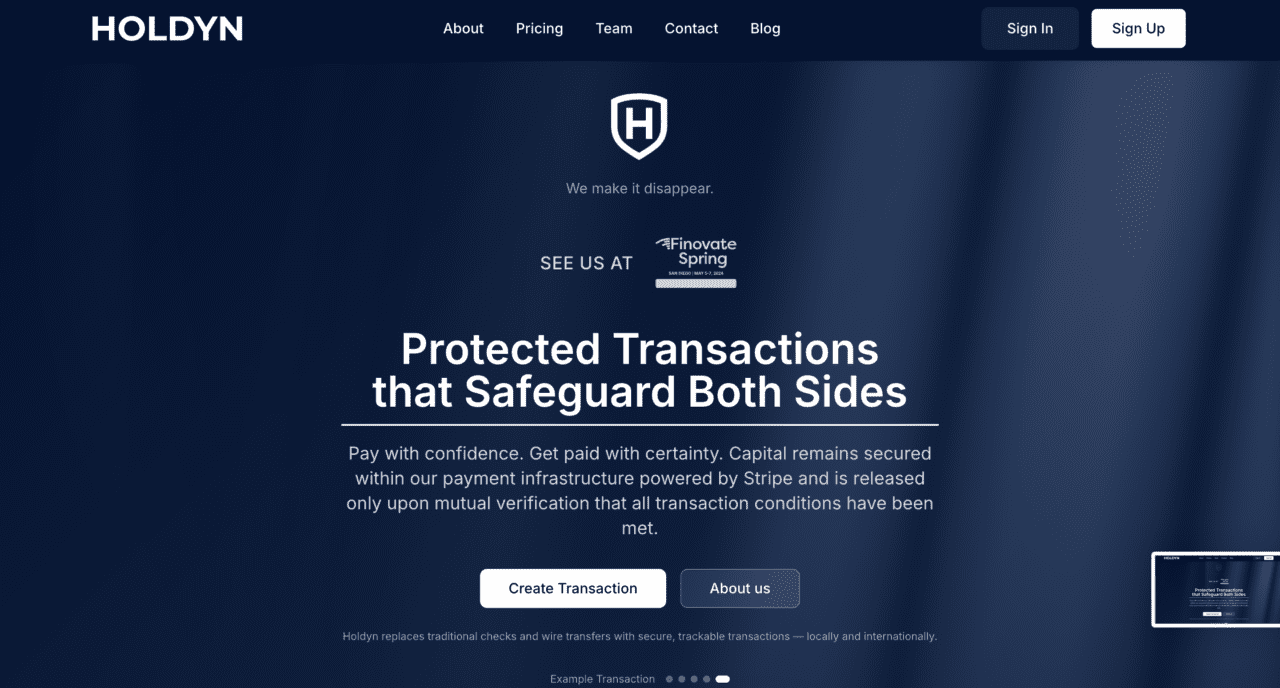
Holdyn is a trust-first fintech platform enabling secure, structured transactions and conditional payments. In addition to moving funds instantly, Holdyn also allows users to define how and when funds are released, reducing counterparty risk in both local and cross-border transactions.
Founded in 2025 and headquartered in Tel Aviv, Israel, Holdyn offers protected transactions that safeguard both sides, enabling users to pay with confidence and get paid with certainty. Capital remains secured within Holdyn’s payment infrastructure—powered by Stripe—and is released only upon mutual verification that all transaction conditions have been met.
Kiro Money helps FIs grow deposits and product adoption by embedding intent-aware guidance that converts user uncertainty into action inside their platforms. The company embeds agentic AI into fintech and banking platforms to deliver contextual, personalized financial intelligence. Kiro Money also offers financial education workshops, programs, and coaching to expand financial guidance and education access to the next generation.
Headquartered in San Francisco and founded in 2024, Kiro Money combines financial expertise and science to simplify finance. The company offers approachable conversations with money coaches to provide clear, direct answers that cut through the complexity to give customers the answers they need.
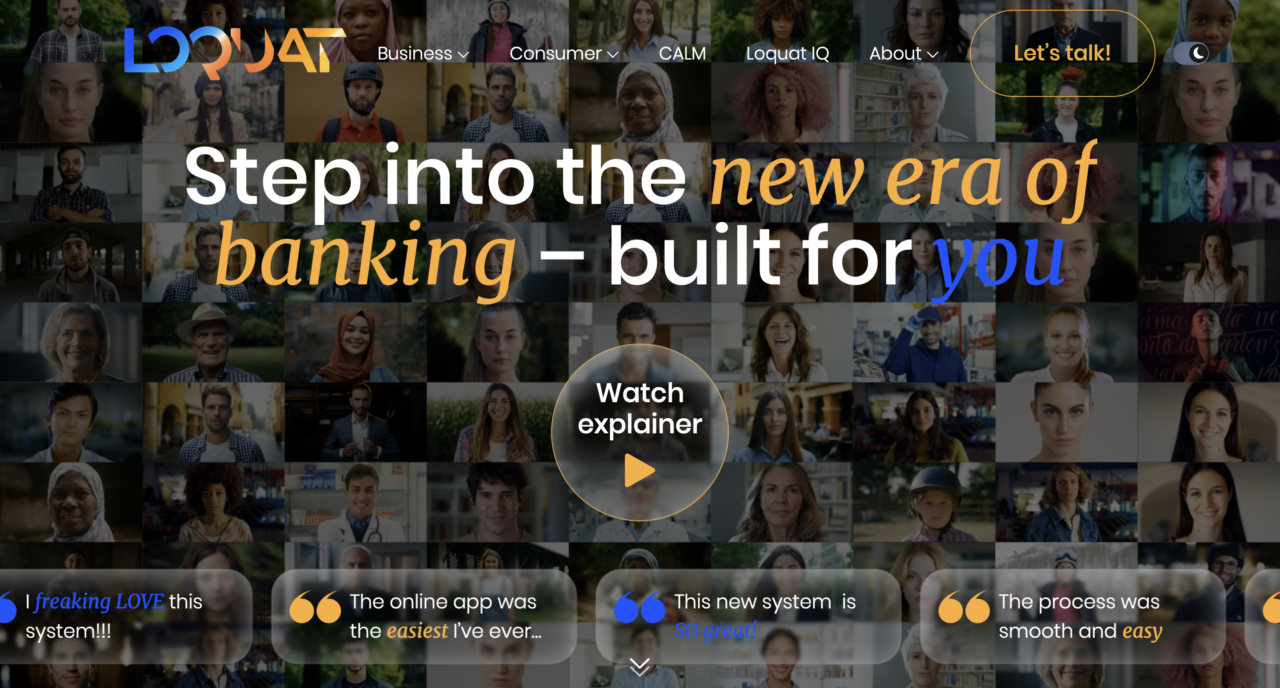
Loquat enables banks and credit unions to scale faster by digitizing onboarding, cutting review times by 80%, and unlocking new deposit growth. The company provides seamless KYC/KYB, fast onboarding, virtual cards, and automated, digital lending with streamlined origination and tailored underwriting. Loquat’s CALM Portal for credit unions and banks provides back-office queue management, compliance monitoring, and application decision-making for institution staff.
Founded in 2018 and headquartered in Miami, Florida, Loquat also offers an AI-driven insights engine, Loquat IQ, that leverages a financial institution’s data to deliver tailored insights for strategic and operational success.
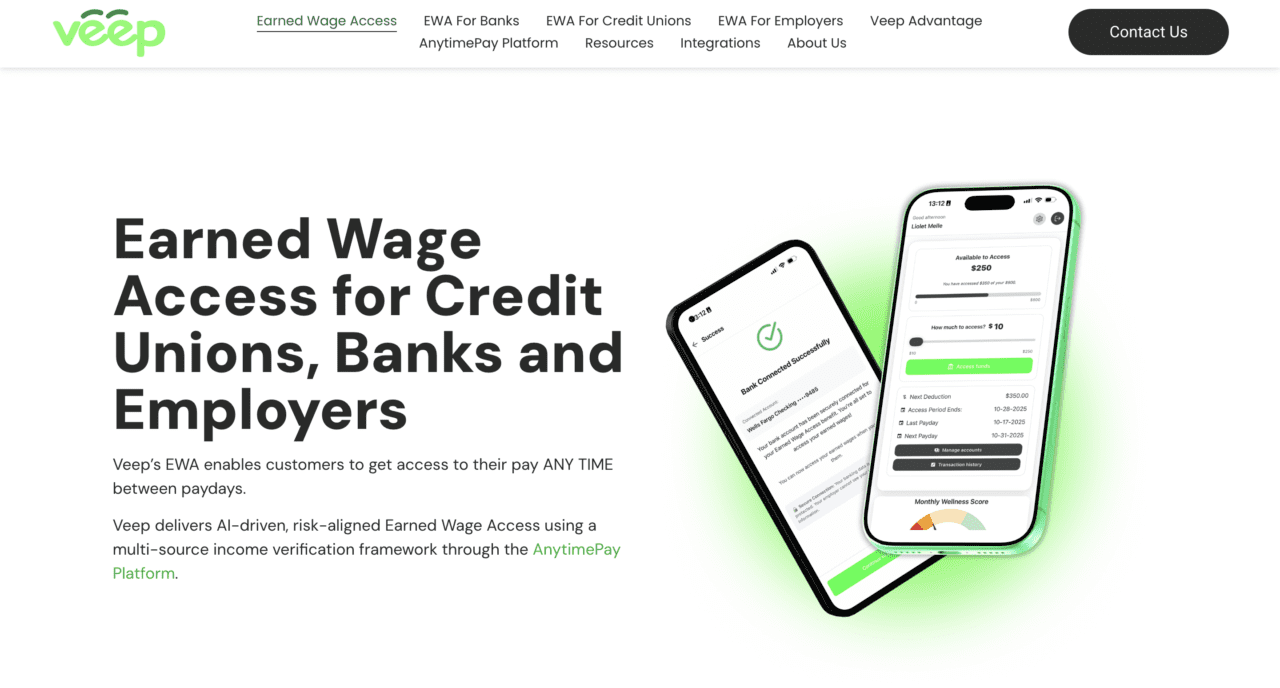
Veep Software offers AnytimePay to banks and credit unions within their app. AnytimePay allows their customers to access their pay between pay cycles. Earned Wage Access solutions like AnytimePay help improve short-term liquidity for employees and reduce reliance on high-cost alternatives. The company’s technology helps attract new, younger members; encourages increased activity within the organization’s app; and provides financial wellness to the organization’s customers.
Headquartered in Miami, Florida, and founded in 2019, Veep Software is innovating how people pay globally, providing technology that enables banks and credit unions to compete with neobanks and fintechs with their own apps.
Why banks should care
Surveys of bank and credit union leaders consistently note that solutions that help them keep their accountholders safe and their financial lives easier to build and manage are prized most by customers and members. At a time of growing cybersecurity challenges—including AI-powered fraud threats—as well as dramatic technological change, partnering with fintechs that specialize in these fields and offer these solutions is a proven way for banks and credit unions to boost efficiency by streamlining operations, and grow their customer bases via in-demand services that offer financial guidance; early access to earned wages; and secure, conditional payments, and more.
How can we recognize AI as a tool for expanding human abilities and enhancing creativity rather than merely a way for corporations to eliminate jobs? What does it mean when some AI experts suggest that AI, instead of replacing human activity, will enable us to use our unique skills as human beings in different, more sophisticated ways?
Finovate Senior Research Analyst Julie Muhn interviewed Georgia Lewis Anderson, Co-founder and AI consultant with Lantyn, and a leading expert on artificial intelligence, to discuss these and other questions about the state of AI in 2026. Following her keynote address at FinovateEurope earlier this year, Anderson discussed the rapid evolution of AI, the idea of AI as a “cognitive prosthetic,” and how this concept can be used to enhance rather than replace human ability and creativity.
“If air travel had evolved at the same rate as large language models, then we would be able to get from London to New York in 15 seconds. So if you’re feeling overwhelmed with AI, it’s not a surprise. I’ve worked in AI since 2016, way before GenAI, before the ChatGPT moment, and I’m still catching up every day. I think anyone who says they know everything about AI is lying, so I just want to quell and soothe the fears. Our skills are going to be used differently. I think we’re all quite worried AI is going to replace us, but I think actually it’s about using our skills in a different way.”
Georgia Lewis Anderson is a leading AI consultant and prompt engineering specialist whose career spans crafting Cortana’s British personality at Microsoft and launching Google Assistant in the UK. More recently, she contributed to Meta’s large language model (LLM), Llama 3. She regularly delivers talks at high-profile events such as Ogilvy’s Behavioural Science Festival, where she shares insights on the intersection of AI, human behavior, and marketing.
Lantyn was launched in 2025 to help people explore artificial intelligence in a more relatable, engaging way, regardless of background or technical experience. The London-based company offers AI cheat sheets on how, when, and where to use AI, and features podcasts in which the team creates AI tools and products, and then shares their experiences with viewers.
For years, Finovate has championed credit unions and the fintechs that serve them through our Credit Union Spotlight. This year at FinovateSpring 2026, Finovate is bringing that same level of attention and insight to the world of community banking with our FinovateSpring Community Bank Spotlight. Taking place on Wednesday morning, May 6, our Community Bank Spotlight is a new and unique opportunity for community bank leaders and employees to network with each other, share best practices, and meet with fintech innovators that have developed solutions specifically for community banks and their customers.
Consumer interest in community banks is strong and community banking leaders are expressing optimism about their near-term outlook. A survey conducted by the American Bankers Association (ABA) in 2026 indicated that more than half (58%) of community banks expected significant growth in their geographic footprint this year. This included more than 20% of respondents noting that they anticipate growth beyond their current footprint in 2026. Additionally, these institutions and their leaders are ready to embrace new technologies in order to run their businesses better. Half of the community banks surveyed indicated that they planned to use technologies like AI to reduce costs.
Nevertheless, community banks face major challenges—perhaps the most significant being the growing gap between bank customer expectations and what many banks, especially community banks, can deliver operationally. A new report—the Integris 2026 Banking Trust and Technology Report—uses data from dual surveys of US banking executives and 1,000 bank customers to show how the high level of trust that customers have in their banks is at risk of being undermined by anxiety over the role of new technologies such as AI. Writing about the report in a recent blog post, the Independent Community Bankers of America (ICBA) noted: “While customers continue to place high trust in local institutions, that trust is increasingly fragile, influenced by cybersecurity visibility, AI decision making, and the perceived maturity of a bank’s technology infrastructure.”
What can leaders and employees of community banks expect from this year’s inaugural Community Bank Spotlight? The session will begin with networking over coffee and breakfast to allow attendees to connect with each other and speak candidly about issues they may not want to share with the broader Finovate audience. Following the networking session and breakfast, a curated selection of fintechs will be invited to introduce themselves and explain how their innovations can help solve challenges for community banks and their customers. Session attendees will have the opportunity to learn about each company during the session, and can follow up with those fintechs that most interest them.
Attendees of our Community Bank Spotlight will also benefit from access to the full conference—including more than 50 innovative fintech demos; insightful, expert speakers from banking, fintech, and technology; as well as high-impact networking with members of the broader financial services and fintech industries.
“Community banks are increasingly attractive to fintech innovators, and smaller FIs are looking more and more for new technologies as they seek to enhance their offerings and grow,” Finovate VP and Director of Fintech Strategy for Informa Festivals Greg Palmer said. “The Community Bank Spotlight is a perfect venue for both sides to come together and have the vital conversations they all need to plan for the future.”
If you are an employee of a community bank and would like to be a part of our Community Bank Spotlight at FinovateSpring this year, contact our Engagement Manager [email protected] to secure your spot on the guest list!
And if you are a fintech looking to show community banks how your innovation can help them grow deposits and offer new, engaging services to their customers, drop us a line at [email protected] to learn more about how to participate!
Alkami Technology, a digital sales and service platform provider for financial institutions, has unveiled its Alkami Code Studio. The new offering is an AI-powered development capability—currently in beta—that will empower banks and credit unions to deliver more personalized and scalable digital experiences.
“Financial institutions are looking for partners who are not only talking about AI, but actively embedding it into their platforms in meaningful ways,” Alkami Chief Technology Officer Deep Varma said. “Alkami Code Studio reflects our commitment to investing in innovation that is both forward-looking and grounded in the needs of our customers—helping them move faster while maintaining the governance, security, and control they require.”
Alkami Code Studio is an AI-powered assistant that supports the creation, validation, and deployment of SDK components on the Alkami platform. Designed for developers, Alkami Code Studio provides standards-aligned, design-compliant components within a secure, governed environment. The solution is powered by closed-loop large language models (LLMs) operating inside Alkami’s secure infrastructure to ensure that customer code remains safely within Alkami’s ecosystem.
Embedded within the Alkami Software Development Kit (SDK) Wizard, Alkami Code Studio sits alongside Alkami’s One-Click SDK Manager, which enables users to self-manage deployments across both staging and production environments. Alkami Code Studio has been developed in collaboration with Alkami’s financial institution clients, including Patelco Credit Union, which played a major role in early testing of the technology.
“Delivering the best digital experiences that are efficient, secure, and tailored to our members’ needs is at the heart of what Patelco does,” Patelco Credit Union Director of Application Engineering Deepan Chandrasekaran said. “The early insight Alkami’s Code Studio gives us into how AI can support development workflows without compromising control brings immense and innovative benefits to our members.”
Alkami Technology’s Alkami Code Studio announcement arrives at the same time that the company previewed the launch of Alkami Engage, its digital adoption and analytics platform built to help banks and credit unions accelerate digital banking adoption. Alkami Engage offers in-app guidance and behavioral analytics to enable financial institutions learn about how their retail and business customers prefer to engage with digital banking across online and mobile experiences. The technology is integrated directly into the Alkami Digital Banking Platform, capturing near real-time user interactions such as page views, clicks, feature usage, and journey progression.
“Financial institutions invest heavily in digital transformation but often lack visibility into user behavior,” Alkami Chief Product Officer Benjamin Conant said. “Alkami Engage delivers real-time behavioral insights and in-app guidance to reduce friction, improve onboarding and self-service, and enable personalized digital experiences that drive growth and efficiency.”
A long-time Finovate alum, Alkami Technology made its Finovate debut as iThryv in 2009. Today, the Plano, Texas-based fintech is a digital sales and service platform provider for banks and credit unions throughout the US, helping them onboard, engage, and grow relationships with their customers and members. Alkami Technology is a pioneer in Anticipatory Banking, which combines onboarding and account opening, digital banking, and personalized marketing to deliver proactive, data-driven experiences that predict account holder needs and surface next best actions. Alex Shootman is Alkami Technology’s CEO.
Financial services software provider Finastra has announced an extension of its long-term partnership with Japan’s MUFG (Mitsubishi UFJ Financial Group).
MUFG will deploy Finastra’s GlobalPayplus payments hub to support ACH services in the US.
Finastra was formed via a merger between Finovate alum Misys and D+H in 2017. The company is headquartered in the UK.
MUFG (Mitsubishi UFJ Financial Group), the largest bank in Japan, has selected Finastra’s Global PAYplus to support ACH services in the United States. The announcement marks an expansion in a partnership between MUFG and Finastra that dates back more than five years when MUFG first initiated its ISO 20022 migration.
The current agreement will extend Finastra’s modern, unified payments architecture across three major regions, representing MUFG’s successful payment architecture transformation in both Japan and Europe. Adopting a modern, standardized platform will enable MUFG to achieve greater efficiency for both domestic and cross-border payments, with straight through processing rates exceeding 95% across its international operations.
“In 2021, we began our ISO 20022 journey with a bold decision to replace the core payment engine with a completely new one,” MUFG Americas CIO Alla Whitston explained. “After careful evaluation, we selected Finastra as our partner to first modernize our legacy ACH platform, benefiting from their global payments’ expertise and modern technology stack. Global PAYplus offers highly configurable capabilities to modernize our payments systems more broadly too, driving ISO 20022 compliance, and providing the flexibility to launch new services.”
Finastra’s GlobalPAYplus will deliver the scale, resilience, and configurability necessary to support MUFG’s operations worldwide, managing growing digital payment volumes and adapting to local market needs. The solution is a modular, composable, multi-cloud, multi-country, multi-rail, highly configurable, ISO 20022-native, API-based payment hub designed to enable banks and other financial institutions to modernize their payment infrastructures. The technology has more than 300 customers around the world and processes more than $7 trillion in payments value daily.
“MUFG’s continued investment is a strong signal of where banking is headed—toward modern, unified, and highly adaptable payments infrastructure,” Finastra EVP of Payments Barry Rodrigues said. “We’re proud to partner with them on this journey, helping deliver the resilience, speed, and flexibility that banks need today, while building a foundation that can evolve with future demands.”
Forged via a union between Finovate alum Misys and D+H (Davis + Henderson) in 2017, Finastra today is a trusted financial services software partner for more than 7,000 customers—including 40 of the world’s top banks. The company has expertise in lending, payments, and universal banking, and includes scalable, mission-critical solutions such as Loan IQ, LaserPro, Trade Innovation, Payments to Go, and Financial Messaging in its product portfolio—along with Global PAYplus. The company is headquartered in London. Chris Walters is CEO.
The 2026 Finovate Awards are here! Celebrating the best and brightest in fintech and financial services, this year’s awards will crown more than 30 winners in fields such as payments, lending, alternative investing, financial inclusion, and more! Nominations are now open, so check out this year’s Finovate Awards categories and submit your nomination. Submit before April 24 and save $100 on the nomination fee.
This year’s competition will be judged by a team of experts from the banking, fintech, and financial services industries. “An award is only worth something if the people giving it know their stuff, and our amazing lineup of judges this year should be exciting for everyone involved,” Finovate VP of Strategy Greg Palmer said, “It’s great to see so much talent on the roster!”
Take a look for yourself at this year’s selection committee. Also joining this year’s judging team will be Finovate VPs Greg Palmer and Heather Stowell, along with Finovate Research Analysts Julie Muhn and David Penn.
Mary Wisniewski, Editor-at-Large, Cornerstone Advisors
Wisniewski is editor-at-large at Cornerstone Advisors where she helps shape content strategy and hosts Money Isn’t Everything, a biweekly podcast that explores early-stage fintech ideas. She also writes a monthly editor’s note, Finteching with Mary, on LinkedIn.
A frequent speaker at leading digital banking events, Wisniewski has covered fintech and digital banking for more than 12 years, with bylines in GonzoBanker, American Banker, Bankrate, the Associated Press, and more.
Kilian Thalhammer, Managing Director, Deutsche Bank AG
With more than 20 years in payments, fintech, e-commerce, and loyalty, Thalhammer is an expert in managing critical product, strategy and business development issues. After being Director Solutions for the Swiss Post, he joined RatePay (Otto Group) as CPO and was global CPO of PAYMILL (Rocket Internet) until 2014.
Kilian is now responsible for the business unit merchant solutions at Deutsche Bank. This covers Deutsche Bank’s global issuing and acceptance business and the business with fintech, platform & technology clients.
Stave serves as Chief Technology Officer of RBC Clearing & Custody, where he has built a 25-year career spanning leadership roles across technology, finance, and operations—most recently as Chief Operating Officer before assuming his current position in 2021.
As CTO, Stave oversees technology product management, technology strategy, data management, engineering, fintech partnerships, service & support, technology training, and consulting for the firm.
Lisa Gold Schier, Advisor, Reading Cooperative Bank
Schier is a trusted C-Suite adviser specializing in fintech evaluation and go-to-market strategy within the banking and technology sectors. She brings deep expertise in assessing financial technology solutions and guiding their successful market entry and adoption by financial institutions.
Schier is recognized for building and leading strategic partnerships from ideation through contract negotiation to financial institution adoption and ongoing business development.
Glen Sarvady, Founder, 154 Advisors
Sarvady is a 25 year veteran of the payments and fintech industries. His firm 154 Advisors provides actionable insights, data-driven analysis and strategy formulation to help FIs navigate the rapidly evolving payments landscape.
Sarvady is a former Federal Reserve Bank examiner and part of the startup team that launched the University of Pennsylvania Student Federal Credit Union. He also managed Deluxe’s financial services check and payments programs for two years.
Ransom is an SaaS entrepreneur, executive, investor, and advisor. He has started, grown, and/or led eight B2B and consumer SaaS companies during startup and growth phases.
He is currently the Managing Director of BankTech Ventures, a strategic investment fund focused on empowering disruptive technologies for community banks. Founded and funded by leaders in the community banking world and endorsed by the ICBA (Independent Community Bankers of America) and The Venture Center, the fund won Finovate’s 2020 Accelerator of the Year.
Jim Perry, Senior Strategist, Market Insights
As Senior Strategist at Market Insights, Perry helps financial institutions across the country make smarter decisions and unlock new paths to growth through custom research and data-driven strategy. A trusted advisor to banks and credit unions across the US, Perry brings clarity to complex challenges and a fresh perspective to conversations about growth, innovation, and relevance in a rapidly changing landscape.
Co-founder of the Fintech Book Club and named one of the “Top 100 Fintech Influencers” by Onalytics, Perry is a regular on the speaker circuit at industry events from local associations to global conferences.
Lohith Paripati, Product Leader, Walmart
Paripati is a seasoned product leader with over a decade of experience building and scaling fintech and commerce platforms. He currently leads AI-driven initiatives for Walmart Marketplace sellers, focusing on applying generative AI to payments and financial workflows to drive growth and efficiency at scale.
Paripati brings deep expertise in payments, monetization, and platform strategy, with a strong focus on aligning customer value with business outcomes.
Tiffani Montez, Principal Analyst, EMARKETER
Montez is Principal Analyst leading the Analyst Access Program for Financial Services at EMARKETER formerly Insider Intelligence. She oversees the content across Banking, which provides actionable insights on advancements in how value is stored, managed, transferred, and spent, for an audience of top banks and neobanks.
Her unique blend of experience as a practitioner, analyst, and vendor solution provider gives her the foundation to be able to provide thought leadership to clients through all lenses of the financial services ecosystem.
William Mills III, Chief Executive Officer, William Mills Agency
Mills joined the firm in 1983 and founded their public relations services in 1989 which now accounts for more than 90% of their billings. He serves as lead consultant for the agency’s clients and has personally advised more than 500 C-level executives on marketing strategy, business development, mergers and acquisitions, company branding and public relations.
Mills’ other responsibilities include agency financial management, client consulting and leading business development and marketing services for the agency.
Eric McCabe, Head of Embedded Finance, Citizens
McCabe serves as Head of Embedded Finance at Citizens. In this capacity he guides the bank’s effort to embed Citizens financial products in third-party platforms used by Citizens customers, and to enable platforms, brands, and fintechs to provide financial services to their customers, backed by Citizens.
Prior to joining Citizens, McCabe held roles in Embedded Payments, Fintech Strategy, Product and Operations at SVB and Citi.
Suraj Manjunath, Executive Director, Investment Banking Technology, JP Morgan
Manjunath is a senior product leader shaping the future of investment banking through AI-driven innovation. He is experienced in leading large, cross-functional teams to drive strategic change and unlock growth, efficiency, and competitive advantage across the global investment banking ecosystem.
Manjunath specializes in applying artificial intelligence, automation, and data-led insight to reimagine how financial institutions operate, make decisions, and deliver value.
Luther Liang, SVP, Head of Product, Grasshopper Bank
Liang leads the strategy and execution behind fintech products that empower small businesses, consumers, commercial enterprises, and fintech (Banking-as-a-Service) partners.
Grasshopper’s product roadmap to delivered the bank a premium exit at ~2.5x tangible book value $369M acquisition by Enova International in December 2025 that significantly outperformed the 1.5x industry median.
Sam Kilmer, Managing Director, Cornerstone Advisors
Kilmer leads Cornerstone Advisors’ fintech advisory practice working with industry providers, fintechs, and investors. He also leads selective strategy engagements with banks and credit unions. Sam’s prior experience includes leadership at two financial tech firms and two midsize banks including digital banking, marketing, analytics, implementations, partnerships, and strategy.
Kilmer is a nationally sought-after speaker, industry research author, host of Fintech Hustle podcast, and a contributor to GonzoBanker and the industry press.
Bruno Jivan, Head of Innovation and Research, Novobanco
Jivan is Director of Innovation & Research at novobanco. He has broad and diversified experience across the financial sector, including credit analysis, risk, project finance, M&A, product, marketing, transformation and innovation.
In his current role, he focuses on fostering innovation culture and mindset, strengthening connections with the fintech ecosystem, and leading the large‑scale adoption of AI across the organization to deliver practical, customer‑centric impact.
Nicolai Farcas, Chief Technology Officer, Consumer, Small & Business Banking Digital, Wells Fargo Bank
Farcas is a senior executive leader with over 25 years of experience driving enterprise strategy, transformation, and execution across global financial services organizations. He specializes in Consumer and Small Business Banking, including the Move Money portfolio, enterprise PMO leadership, and large-scale business and technology transformation initiatives.
During his tenure at Wells Fargo, Nicolai has held senior leadership roles including Global C-Suite Executive, Chief Technology Officer, and Head of the Project Management Office (PMO).
Sam Das, Managing Director, TruStage Ventures
Dasis Managing Director of TruStage Ventures, the venture capital arm of TruStage. Since joining, Das has focused on sourcing, investing and advising early-stage fintech and insurtech startups. He is also the Vice President of Corporate Development at TruStage, evaluating and executing a broad range of strategic transactions for the organization. Das joined TruStage in 2017.
Prior to joining TruStage, Das was the founder and CEO of a fintech startup and served as an investment banker at firms including Houlihan Lokey and Fox-Pitt, Kelton.
Sushma Daggubati, Manager of Product Management, Mastercard
Since 2016, and over her eight years at Mastercard, Daggubati has consistently progressed to more challenging positions every two years from release management to software engineering, leading to her current position, denoting an exceptional ability to transition from pure technical roles to more commercial ones.
She has also contributed to the industry by developing several patents which have been cited by some of the world’s largest and most prestigious firms including Shopify, Walmart, and Worldpay.
Soner Canko, Founder, SC Management Advisory
Canko graduated from the Faculty of Political Sciences at Istanbul University, where he also earned his Master’s and PhD degrees. He began his career in multinational corporations, holding various roles at Procter & Gamble, Citibank, Hewlett-Packard (HP), and First Data.
Recognized for his work in financial technologies, Canko currently serves as a management consultant and independent board member. He is also actively involved in the following platforms: Turkish Enterprise Institutions, FinTech Istanbul, Blockchain Türkiye.
Tanya Andreasyan, Managing Director and Editor-in-Chief, FinTech Futures
Andreasyan is MD and Editor-in-Chief of FinTech Futures, the definitive source of intelligence for the global fintech sector. An experienced journalist and a long-term resident of the fintech ecosystem, she has extensive understanding and knowledge of the industry and its participants.
With in-depth coverage of fintech issues on a worldwide scale, FinTech Futures is a leading resource for technology buyers, sellers, developers, integrators and other specialists across the sector.
FinovateSpring is right around the corner (May 5-7). So while we’re busily compiling and sharing the top fintech headlines and announcements of the day, please forgive us for occasionally sharing our excitement at what we believe is an incredible line-up at this year’s conference.
From the more than 40 companies that will be making their Finovate debuts to an all-star roster of insightful banking and fintech keynote speakers and panelists, FinovateSpring 2026 in sunny San Diego is an event you won’t want to miss!
Until then, we’ll keep you posted on the fintech news you need to know here at the Fintech Rundown!
Wealth management
AI-native registered investment advisor Savvy Wealthunveils its agentic AI solution for advisors, Savvy Intelligence.
Mackenzie Investments teams upOneVest to power a full digital transformation, including the launch of modern advisor and investor portals, a new mobile app, and more.
GCC-based wealth management firm, The Family Office, launches its AI-powered assistant, Wealth Mermaid, fully integrated into its Client app.
Payments
PayNearMeunveils new capabilities within its PayXM platform including Payer Re-Engagement, Dynamic Payment Options, and Invite a Payer.
Enfuce, a card issuing and payment processing provider and a Finovate Award winner, to join Mastercard Product Express to support business card issuance throughout Europe.
Stablecoins
Cross-border payments platform dLocal launchesStablecoin Full to enable merchants to collect, convert, and make payouts using stablecoins across emerging markets.
Business banking fintech Meowpartners with stablecoin infrastructure provider BVNK to power crypto-to-fiat business payments.
C-suite
Capital markets technology platform services provider Trading Technologiesintroduces new Chief Strategy Officer Nick Garrow.
Chase UKselects Monzo’s chief banking officer Kunal Malani as its new CEO.
This week’s edition of Finovate Global looks at recent fintech headlines from Guatemala, El Salvador, and Aruba.
Credit Assessment Platform CreditYa Launched in Guatemala
Colombia-based financial services company YUMIVI S.A.S has brought its AI-powered credit assessment platform, CreditYa, to Guatemala. CreditYa is a digital microcredit platform designed to provide small, fast, accessible, and reliable financing to individuals and small business owners. Founded by Wingston Oswaldo González Reyes, CreditYa’s entry into the Guatemalan market is the company’s first expansion beyond its native Colombia. The company’s Regional Operations Lead María Gabriela noted in a statement that the launch was “the first step in (the company’s) long-term commitment” toward making financial services more accessible to “every hard-working Guatemalan with a digital footprint.”
Gabriela added: “In Guatemala, business opportunities are often fleeting. Whether it is purchasing materials in advance to meet a sudden surge in orders or repairing store equipment that fails unexpectedly, entrepreneurs need timely access to fast and flexible financial support—not an endless approval process. Our goal is to eliminate delays through technology. Users only need to download the app, complete identity verification, and authorize data access within minutes to receive a preliminary credit assessment and, in most cases, gain access to financial support within 24 hours.”
Using advanced data analytics and AI intelligence, CreditYa delivers fast and convenient digital financial services to individuals and microenterprises in Latin America. The company has established partnerships with local payment gateways and data processing providers to ensure that its operations are compliant with local regulations. CreditYa will also work with community organizations to deliver financial education and boost financial inclusion in the Guatemalan market.
“We are not just a financial app,” Gabriela said. “We aspire to be a trusted partner for users as they pursue a better life and grow their businesses.”
Tether Introduces New Stablecoin Wallet
Digital asset company and issuer of the USDT stablecoin, Tetherlaunchedtether.wallet, the People’s Wallet, this week. Tether.wallet is a self-custodial digital wallet that puts the company’s international financial infrastructure directly into the hands of its users.
“Tether has achieved, without any doubts, the widest financial inclusion success story in the history of humanity,” Tether CEO Paolo Ardoino boasted. “With more than 570 million people already using Tether’s technology, the next step is making that digital infrastructure even more accessible and usable by the end users. The objective is to remove the complexity that has prevented broader adoption while preserving the properties that make the digital assets technology valuable.”
Until now, Tether operated primarily as part of the underlying layer of the digital economy, enabling liquidity, settlement, and payments across more than 160 countries, with its USDT stablecoin becoming among the most popular digital representations of the US dollar. The launch of tether.wallet puts this entire infrastructure in the hands of end users, enabling them to transact in digital dollars by way of USDT and USAT, gold by way of XAUT, and via Bitcoin. The wallet is built to remove the complexity that tends to limit broader embrace of digital assets, for example, enabling users to send funds with simple, straightforward, human-readable identifiers such as “[email protected]” rather than long, error-prone wallet addresses.
The solution is 100% self-custodial. All transactions are signed locally on the user’s device before being broadcast to the network, and private keys and recovery phrases remain under exclusive control of the end user.
“Tether.wallet is ‘the People’s Wallet’ because it truly reflects the natural evolution of Tether’s role, from building the foundation of the digital asset economy to making it directly usable by anyone, ready for a future in which tens of billions of humans, machines, and trillions of AI agents will transact seamlessly at the speed of light,” Ardoino said.
Founded in 2014, Tether named El Salvador as its formal headquarters last year after securing a license under the country’s Digital Asset Issuance Law. The goal was to capitalize on El Salvador’s status as an emerging crypto currency hub and its embrace of Bitcoin. The move gave Tether its first physical headquarters. The firm was previously incorporated in the British Virgin Islands.
Aruba-based AIB Bank Partners with Finastra for Digital Banking
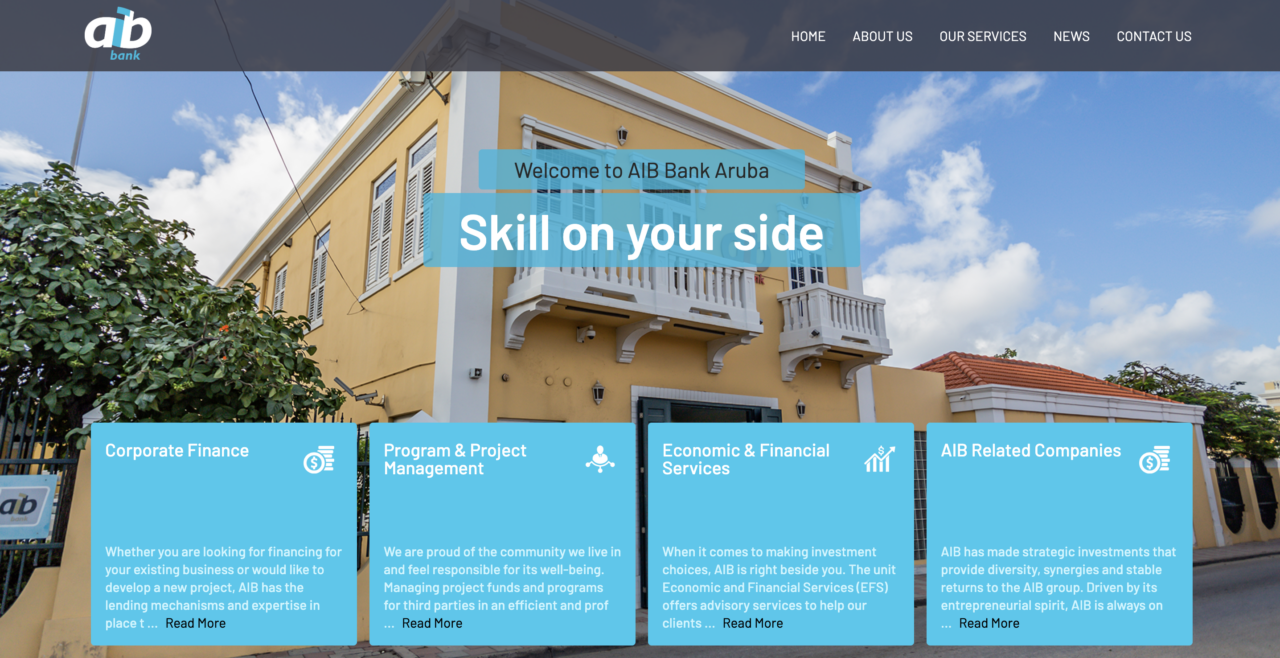
AIB Bank, an Aruba-based financial institution with nearly $2 billion in assets, has inked a deal with Finastra to deploy its Finastra Essence core banking solution. The deployment is part of AIB Bank’s goal of establishing the first fully digital bank in the country. Finastra Essence will deliver an enhanced core solution that blends broad and deep digital banking functionality with advanced technology to empower banks to offer customers faster transactions, greater reliability and security, and the kind of modern, personalized digital experiences that customers have come to expect.
“Choosing Finastra Essence allows us to position ourselves at the forefront of full-service digital banking innovation in Aruba and across the Caribbean,” AIB Managing Director Frendsel Giel said. “This transformation of our recently acquired commercial bank will not only enhance the way we serve our customers but also establish a solid foundation for accelerated growth and long-term success in Aruba and the region.”
Founded in 1987, AIB Bank is a privately owned financial institution based in Oranjestad, Aruba. The company specializes in loan syndication, agency services, corporate lending, program and project management, as well as advisory services, and has structured large and complex financing through Aruba and the region.
Formed via a merger between D+H Corporation and Finovate alum Misys in 2017, Finastra works with banks and other financial institutions to help them deliver secure and trusted mission-critical financial services technology. Headquartered in the UK, Finastra has more than 7,000 customers around the world using its financial services software, including 80% of the top 50 global banks, and moves $7 trillion in transactions every day. Chris Walters is Finastra’s CEO.
Here is our look at fintech innovation around the world.
Sub-Saharan Africa
PitchBook looked at the current state of venture capital funding for fintechs in Africa.
South African bank Capitec partnered with Wise Platform, Wise’s international payments infrastructure for banks and enterprises.
Visa Africa Fintech Accelerator reached 100 startups since inception with its fifth cohort.
Central and Eastern Europe
Germany’s Deutsche Börse purchased a 1.%% fully diluted stake in crypto platform Kraken.
Polish fintech PragmaGO, which provides financial services for small and medium-sized businesses, expanded to Croatia.
Cryptonews examined how the recent election in Hungary could rekindle debate on crypto policy and regulation.
Middle East and Northern Africa
Central Bank of the UAE unveiled its e-KYC platform
Trading and investment platform eToroannounced plans to acquire Israel-based crypto wallet Zengo.
Nu Mexico, the Mexican subsidiary of Brazil’s Nubank, topped the 15 million customer milestone, establishing itself as one of Mexico’s three largest financial institutions by customer base.
Uruguay-based cross-border payment platform dLocal partnered with Italy’s NEC to power international remittance payouts.
Aruba’s AIB Bank teamed up with Finastra and will deploy the fintech’s core banking solution Finastra Essence.
Asia-Pacific
Japan’s largest bank, Mitsubishi UFJ Financial Group, expanded its partnership with Finastra to support ACH payments in the US.
Indonesian bank CIMB Niaga, Google Cloud, and Artefact unveiled enterprise AI agents to bring greater personalization to the banking experience for customers.
Australian Trade and Investment Commission sent a delegation to Vietnam to support deepening fintech ties with the country.
Oracle is embedding agentic AI directly into corporate banking workflows, launching pre-built agents across credit, trade finance, treasury, and lending.
The tools target some of banking’s most manual, document-heavy processes, enabling faster decisions and allowing teams to scale output without adding headcount.
With a human-in-the-loop approach and hundreds more agents coming, Oracle is positioning AI as operational infrastructure.
Enterprise technology company Oracle is deepening its agentic AI prowess this week. The Texas-based company announced it is adding new embedded AI capabilities and agents for its corporate bank clients.
Oracle’s new agentic AI tools will offer clients a suite of AI-infused applications and pre-built AI agents for treasury, trade finance, credit, and lending. As a result, firms can automate once-manual processes and speed decision-making, ultimately unlocking new opportunities for growth.
“Corporate banking runs on precision, resiliency, and trust,” said Oracle Financial Services Senior Vice President Sovan Shatpathy. “Our AI-powered platform embeds intelligence directly into mission-critical processes, accelerating decisions and strengthening governance so banks can serve clients with greater speed and confidence.”
The two main pillars of the new launch include corporate credit and trade and supply chain finance. The corporate credit arm has five main agents that help with data extraction from loans, financial statements, and documents, and generate credit memo reports. The trade and supply chain finance has an application validator agent that ingests bank guarantee application packages and supporting documents and delivers a risk recommendation, as well as an agent that analyzes sales contracts and designs an appropriate supply chain finance program.
Because Oracle’s agentic AI takes a human-in-the-loop approach, all decisions are supported by human expertise, maintaining oversight and ethical governance. Oracle said that these agents are among “hundreds” of other corporate and retail banking agents that will launch in the next 12 months.
Much of the AI development we’ve seen in banking over the past two years has been customer-facing, taking the form of chatbots and personalization tools. Oracle’s new push into agents removes the strain from some of the most manual, document-heavy parts of corporate banking. Instead of just offering faster memo writing, Oracle’s tools allow credit teams to handle more deals without increasing headcount, offer a standardized approach to trade finance, and provide banks a way to offer faster response time to their clients.