This site is operated by a business or businesses owned by Informa PLC and all copyright resides with them. Informa PLC's registered office is 5 Howick Place, London SW1P 1WG. Registered in England and Wales. Number 8860726.
Finovate Blog
Tracking fintech, banking & financial services innovations since 1994
For companies involved in the business of empowering developers to build business-critical fintech applications, the world has changed a great deal over the past decade. From the rise of AI to a sea-change in regulatory priorities that has increased scrutiny on third-party relationships, fraud and risk management, consumer data protections, and more, the task of providing fintech developers with the tools they need to innovate has only become more challenging.
This makes the recent news from 3forge, a New York-based fintech that has been empowering fintech designers and developers for 15 years, all the more interesting.
“We started 3forge in New York, in 2011, to build a transformative platform enabling your designers and developers to build applications in a fraction of the time and cost, with a focus on business-critical scale, performance, and interoperability,” 3forge Founder and Chief Technology Officer Robert Cooke said from the Finovate stage at the beginning of the company’s Finovate debut in 2022.
Today, the New York-based fintech announced the launch of its application fabric for finance. 3forge Enterprise unifies real-time data, business logic, AI, and application development in a single operational environment. This gives financial institutions a production-ready continuum from data to deployed application. 3forge Enterprise provides a data gateway that unifies current-state access to real-time and historical tables, streams, and procedures across data nodes in the 3forge fabric. The technology enables developers and applications to publish, subscribe, query, and insert data via native connectivity in Java, Python, and C++, and provides failover support and integrations across JDBC, Pandas, and SQLAlchemy libraries. 3forge Enterprise also provides MCP server and AI agent access, live prompting and agentic development, and an operations hub that centralizes the management of 3forge deployments.
“For years, financial institutions treated data platforms, business logic, and applications as separate architectural domains,” Cooke said. “That separation made sense operationally, but it is increasingly inefficient for high-value capital markets workflows. As AI raises the stakes, models and agents need more than disconnected data estates and fragmented application logic.”
3forge Enterprise uses three layers to transform platforms into an enterprise-wide fabric for financial systems: a governed real-time intake and exhaust layer for financial data, an application engine and AI-assisted development layer for building and running financial workflows that helps users move from data to production, and an operational control layer to facilitate managing deployments at scale. Combined, these layers enable vendor platforms, internal systems, and AI-powered applications to access real-time and historical data via unified queries, streams, APIs, and agents. At the same time, 3forge Enterprise preserves the entitlements, auditability, and production controls needed for capital markets.
“An application fabric brings data, decisions, execution, AI, and applications onto the same controlled, auditable foundation,” Cooke explained. “For tier-one financial institutions, 3forge Enterprise provides a way to extend and modernize complex existing infrastructure. For mid-market banks, broker-dealers, hedge funds, and asset managers, it provides access to a production-ready application fabric without having to build one from scratch.”
Founded in 2011 and headquartered in New York, 3forge made its Finovate debut at FinovateFall 2022. At the conference, the company showed how its Full Stack Enterprise platform enables developers to quickly build customized business-critical solutions with an emphasis on workflow transparency, real-time visualization, and data discovery without limitation.
Stripe-owned stablecoin infrastructure platform Bridge is partnering with Banking Circle to enable clients to move stablecoins into and out of local currencies, with support for EUR, GBP, USD, and soon AUD.
The partnership combines Bridge’s stablecoin capabilities with Banking Circle’s regulated banking infrastructure, correspondent banking network, and local clearing access to facilitate cross-border payments and fiat-to-stablecoin conversions.
The deal reflects the growing convergence of traditional banking and stablecoin infrastructure, as businesses increasingly seek regulated on- and off-ramps that make stablecoins practical for everyday global payments.
Banking Circle, a Luxembourg-based bank, announced today that Stripe-owned stablecoin infrastructure platform Bridge is using it to move money across the globe.
Banking Circle’s money movement infrastructure enables Bridge’s clients to move stablecoins in and out of local currencies. Currently, Banking Circle supports EUR and GBP, and plans to offer support for AUD in the third quarter of this year. Bridge will also use Banking Circle’s SWIFT capabilities to allow its clients to send and receive USD.
By offering stablecoin on- and off-ramps to and from local currencies, Bridge is giving its clients the flexibility to send and receive payments in multiple European currencies without having to worry about holding the currencies themselves.
“As payment businesses continue to expand globally, access to reliable, scalable banking infrastructure is critical,” said Banking Circle Chief Digital Assets Officer Kirit Bhatia. “Banking Circle provides regulated banking rails, local clearing access, multi-currency accounts and cross-border payment capabilities through a single integration, helping companies simplify operations and accelerate growth in new markets.”
As a fully regulated, licensed bank, Banking Circle offers Bridge access to its correspondent banking network for global payments. The company was founded in 2013 to provide payments, banking, and lending infrastructure to financial institutions and regulated payment businesses.
The partnership highlights the growing convergence between stablecoin infrastructure providers and traditional banking institutions. While Bridge offers businesses a way to move value using stablecoins, Banking Circle provides the regulated banking rails, local clearing access, and correspondent banking relationships needed to move funds into and out of local currencies.
“Banking Circle’s API-led infrastructure and multi-currency capabilities support our continued global expansion,” said Bridge Head of Product Mai Leduc Blount. “By making it seamless for businesses to convert between fiat and stablecoins, we ensure that any business can use stablecoins for everyday expenses, all around the world.”
Bridge was founded in 2022 to serve as an alternative payment method to compete with SWIFT and credit cards and was acquired by Stripe in 2024 for $1.1 billion. Bridge’s technology allows businesses to move, store, and accept stablecoins using just a few lines of code. The company’s Issuance APIs help clients issue their own stablecoin and accept USD, EUR, USDC, USDT or any other stablecoin.
Pay-by-bank provider Aeropay has teamed up with banking technology and modernization company Jack Henry.
Aeropay will integrate with Jack Henry Payments Orchestrator to boost its bank integration capabilities and enhance its pay-by-bank network.
Founded in 1976 and celebrating its 50th anniversary this year, Jack Henry has been a Finovate alum since 2010. The company is based in Monett, Missouri.
Pay-by-bank provider Aeropayannounced an integration with Jack Henry that will help the company expand its instant payments capabilities and boost the resilience of its national pay-by-bank network. Aeropay is integrating with Jack Henry Payments Orchestrator (formerly Victor Technologies) to not only enhance its bank integration capabilities, but also to introduce new payment rail infrastructure throughout its ecosystem.
“Bank payments just got more reliable,” Aeropay noted on its LinkedIn page when the news was announced. “Aeropay just integrated with Jack Henry, expanding our real-time payment infrastructure and adding smart routing across our network. For merchants, that means even fewer failed payments and faster funds. The integration is live.”
The integration enables request-for-payment (RfP) and real-time payment (RTP) capabilities, enhancing Aeropay’s multi-rail architecture. Aeropay will be able to dynamically route transactions based on performance, availability, and risk conditions. As RfP and RTP networks continue to expand to more and more US financial institutions, this architecture improves uptime, accelerates transactions, and offers greater flexibility for instant payment acceptance and settlement.
Chicago, Illinois-based Aeropay offers a national pay-by-bank network that outperforms cards, cash, and checks with a multi-rail payment infrastructure that includes ACH, RTP, RfP, and FedNow capabilities. Aeropay makes it easy for companies to add and scale bank connections, pay-by-bank, instant payouts, and AI risk prevention. The firm’s pay-by-bank offering lowers processing costs by 50% and helps accelerate cash flow with payments that settle same-day (or faster). Aeropay’s pay-by-bank network also features built-in risk prevention, preventing returns and eliminating chargebacks via real-time verification, AI risk scoring, network intelligence, and guaranteed settlement.
A Finovate alum since 2010, Jack Henry & Associates serves banks, credit unions, fintechs, and businesses with comprehensive, cloud-native solutions that unify core, digital, and other services into a single, adaptable ecosystem. Jack Henry offers financial institutions a range of internally developed modern capabilities as well as the ability to integrate with innovative fintech technologies. Currently celebrating its 50th year, Jack Henry serves more than 7,500 community and regional banks and credit unions with solutions for digital banking, payments, lending, fraud risk, and more. Jack Henry & Associates is headquartered in Monett, Missouri. Greg Adelson is President and Chief Executive Officer.
Banking technology company Temenos announced its acquisition of Swiss fintech additiv in a half-cash, half-equity transaction.
The acquisition will bolster Temenos’ wealth management franchise with additiv’s out-of-the-box orchestration and mass affluent capabilities.
Both Temenos and additiv made their Finovate debuts at FinovateEurope 2013 in London.
Banking technology firm Temenos has agreed to acquire Swiss fintech additiv. The 50/50 cash and equity deal is expected to be completed early in Q3 of 2026.
Additiv offers a specialist platform to orchestrate financial services. The company’s technology integrates process steps and data into a single orchestration layer for wealth and other financial workflows. With 30 clients in wealth management, banking, and insurance, additiv’s technology enables banks and wealth managers to rapidly design and launch wealth propositions that boost advisor productivity, orchestrate investment propositions, and provide consistent client experiences at scale.
With an extensive global client base in the wealth space, Temenos will benefit from additiv’s native mass-affluent capabilities and AI-enabled orchestration layer. The company’s fast, low-risk implementation model offers deployments in as little as 3-6 months compared to the industry standard of 12 months. With a high Net Promoter Score (NPS) above 90, Net Revenue Retention (NRR) of 138%, and double-digit growth over the past three years, additiv will enable Temenos to expand its client footprint within investment services in both developed and emerging markets, as well as provide Temenos’ wealth clients with future-ready, front office workflows.
“This acquisition strengthens our wealth proposition at a time when we see strong, growing demand for our products across tiers and geographies in the wealth segment, with financial institutions increasingly focused on launching scalable hybrid wealth models,” additiv founder Michael Stemmie said. “additiv’s orchestration capabilities complement our market-leading platform and support our strategy to help clients deliver personalized, regulatory compliant wealth services efficiently and at scale. Together, additiv’s AI-powered orchestration capabilities and Temenos’ existing front-end solutions create strong differentiation at the banking experience layer.”
Temenos offers a core banking suite and modular composable solutions to help banks and other financial institutions modernize their operations. Deployable on-premises, via the cloud, or as a SaaS solution, Temenos’ technology empowers financial institutions of all sizes to deliver innovative, AI-enhanced experiences to their customers. Founded in 1993 and based in Geneva, Switzerland, Temenos today serves more than 950 core banking and 600 digital banking clients. Thibault de Tersant is Temenos Chairman. Takis Spiliopoulos is Chief Executive Officer (and interim Chief Financial Officer).
Headquartered in Zurich, Switzerland and founded in 1998, additiv offers an API-first, cloud-based financial services orchestration platform that enables financial institutions and brands to launch, automate, and scale financial services from a singular solution. Empowering companies in wealth management, banking, credit, and insurance, additiv’s technology allows firms to expand their own offerings and introduce third-party products and services to their customers without having to replace core systems. A Finovate alum since 2013, additiv most recently demoed its technology at FinovateAsia 2017 in Hong Kong.
Earlier this year, additiv launched a new dedicated solution to help Germans navigate planned reforms to the country’s pension scheme. The reform calls for a new state-subsidized retirement investment account (Altersvorsorgedepot) that is offered digitally as a simplified, standardized solution, Standarddepot. Millions of legacy pensions (so-called “Riester” contracts) will be migrated to the new pension product, creating new urgency for institutions that seek to attract or simply retain these customers.
“This reform marks a genuine paradigm shift for German private pensions,” additiv CEO Nils Frowein said. “For the first time, capital market-based products are sitting at the heart of state-subsidized retirement savings. Institutions that are now establishing scalable digital infrastructure will secure long-term customer relationships—and with millions of Riester contracts up for migration, the window to act is open.”
Reset raised $6 million in seed funding from credit union customers and partners to expand its embedded earned wage access platform for credit unions and community banks.
The company positions earned wage access as a tool to deepen relationships and grow deposits, reporting that cardholders increase deposits by 27%, maintain 36% higher balances, and generate 20% more interchange revenue.
Credit unions increasingly view earned wage access as competitive infrastructure to defend primary financial relationships against digital banks and neobanks.
Embedded earned wage access platform Resetunveiled today that it has raised $6 million in seed funding. The investment, which comes from credit union customers and strategic partners in the credit union and community banking space, boosts Reset’s total funding to more than $8 million.
Reset will use the funds to expand its sales and implementation capacity, deepen product development, and accelerate existing deployments.
California-based Reset, which aims to serve credit unions and community banks, embeds its technology directly into financial institutions’ existing technology stacks to enable members to access their earned wages on a daily basis, fee-free, via a card issued by the credit union or community bank.
“When your customers lead your funding round, there is no clearer market signal,” said Reset CEO and Co-founder Matt Dicou. “These credit unions aren’t just writing a check. They’re making a decision about where they want to take their members, their institutions, and the credit union industry. They see that Chime and other neobanks are successfully recruiting people away from credit unions today. Our credit union partners already have trusted member relationships. We give them what they need to remain the primary financial home.”
Reset anticipates that the earned wage card will help financial institutions grow direct deposits, since the more a member deposits, the more real-time funds they can access. The company said that cardholders increase deposits held at their credit union by 27% and maintain checking account balances 36% higher than before switching cards.
In addition to the earned wage feature, Reset also helps credit unions generate credit interchange revenue on cardholder’s everyday spend. The company said that its cardholders generate 20% more in credit interchange revenue for their institution.
“When a credit union invests in a fintech, it sends a message: we believe in this enough to put our name on it. Reset is solving a real problem for working members, and it’s doing it in a way that makes the credit union stronger in the process,” said Stephanie Curtis, Chief Member Experience Officer at VyStar Credit Union.
Rather than viewing earned wage access as simply another product offering, many credit unions increasingly see these tools as infrastructure to defend primary financial relationships, capture direct deposits, and compete against digital banks. As neobanks continue using faster access to money as a customer acquisition tool, features like earned wage access may become table stakes rather than differentiators.
Georgia’s Own Credit Union’s investment in Reset highlights this shift from product experimentation toward competitive infrastructure. “Our members are already looking for this, and until now, they’ve had to turn to other options,” said Georgia’s Own Credit Union CTO Kevan Williamson. “Reset levels the playing field for our members. We invested because we’ve seen what it does for members’ financial stability, and because we believe credit unions should be the ones offering it.”
While many banks are still trying to create their stablecoin strategy (or decide to pursue a stablecoin strategy), some of the largest players in payments, acquiring, exchanges, and financial infrastructure are exploring a stablecoin collaboration.
CoinDesk reported that payments giants Stripe, Visa, and Mastercard are backing a stablecoin platform, while Coinbase is considering involvement. The move could challenge the dominance that Circle and Tether have on the stablecoin industry by helping standardize digital currency routing across legacy systems
What impact will this disruption have on players in the traditional space? Here are a few implications.
Stablecoin interoperability improves
As with many new enabling technologies in banking and fintech, stablecoins are quite fragmented. Even though Circle and Tether dominate issuance, moving stablecoins across wallets, exchanges, payment providers, and legacy financial infrastructure remains complex. Additionally, there is no universally accepted framework for how digital currency moves across financial infrastructure.
While both of these factors limit mainstream adoption, a consortium backed by companies such as Visa, Mastercard, Stripe, and Coinbase could help create a common framework that makes digital currency movement feel more like existing payment infrastructure.
For financial services providers in the traditional finance (TradFi) space, this common framework could help decrease integration costs, making stablecoin connectivity easier to implement. The shared framework could lower integration costs by reducing the number of connections banks and fintechs must build and maintain. A standardized ecosystem could potentially offer more consistent routing, settlement, and compliance processes. Importantly, the standardization would mean that banks would be able to act now instead of waiting for the winning standard to emerge.
Stablecoins become infrastructure instead of products
Right now, much of the conversation around stablecoins focuses on which company issues the token used for a transaction. Consumers, however, rarely care which payment rail, settlement network, or digital asset powers their transaction. Instead, they simply expect money movement to be fast, seamless, and secure.
For banks and fintechs, this may mean that owning the token itself becomes less important than controlling the infrastructure surrounding money movement. When consumers are rails agnostic, we may start to see that the companies that facilitate routing, settlement, custody, compliance, and customer experiences gain a competitive advantage over those that issue the underlying asset.
Economics of traditional payments face new pressure
Stablecoins are likely here to stay, but they will not replace cards, wires, or ACH payments. However, if major payment players like Visa and Mastercard help introduce new stablecoin infrastructure, it could create pressure on existing payment economics. For example, cross-border payments and merchant settlement could become faster and potentially less expensive.
This increased competition, even if only viable in certain use cases, could reduce margins and force traditional financial institutions to reconsider where they create value. Because both Visa and Mastercard have a stake in traditional payments, however, they are unlikely to introduce a structure that will eliminate traditional payment revenues altogether. Instead, there will likely be gradual pressure on pricing and a shift toward monetizing new infrastructure layers rather than existing friction.
Stablecoin strategy becomes harder to postpone
It is clear that stablecoins are no longer fringe, and at this point, sitting on the sidelines becomes a strategic decision. While it used to be acceptable to treat stablecoins like an optional experiment, the involvement of established financial infrastructure companies makes it mandatory to understand stablecoins. Traditional financial institutions of all sizes need to consider if they will issue stablecoins, custody them, connect to them, or simply enable customer access.
While the “wait and see” approach is still a valid strategy, at this stage it is more of an active strategic decision instead of a passive delay. Financial institutions that choose not to participate should do so intentionally, taking into consideration which revenue opportunities, customer segments, and payment flows they may be willing to forgo if adoption accelerates.
Finovate’s Fintech Rundown is back with the fintech headlines you need to know as the working week begins!
We’ve got news of a funding in the consumer financing world, new products for financial wellness and credit trading, a collaboration in the money movement market and more. Be sure to check back all week long for the latest in fintech headlines.
Financial wellness
The US arm of BMO launches an new app developed by MSN Holding, DollarGPS, to help users improve their financial health.
Lending
Egyptian Buy Now, Pay Later firm Blnkraises $37 million in combined debt and equity funding.
TP ICAPunveils new credit trading and data platform, RealQ.
Credit intelligence platform OctusacquiresLevPro, a front-office software provider for public and private credit markets.
Agentic AI
Spend management software provider ExpensifylaunchesExpensify MCP, a new integration that enables AI assistants and other MCP-compatible clients to securely access Expensify data via natural language queries.
This week’s edition of Finovate Global looks at recent fintech headlines from the Eastern European nations of Bulgaria, Albania, and Hungary.
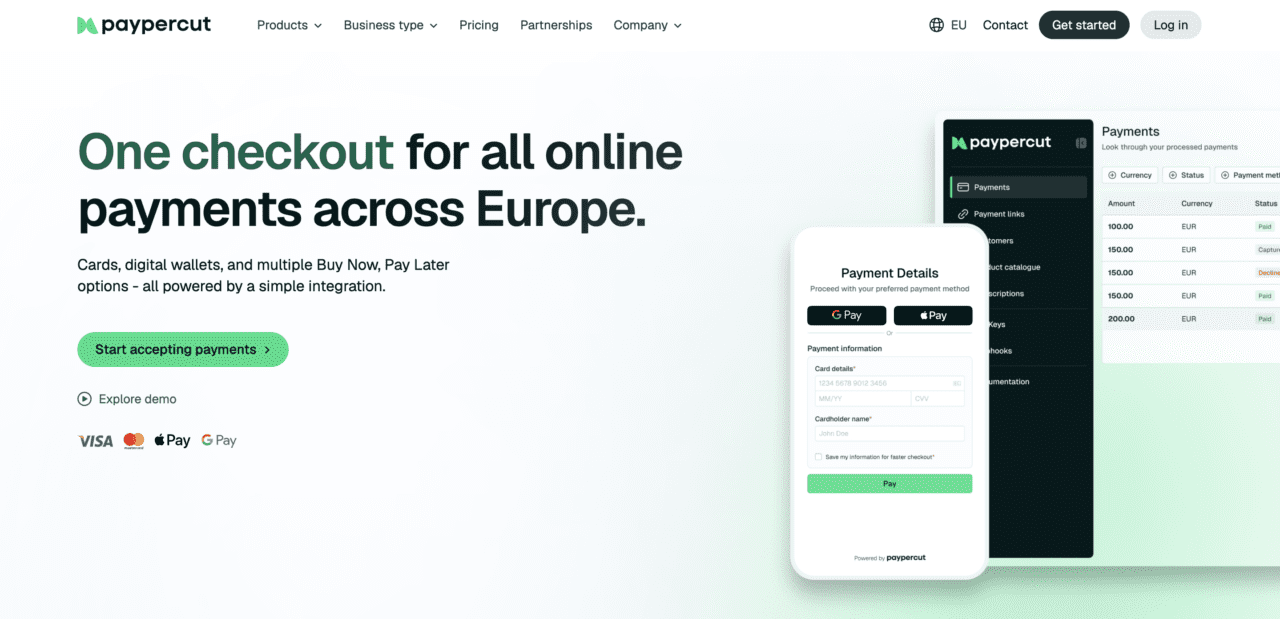
Bulgarian Fintech Paypercut Raises €5M
Paypercut, a fintech based in Sofia, Bulgaria, has secured €5 million in seed funding. The round was co-led by Concentric, Passion Capital, and Araya Ventures, and featured participation from additional investors including SMOK Ventures, Portfolio Ventures, BrightCap Ventures, BlackWood, SABAH.fund, MFG Invest, Main Set, and Matt Doka, a payment entrepreneur. Paypercut’s total funding now stands at €7 million.
Founded in response to the fragmentation of payments in Central and Eastern Europe, Paypercut has grown from a Buy Now, Pay Later aggregator into a more comprehensive payments platform. The company offers merchants access to card payments, local payment options, Buy Now Pay Later products, payment links, QR code payments, multi-currency settlement, and billing tools via a single integration. Paypercut raised €2 million in pre-seed funding in July 2025 and has onboarded more than 200 merchants in eight CEE markets since that time.
This week’s investment will help fuel Paypercut’s continued expansion across Central and Eastern Europe. The funding will also enable the firm to meet the capital requirements for an EMI license with the Central Bank of Ireland.
“CEE has always been treated as an afterthought by the payments industry, seen as too fragmented, too many local specifics, too complicated,” Paypercut Co-Founder and CEO Stoil Vasilev said. “We built Paypercut to fix that. This round gives us the resources to go further and faster: more markets, more payment options for merchants, and the infrastructure to move money in the way it should have always worked, instantly and at a fraction of the cost.”
In addition to its merchant payments operation, Paypercut is also developing stablecoin-based infrastructure for cross-border transfers in the region. The company will initially target high-volume corridors such as those between the Euro and the Polish Zloty (EUR-to-PLN) and the Euro and the Romanian Leu (EUR-to-RON).
Albania’s Tirana Bank Goes Live with Backbase
Tirana Bank, named “Best Bank in Albania” in 2025 by Euromoney, has gone live with a “complete omnichannel retail banking experience” built on the Backbase AI-native Banking OS. The launch covers accounts, deposits, online loan and credit card applications, internal and outgoing transfers, card management, billpay, and financial insights. Tirana Bank will also enable Digital Assist in the employee app.
“This launch marks a significant step in our digital transformation journey, as we continue to invest in solutions that bring real, everyday value to our customers. TiBank+ is designed to deliver a seamless and intuitive banking experience, combining convenience with the trust and human connection that define our model,” Tirana Bank Chief Retail Business Officer Lila Canaj said. “Through our partnership with Backbase, we have accelerated this transformation, bringing to market a modern and scalable platform built to evolve with our customers’ needs.”
One feature that Tirana Bank anticipates its customers will appreciate is real-time spending insights, courtesy of Backbase’s personal finance management capabilities. Offering customers these insights is not a common occurrence in the region and will help Tirana Bank differentiate itself from its competitors. The institution is also going live with Apple Pay, becoming one of the few Albanian banks to offer the service via a mobile app.
“Albania is on its path to EU membership, its government has made digitalization a national priority,” Backbase Regional Vice President for South East Europe Robert Mihaljek said. “Tirana Bank looked at that moment and decided to lead it. They came to us with a clear ambition. Twelve months later, they are live with not only an MVP but a full retail APP. This is a first for Albania, and a reference for the Balkans.”
A four-time Finovate Best of Show winner, Backbase has been a Finovate alum since 2009. The Amsterdam-based fintech offers an AI-native banking operating system that converts fragmented banking operations into a unified frontline for the benefit of customers and employees alike. Founded in 2003, Backbase counts more than 150 leading banks and financial institutions around the world as users of its solutions for retail, small business, commercial, and private banking, as well as wealth management. Riddhi Dutta is CEO.
Can Crypto Make a Comeback in Hungary?
For many observers, liberal democracy was one of the big winners in the recent Hungarian election that saw the end of the Orbán regime. But could the victory of Péter Magyar and his pro-EU Tisza Party also be a good sign for crypto and digital assets in the country?
In 2025, Hungary announced an amended Crypto Act that criminalized unauthorized exchange services and established a validation regime on all crypto-to-fiat and crypto-to-crypto transactions. This incentivized some firms, such as Revolut, to withdraw from the Hungarian market entirely, while others suspended services due to regulatory uncertainty.
This also set off a confrontation with the EU, with the European Commission initiating infringement proceedings against Hungary’s validation regime, saying that it was in conflict with the EU’s MiCA framework. Interestingly, Orbán had previously been relatively pro-crypto, with his regime offering some of the lowest tax rates on crypto in Central Europe. This made Hungary—at least before 2025—an attractive jurisdiction for retail crypto investors in the region.
There are many reasons offered to explain the shift toward a more restrictive attitude in recent years—from the influence of MiCA and its mandates to the regime’s well-known preference for state control and supervision of key financial and industrial activities. But the question now is whether or not new politics will result in new policy? The correct answer, at this point, is that no one knows. What some observers have noted, however, is Magyar’s relatively more pro-EU stance on other issues and his general interest in re-aligning with European institutions more broadly. To this end, even something as straightforward as revising the country’s crypto policy to match MiCA’s mandates—and remove or revise current criminal penalties for policy violations— might be an initial positive sign toward restoring crypto’s status in Hungary.
Here is our look at fintech innovation around the world.
Central and Southern Asia
India travel fintech Scapia, which combines co-branded cards with travel booking, secured $63 million in funding in a round led by General Catalyst.
Raqami Islamic Digital Bank Limited (RIDBL) has been granted a Retail Banking License by the State Bank of Pakistan.
Via its Alipay+ gateway, Singapore’s Ant International announced the launch of cross-border mobile payment services in Latin America.
ACI Worldwide looked at the impact of real-time payments on growth in Peru, Chile, and Argentina.
Tearsheet profiled Brazilian digital financial institution Agibank.
Asia-Pacific
Singapore-based Crypto payments network Moonpay and controlling shareholder Seoryong Electronics announced a joint investment in Korean fintech Finger.
Vietnam Bank OCB selectedBackbase AI lead Chris Shayan as its Acting CEO.
African financial infrastructure company Anchor launched its Anchor MCP Server, becoming the first Nigerian fintech to make. its API documentation natively available to AI systems.
The Africa Report reported on the rise of mobile money in Ghana and how it is challenging the country’s incumbent banks.
Business Insider Africa looks at the fate of small business banking platform Brass which announced that it will be migrating its customers to Paystack Microfinance Bank.
Central and Eastern Europe
PayPalintroduced a pair of Buy Now, Pay Later products for its customers in Austria.
Ripplelaunched its RLUSD stablecoin in Turkey courtesy of partnerships with local platforms BiLira, Bitexen, and Bitlo.
Equifax UK forged a partnership with Polish credit bureau BIK to boost access to identity verification and fraud prevention technology.
Middle East and Northern Africa
Saudi Arabia-based fintech Stitch announced a pivot to focus on infrastructure and offering a financial operating system for banks.
UAE-based fintech Comfi AI secured pre-Series A funding from Yango Group’s Yango Ventures.
Cash App launched Cash App Tags, NFC-enabled, payment “accessories” that let customers pay without their phone or card.
The first of these new tags comes in the form of a wand, but the company said that other form factors will be available in the future.
While payments companies have tried and failed to move the payments form factor from cards and phones, the wands may succeed because they are visible, social, and impossible to ignore.
Cash Appannounced a new payment form factor yesterday that is so outrageous it would have dropped the jaws of payments executives in 2014 to the floor. The payments company unveiled the first release of Cash App Tags, NFC-enabled, payment “accessories” that let customers pay without their phone or card.
The pilot Cash App Tag comes in the form of a pearlescent wand, aptly called Cash App Wand. Eligible users ages 13 and up with an active Cash App Card can activate their wand by linking their wand to their Cash App Card using the Cash App on their phone. Once the wand is activated, customers can tap to pay without holding a phone or card.
The new form factors will work where Visa tap-to-pay is accepted and there are no minimum balance or activity requirements. Just like Cash App’s payment cards, Tags offer real-time transaction alerts, 24/7 fraud monitoring, and the ability to instantly lock, unlock, and deactivate them within the app.
Odds are that if you’re reading this, Cash App’s Tags aren’t marketed to your demographic. The company explicitly designed them for Gen Z customers as a new form of expression and for use in situations where phones aren’t allowed or are too cumbersome to pull out of a bag. Cash App is anticipating that users will want to collect them like Labubu dolls. In a recent survey of Gen Z consumers, the company found that 38% of this generation purchases collectibles, accessories, or limited edition items at least monthly.
“While digital wallets are invisible and physical cards are often buried in wallets, Cash App Tags are just the opposite,” said Block Hardware Lead Thomas Templeton. “We see a unique opportunity here to make payments visible and social for the first time. Early testers have told us that they’ve loved carrying the Wand and showing it off at checkout, so we believe there’s a real appetite for this among our customers”
The Cash App Wand is now available for $25 in the app, and the company plans to release limited runs of new designs in the coming weeks. “We see this as an early starting point for Cash App Tags. The number of form factors we can create is nearly limitless,” added Templeton. “From clothing to jewelry, almost any item can become a way to pay with this technology. We’re looking forward to hearing what our customers want to see next.”
I can’t decide whether I love this or hate this. Payment companies have tried for over a decade to move the payment form factor from the phone to a ring, fitness band, and even a Timex watch, but each effort has failed to gain traction. At the same time, the industry has been hyper-focused on making payments invisible, and this is the exact opposite. Perhaps moving the form factor to something as outrageous as a wand will succeed because it is visible, social, and impossible to ignore.
Digital financial services software company Finastra unveiled its new analytics solution for lenders this week, Data Insights 2.0.
Available for Finastra’s mortgage origination solution, Originate Mortgagebot, Data Insights 2.0 gives lenders a comprehensive view of the borrower journey through the application process to identify areas of friction and applicant drop-off.
Finastra was formed via a merger between Finovate alum Misys and D+H in 2017. Chris Walters is CEO.
A new analytics solution offered by Finastra will help mortgage lenders convert more applications into funded loans. The new tool, Data Insights 2.0, is available for Finastra’s mortgage origination solution, Originate Mortgagebot, and gives lenders an accurate view of the borrower journey through the mortgage application process to identify where applicants tend to drop off. Data Insights 2.0 helps lenders pinpoint performance gaps to enhance their own processes, and features peer and industry benchmarking based on anonymized data from 1,000+ mortgage originators to allow them to measure their performance against the market.
“We knew we were losing applicants at specific points in the process, but we couldn’t figure out why,” United Bank VP and Mortgage Production Manager Brenda Stoerkel said. “Data Insights showed us exactly where the process was breaking down. By fixing our mobile experience and adjusting our communication timing, we saw our completion rates improve. Having the right information to make better decisions makes both our operations and our borrower experience stronger.”
Data Insights 2.0 offers real-time application exit point tracking as well as conversion analysis and geographic heat maps of application activity. The technology also provides insights into borrower demographic profiles, performance metrics for credit score distribution channels, and submission timing analysis. This will enable lenders to identify areas of friction in the application process better—including hard-to-understand forms, slow response times from the system, or a poor mobile experience—enabling them to accelerate approval timelines, enhance communication, and deliver a better experience for applicants. Data Insights 2.0 also provides peer benchmarking against industry standards to deliver a market-wide context for performance. These metrics—including applicant exit points, conversion rates, loan-to-value ratios, and more—enable lenders to move quickly from insight to action.
“Lenders have access to a considerable amount of data, but they need real insights to help them optimize their business,” Finastra Chief Product Officer for Lending Rick Foresta said. “We built Data Insights 2.0 to cut through the noise. It tells you what’s actually happening in your mortgage pipeline and what you should do about it to make it easier for people to buy homes.”
Formed via a merger between Finovate alum Misys and D+H in 2017, Finastra provides financial services software to more than 7,000 customers, including 40 of the world’s top 50 banks. Active in more than 110 countries around the world, the London-based company offers solutions for lending (LoanIQ and LaserPro), payments (Global PAYplus and Payments To Go), and universal banking (Essence), facilitating $7 trillion in transaction value daily.
As financial institutions increasingly deploy AI across customer service channels, many are wondering where they should start.
At FinovateSpring in San Diego earlier this year, I spoke withCresta Director of Customer Success Stacy Osorio about how banks, credit unions, and fintechs should think about customer experience, contact center transformation, and AI-driven automation.
One of the biggest opportunities, Osorio explained, is not simply using AI to reduce costs, but leveraging it to improve customer experiences while helping organizations better understand what is happening across customer interactions.
“Looking at customer experience through that lens, they should be thinking about the role of AI in customer experience transforming your contact center to think about ways to use AI to drive additional revenue, helping to drive that customer experience—whether that’s driving satisfaction or helping coach and innovate different ways or more automation through your AI agent,” Osorio said when discussing how financial institutions should think about AI-powered customer experience.
Osorio also noted that financial institutions should think beyond conversational AI and consider how AI can automate workflows, surface insights from customer interactions, and help human agents have better conversations.
Stacy Osorio serves as Director of Customer Success at Cresta, where she works directly with enterprise customers to help them optimize customer experiences and maximize value from AI-powered customer engagement tools.
Founded in 2017, Cresta offers an AI-powered contact center platform designed to help enterprises improve customer conversations, automate workflows, coach human agents, and better understand customer interactions. The company works with enterprise organizations across industries, including customers such as United Airlines, Cox, Acorns, and others. Cresta’s platform combines conversational intelligence, workflow automation, and AI agents to help organizations improve customer experiences while increasing operational efficiency.
Ramp raised $750 million at a $44 billion valuation as it expands beyond corporate cards and expense management.
The company is betting AI token spend will become a major business cost category requiring new financial infrastructure.
Ramp launched Stack, an AI-native accounting platform, as it pushes deeper into automation, accounting, and enterprise finance.
Corporate card and expense management platform Ramp is on a roll this week. In addition to launchingStack, an AI-native platform for accountants, the New York-based company also raised $750 million at a $44 billion valuation.
The $750 million boosts the company’s total funds to $3.75 billion, following its most recent raise of $300 million in November of last year. Investors in this week’s round include new contributors Goldman Sachs Alternatives, D.E. Shaw & Co., Morgan Stanley Investment Management, Generation Investment Management, Insight Partners, and BroadLight Capital, as well as previous investors Founders Fund, Lightspeed Venture Partners, D1 Capital Partners, T. Rowe Price, General Catalyst, Alpha Wave Global, 137 Ventures, Thrive Capital, Coatue, Sands Capital, Khosla Ventures, 1789 Capital, Avenir Growth, BoxGroup, 8VC, Pinegrove Venture Partners, Definition Capital, and Stripes.
The investment comes as Ramp positions itself as financial infrastructure for AI spending by expanding into managing one of the fastest-growing costs in business: tokens.
“For 500 years, business ran on two pillars of spend: people and vendors. In the last 24 months, a third arrived—intelligence, paid by the token and invisible to every system we’ve built to manage cost. Ramp is the infrastructure for the third pillar,” said Ramp Co-Founder and CEO Eric Glyman.
As businesses embed AI into workflows, employees and agents are generating growing volumes of token-based costs across models, copilots, and automated workflows. Ramp is betting companies will increasingly need tools to monitor, control, and optimize those costs just as they do traditional employee and vendor spending.
The round also comes days after Ramp launched Stack, a tool that allows customers to use agents to do reconciliations, update schedules, post journal entries, and create flux analyses. This creates value for accountants, as it has pre-built integrations that connect to every system their clients use, offers a full audit trail on every action, and provides an underlying model that handles a wide range of accounting tasks.
Some analysts claim that Ramp is overvalued at $44 billion, as it well exceeds competitor Brex’s valuation of $5.15 billion when it was acquired by Capital One earlier this year. It also exceeds PayPal’s valuation of nearly $38 billion.
However, Ramp is defending its value based on its past platform growth and current trajectory. In the past few months alone, Ramp has launched more than 70 products and major features. In addition to token spend management and Stack, the company released budget tools, procurement agents, accounting agents, and customized tools for startups. Also, Ramp closed two acquisitions and announced geographical expansions into the UK and Europe.
“We’re growing as fast as we were three years ago, at roughly twenty times the size,” said Glyman. “And that’s because finance is going through the biggest structural change since the spreadsheet. Every company needs infrastructure to navigate an AI economy, from a CFO in London to an accounting firm in Wichita. While we’re growing fast, we still only serve a fraction of the market. There’s a lot more work to do.”
Whether Ramp’s valuation proves justified remains to be seen. But the company’s recent product launches and messaging suggest it is attempting something larger than expense management. Rather than positioning itself as a corporate card company, Ramp is betting that businesses entering an AI economy will need new financial infrastructure to manage not only employees and vendors, but also increasingly autonomous systems and the costs they generate.