TAPP Engine and Envestnet Team Up for Goals-Based Investing

TAPP Engine and Envestnet Team Up for Goals-Based Investing
  • Wealthech solutions provider TAPP Engine has teamed up with wealth management and financial planning platform Envestnet.
  • Courtesy of the partnership, TAPP Engine will integrate Envestnet’s ActivePassive ETF model portfolios into its digital investing platform.
  • TAPP Engine made its Finovate debut at FinovateSpring 2025. Envestnet most recently demoed its technology at FinovateFall 2021 in New York.

Embedded wealthtech solutions provider TAPP Engine will offer Envestnet’s ActivePassive ETF model portfolios as part of a new partnership announced late last week. TAPP Engine will integrate these portfolios into its digital investing platform to enable credit unions and banks to offer a more customized, goals-based investing experience to their members and customers.

TAPP Engine currently offers self-directed brokerage accounts, goals-based automated investing, fractional share investing, commission-free equity trading, digital account opening and onboarding, single sign-on (SSO) integration with digital banking platforms, integrated custody and clearing services, as well as investor education and financial wellness tools and resources. Integrating Envestnet’s portfolios will provide greater personalization, enhance the overall digital investing experience, and enable TAPP Engine to bring innovative wealth management solutions to more community financial institutions.

“Our mission has always been to help financial institutions deliver modern digital wealth experiences that strengthen member relationships and support long-term financial wellness,” President of TAPP Engine Securities and TAPP Engine Advisors Mark Guglielmo said. “Working with Envestnet allows us to help credit unions and community banks deliver a more customized, goals-based investing experience that keeps the member’s financial journey connected to the institution they trust most.”

The partnership between Envestnet and TAPP Engine comes at a time of growing consumer expectations when it comes to digital investing: namely, that digital investing should be as straightforward and seamless as online banking. Making Envestnet’s ETF portfolios available through TAPP Engine’s platform will enable community financial institutions to deliver the kind of customized digital investing experience that supports financial wellness and drives long-term engagement.

Envestnet’s ActivePassive ETF portfolios are a hybrid investment product that combines both active and passive ETF management strategies into a single portfolio framework. This framework includes passive components such as low-cost, index-tracking ETFs to provide core market exposure along with active components in the form of actively managed ETFs that pursue outperformance via strategic selection and market timing. These portfolios are popular among many investors because they combine the stability and predictability of core holdings with the potential for outperformance and the ability to navigate market volatility.

“For decades, Envestnet has helped shape how advisors think about combining active and passive investing to build better portfolios,” Group Head of Investment Management at Envestnet Erik Preus said. “This collaboration brings that investment discipline to TAPP Engine, giving credit unions and community banks access to institutional-quality ETF portfolios grounded in rigorous research and disciplined portfolio construction. It reflects our belief that sophisticated investment capabilities should be accessible to more institutions and, ultimately, to more investors.”

An alum of both Finovate and our developer conference, FinDEVr, Envestnet made its most recent Finovate appearance at FinovateFall 2021 in New York. The company’s adaptive platform offers interconnected wealth management and financial planning solutions, as well as access to model portfolios, tax management, and high-net-worth consulting. Envestnet has $7 trillion in platform assets and its technology is used by more than a third of all financial advisors across leading banks, wealth managers, brokerages, and RIAs.

Founded in 2021 and headquartered in Quincy, Massachusetts, TAPP Engine made its Finovate debut at FinovateSpring 2025. At the conference, the wealthtech firm demonstrated how its platform enables financial institutions to embed modern wealth solutions directly into their offerings. TAPP Engine’s turnkey microservices infrastructure solutions include end-to-end wealth management services for investing, cash management, custody, and clearing. The company’s platform supports multi-custodian integrations across equities, ETFs, options, and tokenized assets. Tosin Osunsanya is Founder and CEO.


Photo by Towfiqu barbhuiya on Unsplash

How Profitability, Customer Relationships, and AI are Driving Investor Preferences in Fintech

How Profitability, Customer Relationships, and AI are Driving Investor Preferences in Fintech

CB Insights recently unveiled its 2026 State of Venture Tracker. Among the top takeaways from the data is that “bigger, fewer” continues to define VC investing with deal counts at multi-decade lows and so-called mega-rounds taking up more than 80% of invested capital.

Specifically within fintech, the firm noted that while funding was up over the last 12 months compared to the previous 12 months (and by a significant 20.7%), the second quarter of this year saw a pullback of 8% in funding relative to the first quarter. The number of deals in the last three months was also significantly lower than the previous three months, by a factor of more than 27%.

What’s going on? There are at least three main trends driving investment decisions in fintech as we move into the second half of 2026. Here’s a look at what they are and what they mean for fintechs that are seeking funding.

Fewer Bets, Bigger Convictions

The most distinct trend in fintech funding may be the growing preference for companies that can demonstrate proof of performance. If the mantra of recent years has been “how big could this company get?”, the concern now is whether “this company” can become a profitable enterprise.

A growing number of investors have determined that the strategy of five or so years ago of funding many companies, diversifying bets on success, is no longer viable and that backing firms that are—or seem to be—the most likely winners in a given sector is a much surer route to good exits in a reasonable amount of time.

How long will this trend endure? Some observers have suggested that this shift is more structural than cyclical. This, in part, is less because of changes in fintech and more because of changes in the venture capital industry itself. Limited partners (pension funds, family offices, university endowments) are increasingly focused on careful deployment of capital and realized returns. Similarly, a venture capitalist on our All-Star Investor Panel at FinovateSpring in May noted that many LPs have become concerned about the slowing pace of exits and the resulting liquidity challenges they face.

What to watch for? A better IPO environment including strong aftermarket performance would be helpful, as would lower interest rates. An acceleration in M&A activity could also play a major role in shifting VC attitudes toward what companies get funding. Additionally, keep an eye on deal count versus funding amounts.

Customer Relationships Are Where the Value is

The other interesting trend in VC investing in fintech is a growing preference for companies that are closest to the customer rather than companies that essentially sell tools to them. In other words, challenger and neobanks, crypto-native financial institutions, and digital banking platforms are more attractive to investors right now than bank-enabling firms offering core systems, onboarding, etc.

This largely has to do with the perception among investors that, in financial services, the value is in the customer relationship. As financial institutions modernized over the past decade, it seemed as if funding the companies that were providing the tools to accomplish this—payments and wealth APIs, lending infrastructure, data aggregation—was the best investment—and would remain that way. Now, however, investors are finding greater value in things like deposits, customer relationships, cross-selling, and proprietary transaction data, and those “assets” are found among those companies that “own” the customer relationship.

In this thinking, customer relationships—as represented by deposits, transactions, and so on—are hard to build, but difficult to displace once established. On the other hand, technology can be replicated, or even replaced by new technologies. This is not to say that investors believe that fintech infrastructure is a bad investment. In fact, the success of fintech infrastructure companies has in some ways created a glut of these firms in virtually every category from identity and fraud to payments. This makes it harder for investors to differentiate between companies and contributes to the preference for “waiting for the winners” rather than covering the field with multiple modest bets on many companies in the same business.

AI Uber Alles

The amount of spending on AI is the elephant in the room when it comes to venture funding in general. It is no secret that both AI companies and those companies that are making effective, proven use of AI technologies are attracting the lion’s share of investor dollars right now. In fact, if there is an area where that “growth now, profit later” mentality endures, it is here rather than in the world of payments companies.

Is there anything stopping the AI bullet train? The challenge is that AI companies are producing annual recurring revenue numbers that are significantly beyond what software companies were producing ten years ago—and doing it faster. This combination of capital efficiency and growth is virtually irresistible to venture capital investors. AI also has the advantage of being, at least for now, a horizontal technology that reaches a dizzying array of industries from finance and healthcare to manufacturing and law. Like cloud computing, the internet, and the smartphone, AI has a breadth that means increasingly that every investment partnership has an AI aspect.

There are those looking for storm clouds on the horizon. Some critics have suggested that even if AI proves to be every bit the revolutionary technology its proponents believe it will be, not everyone connected with AI is going to get rich because of it. What happens if many of these AI companies struggle to retain customers or spending on (or support for) infrastructure becomes a problem? What happens if fundamentals fail to live up to what turn out to be peak valuations?

The one hopeful aspect of this for fintech is that AI could play a role in revitalizing areas of the industry, such as financial wellness, that have fallen out of favor with VC investors in recent years. Another venture capitalist on our All-Star Investor Panel at FinovateFall last year concluded her remarks with this observation. From regulatory compliance to smart saving, AI has the capacity to help us solve old and new problems with unprecedented efficiency, precision, and personalization–and to make previously lackluster-seeming investment opportunities potentially worth a second look.


Photo by Mike van Schoonderwalt from Pexels

Finovate Global Israel: Autonomous AI and Cross-Border Payments

Finovate Global Israel: Autonomous AI and Cross-Border Payments

This week’s edition of Finovate Global features recent fintech headlines from companies headquartered in Israel.


Tangos AI raises $20 million in seed funding

Tangos AI, an Israeli fintech that specializes in providing autonomous AI solutions for financial crime, fraud, and compliance investigations, has raised $20 million in seed funding. The round was led by Red Dot Capital Partners, and featured participation from Leaders Fund, Clarim, Venture Israel, Signal Fire, Clutch Capital, Selah Ventures, and Bright Data.

Founded in 2025 by Eyal Azoulay, Tangos offers an advanced AI-powered investigation platform that enables financial institutions, fintechs, government agencies, and other organizations to conduct complex investigations into suspicious activity faster, more accurately, and at greater scale. Tangos is unique relative to other compliance solutions insofar as it is built to perform investigative operations automatically. The platform uses domain-specific AI models, structured investigative workflows, and expert-trained reasoning systems to evaluate evidence, test hypotheses, validate findings, and provide comprehensive case studies that can be reviewed, approved, and acted upon by human investigators.

“Financial crime has evolved into a network problem that increasingly exceeds the capacity of traditional investigative processes,” Eyal Azoulay, Founder and CEO of Tangos, said. “Organizations have made tremendous progress in detecting risk, but the investigation process remains one of the largest operational bottlenecks in financial crime prevention. We built Tangos to bring the speed, scale, and consistency of autonomous AI to a process that has historically depended on highly manual work.”

Importantly, Tangos enables firms to expand their investigative capabilities without proportional increases in headcount. This is especially helpful at a time when the growth in fraud and financial crime is resulting in rising alert volumes, increased regulatory expectations, and a worldwide shortage of experienced financial crime investigators. Tangos empowers compliance and risk management teams to work more efficiently while at the same time boosting investigative quality, capacity, consistency, and regulatory readiness.


Western Union to acquire Israeli startup GMT for $70 million

In a transaction valued at more than $66 million, Western Union will acquire Israel-based fintech GMT.

“This marks a brand-new chapter for GMT, unlocking global opportunities, expanding our capabilities, and accelerating our growth,” GMT noted on its LinkedIn page. “We are incredibly proud of our journey so far and thrilled to continue innovating, building, and leading together as part of the Western Union family.”

Founded in 2001, GMT offers international money transfers and advanced payment solutions for Israelis, migrant workers, and their employers. GMT operates under a license from the Israel Securities Authority and holds a banking identification code from the Bank of Israel. Following completion of the transaction, GMT will become a part of Western Union, but will maintain its popular, Israeli brand. Eran Sarouk, GMT CEO, will continue to lead operations after the acquisition.

“The fact that a global company of Western Union’s scale chose GMT from among many international and local players is a tremendous badge of honor for the entire Israeli fintech industry,” Sarouk said. “The transaction will allow us to improve service availability and offer more accessible and advanced solutions to customers in Israel. Beyond that, this is an extraordinary opportunity to integrate the advanced technologies we developed here in Israel into Western Union’s global network.”


Mastercard teams up with Neema

Mastercard has expanded its partnership with Israeli fintech Neema to include a commercial arrangement to leverage the company’s technological infrastructure to support its global money transfer platform, Mastercard Move. The service is expected to launch “within months.”

Mastercard Move is Mastercard’s international money transfer arm. Mastercard Move provides an alternative to traditional cross-border transfers via the SWIFT banking network. In contrast to SWIFT-based transfers, which typically move through a chain of intermediary banks in a process that can be both time-consuming and expensive, Mastercard will use its partnership with Neema to enable companies and individuals outside of Israel to transfer funds into Israel faster, relying on local payment infrastructure rather than the common correspondent banking approach.

“This is another step in our mission to make global payments as seamless as local ones,” Neema noted in a LinkedIn post announcing the partnership. “We’re excited about what’s ahead and look forward to continuing to expand our global payment infrastructure with leading financial institutions and fintechs worldwide.”

Headquartered in Tel Aviv, Israel, and founded in 2015, Neema offers a global cross-border payments platform for financial institutions. Available in more than 120 countries and transacting in 80+ currencies, Neema delivers 98% of its transactions in real-time and provides access to more than seven billion accounts.


Here is our look at fintech innovation around the world.

Sub-Saharan Africa

Central and Eastern Europe

Middle East and Northern Africa

  • Mastercard inked a commercial partnership with Israel-based payments platform Neema to enable real-time money transfers into Israel via Mastercard Move.
  • UK-based Taptap Send received three licenses from the Central Bank of the United Arab Emirates, enabling the firm to offer payments, digital wallets, and cards, and more in the country.
  • Western Union agreed to acquire Israel fintech GMT for $70 million.

Central and Southern Asia

  • Nepal-based commercial bank, Machhapuchchhre Bank Limited (MBL), partnered with ZIGRAM for its AML and financial crime risk management technology.
  • Digital financial services company Atome Philippines secured a $81 million credit facility with Asia United Bank (AUB) to support its continued expansion in the Philippines.
  • Indian payment infrastructure company TotalPay earned authorization from the Saudi Central Bank to operate as an e-commerce payment technical service provider.

Latin America and the Caribbean

  • Equifax announced plans to acquire Mexican credit bureau Círculo de Crédito.
  • Tether invested $20 million in a strategic growth financing round for Brazil’s largest crypto exchange, Mercado Bitcoin.
  • Seattle-based commercial payments firm Convera partnered with Uruguay’s dLocal to enhance cross-border payments infrastructure and streamline international payments.

Asia-Pacific

  • Thailand’s Siam Commercial Bank teamed up with Citi to become the first financial institution to to live with its token clearing solution.
  • Indonesia announced plans to build an International Financial Centre designed to attract between $16.7 billion and $27.8 billion in foreign investment.
  • Singapore-based fintech M-DAQ Global signed plans to integrate with Vietnamese fintech group METech.

Photo by Adam Jang on Unsplash

nCino’s Mortgage Point of Sale Solution Gets a New Capability and a New Customer

nCino’s Mortgage Point of Sale Solution Gets a New Capability and a New Customer
  • Agentic AI banking platform nCino announced a new partnership with Cornerstone First Mortgage, a full-service mortgage bank based in San Diego, California; as well as new capabilities for its Mortgage Point of Sale solution.
  • Cornerstone First Mortgage highlighted nCino’s Mortgage Point of Sale solution in its partnership announcement, praising the technology’s flexibility and mobile capabilities.
  • nCino also unveiled LeadGen PreQual, a new capability for its Mortgage Point of Sale solution that gives borrowers key eligibility information before opening an account or filling out a loan application.

This week marks both a new customer and a new capability for nCino’s Mortgage Point of Sale.

Agentic AI banking platform nCino announced this week that Cornerstone First Mortgage (Cornerstone) has selected nCino’s Mortgage Point of Sale to enhance the customer experience and to support the firm’s continued expansion across the US. The San Diego, California-based full-service mortgage bank chose nCino’s solution for its ability to support Cornerstone’s branch-based model while still providing a consistent borrower experience nationwide. Cornerstone operates in 49 states through a network of 130 branches that support dozens of local brands.

“Your point-of-sale platform is the first representation of your company after that initial conversation with a borrower,” Cornerstone President of Operations Eric Rotner said. “As we evaluated the next phase of growth for our business, we wanted a solution that could support our branch network, preserve the local brands our loan officers have built and provide a better experience for our borrowers. nCino’s Mortgage Point of Sale stood out because of its flexibility, mobile capabilities, and the team’s commitment to helping us succeed.”

Cornerstone, which has doubled in size twice over the past three years, has leveraged its deployment of nCino’s technology to reduce borrower friction and streamline the lending process. The bank is using nCino-connected verification tools to boost adoption of digital income, employment, and asset verification, and is also speeding up its adoption of solutions such as eNotes and remote online notarization (RON).

“Cornerstone has built an impressive growth story by empowering entrepreneurial branch leaders while maintaining a strong commitment to the borrower experience,” nCino General Manager Casey Williams said. “We’re proud to support their continued expansion and look forward to helping the organization drive even greater efficiency, consistency, and customer satisfaction through nCino’s Mortgage Point of Sale.”

nCino’s partnership announcement accompanies news that the company has added a new capability to its Mortgage Point of Sale solution. LeadGen PreQual enables borrowers to receive a real, credit-backed prequalification letter before opening an account or filling out a loan application. The new capability delivers flexible credit and verification options, lender branding, and seamless profile continuity to meet borrowers where they are and where they go.

Why is this a significant addition? nCino notes that many lenders require potential borrowers to create an account and complete a full application before getting any sense of how much they will be able to finance. This often leads to borrower abandonment. While some lenders have attempted to reduce friction with more minimalist lead capture forms, these alternatives fail because they tend to collect unverified, borrower-provided information that produces soft leads rather than credit-backed assessments of borrower eligibility. This forces lenders to have to make product and qualification decisions based on unconfirmed, potentially inaccurate information.

With LeadGen PreQual, borrowers click a link from their loan officer and complete a short, mobile-optimized form. With borrowers’ consent, an automatic credit check analyzes if a conventional loan may receive an Accept risk class from Freddie Mac’s Loan Product Advisor (LPA). This includes the determination of whether the loan is eligible for an automated collateral evaluation (ACE) appraisal waiver. Based on a review of the assessment results, credit information, and data from the mobile form, borrowers can immediately generate and download a prequalification letter on their mobile device.

“Borrowers today expect the same immediacy from their lender that they get from every other financial service they use,” Williams explained. “LeadGen PreQual meets that expectation at the moment it matters most, giving buyers a real answer about what they can afford from their phone before they ever step into a lender’s office.”

Headquartered in Wilmington, North Carolina, and founded in 2011, nCino made its Finovate debut at FinovateEurope 2017. With more than 2,700 customers worldwide—including community banks, credit unions, independent mortgage banks, and some of the largest international financial institutions—nCino offers an agentic banking platform that enables organizations to reduce inefficiency, enhance decision-making, and deliver better outcomes for their customers.

nCino is a publicly traded company on the NASDAQ under the symbol NCNO. The firm has a market capitalization of $1.9 billion. Sean Desmond is nCino’s President and CEO.


Photo by Artful Homes from Pexels

Making an IMPACT: Finovate’s Funders and Founders Event Launches This Fall

Making an IMPACT: Finovate’s Funders and Founders Event Launches This Fall

A decade ago, Finovate launched its developer conference series FinDEVr. The goal was simple: to provide a place for software developers, programmers, and technologists to showcase APIs, open banking solutions, developer tools, and more during a truly revolutionary time in the history of fintech innovation.

Today, one of the biggest challenges to fintech innovation is ensuring that fintech founders get the support and funding they need to grow and succeed in an even more complex and competitive financial services landscape.

Meet IMPACT

The first-ever event bridging capital and innovation in the financial services space, IMPACT Funders & Founders comes to New York for a full day of curated investor meetings, dynamic discussions, and breakthrough pitches from innovative startups ready to scale. Running concurrently with FinovateFall, IMPACT Funders & Founders takes place on Friday, September 11, at the New York Marriott Marquis in Times Square.

Heather Stowell, Finovate VP and Informa Senior Director, shared her thoughts on the upcoming event, and why it is an important opportunity for fintech founders and investors alike.

The core of this new event is to connect startups and scaleups with investors. Many of these startups and scaleups will be raising funding, but we also want to foster an exchange of information.

So, in addition to raising funding, a lot of these conversations will also revolve around investors’ insights that they can share with startups and fostering connections with investors early on that will be useful down the road. It’s all about combining these two communities and creating a real synergy between them.

Heather Stowell is the VP of Demos for Finovate and Senior Director of Fintech and Startup Ecosystems for Informa. Over the last 10 years, Stowell has curated innovative demo lineups for dozens of events, launched a developer conference series in the US and abroad, coached startups to help them deliver impactful demos and presentations, and coordinated VC connections for startups raising early-stage funding.

Learn more about IMPACT in our full-length explainer—Introducing IMPACT: A New Event for Fintech Founders and Investors.

Thought Machine Secures $41 Million in Funding; Tops $100 Million Revenue Milestone

Thought Machine Secures $41 Million in Funding; Tops $100 Million Revenue Milestone
  • Core banking technology firm Thought Machine has raised £30 million ($41 million) in funding from an unnamed Tier 1 bank. The bank, which is both a client and an investor, made its investment in May of this year.
  • The funding will help support Thought Machine’s R&D expansion, including a pledge to hire more than 100 new engineers in 2026.
  • The funding announcement comes as the company reported surpassing the $100 million revenue milestone for the year ending December 2025.

According to multiple reports, core banking technology firm Thought Machine has secured £30 million ($41 million) in funding from an unnamed Tier 1 bank that is also a Thought Machine client. The reports indicate that the investment was made in May of this year; Fintech Futures noted that the funding consisted of £9 million in primary funding and a £21 million secondary market transaction.

The investment will help power the company’s R&D expansion, including support for the firm’s new engineering office in Lisbon, Portugal, and the hiring of more than 100 new engineers. The capital will also help Thought Machine pursue its expansion in the US, having opened a new office in Miami to complement its regional headquarters in the US.

Word of Thought Machine’s spring investment comes as the firm announces that it has surpassed $100 million in total revenue for the financial year ending December 2025. This accomplishment reflects a 57% year-on-year increase in total revenue. Thought Machine also announced that, thanks to a multi-year commitment for several tier 1 bank migrations, the company’s annual recurring revenue (ARR) surpassed the $100 million threshold as of Q2 2026.

“Crossing the $100 million revenue threshold proves that the world’s largest banks are no longer thinking of cloud-native core technology as being solely for greenfield business, they are deploying it at scale for full bank migrations,” Thought Machine CEO and Founder Paul Taylor said. “We have established clear leadership in the tier 1 market because our platform properly fulfills the needs of banks at scale. With a strong balance sheet backed directly by our customer-investors, we have the financial maturity and the technology to power any bank, of any size, anywhere in the world.”

The investment also shines a light on Thought Machine’s other funding plans, namely a London IPO. While a consideration since the company’s Series D funding round in 2022, an initial public offering in the current financial climate is “difficult” in the words of the Thought Machine CEO. As such, he has pushed back the likelihood of a London IPO until 2028 “at the earliest,” and even criticized the merit of valuation as a performance metric relative to revenue.

“We are trying to put less emphasis on valuation and more emphasis on commercial success,” Taylor said. “Funding rounds are just not where we want the attention to be. We want the attention to be on commercial growth. Hitting revenue targets is a far better indicator of success than saying ‘look how valuable we are’.”

Thought Machine introduced itself to Finovate audiences at FinovateEurope 2018 in London. The company offers modern, cloud-based core banking and payments solutions—Vault Core and Vault Payments, respectively—that give financial institutions greater flexibility in creating new banking products and the ability to offer payment options for every method, scheme, and region around the globe. Founded in 2014, Thought Machine has 68 banks around the world using its technology, including 18 of the world’s largest institutions, representing more than 10% of the international market.


Photo by Alicja Ziaj on Unsplash

Decisionly Partners with Episode Six on AI-Powered Dispute Automation

Decisionly Partners with Episode Six on AI-Powered Dispute Automation
  • Card issuer Episode Six has forged a strategic partnership with dispute automation platform Decisionly.
  • The partnership will give card issuers an end-to-end dispute management solution that will enable them to boost efficiency via AI-powered automation.
  • Founded in 2024 by the team that launched Chargehound, Decisionly made its Finovate debut at FinovateFall 2025.

Enterprise-grade card issuer Episode Six has teamed up with AI-powered dispute automation platform Decisionly in a strategic partnership designed to give card issuers an end-to-end dispute management solution. The alliance will help issuers burdened with traditional dispute and chargeback tools deal with the complexity of modern card program management.

Decisionly’s technology automates the entire dispute lifecycle, including regulatory requirements, network rules, and custom program configuration. The platform delivers automation rates of greater than 95% from day one and reduces manual dispute resolution work by more than 80%. Both Decisionly’s and Episode Six’s platforms are based on an API-first architecture and serve overlapping markets. This will allow customers to access best-in-class capabilities across card infrastructure and dispute operations, and help transform disputes from a cost to be dreaded into an opportunity for creating superior experiences for cardholders.

“We built Episode Six to give issuers the infrastructure they need to run modern card programs, and that means addressing every layer of the stack,” Episode Six CEO and Co-Founder John Mitchell said. “The shift towards purpose-built solutions is accelerating across payments, and disputes is one of the clearest examples of an operational function ready for transformation. By partnering with Decisionly, we can now offer those clients the solutions they need.”

Operating in more than 50 countries, Episode Six is an international, API-first, cloud-native card infrastructure provider. The company’s technology can be run as a sidecar to existing systems or as the foundation for a new stack. Episode Six enables creation of a wide range of products including credit, prepaid, and commercial cards; virtual accounts; embedded wallets; BNPL and lending features; and more. Founded in 2015, Episode Six is based in Austin, Texas.

“Partnering with Episode Six was a natural fit,” Decisionly CEO and Co-Founder Pallavi Kuppa-Apte said. “We share the same fundamental belief that modern card programs deserve modern technology at every layer, including disputes. Episode Six gives us a direct path to a strong and growing base of banks and fintechs already running on modern infrastructure, exactly the kind of issuers who are ready to unlock the full value of purpose-built dispute automation.”

Founded in 2024 by the team that launched Chargehound (which was acquired by PayPal in 2021), Decisionly made its Finovate debut at FinovateFall 2025. At the conference, the company demonstrated its AI-powered dispute resolution and first-party fraud detection technology for card issuers. Decisionly automates disputes from intelligent intake to custom investigation,to rapid resolution, combining deep domain expertise with advanced technology to allow card issuers to make faster, smarter decisions while lowering operational risk.


Photo by Mike Kononov on Unsplash

Signicat and TrustTech Bring Reusable Identity to Digital Wallets

Signicat and TrustTech Bring Reusable Identity to Digital Wallets
  • Digital identity innovator Signicat has teamed up with identity verification specialist TrustTech to bring reusable compliance checks to regulated businesses through private digital wallet ecosystems.
  • The partnership combines Signicat’s digital identity platform capabilities with TrustTech’s trust infrastructure to enable verified identity data to be established once and then reused across systems, entities, and borders.
  • Based in Norway, Signicat made its Finovate debut at FinovateEurope 2017 in London.

Digital identity and trust services provider Signicat has partnered with digital trust infrastructure company and identity verification specialist TrustTech to bring reusable compliance checks and trusted signatures to regulated businesses via private wallet ecosystems.

The partnership combines Signicat’s digital identity platform capabilities with TrustTech’s trust infrastructure to help businesses transition away from fragmented identity checks, password-based authentication, and repetitive signing processes in favor of a single, private wallet-driven flow. This enables verified identity and trusted information to be established once and reused across multiple systems, organizations, and borders. The partnership will initially focus on financial services, government, and healthcare, industries where EU-compliant private wallets are already being deployed for employees and customers. These private wallets are front-running eIDAS 2.0, a digital identity framework in the EU that mandates that member states provide citizens with a secure European Digital Identity (EUDI) wallet, and that these wallets be accepted for standardized, cross-border authentication.

“Customers, employees, and partners should not have to prove who they are again and again, and institutions cannot afford to rebuild trust from scratch every time,” TrustTech Chief Commercial Officer Rens Pennings said. “By combining TrustTech’s proven reusable trust infrastructure with Signicat’s European scale, we can help regulated enterprises move from one-off verification to reusable identity. The result is faster onboarding, less manual work, and trusted digital journeys that work across private wallet, sector wallets, and the wider European identity ecosystem.”

TrustTech helps organizations and businesses navigate increasingly complex regulatory regimes, security risks, and fragmented identity systems. The Netherlands-based company’s digital identity solutions and supporting infrastructure enable organizations to securely identify users and customers, protecting sensitive data and conforming with regulations such as eIDAS 2.0, GDPR, and NIS2. Founded in 2025, TrustTech allows organizations to replace repeated checks and paperwork with reusable KYC and compliance checks that feature secure information sharing and cross-organization interoperability.

“Regulated organizations are dealing with identity across more touchpoints than ever, from customer onboarding to employee access, partner checks, and digital signing,” Signicat Chief of Enterprise for Central & Southern Europe Thijs Vink said. “Private wallets give them a practical way to bring those journeys together today, rather than waiting for the wider public wallet ecosystem to mature. By partnering with TrustTech, we can help enterprises create trusted identity experiences that are easier to manage, safer to use, and ready to scale across Europe.”

Founded in 2016 and headquartered in Trondheim, Norway, Signicat made its Finovate debut at FinovateEurope 2017. Today, more than 21,000 organizations around the world use its digital identity solutions for identity proofing, authentication, electronic signatures, trust orchestration, and more. Signicat’s digital identity platform features more than 35 electronic identity methods, as well as access to 500+ digital identity experts across Europe. Asger Hattel is CEO.


Photo by Simon Williams on Unsplash

AI-Driven Investment Platform MDOTM Raises $27 Million

AI-Driven Investment Platform MDOTM Raises $27 Million
  • AI-powered investment solutions provider for asset and wealth managers MDOTM has raised $27 million in funding.
  • The round was led by Expedition Growth Capital and takes MDOTM’s total funding to $36.5 million.
  • MDOTM made its Finovate debut earlier this year at FinovateEurope 2026, introducing its proprietary AI investment platform Sphere.

In a round led by Expedition Growth Capital, AI-driven investment solutions provider MDOTM has secured $27 million in growth equity funding. The investment takes the company’s total funding to $36.5 million, and will be used to accelerate international expansion and hiring across AI research, engineering, product, sales, and client solutions.

With clients including Morgan Stanley, Amundi, and Zurich Bank, MDOTM serves more than 60 financial institutions throughout Europe, the UK, and the US, enabling a growing number of firms to use AI-powered solutions to manage complex investment portfolios at scale. The company’s flagship offering, Sphere, analyzes market and macroeconomic data to identify market regimes and provide forward-looking insights across asset classes. Investment teams can leverage this analysis to construct their own market views, which are then translated into portfolio construction and rebalancing tools. This empowers users to create, customize, and manage investment portfolios at scale, leveraging Sphere’s generative AI capabilities to automatically create personalized portfolio commentary and client reporting.

“Asset and wealth managers are no longer asking whether to use AI in investment decisions, but how to deploy it at scale across thousands of portfolios while maintaining control,” MDOTM CEO Tommaso Migliore said. “That is exactly what Sphere was built to enable, which is why leading financial institutions are already running the platform in production. This investment will help us expand our team and meet the accelerating demand in the US and European market.”

MDOTM’s funding comes as asset and wealth managers are dealing with the twin challenges of fee compression and a demand for personalization. Further, the rising number of investment opportunities is making portfolio orchestration increasingly complex. This requires asset and wealth managers to manage a greater number of inputs, constraints, and decisions across thousands of portfolios. In response, MDOTM’s Sphere delivers an end-to-end AI workflow for investment teams, providing them with AI-driven insights, automated portfolio construction, customization, and rebalancing, personalized portfolio commentary, and more. With over $100 billion in assets under management, MDOTM’s Sphere is backed by a team of 60+ data scientists, engineers, and finance experts, as well as the MDOTM LAB, an academic network of 20+ professors and PhDs engaged in research on machine learning, portfolio management, behavioral finance, and AI ethics.

“Financial institutions have spent the last decade buying back-office and front-end software, but the work in the middle still happens in spreadsheets: rebalancing, keeping portfolios aligned with house views, and generating client commentary,” Expedition Growth Capital Partner Steve Twomey said. “MDOTM has built the AI infrastructure that finally scales that work, with the explainability and governance institutional buyers demand.”

Founded in 2015 in London, MDOTM made its Finovate debut at FinovateEurope 2026. At the conference, the company demonstrated its proprietary AI platform, Sphere, which enhances investment processes and decision-making for banks, insurers, asset managers, and wealth management firms.


Photo by Lucas Davies on Unsplash

Fintech Rundown: A Rapid Review of Weekly News

Fintech Rundown: A Rapid Review of Weekly News

After a thrilling weekend of World Cup matches, fans in the US are readying for this evening’s big contest against Belgium. To help you while away the hours until then, here’s a look at some of the top fintech headlines that are coming across our radar today. Be sure to check back with Finovate’s Fintech Rundown all week long for the latest updates.


Digital banking

Cloud-native core banking and payments platform Thought Machine surpasses $100 million total revenue milestone.

Digital banking platform for small businesses Bluevine expands its services to selected foreign-resident owners of US businesses.

Back office

VyStar Credit Union expands partnership with FMSI to advance branch performance strategy.

Agentic AI

BBVA completes its first AI agent-initiated transaction on behalf of a cardholder.

Caixabank initiates its first agentic shopping transaction.

Stablecoins

Standard Chartered launches new capability enabling institutional clients to access USDC minting and redemption.

Payments

PayPal joins the European Payments Council (EPC).

Tuition.io partners with ACHS.edu to support employee education and career growth.

Nium acquires Cypher, expanding its fiat-to-on-chain money movement infrastructure.

Much Better Adventures selects Gr4vy to orchestrate payments and support global marketplace growth.

Investing, wealth management, and PFM

SoFi acquires AI-based investing startup Composer.

Nigerian-founded financial services fintech LemFi secured regulatory approval to acquire investment platform Wealth8.

Greenlight launches Greenlight Family Hub device, Greenlight Financial CUSO surpasses 100 Credit Union partners.

Identity and authentication

Signicat and TrustTech team up to introduce reusable identity to European digital wallets.

Visa unveils threat intelligence platform to bolster cyber and fraud defense.

Lending and financing

Aria closes €7 million equity round and launches €240 million debt facility to scale invoice financing across Europe.


Photo by Fauzan Saari on Unsplash

Finovate Podcast Features the Five Best of Show Winners from FinovateSpring 2026

Finovate Podcast Features the Five Best of Show Winners from FinovateSpring 2026

Finovate Podcast host Greg Palmer showcases the winners of Best of Show from FinovateSpring 2026 in his latest series of podcast conversations.

The five companies that won Best of Show represent many of the top trends in fintech today, from embedded finance and stablecoin-powered payments to mainframe modernization and AI-enabled personalization. In these interviews, we learn about the inspiration behind the founding of these innovative companies and the problems they are solving for banks, credit unions, other financial institutions, and their customers.


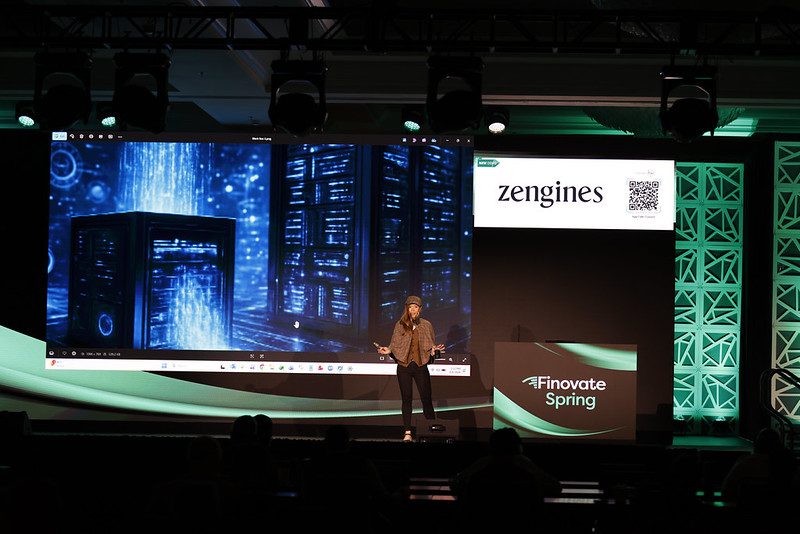
Finovate podcast host Greg Palmer talks with Caitlyn Truong, CEO and Co-Founder of Zengines.

Palmer and Truong discuss how Zengines addresses the challenge of managing legacy core banking applications written in older programming languages like COBOL, RPG, and PL1. Truong explains how her company is modernizing legacy mainframe applications without losing critical logic, satisfying auditors faster, and making legacy systems searchable so transformation and compliance do not stall.

EP 299: Caitlyn Truong, Zengines


Juan Jurado-Blanco and Armando Quintana, CEO and Chief Revenue Officer of Clockout, respectively, sit down with Greg Palmer in this Finovate podcast conversation.

The trio discuss the benefits of earned wage access as an offering for community banks and credit unions. Clockout’s technology enables users to access their earned wages the same day they work, rather than waiting for traditional biweekly or even monthly pay cycles. The solution embeds seamlessly into existing bank experiences.

EP 298: Juan Jurado-Blanco and Armando Quintana, Clockout


Oren Buskila, CEO and Co-Founder of Cobalt, talks with Finovate podcast host Greg Palmer about the challenge of financial institution system dependencies.

Cobalt offers a technology that automatically maps real system dependencies across complex banking environments, enabling agentic AI, real-time visibility, safer changes, reduced risk, and confident operations. Cobalt enables technical teams to anticipate the consequences of modifications before implementation, preventing failures and ensuring safer deployments.

EP 297: Oren Buskila, Cobalt


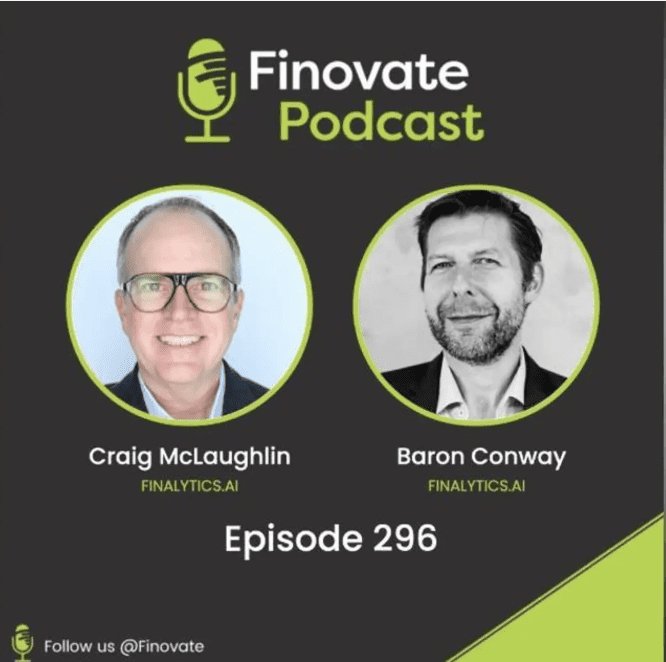
Podcast host Greg Palmer catches up with Craig McLaughlin (CEO) and Baron Conway (Chief Strategy Officer) of Finalytics.AI in the wake of the company’s second consecutive Best of Show win at FinovateSpring (2025 and 2026).

Palmer, McLaughlin, and Conway discuss how Finalytics.AI enables community financial institutions to deliver personalized, high-touch experiences through digital channels while leveraging the wealth of customer data these banks and credit unions possess.

EP 296: Craig McLaughlin and Baron Conway, Finalytics.AI


Host Greg Palmer interviews Crebit co-founders Jensen Coonradt (CEO) and Simmi Sen (Chief Product Officer).

In this podcast conversation, Coonradt and Sen explain how their company is modernizing international money transfers by leveraging stablecoin technology to send money across borders as easily as sending a text message. Crebit’s “stablecoin sandwich” approach enables users to on-ramp funds using local payment methods before settling into virtually any currency worldwide in minutes.

EP 295: Jensen Coonradt and Simmi Sen, Crebit

US Bank’s Queanne Smith on Streamlining Small Business Banking

US Bank’s Queanne Smith on Streamlining Small Business Banking

How are financial institutions like US Bank helping small businesses take advantage of new, innovative tools and technologies that will enable them to better serve their customers and scale their operations? At FinovateSpring 2026 earlier this year, I spoke with Queanne Smith, Senior Vice President at US Bank, on how integrated digital solutions and strategic partnerships can bring greater efficiency and new revenue opportunities to small and medium-sized enterprises.

In our conversation, Smith talks about the challenges that small businesses face when confronted with fragmented banking services, and explains how embedded banking and platform integration can build trust and efficiency. Smith also discusses the importance of delivering end-to-end solutions like billpay and payroll and shares her thoughts on the best practices for bank-fintech partnerships.

“We did a survey in 2025 with about a thousand of our small business owners and identified that 63% of those small business owners were really struggling and overwhelmed by the number of platforms they were utilizing for their cash management services … The integration that we’re looking to build enables our small business owners and midsize businesses to have a one-stop shop experience. The opportunity for us to think about how clients interface with us and experience us is a real thing. The objective is to minimize the points of friction and improve the client experience overall.”

Queanne Smith is a Senior Vice President at US Bank, where she leads business strategy and partnerships designed to expand access to capital and growth tools for small business owners. Smith works at the intersection of banking, technology, and community impact, leveraging partnerships, data, and emerging tools to deliver scalable, measurable outcomes. In 2025, Smith was recognized as part of American Banker’s Most Powerful Women in Banking Top Teams.

The fifth-largest commercial bank in the United States, US Bank serves millions of clients via a diversified range of business lines. These operations include commercial and institutional banking, business banking, payments, wealth management, and consumer banking. Headquartered in Minneapolis, Minnesota, and a member of the Fortune 500, US Bank was named one of the World’s Most Ethical Companies by the Ethisphere Institute.


Photo by Giant Asparagus from Pexels