This site is operated by a business or businesses owned by Informa PLC and all copyright resides with them. Informa PLC's registered office is 5 Howick Place, London SW1P 1WG. Registered in England and Wales. Number 8860726.
Finovate Blog
Tracking fintech, banking & financial services innovations since 1994
This week’s edition of Finovate Global is a hat tip to the companies from outside the US that are traveling to New York to demo their latest fintech innovations live on stage at FinovateFall 2026.
It is true that our European conference tends to feature the highest proportion of non-US companies. That said, FinovateFall is a popular destination for emerging and established fintechs looking to showcase their solutions to an audience of banking and financial services professionals and decision-makers.
Get to know our dozen international fintechs below—and be sure to catch them on stage next week at FinovateFall!
FinovateFall 2026 comes to the Marriott Marquis Times Square in New York, September 9 through 11. Tickets are still available, so visit our registration page and save your spot, book your room, and join us next week in New York!
3 Degrees enables community banks and credit unions to deliver fully digital international payments that improve the customer experience and create new revenue. Founded in 2025, 3 Degrees is headquartered in London.
Covecta builds agentic operating systems for community banks and credit unions. The company’s solutions optimize bank performance via autonomous agents working across the full lifecycle, connecting strategy to execution. Founded in 2024, Covecta is headquartered in London.
Data City offers an “Industry Engine” that uses AI and the open web to instantly and compliantly assign accurate industry codes to companies for KYC/KYB screening, risk management, and identification of market opportunities. Founded in 2018, Data City is headquartered in Leeds.
Doshi is an AI-native engagement layer for banks that gamifies financial education to transform behavioral data into actionable, revenue-generating product readiness signals. Founded in 2023, Doshi is headquartered in London.
Finerative introduces Wealth MCP, a comprehensive solution that integrates seamlessly with the AI clients that financial institutions already use while maintaining full compliance. The platform delivers secure access to portfolios, products, and market data through a permissioned and encrypted infrastructure with complete audit trails. Founded in 2023, Finerative is headquartered in Madrid.
LemonadeLXP is an AI-powered learning and knowledge platform for financial institutions. The solution drives staff performance and customer growth via engaging learning experiences. Founded in 2018, LemonadeLXP is headquartered in Ottawa.
Nextvestment enables safe self-service exploration of investment opportunities and financial planning scenarios while guiding advisors to intervene at the right moments, improving client engagement and advisor productivity without changing advisory models. Founded in 2024, Nextvestment is headquartered in Singapore.
Omnisient is a privacy-preserving data collaboration platform that enables financial institutions to tap into consumer behavior data directly from retailers and consumer brands to help financial institutions find best future customers—without any data ever changing hands. Founded in 2019, Omnisient is headquartered in London and Cape Town.
Palomonte Labs offers Cube2, a solution that makes financial APIs AI-readable, enabling developers and AI agents to safely understand and execute financial integrations. Founded in 2019, Palomonte Labs is headquartered in Miami and Buenos Aires.
Tapix is a transaction intelligence API that transforms banks’ raw payment data into clear merchant, location, and category data, powering engagement, insights, and personalization. Founded in 2013, Tapix by Dateio is headquartered in Prague.
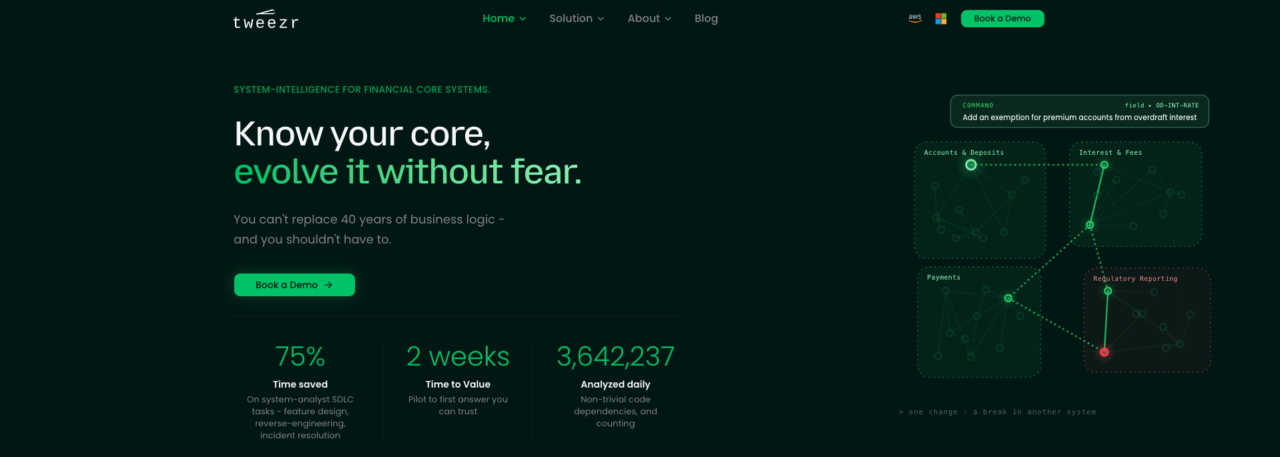
Tweezr enables firms to transform and grow by accelerating time to market and increasing developer productivity for both legacy system maintenance and modernization. Founded in 2024, Tweezr is headquartered in Tel Aviv and Amsterdam.
Young Early Starters (YES) is the investing and financial education app that enables children to invest in stocks and exchange-traded funds (ETFs) with every transaction requiring parental approval. Founded in 2026, Young Early Starters is headquartered in Belgium.
Here is our look at fintech innovation around the world.
Analysts expressed concern over the growing popularity of “fintech financing” among workers in Argentina’s gig economy.
Asia-Pacific
Japan’s SBI Holdings acquired a 20% stake in Indonesian online trading platform Ajaib.
The Reserve Bank of Australian concluded there was “no clear public interest” for a central bank digital currency based on a public consultation conducted by the Verian Group.
Egyptian founded and UAE-headquartered fintech Remi received $135,000 from the Stellar Community Fund to build a confidential settlement layer for regulated financial institutions leveraging the Stellar network
Central and Southern Asia
Pakistan-based Buy Now, Pay Later fintech Qist Bazaar raised $1.8 million in funding.
Concerns over data security, money laundering, and cyberfraud were cited by India in its decision to suspend action on a proposed link between Alipay+ and UPI.
India’s NBFC Business Nextgen Finance secured $22 million in funding from Beams Fintech Fund.
We’re looking forward to hosting more than 2,000 senior-level decision-makers, including more than 1,000 from banks and financial institutions, and more than 300 from credit unions and community banks. Add to that our full, 72-demo roster and a slate of insightful keynote speakers and panelists, and we’re on track to deliver one of the best FinovateFall conferences to date.
To help you make the most of your experience, here’s a handy guide of need-to-knows before and during your time at FinovateFall next week. We’ll see you at the Marriott Marquis Times Square in New York!
Connect Yourself
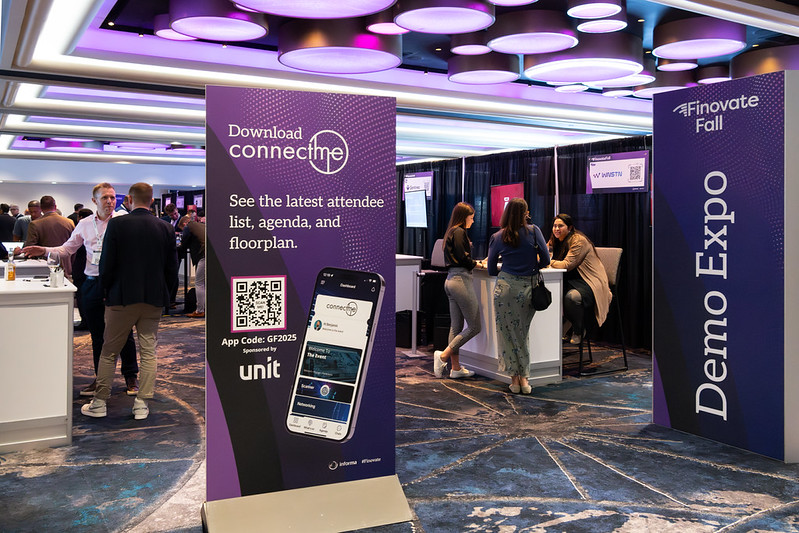
The first step is to download the ConnectMe app from your preferred app store and set up your attendee profile. The ConnectMe app is a great way to review and keep up with the conference agenda as the show gets going. You can also use ConnectMe to set your schedule for the week and begin networking. We’ve added functionality within the app to make it easier than ever to exchange digital business cards with your fellow attendees.
Follow #FinovateFall on LinkedIn for live updates. We’ll share event photos and announcements throughout the conference.
FinovateFall is about helping you connect with the people you want to meet, which is why we offer more than ten hours of dedicated networking time across the three days of the event. In addition to organic networking, we’re also helping you find meetings that matter via our ConnectMe platform, where you can search other attendee profiles and schedule meetings directly through the app. FinovateFall is also featuring a number of interactive discussion roundtables to facilitate conversations between industry experts and your peers. Check out our agenda to see which roundtables most interest you.
At the Conference
The conference begins Wednesday, September 9. Registration opens each morning at 8am. Continental breakfast and coffee will be available in the networking area.
The general sessions will begin each morning at 9am with networking breaks scheduled throughout the day. Each conference day will conclude with a drinks reception and networking opportunity.
With so much going on at FinovateFall this year, a little preparation can go a long way toward ensuring you don’t miss the sessions, speakers, and demos you’re looking for. In addition to the agenda in ConnectMe, check out our blog posts highlighting some of this year’s top attractions.
Special Attractions
FinovateFall 2026 has something for everybody, along with a few offerings designed for specific audiences. These include our Leaders+ and Credit Union Spotlight on September 8. These pre-event exclusives give bank and credit union professionals, respectively, an opportunity to discuss issues relevant to their organizations and hear insights and experiences from industry analysts, executives, and innovators. To learn more about joining us for Leaders+ or the Credit Union Spotlight, reach out to [email protected].
Free books! FinovateFall 2026 is proud to host a pair of book signings. Steve Bishop and Tony del Fierro, co-authors of Know Your Agent, will sign their book on the morning of Wednesday, September 9. Author and founder of Unconventional Ventures Theodora Lau will sign her latest book, Banking on (Artificial) Intelligence, during the networking session Wednesday evening.
Our award-winning strolling magician and mentalist is back! Joining attendees at the networking reception Thursday evening—ahead of our Best of Show awards presentation—our magician will wow you with feats of close-up magic and live illusions!
Final Notes
There’s a lot going on at FinovateFall this year. To make sure you get seamless access to everything you’ve registered for, please remember to bring—and wear—your badge every conference day.
Dress code for FinovateFall is business casual to business formal. Need some guidance? Here are some tips for women and for men.
Questions? Before the event, feel free to reach out to us at [email protected]. Once you’re at the venue, stop by our registration desk on the fifth floor or ask a Finovate staffer if you need help.
Banking transformation company Finzly has launched its AI-powered security and assurance layer Assure.
Assure provides banks and other financial institutions using Finzly’s BankOS with AI-powered security, compliance monitoring, and operational resilience that is native to the infrastructure they rely on.
Headquartered in Charlotte, North Carolina, Finzly is a two-time Best of Show winner. The company most recently demonstrated its technology at FinovateSpring 2022.
The latest product launch from banking transformation company Finzly weaves security and continuous assurance natively into the infrastructure its banking customers rely on. Assure, Finzly’s newly released security and assurance layer, is part of the company’s Agentic Galaxy suite of AI capabilities, which powers BankOS, its modern operating system for banks. Financial institutions using BankOS will benefit from Assure’s AI-powered security, compliance monitoring, and operational resilience that is native to the infrastructure they are currently using.
“Banking is entering a new era where attacks happen at machine speed, requiring intelligence, innovation, and trust to evolve together,” Finzly CEO and Founder Booshan Rengachari said. “BankOS was created to help financial institutions continuously evolve, and never has that been more needed than with AI. We introduced Agentic Galaxy to transform banking operations with AI, and with Assure we are extending that intelligence into security and resilience, helping banks innovate faster while maintaining the trust their customers depend on.”
Finzly’s Assure will enable banks to detect and respond to fraud threats faster, leveraging AI to accelerate triage and investigation. The technology provides continuous monitoring of attack surface risks rather than relying on point-in-time reviews, and delivers security testing that covers both traditional and AI-enabled development. Assure also offers banks ongoing compliance evidence that is automatically collected instead of being compiled by hand.
The new offering comes at a time when AI-based fraud is transforming the threat environment for financial institutions. According to TrendAI’s Modern Bank Heists 2026 report, AI-powered attacks on banks and other financial institutions climbed by 89% year over year, while 67% of institutions reported that attackers were actively countering defenders during live incidents.
This underscores the value of continuous assurance. By giving banks evidence that critical controls are working as expected, AI-powered tools such as Assure can continuously monitor signals, identify anomalies, test controls, surface potential gaps, and expand the scope of security and compliance monitoring. Assure accomplishes this without the additional costs and manual efforts typically associated with these processes.
“As financial institutions embrace AI, security must evolve alongside innovation,” Finzly Chief Information Security Officer Supro Ghose said. “As AI security researcher Roman V. Yampolskiy has written, ‘our best hope to defend against AI-enabled hacking is by using AI.’ Assure represents our commitment to making security and intelligence foundational elements of BankOS, helping banks operate with greater confidence in an increasingly complex digital environment.”
Making its Finovate debut at FinovateFall 2019, Finzly is a two-time Best of Show winner, most recently demonstrating its technology at FinovateSpring 2022. At the conference, the company showed how to build and launch a new, modern, digital banking proposition in minutes using its bank operating system technology. Finzly’s BankOS is a modern operating system for banks that manages traditional and tokenized money and the movement of that money through ACH, wires, RTP, FedNow, SWIFT, and other payment rails via ISO 20022-native processing. Finzly offers banks a single platform with advanced payment processing and a unified ledger that enables them to modernize payments and launch new products and services. Headquartered in Charlotte, North Carolina, Finzly was founded in 2012.
Cross-border money transfer and top-up firm Félix Pago (Félix) has raised $200 million in combined equity and debt funding.
The equity component, in the amount of $87 million, was led by Andreessen Horowitz. The General Catalyst Customer Value Fund provided a $113 million credit facility.
Félix will use the funding to scale its existing remittance business and to support the expansion of its product suite to include lending and savings. The Miami, Florida-based company made its Finovate debut at FinovateSpring 2025 in San Diego, California.
Cross-border money transfer startup Félix Pago has secured $200 million in Series C funding for its technology, which leverages WhatsApp to offer a conversational remittance experience for Latinos and Hispanics living in the US. The round consists of $87 million in equity funding led by Andreessen Horowitz (a16z) and a $113 million credit facility from the General Catalyst Customer Value Fund. The equity portion also featured participation from QED Investors, Castle Island Ventures, Switch Ventures, Contour Venture Partners, and Endeavor Catalyst.
The investment will help Félix scale its remittance and mobile top-up services, as well as add new team members in engineering and AI. The funds will also enable Félix to expand its offering into lending and savings via third-party solutions. Félix currently offers transfers from the US to 11 countries in Latin America including Mexico, Guatemala, Honduras, El Salvador, Nicaragua, Colombia, the Dominican Republic, Costa Rica, Brazil, Ecuador, and Peru. Reporting revenue growth of 2.5x over the previous year, Félix has processed more than $8 billion in transactions since inception and served more than six million customers.
“We started Félix with remittances because sending money home is one of the most important financial needs our community has,” Félix CEO and Co-Founder Manuel Godoy wrote on his LinkedIn page. “Since then, we have processed more than $8 billion in transactions and impacted over six million people. But remittances were always the beginning. Now, we are building Félix into a Cognitive Financial Companion: a financial experience that begins with what someone wants to accomplish, rather than with a product, a form, or another app.”
Operating without a physical branch network, Félix relies on a financial infrastructure layer supported by partners such as Stripe, Mastercard, Checkout, and dLocal, and enhances its cross-border capabilities through partnerships with USDC stablecoin issuer Circle, Latin American cryptocurrency exchange Bitso, UniTeller and zerohash. It is this constellation of partners that enables Félix to operate: the company uses a WhatsApp-based AI chatbot to manage transfers and leverages USDC on the Stellar blockchain for settlement. Bitso serves as the on/off ramp for getting funds into the hands of recipients.
Founded in 2021 and headquartered in Miami, Florida, Félix made its Finovate debut at FinovateSpring 2025. At the conference, the company demonstrated its Félix Send solution, which allows financial services firms to embed cross-border remittances into their apps with a simple integration. Félix Send enables users to initiate remittances via WhatsApp with a single tap: funds are debited through the partner platform and recipients receive their money in seconds. Félix Send helps financial services companies generate new revenue streams, boost engagement, and deliver greater value to their customers.
UK-based lending technology provider Lenvi has unveiled its new automated loan verification software, ALVIN, designed to combat fraud risks such as double pledging. The launch follows a series of high-profile fraud cases involving MFS, Tricolor, and First Brands Group.
Double pledging takes place when a borrower uses the same asset as collateral to secure multiple loans from different lenders simultaneously—without informing the lenders that the collateral has already been pledged as security for other loans. This fraud tactic drew significant public attention this year when a number of high-profile fraud cases involved double pledging.
For example, Market Financial Solutions was a UK property lending company that collapsed in February 2026 as a result of a £1.3 billion fraud and double pledging scandal. Executives at Tricolor Holdings were accused of running a massive fraud scheme—also using double pledging—around subprime automobile loans and were charged by the SEC in August in connection with the firm’s $1.9 billion collapse. First Brands Group was another case of multibillion-dollar fraud involving fake collateral and not just double pledging, but triple pledging.
Historically, lenders have defended themselves against double pledging via collateral registries, UCC (Uniform Commercial Code) filings and searches, regular and AUP audits, and even blockchain-based and digital registry solutions. Unfortunately, many of these methods fall short due to the lack of centralization among registry systems, the prevalence of manual and periodic verification processes, and increasingly sophisticated fraud strategies, including document forgery and digital manipulation—both accelerated by AI—as well as the use of shell companies and jurisdictional arbitrage.
In response, Lenvi’s ALVIN provides continuous, automated loan verification across the entire lending portfolio. Built on agentic AI, ALVIN operates alongside Lenvi’s existing AUP (Agreed-Upon Procedures) and compliance services to deliver robust, end-to-end protection for capital markets investments. ALVIN can analyze data tapes or connect directly to loan management systems via APIs, consuming data at the source to provide visibility across all funding lines. ALVIN verifies every loan document, every customer, and every pledged asset. This empowers funders to monitor processes on an ongoing basis instead of using periodic or smaller-sample checks alone.
Additionally, to help guard against double pledging, each loan is tokenized with a unique digital fingerprint. If ALVIN encounters another loan with a similar fingerprint or other matching characteristics, the software instantly alerts the funder, enabling them to investigate the matter further. ALVIN also delivers real-time visibility of cash movements, monitoring transactions from origination through repayment to ensure the funds reach the correct recipients.
“Developing ALVIN was all about helping investors to confirm that what’s on paper matches reality,” Lenvi Director of Capital Markets Owain Chambers said. “The recent cases with MFS, Tricolor, and First Brands Group have naturally shaken the market and increased scrutiny of loan verification, particularly around the risk of double pledging. This software responds directly to that nervousness and helps detect any irregularities before they cause lasting damage.”
Founded in 1988 and headquartered in Leeds, UK, Lenvi made its Finovate debut at FinovateEurope 2023. At the conference, the company demonstrated how its technology delivers rich and mature lending functionality and broad, extensible, first-party API support. This facilitates feature toggling alongside fully automated online deployments, while a React user interface and API support an endlessly configurable workflow engine in an environment that is compliant and secure. Richard Carter is Lenvi’s Chief Executive.
MeridianLink announced its acquisition of financial wellness platform Credit Mountain. Financial terms were not disclosed.
The acquisition will help MeridianLink launch its Pathway solution, which helps community financial institutions provide declined borrowers with a personalized pathway to loan approval.
Credit Mountain won Best of Show in its Finovate debut at FinovateFall 2024 in New York.
As FinovateFall 2026 approaches, we’re sharing news from FinovateFall alumni to give you a sense of the kind of companies that will be demoing their latest innovations live on stage September 9 through 11.
Consider Credit Mountain, a financial wellness platform that won Best of Show in its Finovate debut at FinovateFall 2024. Earlier this month, MeridianLink, a software platform provider for financial institutions and consumer reporting agencies, announced its acquisition of the company. In a statement, MeridianLink said that the acquisition will support the launch of its MeridianLink Pathway, which enables community financial institutions to provide declined borrowers with a personalized and fully compliant pathway toward loan approval. MeridianLink also previewed MeridianLink Coach, which is scheduled to launch later this year and leverages AI-powered guidance to help consumers build or improve their credit profile.
“Through MeridianLink Pathway and the future launch of MeridianLink Coach, we’re helping community financial institutions transform the loan decline experience,” MeridianLink CEO Larry Katz said. “Pathway gives borrowers a personalized, compliant path toward future approval, while MeridianLink Coach delivers AI-powered guidance to help consumers strengthen their financial health over time. Together, these solutions help financial institutions create more paths to yes, improve financial outcomes, and build trusted relationships that extend far beyond a single lending decision. To us, that is the true spirit of Lending Made Human.”
MeridianLink’s acquisition of Credit Mountain is the latest example of the company’s accelerated technology investment strategy. This includes MeridianLink’s Lending Lifecycle initiative, which is designed to empower financial institutions to engage borrowers before, during, and after the lending decision. As credit unions and community banks are pursuing ways to make faster lending decisions, engage more creditworthy borrowers, and deepen member and customer relationships, solutions that help enhance financial wellness and expand access to credit have become increasingly valuable. Credit Mountain’s expertise in helping lenders and financial institutions remain constructively engaged with borrowers who experience an initial loan rejection supports all of these goals.
When a borrower is rejected, MeridianLink Pathway will automatically provide a personalized adverse action experience to enable the applicant to understand the reasoning behind the loan decision and the steps they can take to successfully secure financing going forward. Unlike other approaches, Pathway communicates support rather than rejection by providing financial guidance and a personalized “Path to Yes” plan. It also enables lenders and financial institutions to turn adverse action compliance into an opportunity to build better relationships.
“Community financial institutions succeed when they help consumers achieve their financial goals,” Credit Mountain Founder Nathan Pinto said. “This acquisition strengthens our ability to help more lenders serve more borrowers, build deeper relationships, and offer innovative lending experiences where every borrower has a clear path forward. We’re thrilled to be a part of MeridianLink and look forward to continued innovation together.”
Founded in 2021 and headquartered in Dallas, Texas, Credit Mountain made its Finovate debut at FinovateFall 2024. At the conference, Pinto demonstrated how the company’s technology transforms the end-to-end decline experience for lenders when they must reject a borrower. Credit Mountain offers a lead tracking/nurturing system and personalized Path to Yes, enabling lenders to give declined borrowers a path to securing the financing they need.
Serving more than 1,800 community financial institutions and 78 million credit union members throughout the US, MeridianLink offers a digital lending platform and suite of solutions to help banks, credit unions, and consumer reporting agencies serve, scale, and grow. Leveraging automation, built-in compliance, trusted AI and data, as well as a robust partner network, MeridianLink provides solutions across account opening, loan origination and optimization, digital mortgages, collections, and reporting. Headquartered in Irvine, California, MeridianLink was founded in 1998.
There are still a few weeks left of summer, but the final day of August often serves as the unofficial end of summer for many—with kids returning to school and Labor Day around the corner.
As the week begins, Finovate’s Fintech Rundown is highlighting a handful of fintech funding announcements in payments, wealth management, and capital markets, as well as interesting partnership news in DeFi and identity verification involving fintechs from Singapore and South Korea.
Visainks a strategic partnership with South Korean fintech Dunamu to develop stablecoin payments, international remittance services, and AI-powered e-commerce solutions.
Credit unions
Baton Rouge Telco Federal Credit Union launches AI-powered smart financial calculators courtesy of its partnership with Appli.
Lending
RateZiplaunches live US bank rate and mortgage rate app in ChatGPT.
How do companies get priced? What variables are involved in determining the true value of a firm, especially as it moves closer to leaving the private market and becoming a publicly traded entity?
We caught up with Isabelle Freidheim, founder of Athena Capital, to answer these and other questions about the current investment landscape, especially for fintech companies. In this extensive conversation Freidheim shares her insights into the challenge of helping profitable technology companies navigate the runway to an IPO or strategic sale.
We learn how the commoditization of the core technology layer is driving investment trends in fintech, the consequences of companies staying private longer, and how she leveraged talent “mispricings” to build a team of exceptional operating partners—sitting and former CEOs, Fortune 500 directors—that give Athena Capital a “sourcing and diligence advantage.”
“The stage is our thesis. At 12 to 36 months out, the diligence question changes character. I am not asking whether the market will materialize. I am reading retention cohorts, gross margin trajectory, net revenue retention, sales efficiency, customer concentration, working capital. Those are facts. Earlier-stage investing requires you to be right about the future; this stage requires you to be right about the present, which is a materially better risk-adjusted proposition and one where our operating experience compounds.”
Tell me about the thinking behind the founding of Athena Capital. What were your initial goals when you founded the firm?
Isabelle Freidheim: I spent fifteen years investing in private equity and venture capital, founded Magnifi and sold it to TIFIN in 2020, then chaired public companies and sponsored three SPACs. The investing years taught me how companies get priced. Building one taught me what actually determines the price, and those are different subjects.
The variables that moved my own outcome were invisible from the seat I had just left: whether the board had anyone who had sold a company before, whether the financials were built for a buyer’s accountants or a growth investor’s, whether two strategic acquirers already understood the business before a banker introduced them. None of that shows up in a diligence file. All of it moves the exit.
That’s the gap Athena was built for: the 18 months before liquidity, when growth investors have stepped back and bankers haven’t arrived. We take minority positions in profitable technology companies 12 to 36 months from an IPO or a strategic sale. We’re not buying control or fixing broken businesses. We’re underwriting companies that already work and helping them arrive prepared rather than improvising.
The second design decision was the team. Athena’s general partnership is from SoftBank, and our council of operating partners is composed of roughly 30 senior women: sitting and former CEOs, Fortune 500 directors, and operators who’ve run the functions our companies are building. That’s not a value statement; it’s a sourcing and diligence advantage. They see deals before the intermediated market does and open doors our portfolio companies can’t open alone. Execution capability at that level is systematically underpriced, and we built the firm to capture the discounts.
What companies are most attractive to you as investments? Why target businesses at this stage in their development?
Freidheim: Profitable or near-profitable, technology-enabled, and close enough to an exit that we are underwriting performance rather than a forecast. Fintech, AI infrastructure, enterprise software, cybersecurity, healthcare technology, deep tech—the sector matters less than whether the business is exit-ready and whether the exit has been engineered rather than assumed.
The stage is our thesis. At 12 to 36 months out, the diligence question changes character. I am not asking whether the market will materialize. I am reading retention cohorts, gross margin trajectory, net revenue retention, sales efficiency, customer concentration, working capital. Those are facts. Earlier-stage investing requires you to be right about the future; this stage requires you to be right about the present, which is a materially better risk-adjusted proposition and one where our operating experience compounds.
It is also the point at which we can change the outcome. What a company does in this window—who joins the board, how the financials get restated to public-company standards, whether it has done a tuck-in acquisition that broadens the story, whether it has cultivated two credible strategic acquirers alongside the IPO path—moves the exit valuation more than anything the business does operationally in the same period. Most management teams have never done it before. Our council members have done it repeatedly.
And we insist on optionality. A company that can only IPO is a company with one buyer, which is the market on a given Tuesday. We want every portfolio company positioned so that an IPO, a strategic sale and a sponsor transaction are all live, because the path you can take is determined by conditions you do not control, and the only protection against that is having more than one.
One major theme about investing in technology companies in general and fintech companies in particular is the idea of fewer but bigger deals. Does this scan with what you are seeing right now? If so, what do you believe is driving this trend?
Freidheim: It scans, but I would describe the cause differently than most people do.
The standard explanation is discipline: investors got selective after a loose period, so capital concentrated in quality. That is true at the margin and it is not the main mechanism. The main mechanism is that price discovery has moved into private markets and stayed there. Companies that would once have listed to raise capital no longer need to. Sovereign funds, crossover investors, private credit and secondary vehicles will fund them at scale without the disclosure burden. So the round sizes that used to be IPOs are now Series E and F.
That produces exactly the pattern you are describing. A small number of companies can absorb capital in the size that large funds must deploy, and those companies raise repeatedly at escalating marks negotiated between a handful of counterparties whose incentives are correlated. Everyone else is starved. It looks like selectivity. It is closer to concentration of access.
In fintech specifically, there is a second driver. The core technology layer has commoditized: payment rails, KYC, ledger infrastructure, onboarding are all buyable. Differentiation has moved to distribution, regulatory position, and the ability to consolidate adjacent capabilities. That structurally favors larger, better-capitalized companies, because those are advantages you buy rather than build.
The investable consequence is the part I care about. If compounding is happening privately, the returns are being captured privately, and by the time a company reaches the public market the repricing has already occurred. That is not a reason to avoid technology. It is a reason to be positioned in the private vehicle before the event rather than in the listing after it.
I noticed that one of the companies Athena Capital has invested in is Paystand, a company that demoed at Finovate years ago. What most excites you right now about what is happening in fintech in particular?
Freidheim: The most interesting fintech is not the interface. It is the plumbing that changes the unit economics of a process that companies were treating as fixed cost.
Paystand is a clean illustration. Business-to-business payments are still routed through card networks and manual accounts receivable work, and the cost of that is absorbed as a permanent line item—transaction fees, days sales outstanding, headcount in collections, etc. Paystand attacks the cost structure itself rather than putting a better screen on top of it. When a company can compress its receivables cycle and take fees out of the payment, that shows up in working capital and cash conversion. That is a CFO-level outcome, not a product feature. And it produces the characteristics I underwrite: recurring usage, deep integration into the financial stack, high switching costs, and a value proposition you can compute rather than describe.
That is the general pattern I am watching: financial operations, embedded finance, compliance infrastructure, treasury and data. Boring categories where the return is measurable.
On AI in fintech, I hold a specific view. The model layer has been built and it has been repriced, and that repricing happened almost entirely in private markets. The value that remains available now sits in deployment: the infrastructure that lets a regulated financial institution actually put a model into production against its own data, with auditability, model risk governance and controls that survive an examination. Financial services is the hardest deployment environment there is, which is exactly why the companies that solve it will be durable. The question I ask is never whether a company uses AI. It is whether the model changes the loss rate, the margin, the cycle time or the compliance cost by an amount you can measure.
What are your thoughts on fintech valuations of late? Some see the hefty valuations for AI-native fintechs as appropriate given the potential for the sector. Others are calling for more modest valuations based on actual profitability as opposed to revenue growth. Where do you stand?
Freidheim: Both camps are arguing about the wrong variable. The question is not whether AI-native fintech valuations are high. It is who realizes the return at those valuations and where in the capital structure they sit when it happens.
A private mark is not a price. It is the outcome of a negotiation between a small number of parties, several of whom already hold the asset and benefit from the mark moving up. That is not price discovery, and treating it as though it were is how public investors end up buying at the top of a curve that was constructed elsewhere. So when I hear that an AI-native fintech is worth 20 times forward revenue, my first question is not whether the multiple is justified. It is who set it and what they own.
On the underlying debate: revenue growth without margin structure is not a business, and profitability as a single test would have disqualified most of the infrastructure companies worth owning. What I actually underwrite is whether the growth is being purchased or earned. Net revenue retention, gross margin by cohort, sales efficiency, the ratio of customer acquisition cost to lifetime value and the direction that ratio is moving. If a company is spending ahead of growth and the cohorts are improving, the spending is investment. If the cohorts are flat and the spending is what produces the growth, the spending is the business model, and that does not survive a funding environment change.
In fintech, there is an additional test that generalist investors underweight. Regulated financial activity carries capital, compliance and operational obligations that arrive with scale, not before it. A company that has not built for that is carrying a liability that is not in the model.
Discipline here does not mean paying less. It means being clear-eyed about whether you are buying an asset or providing someone else’s exit.
I recently spoke with a VC investor who expressed concern about companies staying private longer and timing mismatches between fund deployment cycles and return periods trapping wealth in illiquid portfolios for 15 years or more. Given Athena Capital’s interest in companies nearing exits or considering IPOs, do you share this concern?
Freidheim: I share it, and I would put it more bluntly. The consequence of companies staying private is not merely that returns are delayed. It is that the compounding happens where public investors cannot reach it, and by the time they can, it has already happened.
Look at what an IPO now is. A company that stayed private for twelve or fifteen years, funded by investors who marked it up across a dozen rounds, lists a small percentage of its equity. The listing is not a capital-raising event; the company usually did not need the money. It is a liquidity event for the people who already own it. Public investors are being offered the opportunity to underwrite someone else’s exit and are frequently doing so at a valuation set by parties on the other side of the trade. That is a structural transfer, and it is not being described as one.
The fund-life mismatch your VC identified is the other half of the same problem, and it is real. A ten-year fund holding a company that will not resolve for fifteen years forces bad choices—continuation vehicles, secondaries at negotiated prices, extensions that convert an investment decision into a liquidity management problem. Founders and employees carry it too. Paper wealth that cannot be converted is a retention problem and eventually a governance problem.
Athena is structured as a response to this. If we invest in profitable companies 12 to 36 months from a transaction, the mismatch does not arise; our holding period and our fund life are the same problem. And by working on exit-readiness inside the company, we shorten the distance between value creation and value realization rather than waiting for market conditions to do it for us.
What I would not accept is the framing that companies should simply list earlier. That is asking founders to solve an investor problem. The honest answer is that the public markets have become the wrong place to source technology exposure at the point of compounding, and investors who want that exposure need to be in the private vehicle before the repricing. That is the business we are in. The corollary is that the genuinely interesting public-market opportunity right now is not the model layer, which has already been priced privately; it is the infrastructure and enabling companies that AI deployment runs on, many of which are already public and are not being valued as beneficiaries.
You made history when you became the youngest female chair of a publicly traded company in the US in 2021. What did this achievement mean to you?
Freidheim: Honestly, the number itself is a trivial fact. What it indicated was not.
I chaired a public company because I had a company and sold it, and because I could structure a transaction. Those are the qualifications. The reason the milestone was notable is that the pipeline into public-company chairmanships had been narrow enough that the intersection of “has operated,” “has transacted” and “is a woman” was nearly empty; not because the talent was absent, but because the selection process was not looking there.
That observation became a business. I have sponsored multiple all-women SPACs and raised over $1.2 billion across vehicles, and the operative fact is not the composition of those teams. It is that the composition let me recruit boards and management benches other sponsors could not access, because I was hiring from a pool everyone else had priced at a discount. Athena’s council is the same trade at scale: senior women operators whose track records are documented and whose availability, sourcing reach and enterprise relationships are worth considerably more than the market pays for them. That is a mispricing, and mispricings are what investors are supposed to find.
What the chairmanship actually taught me was operational, and it shows up in our work now. Public-company governance is a discipline. (It is) the cadence of a board, what an audit committee needs to see and when, how a material disclosure gets made, what happens to a stock when guidance is missed by a small amount, how a register of shareholders behaves under pressure. Most private companies discover all of that in the first year after listing, badly and expensively. Our portfolio companies get it beforehand, from people who have done it.
Trust infrastructure for global identity and risk intelligence, Socure, has secured a strategic growth investment of $156 million, boosting the firm’s valuation to $5.2 billion.
In addition to the funding announcement, Socure announced that it is acquiring Fravity, an agentic AI platform for risk and compliance.
Socure has been a Finovate alum since 2013. Fravity made its Finovate debut last year at FinovateFall 2025 in New York.
Socure, which offers trust infrastructure for global identity and risk intelligence, has received a $156 millionstrategic growth investment that gives the firm a valuation of $5.2 billion. The investment was led by Summit Partners and included participation from Goldman Sachs Alternatives, Wells Fargo, and Docusign, among others. The funding also included both primary capital and an existing employee secondary tender offer.
“What stands out to us about Socure is the combination of durable growth and disciplined execution at this scale. We have followed this market closely for years, and we believe Socure is well positioned to bring identity, fraud, and compliance workflows onto a single platform,” Summit Partners Managing Director Matt Hamilton said.
The numbers for Socure are strong. The company closed Q2 2026 with $364 million in total ARR, 63% year-over-year ARR growth, 1.3x net dollar retention, and 0.01% logo churn. The company also noted that its international volume now represents a “double-digit” share of Socure’s network, up from two years ago.
In addition to the investment, Socure announced that it is acquiring agentic AI platform Fravity, which automates fraud, risk, and compliance operations. A Finovate alum that made its debut at FinovateFall 2025, Fravity provides AI agents that power deep investigations and execute workflows for onboarding, business due diligence, dispute resolution, and AML compliance. Founded in 2024, Fravity will add a native, first-party agent development platform and agentic operations layer to Socure’s RiskOS, an orchestration and decisioning platform that serves the firm’s 3,000+ customers. Integrating the two firms is expected to be relatively straightforward; Socure and Fravity share many enterprise clients, and the founding teams of both companies have collaborated across multiple companies for more than ten years. Fravity’s agentic AI capabilities will be delivered through Socure’s RiskOS platform as “RiskOS_Agents.”
“Stopping financial crime in the age of AI is getting harder every day, and there is no version of this where institutions hire their way out of it,” Socure Co-Founder and CEO Johnny Ayers said. “The solution will come from the infrastructure with the platform, proprietary data, first-party agents, and vertical domain expertise. Fravity, now as RiskOS_Agents, gives us the agent-building and ontology layer, wired into the nucleus of RiskOS, on top of our proprietary data and models, providing the complete loop to maximize customer decisioning accuracy. We are grateful for the support of Summit Partners and our other investors as we deliver on our vision for the future.”
Socure’s funding and acquisition come at a time when banks are spending significant amounts of time and money fighting fraud. Intelligence platform Liminal reported that organizations in the US spend $100 billion a year staffing internal and outsourced fraud, compliance, and risk management teams. Nevertheless, Liminal also noted that AI-powered fraud attacks have increased 8,000% over the last year, creating alert volumes that are increasing faster than fraud teams can staff for. Add to this the time spent on reviews—Liminal noted that 53% of banks spend at least an hour reviewing each alert, and 37% manually review more than 40% of their alerts—and the challenges facing banks and other organizations become all the more clear.
In contrast, Fravity has reduced cost per case by 80%, accelerated case resolution by up to 5x, and reduced false positives by as much as 70% across its current deployments. With its capabilities delivered as RiskOS_Agents, the technology will be wired directly into Socure’s proprietary datasets, purpose-built models, and downstream decision outcomes to maximize accuracy. Furthermore, RiskOS_Agents can learn from approximately 10 billion decisions a year and millions of resolved cases across the Socure network, creating a closed feedback loop that standalone agentic AI vendors cannot be easily replicated.
Socure serves customers in 190+ countries across financial services, e-commerce, government, healthcare, telecom, and gaming. The company’s clients include the top five US banks, four of the Magnificent Seven, 160 organizations throughout the public sector, and more than 600 fintechs.
Now in its fifth year, the Finovate Sustainability & Inclusion Scholarship Program has helped bring dozens of innovative fintech startups to the attention of banks, credit unions, investors, and journalists. This year, for FinovateFall, the Finovate Scholarship Program is proud to support six fintechs that are innovating in fields such as lending, customer service, small business financial management, fraud prevention, and biometric-enabled commerce.
The Finovate Scholarship Program spotlights underrepresented fintech founders and startups whose innovations support climate sustainability, diversity, financial inclusion, and responsible corporate governance. Scholarship winners are granted complimentary demo participation and are included in Best of Show voting, making them eligible to win the conference’s Best of Show award.
“This year’s scholarship recipients have added incredible depth to our demo lineup,” Finovate VP and Senior Director of Startup Ecosystem Heather Stowell said. “From socially conscious platforms addressing real-world challenges to companies setting new standards in responsible governance, plus groundbreaking work from BIPOC and female founders, these teams represent the diverse thinking that’s driving the industry forward. It’s exactly this mix of founders and fintech themes that makes our demo showcase so compelling.”
FinovateFall 2026 will be held at the Times Square Marriott Marquis in New York from Sept. 9—11. Tickets are available now. Save your spot. Book your room. And join us in New York for the most unique fintech event of the fall.
Goodbuy
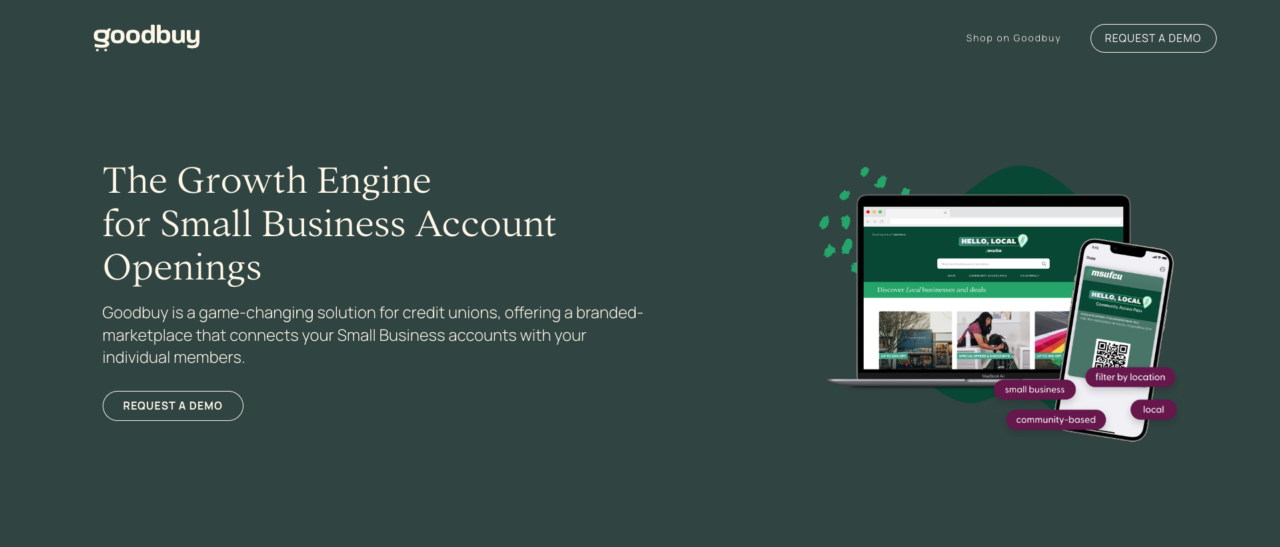
Goodbuy transforms small-business engagement into a new growth channel, enabling financial institutions to drive account activation, deposits, and interchange through connected community commerce. Goodbuy was founded in 2021 and is headquartered in Boise, Idaho.
Goodbuy is a scholarship winner in our Female Founded/Owned category, which is available to fintechs with female founders or owners. Goodbuy will be represented at FinovateFall by co-founders Cara Oppenheimer (Chief Executive Officer) and Cary Telander Fortin (Chief Impact Officer).
FinZee AI
FinZee AI connects biometric data from wearable devices to real-time financial decision-making, stopping impulse buying before it happens. Founded in 2025, the company is based in Kapolei, Hawaii.
FinZee AI was one of the winners in the Social category, which is available to firms with socially conscious fintech solutions.
Kita Technologies
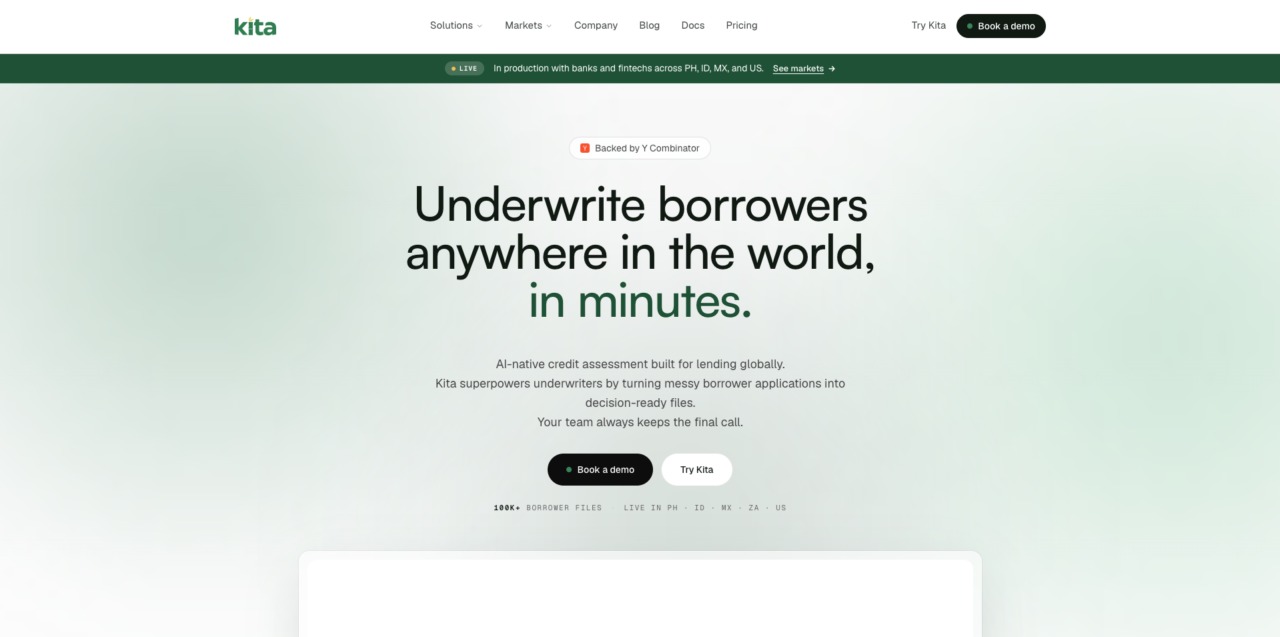
Kita is an AI-powered lending operations platform that transforms borrower documents into fraud-checked underwriting signals in minutes. Kita Technologies was founded in 2025 and is headquartered in San Francisco, California.
Kita Technologies is a winner in the Female Founded/Owned category, which is available to companies founded or owned by women.
McCarthy Hatch
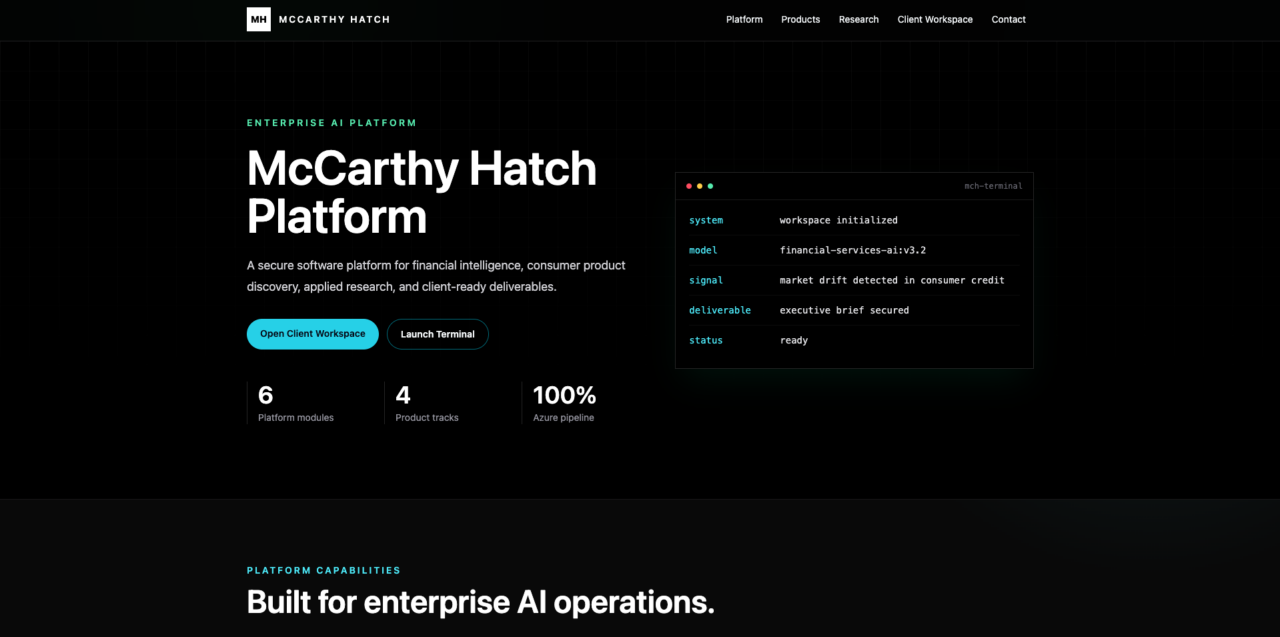
Headquartered in Los Angeles and founded in 2024, McCarthy Hatch is the company behind FSAi, an AI-powered analytics platform that detects systemic consumer harm patterns in financial services by analyzing customer complaints.
McCarthy Hatch is a scholarship winner in the Governance category, which is available to companies that emphasize responsible governance and leadership.
On Time Harvest
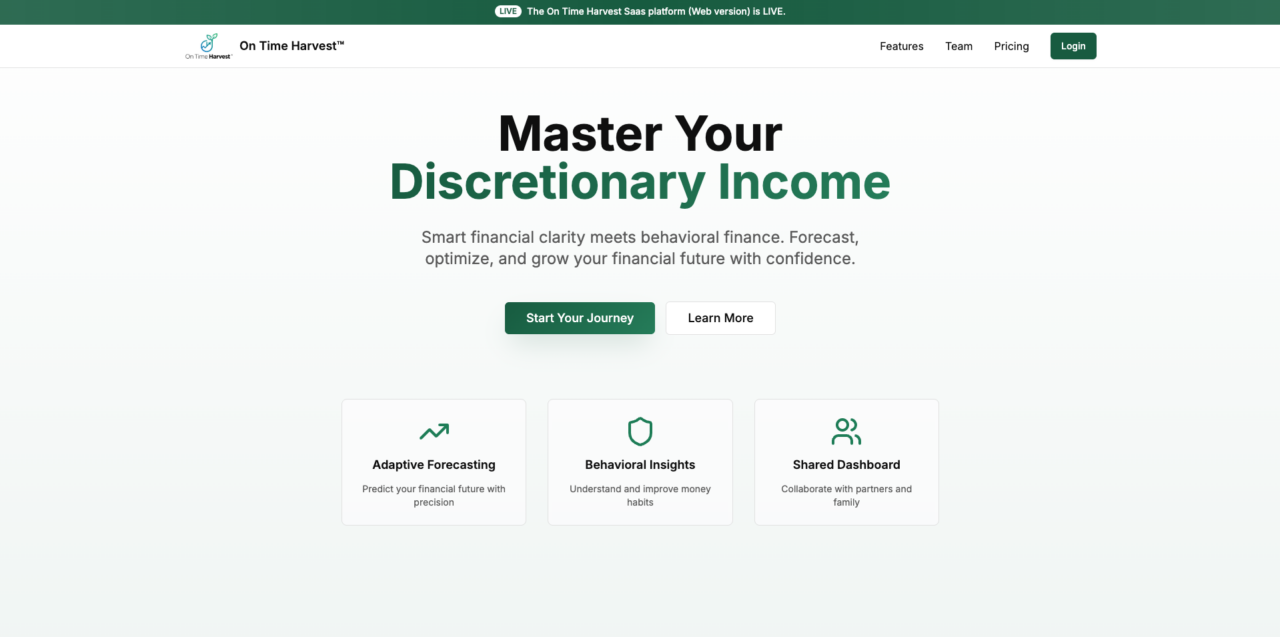
On Time Harvest is an AI-powered fintech platform that forecasts discretionary income up to five years in advance, delivers financial education and analysis, and builds responsible safeguards for BNPL. The company was founded in 2025 and is headquartered in Waldorf, Maryland.
On Time Harvest is a scholarship winner in our BIPOC Founded/Owned category. BIPOC refers to Black, Indigenous, and people of color.
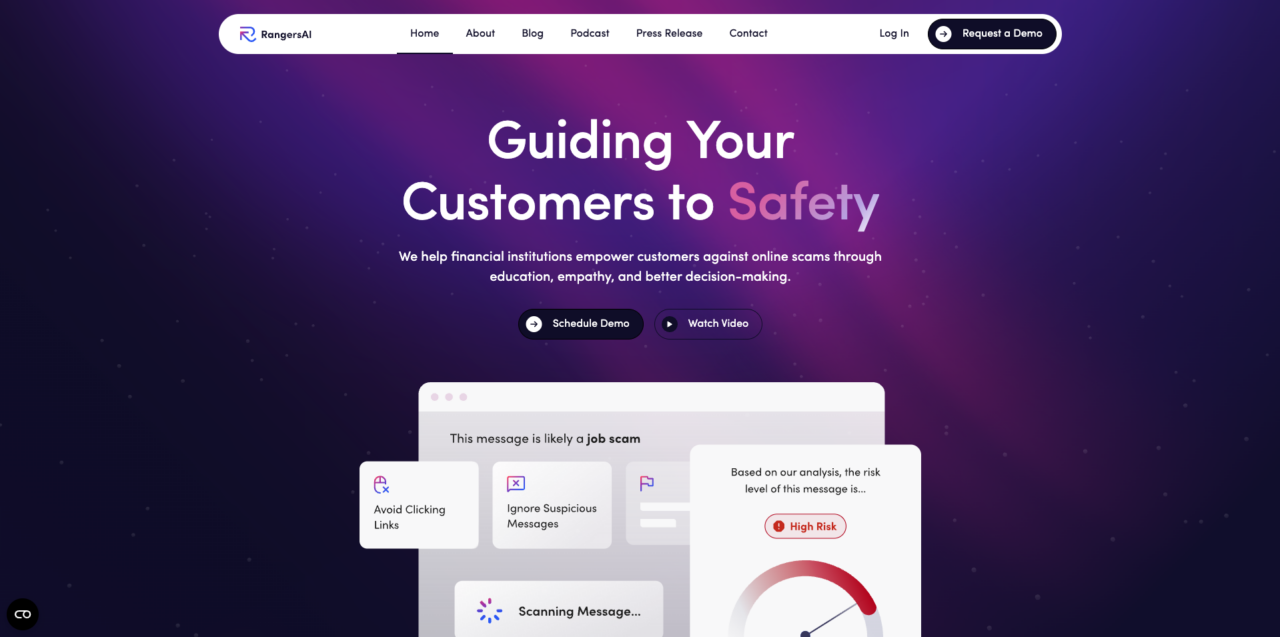
RangersAI
RangersAI offers an AI-powered scam resilience platform that helps financial institutions empower consumers to avoid scams through real-time guidance, in-context education, and trusted digital interactions. RangersAI was founded in 2024 and is headquartered in Boca Raton, Florida.
RangersAI is a scholarship winner in our Social category, which is available to companies with socially conscious fintech solutions.
Fraud prevention and identity verification company Fideo Intelligence has launched its investigative intelligence platform Fideo Lens.
Fideo Lens enables fraud and financial crime teams to discover hidden relationships between identities, accounts, devices, and behaviors at a time when fraud attacks increasingly involve multiple connected entities and organizations.
Headquartered in Denver, Colorado, Fideo Intelligence made its Finovate debut at FinovateFall 2025 in New York.
Financial crime prevention specialist Fideo Intelligence has unveiled its investigative intelligence platform Fideo Lens. The new offering helps fraud and financial crime teams uncover hidden relationships between identities, accounts, devices, and behaviors, enabling them to better address the increasingly coordinated nature of fraud attacks.
Starting with a single identity signal, fraud investigators can use Fideo Lens to visualize and connect data associated with that identity and convert fragmented identity data into interactive investigative intelligence within minutes, reducing the time spent on manual searches across multiple systems. Fideo Lens gathers relevant entities, people, devices, identifiers, behaviors, and activity into one interface, making it easier to spot potential connections between individual signals. This accelerates the fraud investigation process while enabling teams to make more confident decisions.
“Fraud and financial crime rarely exist as isolated events anymore; they play out across networks of connected identities, devices, and organizations,” Fideo Intelligence CEO Chris Harrison said. “Most investigators still have to piece those relationships together manually. Fideo Lens helps investigative, fraud, and financial crime teams uncover hidden connections in minutes, so they can move faster on critical cases and disrupt financial crime networks to prevent losses or additional risk.”
Search-based fraud investigations can fail to identify the relationships within the coordinated network of aliases, shared devices, and interconnected accounts that increasingly underpin modern fraud and financial crime. As a result, fraud investigators have had to spend significant time piecing together fragmented data from multiple, disconnected systems in order to see the entire network. In contrast, Fideo Lens gives teams interactive relationship mapping, broad identity intelligence, faster entity resolution, stronger network analysis, explainable findings, and continuously refreshed intelligence to help investigators spot emerging relationships and changing risk patterns.
“Analysts and investigators should not have to spend most of their time jumping between disconnected systems,” Harrison added. “Fideo Lens turns fragmented identity data into a clear view of the people, accounts, and devices involved, helping teams investigate cases faster and improve fraud and recovery outcomes.”
Fideo Intelligence made its Finovate debut at FinovateFall 2025 in New York. At the conference, the Denver, Colorado-based company demonstrated Fideo Verify, its AI-powered identity verification and fraud prevention platform for banks, credit unions, fintechs, and financial platforms. Fideo Verify combines multiple identity verification strategies, such as synthetic ID detection, device analysis, and breach exposure, into a single API. Powered by Fideo Intelligence’s Identity Fraud Intelligence Network, Fideo Verify streamlines risk decisions, lowers operational costs, and continuously learns by analyzing dynamic data.
Founded in 2024, Fideo Intelligence screens more than 95 billion transactions a year. The firm is backed by Baird Capital, Blue Note Ventures, and Foundry Group.
FinovateFall 2026 will showcase more than 70 innovative fintech companies. Join us September 9–11 at New York’s Marriott Marquis Times Square for three days of cutting-edge fintech demos, expert insights, and high-impact networking.
German digital banking and investment company Scalable Capital has opened its platform to major AI assistants including OpenAI, Claude, and Grok.
Clients of Scalable Capital will be able to connect their accounts to their preferred AI assistant via this new Agentic Investing capability, and have the assistants conduct a range of operations from developing savings plans to executing trades.
Founded in 2014, Scalable Capital made its Finovate debut at FinovateEurope 2016 in London.
If you didn’t get enough German fintech news with last week’s edition of Finovate Global, then we’ve got another story for you!
Munich-based digital banking and investment firm Scalable Capital has opened its platform to major AI assistants, including OpenAI’s ChatGPT, Anthropic’s Claude, and X’s Grok. Announced this week, the new Agentic Investing capability can be activated in clients’ profile settings, allowing them to connect their account to their AI assistant of choice.
“Agentic investing represents the greatest technological shift in financial technology since internet banking,” Scalable Capital Founder and Co-CEO Erik Podzuweit said. “By opening our platform, we are setting the benchmark for how humans, AI, and the capital markets interact.”
Clients will have access to all key features of Agentic Investing from day one: trading, establishing savings plans, managing watchlists, and creating price alerts. Agentic Investing offers native search for stocks, ETFs, and derivatives like options—with news, real-time quotes, and historical price data available free of charge. Clients will also be able to take advantage of Scalable Insights, which enables human investors and AI assistants alike to conduct in-depth portfolio analysis, including diversification health checks, scenario analyses, sector and regional breakdowns, and risk assessments.
Agentic Investing enables clients to manage a wide range of actions using simple, natural language prompts. From creating personalized newsletters and monitoring model portfolios to developing savings plans, managing trade orders, and building custom tools like interactive dashboards, the new offering delivers enhanced personalization and efficiency.
The new capability is the latest iteration of Scalable Capital’s AI ecosystem. In August of last year, the company unveiled Insights, an AI-powered chatbot that responds to financial queries and provides real-time analysis directly through the Scalable Capital app. The company noted that it will continue expanding Agentic Investing and integrating AI across more areas of its platform to support clients as they build their wealth. To facilitate integration, Scalable Capital provides both a Command Line Interface (CLI) and a Model Context Protocol (MCP) server. The CLI application can be installed directly on a user’s device. MCP is a standard originally developed by Anthropic that is now supported by major AI assistants to connect with external providers.
Founded in 2014 and headquartered in Munich, Germany, Scalable Capital made its Finovate debut at FinovateEurope 2016. The firm offers individuals accounts that enable them to save and borrow, as well as invest in stocks, ETFs, cryptocurrencies, funds, and more. The company’s digital wealth management business creates and manages globally diversified ETF portfolios for clients.