Veem Teams Up with Visa, Q2 to Bring Digital Money Management and AR/AP Innovations to SMEs

Veem Teams Up with Visa, Q2 to Bring Digital Money Management and AR/AP Innovations to SMEs


From a collaboration with Visa to a partnership with Q2, new Finovate alum Veem, which made its Finovate debut last September at FinovateFall, continues to offer the kind of solutions to help make business payments easy, efficient, and affordable.

In fact, within one month of the company’s first-ever demo on the Finovate stage – a presentation of Veem’s Partner Connect product – the San Francisco, California-based company inked two major deals with some of the most innovative companies in financial services and digital banking.

Veem’s partnership with Visa, announced in the first half of October, will give the company’s 400,000+ customers access to a new SMB Visa card program, as well as digital money movement capabilities courtesy of Visa’s real-time push payments platform, Visa Direct. The agreement will enable Veem customers to generate and issue virtual Visa payment cards that can be used to cover business costs ranging from payments to suppliers to more general business expenses. The virtual card program, along with Veem’s spend management tools, also provides reconciliation and other financial benefits to help customers further digitize and streamline their operations. Access to Visa Direct will give Veem’s U.S. clients the ability to send money directly to both bank accounts and eligible Visa cards in more than 160 currencies.

“Visa is renowned for having broad network acceptance both domestically and internationally,” Veem CEO Marwan Forzley said. “Our collaboration helps Veem expand digital payment options for our customers, as we continue to build the next generation global solution for businesses.”

Veem also last month announced that it was teaming up with digital banking innovator Q2. The partnership is geared toward taking the friction out of the accounts payable/accounts receivable process for SMEs by making Veem’s AP/AR automation platform available to the 450+ financial institutions and 1.5 million businesses on Q2’s digital banking platform.

“This partnership with Veem gives our Financial institutions the ability to deliver Veem’s modern payment services to SMB customers with agility and reliability,” Q2 Innovation Studio Managing Director Johnny Ola said. “Businesses are looking for embedded solutions that act as a one-stop-shop to conduct all their day-to-day transactions. With our integration with Veem, we are excited to give our financial institution customers the option to offer small businesses innovative technology solutions.”

The two collaborations were only part of a very busy autumn for Veem, which was founded n 2014. Also last month, the company appointed Jeff Revoy as Chief Growth Officer and Travis Green as Vice President of Product Management. Revoy brings 20 years of CEO, President, and C-level experience at a number of public and VC-backed firms. Previous to his joining Veem, Revoy was Chief Operating Officer for SpaceIQ, a real estate workplace management software company he founded in 2016 that was acquired by WeWork in the summer of 2019.

In September, Veem secured $31 million in strategic funding in a round led by Truist Ventures. The company said in a statement that the capital will help it develop a robust channel partner program to broaden the company’s geographic footprint. The investment takes the company’s total equity funding to just over $100 million.

“This funding round marks an important milestone for the company, putting us in an ideal position to build out our channel partner program and prepare for Veem’s next stage of global growth,” Forzley said when the investment was announced. “Our channel partner network serves as our vehicle to better commercialize our product offering and further expand upon our market development efforts.”

As Veem’s FinovateFall debut showed, the development of its channel partner program has already borne fruit. At the conference, Veem’s Revoy and Connor Grilo demonstrated a new minimal code integration – Partner Connect – that enables banks to offer their clients an all-in-one, global payments platform designed for small and mid-sized businesses that keeps the bank’s branding at the forefront. The solution is integrated with the major accounting platforms so that, with a couple of clicks, users can reconcile what they are sending out from or receiving in Veem with their accounting software.

“There’s no back and forth, there’s no trying to keep two separate systems,” Revoy said from the Finovate stage. “All of this is automated and designed in a way so that, as a business owner, it can be fast, it can save you time, hopefully it will save you money, and will save you a lot of headaches, because everything is tied together.”


Photo by Ariadne Barroso from Pexels

Instant Payments, TED, and PIX: Open Banking Advances in Brazil

Instant Payments, TED, and PIX: Open Banking Advances in Brazil

This week marks the beginning of Phase 3 of Brazil’s embrace of open banking. Phase 3 is the second-to-last stage of the implementation plan set out by the Brazilian Central Bank. According to reports, Phase 3 arrives about one month late – the original date was September 30th – but the changes that the newest phase of the open banking initiative will bring are significant enough to be worth the wait.

Divided into four parts, the goal of Phase 3 is to usher in the regulation of payment initiation from any online platform. This will initially involve enabling consumers to pay for products and services using PIX – without the consumer having to use their bank’s app. PIX is the smartphone-based, instant payments technology launched by the Brazilian central bank almost a year ago. The second part of Phase 3, enabling payments made with TED (transferência eletrônica disponível) and transfers between accounts of the same bank, is set to begin in mid-February of 2022; the third part, enabling payments via bank slip, is slated to begin in late June; and the fourth and final part of Phase 3, enabling payment by debit account, is set to go live at the end of September.

Payment initiation is only one component of the open banking project Brazil has undertaken. Giving consumers the ability to make price comparisons, as well as compare rates and credit offers, are also major new possibilities for consumers that will be available thanks to the introduction of open banking in the country. These elements are expected to begin at the end of March 2022.

“The initiation will have a great impact especially on fintechs, which may offer more practical solutions for consumers or improve your internal financial processes from direct payment,” Belvo General Director Albert Morales explained. “Large banks, on the other hand, should start to rethink prices and solutions offered, both to attract new users and to retain users.”

Brazil’s open banking project, approved in 2019 by the country’s central bank, is part of a larger modernization effort for the Brazil’s entire financial system. And while the global pandemic has played a major role in complicating the project’s original timeline, officials expect open banking to be fully implemented in the country by September of next year.

Read more about Brazil’s open banking project in this interview with Otávio Damaso, Regulation Director for Brazil’s central bank, conducted by The Paypers last month. Damaso explains why Brazil has embraced open banking, and how open banking fits into the larger context of regulatory changes and trends in the country.


Here is our look at fintech innovation around the world.

Sub-Saharan Africa

Central and Eastern Europe

Middle East and Northern Africa

Central and Southern Asia

Latin America and the Caribbean

Asia-Pacific


Photo by Aline Cardoso from Pexels

Visa Invests in Deserve to Boost Access to its Credit Card-as-a-Service Product

Visa Invests in Deserve to Boost Access to its Credit Card-as-a-Service Product

Credit card innovator Deserve is getting a boost this week. That’s because Visa invested an undisclosed amount into the credit card company, which already counts $287 million in total funding.

The two have also formed a strategic partnership with an aim to expand access to Deserve’s credit-card-as-a-service for financial institutions, fintechs, and brands. This comes after the two parties collaborated in Visa’s Fintech Fast Track program to launch a credit card with crypto rewards in partnership with BlockFi.

“Visa’s Crypto team collaborated with BlockFi and Deserve to launch a crypto rewards credit card that would appeal to crypto enthusiasts and introduce crypto to the masses,” said Visa’s Vice President of Crypto AJ Shanley. “The BlockFi Bitcoin rewards credit card has been an immediate success. We are excited about our partnership and new investment in Deserve and are looking forward to continuing to drive the adoption of crypto powered card programs together.”

Founded in 2013, Deserve rebranded from SelfScore in 2017. The company has re-imagined traditional credit cards, thinking outside of the 3.37 inch by 2.125 inch plastic square. Deserve is bringing credit cards into the digital era by transforming the application and onboarding processes, as well as the credit card itself.

The company’s products include a co-branded credit card program to help firms create and launch their own credit card, a credit card-as-a-service offering that provides a turnkey card solution, and a direct-to-consumer digital-first card with a tandem mobile app. As Deserve Co-Founder and CEO Kalpesh Kapadia explains, “We’re transforming credit cards into software that lives on mobile devices not in wallets.”

Part of operating in today’s digital-first world includes helping firms compete with fintechs. Deserve offers commercial customers tools that go beyond traditional credit card rewards. For example, the company delivers additional capabilities to include Buy Now Pay Later, installment loans, and even payroll advance. Deserve’s clients include Sallie Mae, BlockFi, OppFi, Seneca Women, and Notre Dame.


Photo by Ruthson Zimmerman on Unsplash

From Affirm to Visa: The Latest from the Buy Now Pay Later Beat

From Affirm to Visa: The Latest from the Buy Now Pay Later Beat

The Buy Now Pay Later (BNPL) revolution shows no signs of abating any time soon. A combination of newcomers, Buy Now Pay Later pioneers, and even credit card companies like Visa and Mastercard are figuring out new ways to integrate themselves into the biggest consumer commerce phenomenon since shopping by smartphone.

According to CNBC, which bases its analysis on data from FIS Worldpay, the Buy Now Pay Later market has an estimated value of $60 billion globally as of 2019 – though there are even higher estimates. Excluding China, this sum represents 2.6% of all e-commerce. And while BNPL represents less than 2% of sales in North America, the overall BNPL market, CNBC believes, could reach $166 billion by 2023.

Here is just a smattering of this week’s headlines from the Buy Now Pay Later beat that only underscores the velocity of the flight from credit cards and traditional consumer financing.

Stripe teams up with Klarna as BNPL competition from Square, PayPal intensifies

Klarna, a company with a long pedigree in providing consumers with alternative payment options, announced this week that it was partnering with ecommerce innovator and payments platform Stripe. The deal will enable Stripe customers in 20 countries to offer Klarna as a payment option to their customers. As part of the partnership, Klarna will use Stripe to accept payments from consumers in both the U.S. and Canada.

“Over the past years, Klarna and Stripe redefined the e-commerce experience for millions of consumers and global retailers,” Klarna Chief Technology Officer Koen Köppen said. “Together with Stripe, we will be a true growth partner for retailers of all sizes, allowing them to maximize their entrepreneurial success through our joint services. By offering convenience, flexibility, and control to even more shoppers, we create a win-win situation for both retailers and consumers alike.”

The partnership is widely seen as a way for Stripe to compete with payments rivals PayPal and Square, which have deepened their commitment to BNPL in recent months. Square agreed to acquire Australia’s Afterpay for $29 million in August. A month later, PayPal announced its $2.7 billion acquisition of Japanese Buy Now Pay Later company Paidy.


Affirm partners with American Airlines to ease cost of holiday travel

In a move well-timed to take advantage of end-of-year travel trends, American Airlines has announced a partnership with Buy Now Pay Later innovator Affirm. The collaboration will enable eligible travelers to pay for the costs of airfare over time on an installment basis, providing them with “flexibility, transparency, and control,” according to Affirm Chief Commercial Officer Silvija Martincevic. Using Affirm, travelers can pay for flights costing at least $50 with monthly installments without having to pay late fees or worry about hidden charges.

“While consumers are as eager as ever to get away,” Martincevic said, “they remain conscious of fitting travel into their budget.” Martincevic cited a survey conducted by the company that indicated that 74% of Americans queried said they would spend more on holiday travel this year “than ever before,” but that 60% were worried that they would not be able to “afford to travel as they would like to.”

The offering is currently available only to select customers, but will be expanded to include more U.S. consumers in the weeks to come. The collaboration marks the first time that American Airlines has integrated BNPL options into its website.


Marqeta and Amount announce collaboration to help banks offer BNPL

The partnership announced this week between card issuing platform Marqeta and bank technology provider Amount will make it easier for financial institutions to get into the Buy Now Pay Later business. Marqeta and Amount have forged a virtual card and loan origination partnership that will enable banks to go to market with their own BNPL/virtual card offering in months. This will help them boost revenues, grow market share, and promote loyalty.

Echoing the challenge that banks and other financial institutions face from Big Tech and fintech alike, Amount CEO Adam Hughes pointed to the partnership with Marqeta as a way for banks to close the consumer expectations gap between themselves and more tech-savvy, tech-native enterprises entering the financial services space. “Banks must compete or continue to lose market share to digital challengers who offer a more flexible way for their customers to pay,” Hughes said.

Part of what makes the Marqeta/Amount partnership interesting is how it takes advantage of research that suggests that a significant number of consumers who have used BNPL would prefer it if the service came from their bank or credit card provider. Amount’s modular approach to BNPL is configurable, easy to deploy, and integrates readily with banks’ legacy platforms, giving FIs the ability to introduce BNPL offerings over a variety of different channels and payment methods.


Berlin-based Billie banks $100 million in funding

The latest reminder of the international growth of Buy Now Pay Later comes from the $100 million investment secured by Berlin, Germany-based, B2B Buy Now Pay Later startup, Billie. The Series C round was led by U.K.-based Dawn Capital and featured participation from Tencent and, interestingly enough, Klarna. In fact, Klarna’s investment comes in the wake of a strategic partnership with Billie in which the two companies will integrate their service to better leverage their core competencies, with Billie serving business customers and Klarna handling retail consumers.

“BNPL for B2B is still in its infancy phase,” Klarna CEO and co-founder Sebastian Siemiatkowski explained, “even though the demand has never been higher. We are here to solve problems and by being able to offer this service to our merchant partners together with Billie, we are doing just that.”

The Series C round gives Billie a valuation of $640 million, and is believed to be the largest B2B Buy Now Pay Later funding round to-date. Co-founder and co-CEO of Billie, Dr. Matthias Knecht noted that those companies buying from larger businesses and individual retailers are increasingly embracing a “digital-first” approach that includes not just “modern user interfaces, high limits for shopping carts, as well as real-time decisions for B2B” but options like BNPL, as well. “There is nearly no provider of a BNPL product (for these companies) like what Klarna offers for B2C,” Knecht said. “We aim to close this gap.”


Visa expands BNPL offerings in Canada via partnership with Moneris

International card company and financial services provider Visa has been making inroads of its own into the Buy Now Pay Later market. This week, the company made headlines in the Canadian fintech news space via a new collaboration with unified commerce company Moneris.

“We’re happy to be working with a trusted brand like Visa Canada on providing a buy now pay later option to Canadians,” Moneris Chief Product and Partnership Officer Patrick Diab said. “Bringing flexible payment methods like buy now pay later to our merchants helps them offer their customers more options when it comes time to pay.”

Courtesy of the new collaboration, merchants partnered with Moneris will be able to leverage Visa’s BNPL solution – Visa Installments – to give eligible Canadian credit cardholders access to installment payments on qualifying purchases. Cardholders can use the existing credit on their cards to pay for purchases in smaller, equal payments over a defined time period, with no additional, new service sign ups or requirement to apply for a new line of credit.

Moneris is set to begin offering Visa Installments to its customers by the spring of 2022.


Photo by Karolina Grabowska from Pexels

Currencycloud Valued at $963 Million On News of Visa Acquisition

Currencycloud Valued at $963 Million On News of Visa Acquisition

Global payments platform Currencycloud is the latest fintech to catch the eye of Visa, which announced this week that it has agreed to acquire the London-based fintech in a deal that values the company at $963 million (GBP 700 million). The acquisition announcement noted that the pact builds on a partnership that extends back to 2019 and bolsters Visa’s foreign exchange capabilities, enabling them to better serve FIs, fintechs, and other partners, as well as help them explore new use cases and payment flows.

“At Currencycloud, we’ve always strived to deliver a better tomorrow for all, from the smallest start-up to the global multi-nationals,” Currencycloud CEO Mike Laven said. “Re-imagining how money flows around the global economy just got more exciting as we join Visa.” Laven added that bringing Currencycloud’s expertise in fintech to Visa’s network will “enable us to deliver greater customer value to the businesses moving money across borders.”

Currencycloud will continue to operate out of its London, U.K. headquarters and its current management team will remain intact.

The acquisition news comes just a few weeks after the Currencycloud announced a partnership with Global Processing Services (GPS) to expand access to cross-border payments. The collaboration will give fintechs the ability to enhance their current product offerings with products like multi-currency digital wallets and services like point-of-sale foreign exchange.

“For Fintechs, building a multi-currency solution requires a huge effort across multiple functional and regulatory domains,” Currencycloud co-founder and VP of Partnerships & Enterprise Stephen Lemon explained when the collaboration was announced in June. “By working with Currencycloud and GPS, fintechs can reduce the complexity involved and get to market much more quickly for a fraction of the cost of self-building, while vastly reducing ongoing operational risk and overhead.”

A Finovate alum for more than six years, Currencycloud most recently demonstrated its technology on the Finovate stage in 2018, where the company presented its Global Collections product. Since then, Currencycloud has grown into a platform whose APIs have enabled processing of more than $100 billion in transactions for companies ranging from neobanks to financial services corporations. Currencycloud currently supports nearly 500 bank and fintech customers, reaching more than 180 countries.


Photo by Brixiv from Pexels


Nutmeg Acquired, OCR Labs Raises Capital, and Mortgagetech on the Rise in Mexico

Nutmeg Acquired, OCR Labs Raises Capital, and Mortgagetech on the Rise in Mexico

The fact that venture capital has been pouring into Latin America of late has been hard to ignore. This week’s news that Kredi, a Mexican company that hopes to become the “Rocket Mortgage” of Latin America, had raised $3.1 million in funding was a reminder that fintech funding in the region is as diverse as is it abundant.

With many investment dollars in Latin America flowing toward everything from digital banking to cryptocurrencies, the fundraising success of a company like Kredi, which seeks to make it easier for the average, middle-class Mexican family to own a home, suggests a healthy fintech market is continuing to develop in the country. Mortgage-related fintechs are not as common in Mexico as fintechs involved in SME financing, digital banking, cross-border fund transfer, and even financial inclusion. Adding a mortgagetech like Kredi to the country’s ranks of funded fintechs could open the door for other entrepreneurs to innovate in the space.

Founded by Javier Aldape, Fernando Nader, Hernán Belden, and Juan Carlos Mercado, Kredi provides Mexican homebuyers with a marketplace where they can find the financing product that suits their needs best. The company sees itself as part of the trend toward greater digitization in financial services in general, as well as a way to help overcome the inefficiencies and expense of mortgage financing in Mexico in specific.


Finovate alums in a number of countries made the news this week. In the U.K., digital wealth management company Nutmeg agreed to be acquired by JPMorgan. Terms of the deal were not disclosed, but a “source close to the transaction” said that Nutmeg was valued at more than $972 million. On the other side of the world, OCR Labs, an identity verification specialist based in Australia, announced that it has secured an investment of $15 million in a round led by Turkish firm Oyak Group. OCR Labs is an alum of both our developers conference, FinDEVr, and our fintech conference FinovateAsia, where it took home a Best of Show award for a demonstration of its technology.

Another Finovate Best of Show winner from outside of the United States made fintech headlines this week. Conversational AI specialist Finn AI, headquartered in Vancouver, British Columbia, announced a set of new additions to its platform to give banks and credit unions greater flexibility in their embrace of chatbot technology. Salt Edge, a Finovate alum that specializes in open banking APIs that also hails from Canada, announced this week that it would help Cyprus based electronic money institution (EMI) OROPAY become PSD2 compliant.


Also too: Be sure to check out our latest guest post from Adam Goulston of Scize Group. Goulston looks at recent fintech trends in Asia and projects what those trends mean for fintech in the region going forward.


Here is our look at fintech innovation around the world.

Latin America and the Caribbean

Asia-Pacific

Sub-Saharan Africa

Central and Eastern Europe

Middle East and Northern Africa

Central and Southern Asia


Photo by Los Muertos Crew from Pexels

FinovateSpring Celebrates International Fintech Innovation

FinovateSpring Celebrates International Fintech Innovation

Finovate Global extends a special thanks to the demoing companies, keynote speakers, and attendees that joined us for FinovateSpring this week via our digital platform. On Demand video from the conference will be available soon.

And for Finovate Global readers with an interest in innovators from outside of the U.S., here are some of the companies to look out for when the On Demand video is made available in the coming days.

Aisot Technologies (Switzerland) with its technology that provides next-generation, real-time analytics and forecasts, allowing financial services to enhance returns, reduce risks, and increase efficiency.

Coconut Software (Canada) with its customer engagement platform for financial institutions that want to improve their digital and physical engagements.

DigiShares (Denmark) with its white-label platform for tokenization of real estate to provide automation and liquidity to the real estate markets.

Dreams (Sweden) with its technology that leverages cognitive and behavioral science to help banks increase their end users’ financial wellbeing and engagement, and attract new audiences. Best of Show winner.

Flybits (Canada) with its customer experience platform for the financial services sector, delivering personalization at scale.

FormHero (Canada) with its SaaS solution that enables rapid creation of digital front-end experiences to solve for complex data collection needs.

Expect an even greater international representation next month at our all-digital FinovateAsia event!


Here is our look at fintech innovation around the world.

Sub-Saharan Africa

Central and Eastern Europe

Middle East and Northern Africa

Central and Southern Asia

Latin America and the Caribbean

Asia-Pacific


Photo by NastyaSensei from Pexels

FinDEVr Shines a Light on Fintech’s Developers at FinovateSpring

FinDEVr Shines a Light on Fintech’s Developers at FinovateSpring

With apologies to LL Cool J, feel free to call it a comeback.

FinDEVr, our conference series dedicated to developers in fintech and financial services, is back. We’re saving the final day of FinovateSpring this year to shine a light on the role that developers continue to play in building and applying the technologies that keep fintech at the cutting edge.

Some of Finovate’s most illustrious alums have, in fact, been alums of FinDEVr. Among those at the top of the list are innovators like Plaid. The company, nearly acquired by Visa for more than $5 billion last year, was a big part of one of our earliest FinDEVr events in 2014 where it introduced its “API for Financial Infrastructure” to fintech audiences.

FinDEVr has also served as a platform for innovative fintechs not just from outside of Silicon Valley, but from outside the U.S., as well. An excellent example of this kind of FinDEVr alum is Nubank. Making its FinDEVr debut at our first developers conference on the east coast, FinDEVr New York, in 2016, the Brazilian financial services startup has grown into a major regional neobank and the biggest fintech in Latin America with more than 34 million customers.

For this year’s return, FinDEVr will feature a quintet (or more!) of innovative companies that are busying building tomorrow’s fintech today. Each company will provide both a TECHTalk and an informative workshop to dive deeper into the enabling technologies being discussed. Take a look at our current line-up below, as well as the topics we’ll be talking about.

Connecting Siloed Financial Data: Open Banking’s Impact on the Financial Experience

Join Finicity as they explore the implications of an open financial ecosystem, shifting control to consumers, what the impact is for technologists and developers, and how open banking is being leveraged to improve financial literacy and inclusion. Finicity will follow this with a workshop on how to leverage the power of open banking with a hands-on introduction to their platform. Learn more.

The Tango: Operationalizing Predictive Models, an Engineering and Data Science Collaboration

Instnt will examine the different workflows followed by data science and engineering and discuss why they must come together in the deployment and maintenance of application models. The conversation will be followed by a workshop on rapid feature development and analysis in the identity verification space. Learn more.

Simplifying the complex with an innovative tech stack

LoanPro’s TECHTalk will discuss the importance of a modern and secure technology stack that is cloud-based, uses a configuration first approach, and maintains security throughout the process. LoanPro will follow up with a workshop on how to connect with and build loans via LoanPro’s API in less than 90 minutes. Learn more.

Data for sustainability

What is the relationship between data, sustainability, and financial services? In their TECHTalk Ecolytiq will discuss how their Sustainability-as-a-Service model helps ensure that financial institutions have access to relevant, contextual information at the right time. After the presentation, Ecolytiq will lead a conversation on how to ethically manage different data assets, and how to integrate them into the decision-making process. Learn more.

Scalable fintech product development

How can product development teams keep up with the rapid pace of fintech product adoption while remaining efficient and keeping costs down? Praxent’s TECHTalk will examine this challenge in greater detail and highlight ways to resolve productivity challenges. The workshop afterward will feature best practices for identifying bottlenecks in the development process and how to accurately benchmark your team’s progress. Learn more.


To find out more about the return of FinDEVr, visit the FinDEVr section of our FinovateSpring hub for more information.


Photo by Startup Stock Photos from Pexels

Europe’s Robinhood Brings in the Bucks with $80 Million Investment

Europe’s Robinhood Brings in the Bucks with $80 Million Investment

In a round led by Prosus Ventures and Tencent, Amsterdam-based fintech BUX has secured $80 million in funding that will fuel both international expansion and new product development. The investment also featured a change in the leadership ranks at the company, with founder Nick Bortot handing over the CEO reins to COO Yorick Naeff.

“With this new funding round, BUX will continue to spearhead innovation by implementing advanced features to further shape the future of how Europeans invest,” Naeff said. We are extremely grateful to have top tier investors like Prosus Ventures and Tencent onboard to support us in our mission.”

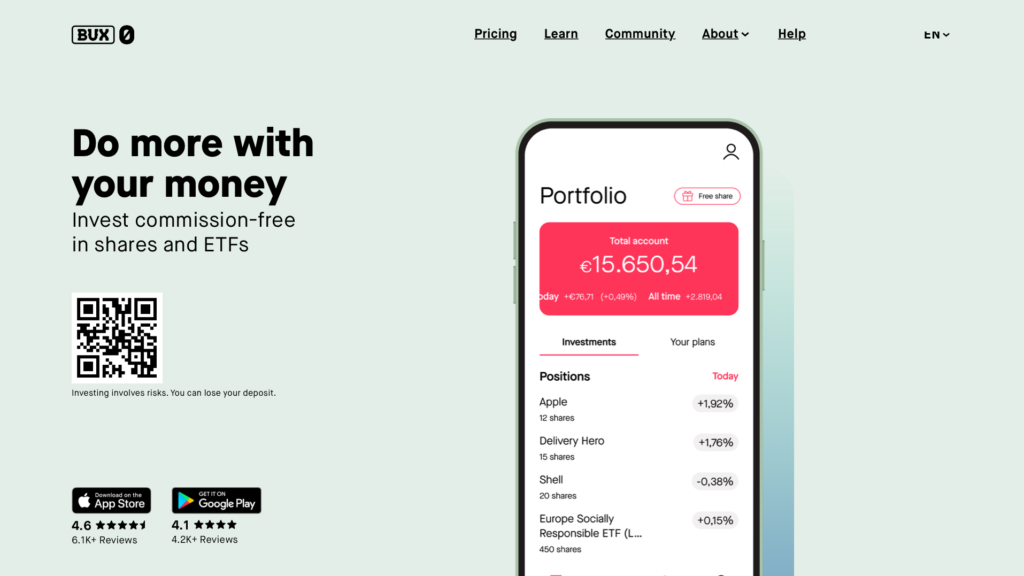
With half a million customers in the Netherlands, Austria, Belgium, France, and Germany, BUX enables investors to buy and sell shares and exchange-traded funds (ETFs), without having to pay commissions. Dubbed the “Robinhood of Europe”, BUX is a response to what Naeff said is a growing awareness of the importance of investing by younger Europeans. Naeff underscored financial uncertainty as a major concern among the younger generation and credited them for realizing that investing is “one of the few viable ways left” to manage that uncertainty. The self-directed nature of investing on BUX’s platform – for shares and ETFs, as well as cryptocurrencies on its BUX Crypto app, and CFDs on its BUX X solution – is another appealing aspect, Naeff said.

“Traditional financial market investing comes with a lot of friction and we firmly believe in the democratization of access to financial services for the next generation of investors,” Head of Europe Investments for Prosus Ventures Sandeep Bakshi said. “The existing solutions are expensive, complex and not designed for younger generations.” Alex Leung, Assistant GM at Tencent, Strategic Development, noted that Bux’s business model does not depend on some of the revenue-raising strategies that have been criticized at rivals like Robinhood. “BUX is the only neo-broker in Europe that offers zero commission investing without being dependent on kickbacks or payments for order flow,” Leung said. “This ensures that its interests are fully aligned with its customers.”

No valuation information was provided as part of the funding announcement. The company noted that its signature BUX Zero solution “has more than doubled its assets under management” in the past three months.


Here is our weekly look at fintech around the world.

Central and Southern Asia

Latin America and the Caribbean

Asia-Pacific

Sub-Saharan Africa

Central and Eastern Europe

Middle East and Northern Africa


Photo by HoliHo from Pexels

Visa to Enable Cryptocurrency Trading

Visa to Enable Cryptocurrency Trading

For those still waiting for greater institutional endorsement of digital assets, the news that Visa will enable cryptocurrency trading on its network should come as a welcome sign.

Visa CEO and chairman Alfred Kelly announced the plan in an earnings call last week. Kelly noted that not only would Visa allow buying and selling of cryptocurrencies on its platform, but also that the company was “uniquely positioned” to do so, and to do so safely and securely.

Visa’s plan is to divide digital assets into two categories: cryptocurrencies and digital currencies. Cryptocurrencies, per Kelly, represent the “digital gold” of the digital asset market insofar as they are not typically used as a form of payment. For these assets, Visa plans to work with wallets and exchanges to allow users to buy these currencies using their Visa credentials. Visa also plans to enable users to cash out of their cryptocurrencies onto a Visa credential to make fiat-money purchases wherever Visa is accepted globally.

With regard to digital currencies, Visa defines these assets as “fiat-backed digital currencies including stablecoins and central bank digital currencies.” These assets, per Kelly, could find use cases in global commerce “much like any other fiat currency” and could run on public blockchains as additional networks much like RTP and ACH rails.

Kelly noted that Visa already has a strong relationship with 35 digital currency platforms and wallets, including BlockFi and BitPanda. These partnerships, Visa claimed, represent potentially more than 50 million Visa credentials – a significant size advantage over the company’s rivals. “And it goes without saying,” Kelly added, “to the extent a specific digital currency becomes a recognized means of exchange, there’s no reason why we cannot add it to our network, which already supports over 160 currencies today.”

Visa’s positive news on cryptocurrencies comes on the heels of the company’s announcement that its planned $5.3 billion acquisition of fintech infrastructure provider and fellow Finovate alum Plaid is now off the table. Visa is an alum of both our Finovate conferences, making its Finovate debut at FinovateSpring ten years ago, and participating in our developers conference, FinDEVr Silicon Valley, four years later in 2014.


Photo by Worldspectrum from Pexels

Payshield Leverages Visa’s Verifi to Fight Chargebacks

Payshield Leverages Visa’s Verifi to Fight Chargebacks

PCI-DSS innovator PayShield announced a partnership with Visa’s Verifi, a chargeback protection suite solutions provider this week.

PayShield selected Verifi to bolster its Express Resolve chargeback prevention solution in the Asia Pacific (APAC) region. Australia-based PayShield is leveraging Verifi’s dispute management tools that offer pre-dispute management solutions for chargebacks. Specifically, Verifi offers a three-pronged approach, allowing merchants to prevent disputes, resolve disputes, and inform the parties involved.

“PayShield has invested an incredible amount of time, effort, and resources into developing and testing our unique API and we are thrilled to be able to offer our ‘Express Resolve’ product to APAC merchants in partnership with Verifi,” said PayShield CEO Daryn Griggs. “Through the PayShield and Verifi relationship, merchants benefit from a global pre-dispute coverage that enables them to identify, resolve, and respond at unmatched velocity, which in turn, delivers higher successful resolution rates and greater cost savings.”

PayShield’s implementation is a timely one, as many merchants and services have had to move their sales online. This increase in card-not-present transactions has increased the potential of fraudulent activity in online purchases. Integrating Verifi’s dispute management tools offers a holistic solution for PayShield’s merchant clients, ultimately helping them land higher win rates, reduce manual reviews, and boost profits.

Founded in 2005, Verifi was acquired by Visa in 2019 for an undisclosed amount. Today’s deal marks Verifi’s first Australia-based partnership. “Extending global coverage by creating meaningful relationships with partners is important for us to enable sellers and issuers to benefit from pre-dispute solutions and evolve the chargeback process to enhance the cardholder experience,” said Verifi CEO Matthew Katz.


Photo by Snapwire from Pexels

Justice Files Suit to Block Visa’s Acquisition of Plaid

Justice Files Suit to Block Visa’s Acquisition of Plaid

It looks like the Biden transition team aren’t the only ones being told to slow their roll by the Trump administration: the U.S. Department of Justice has filed a civil antitrust lawsuit to block Visa’s ability to acquire innovative fintech – and Finovate alum – Plaid.

“American consumers and business owners increasingly buy and sell goods and services online, and Visa – a monopolist in online debit services – has extracted billions of dollars from those transactions,” Assistant Attorney General Makan Delrahim of the Justice Department’s Antitrust Division said. “Now, Visa is attempting to acquire Plaid, a nascent competitor developing a disruptive, lower-cost option for online debit payments.  If allowed to proceed, the acquisition would deprive American merchants and consumers of this innovative alternative to Visa and increase entry barriers for future innovators.” 

The move by the Justice Department was anticipated. An investigation into the acquisition was launched in late October, after the department spent a year examining how the deal would impact the financial services market more broadly. And in its statement, the Department has concluded not only that the impact would not be good, but also that Visa’s motives for the acquisition are problematic, as well. DOJ accuses Visa of purchasing the fintech company as an “insurance policy” to defend its U.S. debit business. The statement indicates that Visa feared that, either by itself or in partnership with a competitor, failure to deal with the “threat” of Plaid could result in “potential downside risks of $300 million to $500 million” in its debit business.

Visa’s criticism of the lawsuit mirrors somewhat the broader critique that we often hear when politicians get involved in technology; namely, you just don’t get it. Specifically, Visa accused the government of not “understanding Plaid’s business and the highly competitive payments landscape in which Visa operates.” The company, which has 70% of the online debit transactions market compared to rival Mastercard with 25% share, added that rather than a competitor, it sees Plaid simply as a firm with complementary capabilities.

“Visa’s business faces intense competition from a variety of players,” the company’s statement read, “but Plaid is not one of them.” For its part, Plaid has not commented on the lawsuit at this point.

What are the odds of the Visa-Plaid acquisition emerging successfully from this legal challenge? While it is difficult to predict an outcome, what is catching the eye of some observers is the possibility that DOJ’s interest in Visa’s Plaid acquisition could be just the beginning. Citing language in the lawsuit that refers to Visa’s “long history” of aggressive action toward fintechs like PayPal, Bloomberg Law quoted former DOJ antitrust division attorney John Newman who said a “monopolization case” could be in the offing against Visa – even if the current case is limited to blocking the acquisition of Plaid.


Photo by Sora Shimazaki from Pexels