This site is operated by a business or businesses owned by Informa PLC and all copyright resides with them. Informa PLC's registered office is 5 Howick Place, London SW1P 1WG. Registered in England and Wales. Number 8860726.
Finovate Blog
Tracking fintech, banking & financial services innovations since 1994
How can we recognize AI as a tool for expanding human abilities and enhancing creativity rather than merely a way for corporations to eliminate jobs? What does it mean when some AI experts suggest that AI, instead of replacing human activity, will enable us to use our unique skills as human beings in different, more sophisticated ways?
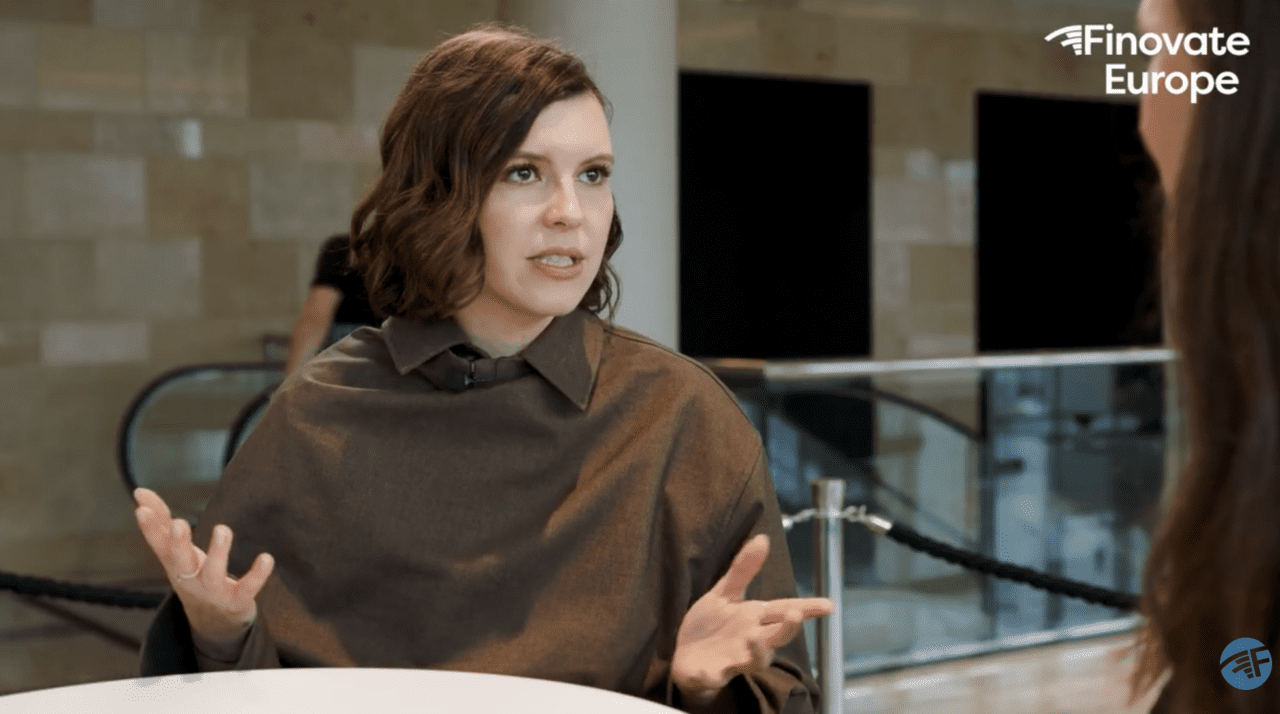
Finovate Senior Research Analyst Julie Muhn interviewed Georgia Lewis Anderson, Co-founder and AI consultant with Lantyn, and a leading expert on artificial intelligence, to discuss these and other questions about the state of AI in 2026. Following her keynote address at FinovateEurope earlier this year, Anderson discussed the rapid evolution of AI, the idea of AI as a “cognitive prosthetic,” and how this concept can be used to enhance rather than replace human ability and creativity.
“If air travel had evolved at the same rate as large language models, then we would be able to get from London to New York in 15 seconds. So if you’re feeling overwhelmed with AI, it’s not a surprise. I’ve worked in AI since 2016, way before GenAI, before the ChatGPT moment, and I’m still catching up every day. I think anyone who says they know everything about AI is lying, so I just want to quell and soothe the fears. Our skills are going to be used differently. I think we’re all quite worried AI is going to replace us, but I think actually it’s about using our skills in a different way.”
Georgia Lewis Anderson is a leading AI consultant and prompt engineering specialist whose career spans crafting Cortana’s British personality at Microsoft and launching Google Assistant in the UK. More recently, she contributed to Meta’s large language model (LLM), Llama 3. She regularly delivers talks at high-profile events such as Ogilvy’s Behavioural Science Festival, where she shares insights on the intersection of AI, human behavior, and marketing.
Lantyn was launched in 2025 to help people explore artificial intelligence in a more relatable, engaging way, regardless of background or technical experience. The London-based company offers AI cheat sheets on how, when, and where to use AI, and features podcasts in which the team creates AI tools and products, and then shares their experiences with viewers.
AI is making a major impact on all aspects of banking, fintech, and financial services, and the world of investing is no exception. From helping investors better understand the volumes of financial, economic, and market data available to them to creating more personalized investment strategies, AI is empowering average retail investors to make smarter decisions and take greater control over their financial futures.
At FinovateEurope 2026 in London this year, I sat down with Nitzan Nachum, Chief Revenue Officer at BridgeWise to talk about the company’s mission to make investing more accessible to a greater range of investors. We also discussed the key role AI is currently playing in helping investors find the information they need and ensure it is accurate and from trusted sources.
“When BridgeWise was founded, it was about filling the gap of financial information asymmetry in the market. For years, for decades, information has been owned only by professionals or by people that are really early adopters of technology and know how to find the right information. But for many, and for most retail investors, most of them couldn’t find information about their portfolios except through the news or through a professional such as their relationship manager or wealth advisor …
We wanted to make this (information) accessible to everyone, so that everyone would have the same information when they are in the process of decision-making about whether they want to invest in a certain stock, fund, or any financial asset.”
Chief Revenue Officer at BridgeWise, Nitzan Nachum has more than eight years of experience leading fintech growth and revenue operations. With degrees from Tel Aviv University, Nachum has demonstrated expertise in global sales, international expansion, and go-to-market strategy across multiple markets.
BridgeWise is a technological research company that leverages AI-based analysis and large language models (LLMs) to offer comprehensive insights into global stocks. The company’s solutions are designed to bridge the knowledge gap in the investment world to empower investors of all types to become “super investors.” Integrated into brokerage platforms and the infrastructures of other financial institutions, BridgeWise provides instant fundamental analysis of stocks around the world, as well as bespoke investment strategies, to enable millions of investors to make informed investment decisions.
Headquartered in New York and founded in 2019. BridgeWise recently published its inaugural State of AI for Wealth report. The report is a comprehensive review of international sentiment towards using AI for investment information and surveyed 2,100 individuals across 19 countries.
Bringing more personalized financial products and services to consumers is one of the great promises of enabling technologies like AI. It is also increasingly recognized as one of the best ways for banks, credit unions, and other financial services providers to differentiate their offerings from rivals—including those from Big Tech and Big Retail.
At FinovateEurope 2026 earlier this year, I spoke with Gregor Bierent, CEO of NF Innova, about how the company helps traditional banks embrace digital transformation through their innovative platform, FinTense. In our conversation, Bierent discussed the power of FinTense’s digital banking score, the importance of micro-personalization, and how AI-driven solutions can enhance customer experience and boost banking efficiency.
“We see that there is more and more drive and demand for banking to become more unique (and personalized). No matter which bank you’re working with, banking for private individuals or for the small and microenterprises, what we see is that user experience needs to be individual … Your banking needs are different from mine. You like different colors. You have different ways of finding something, of clicking and navigating. This is where personalization—or micropersonalization—kicks in.”
Gregor Bierent is a veteran C-level executive with a track record of growing and improving business in the international information technology and services industry. With a background in consulting, digital strategy, and enterprise software, Bierent has a demonstrated history in providing strong leadership and driving both revenue and profitability. He joined NF Innova as CEO in 2021.
NF Innova, a Noventiq company, helps banks achieve their digital transformation objectives. The firm’s FinTense digital banking platform enables incumbent banks to enhance customer engagement across all digital touchpoints, automate customer-facing processes, and adopt other innovations to better compete with fintechs and challenger banks. The company recently demonstrated its technology at FinovateEurope 2024, presenting its personalized banking experience module. Founded in 2015, NF Innova is headquartered in Belgrade, Serbia.
As the push into AI continues, many banks are still struggling to modernize their digital foundations without simply recreating their existing platforms. For institutions operating across multiple markets, that challenge becomes even more complex, as firms need to balance local autonomy with the need for standardization, speed, and scalability.
In a recent conversation with Vanja Tokic of Raiffeisen Bank International, Tokic explained that the real work of transformation is happening in how banks rethink processes, align teams, and prepare their data and systems for what comes next. He also talked about what it takes to actually get started.
“There is still a lot of overhype on the GenAI topic. Banks and people in general are underestimating what it takes to put those things into real processes, into real production… It looks really simple when you start prompting, but when you actually have to do it in a regulated environment, then it’s really difficult to get it done.”
Tokic serves as Head of Digital Channels and Conversational AI and previously led retail digital transformation strategy at Raiffeisen Bank International. With more than two decades of experience in digital banking, he focuses on translating high-level strategy into execution by aligning teams across markets, driving adoption of reusable platforms, and building what he describes as a “digital bank with a human touch.”
Raiffeisen Bank International is an Austria-based banking group that operates across Central and Eastern Europe, serving millions of customers through a network of subsidiary banks. The organization functions as both a central institution for the Raiffeisen Banking Group and a holding company for its international operations, offering retail and corporate banking services across the region.
Finovate kicks off its Women’s History Month commemoration with this salute to the women who introduced their companies to our FinovateEurope 2026 audience last month in London.
These CEOs, founders, executives, and analysts demoed a range of fintech solutions to help banks and other financial institutions integrate enabling technologies, grow their businesses, and enhance the customer experience for financial services consumers everywhere.
Natalia Corobco, CEO, Founder, and Marzia Niccolai, Chief AI Officer, Francis
Francis helps financial institutions and fintechs tackling open finance problems put AI at the center of the client’s value proposition. Headquartered in London, England, Francis was founded in 2025. Demo video.
Triin Preem, Head of Strategic Partnerships, Northern Eruope, Mifundo
Mifundo helps banks grow business volume by up to 15%, reflecting the share of foreign and cross-border customers in most European markets, by enabling them to serve this segment effectively. Headquartered in Tallinn, Estonia, Mifundo was founded in 2022. Demo video.
A digital technology companies working at the nexus of fintech and edtech, MyPocketSkill is making Gen Z more money savvy and able to save and invest. Headquartered in London, England, MyPocketSkill was founded in 2020. Demo video.
Svitlana Vyetrenko, Founder & CEO, Outsampler
Outsampler improves research productivity by 40% so that portfolio managers can focus on high-value client conversations. Headquartered in Strasbourg, France, Outsampler was founded in 2025. Demo video.
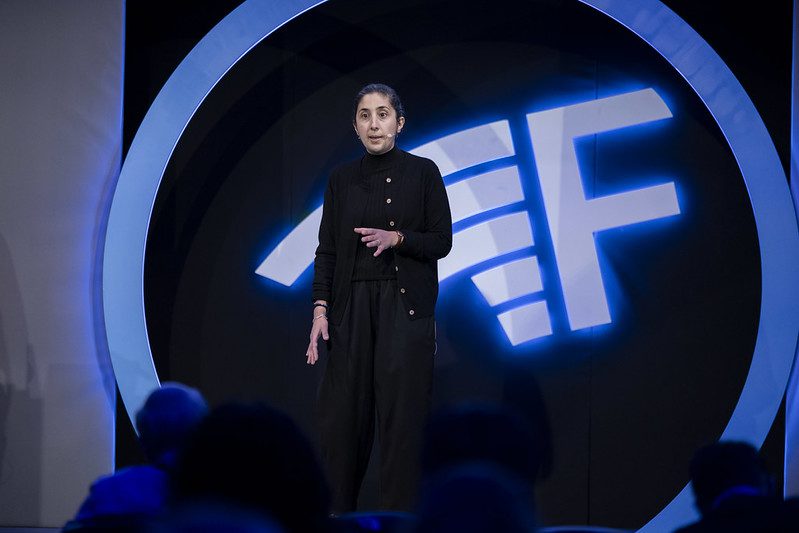
Marya Bazzi, CEO & Co-Founder, Sea.dev
Sea.dev automated underwriting workflows, eliminating copy-paste and document collection so credit analysts can focus on higher-value analysis, faster decisions, and growth—ultimately serving more of the economy. Headquartered in London, England, Sea.dev was founded in 2024. Demo video.
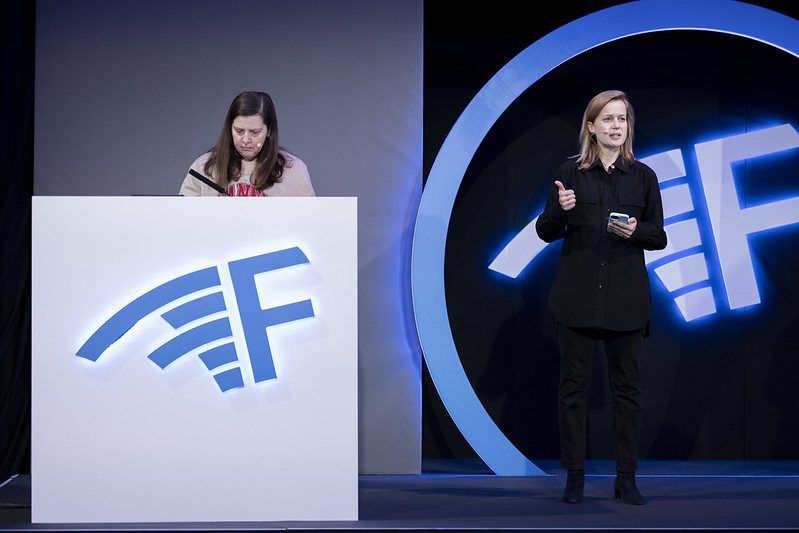
Savannah Price, Founder & CEO, and Lizzie Collins, Chief of Staff, Serene
Serene transforms a compliance burden into sustainable growth. The company’s technology delivers insights that optimize collections, reduce arrears, empower front-line teams, and safely expand lending to underserved markets. Headquartered in London, England, Serene was founded in 2023. Demo video.
Magda Targosz, CEO, Skill Studio AI
Skill Studio AI reduces training costs by 95%, accelerating compliance readiness from weeks to minutes, and scales globally with 170-language support—eliminating a regulatory risk and operational bottlenecks. Headquartered in Dublin, Ireland, Skill Studio AI was founded in 2025. Demo video.
Ashley Parekh, CEO, Syntex
Syntex lets clients submit applications and documents digitally while giving bank teams visibility into approvals, document status, and ownership, reducing delays, drop-off, and lost deposits. Headquartered in San Francisco, California, Syntex was founded in 2025. Demo video.
FinovateSpring 2026 will take place at The Sheraton San Diego on May 5-7. Register today using this link and save 20%.
If you missed out on FinovateEurope earlier this month, you don’t have to feel left out any longer. The 22 demo videos are now live (and free to watch!) on the Finovate website and on Finovate’s YouTube channel.
Each seven-minute video offers a fast and efficient way to catch up on the latest new launches in fintech. We’ve highlighted the three Best of Show-winning demos below to get you started.
For more coverage of on-stage content at FinovateEurope, check out our post-show analysis. And if you don’t want to miss out on the live action next time around, be sure to register for FinovateSpring, taking place on May 5 through 7 in San Diego, California. We’ll see you there!
Great conferences are defined largely by what does happen: what themes are discussed, what trends generate the most passionate conversations. But great conferences are also defined by what doesn’t happen: by those topics and trends that have become exhausted, failed to live up to the hype in the first place, or simply aren’t ready for prime time.
Sustainability has been a stronger theme among fintech innovators in the UK and the EU compared to the US—and arguably all the more so given the fusillade of disincentives from the Trump Administration. Past Finovate conferences have showcased fintechs such as Connect Earth (UK), ecolytiq (Germany), and Little Blocks (India) that are helping institutions and individuals calculate their environmental impact; reduce carbon emissions via online marketplaces, and align their investing and banking preferences with their attitudes toward the environment.
While never a large fraction of the demoing companies at any given show, it was notable that no companies focused on sustainability on the demo stage. This likely reflects at least in part the shift in emphasis toward AI and blockchain-related innovations, especially as these innovations are increasingly moving from the experimental to real-world use cases. Even as these enabling technologies appear to be in their earliest stages, the fact that they already are responding to real problems in financial services makes them an especially attractive field for innovation compared to sustainability.
It is important to note that this does not necessarily mean that there has been a decline in interest in sustainability and climate-related fintech innovation. In fact, investment in climate-related fintech—and climatetech in general—increased from 2024 to 2025. Europe represented a significant amount of the $103 billion raised globally at 56%, with US-based funds contributing 16% toward the international total. But sustainability is increasingly being seen less as a standalone solution, and more as a cost-cutting feature to be integrated as in embedded finance or as part of a broader risk and data analytics package. Those looking for sustainability to return to the center stage will likely need to see the rise of stronger regulatory mandates such as those for stricter environmental financial disclosure or other incentives. Technological innovation alone may not do it.
Quantum Computing: Waiting for the Great Leap Forward?
While there was a sole presentation on quantum computing at FinovateEurope, the discussion of this technology still remains limited in most fintech forums. This is despite the conviction by analysts that quantum computing will make a significant impact on all technology—including financial technology—in the years to come. It is also interesting insofar as we are seeing emerging, enabling technologies in AI and the blockchain that continue to surprise detractors and outperform expectations when it comes to practical use cases. Why not quantum computing?
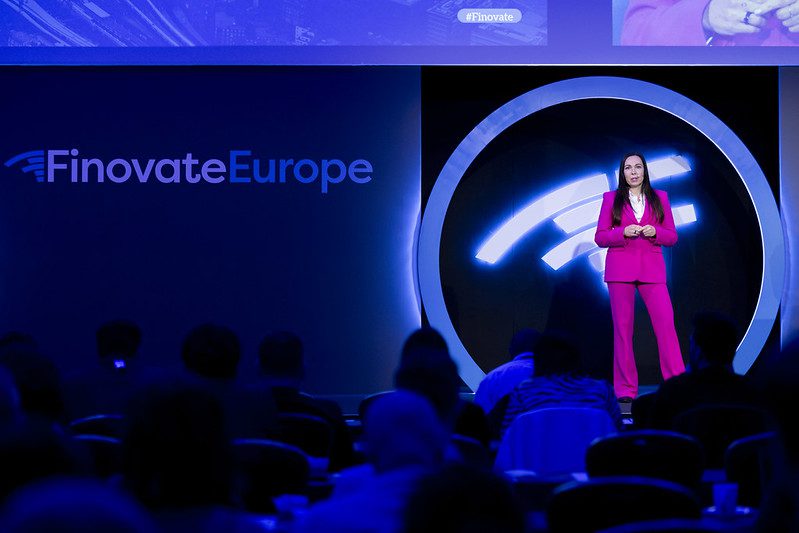
First, credit where credit is due: Day One of FinovateEurope featured Amal Nazar, Head of GTM at Wultra, a firm that provides post-quantum authentication solutions to financial institutions around the world. Nazar’s Special Address emphasized that it was important for banks and other financial institutions to transition to post-quantum cryptography in order to secure long-term digital operations. With regulators urging firms to complete this shift by 2030, it is clear that whatever conversations we are not yet having with regard to quantum computing will likely begin sooner than we think.
But not quite yet. Unlike AI and blockchain-based technologies like stablecoins, quantum computing is still significantly “pre-commercial,” meaning that while there is considerable investment interest, practical commercial applications in financial services have yet to materialize. There are a number of reasons for this, but essentially the issue is developmental (read: hardware) rather than software or regulation-related in the cases of AI and stablecoins, respectively. Arguably, when it comes to quantum computing, this technology as it applies to financial services is about where AI and stablecoins were seven to ten years ago: long on hype and promise, but short on use cases. Those use cases are developing; as Nazar’s presentation suggests, cryptography is one of the primary areas where we should anticipate quantum computing use cases emerging. But compared to AI and stablecoins, quantum computing may experience the “always a bridesmaid, never a bride” syndrome for a few more seasons, at least.
“Nobody Here But Us Cloud Companies …”
If you suspected that the inclusion of “cloud” as a theme that was underrepresented at FinovateEurope was little more than a ruse to talk about AI, then I confess to being guilty as charged. But the comparison between the “cloud revolution” and the “AI revolution” was one I heard from Finovate delegates and on-stage experts alike, and an interesting notion to add to this conversation on fintech trends.
No company demoing declared themselves a cloud company this year. That’s because, in a sense, they are all “cloud companies.” The ubiquity of cloud technology in fintech has rendered the descriptor almost obsolete. And increasingly something similar is happening with AI. While we did go through the obligatory period when companies felt the need to append “ai” to their names, we are nevertheless seeing an impressive urgency with which companies are seeking to leverage AI to improve efficiency for both their own workers as well as for their customers. Perhaps not since the early days of digital banking has as much attention been paid and innovation devoted to both sides of the customer experience at the same time.
What this means, as Senior Finovate analyst Julie Muhn remarked to me in the run-up to FinovateEurope this year, is that there is less and less a conversation about “AI,” and more and more a conversation about generative AI, or explainable AI, or agentic AI, or ethical AI … You get the point. The evolution in our way of talking about AI reflects nothing more than our growing understanding of the diverse ways AI technology can be deployed, as well as the myriad responsibilities involved in deploying it. So while we won’t stop hearing about “AI” anytime soon, we should be prepared for a new way of talking about the technology as our relationship to it evolves.
This article is brought to you in collaboration with Gregory.
AI is rapidly reshaping the competitive landscape in banking, and for many institutions, the real challenge lies not in experimentation, but in implementation. Richard Davies, CEO of Allica Bank, has been focused on exactly that: how to successfully deploy AI across an organization and drive meaningful adoption at scale.
Founded in 2020, Allica is a digital bank focused on established small and medium-sized businesses. To date, it has lent over £3 billion and been twice named by Deloitte as the UK’s fastest growing technology company. In 2025 the Financial Times identified it as the second fastest growing company in Europe.
Richard delivered a fascinating keynote address at FinovateEurope, titled: “Successfully Implementing AI & Scaling Adoption: What Are the Challenges Around Rolling Out to Production?”. Afterwards, we sat down with him to talk about what it really takes to embed AI into a bank’s operating model.
Tell us a little more about your role as CEO of Allica Bank and what you’re focused on at the moment?
Richard Davies: Allica is a fintech bank focused on established small and medium-sized businesses. We typically define that as businesses with five or more employees or at least £500,000 in revenue. So we’re not talking about the very smallest microbusinesses, but those that are at a point where things start to get more complex and there are multiple staff to support.
We find these businesses fall into a gap between the corporate banking divisions and retail banking divisions of the major banks. That’s the space we focus on.
We have been building Allica for five or six years now and provide a full stack of services, including current accounts, cards and all types of lending. Increasingly, we are moving into financial operations areas such as spend management and cash flow forecasting. Alongside that, we have been thinking hard about how we can apply AI to power many elements of what we do across the organisation.
In your keynote, you spoke about successfully implementing AI and scaling adoption. What do you see as the biggest challenges for banks when it comes to rolling AI out in practice?
Davies: I would group it into three main areas:
First, ensuring that AI adoption happens across the whole company, rather than sitting in an innovation lab or small specialist team. A big focus for us has been getting people bought in, upskilled and confident, and encouraging teams to create their own simple, agentic use cases. I am a big believer that bottom-up adoption tends to win over purely top-down mandates.
Second is software engineering and product development. Around a third of our staff are in engineering, and that is probably the area that has seen the greatest progress in AI tooling. We have focused on helping people move towards more T shaped or full stack roles, and ensuring our tech stack is AI enabled to unlock significant productivity gains. Depending on what you measure, we are seeing productivity improvements of two to ten times.
Finally, there are more complex agentic use cases. We have specialized teams working on these, and we have been learning a lot over the past two years about what it takes to get them live in production. It’s exciting because beyond engineering, you start solving real world problems that consume a lot of human time and can be inconsistent when done manually.
A lot of banks are investing in AI at the moment. How should they decide where it makes the most sense to focus first?
Davies: My view is that you should not overly narrow your focus. If you pick two areas, you are neglecting ten others, and those areas will fall behind.
Perhaps I have the luxury of leading a fintech organization that is naturally inclined towards this, but I think AI needs to be embraced across the company. Where you do need focus is on infrastructure, including data quality, enabling access to different AI models and ensuring that is done company wide.
If I had to pick one area with immediate and certain benefit, it would be engineering. The productivity unlock in software development is huge. If teams are still working in traditional ways, they need to move quickly, not just for the company’s benefit, but for their own careers. The industry is shifting rapidly, and people need the skills and experience to keep up.
Beyond the technology itself, what changes do banks need to make internally for AI to really become part of how they operate?
Davies: Culture is a big part of it. People need to lean into it. You need the infrastructure in place, as well as training and upskilling so people feel confident using AI.
At the same time, organizations need to remain risk aware. Different AI use cases carry different risks, and teams need to understand those.
In many ways, it’s similar to previous organizational transformations, such as moving from traditional waterfall practices to agile. The enablers are not conceptually different, but it does require deliberate leadership and a clear view of how you enable the organization to change.
From what you’ve seen at FinovateEurope so far, what themes or conversations around AI in banking have stood out to you the most?
Davies: Some of the most interesting conversations have been happening off stage. Recently, we have seen software company valuations come under pressure following major AI model releases, with the view that people can now build their own software more easily.
At the same time, traditional banks have re-rated quite significantly over the past year. In the UK, share prices are up roughly 80 percent. It creates an interesting dynamic.
Fintech has at times in the past been viewed by investors as a poor relation to software, but in reality, building a fintech is much harder than building a pure software company. You have complex regulatory requirements and balance sheet considerations that software firms do not.
It feels like there may be a shift happening in the relative valuation of where companies with real assets versus asset light software companies. For many fintechs, particularly those with strong fundamentals, that could ultimately be a net positive.
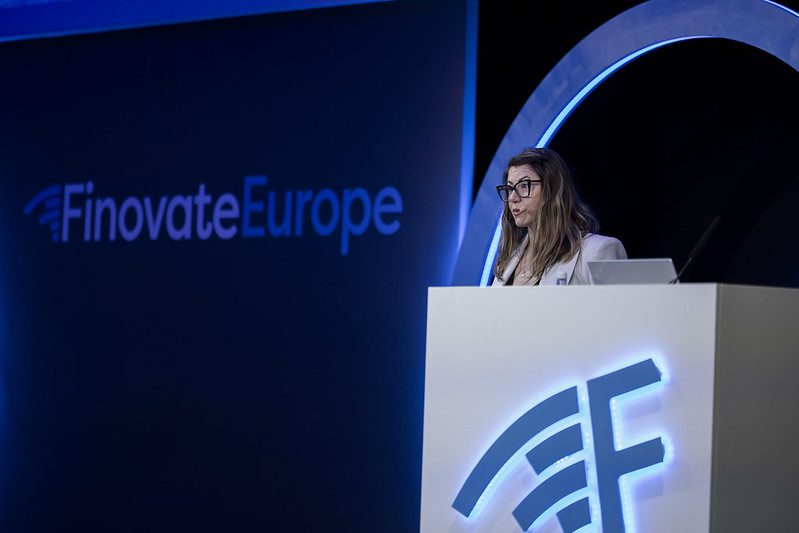
FinovateEurope 2026 wrapped up last week, but the fintech conversations are still flowing across social media. The two-day event was packed with meaningful conversations, fast-paced demos, a reunion of familiar faces, and new connections.
And while speakers and attendees were busy talking and learning about all things fintech and banking, Finovate’s photographer was capturing the event in more than 1,000 photos.
The photos are broken down into three categories, and we’ve pulled in a few photos as well as highlights to help summarize FinovateEurope via pictures. If you’re looking for a full content summary, check out our event summary blog post.
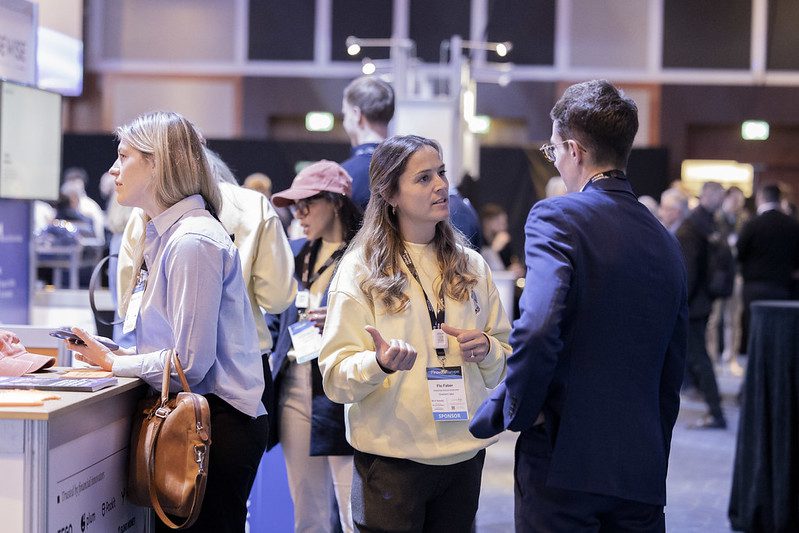
Some of the best discussions happen off stage. And with almost a dozen networking sessions baked into the event, there were a lot of valuable ideas exchanged in the hallways and on the networking floor. Heightening this experience were a live caricaturist and, even though fintech has a magic of its own, a magician.
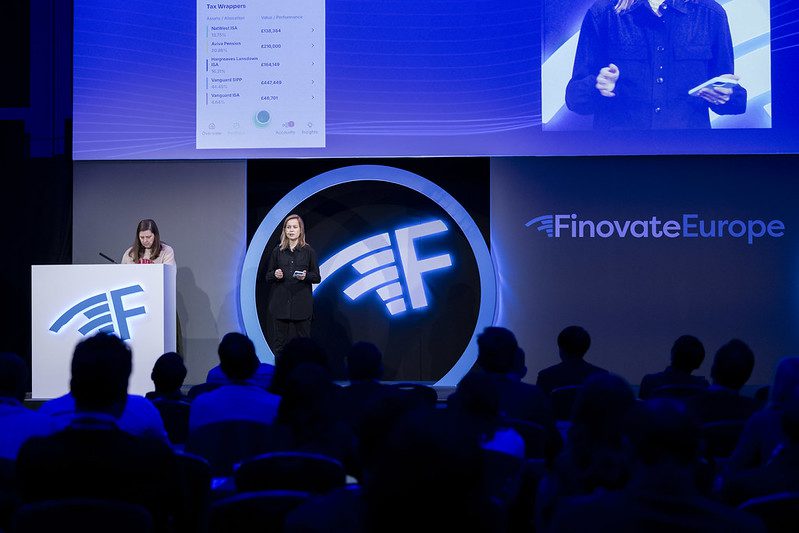
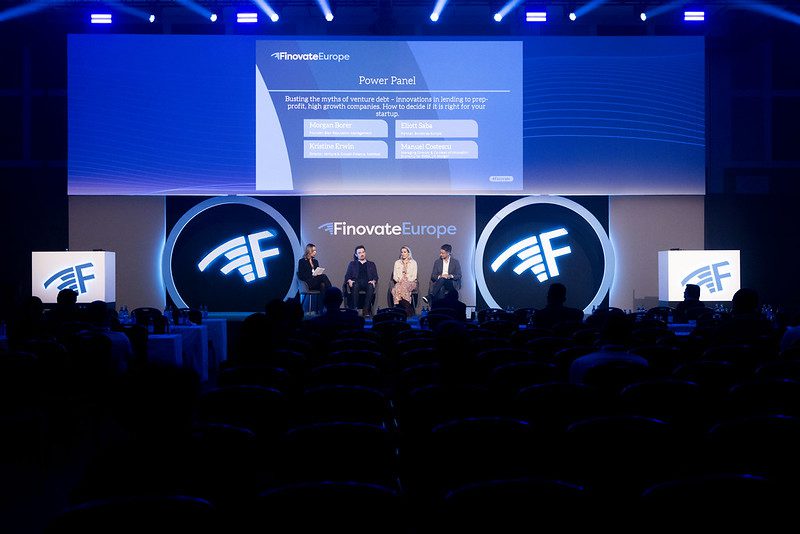
Between panel discussions, fireside chats, and keynote presentations, the FinovateEurope stage hosted some of the brightest minds in fintech (and I’m not just saying that because I was on stage). We heard from founders on their biggest challenges, venture capitalists on the state of funding as we move into 2026, and bankers on how they actually measure the value of AI pilots.
The more than 20 companies that demoed their newest technology on stage showcased some of the most cutting edge ideas in fintech. From identity verification to core modernization, banks and fintechs face a lot of challenges. These fintechs took the stage to show their newest technology in under seven minutes.
If you attended FinovateEurope in London last week, you may have noticed that the energy of the event felt different.
In previous years, the conversation leaned heavily toward experimentation. This year, it shifted toward execution. Across the demo stage, panel sessions, and hallway conversations, it was clear that fintech is maturing. And that maturity is reshaping how banks create, partner, and serve customers.
AI moves from experimentation to operationalization
Agentic AI dominated the agenda in a pragmatic way that eschewed hype for reality.
Speakers discussed the importance of governed agentic AI that protect users with guardrails, auditability, and human oversight. Among these protective barriers, trust, explainability, and regulatory alignment were highlighted as central design principles when implementing agentic AI tools. It is clear that the conversation has shifted from “Can AI agents work?” to “How do we deploy them safely inside regulated institutions?”
Fraud and identity also pulsed throughout conversations about AI, as new technologies are evolving these elements from singular checks to continuous behavioral intelligence. The topics of responsible AI and the impact of AI on the future workforce were also front and center, with standing-room-only crowds on the AI stage discussing governance, skill atrophy, and ethical deployment.
As one attendee said, “When it comes to AI, speed may win attention, but trust wins the relationship.”
Customer experience: from product-centric to embedded
In the Analyst All-Stars session, much of the conversation centered on customer-centricity. Banks are moving from product-centric models to embedded, predictive, and contextual financial experiences.
In my panel discussions on embedded and challenger banking, we explored how digital lending is moving closer to the customer as part of the journey. Executing embedded lending is about being present at the moment of need in the correct channel.
Other panel discussions and keynotes offered more insights around improving the customer experience:
Customers compare bank journeys to every digital experience they have.
Onboarding remains a major friction point.
Personalization and channel choice are now expectations.
Balancing compliance, risk, and conversion requires smarter orchestration.
Challenger banks continue to influence customer expectations, especially when it comes to how they think about brand and community. Many conversations along these lines considered the benefits of collaboration. In fact, over 70% of fintech product launches now involve strategic partners, and panels on platform banking reinforced that partnerships are structurally necessary to compete.
Payments, tokenization, and agentic commerce
Many of the payments discussions highlighted the fact that instant payments are becoming mainstream, but geography and behavior matter. By increasing the speed of payments, fraud also accelerates. This shift is pushing institutions toward implementing “friendly friction,” with biometrics and AI-powered detection.
While not highlighted quite as much, the topic of agentic commerce was brought up in the payments track. If (or when?) bots become customers, banks must rethink identity verification and value-chain control. With ISO 20022 becoming the common language for blockchain-based value exchange, tokenization and programmable money will become key pieces of infrastructure.
Capital is maturing
Most of the investors on the networking floor and up on stage agreed that fintech funding rebounded globally in 2025. Today, capital efficiency and unit economics have returned to the center of strategy. To keep up, founders are tightening business models and refining their distribution strategies. Additionally, panelists mentioned that community-backed capital structures, which add accountability, are increasingly being used alongside traditional venture funding.
Beyond the stage
The Women in Fintech panel was one of the most popular sessions. The overflowing crowd was a reminder that inclusion plays a role in organizational growth. Geopolitical risk, national security strategy, and regulatory shifts also underscored the fact that financial services innovation does not happen in isolation.
Thanks to all of our speakers who braved the stage to share their insights, and to everyone who attended. You all make up such a great community and we truly could not do this without you all!
The countdown is on! FinovateEurope 2026 lands in London on February 10 through 11 at the InterContinental O2 in London, and the global fintech community is gearing up for one of the year’s most engaging events.
The two-day conference will feature more than 1,000 senior decision-makers, including bankers, investors, founders, and fintech leaders as they uncover what’s next in fintech and banking. You’ll see over 20 live demos of cutting-edge technology with 100+ expert speakers offering insights that go well beyond buzzwords.
If you already have your ticket (if you don’t, there’s still time to register), here’s how to make the most of your days on-site:
Download the ConnectMe app and create your profile to start networking, set your schedule, and view the agenda.
The invitation-only Leaders+ and Impact+ sessions begin on February 9 at 6:00 pm.
Registration and networking begins at 8:15 am on February 10 and the day concludes with the Best of Show announcement during the evening cocktail reception, which starts at 4:30 pm.
Breakfast and networking begins at 8:15 am on February 11 and the day concludes with the Investor All Stars panel, which wraps up at 4:30 pm.
Bring your badge each day. You’ll need it for entry!
Plan your travel time to the venue, especially if you’re commuting or taking public transport.
Dress code? Business casual to business formal. Be comfortable, but ready to make an impression.
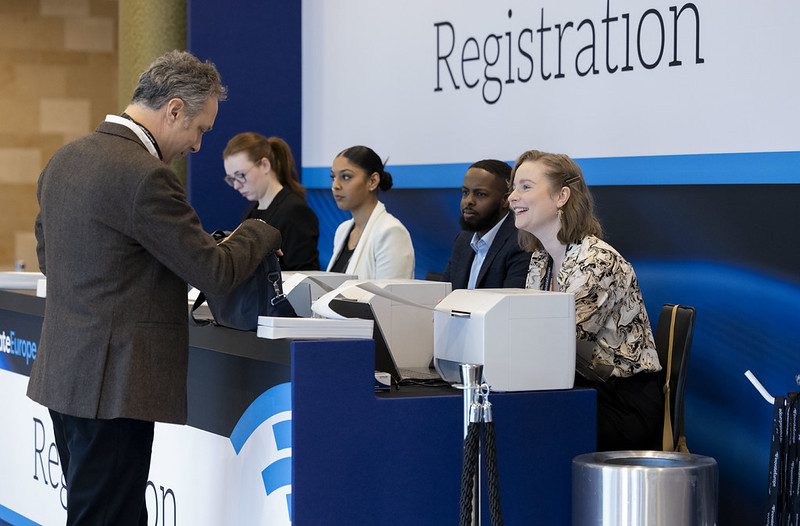
Need help? Stop by the registration desk or find a Finovate team member for assistance.
Follow #FinovateEurope on LinkedIn and Twitter for live updates and key takeaways.
Whether your goal is to track early fintech trends, forge new partnerships, or benchmark your strategy against peers, FinovateEurope delivers. With elite networking, live product insights, and industry-shaping conversations all under one roof, this conference promises to kick off 2026 with fresh ideas and real momentum.
As FinovateEurope returns to London on February 10 and 11, the spotlight on the second day of the conference shifts from demos to deep discussion. On February 11, FinovateEurope’s Industry Stages run in parallel with one another, giving attendees the opportunity to dive into strategic conversations shaping financial services in 2026.
This year’s event features five Industry Stages: Artificial Intelligence; Banking, Regulation & Risk; Customer Experience; Lending; and Payments. Each stage is designed to offer banking and fintech leaders more than just theory. The sessions focus on what’s working in practice, what’s breaking under the pressure of new technology and regulations, and what institutions need to rethink about their current operations.
Artificial Intelligence: from pilots to production
The AI stage will feature discussions on one of the biggest challenges facing financial institutions today: moving beyond experimentation. The sessions will explore lessons learned from early AI agent pilots, governance frameworks to combat “shadow AI”, and how banks can scale AI responsibly. Highlights include a keynote from Richard Davies, CEO of Allica Bank, who will speak about the realities of implementing AI in production. The stage will also host panels tackling ROI, data readiness, and responsible AI as a competitive necessity.
Customer Experience: personalization without losing the human touch
On the Customer Experience stage, the conversation moves past buzzwords to focus on execution. Sessions will examine how open data enables hyper-personalization, why mindset can be the biggest challenge, and how banks can retain empathy while scaling. A standout power panel brings together leaders from J.P. Morgan, Invesco, and PolyAI to explore what banks can learn from other industries as customer expectations are being reset by the evolution of enabling technologies.
Payments: instant, intelligent, and under threat
Payments are quickly evolving across the globe, especially with new regulations such as PSD3 and new capabilities and enabling technologies such as instant payments, stablecoins, and cross-border modernization. Panels will focus on how data-centricity and AI can unlock growth while strengthening security, especially as fraud losses and cyber threats keep rising.
Banking, regulation & risk: resilience in a volatile world
Regulatory pressure and operational resilience will be the center of the conversation on this stage, where discussions will span DORA, dispute management, and the risks embedded in cloud and AI adoption. These sessions are especially relevant for banks navigating complex vendor ecosystems while being asked to do more, faster, and with greater accountability.
Lending: capturing the embedded opportunity
The Lending stage will look at how banks can reclaim growth by meeting unmet needs, especially in small business and embedded lending. Panelists will explore how AI is reshaping credit decisioning, how regulation is evolving, and where incumbents can realistically compete with fintech challengers.
Together, these five Industry Stages on February 11 will offer a concentrated look at the decisions that will define banking’s next chapter. If you register for FinovateEurope before January 30, you can still save £300.