This site is operated by a business or businesses owned by Informa PLC and all copyright resides with them. Informa PLC's registered office is 5 Howick Place, London SW1P 1WG. Registered in England and Wales. Number 8860726.
Finovate Blog
Tracking fintech, banking & financial services innovations since 1994
MoonPay launched PayBox, enabling ChatGPT and Claude users to authorize AI agents to make purchases, trade tokens, interact with DeFi, and move assets using natural language.
The platform combines Visa’s agentic commerce protocol, x402, and cryptographic security to let AI transact while keeping users’ card details and wallet keys protected.
PayBox reflects the growing shift toward agentic commerce, as companies build the payment infrastructure that will enable AI agents to transact safely on users’ behalf.
Stablecoin infrastructure provider MoonPaylaunchedPayBox this week. The new payment vault allows users’ AI agents to trade tokens, bridge assets, interact with DeFi, and transact online without leaving the conversation.
The new capability enables Claude and ChatGPT users with a PayBox connector to offer their AI the ability to transact by describing what they want in natural language. In addition to requesting their AI to make purchases like booking a flight, customers can also ask things like, “Maximize yield using Aave” or “Onramp $100 into PYUSD.”
After the user installs PayBox on Claude or ChatGPT, the AI prepares the transaction, then the user approves the transaction with a passkey and PayBox moves the money without having to involve a developer tool or third party. MoonPay is using x402, an open protocol that enables AI agents and web services to initiate and settle payments programmatically across the internet, to allow AI to pay any service on the consumer’s behalf.
PayBox works with two payment methods, cards and wallets, both of which are kept secure. MoonPay leverages Visa’s agentic commerce protocol to avoid seeing or storing full payment details, while wallet keys are protected by threshold cryptography and secure enclaves. These protections never offer MoonPay or the agent access the full private key or allow the agent to sign transactions without user approval.
Users can choose between an approval mode, in which every transaction requires passkey confirmation, or an autonomous mode that lets AI agents complete transactions within user-defined spending limits and policies. Even in autonomous mode, the agent never gains access to users’ card credentials or wallet private keys.
“The card hid the cash. The phone hid the card. This is the era where money disappears into conversation,” said MoonPay CEO and Founder Ivan Soto-Wright. “Billions of AI agents are coming online, and every one of them will need to hold, move, and spend money safely. Someone had to build the trust layer for that world. We just did. PayBox is the product that MoonPay was built to make.”
Agentic commerce is moving beyond experimentation as AI assistants are starting to complete transactions on users’ behalf. To capture this opportunity, companies are racing to provide the payment layer for AI agents, especially as stablecoin infrastructure, payment networks such as Visa, and emerging standards like x402 continue to converge.
PayBox is launching with support for Solana, Ethereum, Hyperliquid, Tempo, Base, Robinhood Chain, Arbitrum, and Polygon, with plans to add more chains. The first PayBox integrations are already live, and MoonPay expects to introduce additional use cases every week. Additionally, MoonPay noted that support for AI platforms beyond Claude and ChatGPT is coming soon.
While it used to be largely experimental, AI has quickly evolved into a practical tool that is reshaping how banks and fintechs operate. Today’s AI platforms are helping bankers, advisors, operations teams, and customer service representatives work more efficiently by automating routine tasks, surfacing insights faster, and reducing the amount of manual work required to serve customers.
At FinovateFall 2026, which takes place September 9 through 11 in New York, we’ll see 68 companies take the demo stage, more than a dozen of which will use their seven-minute slot on stage to demonstrate how they’re putting AI to work across financial services. From advisor copilots and employee training to customer support, analytics, workflow automation, and personalized banking experiences, these fintechs are helping financial institutions become more productive without sacrificing the customer and partner relationships that remain central to banking. Below are 14 companies that will showcase how AI can help banks, credit unions, and fintechs work smarter.
AdvisorHelpAI equips financial advisors with an AI-powered assistant designed specifically for wealth management. The platform helps advisors quickly access firm knowledge, prepare for client meetings, summarize documents, and streamline administrative work, allowing advisors to spend more time building client relationships instead of searching for information.
Covecta uses AI to help financial institutions automate knowledge work and improve operational efficiency. By organizing institutional knowledge and making it instantly accessible through conversational AI, the platform helps employees find answers faster and reduces time spent navigating internal documentation and procedures.
Built specifically for credit unions, CUltivate leverages AI to improve employee productivity and member service. The platform helps staff quickly locate policies, procedures, and operational guidance, enabling faster responses while creating a more consistent member experience.
FinzeeAI helps credit unions connect biometric data from wearables to real-time financial decisions in order to stop impulse buying before it happens. The company provides an intelligence layer between the user’s money and their health to intervene in real time when the shopper’s body signals stress, stopping the impulse purchase from happening.
GPTAdvisor brings generative AI capabilities to financial advisors, helping automate research, summarize complex financial information, and assist with client communications. The platform aims to reduce administrative burdens while allowing advisors to focus on delivering higher-value financial advice.
Inbenta combines conversational AI, chatbots, and intelligent search to improve customer support. Its platform enables financial institutions to resolve customer inquiries more quickly through self-service while seamlessly escalating more complex issues to human representatives when needed.
Lemonade LXP helps banks train and support employees using AI-powered learning experiences. Rather than relying on static training materials, financial institutions can provide personalized guidance that helps employees build knowledge, stay compliant, and confidently serve customers.
Palomonte Labs’ Cube2 makes financial APIs AI-readable to enable developers and AI agents to safely understand and execute financial integrations. The AI infrastructure enables AI agents to automate financial integrations and maps business use cases into validated AI workflows.
Pyramid Insights applies artificial intelligence to help financial institutions uncover meaningful business insights from large volumes of operational and customer data. By surfacing trends, opportunities, and performance metrics more quickly, the platform supports better-informed business decisions.
ScreenSteps provides AI-assisted employee guidance that helps frontline staff complete complex banking processes accurately and consistently. The platform delivers step-by-step instructions within existing workflows, reducing training time while improving service quality and compliance.
Titan AI helps financial institutions automate routine banking tasks while providing employees with AI-powered assistance for everyday operations. The company’s platform is designed to improve efficiency, reduce manual effort, and enhance customer service across the organization.
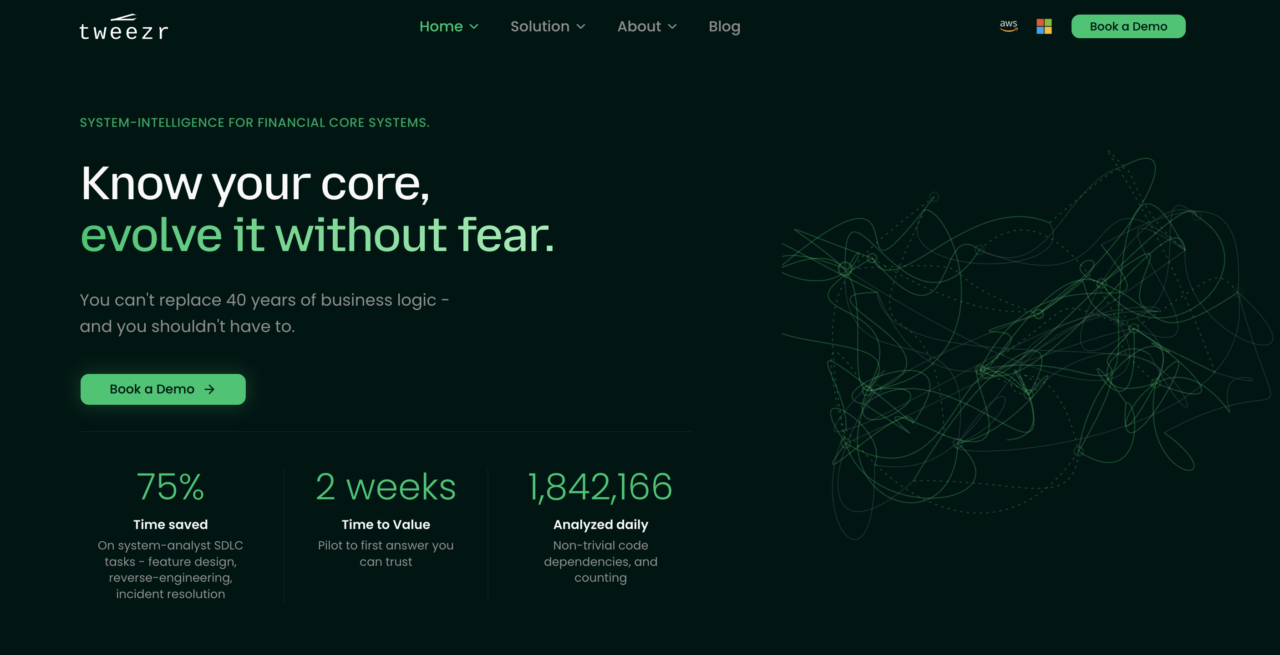
Tweezr uses AI to simplify internal workflows and help teams complete operational tasks more efficiently. By reducing repetitive manual work and improving process execution, the platform enables financial institutions to accomplish more with existing resources.
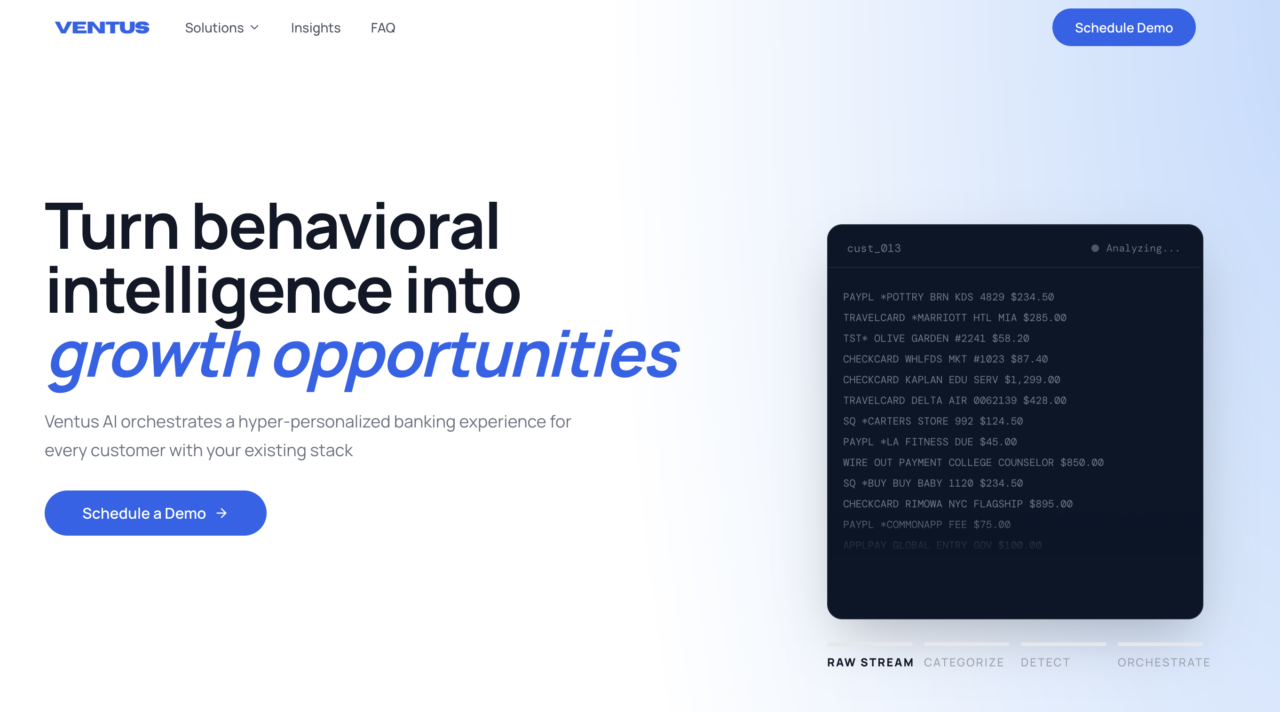
Ventus AI transforms raw banking transactions into semantic customer intelligence, enabling personalized experiences, smarter analytics, and human-centered digital banking without changing core infrastructure. The tool offers plug-in intelligence for any core banking system, turns transactions into dynamic personas, and detects life events before customers tell their bank.
Vertice AI’s OPTIMIZE transforms institutional growth goals into optimized, AI-executed marketing campaigns with human approval at the strategic level. The company offers autonomous campaign planning and execution with one-click approval, delivers end-to-end, goal-driven campaign optimization, and provides AI-generated, compliant, personalized multi-channel marketing.
Why banks should care
The conversation around AI in banking has matured considerably over the past two years. Financial institutions are moving beyond asking whether they should adopt AI and are instead determining where it can deliver measurable value. The greatest opportunity often comes when eliminating the repetitive work that prevents employees from focusing on customers, strategic decisions, and higher-value activities. AI-powered copilots, knowledge assistants, workflow automation, and intelligent analytics can improve productivity across nearly every department, from the contact center and lending operations to wealth management and compliance.
In looking at the companies demonstrating at FinovateFall 2026, it is clear that AI has become an enabling technology that touches every aspect of financial services. Whether banks are looking to improve employee efficiency, strengthen customer service, accelerate decision-making, or uncover deeper business insights, these solutions demonstrate practical ways to deploy AI today. For financial institutions seeking to compete in an increasingly digital marketplace, understanding these emerging capabilities may prove just as important as evaluating the next generation of payments, lending, or fraud technologies.
Increase has launched Increase Bank, combining an FDIC-member institution with its API-first banking core and direct connections to the Federal Reserve, The Clearing House, and Visa.
The company entered banking through its 2025 acquisition of Washington-based Twin City Bank, which continues serving existing community customers under the Twin City Bank name.
By operating its own bank while continuing to work with partner banks, Increase is integrating more of the embedded-finance stack and gaining greater control over product development, compliance, payments, and economics.
API-first banking fintech Increase is launching Increase Bank to bring its modern bank core to help businesses build and launch financial products.
With today’s launch, Increase now includes Increase Bank, an FDIC-member institution, plus its built-from-scratch banking core with direct connections to the Federal Reserve, The Clearing House, and Visa.
“This is a bank built by a team of product-obsessed operators for ambitious companies that are just as obsessed with building the best possible products for their customers,” said Increase Founder Darragh Buckley. “It is programmable at scale and designed for reliability, speed, and flexibility.”
Rather than pursuing a new bank charter from scratch, Increase acquired Washington-based Twin City Bank in 2025, giving it a regulated banking institution to complement its API-first infrastructure platform. The single-branch bank now operates as Increase Bank while continuing to serve Twin City Bank’s existing community banking customers under the Twin City name.
While the bank expands Increase’s role in the financial stack, the technology remains central to its strategy. Instead of serving exclusively as middleware between fintechs and sponsor banks, the company is integrating more of the stack by operating its own bank while continuing to partner with others. The move gives Increase greater control over product development, compliance, and payment operations, while positioning it to capture a larger share of the economics behind embedded finance.
“A fintech company’s ability to scale often comes down to whether they have a banking partner that can move at their pace, build solutions to the edge cases they are solving, and give them direct access to payment rails,” said Stripe Head of International Diede van Lamoen. “Increase was built by people who have first-hand experience with these challenges and a drive to support users from the first payment to their billionth.”
Founded in 2020, Increase provides the banking infrastructure behind companies including Gusto, Ramp, and Stripe. Its API-first platform enables developers to build products for money movement, deposit accounts, and card issuing using programmable banking components.
Ramp has officially launched in Canada, marking the spend management platform’s first expansion outside the US and bringing its corporate cards, expense management, bill pay, and accounting tools to Canadian businesses.
The Canadian platform includes localized features such as CAD and USD spending without FX markup, automatic GST/HST/PST/QST tax coding, Canadian-dollar accounting integrations, and cards issued through Peoples Trust.
Ramp’s expansion comes as competition in business banking intensifies, following Expensify’s UK and EU corporate card launch and Intuit’s introduction of a QuickBooks-connected corporate credit card.
Corporate card and expense management platform Ramp is moving across international borders this week. The New York-based company is now available to businesses in Canada.
Today’s launch comes after Ramp piloted its Canadian operations with a select few Canada-based small businesses. With the broad launch, businesses headquartered in Canada can now use Ramp’s capabilities for managing spend, paying bills, and closing their books. Notably, Ramp is still not available to businesses based in Quebec or Saskatchewan.
Ramp’s new Canadian operation is built for Canadian businesses, allowing businesses to spend in CAD and USD without additional FX markup. Additionally, the platform is designed to accommodate Canada’s tax system by automatically coding transactions with the appropriate GST, HST, PST, or QST, helping finance teams streamline expense management and tax compliance.
The Canadian offering brings the same capabilities as the US platform, including corporate cards, expense management, reimbursements, bill pay, and accounting sync. However, Canadian businesses make payments in CAD and cards are issued through Peoples Trust. Card transactions sync natively with QuickBooks Online, Xero, Microsoft Business Central, NetSuite, and Sage Intacct in Canadian dollars.
To support its Canadian expansion, Ramp will open its first office in Toronto, where it will build a local team to provide sales, implementation, and customer support for Canadian businesses. The local presence underscores Ramp’s longer-term investment in the Canadian market as it expands beyond the US.
Ramp, which is used by over 70,000 businesses, was founded in 2019 and has experienced notable growth, most recently fueled by a $300 million financing round that valued it at $32 billion. The company powers over $100 billion in purchases annually. Interestingly, Ramp’s launch into Canada comes before the company’s expansion into the UK and EU, which Ramp announced would happen “this summer” after its March acquisition of Billhop, a Stockholm- and London-based payments platform.
Today’s announcement comes at a time when competition in business banking is heating up. Just last week, Expensifylaunched its corporate card across the UK and EU, while five days ago, Intuit launched its own corporate credit card that will be connected to QuickBooks. Together, the moves underscore how providers are racing to expand both geographically and across the business finance stack, giving small and midsize businesses more integrated options for managing spending, payments, and accounting.
Digital banking and client lifecycle management solutions provider Fenergo has launchedFen-AI, an agentic AI orchestration platform for banks. The Ireland-based company built Fen-AI to enable banks to automate routine client onboarding, due diligence, and ongoing compliance tasks while keeping human reviewers in control and maintaining an audit trail.
“Risk moves in real time and regulation evolves continuously,” said Fenergo CEO Marc Murphy. “Yet the work of compliance still depends on review cycles built for a slower world. Fen-AI changes that. We’re enabling institutions to move from periodic control to continuous control, delivering faster client onboarding, greater operational efficiency, and stronger compliance without increasing risk or headcount.”
Fen-AI uses an Agent-to-Agent (A2A) Interoperability Framework that allows banks to connect to Fenergo and third-party agents through a single interface. The platform authenticates requests, preserves context across handoffs, and attributes each completed action. Each outcome, along with its audit trail, is captured using the Fen-X Legal Entity System of Record.
In addition to the audit trail, Fen-AI also reports on the value created by agentic capabilities. The reports enables teams to monitor the tasks completed by agents, the number of analyst hours saved, the amount of manual activity avoided, and more to identify where more automation or controls may be beneficial.
Fen-AI powers Fenergo’s KYRA, an agentic workforce that coordinates banks’ internal AI-driven activity. With KYRA, every action, source, decision, and rationale is recorded as agents complete tasks. By automating processes using an agentic workforce while keeping a record of decisions and rationales, banks can increase the speed and scale of their CLM and KYC operations.
“AI in financial institutions will succeed only if it’s built on trust. Regulators will not accept ‘the AI decided’ as an answer,” said Fenergo President and COO Hishaam Caramanli. “That is why we built governance into the foundation of Fen-AI from day one. Every action is attributable. Every decision is explainable. Every outcome is anchored to a trusted system of record. We are creating a new category for regulated industries: the governed agentic workforce.”
Founded in 2009, Fenergo showcased its client onboarding tool at FinovateEurope 2012. The company provides client lifecycle management, know your customer, onboarding, transaction monitoring, anti-money laundering, sanctions screening, and regulatory compliance tools to more than 40% of the world’s top 50 banks and over 110 financial institutions.
While today’s release includes six automation agents, Fenergo noted that additional Fen-AI capabilities will be introduced in the coming quarters.
For banks, Fen-AI can help make their AI agents more useful in a regulated environment. Banks have been cautious about deploying agentic AI in compliance because they must be able to explain how decisions were made, identify which system or agent took an action, and produce evidence for regulators. With Fen-AI, banks can use agents to onboard more agents and implement continuous oversight without adding staff.
The platform could also make it easier for banks to adopt AI from multiple vendors without losing control over how agents share information or complete tasks. Ultimately, however, Fen-AI’s impact will depend on how reliably the agents perform, how smoothly Fen-AI integrates with banks’ existing systems, and whether institutions can demonstrate measurable efficiency gains without weakening compliance controls.
Cross River Bank will provide the regulated banking infrastructure behind X Money, X’s new embedded financial services offering.
X Money will bring FDIC-insured, interest-bearing accounts, a Visa debit card, and peer-to-peer payment capabilities directly into the social media platform.
The launch advances Elon Musk’s “everything app” vision and will test whether US consumers are willing to use a social platform as a primary financial interface.
Cross River Bank, a bank and banking-as-a-service (BaaS) provider, announced today that it will power X Money, the financial services capability in X (formerly Twitter).
Through the partnership, X will embed FDIC-insured, interest-bearing accounts, a Visa debit card, and broader payment capabilities directly into its social media platform. Cross River will power the financial capabilities through its regulated infrastructure and access to payment rails.
“With Cross River providing the banking backbone and X connecting users across the United States, the collaboration represents a new standard for money movement, combining compliance, speed, and scale in a way that meets the needs of today’s digital-first consumers,” the company said in a statement. “By enabling seamless, in-app finance, this will unlock a future where financial services live within the platforms that consumers already use every day.”
Founded in 2008, Cross River offers scalable, embedded payments, cards, lending, and crypto solutions to businesses and consumers. The bank is known for its API-driven banking core and regulatory expertise. Because it owns its infrastructure, Cross River eliminates the risk and compliance gaps that come with bringing on third-party systems.
X selected Cross River because of its ability to handle payments quickly and at scale, enabling it to support new financial products and features.
This follows years of promises from X owner Elon Musk to turn X into “the everything app.” Adding embedded accounts, debit cards, and peer-to-peer payments moves that ambition beyond social media content and into financial services. It also gives X a way to deepen engagement by allowing users to store, spend, and transfer money without leaving the platform.
The launch of X Money will be a good test of whether US consumers are ready to treat a social media app as a primary financial interface. If it is successful and its users willingly adopt it as a payments platform, X will have access to valuable transaction data and can create new opportunities around commerce, creator payouts, subscriptions, and other financial products such as lending. It would also put the platform in more direct competition with digital wallets and challenger banks. Cross River’s role is critical because it gives X the regulated banking and payments infrastructure needed to pursue that vision without becoming a bank itself.
We’re down to one week left in July, and I have a feeling August will bring a wave of news releases and updates as organizations rush to polish off objectives on their 2026 goal list. For now, here’s a look at the top news headlines for this week. We’ll continue to add more announcements as the week progresses.
The OCC conditionally approved Upstart to establish a branchless, full-service national bank just four months after the company applied.
The charter would let Upstart originate loans nationwide, accept FDIC-insured deposits, and reduce its reliance on third-party banking partners while preserving its existing loan-purchaser network.
The approval reflects growing fintech interest in bank charters, but the OCC’s rejection of Wise’s application shows that regulatory approval is still far from guaranteed.
Lending marketplace Upstart has been granted conditional approval from the US Office of the Comptroller of the Currency (OCC) to establish Upstart Bank. The news comes four months after Upstart submitted its initial application.
Upstart is pursuing a de novo bank charter—a license to establish a newly formed, full-service national bank—and will accept the accompanying bank holding company oversight. The charter will allow Upstart to reduce operational complexity as well as reliance on third party partners.
“Conditional approval from the OCC is an important milestone for Upstart Bank and we will continue to work with the OCC, the FDIC, and the Federal Reserve on the remaining steps,” said Upstart Co-Founder and CEO Paul Gu. “Upstart Bank will allow us to lower the cost of lending and bring our full product offering to all 50 states, advancing our mission to radically reduce the cost and complexity of credit for all Americans.”
While the newly formed bank will be headquartered in Delaware, it will not have any physical branches. The new charter will allow it to originate loans to all US consumers and accept FDIC insured deposits. Upstart emphasized that the new bank is intended to complement its existing funding model instead of replace it. Banks, credit unions, and institutional investors are expected to continue purchasing the vast majority of loans originated on the Upstart platform.
California-based Upstart was founded in 2012 and leverages AI to price credit and automate the borrowing process. The company closed its IPO in 2020 and is currently traded on the NASDAQ under the ticker UPST with a market capitalization of $2.67 billion.
Upstart’s conditional approval comes as bank charter activity is accelerating under a more fintech-friendly regulatory environment. At the same time, regulators are demonstrating that approvals are far from automatic. Just one day after Upstart’s announcement, the OCC rejectedWise’s application for a national trust bank charter, underscoring that applicants must still satisfy supervisory and compliance expectations.
Intuit launched a QuickBooks-native business credit card that combines spending, expense management, and accounting in a single platform.
The move puts Intuit in more direct competition with spend management fintechs like Ramp, Brex, and Expensify by eliminating the need for multiple corporate spend tools.
With native access to QuickBooks data and nearly 100 million customers across its ecosystem, Intuit enters the market with significant underwriting, distribution, and cross-selling advantages.
Intuit has unveiled the Intuit Business Credit Card, a new Mastercard to help small businesses manage spending, access credit, and understand their financial health in one place. With the launch of the new card, QuickBooks is moving upstream in the small business services space from bookkeeping into the moment a business expense is authorized.
The new card syncs natively with QuickBooks to automatically match receipts to transactions, which offers visibility into spending and cash flow. Additionally, cardholders benefit from unlimited 2% cash back on purchases and 5% cash back on Intuit products and services, unlimited employee cards, customizable spend controls, and real-time transaction notifications.
“The Intuit Business Credit Card gives businesses something they have never had before: a single, connected solution for spending, cash flow, and credit that is built around how their business actually performs,” said Intuit EVP and General Manager, Services Group David Hahn. “We know businesses don’t have a one-size-fits-all need for capital, which is why we’re building a range of capital solutions on the Intuit platform. The Intuit Business Credit Card introduces a smarter way to power business growth with critical controls and value on every dollar spent. This is an important part of Intuit’s broader commitment to building the capital solutions small businesses need to grow with confidence.”
For businesses, bringing a familiar accounting tool like QuickBooks and a credit card in one place eliminates the need to manually reconcile line items or fix a broken account connection. Additionally, the WebBank-issued credit card automatically matches receipt photos to the corresponding transaction in QuickBooks, reducing manual entries and potential errors.
From a competitive standpoint, Intuit has been adjacent to Ramp, Brex, and Expensify for years. The launch places the company in more direct competition with the integrated corporate card and spend management model these fintechs helped popularize. Until now, a typical small business might have relied on four separate providers to manage corporate spending: a bank-issued credit card, Ramp or Brex for employee cards and spending controls, Expensify for expense reporting and reimbursements, and QuickBooks as the accounting system of record. Intuit is now collapsing much of that workflow into a single platform, reducing the number of tools businesses need to issue cards, manage spending, and reconcile transactions.
While Intuit is now competing directly with Ramp, Brex, and other spend management providers, it also enters the market with an advantage those companies cannot easily replicate. Because the card is native to QuickBooks, Intuit already has access to customers’ accounting data, giving it a richer understanding of business cash flow and financial health. That could enable faster underwriting, reduce application friction, improve credit decisions, and create opportunities to expand relationships through lending, payments, and other financial services.
Beyond its underwriting advantage, Intuit also brings unmatched distribution. The company serves nearly 100 million customers worldwide across TurboTax, Credit Karma, QuickBooks, Mailchimp, and Intuit Enterprise Suite, giving it an enormous installed base from which to market new financial products. It also benefits from decades of brand recognition and customer trust. For many small businesses, applying for a business credit card through a platform they already use every day may be a far easier decision than establishing a relationship with another fintech.
It is clear that the payments industry is entering its next phase. With stablecoins, AI advancements, and real-time payments, the payments scene of 2026 is a vastly different landscape from what it was in 2012. In this new era, success depends on scale, specialization, and settlement infrastructure.
This summer, three major announcements in the payments space have both supported evidence of this new era and hinted at where we can expect it to go next. Here are the top three headlines that will have impact on the space in the months to come.
Ant International raises $1.2 billion to expand cross-border payments and agentic commerce
What happened: Singapore-based Ant International raised $1.2 billion in Series A funding. The company said it will use the investment to accelerate global expansion, strengthen cross-border payments infrastructure, and invest in AI-powered merchant services and agentic commerce solutions. Ant International already connects more than 150 million merchants with over 2 billion user accounts through businesses including Alipay+, Antom, and WorldFirst.
Why it matters: The move to expand internationally and bolster its cross-border payments indicate two things. First, it shows that infrastructure for cross-border, agentic payments is becoming increasingly valuable, even if consumers are not ready for an agentic-led future. Second, Ant International’s plan for growth suggests that the company is readying for a potential future IPO. It is rumored that Ant International plans to IPO in Hong Kong as early as this year, which has the potential to create a new global payments heavyweight.
Stripe and Advent’s Failed $53 billion bid for PayPal
What happened: Stripe and private equity firm Advent International have made a joint offer to acquire PayPal Holdings. The move would have taken PayPal private and offered Stripe scale in addition to access to PayPal’s progress in the DeFi space, including its own stablecoin PYUSD. PayPal’s board rejected the bid, saying that it undervalues the company.
Why it matters: Whether or not a deal materializes, the reported bid signals that large payments platforms remain highly valuable strategic assets. It also suggests that established payments companies are increasingly being evaluated not only for their merchant and consumer networks, but also for emerging capabilities such as stablecoins, digital wallets, and AI-driven commerce, as well as their long-standing reputation and trusted consumer relationships.
Open USD Consortium launch
What happened: Visa, Mastercard, Stripe, Coinbase, and more than 140 other companies joined forces to launchOpen USD, a consortium-backed stablecoin designed to create an open, interoperable digital dollar for business payments. Open USD will be operated by Open Standard to ensure decisions are made for the collective interest, not a single entity.
Why it matters: The new consortium offers a standardized, interoperable way for businesses to mint and redeem Open USD without relying on a single issuer or payments provider. By bringing together competitors such as Visa, Mastercard, Stripe, and Coinbase, the initiative could accelerate enterprise adoption of stablecoins for cross-border payments, treasury management, and settlement while reducing concerns about vendor lock-in.
Reading Between the Headlines
Taken individually, these stories may seem unrelated. Together, however, they reveal that the payments industry is undergoing a transformation. While the industry used to favor those who could process a transaction the fastest or cheapest, in 2026 however, the winners will be those that build the most intelligent, connected, and globally interoperable payments ecosystem will be the winners.
For banks, fintechs, and payments providers, success in the years ahead will rely on more than just the ability to keep pace with new technologies. It will require rethinking how money moves in an era of AI-native commerce, global payment networks, and digital-dollar infrastructure. Organizations that embrace agentic capabilities, integrate stablecoin-based settlement where it adds value, and build for interoperability will be better positioned to meet evolving customer expectations in 2027 and beyond.
Expensify has expanded its partnership with Marqeta to launch the Expensify Card in Spain, Ireland, Poland, and the Netherlands.
The European rollout gives multinational businesses access to spend controls, virtual and physical cards, receipt matching, and no foreign transaction fees.
The launch reflects growing competition among US spend management providers to expand internationally, while highlighting Marqeta’s role in enabling cross-border card programs.
Business expense management company Expensify has expanded its partnership with card-issuing platform Marqeta to bring its corporate card offering into select European markets, including Spain, Ireland, Poland, and the Netherlands.
The Expensify Card, which the company originally launched in the US in 2019, offers multiple features that cater to businesses’ needs. In addition to automatic transaction coding and receipt matching, the card also offers real time visibility into spending, spending limits and category rules, virtual card creation, and integrations with major accounting platforms. Crucial to the international launch, the Expensify Card does not charge foreign transaction fees and can be connected to any GBP, EUR, or US business bank account with no minimums, deposits, or credit checks required.
“The Expensify Card works quietly in the background to keep your business spend controlled, compliant, and ready for accounting,” said Expensify Founder and CEO David Barrett. “It’s a preaccounting assistant that eliminates hours of reconciling transactions, chasing receipts, and reimbursing employees. One of our US customers, Pivot Bio, cut down on their expense report audit times by 90%. We can’t wait to share that same time savings with millions of businesses in the UK and EU.”
The launch represents the Expensify Card’s first broad commercial expansion beyond the US, following a UK and EU beta introduced in 2025. The European launch extends the company’s ability to serve multinational businesses with its unified spend management platform. It also serves as another example of how US spend management providers such as Brex and Navan are investing more resources into international expansion to support multinational businesses. While the demand for global corporate spend management tools and card providers expands, global reach has become an important competitive differentiator.
Fueling this launch is Marqeta’s multinational card-issuing capabilities. Leveraging Marqeta’s platform, Expensify is offering physical, virtual, and tokenized cards. Businesses can use the cards for a variety of use cases, including travel, one-time vendor purchases, and departmental expenses. Additionally, Marqeta’s card capabilities enable Expensify clients to set spend controls by cardholder, authorize transactions in real-time, and provide insights into spending patterns that can help improve cashflow visibility and budgeting.
“With multinational card issuing capabilities built into our platform, we are uniquely positioned to support this type of international scale, enabling customers to enter new markets and grow their card programs while simplifying the complexities that come with global expansion,” said Marqeta Chief Revenue Officer Todd Pollak.
For Marqeta, the partnership is another example of how embedded card issuing providers are key enablers of global fintech growth. Rather than building payments infrastructure market by market, fintechs are increasingly relying on third parties with established regulatory, issuer, and network relationships to accelerate international expansion.
Founded in 2009, Marqeta provides infrastructure and tools to help companies build and manage their own payment programs. The company, which just expanded its partnership with Klarna, processed nearly $383 billion in annual payment volume in 2025 and has increasingly focused on helping customers scale internationally through its multinational issuing capabilities.
Chime has launched Chime Invest, allowing users to trade stocks and ETFs commission-free or choose an Atomic Invest-managed portfolio.
The new feature aims to lower investing barriers with no account minimums and management fees ranging from 0% to 0.25%, depending on membership tier.
Chime Invest strengthens Chime’s push to become a broader financial platform and reflects fintech’s wider shift toward rebundling banking, investing, lending, and other services in one app.
Digital bank Chime is giving its users one more reason to spend more time in its app with the launch of Chime Invest, a new investment capability. With the new investing tool, users can buy stocks and ETFs commission-free or use an expert-managed portfolio option.
The managed accounts are managed by Atomic Invest, an SEC-registered investment adviser that offers users a diversified portfolio personalized to their goals and risk profile with up to $500,000 of protection by SIPC. For Chime Prime members, the managed accounts do not require balance minimums or charge management fees. Chime Plus members face a 0.10% annual management fee, while all other Chime members are charged 0.25% for the managed portfolio option.
According to a Gallup Economy and Personal Finance survey, around 40% of Americans report that they do not own any stock. Chime anticipates that its new investing feature will lower barriers to entry in investing by not requiring an account minimum and by offering a managed portfolio option for those who may be intimidated to make trades on their own.
“The hardest part of investing is often getting started and sticking with it,” said Chime CEO and Co-founder Chris Britt. “Millions of people already trust Chime with their money every day. By bringing investing into the app they already know and love, we’re making it easier to turn saving into investing and investing into long-term wealth.”
The average Chime member opens the app five times a day and makes approximately 50 transactions each month. Adding investing tools within its app will not only make it easy for users to begin investing, but it also gives existing investors another reason to keep their financial activity within the Chime ecosystem instead of turning to a third-party brokerage.
Chime was founded in 2012 and is well known in fintech for offering tools and services that cater to lower-to-middle income consumers. The challenger bank offers an earned wage access tool that allows users to receive their paycheck up to two days earlier when they set up direct deposit, a credit-building tool, and a feature that will spot users up to $200 to avoid account overdrafts. The fintech has three membership tiers with varying benefits based on the direct deposit amount.
The addition of Chime Invest is another example of how fintechs are rebundling multiple services into singular apps to become more comprehensive financial platforms. Instead of competing solely on checking accounts or payments, companies are increasingly layering on adjacent services such as investing, lending, insurance, financial planning, and even mobile telco plans to deepen customer relationships and increase lifetime value.
For traditional banks, the rebundling trend increases competition by demonstrating that consumers increasingly expect everyday banking and long-term wealth-building tools to coexist within a single digital experience. For fintechs, it underscores that customer engagement is becoming more valuable than customer acquisition as a competitive advantage.
Chime Invest will be generally available to members in the coming weeks.