JP Morgan Payments Taps Mirakl to Enable Agentic Commerce

JP Morgan Payments Taps Mirakl to Enable Agentic Commerce
  • JP Morgan Payments and Mirakl are partnering up to offer agentic commerce to JP Morgan Payments’ merchant customers.
  • The companies are integrating Mirakl’s Nexus platform with JP Morgan Payments’ infrastructure to enable secure transactions when AI agents shop on behalf of consumers.
  • Mirakl will manage product discovery, order lifecycle, and marketplace orchestration, while JP Morgan Payments provides payment processing, tokenization, and fraud protection for autonomous purchases.

JP Morgan Payments is teaming up with intelligent commerce operating system Mirakl to enable agentic commerce for merchants. The new infrastructure is designed to support autonomous transactions for consumers seeking to use AI agents to execute purchases on their behalf.

Specifically, JP Morgan Payments will integrate Mirakl Nexus into its payments infrastructure to power secure transactions when AI agents shop on consumers’ behalf. Mirakl’s AI commerce engine Nexus connects shoppers and merchants to agentic platforms, facilitates autonomous discovery, and enables transactions and post-sales management.

“Agentic commerce requires both intelligent commerce infrastructure and trusted payment infrastructure working in concert,” said Mirakl Co-founder and Co-CEO Adrien Nussenbaum. “Mirakl Nexus is key to unlocking agentic commerce—optimizing product catalogs for AI discovery and enabling merchants to sell directly through LLM channels like Gemini, Copilot, and Perplexity, and JP Morgan Payments brings the payment and risk management capabilities that enable AI agents to support user-verified purchases securely and at enterprise scale.”

Mirakl and JP Morgan Payments are partnering to support agentic commerce by enabling AI agents to autonomously discover, evaluate, and purchase products. Mirakl’s Nexus platform will manage commerce orchestration and the full order lifecycle, while JP Morgan Payments will provide secure payment processing, fraud protection, and global payment infrastructure. Together, the companies aim to deliver a unified solution that allows merchants to integrate agentic commerce capabilities at scale, combining eCommerce management with reliable payment and risk systems across markets and channels.

Mirakl was founded in 2012 and helps brands such as Macy’s, Decathlon, Carrefour, Asos, and Airbus Helicopters compete in the platform economy. Mirakl’s operating system enables 450+ marketplaces and a network of over 100,000 third-party marketplace sellers to launch, scale, and operate marketplaces. The company also offers AI-powered multichannel selling tools, as well as retail media products.

JP Morgan Payments anticipates that combining these capabilities with its own infrastructure will make agentic commerce more approachable for merchants. This infrastructure includes secure payment processing, tokenization for AI agent transactions, and fraud protection to ensure consumer safety, merchant control, and brand integrity.

Merchants using JP Morgan Payments will be able to create differentiated shopping experiences. By serving AI agents and Model Context Protocol Apps, offering richer product information, more sophisticated recommendation capabilities, and seamless autonomous purchasing flows, retailers will stand out to both AI agents and their end customers.

“We are entering an era where AI agents won’t just assist with shopping, they will transact,” said JP Morgan Payments Global Head of Merchant Services Mike Lozanoff. “As agents move from browsing to buying, the differentiator won’t be ‘AI’—it will be governance: identity, consent, limits, and interoperability at global scale. Our job is to make that autonomy safe and auditable, with verified agent identity, user-controlled permissions, and bank-grade risk management built into every payment. We are working in earnest to guide our merchants as they engage with agentic commerce, help agents create a scalable experience, and work with the industry to define standards.”

Agentic commerce is on the rise and there is no doubt that it will reshape how consumers shop online. As AI agents begin to handle product discovery, research, and purchasing on behalf of consumers, merchants will need new systems designed for both consumers as well as agent-driven interactions. With Mirakl’s commerce orchestration tools, JP Morgan Payments will help provide the infrastructure for this new frontier of commerce. The company is currently working with select retailers and merchants in a closed beta program, and plans to offer broader availability later this year.



Photo by www.kaboompics.com

AutoRek Teams Up with JP Morgan Payments

AutoRek Teams Up with JP Morgan Payments
  • Automated reconciliation software company AutoRek has announced a partnership with JP Morgan Payments.
  • The partnership will help insurance companies better manage financial data flows from banking sources.
  • AutoRek made its Finovate debut at FinovateEurope 2023 in London.

Automated reconciliation software provider AutoRek has teamed up with JP Morgan Payments to enhance premium processing for insurance companies. The partnership will help insurance firms better manage financial data flows from banking sources, as well as improve their ability to manage cash allocation, matching, and credit control.

“Working with a specialist company like AutoRek will complement our existing solutions to help deliver an end-to-end solution across the entire insurance value chain,” JP Morgan Payments Head of Insurance, EMEA, Darren Snoxell said. “Together we will deliver tangible benefits to brokers, carriers, reinsurers, multinational insurance programs, captives, and across the London Market. We look forward to working with the team.”

Processing nearly $10 trillion payments a day, JP Morgan Payments operates in more than 160 countries and transacts in 120+ currencies. The firm combines treasury services, trade and working capital solutions, and card and merchant services to facilitate payments to both customers and employees around the world.

“We are proud of this partnership, which presents a powerful combination of proven solutions, and will deliver optimal results for clients in the insurance market,” AutoRek Global Insurance Lead Piers Williams said. “By working together, we will unlock many opportunities for insurance firms to streamline the premium receivables process. This will help them to increase efficiency, accelerate cash flow, reduce write-offs and enhance controls.”

Headquartered in Glasgow, Scotland, AutoRek made its Finovate debut at FinovateEurope 2023. At the conference, the company showed how its automated reconciliation technology helps banks, insurance firms, building societies, and other financial services companies overcome high-volume reconciliation challenges, improve auditability, and keep operating costs low.

Earlier this month, AutoRek was named “Best CASS Solution” at the Systems in the City Fintech Awards 2024. The recognition marked AutoRek’s fifth consecutive win in this category. In May, the company announced that insurance broker Howden had selected AutoRek to drive digital transformation and boost efficiency for a number of key back-office processes using intelligent automation.

“Insurer statement reconciliations are especially onerous on our resources and we expect AutoRek to significantly reduce the expenditure of effort in this area, which in turn will not only enhance our service to our markets, but will also release our staff to concentrate on more value-added tasks,” Howden Head of IBA UK Operations Guy Turner said. “We are very much looking forward to deploying the solution in this regard.”

AutoRek was founded in 1994. Gordon McHarg is CEO.


Photo by Pixabay

What is Missing from Chase’s Media Solutions Business?

What is Missing from Chase’s Media Solutions Business?

Most of us have heard the phrase, “If you aren’t paying for the product, you are the product,” meaning the company providing the service you’re using is profiting off your data. But what if you’re both paying for the product and your data is being used for profit? That is what Chase’s new Media Solutions business is aiming for.

Chase announced the launch of Chase Media Solutions earlier this week. The new digital media business aims to connect brands with its 80 million customers by way of customers’ transaction data. While this move will provide consumers with personalized offers and cashback opportunities, it also raises concerns about data privacy and consumer consent.

Chase Media Solutions will offer a new stream of revenue for the bank. By leveraging customer transaction history, Chase can offer highly targeted advertising opportunities to brands, generating revenue from both consumers and advertisers. And while consumers are promised some value, such as cashback and personalized offers (if you consider personalized offers valuable), the new launch raises ethical questions about whether banks should be profiting off consumer data in this way. This is especially a concern when, in many cases, consumers are already paying for the bank’s services.

So what is missing from Chase Media Solutions? One of the key issues with the launch that was notably left out of the announcement is availablility of an opt-out option for consumers. Traditional media platforms, such as Facebook, allow users to choose whether to share their data for targeted advertising. Chase, on the other hand, did not mention offering the ability for consumers to opt out of having their data used.

This raises questions about privacy and whether consumers are fully aware of how their data is being used. As the U.S. prepares to enter a new era of open banking, Chase’s stance on who owns customer data becomes clear. By seeking to profit from customer data, the bank is asserting its belief that consumer data ultimately belongs to the bank.

Part of the reason Chase’s launch of a media business is so notable is because it is the first bank to make the move. This begs the question– why haven’t other banks launched similar initiatives? One reason could be the complexity and sensitivity of consumer data. Chase didn’t mention whether it plans to tokenize customer data, but even if it does, using customer data for advertising purposes could be seen as a breach of trust. Additionally, banks may be concerned about drawing attention from regulators, especially in light of increasing scrutiny over data privacy and security. And if you add in the uncertainty around pending open banking regulation, starting a media business like this is a bit risky. The launch of Chase Media Solutions is a bold move.


Photo by Alex Green

J.P. Morgan Acquires Aumni, Investment Analytics Provider

J.P. Morgan Acquires Aumni, Investment Analytics Provider
  • J.P. Morgan is acquiring investment analytics tool Aumni.
  • While terms of the deal are undisclosed, CNBC reports that J.P. Morgan will pay around $232 million for Aumni.
  • J.P. Morgan expects the buy will bolster its private markets platform for companies, their employees, and investors.

J.P. Morgan has agreed to acquire Aumni, an investment analytics tool for private capital markets. Announced today, the deal is expected to close in the first half of this year. While financial terms of the deal are undisclosed, CNBC reports the deal will be valued at $232 million.

Aumni’s investment analytics platform leverages AI to extract and analyze deal data buried in legal agreements. The company serves 300 institutions, including venture capitalists, family offices, and university endowments helps firms compile investment data reports, facilitate limited partner reporting, identify co-investors, generate equity financing summaries for each investment in their portfolio, and more.

Founded in 2018, the company has evaluated more than $600 billion in capital across more than 17,000 private companies. Aumni counts names such as Sapphire Ventures, Khosla Ventures, and Berkeley Law among its clients.

“We’re thrilled to see this collaboration come to fruition as J.P. Morgan first invested in Aumni in 2021 and quickly realized shared synergies of providing more transparency to the private markets,” said J.P. Morgan Head of Digital Investment Banking, Head of Digital Private Markets Michael Elanjian. “Aumni’s market-leading data structuring and portfolio monitoring solutions, combined with the capital raising and cap table management services of Capital Connect and Global Shares, further enhances the ecosystem of digital solutions that J.P. Morgan is building for companies and investors in both growth and later-stage private markets.”

J.P. Morgan expects the buy will bolster its private markets platform for companies, their employees, and investors. Also contributing to the mission of building a private markets platform are the firm’s launch of Capital Connect, a match-making platform that connects entrepreneurs with venture capitalists and limited partners; and its acquisition of share plan management software company Global Shares.

“Together, we can create a best-in-class suite of services for private market participants, enhancing the experience for all current and future clients,” said Aumni CEO Tony Lewis. Aumni will maintain its headquarters location in Utah and will continue to serve its existing client base.


Photo by Yash Savla on Unsplash

JP Morgan and Mastercard Leverage Open Banking to Launch Pay-by-Bank Tool

JP Morgan and Mastercard Leverage Open Banking to Launch Pay-by-Bank Tool
  • J.P. Morgan Payments and Mastercard partnered to launch Pay-by-Bank, an ACH payment tool that leverages open banking.
  • Billers who offer consumers an option to a pay via ACH can integrate Pay-by-Bank into their existing payments page.
  • Pay-by-Bank is currently in a pilot phase with a small number of U.S. billers, but will be rolled out to more billers in 2023.

Today’s news proves you can indeed teach an old dog new tricks. ACH, a technology that is 50+ years old, is getting a makeover with open banking.

J.P. Morgan Payments and Mastercard have joined forces this week to launch Pay-by-Bank, an ACH payment tool that leverages open banking and consumer-permissioned data to make it easy for users to pay bills directly from their bank accounts.

“We realized years ago that the way people think about money and commerce is changing,” said Mastercard North America Executive Vice President Chiro Aikat. “They want to pay and get paid how they choose, where they choose and when they choose. We’re excited by this new partnership with J.P. Morgan Chase, and our opportunity to empower people with enhanced payment experiences.”

Billers who offer customers an option to pay using ACH can integrate Pay-by-Bank into their existing payments page. Customers who opt to use the new technology will be prompted to find their bank, complete the bank’s account login process, and share their bank account information with JP Morgan Chase.

Pay-by-Bank makes for a better user experience. Consumers will no longer need to type in their routing and account number each time they go to pay a bill. As for the billers, they will not be faced with the liability of storing consumers’ account information.

“Billers and consumers both get greater payment choice,” said Aikat, “but the partnership also propels payments innovation on two fronts — in the ease of the user experience and in the security of data sharing.”

J.P. Morgan Payments Head of Payments and Commerce Solutions Max Neukirchen echoed this sentiment. “The technology behind Pay-by-Bank reduces the likelihood of unauthorized transactions and frees our clients from the need to retain — and the responsibility to securely maintain — consumer banking information,” Neukirchen said.

As an additional benefit to consumers, Pay-by-Bank leverages machine learning to estimate the optimal time to initiate the payment based on the consumer’s historical transaction behavior and risk patterns. This helps reduce the risk of non-sufficient funds for the consumer and helps ensure the merchant receives the payment on time.

Pay-by-Bank is still in a pilot phase with a small number of U.S. billers and merchants, but J.P. Morgan Payments and Mastercard anticipate they will expand the program next year. 

JP Morgan Chase to Create Rental Payments Platform for Tenants and Landlords

JP Morgan Chase to Create Rental Payments Platform for Tenants and Landlords
  • JP Morgan Chase is working on a rent management tool for owners of multi-family housing buildings.
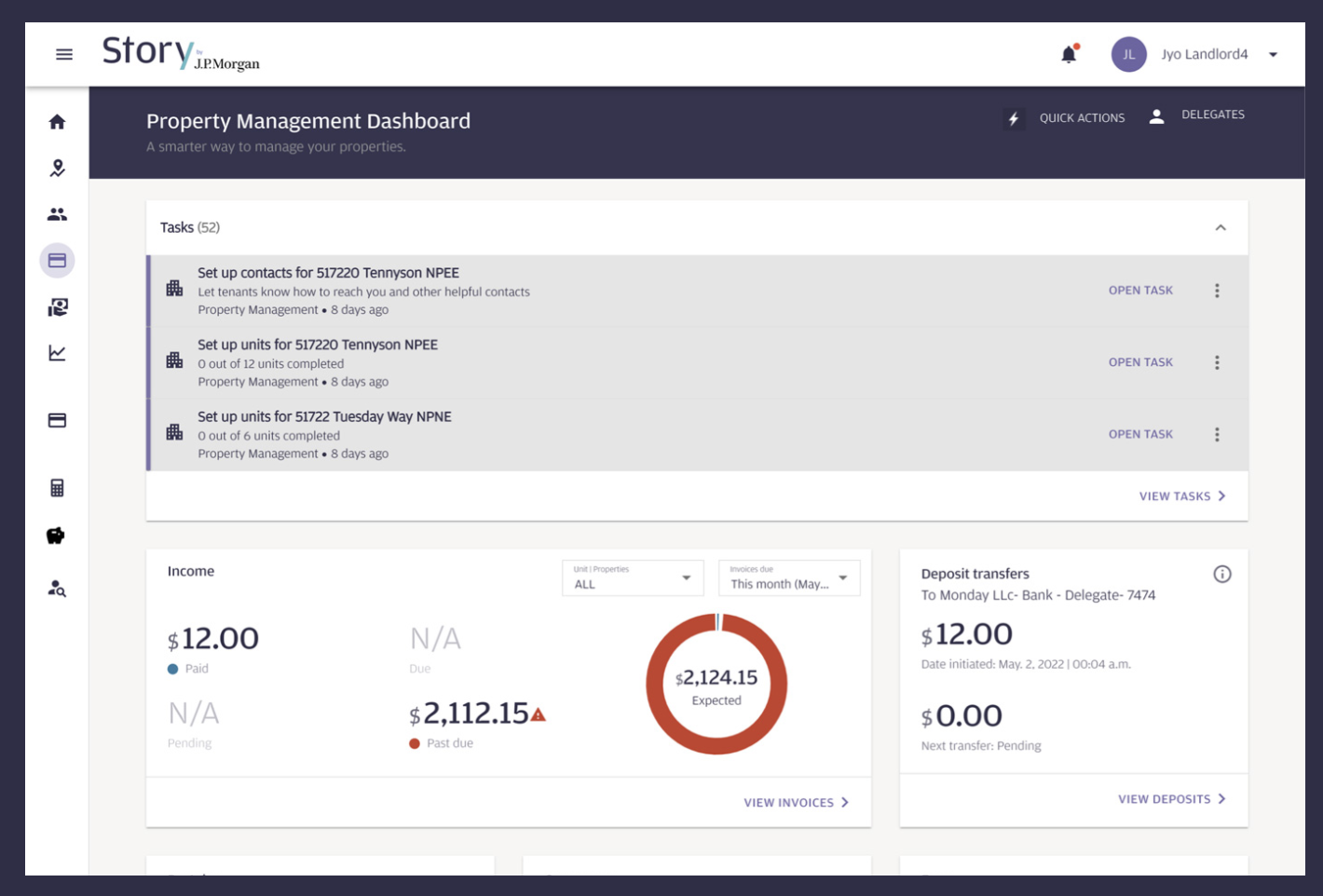
  • The new tool, called Story, will enable landlords to send invoices, receive payments, track payments, view analytics, determine rent prices, and screen potential tenants.
  • Story is currently in beta, but is expected to be released to a broad audience in 2023.

JP Morgan Chase is piloting a platform to facilitate rent payments for tenants living in multifamily housing. The new technology, called Story, is a rent management tool for multi-family property owners.

As its core functionality, Story will enable landlords to automate rent invoices and receive rent payments. As not all tenants pay rent on time or in full, Story serves as a platform to help landlords track which tenants have paid and which still owe. Additionally, the new offering will provide property owners with analytics, help them determine rent prices, and will even offer a tool to screen potential new tenants.

As for renters, Story will remind them of upcoming rent payments, offer them multiple payment options, enable autopay, track their previous rent payments, and show a copy of their lease.

The bank has not yet set a price for the tool, but indicated that it will not charge a transaction fee for ACH, debit, or credit card payments for the first year. After that, Chase clients that hold an unspecified minimum balance will receive free ACH payments.

Story, which is currently available in 15 U.S. states, will be released to a broader set of users next year.

I’m always surprised at the lack of property tech (proptech) solutions in the fintech space. During the last decade, tenants’ rent payments totaled $4.5 trillion, and this number is set to increase massively between 2020 and 2030. Aside from insurtech, proptech is one of the last frontiers of fintech to be digitized. Now that we’re seeing a large incumbent like JP Morgan get into the game, it is only a matter of time before we see competing proptech innovations from other traditional banks.


Photo by Kenny Eliason on Unsplash

JP Morgan Taps Thought Machine to Replace Retail Banking Core

JP Morgan Taps Thought Machine to Replace Retail Banking Core

JP Morgan Chase announced this week it will replace its U.S. core banking suite with U.K.-based Thought Machine’s Vault.

Founded in 2014, Vault is a cloud native core banking engine that leverages smart contracts to help banks and fintechs build in the cloud and avoid the constraints of legacy technology. Vault provides a full range of retail and small business banking capabilities, including checking accounts, savings, loans, credit cards, and mortgages.

In the future, Thought Machine plans to build Commercial and Private Wealth offerings into Vault, as well.

JP Morgan, which was in the headlines yesterday for its purchase of college planning platform Frank, will benefit from Vault. The technology’s cloud-based nature will decrease the siloed structure that comes with most large, legacy banks. Instead, JP Morgan will operate as a universal banking platform where all products run on a single system.

“JPMorgan Chase represents one of the most ambitious, powerful financial institutions in the world—and our joint work signals to the finance industry that cloud native core banking technology is the future for financial services,” said Thought Machine CEO and founder Paul Taylor. “We are delighted to be working with JPMorgan Chase on this project, delivering modern core technology to the bank, and powering the next generation of financial services in North America.”

Thought Machine, which raised $125 million last year, is said to be working on another $205 million funding round. The company has seen significant growth over the past year and has scaled up its clients base to include Lloyds Banking Group, Standard Chartered, Atom bank, Monese, and SEB. Not only that, the company added 100 employees in the first half of 2020.


Photo by Sean Stratton on Unsplash

Greenlight to Power Chase’s New Bank Account for Kids

Greenlight to Power Chase’s New Bank Account for Kids

When it comes to payment and savings account services designed for minors, most large banks have stayed on the sidelines. In fact, much of the development has come from fintechs that layer kid-friendly tech on top of existing bank accounts.

This bank-fintech partnership is exactly what Chase is relying on for its new bank account for kids that it is launching this week in collaboration with Greenlight, a company that provides financial tools for children. The new offering, Chase First Banking, aims to help parents manage allowances, complete and check off chores, monitor spending, and help kids save towards a goal. 

“Families are juggling so many more responsibilities today than ever before,” said JPMorgan Chase Head of Digital for Consumer and Community Banking Allison Beer. “To help, we’ve made it easy for parents to manage kids’ allowances, keep track of chores and teach important financial skills from within the Chase Mobile app.”

The accounts have three features that encourage kids to earn, spend, and save. The Earn function allows parents to set allowances and assign chores and allows the child to check off when each chore has been completed. The Spend tool provides kids with their own prepaid debit card that they can use to shop at stores that their parents have approved. Parents have ultimate control of the card and can lock or freeze it at any time. The Save function helps the child set aside money toward a goal and allows parents to move funds, as well.

Chase First Banking accounts, which are aimed at grade school children, are available for free to Chase retail deposit account customers. The bank already offers checking and savings accounts tailored to high school and college-aged users.

Founded in 2014, Greenlight competes with startups such as Oink and FamZoo. In addition to the Earn, Spend, and Save features offered with Chase, Greenlight’s B2C offering, which costs $5 per month, also offers a Give tool and will soon launch an Invest feature. The company rebranded earlier this year which helped it double its growth and set it on track to double again by the end of the year. Late last year Greenlight raised $215 million. The company is valued at $1.2 billion.


Photo by McKaela Taylor on Unsplash

Chase Bank’s Jot App Shows the Future of Mobile Transaction Processing

image image I’ve been waiting for something like Chase Bank’s Jot (see note 1). It’s part of the "second wave" of mobile apps that demonstrate why mobile banking will soon be better than online banking.
_________________________________________________________________________________

Mobile banking phase 1: 2008 through 2011
________________________________________________________________________________

Mobile’s first wave was all about porting the most-used online functions, balance inquiry and statement viewing, to a smaller screen. That was convenient for smartphone owners on the go, but it didn’t add much to the overall user experience. 

The test of whether you’ve nailed the mobile UX is if that even if you are within arm’s reach of your laptop, you still pick up the mobile to perform a function. Most mobile banking systems fail that test, i.e. you only use mobile banking when online access is inconvenient or insecure.
________________________________________________________________________________

Mobile banking phase 2: 2011+
________________________________________________________________________________

The second wave is much more interesting. Your mobile phone can do financial chores that simply cannot be accomplished online, for example:

  • Deposit a paper check via mobile camera (USAA, Chase, PayPal and many more)
  • Transfer money to your friend by "bumping" phones (PayPal, ING Direct)
  • Alert you to special merchant offers in your exact location that are redeemable simply by using your bankcard (BankOns)
  • Pay your bill automatically by scanning the billing statement (Mitek)
  • Upload paper receipts and append them to expense reports (Expensify)

And the latest addition to that list:

  • Receive feed of transactions and tag them with categories for future reference and reporting (Chase Jot)

________________________________________________________________________________

How Jot works
________________________________________________________________________________

Chase’s new app (announced 1 June 2011) may not be as cool as remotely depositing a check, but it’s much more useful for most cardholders. The iPhone and Android app, which is currently available only for the bank’s Ink business credit card, sends push notifications of each transaction (see inset) and enables users to (relatively) quickly append transactions with category information, i.e. "tag" transactions. 

image One key Jot feature, missing in most mobile banking services, is a running list of the transactions waiting to be tagged (see right).

That way, when the business owner has a few spare moments, they can quickly get caught up with their categorizing work. This ongoing attention will reduce the quarterly game of "what’s that transaction" played when finalizing the company books.

So not only does Jot save time, it potentially improves the quality of the accounting data, always a good thing for business management. 

The app also includes other business credit card management functions such as basic reports by tag, the ability to change employee credit limits, and info on outstanding balances and payment due dates.

While the functionality is still pretty basic (e.g., there is no way to add more than one tag to a transaction), there are only 60 days of transactions available, and login needs to be simplified, overall Jot is a winner. We are tagging it with an A-.

—————————————————-

Notes:
1. The Jot landing page is well done and includes a series of four short demo videos.
2. For OBR subscribers, see our previous Online Banking Reports on mobile banking and payments.

PayPal Revives X.com Domain for its Lab Site

Last century, serial entrepreneur Elon Musk launched what he expected to be a top-10 bank by now. And in true late-1990s dot-com fashion, it was simply called X.com. In retrospect, maybe not the best name for a bank, but it certainly was more memorable than First Security Bank of Whatever. The company soon merged with PayPal, dropped the single-letter name, and eventually took over the world of alt-bank payments.

For most of the past eight years, if you typed X.com into your browser, you simply ended up on the PayPal homepage. But recently, PayPal has opened a new area under the X.com URL called PayPal Labs. This is a place where competitors, developers, analysts, and anyone with too much time on their hands can see the latest new "beta" services under development at PayPal.

With just two services listed (see below), it's no Google Lab, but it shows that PayPal still has Silicon Valley DNA at its core, despite five years working within the shadow of the larger eBay brand.

My take: More financial institutions should open "lab sites" to demonstrate their commitment to innovation. The only one I remember was JPMorgan's LabMorgan, which was really was part VC, part incubator. But its URL only shows an error message these days, a shame. 

Update (10 Oct): A reader reminded me about Fidelity's lab site, fidelitylabs.com.

In the PayPal Lab

  1. PayPal Request Money for Facebook (see previous coverage here)
  2. MySpace Fundraising Badge


JPMorgan Chase Launches New Corporate Payments Vehicle

Last week, JPMorgan Chase & Co. launched ExacTrac, a new card-based corporate payments vehicle designed to be integrated into a company’s purchasing systems.

The product issues users a unique credit card number, complete with spending limits, for particular events. The system automatically reconciles the transactions connected to that event and includes that special account number on all bills and payments connected to it, and populated within company books.

Bryan Clancey, chief financial officer of Embryon Inc., has been using ExacTrac for a year to control spending on his pharmaceutical marketing firm’s conferences and roundtables. Clancey says he likes the system because it allows him to closely track his expenses—and because it’s free.

“I like it because I have no administration,” he says. “When that record comes in, it goes right into my system. We send out a request for a unique card, and when that transaction is passed back to us and the transaction has occurred, Morgan passes the same meeting ID back to me, so I can automatically load it into my system.” Clancey describes that system as a financial supply-chain logistics program that was developed in-house seven years ago. Using the product, he adds, meant writing a lot of customized security software to protect the interface with the bank.

Clancey also likes the JPMorgan Chase product because of its perks. “I get rebates (when using ExacTrac),” he says. “I pay face value on the bills, and get 100 to 145 basis points back on total annual value spent.” Embryon was one of ExacTrac’s beta sites; it’s been using it since last July. Another, unidentified company has been testing the product for about 18 months. The product which JPMorgan Chase issues under both Visa and MasterCard branding is part of its PaymentNet core payments processing system.

Clancey says he pays for thousands of meetings in restaurants every year, and to have a major credit card issuer like Morgan Chase forgo a lucrative revenue stream like that may sound unusual. But Frank Dombroski, a Morgan Chase vice president of commercial card solutions, says one of the reasons for launching ExacTrac was to reinforce Morgan Chase’s card business.  He also confirms the rebates.

Because it would be a poor CFO indeed who carried an interest-earning credit card balance, clients would typically use it only as a transaction account, meaning that Morgan Chase earns only between 55 and 100 basis points per transaction—not much more than the program’s administration costs.

“We do make money on it,” says Dombroski. “The margins are thin in this business, much more so than four or five years ago, but for us, it’s a numbers game and (allows for) efficiency of processing and automation.”

That may be true, says Christine Barry, a research director at Aite Group, but it’s hardly the only reason Morgan Chase chose to promote a card system like this: It’s mostly a matter of shifting priorities, and of meeting the competition wherever it happens to be.

“There’s been a lot more investment by banks, recently, on the corporate side, instead of the retail side of their business,” she says. Barry estimates that until now, about 60 percent of bank technology expenditures have been on the retail side of the bank.

“They’re shifting focus, and a lot of the new investments they’ve been making don’t necessarily result in cost savings for the bank, or even new revenues being generated,” she adds. “It’s been a big focus on providing more service and convenience to customers. It’s the customers that are getting the benefits, and not the banks, except on paper.” (Contact: Embryon Inc., Brian Clancey, 908-231-6000; JPMorgan Chase & Co., Frank Dombroski, 212-270-7013; Aite Group, Christine Barry, 917-546-9180)

Paper Checks Remain “Business as Usual”

BizchecksWhen the last paper check is dropped in the mail, it will be a business check. All signs point to that day being over the horizon.

Not that no efforts are afoot to squeeze business checks out of the payments system. At least a dozen companies around the world are trying to automate business payments with so-called order-to-pay software systems, including, in the U.S., Bottomline Technologies, Harbor Payments, and Xign Corp.. Various business payment card systems continue to emanate from the nation’s banks. And advocates of routing business payments through the automated clearinghouse have been working diligently at the task for years.

But checks remain stubbornly alive: According to the Federal Reserve's landmark 2004 Payments Study, total check volumes between 2000 and 2003 only declined from 41.9 billion items to 36.7 billion items. And according to the US Census Bureau's 2005 Statistical Abstract of the United States, consumer payments made by check between 2000 and 2003 only declined from 28.8 billion items to 26.8 items. The 10 billion item difference, says a Fed spokesman, can be considered business checks. This suggests some little progress in squeezing paper out of the system, but no reason to write checks’ obituary.

The most progress in eliminating paper checks is seemingly being made in online bill payment. According to the American Banker’s Association, less than half of all consumer bills—49 percent—were paid by check in 2005, compared with 72 percent in 2001. Since bills represent a large fraction of consumer checks written, this suggests an accellerating trend away from consumer checks,.

But if civilians seem to be edging away from checks, business is apparently sticking to the tried-and-true. This is actually counterintuitive, since businesses would seem to have a lot to gain by giving up paper checks, if only for efficiency’s sake, while civilians, who get free checking, have no such incentives.

As usual, things look different once you’re in the weeds. In this case, a superficial analysis ignores simple balance-of-power and treasury-management issues, not to mention the tyranny of sheer habit.

Aside from sheer convenience, consumers have little to gain from paying their bills online, but as indicated by the numbers, that matter alone–combined with minor carrots and sticks from billers and banks–seems to have turned the tide.

Businesses, on the other hand, not only have a lot more power in their financial relationships than a typical consumer, but also are loath, to say the least, to abandon a treasury-management game that businesses have been playing since prehistory: demand immediate payments (even prepayment), but don’t pay yourself until the sheriff is coming up the driveway; meanwhile, use the float for a hundred purposes.

The irony is that the vendors of order-to-pay software systems can make a very good argument that discarding those old-fashioned treasury-management techniques is good business. Companies using order-to-pay systems, they say, free up working capital from their balance sheets, and that what they lose in float, they more than gain from being able to pinpoint exactly how much money they have on hand.

Tom Glassanos, for instance, president and chief executive of Xign Corp., points out that 19 Fortune 500 companies use his firm’s order-to-pay products, including Charles Schwab & Co., MetLife, Pacific Gas & Electric, and The Williams Companies.

But even he will concede that not every company thinks order-to-pay is a good thing. "There are good reasons why this hasn’t happened yet and continues to go slow,” he says. “There’s a certain (business) population that would like to get on board, but can’t get remittances across. And there’s a lot of work involved in telling your suppliers that you’re going to pay them via ACH instead of by check.”

The result, says Glassanos, is that “Just to get it to work, they find out, seems to them to be a lot more work than the value they get back, and they also have to deal with losing some float. So when they add the plus and negative columns, it doesn’t come out to be all that different, and they decide to go with what they’ve been doing.”

Banks are likewise not overly enthusiastic about the order-to-pay idea, except for US Bank, which has a patented order-to-pay product it calls PowerTrack. Even Glassanos concedes that only one bank uses his stuff, JP Morgan Chase & Co., which uses Xign in conjunction with Vastera, the trade receivables system which it bought early last year. Glassanos says two other big banks have recently signed on, but that he couldn’t disclose their names at NB’s press time.

Why the slow uptake at banks? The reasons are pretty simple. Banks make too much money from the various fees attached to business checking to embrace order-to-pay; for one thing, when you can charge your customer for removing every paper clip in a pile of checks, it’s a hard business to give up. For another, there’s no reason to expect checks to be disappearing anytime soon, so there’s little reason to close a profitable department, especially when most banks’ revenues are under pressure in the first place. And, banks tend to view change as something that has to be adapted to the bank’s interests, leading banks to come up with ideas that make sense for the bank, and not necessarily for the customer.

Card-based corporate payments systems, like Bank of America’s new ePayables product, are a good example. Cards would seem to answer a lot of problems for corporations, including digital data streams, easy tracking, and a means to mimic traditional pay-at-the-last-minute treasury-management games.

There’s only one fly in this particular ointment: The payee has to pay to get their money, in the form of interchange. The alternative would be to accept a discounted invoice in order to get paid early. “If you’ve been paying cash or check or anything for a transaction, the payor has been footing the bill, but here the recipient is paying for the transaction,” an unappealing prospect at best, says Penny Gillespie, president of Gillespie International, and one that payees can easily block.

Looked at this way, it’s not surprising that checks will likely linger—some would say malinger—for many more years. But there’s another reason, one that many overlook: Most businesses aren’t the Williams Companies or Pacific Power & Lights of the world. According to the U.S. Census Bureau’s 2001 Statistics of U.S. Business, only 26,000 companies had sales over $50 million, out of a total of 5.5 million; and only 103,000 of America’s 4.9 million firms that have any employees at all had more than 100 employees, although those larger companies employed 74 million of the nation’s 115 million workers.

That’s the real rub. There are some 5 million companies in the U.S. that have little time to  automate their accounts payable and receivables departments, which means that trying to sell them an order-to-pay system is a waste of time. At a minimum, the annual return on such a system is not enough to make a compelling case for expensive, complicated software. And payment cards likewise have little application, since smaller companies tend to pay higher discount rates.

This being the case, banks aren’t foolish to hold on to their business checking departments. And your local Postman probably isn’t headed for the unemployment line. (Contact: Xign Corp., 925-469-9446; Gillespie International Inc., Penny Gillespie, 703-815-0706)