This site is operated by a business or businesses owned by Informa PLC and all copyright resides with them. Informa PLC's registered office is 5 Howick Place, London SW1P 1WG. Registered in England and Wales. Number 8860726.
Finovate Blog
Tracking fintech, banking & financial services innovations since 1994
In today’s era of embedded finance, everything is available as a service. Digital banking services company Q2 is at the leading edge of this trend, offering a range of solutions for banks’ retail clients, their commercial customers, and fintechs.
Many fintechs sell an “as-a-service” offering that focuses on a single aspect of banking. Q2, however, takes a more holistic approach. Here’s a look at some of the company’s embeddable offerings.
Q2’s consumer solutions include remote onboarding, PFM tools, remote deposit check capture, lending tools, marketing offers, behavioral biometrics, and authentication. The company helps banks leverage client data using machine learning technology that brings the necessary intelligence to effectively market new products to customers.
On the commercial side of things, Q2 can aid with account opening, loan origination, ERP integration, and scalable tools to suit a range of business sizes.
Q2 offers fintechs both lending-as-a-service and banking-as-a-service tools to integrate into their existing offerings. The former focuses on the application, approval process, and loan funding, while the latter offers bank accounts, debit cards and payment solutions without the need to partner directly with a traditional bank.
In addition to these embedded finance offerings, Q2 is venturing into the bank-fintech collaboration space. In a Best of Show winning demo at FinovateFall last month, Q2 launched its Partner Marketplace, an app store integrated within the company’s digital banking platform. Fintechs can upload their tools on the platform’s app store and banks can browse the offerings they’d like to integrate.
By relying on fintechs to bring the tech, the Partner Marketplace broadens Q2’s reach as a provider of embedded finance. The company offers banks access to a variety of fintech solutions that range beyond what Q2 itself is able to create or provide.
For fintechs, the marketplace lowers customer acquisition costs by making the startups’ solutions visible to Q2’s network of bank partners on the platform. It also helps with integration and deployment– after integrating with Q2’s digital banking platform, fintechs can offer their product to 400+ banks and credit unions, one million businesses, and 16+ million end users.
The big changes we are seeing in the realm of customer engagement have to do with inevitable trends becoming immediate demands. Whether the need is reaching customers over the digital channel for the first time or automating and streamlining processes to improve efficiency and maximize productivity, the global health pandemic has been the midwife – if not the mother – of the fast-changing technology landscape we live in today.
“Meeting customers where they are” has been a rallying cry for customer engagement specialists for years. And as the number of channels grows, more companies are offering new solutions that provide easy-to-use, secure, and compliant ways for businesses to more comprehensively engage with their customers and clients.
One company in this space is Revation Systems. A Minneapolis, Minnesota-based firm, founded in 2003, Revation recently partnered with fintech and regtech solution provider Computer Services Inc. (CSI), who will offer Revation’s LinkLive Banking platform to community banks. LinkLive Banking provides regional and community banks, as well as credit unions, with key capabilities such as digital messaging, AI-powered chatbots, voice and video communications, and the ability to move seamlessly between physical and digital channels.
“Given the remote work demands of COVID-19, LinkLive Banking empowers our banks to provide a world-class customer experience while taking precautions to protect the health and safety of their employees and customers,” CSI Group President of Enterprise Banking Giovanni Mastronardi said. “Together with Revation Systems, we’re providing the innovative technology necessary to increase customer satisfaction and reduce friction in the customer journey.”
In addition to its messaging, chatbot, voice, and video functionalities, the platform also provides secure desktop sharing and encrypted email. LinkLive Banking leverages AI to power service chatbots with keyword recognition and the ability provide fast, automated responses to common banking queries. The video banking capabilities, announced in August, are the most recent addition to the platform.
“We are extremely excited about utilizing LinkLive’s video banking features as we seek to improve our member experience,” United Educators Credit Union CTO Dennis Griesgraber said. He noted that the new feature integrated not only with the LinkLive contact center the credit union used, but also with the institution’s digital banking platform. John Eyre, Assistant VP of Information Technology at TAPCO Credit Union underscored the technology’s value for enhancing communications among employees, as well. “LinkLive’s video banking feature will not only enhance the interactions between our members and representatives, but will also help improve communication among our own staff internally,” Eyre said.
Active in the healthcare vertical as well as financial services, Revation has more than 400 customers using its LinkLive Banking platform, representing more than 100 million digital banking customers. Adding the video banking component, Revation notes, requires only a few configuration changes to the LinkLive platform, and does not require the customer to download an app or manage a separate communications account to participate in video banking.
Perry Price, Revation CEO, echoed the now-common wisdom that the pandemic has accelerated pre-existing, if not inevitable technology trends. He noted that while adoption of video banking before COVID-19 had been a “long-term goal,” the onset of the crisis had turned those goals into “urgent” priorities.
Featured in CIOReview’s Most Promising FinTech Solution Providers for 2020 this spring, Revation is scheduled to make its Finovate debut next month at FinovateWest Digital. To learn more about our upcoming, all-digital event and how to watch Revation’s technology in action, visit our FinovateWest Digital hub.
While many fintechs were working on digital transformation, Linqto was focused on complete transformation. That’s because the San Francisco-based company recently made a major pivot.
Linqto was founded in 2010 as a digital banking technology company that provided software-as-a-service to fintechs. Perhaps most notable during the company’s first few years of operation was the launch of its Otter API which, along with a partnership with LEVERAGE, powered Linqto’s App Store for Banks, a marketplace where banks could select from new apps to brand them as their own and launch them in app stores for their end customers to download.
“By working with Linqto, credit unions are still able to offer their traditional services, but now they can also pair those services with premium technology from branded apps, enhancing mobile strategies and changing their members’ mobile experience,” said LEVERAGE President and CEO Patrick La Pine when the deal was announced in 2016. “This brings a dramatic shift in the relationship members have with their credit union and their mobile devices.”
Fast forward two years and Linqto had raised $1.6 million in two funding rounds and transformed itself into an investment service with its Global Investor Platform. Key to this transition, the company acquired investment trading platform PrimaryMarkets for $33 million in December 2018.
“Linqto is acquiring PrimaryMarkets, an established global trading platform, to launch its platform as part of the Global Investor Platform,” said Linqto Founder and CEO Bill Sarris. “The Takeover will allow the establishment of an inclusive trading platform and the capability for the Linqto Platform to broaden our revenue model from a strictly SaaS model to a transaction-based model, whereby Linqto will share in commissions and broker fees realized by the Platform.”
PrimaryMarkets a global online marketplace that enables users to conduct secondary trading of existing securities and investments, manage secondary securities trading on behalf of companies, and assist unlisted companies in raising new funds.
In February of this year, while the world’s attention was consumed with the threat of the then-epidemic-now-pandemic coronavirus, Linqto announcedEquity in Unicorns, a new investing platform for private securities. Equity in Unicorns is designed to help accredited investors invest in the private market via a simple, quick, and relatively inexpensive platform.
“Small Accredited Investors now have the opportunity to participate in the growth and superior returns of private markets, as large institutional investors have done over the past 30 years,” said Sarris. “Private investing made simple.”
Since its pivot, Linqto now counts more than 100,000 accredited investors in its global network. Currently, Linqto allows these users to invest in a range of pre-IPO startups, including Upgrade, Uphold, Ripple, SoFi, Blockchain Coinvestors, Kraken, and even in its own company.
Linqto was slated to debut its new platform at FinovateSpring earlier this year. However– thanks to COVID– the conference, along with Linqto’s demo, will be featured at FinovateWest on November 23 through 25.
One of my favorite sayings popularized by the current Democratic Party candidate for president is “don’t tell me your values. Show me your budget.” The implication is that, at the end of the day, talk is cheap. Show me how you actually spend your money, and I’ll learn all I need to know about what matters to you and what does not.
By that metric, the news that Dutch fintech and Finovate alum Ohpen has acquired Saas-based, crossborder mortgagetech Davinci tells us quite a bit about what what the Amsterdam-based cloud core banking engine maker thinks about the importance of expanding beyond its competencies in savings, investments, loans, and current account products.
“We are a growing company with huge ambitions,” Ohpen CEO Matthijs Aler said. “Together, we intend to lead the charge in directly challenging incumbent providers with outdated technology. Our mission is – and always has been – to set financial institutions free from legacy software. Now we can help a broader range of financial institutions deliver tangible change to meet the needs of tomorrow’s customers.”
Ohpen put the acquisition announcement in the context of its global growth strategy. This includes scaling operations in the Netherlands – where the company is a market leader – the United Kingdom, and Belgium initially, as well as expansion to other areas. Ohpen also plans to scale up its development centers in Spain and Slovakia.
The terms of the acquisition were not disclosed, but the combined entity will have 350 employees and $35 million in revenue. Davinci is Ohpen’s second acquisition. The company purchased core banking system implementation consultancy FYNN Advice in the fall of 2017.
Davinci leverages machine learning and AI to enhance and accelerate digital onboarding and acceptance during the mortgage lending process. Delivering cost savings of as much as 80%, the company’s signature solution is Close, a cloud-native platform for mortgage loan origination and servicing.
Calling the acquisition, “the natural next step” for both companies, Davinci Director Alwin van Dijk said, “We are the only two players with a real focus on back and middle office innovation for new and existing propositions.” van Dijk added that the ability to offer a broader range of products will be a “market game changer.”
With $47 million (€40 million) in funding from investors including NPM Capital and Amerborgh, Ohpen began the year teaming up with pensions administrator TKP Pensioen. The partnership with the Groningen, Netherlands-based digital pension platform enabled Ohpen to enter the pension market for the first time. Aler pointed out that the integration would enable the “originally conservative industry” of pension management to have a “fully digital and futureproof pension solution at its disposal.” This spring, Ohpen partnered with another pension management firm, Ortec Finance, integrating the company’s forecasting engine with the Ohpen platform.
If the future is digital –which it is– then the future must also be in real time. And while our industry typically thinks about real-time in terms of payments, there’s one fintech that’s working to bring information into the real time realm.
Banking technology company Plaid is launching instant account activity today. The new release allows financial institutions on Plaid Exchange to send user-permissioned transactions data to Plaid developers within seconds of the user’s activity. As a result, the consumer receives an up-to-date picture of their finances.
During a time when many consumers are working in the gig economy and budgeting for their expenses on a day-by-day basis, having the most recent information about their account balances is critical and could make the difference between overdrafting or staying afloat.
“Instant, real-time data has become standard for consumers today and it’s a critical piece of information that our users need to make sound financial decisions,” said Atif Siddiqi, CEO of Plaid client, Branch. “Plaid provides our users with the most current picture of their transaction history, empowering their daily financial decisions.”
Today’s development is the latest in a string of updates for Plaid, which recently launchedPlaid Exchange, an open finance solution that offers banks a way to provide open banking connectivity to their clients while keeping their clients’ data safe and giving them control of their data.
Last week, the company announced an addition to its suite of payment products with the launch of standing orders in the U.K. With standing orders, end users can make recurring payments with a single authorization for things like gym memberships and rent payments.
Plaid is an alum of Finovate’s developer conference. In 2014, the company’s CEO and co-founder, Zach Perret, showcased the Plaid API for financial institutions.
What have the companies that won Best of Show awards at last year’s FinovateFall conference been up to in the months since our New York show? With our autumn event less than a month away, we thought it would be a great time to check in on the nine companies that took home top honors this time last year.
BlytzPay – Integrated its digital payments technology with Dealer Management Systems (DMS) leader ABCoA Deal Pack. Announced strategic partnership with AFS Dealers.
Cinchy – Joined the 2020 MassChallenge FinTech Program in December 2019 along with five fellow Finovate alums. The program noted that 70% of the participants in its previous cohort launched a pilot or proof of concept within a year. Earned a $500,000 cash prize as one of the winners of the 2019 VentureClash competition. Raised $10 million in funding in May.
College Aid Pro – Partnered with Horsesmouth, a company that provides educational and marketing solutions for financial advisors and their clients. Announced collaboration with the American Institute of Certified College Financial Consultants. Teamed up with online student loan refinancing marketplace Credible.
ebankIT – Forged North American partnership with fellow Finovate alum Enterprise Engineering this spring. Announced updates to its multichannel banking platform.
Glia – Won Best of Show at FinovateEurope for a second year in a row. Integrated its technology with fellow Finovate alum Alkami’sOnline Banking Platform. Inked partnerships with 20 credit unions across the U.S.
MX – Topped 50,000 direct-to-bank API agreements to major financial institutions and fintechs. Launched data connectivity API, Path by MX. Named one of Inc. Magazine’s Best Workplaces 2020.
owl.co – Named one of Canada’s Most Innovative Tech Companies by the Canadian Innovation Exchange. Delivered $1 million in revenue within six months of launching.
Pinkaloo Technologies – Raised $1.25 million in funding. Joined Goldman Sachs-owned Ayco Marketplace for financial counseling and wellness services. Partnered with Eastern Bank to power its Give for Good charitable giving program.
Zogo Finance – Teamed up with fellow Finovate alum Bankjoy. Announced partnerships with 11 community banks and credit unions across 12 states. Surpassed 1,000,000 financial literacy modules completed.
FinovateFall Digital 2020 kicks off Monday, September 14 and continues through Friday, September 18 with hours of live and on-demand content. Visit our registration page today and join us for Finovate’s biggest, digital-first event to date.
After teasing the launch of its debit card in the U.S. earlier this year, Samsung announced that its digital debit card, the Samsung Pay Card, is now available in the U.K.
To make the launch possible, Samsung has teamed up with Curve, a fintech that consolidates all of a user’s existing Mastercard and Visa payment cards. The London-based company makes all of a user’s cards contactless and compatible with Samsung Pay.
Users will receive access to Curve features such as peer-to-peer money transfers, instant notifications about spending, competitive foreign exchange rates, 1% cash back on purchases made with a select group of three merchants, and 5% cash back on purchases made at Samsung.com. Samsung Pay Card users will also be able to use Curve’s Go Back in Time feature that allows them to switch payments from one card to another for up to 14 days after the purchase was made.
The deal is a win-win for both companies; Samsung will benefit from Curve’s e-money license with the U.K. Financial Conduct Authority, and Curve will gain from an increase in users. Interestingly, however, existing Curve users cannot also apply for a Samsung Pay card. As other sources have pointed out, the reason for this exclusion isn’t entirely clear.
“At Samsung we believe in the power of innovation and, through our partnership with Curve, the Samsung Pay Card brings a series of pioneering features that will change the way that our customers manage their spending, with their Samsung smartphone and smartwatch at the heart of it,” said Conor Pierce, Corporate VP of Samsung U.K. and Ireland. “This is the future of banking and we look forward to continuing this journey with our customers.”
Whatever benefits the challenger bank revolution may bring to retail banking customers, the opportunities these neobanks provide to small businesses may be even more significant. In fact, there is a growing cadre of digital-first challengers who have decided to put innovating on behalf of small business banking at the top of their priorities.
One such company is Wise, a BBVA-backed challenger based in San Mateo, California, that announced the release of its premium checking account in the U.S. this week. The new offering, available for $10 a month, enables businesses to earn up to 1% APY on deposits through a combination of a 0.5% base APY and an additional 0.1% for every $1,000 purchase using a Wise debit card. Accountholders get 25 free ACH deposits and 25 free outgoing bank transfers a month, as well as additional payments services. Among the functionalities to be added are remote check deposit, the ability to send digital checks and international wires, and support for Quickbooks.
The new offering comes in the wake of the company’s first major fundraising: a $5.7 million seed round in April led by Base10 Partners and featuring the participation of several other investors including Abstract Ventures and Backend Capital. The company told TechCrunch earlier this year that it has 1,000 business customers, with average workforces ranging from 2 to 10 employees, and “between $500,000 and $5 million in ARR (annual recurring revenue).”
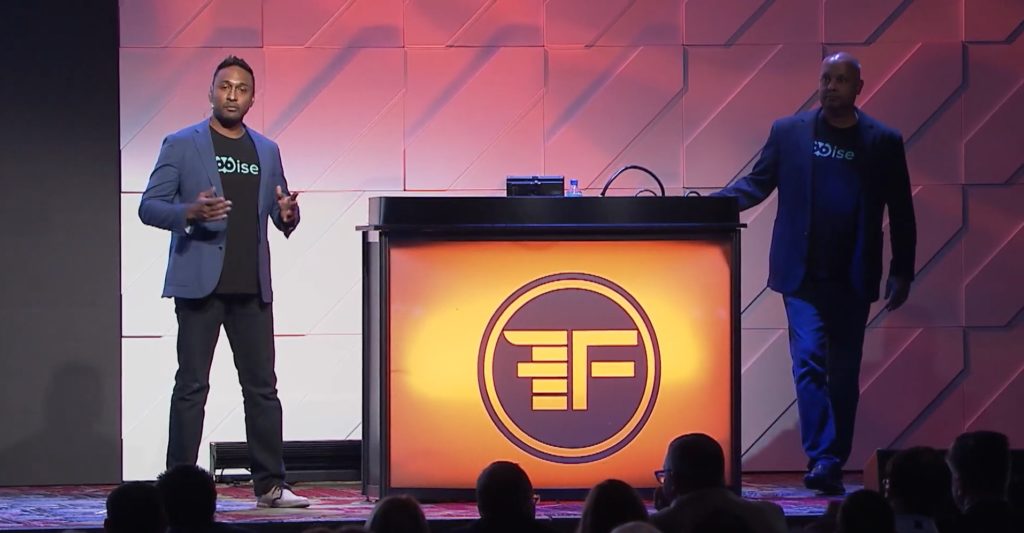
Finovate audiences met Wise last year when the company made its Finovate debut at our September conference in New York. At the event, Wise co-founders Arjun Thyagarajan (CEO) and Suresh Venkatraman (CTO) demonstrated the company’s “small business banking-in-a-box” solution, and previewed additional products and services for small businesses including payments and invoicing.
From left: Wise co-founders Arjun Thyagarajan (CEO) and Suresh Venkatraman (CTO) at FinovateFall 2019.
Thyagarajan founded Wise after a stint managing product for Mojio, a platform for connected cars. Before that he was a classic serial entrepreneur, launching a personal organizer (LivingOrganized), and a pair of password management platforms (TeamsID and Gpass). But a sense that he wasn’t “doing what I really wanted to do” led him to leave the “hot startup” in search of what he called “problems that needed solving.”
“My explorations led me to FinTech and I was pleasantly surprised with the rapid advancements in technology transforming the financial industry, especially in banking and payments,” Thyagarajan wrote on the company blog last summer, looking back on his decision to launch Wise. “It got me thinking: what if we could build a banking product that can deliver on the promise of putting the customer first … And solving real world problems.”
Thyagarajan’s reflections are similar to those his co-founder Venkatraman, who in a companion post observed that Wise’s own experience as a small business trying to secure quality banking services was vindication of the company’s mission.
“The day started innocently enough as we walked into a local bank with all our paperwork in hand,” he wrote. “That was the beginning of a chase around Silicon Valley to find a bank that would take our money and open up an account. Banks would reject us for all sorts of reasons or just ignore us.”
These days, with an new offering, a big investment and a major banking partner in BBVA in hand, it looks like the fintech world might be ready to wise up.
Point of sale financing is all the rage in fintech right now. Consumers are looking to continue buying habits despite lower income and merchants are vying for ways to boost consumer spending.
So when it comes to one of the biggest online merchants launching a buy-now-pay-later offering, its a big deal. It is, anyway for Citi, which struck up a partnership with Amazon this week to provide a buy-now-pay-later option for Citi credit cardholders.
The tool is called the Citi Flex Plan and offers Citi credit cardholders a way to pay for larger purchases over time. Loan terms range from three to 48 months with terms ranging from 6.74% APR to 8.74% APR depending on the amount financed. Borrowers face no credit inquiries, no incremental fees, and are not required to fill out a formal application.
“Amazon is one of the most popular destinations for our customers to shop and redeem ThankYou Points,” said CEO of Citi U.S. Consumer Bank Anand Selva. “We want to meet them where they are with another instant, convenient and easy payment option.”
Essentially, Citi cardholders have two forms of credit in one when they shop on Amazon. How do the logistics work? When they place their order, the total purchase amount will be deducted from their available credit. The monthly payment– the amount that varies based on the purchase price– is due to Citi at each billing cycle.
After Citi initiated a partnership with Google in 2019 and yesterday’s news of six more traditional banks following suit, today’s announcement comes as no surprise. Challenger banks are on the rise, and consumers are opening new accounts with these alternative banking providers at a faster rate than before.
By providing its customers with the new buy-now-pay-later option, a traditional financial services provider such as Citi is appealing to the lower income group that is most attracted to challenger banks. The bank is also helping to position its card at the top of consumers’ virtual wallets when they shop at Amazon. This is key since more than one-third of active Citi cardmembers made at least one purchase on Amazon in the past year.
Additionally, partnering with a big tech company helps Citi align more with the tech side of banking. And indeed, the bank has been closer to the forefront of fintech than many of its rivals. At our developers conference Citi showcased its developer hub and sandbox.
When Bank Operating System creator nCinowent public earlier this month, we shared a feature on some of the other fintechs – Finovate alums all – that, like nCino, also hail from the state of North Carolina.
For those who may find North Carolina an atypical location for some of the country’s most innovative fintech companies, recall that many of these fintechs are benefitting from the proximity of the famous Research Triangle. This area of the state includes three universities – Duke University, the University of North Carolina at Chapel Hill, and North Carolina State University, and has had a reputation as a technology hotspot since the 1950s. Hall of Fame caliber technology firms from IBM to Cisco Systems to Red Hat have made “The Triangle” their home over the years, solidifying the region’s high-tech reputation and helping attract new generations of entrepreneurs and technologists.
Recently we learned of big news from one of the members of this new generation. Cognitect, which provides engineering and software development talent and technology to clients in industries ranging from health and science to fintech, announced that it has agreed to be acquired by long-time client Nubank, a financial institution based in Brazil.
Cognitect founder and President Stuart Halloway called the company’s relationship with Nubank “a spectacular success story” for its two signature offerings: Clojure – Cognitect’s general purpose programming language – and Datomic – the company’s transactional database. Nubank currently has 600 Clojure developers, running 2.5 million lines of Clojure code in 500 microservices on 2000+ Datomic servers. “Cognitect has been there every step of the way, helping Nubank’s developers translate Clojure’s ideas into business agility,” Halloway wrote at the company’s blog.
The acquisition, according to Halloway, will pave the way for bigger teams for both Clojure and Datomic – technologies Finovate fans were first introduced to via our FinDEVr developers conference in 2016. In that presentation – and in the company’s return to the FinDEVr stage the following year – the Durham, North Carolina-based company demonstrated how its solutions enable companies to have more control over and insight into their data – including the ability to conduct analytics on real-time information without hindering performance.
Nubank’s relationship with Cognitect in general and Clojure and Datomic in specific stems from the Brazilian neobank’s decision to use those technologies to provide a data infrastructure for its microservices platform. The result, for Nubank’s customers, has been greater clarity and complete history on transactions, as well as insight into the origins of suspicious cyber incidents or problems with data.
“Because we use Clojure and Datomic, we’ve built a tool that has already moved beyond what many of our competitors do, and our speed of innovation – new features, continuous deploys – increases with every passing day,” Nubank CTO and cofounder Edward Wible said in a statement. Founded in 2013, Sao Paulo-based Nubank is Latin America’s largest fintech with more than 20 million customers. Cognitect is the firm’s second acquisition of the year, having purchased software engineering company Plataformatec in January.
Going forward, Cognitect will benefit from the continued leadership in its Clojure and Datomic teams, and the company itself will remain a U.S. C corporation. Datomic customers will continue to receive professional services from Cognitect, though the company expects to transition away from general consulting development. Customers also will likely get the next Datomic feature “a bit sooner” Halloway added, pledging to users that “the resources behind (their) software are greater than ever before.”
You’ve probably heard that cryptocurrency exchange platform Coinbase is considering going public later this year or early next year.
But this likely won’t be a traditional fintech IPO. That’s because the California-based company’s culture is rooted in the blockchain, a technology that embraces alternative finance. Furthermore, Coinbase would be the first major U.S. cryptocurrency exchange to go public, and the fintech community will be paying close attention to the outcome.
That said, there are some roadblocks Coinbase may encounter on its journey to Wall Street.
First, in order to go public, the transaction would need to be approved by the U.S. Securities and Exchange Commission (SEC). The hurdle here is that while the SEC has issued guidance on cryptocurrencies, labeling them as securities that are subject to regulation, the organization hasn’t issued guidelines on specific coins, except for a few. In fact, many mainstream financial institutions are wary of cryptocurrencies and see them as a tool for money laundering and illicit activities.
Coinbase will also need to decide how it will be listed. The company can either undergo a traditional IPO that caters to Wall Street investors, take a direct listing approach, or go public via a token offering on the blockchain. While involving the blockchain may be a logical approach for a blockchain-based company, it may cause difficulty, as even a hybrid model would need to be approved by the SEC.
Coinbase must also balance the cryptocurrency market itself. As Laura Shin points out in her podcast Unconfirmed, Coinbase will likely try to time its public debut with the cryptocurrency market, which is known for its volatility. Debuting during a dip in the cryptocurrency market may result in Coinbase receiving a lower-than-expected initial stock price.
What do mid-tier and boutique banks need in order to enhance their ability to onboard new customers quickly and efficiently? What solutions are available to enable them to remain compliant with an ever-changing set of regulations while at the same time keeping up with even faster changes in customer expectations? And how has the global health pandemic made these challenges all the more complicated for financial institutions of all sizes?
We caught up with James Follette, Head of North American Sales and Global Head of Commercial, Business, and Retail Banking with Fenergo. A Finovate alum since 2012, the Dublin, Ireland-based company specializes digital transformation, customer journey, and client lifecycle management (CLM) solutions for banks and other financial institutions.
Finovate: Fenergo secured a major investment earlier this year – the largest in the company’s history, I believe. What was the significance of this fundraising in terms of helping Fenergo reach its goals for 2020 and beyond?
James Follette: Fenergo received $80 million in funding from DXC Technology and our client, ABN AMRO at a valuation of just under $1 billion, so it was of huge significance for the business. Both firms’ pedigrees, deep experience and industry knowledge made them the ideal investment partners for Fenergo. Apart from the continuous enhancement of our product, the funding will go towards recruitment and growth initiatives.
Finovate: The company just released a cloud-based version of its CLM solution, Fen-Xcelerate. What does the technology do? Who does it do it for? And why make the solution available now?
Follette: Fen-Xcelerate is a lower cost, cloud-based SaaS version of Fenergo’s client lifecycle and journey management (CLM) solution. It is tailored specifically to mid-tier, community and boutique commercial, business and retail banks seeking to accelerate digital transformation, so they can offer digital services and open accounts remotely.
Fenergo launched Fen-Xcelerate in response to a growing demand amongst mid-tier and boutique banks for a digitally enabled CLM solution that could be up and running in weeks. This cohort of banks, heavily reliant on manual processes for onboarding and compliance, were also looking for an off-the-shelf solution that was plugged into Customer Relationship Management (CRM), data and screening providers such as Salesforce, Microsoft, Refinitiv and RDC, at a price point more suited to their budgets. Fen-Xcelerate addresses these challenges, enabling banks to more readily step up and support businesses and the community in their hour of need.
Finovate: What is required on the bank’s part in terms of deployment and integration? How much work and how much time is involved?
Follette: With minimum customization, Fen-Xcelerate can be deployed in six to twelve weeks. It removes the need for banks to spend time and resources plugging into services such as Salesforce, RDC and World-Check One. As a result, banks can very quickly switch to a digital onboarding and client journey management model, while performing client due diligence (CDD) for KYC and Anti-Money Laundering (AML) compliance, digitally and seamlessly. Deployment will typically be carried out by Fenergo’s professional services team.
Finovate: The combination of rapid technological advancement, accelerating customer expectations, and ever-changing regulatory obligations can create a challenging environment for mid-tier business and retail banks. How does Fenergo, both specifically with Fen-Xcelerate and more generally, help these FIs successfully navigate this territory?
Follette: Many mid-tier commercial, business and retail banks lack the wholistic solution required to offer digital services and open accounts remotely, while being able to meet regulatory obligations and detect financial crime. With Fen-Xcelerate, mid-tier and boutique banks can benefit from Fenergo’s deep financial services heritage and best-in-class CRM, data, screening and identity and verification (ID&V) integrations in one solution. Validated by the industry, Fen-Xcelerate can be quickly deployed to digitalize account opening while delivering a seamless customer experience and regulatory compliance across 100+ jurisdictions and offering access to Fenergo’s community of global banks and regulators. By leveraging Fen-Xcelerate, the goal posts for digitalization within these banks could move from months to just weeks.
Finovate: This territory has become all the more complicated with the global public health crisis – and the economic consequences of fighting it. What has Fenergo done to help its customers and partners manage this challenge specifically?
Follette: Our community of clients, partners, regulatory and financial services experts means that we are very tuned in to the needs of the industry. We are continuously enhancing our solution according to the rapidly evolving technology and regulatory needs of financial institutions – and today is no different. Many of our clients have had to pivot to a remote account opening model overnight, this is why we brought forward the launch of Fen-Xcelerate. Banks need to be up and running with a client onboarding and journey management solution very quickly, so that they can provide support to their customers when they need it most.
Finovate: This year Fenergo has introduced its remote account opening solution, partnered with the likes of IBM, PwC, and Aviva, and of course, released Fen-Xcelerate. What can we expect to see from Fenergo in the second half of 2020?
Follette: We are experiencing very high demand and have signed 16 new clients since the beginning of the year. The second half of the year will be spent doubling down on supporting our clients in their digital transformation journeys, as they navigate uncertain territory.