This site is operated by a business or businesses owned by Informa PLC and all copyright resides with them. Informa PLC's registered office is 5 Howick Place, London SW1P 1WG. Registered in England and Wales. Number 8860726.
Finovate Blog
Tracking fintech, banking & financial services innovations since 1994
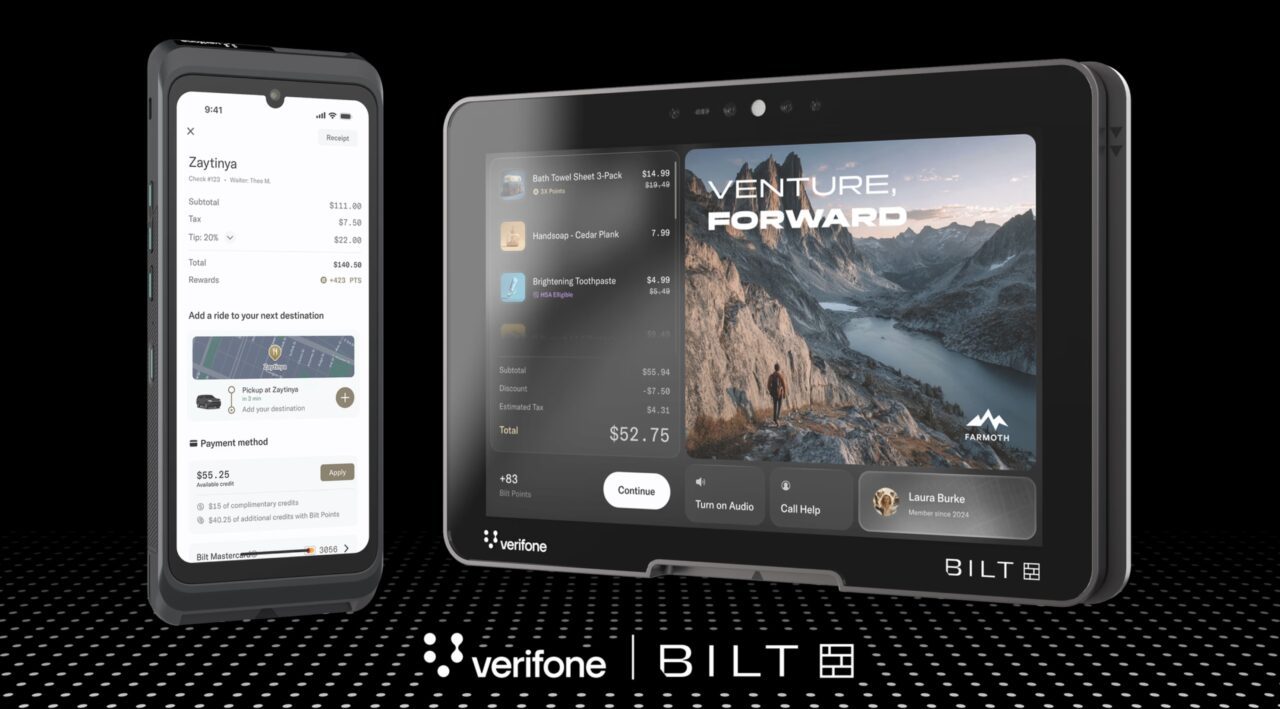
Bilt is partnering with Verifone to embed its loyalty and customer experience platform directly into Verifone Victa point-of-sale devices and will allow merchants to recognize and engage members at checkout with personalized experiences.
The integration requires no new hardware and works across multiple payment providers.
For Bilt, the deal creates a scalable distribution channel through Verifone’s point-of-sale devices, significantly expanding its merchant reach.
Loyalty platform Biltannounced it is teaming up with Verifone this week. The partnership will integrate Bilt’s experience and loyalty platform into Verifone’s Victa point-of-sale hardware devices.
The nine Verifone Victa point-of-sale devices range from enterprise-grade registers to small mobile and portable devices. Integrating Bilt’s loyalty tools into these devices will help merchants engage customers at point of sale by embedding personalized experiences and member identity into the payment experience.
The native integration, which won’t require additional hardware investment or changes to existing workflows, is designed to be easy for merchants to adopt. It works across multiple payment providers as an out-of-the-box tool that has already been tested and certified, which lowers implementation risk and shortens the time it takes for businesses to go live with Bilt’s customer experience tools.
“By embedding Bilt’s loyalty technology directly into the Verifone platform, delivered through Victa, we’re enabling merchants to elevate customer engagement without adding hardware or disrupting existing workflows,” said Verifone CEO Himanshu Patel. “Through the Verifone gateway, merchants get a pre-certified, enterprise-grade integration that accelerates time to market and is already proven at scale—while unlocking access to Bilt’s member base.”
Bilt was founded in 2021 to offer a loyalty rewards program and credit card that allows renters to earn points when they pay their rent, building credit with every payment. With no annual fee, the Bilt Mastercard credit card also allows cardholders to earn points on select dining experiences, rideshare purchases, and travel purchases. These points can be redeemed for travel, fitness classes, home decor, and even a down payment on a future home.
For Bilt, today’s partnership has the potential to massively increase its merchant footprint by placing its loyalty and customer experience tools directly into widely deployed point-of-sale hardware. By meeting merchants where transactions already occur, Bilt can scale distribution without requiring merchants to adopt new systems or change how they operate.
This is big news for Bilt. The partnership has the potential to move Bilt from a card-centric loyalty program into embedded commerce infrastructure that meets consumers and merchants directly at the point-of-sale.
“Partnering with Verifone—the gold standard in payment hardware—means our merchant partners get best-in-class customer experience technology that’s already delivering better reviews, faster operations, and happier customers,” said Bilt Founder and CEO Ankur Jain. “This partnership with Verifone brings our proven membership and loyalty tech right to the point-of-sale—dining, fitness, retail, you name it. Together, we’re completely changing how merchants connect with their customers. Now they can automatically recognize and reward people at checkout, which means every transaction becomes a chance to build real relationships and unlock new revenue with personalized offers.”
Bilt will begin rolling out the Verifone integration with select restaurant groups, and will make its tools more available to a broader set of merchants throughout 2026.
This week’s edition of Finovate Global looks at recent fintech headlines from Egypt.
Valu Launches Platform in Jordan
Egyptian fintech Valu has secured final approval from the Central Bank of Jordan to begin operations in Jordan. Valu was granted a Specialized Finance license that will enable the company to launch financial services in the Kingdom. Valu said it would being offering services in Q1 of 2026, providing consumers with flexible financing solutions across retail, healthcare, electronics, and education. Former Jordanian Minister of Investment and Digital Economy Mothanna Gharaibeh will serve as Chairman of the new entity, with fintech executive Mohammad Al Yousef serving as CEO.
“Securing final approval from the Central Bank of Jordan under a Specialized Finance license is a pivotal moment for Valu and a testament to the strength of our platform, governance model, and long-term vision for the market,” Valu Chief Market Expansion and Strategy Officer Habiba Naguib said. “Jordan is a key pillar in Valu’s regional expansion strategy.”
The decision to launch in Jordan reflects Valu’s determination to further financial inclusion and deepen its presence in the region. Valu secured initial regulatory clearance in 2025, the same year it was listed on the Egyptian Exchange (EGX), and strengthened its partnership with Amazon. Amazon purchased a 3.25% stake in the Egyptian fintech last spring.
“As we prepare to begin operations in the first quarter of the year 2026, our focus remains on driving financial inclusion through innovative, customer-centric products while investing in local talent and contributing meaningfully to the Jordanian financial ecosystem,” Naguib added.
Founded in 2017 and headquartered in Sheikh Zayed City, Egypt, Valu is a lifestyle-enabling fintech platform and a pioneer in offering Buy Now, Pay Later (BNPL) solutions in the MENA region. Valu offers flexible, customizable financing plans across more than 5,000 points of sale and more than 600 websites. The company also offers investment products, savings solutions, HR payroll services for businesses, and Sha2labaz, an instant cash redemption program.
Bank NXT Teams Up with IBM
Egypt-based Bank NXT has selected a trio of solutions from IBM to accelerate its digital banking transformation. In collaboration with Inspire for Solutions Development, the financial institution will implement IBM’s Instana, Turbonomic, and Cloud Pak solutions to enhance real-time observability, automated resource optimization, and advanced integration. The addition of all three technologies reflects Bank NXT’s integrated approach to boosting resilience, minimizing downtime, optimizing IT resources, and delivering better banking experiences for customers.
“This progress strengthens the reliability of the bank’s digital platform and boosts operational efficiency,” Bank NXT Chief Executive Officer and Managing Director Tamer Seif said. “It accelerates service delivery and expands the range of digital solutions we offer, ultimately leading to a better customer experience and faster, more responsive service.”
IBM Instana will provide the financial institution with real-time observability across digital banking applications to support proactive monitoring and faster issue resolution. IBM Turbonomic offers automated, intelligent resource optimization across hybrid cloud environments, helping maximize IT utilization while keeping costs low and performance consistent. IBM Cloud Pak—both for Integration and for Business Automation—runs on Red Hat OpenShift to create a unified digital platform that streamlines operations, reduces complexity, and promotes faster development and deployment of new solutions and services.
“Our collaboration with IBM and Inspire for Solutions Development is a crucial part of the bank’s transformation strategy,” Seif said. “By adopting the DevOps model and improving our business automation capabilities, we have enhanced the flexibility of our technology infrastructure. This advance prepares us to integrate with fintech companies through an API-driven ecosystem, fostering a more open and innovative environment.”
Founded in 1978 and headquartered in Cairo, Bank NXT serves both retail and business customers with services ranging from basic bank accounts and loans to wealth management.
AFS Launches SoftPOS
Arab Financial Services (AFS) announced that its subsidiary in Egypt has secured a SoftPOS license from the country’s central bank. The approval makes AFS Egypt one of the first fintechs in Egypt to bring a fully licensed SoftPOS solution to market.
AFS’s SoftPOS solution transforms any NFC-enabled smartphone into a secure and fully functional payment terminal. The solution provides merchants with a fast, low-cost, and highly scalable option for accepting payments. The technology eliminates the need for expensive hardware and supports all types of contactless cards, making digital commerce more accessible for both merchants and their customers.
“Going live with SoftPOS in Egypt is a transformative milestone for AFS and the Egyptian market,” AFS CEO Samer Soliman said. “This fully licensed solution allows us to instantly turn any NFC-enabled Android smartphone into a secure payment terminal, eliminating hardware costs and making digital acceptance accessible to businesses of all sizes. We view this launch as the foundation, and our immediate plan is to continuously expand its feature set and introduce innovative use cases that will further accelerate financial inclusion and power a digitally empowered economy.”
AFS Egypt is a subsidiary of AFS, which was formed in 1984 to provide banks and merchants with payment services, solutions, and expertise. Today, the company is owned by 37 banks and financial institutions, serving more than 60 clients in 20+ countries throughout the MENA region. A leading digital payment solutions provider regulated by the Central Bank of Bahrain, AFS boasts a portfolio that includes digital mobile wallets, merchant acquiring services, digital payroll solutions, contact centers, and more.
Here is our look at fintech innovation around the world.
Central and Southern Asia
Pakistan-based digital nano-lending platform Daira announced a strategic partnership with Infinix Pakistan, itel Pakistan, and Tecno Mobile Pakistan to deliver Buy Now, Pay Later services.
Bangladesh’s largest private commercial bank Pubali Bank PLC and payments solution provider BPC teamed up to modernize the bank’s card management infrastructure.
Forbes profiled recent fintech developments in countries in “South Asia beyond India” including Pakistan, Bangladesh, and Nepal.
In our latest interview from FinovateFall 2025, Beyond the Arc CEO Steven Ramirez talks with Shruti Patel, EVP and Business CPO at US Bank, about the institution’s approach to supporting small- and mid-market businesses. The two discuss the emergence of new digital capabilities, embedded payroll and account payable solutions, as well as the role of customer experience in shaping product design.
“We are super focused on our small businesses. They are looking for very simple banking products: an easy-to-use, best-in-class operating, savings, or money market account. They’re looking for a great rewards card. And then, last but not least, small dollar loans. We excel in our small business access loans. We are number four nationally and very close in California, as well. When it comes to their lending needs, when it comes to their banking needs, we’re very much focused on how can we make the life of a small business really, really easy.”
Joining US Bank in 2023, Patel has brought leadership experience from across fintech, banking, and payments. Previously head of global partnerships and monetization at Shopify—and before that head of embedded payments and partnerships at JPMorgan Chase—Patel today oversees services for US Bank’s small business and mid-market customers across money movement and credit card solutions, as well as the bank’s full suite of digital capabilities.
With nearly 1.4 million business customers representing up to $25 million in revenue, US Bank serves its clients at every business life stage—from starting a business to managing a growing company to selling a successful venture. US Bank provides a comprehensive and integrated suite of banking and payments solutions delivered both digitally and via its trusted banking partners.
Clover is partnering with Wink to embed biometric identity directly into the payment flow across Clover’s point-of-sale ecosystem.
The integration enables identity-based payments using facial, palm, and voice recognition and will support transactions, loyalty enrollment, and age verification without passwords, physical cards, or additional hardware.
The partnership treats identity as a core layer of the transaction and aims to deliver faster checkout, reduced fraud, and simpler operations for merchants.
Fiserv-owned Clover, a company that provides Android-powered point-of-sale tools, announced it is partnering with biometric identity and payments platform Wink to offer a new way to pay.
Clover will integrate Wink’s biometric identity technology into its existing platform, enabling identity-based payments designed to improve security and streamline checkout for both merchants and customers.
Texas-based Wink, a FinovateSpring 2023 Best of Show winner, provides a multi-factor biometric platform that combines facial, palm, voice, and device recognition to authenticate customer identities across in-store, mobile, and online transactions—without relying on passwords, physical cards, or additional hardware.
The integration brings together Clover’s payment and loyalty tools with Wink’s biometric authentication capabilities, allowing consumers to complete transactions, enroll in loyalty programs, and verify age-restricted purchases using biometric authentication. All transactions are processed through Wink’s PCI Level 1 and SOC 2–compliant payment gateway.
“The future of commerce is the unification of payment and identity,” said Fiserv SVP and Global Chief Product Officer of Merchant Solutions Sanjay Saraf. “By embedding Wink’s leading biometric security and intelligence directly into the Clover platform, we’re making cutting-edge technology simple, secure, and accessible for Main Street SMB businesses, helping them to deliver exceptional experiences and unlock new opportunities for growth.”
While contactless payments tools became less exciting after COVID, the heart of this collaboration is around a more central aspect of payments: identity. By integrating Wink’s tools, Clover is bringing identity into the core layer of the transaction, rather than a separate step handled through passwords, cards, or manual checks. For merchants, this could mean faster throughput, lower fraud, and fewer operational touchpoints.
Clover was originally founded in 2010 to help small businesses accept payments. Today, the company serves as a one-stop shop for multiple payment needs. In addition to offering a range of payment acceptance terminals, Clover also has software to help businesses with online orders, accounting, loyalty programs, staff management, inventory, and more.
Clover was acquired in 2012 by First Data, which was acquired by Fiserv in 2019.
“Wink’s strategic integration with Clover will bring unparalleled security, speed, and intelligence to every transaction across a large ecosystem of merchants, app developers, and partners,” said Deepak Jain, Founder and CEO of Wink. “We are excited to work closely with Fiserv to bring to market many advanced use cases of identity-driven payments that will define the future of connected commerce at scale across retail, hospitality, venues, and stadiums.”
Clover will make the biometric capabilities available across all of its point-of-sale devices, including Station Duo, Mini, Flex, and Clover Kiosk, and will not require additional hardware changes. The new biometric technology will be available to QSRs, sports venues, and retailers, in a continuous rollout throughout 2026.
UK-based paytech Modulr has entered the US as part of a strategic partnership with global fintech FIS.
The partnership will enable FIS to leverage Modulr’s technology for its cloud-native orchestration platform Money Movement Hub.
Founded in 1968 and headquartered in Jacksonville, Florida, FIS has been a Finovate alum since 2010.
UK-based payment technology provider Modulr has gone live in the United States, bringing its real-time, API-first payment capability to one of the largest payment markets in the world. Modulr has forged a strategic partnership with global fintech FIS and will provide critical technology for the company’s Money Movement Hub, a cloud-native orchestration platform that harmonizes the payments ecosystem by integrating major global networks via a single API.
“Expanding into the US is a natural step for Modulr as we respond to growing global demand for real-time, reliable payments infrastructure,” Modulr Founder and CEO Myles Stephenson said. “Our partnership with FIS is a collaborative launchpad, combining our proven expertise with FIS’s deep market presence to help US financial institutions modernize, innovate, and unlock the full potential of instant payments.”
FIS Money Movement Hub offers a unified point of access to real-time, batch, and cross-border payment rails, enabling financial institutions to provide their customers with faster, more flexible services. For its part, Modulr brings extensive experience in accessing payment schemes across the UK and Europe, including the company’s direct participation in the UK’s main payment schemes, Faster Payments and Bacs, as well as SEPA and SWIFT access.
“Modulr’s expertise in payments and scalable solutions perfectly complements FIS’s expansive reach,” FIS Co-President, Banking Solutions, Jim Johnson said, “creating a powerhouse for innovation, efficiency, and expansion across the money lifecycle.”
Processing more than 300 million transactions a year, with a total payment volume of more than £150 billion, Modulr’s API-first platform enables companies to embed payments into core solutions and services. With deployments across a network of more than 15 ERP, accounting, payroll, and travel booking integrations—including Sage, BrightPay, Xero, and Juniper—Modulr’s payments hub provides customers with greater efficiency, control, and security. Founded in 2015 and headquartered in London, Modulr is a regulated Authorized Electronic Money Institution (AEMI) in the UK under the Financial Conduct Authority and is regulated in the Netherlands by De Nederlandsche Bank.
A Finovate alum since 2010, FIS most recently demoed on the Finovate stage at FinovateFall 2016. The company provides comprehensive financial services including payment processing, banking technology, and financial software, working with banks, merchants, and capital markets firms to improve efficiency, scalability, and security. Headquartered in Jacksonville, Florida, and founded in 1968, FIS works with 95% of the world’s leading banks and has more than 14,000 clients across 150 countries. FIS counts 90% of private equity firms, 70% of the top 100 insurance firms, and more than 4,900 financial services companies and credit unions among its customers and partners.
FIS ended 2025 being recognized as a Leader in the Gartner Magic Quadrant for retail core banking systems in North America. Stephanie Ferris is the company’s CEO and President.
As we enter the next era of digitization 2.0, identity verification and fraud prevention have moved from supporting roles to critical infrastructure. At the same time, advances in AI are making it easier for bad actors to circumvent legacy controls, increasing both the complexity and the stakes of managing digital risk.
From onboarding new customers to authenticating transactions and preventing losses in real time, banks and fintechs are under pressure to strike the right balance between security and user experience. Fortunately, fintechs are tackling this challenge head-on, building identity and fraud controls that reduce friction, strengthen trust, and make digital finance scalable. The four companies below are building some of the most cutting-edge tools in this segment and will showcase their solutions on the demo stage at FinovateEurope, which takes place February 10 and 11 in London.
Candour Identity aims to improve digital onboarding by combining identity verification, biometrics, and fraud prevention into a single workflow. The platform is designed to help financial institutions increase conversion rates while maintaining regulatory compliance, enabling ongoing biometric authentication beyond initial onboarding. By supporting daily identity checks for login and payment use cases, Candour reduces fraud losses without introducing additional friction for legitimate users.
Darwinium helps organizations detect and prevent fraud while minimizing friction for trusted customers. Its platform distinguishes between high-risk and low-risk users in real time, allowing banks and fintechs to provide a “VIP” experience to good customers while applying stronger controls where needed. The approach is designed to reduce fraud losses without sacrificing the overall customer experience.
Elephant targets false declines and chargebacks, two persistent challenges in digital payments. By improving transaction decisioning, the company helps businesses approve more legitimate transactions while reducing downstream fraud and disputes. The result is higher authorization rates, fewer customer complaints, and lower operational costs tied to chargeback management.
With Keyless, users are the key. The company’s technology replaces traditional multi-factor authentication methods, such as one-time passwords, with biometric authentication. Keyless’s technology enables passwordless and tokenless login experiences while maintaining strong security controls. By removing reliance on call centers and manual recovery flows, Keyless aims to improve user experience and significantly reduce authentication-related costs for banks. Keyless was acquired by Ping Identity in November 2025.
Why banks should care
Digital channels are increasingly becoming the primary point of interaction with customers, shifting the importance of verification technologies. The companies highlighted above show how banks, payments firms, and marketplaces can reduce fraud and operational costs while improving customer experience by applying smarter, more adaptive controls. Rather than relying on rigid rules or legacy authentication methods that can easily be spoofed using AI, modern identity and fraud platforms allow banks to approve more good customers, intervene only when risk is real, and scale digital growth without sacrificing trust.
To watch these companies demo their newest tools in person, register for FinovateEurope, see what’s new, and shake hands with the innovators.
Czech Republic-based digital banking company Finshape introduced new CEO Neil Budd. Budd replaces current CEO Petr Koutný, who will take on a new position as Chairman of the Board.
Budd comes to Finshape after serving in executive roles for companies including Finastra and Accenture.
Forged in a 2021 merger between W.UP and BSC, Finshape won Best of Show in its Finovate debut at FinovateEurope 2022.
Digital banking company Finshape, which won Best of Show in its debut at FinovateEurope 2022, has appointed a new CEO. The Prague, Czech Republic-based fintech introduced Neil Budd—a veteran financial services executive with more than 25 years of experience in banking, technology, and consulting—as its new Chief Executive Officer.
“Banks are looking for technology partners they can trust for the long term,” Budd said in a statement. “Finshape has a strong, relevant product portfolio, experienced teams, and stable, trusted relationships with banks. With our Agentic Digital Bank Operating System and new capabilities in loyalty and personalization, I am confident we will continue to help banks deliver tangible value to their customers and accelerate our growth journey to new markets.”
New markets, indeed. CEO Budd will be tasked with driving the company’s continued growth internationally, and expanding operations across Western Europe, the Middle East, and the APAC region. Finshape’s current CEO Petr Koutný will transition into the role of Chairman of the Board.
“Clients value not only our products and expertise, but above all the practical impact that digital transformation delivers as part of their strategic programs,” Budd said. “Our goal is to continue developing technologies and services that perform in the demanding banking environment. At the same time, we are open to working with partners who share the same values—a strong focus on quality and customer orientation.”
Budd’s experience includes more than three years at Finastra, where he served as Vice President & Global Head of Strategic Partnerships, Ecosystems and Alliances—as well as Global Head of Managed Services. Before that, he was Managing Director responsible for financial services at Accenture. Immediately preceding his appointment with Finshape, Budd was Senior Partner and Chief Revenue Officer at Phi Partners, a capital markets consulting firm that specializes in quantitative and technology services.
Founded in 2021 via a merger between W.UP and BSC (Banking Software Company), Finshape won Best of Show in its Finovate debut at FinovateEurope 2022 and returned the following year for FinovateEurope 2023. In its most recent appearance, the fintech demonstrated its offering, called SME Stories, which helps banks boost digital engagement, loyalty, and sales among their micro- and small business customers via automated, easy-to-digest swipeable stories filled with actionable insights.
Finshape’s C-suite announcement coincides with the company reporting 55 million Euros in revenue in 2025, with 30% year-on-year growth. Finshape also noted its August acquisition of loyalty platform Realtime XLS from Collinson Group, which Koutný called at the time a “strategic milestone,” adding that the platform would “form an integral part of our growing, customer-centric digital banking portfolio.” In October, the company announced a partnership with Dubai Islamic Bank (DIB), the world’s first Islamic bank and the largest bank in the United Arab Emirates.
Barclays has made its first investment in digital currency infrastructure by backing Ubyx.
Ubyx aims to simplify the redemption and acceptance of stablecoins and tokenized deposits through a many-to-many clearing system designed to unify today’s fragmented digital money landscape.
The move shows that Barclays is focused on regulated interoperability rather than issuing its own stablecoin.
UK-based banking giant Barclays is making its first investment in the digital currency infrastructure space this week. The bank made a strategic investment in Ubyx, a US-based clearing system for digital money.
Ubyx was founded in 2025 to create stablecoin ubiquity. In other words, the company focuses on facilitating live transactions through a many-to-many clearing system to make redeeming stablecoins and tokenized deposits as simple as depositing a check. Ubyx uses a collaborative network model to transform the current, fragmented stablecoin landscape into a unified, ubiquitous payment system.
“Our mission is to build a common globalized acceptance network for regulated digital money including tokenized deposits and regulated stablecoins,” said Ubyx CEO Tony McLaughlin.
Barclays’ strategic involvement is especially important in Ubyx’s model, as the traditional bank adds a regulated element to the payments model. “Bank participation is vital to provide par value redemption through regulated channels. We are entering a world in which every regulated firm offers digital wallets in addition to traditional bank accounts.”
While it serves as one of the top banks in the UK, Barclays has previously not been among those launching stablecoin programs. Today’s investment is Barclays’ first major move in the stablecoin space since October of 2025, when the bank joined a group of ten major financial institutions to explore a jointly issued stablecoin pegged to G7 currencies.
“Interoperability is essential to unlock the full potential of digital assets,” said Barclays Head of Digital Assets and Strategic Investments Ryan Hayward. “As the landscape of tokens, blockchains, and wallets evolves, specialist technology will play a pivotal role in delivering connectivity and infrastructure to enable regulated financial institutions to interact seamlessly. We are pleased to be joining Ubyx on their journey as we drive forward our shared ambition to accelerate and shape innovation across our industry.”
What’s interesting in this move is that Barclays isn’t taking a step toward issuing its own stablecoin or tokenized deposits. Instead, the bank is focused on interoperability, redemption, and acceptance at par.
While clearing and settlement have long been dominated by bank-led networks, they are currently a bottleneck in digital money adoption. Ubyx’s many-to-many clearing model aims to solve that bottleneck, and Barclays’ participation adds regulatory credibility at a moment when banks are looking for ways to engage with digital assets without fragmenting liquidity or bypassing existing safeguards.
Two UAE-based companies—digital bank Zand and business banking platform Yuze—have teamed up to help small businesses, startups, and entrepreneurs secure digital business accounts.
The strategic alliance between the two firms is designed to make financial services available to eligible, underserved companies via fast onboarding, an IBAN account, digital banking solutions, and advanced business tools.
Both companies are headquartered in Dubai. Zand was founded in 2018. Yuze launched in 2022.
Blockchain-powered digital bank Zand and digital business banking platform Yuze have teamed up to help small businesses, startups, and entrepreneurs secure digital business accounts. The strategic alliance will enable eligible, underserved businesses in the UAE to access financial services via Yuze’s platform.
“The SME sector is a key growth engine driving the UAE economy,” Zand CEO Michael Chan said. “We are excited to partner with Yuze to support the business banking needs of SMEs and startups across the UAE, with our innovative and client-centric digital banking solutions.”
The strategic alliance will provide companies with access to IBAN accounts, digital banking solutions, and advanced business tools to support their operational and financial management, as well as their future growth. The partnership will also streamline the onboarding process for business customers, allowing them to establish banking relationships more quickly.
“At Yuze we believe that when banking becomes intelligent, businesses become limitless,” Yuze CEO Rabih Sfeir added. “Together with Zand, we are committed to providing customer-centric and next-generation banking services to businesses in the UAE.”
Headquartered in Dubai, Yuze offers modern business banking solutions including digital onboarding, business banking accounts, payment cards, and expense management tools. Founded in 2022, Yuze recently announced the launch of its Yuze Freelancer App in India. Designed to empower the next generation of freelancers, the solution enables users to open a digital wallet in minutes, send and receive payments, and track income and expenses—all within a single, intuitive app. “We’re not just giving financial access,” Sfeir said when the offering was announced. “We’re giving a partner that listens, understands, and grows with people.”
Founded in 2018 and based in Dubai, Zand is a digital bank that serves both retail and enterprise banking customers. A self-described “blockchain-powered bank,” Zand specializes in using AI and blockchain technology to bridge the gap between traditional and decentralized finance. The institution is licensed by the Central Bank of the UAE, the first all-digital bank in the UAE to earn this accreditation. Zand is also the first bank in the region to secure ISO certifications for information security management systems and for privacy information management systems covering Web3 services.
Citi has selected CredAble as a fintech partner to modernize trade finance controls by adding invoice and shipping data verification to its digital trade loan tools.
By integrating CredAble’s white-labelled technology, Citi aims to reduce fraud, manual reconciliation, and post-disbursement risk while improving transparency and speed for corporate clients and their suppliers.
The partnership reflects a broader trend of banks embedding fintech infrastructure into core trade finance workflows, as institutions look to add automation, intelligence, and trust to increasingly complex global supply chains.
Citi has selected India-based CredAble, a company that provides working capital infrastructure for banks and other businesses, to modernize trade finance controls and better verify invoices after payments are made across global markets.
Through its network of more than 20 ecosystem partners, CredAble provides liquidity programs for enterprise ecosystems, offers API-based working capital solutions and embedded credit solutions for banks, and provides an all-in-one credit, trade, and cash management platform for small businesses. Since it was founded in 2017, the company has served more than 175 corporations and 350,000 small businesses.
“This partnership goes beyond product innovation. It reflects our joint vision of making trade finance smarter, more secure, and aligned with the digital expectations of global businesses,” said CredAble Co-founder and MD Ram Kewalramani. “We are proud to be Citi’s fintech partner and elevate the standard for invoice verification and supplier financing.”
Citi will use a white-labelled solution from CredAble to add a verification layer to its digital trade loan tool. Integrating CredAble’s technology will allow Citi to help its corporate clients and their suppliers validate invoices by detecting inconsistencies and verifying shipping data with a user experience that offers better transparency and speed.
Overall, Citi’s tool will reduce manual follow-ups and enhance the accuracy of invoices without disrupting existing business workflows.
“As supply chains become more global and complex, digitization is essential to deliver control and confidence at scale,” said Citi Head of Asia South and Indian subcontinent, Trade and Working Capital Solutions, Mayank Gupta. “Our collaboration with CredAble supports our vision of modernizing trade with technology that is secure, user-centric, and built for widespread adoption.”
In an increasingly digital era, traditional banks are turning to fintechs to modernize trade finance infrastructure. Embedding invoice verification and shipping data validation into digital trade loan tools will help banks address fraud, manual reconciliation, and post-disbursement risk. As international trade continues to rise, fintechs like CredAble and its competitors like Persona will increase in popularity as they help banks add intelligence, automation, and trust to trade finance processes.
Eltropy, an AI-powered conversations platform for community financial institutions (CFIs), announced this week that Nebraska-based Cobalt Credit Union has deployed its Eltropy AI Voice solution. This has enabled the credit union to secure an 83% session containment rate while maintaining high member satisfaction.
Session containment rates refer to the percentage of customer interactions that are successfully resolved by the AI without the participation of a human agent. Typically, these rates range between 60% and 80%, and are lower than those for text-based systems due to the greater complexity of voice-based AI systems and the nuances of natural language processing (NLP) in spoken conversations. For Cobalt to achieve session containment rates exceeding 80% with its voice-based system is a significant achievement.
“From day one, our AI-powered contact center assistant, Coby, has delivered measurable results and positive feedback from both members and staff,” Cobalt Credit Union VP of Digital Banking Chasmine McIntosh said. “What Coby does is handle routine inquiries 24/7, which frees up our team to focus on the complex situations where members really need that human touch. We consider him a vital member of our contact center team, handling high volume with empathy and accuracy.”
Formerly SAC Federal Credit Union, Cobalt CU is no stranger to AI-enabled technology. The institution implemented its first AI agent in August 2024: an intent-based system that ran alongside the credit union’s new digital banking platform. Before the end of the year, Cobalt CU had added generative AI capabilities to enable its contact center assistant, Coby, to respond to an even broader range of queries. The implementation of AI Voice represents the completion of Cobalt CU’s multi-channel AI strategy, enabling members to engage with the institution via the channel of their choice.
“The key to effective AI Voice is that it goes beyond just understanding member requests—it takes action,” Eltropy VP of Product, AI, Saahil Kamath said. “Members calling to check balances or transfer funds don’t want to work through phone menus and hold times. Our AI handles authentication conversationally, processes transactions in real-time, and provides confirmation—maintaining a natural, human-like interaction throughout. Cobalt members are experiencing this firsthand.”
Founded in 1946 as SAC Federal Credit Union, the institution rebranded as Cobalt Credit Union in 2018. Cobalt CU is headquartered in Papillion, Nebraska—part of the Omaha metropolitan area—and has more than 20 branches serving approximately 120,000 members throughout Nebraska and Iowa. The credit union has $1.3 billion in assets under management. Robin Larsen is President and CEO.
A Finovate alum since 2017, Eltropy most recently demoed its technology at FinovateFall 2022 in New York. Headquartered in Santa Clara, California, Eltropy offers a unified conversations platform that enables more than 700 credit unions and community banks to transform the member and customer experience. With more than 40 use cases ranging from straightforward 1:1 texting and video banking to appointment and lobby management, Eltropy integrates AI at every step to automate processes and streamline complexity. Financial institutions using Eltropy’s technology have seen reductions in delinquency and fraud rates, as well as up to a 20% acceleration in lending processes.
FinovateEurope 2026 takes place in London on February 10 and 11. Register to attend and save up to £400.
FinovateEurope is returning to London in February, spotlighting the latest in fintech innovation.
The exceptional lineup of 30+ cutting-edge demos and 1,000+ senior-level attendees—including an impressive 600+ from banks and other financial institutions—makes FinovateEurope a must-attend event.
This year’s demo lineup showcases the key trends driving change across the financial services sector and the innovative technologies bringing them to life. Here’s an early look at the first wave of companies taking the stage:
Stay tuned for more announcements as we reveal the next wave of innovators in the coming weeks!
Interested in demoing? Applications are still open!
FinovateEurope is the perfect platform for organizations driving innovation in financial services—whether you’re a startup, bank, public entity, or established leader. Demoing offers unparalleled exposure, including:
7-minute demo slot on the main stage
A plug-and-play exhibit hall stand
Speaker passes and lead generation reports
Coaching calls with Finovate’s host and resident expert
Marketing and media coverage
Don’t miss the chance to kick off 2026 with a strong pipeline of leads and high ROI. Apply now to secure your spot.