This site is operated by a business or businesses owned by Informa PLC and all copyright resides with them. Informa PLC's registered office is 5 Howick Place, London SW1P 1WG. Registered in England and Wales. Number 8860726.
Finovate Blog
Tracking fintech, banking & financial services innovations since 1994
Digital banking development platform Plumery unveiled its AI Fabric this week.
The new offering will help banks operationalize AI safely and aid them as they deploy AI-assisted digital banking solutions.
Headquartered in Amsterdam, Plumery made its Finovate debut at FinovateEurope 2025 in London. Ben Goldin is Founder and CEO.
A new offering from digital banking development platform Plumery will help banks safely operationalize AI and provide a foundation for AI-assisted digital banking. Plumery’s AI Fabric gives financial institutions a standardized way to connect AI and generative AI models and agents to banking data. This alleviates the need for customized system integrations and helps direct institutions toward an event-driven, API-first architecture that scales as firms grow.
“Financial institutions are clear about what they need from AI. They want real production use cases that improve customer experience and operations, but they will not compromise on governance, security, or control,” Plumery Founder and CEO Ben Goldin said. “Our AI Fabric gives them a standard, bank-grade way to allow AI use within their tools and data without rebuilding integrations for every model. The event-driven data mesh architecture improves the process by transforming how banking data is produced, shared, and consumed, instead of adding another AI layer on top of fragmented systems.”
One of the biggest challenges faced by banks when seeking to operationalize AI is data fragmentation across legacy cores, channels, and integrations. This means that each new AI project tends to start from scratch, with additional infrastructure setup, security review, and governance—all of which can slow the process, delay value realization, and increase risk. Growing regulatory concerns regarding AI auditability and explainability also put pressure on institutions trying to take an ad-hoc approach to implementing and scaling AI.
Plumery’s AI Fabric empowers institutions to integrate and exchange AI capabilities as the ecosystem evolves. The technology presents quality, domain-oriented banking data streams and events across products, channels, and customer journeys in a consistent, governed, and reusable manner. Plumery’s AI Fabric distinguishes systems of record from systems of engagement and intelligence to enable institutions to innovate continuously, integrate new capabilities seamlessly, and deliver consistent experiences across channels. The company’s latest offering enables institutions to move away from point-to-point integrations and one-off data pipelines, simplifying changes and making adjustments safer, cheaper, and less complex. Because Plumery’s AI Fabric provides institutions with clear data lineage, ownership, and control, companies can explain decisions, manage risk more effectively, and satisfy compliance regulations.
Founded in 2016 and headquartered in the Netherlands, Plumery made its Finovate debut at FinovateEurope 2025 in London. At the conference, the company demonstrated its Super App Accelerator, which empowers financial institutions to launch a comprehensive Super App within weeks. Last fall, Plumery unveiled its cashback management capability, which helps banks build and launch their own cashback programs in weeks, featuring real-time, personalized rewards to boost customer engagement.
Learn more about Plumery and its innovations in digital banking in this interview from the company’s FinovateEurope appearance last year.
A look at the companies demoing at FinovateEurope in London on February 10. Register today using this link and save 20%.
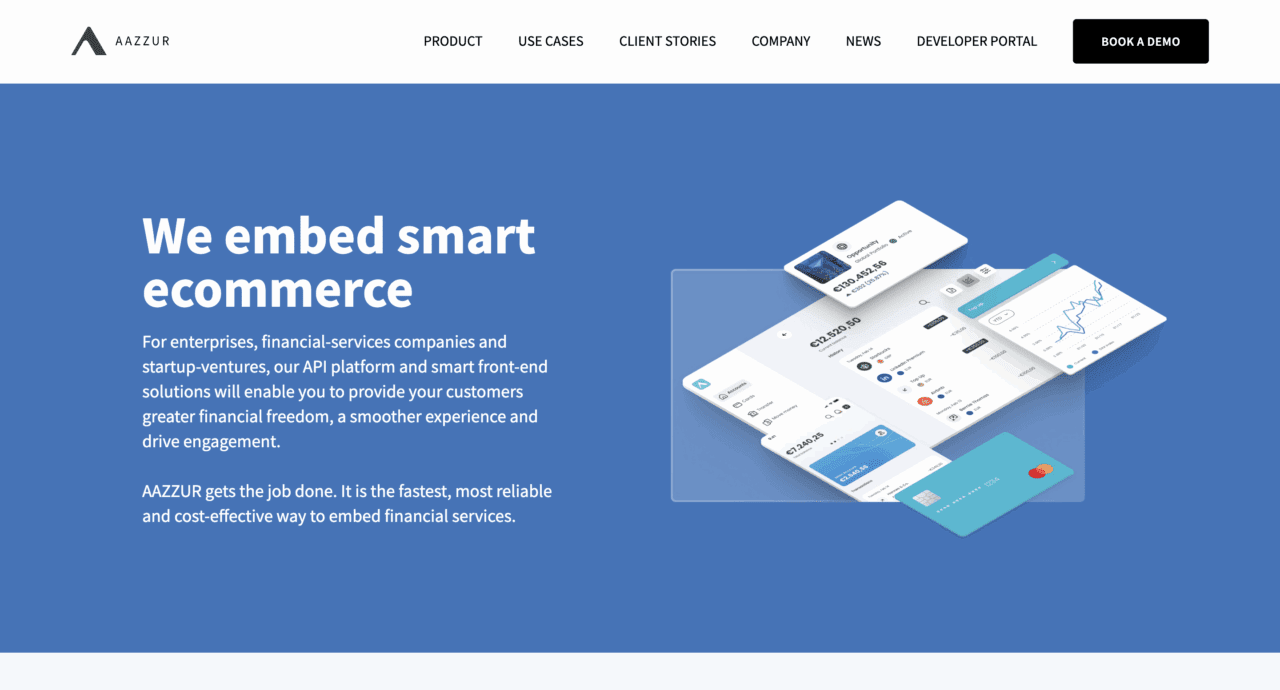
AAZZUR
AAZZUR is an easy and cost-effective way for brands and platforms to seamlessly integrate financial products and increase customer value.
Features
10x cheaper and 4x faster: Launches banking and cards in 4 to 6 months
70+ plug-and-play modules and use case packages: Delivers hassle-free embedded finance
Vendor-agnostic orchestration: Offers one integration for 30+ fintech partners
Who’s it for?
Challenger brands and mid-stage fintechs.
Francis
Francis is a personal finance AI for people in tech that turns fragmented financial data into actionable wealth insights. Pensions, property, investments, cash – all data in one place.
Features
Tracks all pensions and ISAs in one place
Checks and optimizes investment fees
Benchmarks the user’s portfolio against a market index
Estimates total investable cash
Who’s it for?
Francis is for all of the unadvised, mass-affluent tech and digital professionals with global compensation, starting with big tech in the UK.
mAI Edge
mAI BrandOS is an AI-powered creative system for banks. Fine-tuned per brand, it generates publish-ready, compliant marketing content across dozens of channels in minutes.
Features
Fine-tuned per brand: Encodes visual identity, tone, and compliance rules
Delivers publish-ready outputs: No manual rework or supplier delays
Provides built-in governance: Audit trails, GDPR compliant, EU AI Act ready
Who’s it for?
Tier 1 and Tier 2 retail and commercial banks or insurance companies in CEE, DACH, and Western Europe.
R34DY
ABLEMENTS is a context engineering platform that transforms complex IT landscapes, systems, data, processes, and architecture into AI-ready intelligence that enables enterprise transformation.
Features
Automates legacy discovery
Accelerates M&A integration
Drives digital transformation and AI enablement
Who’s it for?
Banks, credit unions, and enterprises struggling with legacy complexity and system integrators delivering digital transformation and M&A integration.
Klarna has launched peer-to-peer payments in 13 European markets, enabling users to send money, split bills, and gift cash directly within the Klarna app.
The move shifts Klarna beyond buy-now, pay-later toward becoming an everyday digital hub for spending and money management.
While initially limited to Klarna users sending domestic payments to other Klarna users, the company plans to expand P2P payments to non-users, cross-border transactions, and potentially stablecoin-based options in the future.
Digital payments app Klarna is taking a step to become more like a bank. The Sweden-based company has launched peer-to-peer (P2P) payment capabilities this week, making it possible for users to send funds to family and friends.
The new P2P capabilities will initially be available in 13 European countries: Belgium, Denmark, Finland, France, Germany, Italy, Netherlands, Norway, Poland, Portugal, Spain, Sweden, and the UK. Customers in these nations will be able to use the Klarna app to split bills, gift cash, and send funds under the protection of a regulated bank.
Klarna, which originally launched as a buy-now, pay-later tool in 2005, views this launch as the next step in its evolution as an everyday digital hub for spending and money management.
“Customers are sick of the friction and fees of traditional banking, which is why millions signed up to Klarna Card within a few months of launch,” said Klarna Co-founder and CEO Sebastian Siemiatkowski. “With peer-to-peer payments we’re making it even easier to manage all of your payments through Klarna, now including small transfers, making managing your money quicker, easier, and cheaper.”
At launch, P2P payments will only work between Klarna users sending domestic payments. To send funds, users need a recipient’s phone number or email address, or they can use a QR code or saved contact. When the sender confirms the amount, Klarna checks the transaction details for fraud. The company plans to expand the capabilities to non-Klarna users and to cross-border payments in the future.
This is among the first major announcements Klarna has made since going public in September 2025. And while it comes two months after the company debuted the KlarnaUSD, its stablecoin, the company said that its P2P payments will initially run over traditional payment rails, though it is exploring stablecoin-based options.
The launch of the new P2P payment capabilities marks Klarna’s first move in 2026 after a busy 2025, when the company saw the deposits in its Klarna Balance account double from $9.5 billion in 2024 to $14 billion in 2025. Additionally, Klarna’s debit card saw more than four million sign-ups just four months after launching.
Klarna made no mention of plans to launch P2P payment capabilities in the US, where it would face entrenched competitors such as Cash App, Venmo, and Zelle. However, adding P2P payments to an already robust app deepens Klarna’s role in users’ daily financial lives, which would reinforce its ambition to move beyond buy-now, pay-later and closer to a full-service digital banking experience.
While perhaps not as flashy as AI or blockchain technology, embedded finance, open banking, and open finance are already transforming the way individuals and businesses interact with banks, financial service providers, and even retail organizations. By enabling firms to leverage partnerships and APIs to offer services and products they would struggle to offer on their own, these technologies give companies a tremendous opportunity not only to enhance their offerings with greater efficiency and personalization, but also to expand their product lines, provide new solutions, and secure new sources of revenue.
This week, in our continuing series previewing companies that will demonstrate their latest innovations at FinovateEurope 2026, we showcase four companies that are helping banks and other financial institutions take advantage of the opportunities made possible by embedded finance, open banking, and open finance.
FinovateEurope 2026 will take place at London’s Intercontinental O2 on February 10 and 11. Tickets are available now. Visit our FinovateEurope hub today and take advantage of big early-bird savings!
AAZZUR enables brands—both small and medium-sized businesses as well as large corporations—to launch their own embedded finance solutions with a single integration. The company’s open banking platform serves as a layer above banks and fintechs, facilitating the exchange of data, messages, and transactions to boost satisfaction, retention, and monetization, while enhancing the way fintechs work with banks. Headquartered in Berlin, Germany, AAZUR was founded in 2017.
Francis enables financial institutions and fintechs to leverage AI to resolve challenges in their open finance initiatives. The company’s technology transforms fragmented financial data from pensions, property, investments, cash, and other sources into actionable wealth insights. Francis uses AI to process unstructured data and integrates it with market data, providing a holistic view of both personal and business finances. Founded in 2025, Francis is based in London, England.
Opentech, a digital payments and transaction enrichment services provider, develops and operates full-stack solutions currently deployed by financial institutions and service providers in Italy, Switzerland, and Austria. The company’s open and scalable platform fosters interoperability between banks, card issuers, and international payment networks. Founded in 2003, Opentech is headquartered in Rome, Italy.
Hagbad works with organizations to digitize trust-based savings. The company modernizes traditional group savings systems through its secure digital platform, enabling compliant engagement, expanding customer reach, and promoting inclusive growth via a regulated, culturally aligned financial infrastructure. Hagbad’s platform features automated tracking and real-time transparency to ensure that contributions, payouts, and group activity are effectively monitored. Headquartered in the UK, Hagbad was launched in 2025.
Why banks should care
Embedded finance, open banking, and open finance offer banks an exceptional opportunity to introduce new products and services and to compete more effectively with rivals in both Big Tech and Big Retail. All three innovations foster increased accessibility, enabling financial institutions reach customers where they are. They also support greater personalization, empowering firms to offer more tailored financial products to customers, while simultaneously creating new revenue sources to diversify beyond traditional banking offerings.
Catch these and other innovative fintech companies next month at FinovateEurope 2026. With less than a month to go, there’s no better time than now to visit our FinovateEurope hub and secure your spot to the first big fintech conference of the year!
B2B2C crypto enablement platform Coinme has agreed to be acquired by Web3 software development firm Polygon Labs in a deal that also involves onchain payments company Sequence.
The two acquisitions will help Polygon Labs complete its Open Money Stack, which is designed to enable regulated stablecoin payments and transfers.
Founded in 2014 and headquartered in Seattle, Washington, Coinme made its Finovate debut at FinovateSpring 2022. Neil Bergquist is CEO.
Coinme, a US-based B2B2C crypto enablement platform, has agreed to be acquired by Web3 software development firm Polygon Labs. Polygon Labs is also acquiring Sequence, which facilitates onchain payments at scale. Acquiring the two firms gives Polygon Labs the core infrastructure it needs for its Open Money Stack, an open and integrated suite of services and technologies that enable regulated stablecoin payments and money movement, powered by Polygon’s blockchain rails.
“By combining Coinme’s regulated US payment infrastructure and nationwide cash network with Polygon’s ecosystem, we’re creating something powerful: a turnkey solution that enables Web2 and Web3 companies to embed compliant stablecoin payments directly into their platforms,” Coinme noted in a statement. “This means seamless movement between traditional fiat systems and onchain settlement—the kind of infrastructure needed to support the global stablecoin payments market, projected to exceed $2.8 trillion in transaction volume by 2028.”
The transaction is pending customary regulatory approvals. Following the acquisition, Coinme will operate as a wholly owned subsidiary of Polygon Labs, managing its regulated exchange, wallet, and Crypto-as-a-Service platform. Coinme operates a network of 50,000+ locations across the US where individuals can exchange cash for cryptocurrencies, and holds a money-transmitter license in 48 US states.
The Sequence acquisition is intended to “complement and accelerate” Polygon Labs’ interoperability goals. Sequence offers enterprise-grade smart wallets and a solution, Trails, which acts as a one-click, cross-chain routing and intents engine. Sequence also provides infrastructure that conceals bridging, swaps, and gas fees from end users. This helps applications move stablecoins between networks without exposing users or payment teams to underlying blockchain complexity.
The popularity of stablecoins is soaring, particularly in use cases such as serving as a settlement layer for cross-border and international payments. According to Polygon Labs, the primary barriers to more robust use of this technology are the requisite regulation, orchestration, and integration needed to make stablecoins easier for companies to deploy. The company’s acquisition of Coinme and Sequence, running on Polygon rails that have already facilitated trillions in onchain value transfer, will make it possible for more financial systems to deploy onchain money and achieve faster settlement, lower fees, better execution, and capital that is always at work.
“By combining regulated access, enterprise infrastructure, and onchain settlement, Polygon Labs establishes a clear path to more than $100 million in annual revenue, driven by real payment flows,” Polygon Labs said in a statement. “Combined, these companies have already processed $1 billion in offchain sales and $2 trillion in onchain volume.” The statement also mentioned that successful execution will mean that the company is no longer reliant on financial support from the Polygon Foundation. “Instead,” the statement continued, “Polygon Labs is building payments infrastructure that earns revenue the same way the global payments industry always has: by moving money reliably, at scale.”
Founded in 2014 and headquartered in Seattle, Washington, Coinme made its Finovate debut at FinovateSpring 2022. Today, the company is a licensed and regulated B2B2C crypto enablement platform provider that enables its partners to quickly launch and scale native crypto products into their offerings. Coinme customers leverage the firm’s crypto infrastructure, compliance program, and regulatory licensing to offer crypto trading, custody, and on/off ramps. Neil Bergquist is Co-founder and CEO.
Checkout.com has received approval for a Merchant Acquirer Limited Purpose Bank (MALPB) charter in Georgia.
The charter enables the UK-based payments provider to operate as its own acquirer in the US.
The move marks a major expansion of Checkout.com’s North American strategy, as it expects full banking operations in 2026.
Digital payments provider Checkout.com has received approval for its Merchant Acquirer Limited Purpose Bank (MALPB) charter from the Georgia Department of Banking and Finance. For UK-based Checkout.com, this regulatory approval will allow the fintech to transition to operating a MALPB in the US.
Checkout.com sees the approval as the next step in its journey, which includes direct US card network integration and the ability to operate as its own acquirer in the US market. Bringing both of these aspects in-house will offer Checkout.com more control, allow it to move faster, and offer better acceptance rates in order to deliver the performance US merchants expect.
The approval reduces Checkout.com’s dependence on sponsor banks, which will enable greater control over settlement, risk management, and merchant onboarding. These capabilities are increasingly important as payment volumes and regulatory scrutiny grow in the US market.
“With our MALPB charter now approved, the ‘definitive catalyst’ we identified in October is officially activated. This milestone paves the way for a new era of payment performance,” said Checkout.com MALPB CEO and Head of North American Banking Jordan Reynolds. “Our focus is now on scaling our infrastructure and building up talent in Atlanta and the US to meet the rigorous conditions of our approval. We are on track toward full charter banking operations in 2026, doubling down on our commitment to provide US enterprise merchants with the performance and reliability they demand.”
As Reynolds hints, while the charter has been approved, Checkout.com will still need to meet regulatory and operational milestones before fully launching banking operations, which it expects to complete later this year.
Today’s move indicates that Checkout.com is interested in significantly expanding its North American operations. The US bank charter will offer US enterprises a payment platform optimized for the complexities of the US market.
The company operates a US headquarters in Atlanta, Georgia with additional offices in New York and San Francisco. Checkout.com was authorized as an electronic money institution in the UK in 2017 and in France in 2019. In 2023, the company obtained its Retail Payment Services license from the Central Bank of the United Arab Emirates and since then has brought Mada (Saudi Arabia’s National Payment Network) and Apple Pay to merchants across the UAE and KSA.
Founded in 2012, Checkout.com is a global payments platform that empowers businesses to accept, process, and manage payments seamlessly. The company uses its payments network to enable organizations to accept payments locally and internationally with global acquiring capabilities. The company also offers a suite of services that allows businesses to create and manage their own payment cards, advanced risk management tools to optimize performance and reduce fraud, and treasury management services to streamline cash flow and reconciliation.
Checkout.com processed more than $300 billion in ecommerce volumes last year and counts Uber, eBay, Pinterest, Klarna, and GE Healthcare among its clients.
Nationwide has selected Moneyhub to enrich and categorize card and direct debit transaction data using AI-driven analysis.
The partnership enables deeper transaction-level insights that support better personal finance management for customers, alongside improved fraud detection, risk monitoring, and personalization for Nationwide.
The deal highlights how transaction data is becoming a strategic differentiator for banks competing on insight-led products and customer experience.
UK financial services company Nationwide has selected open data platform Moneyhub to help categorize, enrich, and better understand consumer transaction data.
Nationwide will leverage Moneyhub’s AI-driven Categorization and Enrichment engine to analyze consumer transactions made on cards and with direct debits. The transaction analysis will allow Nationwide to see details such as contact and location data for the website or store where the purchase was made.
This deep understanding of transaction details will benefit both customers as well as Nationwide. The additional data will help customers better manage their personal finances and quickly identify fraudulent transactions. For Nationwide, the granular insights support more accurate transaction categorization, improved risk detection, and the ability to deliver more personalized products and services. By working with Moneyhub, Nationwide is positioning itself to turn raw transaction data into actionable insights that can power smarter products, clearer customer experiences, and more proactive financial support.
“At Nationwide our tech teams work to deliver fairer, more rewarding, and more convenient banking, so selecting the right partners is crucial, to make sure we’re giving our customers the best experience possible,” said Nationwide Chief Data and Analytics Officer Sri Kanisapakkam. “Moneyhub’s AI-driven tech will help enrich the data we’re giving back to our customers and set us up for success with even more personalized products and services in the future.”
Moneyhub was founded in 2014 and offers personal finance technology tools, open data APIs, decisioning solutions, and payments capabilities. Its platform is designed to empower financial institutions, employers, and technology providers to deliver more tailored financial experiences through real-time data access and intelligent analysis. Regulated by the FCA, Moneyhub’s infrastructure supports a wide range of use cases, including budgeting tools, affordability assessments, wealth insights, and financial wellness programs.
“Moneyhub exists to help our financial services clients build services that improve their customers’ digital experience and deliver better financial outcomes,” said Moneyhub CEO Alastair McGill. “Presenting retail customers with a fine-grained understanding of their income and expenditure is an essential part of this journey, so we’re delighted that Nationwide selected our Categorization and Enrichment engine. We look forward to working with Nationwide as they continue to further enhance their customer engagement.”
Across the globe, transaction data is becoming a strategic asset for banks. As competition heats up in the traditional banking space, financial institutions face growing pressure to improve personalization, fraud prevention, and customer trust. Fortunately, the broad availability of AI tools combined with open banking regulations such as PSD2 make it easier than ever for firms to gain insights from transactions.
Moneyhub demoed its enterprise platform at FinovateEurope 2017. Last year, the company formed a partnership with Lloyds, deepened ties with Experian, and appointed a new CEO.
Challenger bank Revolut has launched new anti-impersonation functionality on its app to help its users avoid deepfakes and scams.
The new in-app identification feature works in real-time to let users know if they are receiving a call from a legitimate Revolut agent or a potential fraudster.
Founded in 2015, Revolut made its Finovate debut at FinovateEurope the same year. Nik Storonsky is Founder and CEO.
How confident are you that you can tell the difference between a genuine caller and an AI-powered deepfake impersonation? All the time? Most of the time? Some of the time?
According to a report from the National Library of Medicine, only 25% of people can accurately identify a deepfake voice, making impersonation scams that much more effective and turning voice calls into what it called “a critical vulnerability.”
In response, Revolut has unveiled its solution to the rising security challenge of AI deepfakes and impersonation scams. The company announced a new in-app identification feature that detects when users are in a call and verifies if the call is coming from a legitimate Revolut employee or a potential scammer, all in real time.
“As fraudsters adopt AI and advanced deepfake tools, we need to innovate fast to defend our customers and stay ahead of rapidly evolving fraud threats,” Revolut Product Owner Rami Kalai explained. “This new feature not only gives users real-time, contextual warnings in the moment they need them most, but also guides them to identify impersonation scams, providing clear, actionable steps to keep their money safe while the fraud attempt is happening.”
Revolut’s anti-scam solution is straightforward. When a user receives a call, they simply check their mobile Revolut app. If the call is legitimate, a banner or pop-up will appear to confirm that the call is from Revolut. If the call is not from Revolut, the pop-up will turn red and warn the user. At this point, the user can tap the pop-up to alert Revolut that they have received a potential scam call, and then hang up immediately. The technology is currently active for all Revolut customers using iOS devices. Customers using Android will need to specifically authorize the new functionality from the Security Hub.
The range of scam types is truly staggering, including purchase scams, investment scams, impersonation scams, job scams, romance scams, delivery scams, charity scams, rental scams, and triangle scams. Revolut’s new anti-impersonation feature is only the latest solution the company has deployed to help its customers deal with the growing threat of fraud and financial crime in recent years. Among these solutions are biometric verification to help prevent transfer mugging (in which a victim is coerced or threatened into transferring funds from their account to a fraudster) and advanced machine learning strategies to identify suspicious transactions.
A Finovate alum for more than a decade, Revolut first demoed its technology on the Finovate stage at FinovateEurope 2015. Today, the company boasts more than 65 million customers around the world—12 million in the UK alone—offering a range of banking services via its mobile app. Revolut retail and business customers have access to money transfer services, stock trading, a cryptocurrency exchange, current accounts, a pre-paid debit card, insurance, and more—as well as premium services available via subscription. Operating under a European banking license, and having licenses and approvals in Mexico, Australia, Japan, the UK (restricted) and the US (via partnerships), Revolut has a presence in more than 48 countries.
Headquartered in London, England, Revolut was founded in 2015. Nik Storonsky is founder and CEO.
International data, analytics, and technology company Equifax UK has teamed up with Greece’s sole credit bureau Tiresias.
The strategic partnership is designed to help Tiresias develop modern business tools to enhance credit assessment, bolster fraud prevention, encourage responsible lending, and improve debt management.
Equifax UK is a division of Atlanta, Georgia-based Equifax located in London, England.
In Greek mythology, Tiresias was a blind prophet famous both for his clairvoyance and for being transformed into a woman for seven years by the Greek goddess Hera.
Tiresias is also the name of the sole credit bureau in Greece and is the latest strategic partner of global data, analytics, and technology company Equifax UK. The two entities are collaborating in an effort to boost financial inclusion, stimulate economic growth, and bring advanced credit assessment and fraud prevention to businesses and consumers in Greece.
“Our partnership with Tiresias is a testament to everything we have built at Equifax and the strength of our global solution capabilities and expertise in the marketplace,” Equifax UK Chief Strategy & Innovation Officer Craig Tebbutt said. “This collaboration will further strengthen Tiresias as a strategic pillar of the Greek economy, drawing on Equifax data, analytics capabilities, and cloud technology to drive insights and decision-making confidence, helping more people live their financial best.”
Tiresias will benefit from access to Equifax’s advanced data and analytics expertise, technology platforms, and best-in-class practices to assist the bureau as it develops new, modern products and services. Among these new offerings are business tools to enhance credit assessments, bolster fraud prevention, encourage responsible lending, and improve debt management. In a statement, Tiresias highlighted Equifax’s global reach, with operations in 24 countries, as well as the firm’s combination of differentiated data, analytics, and cloud technology.
“This marks a new chapter in the Greek credit market, where transparency, reliability, and innovation will combine to deliver modern, safe, and more effective services to benefit society, while safeguarding the rights and freedoms of individuals and protecting their personal data,” Tiresias Chief Executive Officer Ilias Xirouchakis said.
Founded in 1992 and based in Marousi—a suburb north of Athens—Tiresias is an interbank company that provides reliable data on the assessment of credit risk for businesses and private citizens. The company seeks to limit the over-indebtedness of individual borrowers, facilitate responsible lending, protect against fraud, and enhance the security of commercial transactions via its Tiresias Risk Control System (TSEK).
Headquartered in Atlanta, Georgia, Equifax has been a Finovate alum since 2011. The company’s UK-based division, Equifax UK, offers credit scores and credit reports, as well as identity protection tools. The company also provides resources to help consumers find the right loan, credit card, automobile financing, and insurance offers, as well as educational information on financial subjects ranging from debt management to mortgages.
Google launched Universal Commerce Protocol (UCP), an interoperability layer that lets AI agents discover products, authenticate users, and complete transactions.
Unlike AP2, which governs how agents move money, UCP orchestrates the entire commerce flow.
UCP will require banks to create new approaches to authentication, consent, liability, and trust as AI agents become active participants in commerce.
Google unveiled its Universal Commerce Protocol (UCP) today, which essentially serves as the plumbing for how AI agents buy things on consumers’ behalf. But what does it really do and how is it different from Google’s AP2 launched last fall? Here’s a simple breakdown of the newly launched protocol.
What does UCP do?
Co-developed with major retailers and ecommerce players, including Shopify, Etsy, Wayfair, Target, and Walmart, Google’s Universal Commerce Protocol is essentially a standardized way for AI agents to discover products, request prices, authenticate users, and complete transactions. You can think of it like HTTPS, which is a set of rules that serves as a standardized protocol that governs and encrypts how browsers request and servers send web content over the internet.
Similarly, UCP is an interoperability layer that allows many systems to talk to each other and enables AI agents to make purchases and decisions on a consumer’s behalf, instead of just making product recommendations. UCP is more than a marketplace or a wallet. The new protocol coordinates the various aspects of how agents, merchants, identity systems, and payment rails interact during a transaction.
Google plans to use UCP to power a new checkout feature on select Google product listings that will allow shoppers to check out using Google Pay and PayPal from eligible retailers in AI Mode within Search and in the Gemini app.
From an end users’ perspective, this may seem similar to OpenAI’s partnerships with retailers like Walmart that allow shoppers to make purchases within ChatGPT. Google’s move, however, is markedly different. That’s because Google owns the payment rails. While the retailer remains the seller of record, Google controls the checkout experience as well as the protocol, which standardizes identity, payment credentials, shipping information, and consent.
How does UCP differ from AP2?
The final quarter of 2025 brought a deluge of new agentic commerce protocols to the market, creating confusion about the roles of protocols and the players involved. Among the protocols launched last year was Google’s AP2, its Agent Payments Protocol. AP2 is much narrower in scope than UCP, however, because while AP2 governs how an AI agent is allowed to move money, UCP orchestrates the entire commerce flow.
UCP handles product and service discovery, pricing and availability queries, merchant interaction, user intent and authorization checks, transaction confirmation, and fulfillment. AP2, on the other hand, is entirely payments focused. It handles payment initiation, authorization limits, credential handling, transaction execution, and settlement signaling.
What does all of this mean for banks?
Agentic commerce is moving fast and is set to change how transactions are initiated, authorized, and executed. As AI agents take on a more active role in purchasing, banks will need to rethink their role in the transaction stack and consider how to authenticate AI agents and create policies around who is liable when an agent transacts. Fortunately, protocols like UCP create auditability and can program trust into every transaction.
There is a race to the top in Agentic commerce, and Google is here to make sure its name is front and center. The tech giant launched its Universal Commerce Protocol (UCP), a new open standard for agentic commerce, and payments companies like PayPal and Ant International are jumping on board. Read on for more fintech news headlines. We’ll continue to add more announcements as the week progresses.
DeFi
Rainraises $250 million Series C to scale stablecoin-powered payments infrastructure for global enterprises.
BNYextends digital cash capabilities for institutional clients.
Ripplereceives FCA permissions to scale Ripple Payments in the UK.
Emburselaunches Invoice Tax Validation to help global businesses comply with growing wave of e-invoice regulation.
Affirmupdates underwriting with enhanced signals to better reflect consumers’ real-time finances.
AMLYZEpartners with Vinted Pay as it expands payment infrastructure.
Digital banking
The State of Georgia Department of Banking and Finance has officially acceptedCheckout.com‘s application for a Merchant Acquirer Limited Purpose Bank (MALPB) charter.
Wio Bankunveils first UAE bank account for content creators.
There’s no doubt that 2026 is shaping up to be yet another year in which DeFi—from stablecoins to tokenized assets—commands its share of fintech headlines. But the innovations taking place in insurance and insurtech are also worthy of note.
From embedded insurance solutions to insurance that is bundled with loans, mortgages, or other financial products, technology is having as much impact on the insurance industry as it is in any other field within fintech. Insurtech is leveraging automation, machine learning, AI, and even blockchain technology to help improve efficiency, control costs, better manage and safeguard data, and enhance the insurance process for both retail and enterprise customers. Here’s a look at a handful of recent stories that help show where insurtech is today.
Corgi Investment Fuels AI-Powered Insurance for Startups
Corgi Insurance has secured $108 million in funding, as well as regulatory authority to operate an AI-native, full-stack insurance carrier dedicated to startup companies. Investors included Contrary, Glade Brook Capital Partners, Kindred Ventures, Leblon Capital, Oliver Jung, Seven Stars, and Y Combinator.
Also participating in the funding were Andrej Henkler and Fadwa Ouardani, Alumni Ventures, Fellows Fund, Phosphor Capital, Quadri Ventures, SV Angel, and Vocal Ventures.
Corgi Insurance will use the capital to grow its insurance offering for startups, with a focus on broadening coverage options and widening distribution. The company will also invest in its AI systems that support underwriting, claims processing, and policy administration.
“Founders shouldn’t have to choose between speed, coverage quality, and price,” Corgi Co-Founder and CEO Nico Laqua said. “We built Corgi to deliver all three in one place, so startups can get covered quickly and focus on building. This capital helps us expand coverage and keep improving the product.”
Headquartered in San Francisco, California and founded in 2023, Corgi is a full-stack carrier, overseeing the design and management of its insurance products internally. This makes it easier to adapt policies to fit startup customers as they grow. Additionally, Corgi notes that its technology enables instant quotations, pricing, and coverage that changes as businesses scale. Securing regulatory approval makes Corgi a licensed insurance carrier, providing underwriting, claims handling, and policy management via its AI-enhanced platforms.
Corgi’s insurance products include AI liability, directors and officers liability, errors and omissions liability, commercial general liability, cyber insurance, fiduciary liability, and hired and non-owned auto coverage. The company has reported annual recurring revenue of more than $40 million since securing full regulatory approval in July 2025.
Insurtech Covr Announces New C-Suite Leadership
Digital insurance solutions provider Covr Financial Technologiesshared news of two major C-suite changes last week. The company announced that Sam Barnett would join Covr as Chief Executive Officer (CEO) with Bob Klein taking on the role of Chief Distribution Officer (CDO). Barnett and Klein are co-founders of VIBE Insurance Services and, as part of the leadership transition, Covr will “acqui-hire” the VIBE team.
The leadership announcement also follows Covr’s recent merger with Optifino in the fall of 2025. Together, the three entities combine Covr’s operational and compliance infrastructure, Optifino’s AI-powered platform, and VIBE’s independent agency expertise and leadership to offer a comprehensive suite of insurance solutions.
“Following the Optifino-Covr merger last fall, I retained Sam and Bob’s firm, VIBE Consulting Services, to help guide our transition,” current Covr CEO David Kleinhandler explained. “As we worked together, it became clear that the opportunity was larger. Their expertise, vision, and ability to execute made them the natural choice to run the newly merged company, and I approached them about joining full-time to help author our next chapter. I’m truly excited that they accepted, and look forward to our ongoing collaboration.”
Headquartered in Hartford, Connecticut, and founded in 2016, Covr empowers advisors to identify the right insurance product for their clients at the right time. The firm boasts 20 partnerships with financial institutions and banks, offers 122 insurance products, and serves more than 30,000 financial professionals and 100+ million customers. The company leverages enterprise-grade distribution, best-in-class compliance infrastructure, and advanced AI-driven planning tools to deliver faster case design, smarter product fit, and a seamless end-to-end insurance journey.
“This merger creates powerful synergies,” Covr Chief Innovation Officer Michael Doniger said. “Our institutional distribution and compliance infrastructure perfectly complements Bob and Sam’s independent channel distribution. And when you layer in our strong carrier relationships with the tech firepower of the Covr-Optifino platform, we’re giving advisors and agencies capabilities they’ve simply never had before.”
Cyber and Specialty Insurer Cowbell Launches Growth Initiative
It’s been a busy winter for adaptive cyber and specialty insurance solutions provider Cowbell. In November, the company announced a brand refresh to reflect the firm’s growth into a broader digital protection partner in the field of commercial specialty insurance. In December, Cowbell introduced self-service capabilities for its Cowbell Resiliency Services (CRS). This enabled policyholders to query and activate risk management services directly from their policy dashboard. The new offering also expanded Cowbell’s commitment to making it easier for businesses to manage digital risk.
This month, we learned that Cowbell has announced its next stage of strategic growth, which includes an emphasis on five drivers: international cyber, financial lines, resiliency services, mid-market expansion, and franchise subscriptions. In a statement, company CEO and Founder Jack Kudale said that the new initiative marks the firm’s evolution from an Adaptive Cyber Insurance provider to a digital protection partner spanning cyber, professional, and management liability lines.
“As we enter this new cycle, parlaying our success in new products, new services, and new markets over the past 18 months, we are poised to scale responsibly and profitably,” Kudale said. “Cowbell has built a solid foundation of technology, talent, and trust. Now, we’re focusing on translating that strength into sustained growth, global expansion, and operating profitability while continuing to deliver protection that creates confidence, not complexity.”
The company’s strategic growth announcement comes as Cowbell introduces new Chief Financial Officer John Botros, who brings to the insurtech more than 10 years of financial leadership in technology and cyber risk organizations, most recently as CFO of Resilience.
Founded in 2019 and headquartered in Pleasanton, California, Cowbell is a commercial insurance company that helps make digital risks manageable. Cowbell offers cyber liability insurance to defend businesses against cyber risks before, during, and after any incident; errors and omissions coverage for technology professionals; and insurance protection for managers and leaders of small to medium-sized organizations. The firm serves approximately 30,000 SMEs around the world, representing a total insured revenue of $610 billion. Cowbell has paid over $275 million in claims since inception.
M3 Insurance Teams Up with SimplePin to Modernize its Operations
US-based insurance brokerage and risk management firm M3 Insurance has partnered with SimplePin to modernize its finance and accounting operations. SimplePin will help M3 Insurance automate its insurance receivables across multiple payment channels, accelerating processing, enhancing data accuracy, and ensuring organization-wide visibility in financial activity and performance.
“SimplePin helps us reduce manual work behind the scenes while improving the payment experience for clients, carriers, and partners,” M3 Insurance Senior Director of Finance Jamin Friedl said. “It’s a meaningful step forward as we modernize operations and keep pace with where the industry is headed.”
The partnership reflects M3 Insurance’s response to higher transaction volumes, growing complexity in payment options, and other operational pressures. Collaborating with SimplePin will enable the insurer to automate the capture, posting, and reconciliation of insurance payments. This will provide real-time visibility into cash flow and enable M3 Insurance to respond to issues and exceptions. The company praised SimplePin’s platform for its ability to reduce the amount of manual effort involved, and noted that the partnership was about more than a single technology implementation.
“We’re not looking for a traditional vendor relationship,” Friedl said. “We value partners we can collaborate with as the industry changes and new needs emerge. SimplePin stood out as a team that understands insurance operations and is aligned with the way we want to evolve.”
Headquartered in Madison, Wisconsin, and founded in 1968, M3 Insurance is a private and independent insurance broker and risk management firm. The company offers a wide range of services and products including property and casualty coverage, employee benefits programs, retirement and wealth management solutions, HR services, and more.
This week, M3 Insurance announced the promotion of Erik Vandermause to Chief Information Officer (CIO). Part of M3 Insurance since 2023, Vandermause was previously Vice President of Applied Intelligence at the firm. He has served in executive roles at companies including Accenture and CUNA Mutual Group.
Meet Finovate’s Insurtech Alums
Finovate has showcased a number of fintech innovators over the years. Some of these companies provide solutions for insurance companies, while other firms leverage embedded technology to enable companies to offer insurance products to their customers. In fact, this latter group has made up the majority of those insurtechs that have demonstrated their technology live on the Finovate stage. This includes Best of Show winners like Wysh (FinovateFall 2023), startups like Amplify Life Insurance (FinovateFall 2021), and veterans like Insuritas and Gradatim. Mortgage tech Blend launched its own home insurance offering in 2018, the same year Revolut began offering travel insurance.
Also among Finovate’s insurance-related alums are UK-based insurance advisory firm Anorak and Sureify, which specializes in educating insurance consumers. Coverhound, which made its Finovate debut back in 2012, offers a rate-comparison solution to help consumers save money when buying insurance.