This site is operated by a business or businesses owned by Informa PLC and all copyright resides with them. Informa PLC's registered office is 5 Howick Place, London SW1P 1WG. Registered in England and Wales. Number 8860726.
Finovate Blog
Tracking fintech, banking & financial services innovations since 1994
Constructor partnered with Stripe to launch Agentic Checkout, enabling shoppers and AI agents to move from product discovery to purchase within a single AI-powered shopping experience.
The tool integrates Stripe’s payments infrastructure with Constructor’s AI Shopping Agent, allowing customers to pay via Link by Stripe or other payment methods without leaving the agent experience.
The launch helps close a key gap in agentic commerce by bringing discovery and checkout together, allowing AI to support more of the shopping journey from product search and recommendations through payment.
Product discovery platform Constructor has partnered with Stripe to launchAgentic Checkout, an agentic commerce tool available to retailers that enables both human and agent shoppers to find and buy products via the Link by Stripe digital wallet or other payment methods all within a single location.
Constructor’s Agentic Checkout is available to retailers within Constructor’s AI Shopping Agent, a tool that helps shoppers interact with a shopping agent using natural language. The company uses two of its existing tools, Commerce Reasoning Engine and AI Product Insights Agent, to power the new platform. The former helps agents learn from the shopper’s behavior across channels to provide more relevant product recommendations, while the latter answers product-specific questions directly on product detail pages.
“The promise of agentic commerce is that a shopper can express what they need and AI can help them every step of the way, making every part of the journey easier, more helpful, and more enjoyable,” said Constructor CEO and Co-founder Eli Finkelshteyn. “Delivering on that promise requires best-in-class discovery and then best-in-class checkout. Constructor has spent years focused on improving the discovery experience and helping shoppers find the right products, while Stripe has built world-class payments infrastructure that helps shoppers buy those products easily and securely. Together, we’re making agentic shopping more complete for consumers and more valuable for retailers.”
Founded in 2015, Constructor helps retailers deliver the right product to the right person in the right context at the right time for brands including Sephora, Petco, The Very Group, home24, Grove Collaborative, and Fisheries Supply. Constructor reports that, over the past year, the number of companies deploying the company’s AI agents has increased by tenfold.
Constructor likely chose Stripe because it is already used by many businesses and consumers. More than five million businesses run on Stripe, while more than 250 million end customers have set up Stripe’s digital wallet, Link by Stripe, to make payments. Connecting Constructor and Stripe also offers a relatively low-friction path for retailers already using both platforms. Existing Constructor customers can add Stripe-powered checkout by updating Constructor’s UI library and adding their Stripe credentials, while retailers that don’t currently use Stripe can enable Agentic Checkout without changing their existing payment setup elsewhere.
The launch also addresses one of the remaining gaps in agentic commerce. While AI shopping agents have become increasingly capable of helping consumers discover and evaluate products, shoppers have generally had to leave the agent experience to complete a purchase. Bringing checkout into the same platform moves agentic shopping one step closer to an experience in which AI can support the entire purchasing journey, from product discovery to payment.
Later this year, Constructor plans to expand Agentic Checkout beyond the AI Shopping Agent to other parts of retailers’ digital shopping experiences.
Trustly has secured equity commitment letters of more than $40 million from its principal shareholder, Nordic Capital, and Alfvén & Didrikson. The capital raise is expected to conclude in November.
Trustly will use the capital to fund the next stage of its growth strategy, which includes accelerating the development of new products that use AI to bring real-time intelligence to payments.
Founded in 2008 and headquartered in Stockholm, Sweden, Trustly made its Finovate debut at FinovateEurope 2013.
Trustly Holding AB announced that its parent company, Trustly, has received signed equity commitment letters of more than $40 million from Nordic Capital, Trustly’s principal shareholder, and Alfvén & Didrikson, to fund a capital raise in the firm. The company will use the capital to fund the next stage of its growth strategy, accelerating the development of new products that will use AI to transform payments into intelligence that helps businesses win new customers, keep those customers longer, and manage risk better.
“Trustly is the payments network behind more than 50 million consumers and over $120 billion in transactions a year,” Trustly Group CEO Johan Tjärnberg said. “This puts Trustly in a strong position to take a leading role in shaping the new era of financial services by bringing together payment and data services and using AI to embed real-time financial intelligence. This commitment from Nordic Capital and Alfvén & Didrikson is a vote of confidence in Trustly and where we’re headed.”
In a statement, the company said that the signed commitment letters from Nordic Capital and Alfvén & Didrikson are a strong endorsement of Trustly’s strategy to build on its open banking payments network—currently spanning the US, Canada, and Europe—to create a real-time intelligence platform. Trustly sees this as the next evolution in open banking: using AI-powered real-time intelligence to move beyond merely moving money inexpensively toward a world in which each interaction is smarter than the last. This strategy also underscores the company’s determination to defend itself against competition from traditional card networks and account-to-account (A2A) payment providers by providing insights at the point of sale.
The investment is expected to conclude in November 2026, at which point the final amount of the capital raise will be announced. Trustly’s other current shareholders will also be offered the opportunity to participate in the funding.
“Nordic Capital has backed Trustly since 2018, supporting its development of the largest open banking payments networks in Europe and North America,” said Fredrik Näslund, Partner and Head of Technology & Payments for Nordic Capital Advisors. “This commitment reflects a strong confidence in the business and its strategy.”
Founded in 2008 and headquartered in Stockholm, Sweden, Trustly made its Finovate debut at FinovateEurope 2013. Today, the company is an open banking payment solutions provider offering a platform that helps ensure that transactions are processed quickly, securely, and in real time. With partners including PayPal, eBay, T-Mobile, and Coinbase, Trustly enhances the payment experience for more than 9,000 merchants in more than 30 markets, connecting them to 650+ million consumers through 12,000 banks. The company’s Pay by Bank offering helps companies boost customer lifetime value via better conversions, higher approvals, deeper consumer insights, and lower costs compared to cards.
It’s the first full week of October, which means it is officially Spooky Season. However, while there’s lots of fintech news to catch up on this week, none of it is too scary. So take a peek at what fintechs are up to in this week’s list of the top fintech news. We’ll continue to update this post with news throughout the week.
PayNearMe launched an AI Servicing and Collections Agent that handles inbound and outbound customer interactions, including calls, texts, payment scheduling, and issue resolution.
The Agent is embedded in PayNearMe’s PayXM platform, allowing it to use payment data, business rules, and workflows to take action while escalating cases that require human assistance.
The launch reflects agentic AI’s shift from assistance to execution, demonstrating how AI can move beyond answering questions to completing financial tasks on a customer’s behalf.
Payment experience company PayNearMeunveiled its latest tool this week. The California-based company is launching an AI Servicing and Collections Agent, an AI agent to facilitate inbound self-service for consumers and outbound engagement about collections.
PayNearMe’s new Agent calls and texts customers, answers inbound calls, and helps customers make or schedule payments, resolve payment issues, and address other account needs. While the tool can help automate much of the collections process, it can also connect them to a human contact when needed.
The new Servicing and Collections Agent is built on PayNearMe’s Payment Experience Management (PayXM), a platform that offers modern payment processing, self-service tools, and exception management for financial institutions, lenders, gaming companies, mortgage servicing companies, and more. PayXM’s data, rules and workflows, when combined with agentic AI, help users determine the appropriate next step and take action at scale. By placing AI capabilities within the payment experience, PayNearMe creates a smoother, end-to-end experience that feels organic instead of bolted on.
“The real value of an AI agent comes from its ability to use payment context, business rules, and workflows to move an interaction forward,” said PayNearMe Chief Product Officer John Minor. “Because the Agent is embedded directly in PayXM, it can move beyond answering questions to taking the appropriate action and involving support staff when human judgment or assistance is needed.”
Indiana Finance Company, which is piloting the new AI Servicing and Collections Agent, has been using the tool to conduct proactive outreach campaigns and support inbound customer interactions. “The AI Agent gives us the reach of a much larger team and lets us adjust the pace of campaigns based on our needs,” said Indiana Finance Company COO Carl Stamper. “It gives our customers a direct path to payment, while our staff can focus on situations where personal attention matters most.”
This announcement comes after PayNearMe’s acquisition of Marr Labs’ technology assets as well as key employees. The new employees and technology complement PayNearMe’s existing product, engineering, and AI teams and strengthen the company’s ability to apply agentic AI across more of the payment experience.
The launch is an example of a practical use case for agentic AI in financial services. Collections and servicing involve a high volume of routine interactions, but they also require access to payment data and the ability to actually take action and do more than answer questions.
Notably, the new approach shows how agentic AI in financial services is moving from an assistance role to one of execution that uses institutional data, rules, and workflows to complete the task on behalf of the customer.
This week’s edition of Finovate Global features the latest fintech news from Indonesia.
Digital financial platform DANA secures investment
Indonesian digital financial platform DANA has secured an investment from 01Fintech, the growth-stage fintech private equity arm of 01FGroup. Financial terms of the transaction were not disclosed.
A leading Indonesian digital e-wallet and financial services platform, DANA serves consumers, merchants, and financial institutions, providing digital payments, QRIS, money transfers, and AI-powered financial solutions. Founded in 2018 and headquartered in Jakarta, DANA supports millions of users in both metropolitan and non-metropolitan regions of the country, as well as micro, small, and medium enterprises (MSMEs), especially across Tier 2 to Tier 4 regions.
“We are pleased to welcome 01Fintech to DANA’s journey,” company Co-Founder and CEO Vince Iswara said. “Beyond capital, 01Fintech brings specialized fintech expertise, strategic regional connectivity, and a shared commitment to sustainable growth. Together, we remain focused on strengthening our core platform, supporting everyday merchants, and providing trusted financial tools to communities across Indonesia.”
Together, 01Fintech and DANA will investigate ways to create value across the broader financial services ecosystem. These opportunities include expanding credit and capital access for MSMEs, broadening access to financial services via products like micro-insurance and digital savings, and supporting regional connectivity to bring more efficient cross-border payment solutions to Indonesian merchants and consumers.
“Our investment in DANA is grounded in three core convictions: the platform’s exceptional operational discipline, its essential role in empowering local MSMEs, and the team’s unwavering resilience,” said Founder and Managing Partner of 01FGroup Kenny Man. “We are not just capital providers; we look forward to being a long-term partner to DANA as it continues to strengthen Indonesia’s digital financial infrastructure and broaden access to trusted financial services.”
Japanese investor in talks to fund paytech Durianpay
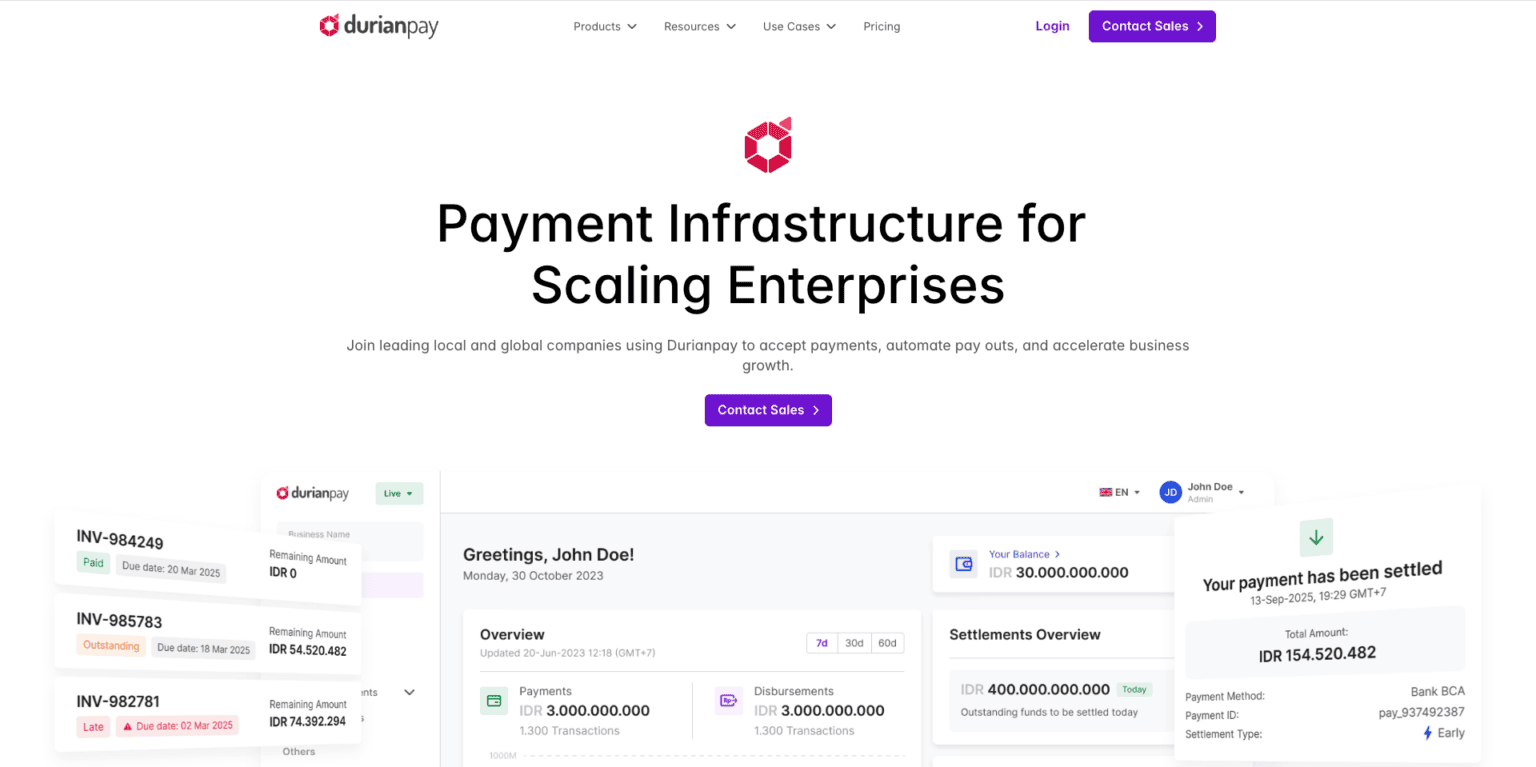
DANA is not the only Indonesian fintech attracting investor dollars right now. Durianpay, a payment infrastructure startup that enables local and international firms to accept payments, automate payouts, and more, has attracted interest from Japanese investors.
According to reporting in Deal Street Asia, the potential funding of the Indonesian payments infrastructure provider is another sign of Japanese investors’ interest in Indonesian fintech. If the investment goes through, the capital is expected to support Durianpay as it expands beyond Indonesia. The funding will also help the company develop new products and services focused on international money movement and digital-asset infrastructure.
“Digital payments in Southeast Asia are poised to grow at 10-13% CAGR for the next few years,” the company noted on its LinkedIn page. “With no clear winners identified yet, we believe the time is right to enter and build mobile-optimized solutions for these markets.”
Durianpay enables connections to more than 20 local payment methods from virtual accounts, e-wallets, cards, QRIS, and more through a single integration. Founded in 2020 and based in Jakarta, the firm serves more than 400 merchants and processes more than five million API requests per day. Durianpay was ranked as the third-fastest-growing fintech in the Asia-Pacific region according to the Financial Times, with an absolute growth rate of more than 1,600%. The company recorded its first full fiscal year of profitability in 2025, processing more than $5.5 billion in total payment volume. In September 2026, the company was named to the Forbes Asia 100 to Watch 2026 list in the finance category.
The challenge of progress: P2P lending in Indonesia
A recent op-ed in Eurasia Review asks an interesting question in the face of rapid technological change: how can value be captured from an economy that moves faster than the state’s capacity to monitor it?
The authors, Andi Mohammad Illham and Andi Mohammad Johan, examine the peer-to-peer lending sector of Indonesia as what they call “a striking case study in the digital age’s most vexing tax challenge.” Through a combination of historical review and statistical analysis, Illham and Johan show how policies in Indonesia that embraced financial inclusion and serving underserved markets combined with a crackdown on the domestic P2P lending industry in China contributed to an influx of Chinese capital, a surge in Indonesia’s outstanding P2P lending debt, and what the authors call “a shadow economy, digitally native, cross-border, and largely invisible to the Directorate General of Taxes (DJP).
The op-ed is an interesting read because it shows how the intersection of policies that encourage and take advantage of greater inclusion—whether they are underserved consumers or capitalists seeking new opportunities—can lead to unintended consequences. The goal of the op-ed is to encourage regulators in Indonesia to look beyond using tax reform to merely close withholding gaps but instead examine the relationships between Indonesian P2P subsidiaries and their parent companies in China. “Until Indonesia extends its reform agenda to the cross-border profit allocation dimension … it will continue taxing only the tip of the value chain,” the authors warn.
Here is our look at fintech innovation around the world.
Sub-Saharan Africa
Mastercardteamed up with The Mojaloop Foundation and AfricaNenda Foundation to help build more inclusive payment systems in Africa.
Pan-African payment infrastructure provider Kora launchedOne Rail to support stablecoin transactions.
Visaunveiled the sixth cohort of its Africa FinTech accelerator, featuring 21 companies from nine countries.
Latvia’s Atrya Technologies secured a MICA crypto license from Latvijas Banka.
Czech fintech Flowpay earned Sifted 100’s ranking as the fastest-growing company among 100 tech firms from Germany, Austria, Switzerland, and Central and Eastern Europe.
Middle East and Northern Africa
Egyptian payments infrastructure provider Paymob raises $35 million in pre-Series C funding.
Saudi Arabia’s Aljazira Bank partnered with Thunes to enhance its international remittance services.
Jordan FinTech Academy (Jordan FTA) inked a Memorandum of Understanding (MoU) with the MENA Fintech Association (MFTA).
Central and Southern Asia
Apple Pay has launched in India via a partnership with Axis Bank.
Stripe has agreed to acquire embedded finance platform Parafin, marking its third acquisition of 2026 and 24th overall.
Parafin brings embedded credit and risk capabilities that have helped more than 60,000 small businesses access capital through platforms including DoorDash, Gusto, Jobber, and Mindbody.
The acquisition advances Stripe beyond its payments roots, expanding the infrastructure platforms can use to become more comprehensive financial hubs for their business customers.
Payment infrastructure fintech Stripe has agreed to acquire embedded finance platform Parafin. The move comes about a month after the California-based company acquired legal infrastructure startup Clerky, marking Stripe’s third acquisition this year and its 24th overall. Financial terms of the agreement were undisclosed.
Founded in 2020, Parafin offers platforms like DoorDash, Gusto, Jobber, and Mindbody provide credit offerings for their small business customers. Since launch, the company has helped more than 60,000 businesses gain access to capital. In addition to its capital offering, Parafin also offers two credit products, Pay Over Time and Spend, that give businesses flexibility in managing their cash flow. Stripe plans to leverage Parafin to support small businesses by offering them the credit they need to grow.
“We started Parafin to give small businesses access to the modern credit products that were only available to large companies,” said Parafin Cofounder and CEO, Sahill Poddar. “Stripe’s financial infrastructure and global reach will help us move faster and serve millions more businesses through the platforms they rely on.”
Stripe has more than 18,000 clients leveraging its platform to build, manage, and grow their businesses. While it is best known for its payment processing tools, the company also offers tools such as Stripe Capital to help small businesses generate new revenue opportunities. Stripe reports that, in the second quarter of 2026, new businesses launching on Stripe increased 86% year-over-year while only 41% of small business loan applications were approved in the US in 2025.
“Platforms power millions of small businesses throughout the world and are central to Stripe’s mission,” said Stripe Business Lead Neetika Bansal. “Sahill, Vineet, and the Parafin team bring acute expertise and leadership in credit, risk, and embedded financial products. Together, we’ll be able to offer a wider range of credit products to a larger ecosystem and increase credit access for high-growth businesses.”
Stripe’s acquisition of Parafin shows Stripe’s ambitions to move beyond its roots in payments. Rather than simply adding another financial product, Stripe is building out the infrastructure that platforms need to serve as comprehensive financial hubs for their business customers. Parafin’s credit and risk capabilities, combined with Stripe’s existing payments, treasury, issuing, and lending tools give businesses another reason to consolidate more of their financial stack with Stripe.
For years the discourse on technological innovation in banking and financial services favored the fintechs. But is it possible that the ones best positioned to take advantage of the biggest technological revolution in decades—artificial intelligence—aren’t bold, new fintech startups, but are instead banks and credit unions?
In this fascinating conversation with Rob Rooney, Co-Founder and CEO of Hyperlayer, we discuss what banks and credit unions can do to overcome the disadvantages of legacy technology, and how these financial institutions can leverage trust and community relationships to “win the future” of agentic finance and the agentic economy.
“Incumbents are very well positioned. They have the customers. They have the regulatory approvals. They have the breadth of products and, critically, they have the trust. They have to leverage those advantages and lean into the agentic economy. It’s coming, but with the trust factor they can really be winners here.”
Rooney is Co-Founder and Chief Executive Officer of Hyperlayer. He is also CEO of Hyperjar, an intuitive digital account with a prepaid debit card that bills itself as the “spending super-app.” Previously, Rooney spent more than 30 years as an executive at Morgan Stanley, serving in multiple roles including CEO of Morgan Stanley International, Global Head of Technology, Operations, and Firm Resilience, and Senior Advisor for Technology and Innovation. He is a graduate of Columbia University.
Hyperlayer is a programmable banking platform that enables financial institutions to innovate at pace without replacing the core systems that provide stability. The platform’s configurable design allows banks, credit unions, wealth managers, and merchants to launch innovative financial products—including agentic solutions—quickly and cost-effectively while maintaining control and remaining compliant.
EquiTrust Life Insurance Company has announced a strategic partnership with life and annuity platform Sureify.
EquiTrust will deploy Sureify’s CoreCONNECT platform to connect its core systems via a single integration layer that facilitates efficient movement of data internally.
Headquartered in San Jose, California, Sureify made its Finovate debut at FinovateSpring 2014.
EquiTrust Life Insurance Company announced a strategic partnership with life and annuity platform Sureify this week. The collaboration is designed to advance EquiTrust’s digital transformation, modernizing the firm’s technology infrastructure by connecting systems, enhancing the flow of data, and reducing operational complexity throughout the business.
At the center of the partnership, EquiTrust will deploy Sureify’s CoreCONNECT platform, connecting its core systems via a single, modern integration layer that allows data to move internally with greater efficiency. CoreCONNECT will also help EquiTrust comply with data exchange standards set by the Insured Retirement Institute. The platform is designed to give distribution partners direct API access to the data and tools they need to deliver innovative digital experiences, reduce manual processes, and enable faster, more efficient growth.
“EquiTrust has built an exceptional company by staying focused on the people it serves,” Sureify Chief Business Development Officer Bryan Padgette said. “Its commitment to financial professionals, policyholders, and long-term value is evident in the way the organization approaches its decisions. We are grateful for the opportunity to support EquiTrust’s vision and proud to play a role in the company’s continued success.”
CoreCONNECT is available as a stand-alone solution or integrated with Sureify’s LifetimeAGENT or LifetimeSERVICE agent and policyholder portal modules. The solution’s APIs aggregate data that is siloed across systems of record, bringing dozens of legacy system data sets together. Sureify noted that CoreCONNECT helps “depressurize” legacy system decision-making by giving IT teams more flexibility and the ability to separate digital experience decisions from system-of-record decisions.
“By creating a more connected and adaptable technology foundation, we can reduce complexity, help our employees work more effectively, and make it easier for financial professionals and policyholders to do business with us,” said Jai Kuchimanchi, SVP for Information Systems with EquiTrust. “Our partnership with Sureify will support EquiTrust’s growth while allowing us to continue delivering the responsive, relationship-focused experience people expect from us.”
EquiTrust Life Insurance Company provides annuity and life insurance products via a network of independent sales representatives and independent marketing organizations. Founded in 2003 as a subsidiary of FBL Financial Group, today the company has total invested assets of more than $37 billion and a solvency ratio of more than 109%. Headquartered in Chicago, Illinois, EquiTrust was named to the Ward’s 50, which recognizes top-performing companies in the life and health insurance industry, for the 11th consecutive year in 2026.
Founded in 2012, Sureify made its Finovate debut at FinovateSpring 2014. In addition to CoreCONNECT, the company offers a modular enterprise product suite, Lifetime, that integrates data from every legacy access point. The suite includes LifetimeACQUIRE, which connects the life and annuity sales journey to eDelivery; LifetimeAGENT, which gives agents a portal to sell, service, and digitally manage their relationships; and LifetimeSERVICE, which enables policyholders to securely access policy information and make transactions. Sureify’s technology facilitates more than 1.5 million agent and policyholder interactions every month; offers more than 80 pre-built, ready-to-launch life and annuity transactions; and features 40+ off-the-shelf form integrations.
SME digital banking platform Bluevine has agreed to be acquired by Valley National Bank for $340 million in cash and stock.
The acquisition will help Valley expand its small business franchise and accelerate its digital and AI strategy.
Bluevine was founded in 2013. Headquartered in Jersey City, New Jersey, the company made its Finovate debut at FinovateFall 2014.
Small business digital banking platform Bluevine has agreed to be acquired by Valley National Bank (“Valley”). The approximately $340 million transaction will consist of approximately 75% cash and 25% Valley common stock.
Bluevine serves 175,000 small business customers and has served more than 415,000 businesses since inception. The company offers an integrated suite of digital banking, payments, lending, and financial management solutions—including high-yield business checking, accounts payable, debit and credit cards, loans, and lines of credit—all tailored for small and medium-sized businesses. The acquisition by Valley will enhance the financial institution’s funding base, expand its small business franchise, and accelerate its digital and AI strategy.
“Bluevine was founded to give small business owners the financial tools and digital experience they need to manage and grow their businesses,” Bluevine Co-Founder and CEO Eyal Lifshitz said. “Valley shares that commitment and brings the balance sheet capacity, relationship banking expertise, and broader capabilities necessary to support our customers through every stage of their journey. Together, we will be able to expand our impact while preserving the technology, customer focus, and entrepreneurial culture that have driven Bluevine’s success. We look forward to joining Valley and continuing to enhance our small business banking platform.”
The acquisition is expected to close in early 2027, subject to standard regulatory approvals. Lifshitz will join Valley as Head of Small Business Banking.
In acquiring Bluevine, Valley National Bank gains a scaled digital small business platform and more than $2 billion in low-cost, digitally-sourced deposits. Valley will also benefit from access to a suite of integrated banking, payments, lending, and financial management solutions designed specifically for small businesses. Additionally, Bluevine’s engineering, product, data science, and AI talent will be valuable in boosting the bank’s longer-term technology strategy. At the same time, access to Valley’s branch network and treasury management, credit, insurance, wealth, and capital markets solutions will give Bluevine customers a more comprehensive value proposition.
“The acquisition of Bluevine directly advances the strategic priorities we have previously communicated to our shareholders,” Ira Robbins, Valley National Bank Chairman, President, and CEO, said. “It is expected to enhance our core funding capabilities, add a proven small business growth platform, and meaningfully accelerate our digital and AI capabilities. Bluevine has built an impressive franchise which has generated a diversified base of small business operating deposit relationships, a highly engaged customer community, and a modern technology platform purpose-built for the needs of small businesses.”
Valley National Bank is a regional financial institution with more than $66 billion in assets. The principal subsidiary of Valley National Bancorp (NASDAQ: VLY), Valley has more than 220 branch locations and commercial offices across New Jersey, New York, Florida, Alabama, California, Illinois, Pennsylvania, and Arizona. The bank was founded in 1927.
Founded in 2013 and headquartered in Jersey City, New Jersey, Bluevine made its Finovate debut at FinovateFall 2014. Since inception, the company has delivered more than $14 billion in loans and has more than $1 billion in managed customer deposits.
Digital banking development platform Plumery launched its DBP Rescue Plan this week to help banks and other financial institutions migrate away from banking platforms that no longer serve their needs.
The offering includes a specialist migration team, migration tooling and playbooks, as well as a Proof of Migration framework that allows institutions to test the migration before committing to it.
Headquartered in Amsterdam, Plumery made its Finovate debut at FinovateEurope 2025 in London.
Digital banking development platform Plumeryunveiled its DBP Rescue Plan this week. The new offering is an international program designed to help banks and other financial institutions transition away from digital banking platforms that no longer serve their needs.
Plumery’s DBP Rescue Plan removes the primary barriers to migration, providing financial institutions with a defined path away from their current platform that doesn’t require them to take on the full risk and expense of switching platforms. Plumery is making the offering available to 10 financial institutions on a first-come, first-served basis. Participating banks will receive a specialist migration team, migration tooling and playbooks, as well as a Proof of Migration framework that enables them to test the migration against their own systems and environment before committing to the program.
Plumery notes that after the transition, banks and other financial institutions will be able to move beyond vendor dependency and create new products and services with greater flexibility and speed. This will ultimately give development teams more control over the kind of digital banking experiences they can provide to customers. Plumery aims to complete all ten migrations within 12 months.
The DBP Rescue Plan arrives at a time when a growing share of bank IT budgets are being dedicated toward maintaining technical debt. Banking trends research from Accenture noted that in 2026, 70% of bank IT budgets were devoted to these costs. At the same time, software costs have outpaced banking revenue growth, growing by 8% annually since 2017. In this context, in some cases, upgrading an existing platform can be more expensive than building a new platform from scratch. This problem is all the more acute when the bank believes that their current platform is no longer meeting their needs.
“Too many financial institutions stay with digital banking platforms that are no longer working for them because leaving feels riskier than staying,” Plumery CEO Ben Gold said. “The DBP Rescue Plan is designed to remove some of that risk. By combining migration expertise, proven tooling, and a commercial model that removes software licensing costs for up to two years during the transition, we’re giving (financial) institutions a practical way to move forward and take back control over their digital future. Now the real risk is staying.”
Founded in 2016, Plumery made its Finovate debut at FinovateEurope 2025 in London. The company helps banks and other financial institutions modernize their tech stacks and assemble new digital and AI-native banking experiences for their customers.
Financial services software provider Finastra announced a pair of new offerings this week.
Finastra Supply Chain Finance (SCF) will help banks scale working capital programs faster and stimulate growth. SCF is integrated with Finastra’s Trade Innovation and Loan IQ platforms via the Nexus API suite and allows banks to offer connected trade, lending, and supply chain finance services.
SCF supports buyer and supplier acquisition, onboarding, fulfillment, servicing, risk management, and secondary market distribution. The technology provides straight-through processing and connects with ERP systems and trade ecosystem partners through the Nexus API suite. SCF also offers a rich data foundation for decisioning and portfolio management. The solution is built on a cloud-native architecture and is available via a variety of deployment models, from on-premises to SaaS.
“Banks are looking for ways to bring new working capital solutions to market faster to capture new revenue streams delivered through STP journeys, and lower costs, while addressing operational risks and regulatory complexity,” Vinay Mendonca, Finastra’s Head of Product, Trade Supply Chain Finance and Corporate Channels, said. “By combining new supply chain finance capabilities with Trade Innovation and Loan IQ, we’re enabling banks to take a more connected approach to working capital. This launch marks an important milestone in the evolution of our Trade Innovation platform as we look to bring more API, AI, and cloud-led innovation to the market, leveraging our deep expertise in the trade domain, to help institutions innovate and grow.”
SCF will help banks accelerate product launches, provide holistic working capital management, automate risk distribution, enhance risk management, and scale efficiently thanks to straight-through processing, real-time servicing, and high-performance architecture. Finastra noted that it plans to expand the capabilities of SCF to include purchase order (PO) finance, pre- to post-shipment finance, inventory finance, distributor finance, as well as other working capital solutions.
The release of SCF is the company’s latest investment in its Trade Innovation and Loan IQ offerings. Trade Innovation is Finastra’s digital trade finance platform that enables institutions to automate workflows, reduce risk, and improve working capital efficiency. Loan IQ is the company’s commercial and corporate loan management and servicing software. SCF extends Finastra’s goal of offering institutions a connected working capital ecosystem through a unified commercial and risk management framework.
Finastra also unveiled a new AI-powered capability within its OperatorAssist solution. Repair Recommendations, announced this week, will enable banks to respond faster to rising payment volumes by bringing better decision-making into their existing workflows. The new offering is designed to help banks avoid the kind of errors and disruptions that can hinder traditional payment processing by enabling teams to resolve issues faster, manage higher volumes more efficiently, and boost success rates without introducing additional complexity.
Repair Recommendations simplifies complex repair scenarios, identifies payment discrepancies and underlying causes, decreases dependence on specialized expertise, and reduces the amount of time and effort required by payment operations teams to manage and resolve payment exceptions. This allows banks to manage higher payment volumes more efficiently as demand from real-time cross-border activity, infrastructure modernization, and digital commerce continues to grow.
“With Repair Recommendations, we’re empowering banks to upgrade their payment operations—reducing resolution times and minimizing errors,” Barry Rodrigues, Finastra EVP, Payments, said. “As payment volumes increase, AI can help deliver immediate value by accelerating repairs, streamlining onboarding, and strengthening resilience. We’re helping banks to scale their operations and deliver faster, more reliable services to their customers.”
Headquartered in London, Finastra was formed in 2017 through the combination of Finovate alum Misys and D+H. In addition to its loan servicing and trade innovation platforms, Finastra offers solutions for payments (Global PAYplus and Payments to Go), core banking (Essence), mortgages (Mortgagebot), and more.
Credit data platform Mifundo has partnered with open banking infrastructure provider Yapily.
The combination of Mifundo’s cross-border credit assessment platform with enriched bank account data from Yapily will make it easier for lenders to serve borrowers who live and work in multiple countries, and provide more accurate credit assessments overall.
Estonia-based Mifundo most recently demonstrated its technology at FinovateEurope 2026 in London.
Pan-European credit data platform Mifundo has teamed up with Yapily, an open banking infrastructure provider based in London. The partnership will combine Yapily’s enriched bank account data with Mifundo’s cross-border credit assessment platform via Yapily’s Data Plus product. Combined with verified credit bureau information from European markets, this data will enable the creation of a single, standardized, cross-border credit report. This will allow lenders to benefit from having multiple sources and types of financial information consolidated into a single report.
“Cross-border credit assessment requires more than one type of financial data,” Mifundo Founder and CEO Kaido Saar said. “Credit bureau data shows how a customer has managed credit over time, while open banking data provides additional insight into their current financial situation. Mifundo brings these different data sources together across countries and standardizes them into one report that banks can use in their credit assessment. Yapily is an important partner in providing open banking connectivity within that wider ecosystem.”
Currently, even as cross-border consumer lending is growing, credit data is typically siloed behind national borders. A consumer may have a strong credit history in one country, but have virtually no credit history in another country where they may be seeking to obtain a loan due to the absence of portable data or cross-border data access. The combination of Mifundo’s credit bureau and registry network and Yapily’s open banking connectivity will enable banks and other lenders to see a more complete picture of a borrower’s finances, their long-term credit management, and their current financial situation.
The partnership also comes at a key moment as the revised Consumer Credit Directive (CCD2) will apply throughout the European Union from November 20, 2026. Article 6 of this directive includes a non-discrimination provision when it comes to accessing consumer credit, which includes discrimination based on a borrower’s place of residence.
“Open banking has an important role to play in making financial data more accessible across borders, and to do that, it needs data that is ready to act on the moment it lands, not a raw feed that still has to be interpreted,” Yapily Director of Sales EMEA, Irene Brime, said. “Our Data Plus product delivers bank account information already categorized and enriched, complementing credit bureau information and helping lenders build a more complete view of customers with financial histories across different countries. We are excited to be partnered with Mifundo and to contribute to a solution addressing a real challenge for European lenders.”
Open banking API infrastructure platform Yapily securely connects its customers to thousands of banks across Europe, enabling them to access financial data, initiate payments and conduct other operations from credit assessment to onboarding. Founded in 2017 and headquartered in London, the company recently reported 2025 revenues that were up 2.5x over 2024, and has achieved and sustained profitability since Q1 2025.
Headquartered in Tallinn, Estonia, and founded in 2022, Mifundo most recently demoed its technology at FinovateEurope 2026. At the conference, the company demonstrated how its cross-border credit data solution enables banks to access the verified credit history of borrowers from other countries. This helps them make lending decisions that are not just more accurate, but also avoid discriminating against worthy borrowers who live, work, or move across international borders. Mifundo makes foreign credit data accessible, standardized, and operational within existing bank processes, facilitating compliant, scalable cross-border lending across the European Union.