This site is operated by a business or businesses owned by Informa PLC and all copyright resides with them. Informa PLC's registered office is 5 Howick Place, London SW1P 1WG. Registered in England and Wales. Number 8860726.
Finovate Blog
Tracking fintech, banking & financial services innovations since 1994
MeridianLink announced its acquisition of financial wellness platform Credit Mountain. Financial terms were not disclosed.
The acquisition will help MeridianLink launch its Pathway solution, which helps community financial institutions provide declined borrowers with a personalized pathway to loan approval.
Credit Mountain won Best of Show in its Finovate debut at FinovateFall 2024 in New York.
As FinovateFall 2026 approaches, we’re sharing news from FinovateFall alumni to give you a sense of the kind of companies that will be demoing their latest innovations live on stage September 9 through 11.
Consider Credit Mountain, a financial wellness platform that won Best of Show in its Finovate debut at FinovateFall 2024. Earlier this month, MeridianLink, a software platform provider for financial institutions and consumer reporting agencies, announced its acquisition of the company. In a statement, MeridianLink said that the acquisition will support the launch of its MeridianLink Pathway, which enables community financial institutions to provide declined borrowers with a personalized and fully compliant pathway toward loan approval. MeridianLink also previewed MeridianLink Coach, which is scheduled to launch later this year and leverages AI-powered guidance to help consumers build or improve their credit profile.
“Through MeridianLink Pathway and the future launch of MeridianLink Coach, we’re helping community financial institutions transform the loan decline experience,” MeridianLink CEO Larry Katz said. “Pathway gives borrowers a personalized, compliant path toward future approval, while MeridianLink Coach delivers AI-powered guidance to help consumers strengthen their financial health over time. Together, these solutions help financial institutions create more paths to yes, improve financial outcomes, and build trusted relationships that extend far beyond a single lending decision. To us, that is the true spirit of Lending Made Human.”
MeridianLink’s acquisition of Credit Mountain is the latest example of the company’s accelerated technology investment strategy. This includes MeridianLink’s Lending Lifecycle initiative, which is designed to empower financial institutions to engage borrowers before, during, and after the lending decision. As credit unions and community banks are pursuing ways to make faster lending decisions, engage more creditworthy borrowers, and deepen member and customer relationships, solutions that help enhance financial wellness and expand access to credit have become increasingly valuable. Credit Mountain’s expertise in helping lenders and financial institutions remain constructively engaged with borrowers who experience an initial loan rejection supports all of these goals.
When a borrower is rejected, MeridianLink Pathway will automatically provide a personalized adverse action experience to enable the applicant to understand the reasoning behind the loan decision and the steps they can take to successfully secure financing going forward. Unlike other approaches, Pathway communicates support rather than rejection by providing financial guidance and a personalized “Path to Yes” plan. It also enables lenders and financial institutions to turn adverse action compliance into an opportunity to build better relationships.
“Community financial institutions succeed when they help consumers achieve their financial goals,” Credit Mountain Founder Nathan Pinto said. “This acquisition strengthens our ability to help more lenders serve more borrowers, build deeper relationships, and offer innovative lending experiences where every borrower has a clear path forward. We’re thrilled to be a part of MeridianLink and look forward to continued innovation together.”
Founded in 2021 and headquartered in Dallas, Texas, Credit Mountain made its Finovate debut at FinovateFall 2024. At the conference, Pinto demonstrated how the company’s technology transforms the end-to-end decline experience for lenders when they must reject a borrower. Credit Mountain offers a lead tracking/nurturing system and personalized Path to Yes, enabling lenders to give declined borrowers a path to securing the financing they need.
Serving more than 1,800 community financial institutions and 78 million credit union members throughout the US, MeridianLink offers a digital lending platform and suite of solutions to help banks, credit unions, and consumer reporting agencies serve, scale, and grow. Leveraging automation, built-in compliance, trusted AI and data, as well as a robust partner network, MeridianLink provides solutions across account opening, loan origination and optimization, digital mortgages, collections, and reporting. Headquartered in Irvine, California, MeridianLink was founded in 1998.
We officially have 72 demos on stage at this year’s FinovateFall conference, taking place September 9 through 11 at the Marriott Marquis in New York (book now!). This year’s lineup is a nice mix of startups with established players, and with all demos running on a single track, you won’t miss a thing. This concentrated format makes it easy to spot the patterns shaping bank roadmaps for the next 12 to 18 months.
Here’s a look at what trends lie ahead, based on what we’re seeing across this year’s demo companies.
AI gets to work
It will come as no surprise that AI is the most prominent enabling technology on the FinovateFall stage this year. What’s more interesting is that this year’s demo companies are showing that the industry has evolved its use of AI to tackle specific jobs that are expensive, repetitive, time consuming, or difficult to scale.
In wealth management, AdvisorHelpAI, Covecta, GPTAdvisor, Nextvestment, Mobena, and Valcori Automated Solutions are using technology to augment advisors, improve planning, organize institutional knowledge, or streamline the work that happens around client relationships. CUltivate AI, LemonadeLXP, and ScreenSteps are focused on the employee side of the equation, helping financial institution staff learn, find information, and navigate complex processes more efficiently. Inbenta, Titan AI, Tweezr, Birdie AI, and Hamming AI similarly point toward a future in which AI is embedded into service and operational workflows rather than living in a standalone chatbot.
The same shift is happening with data. Pyramid Solutions, Data City, Preql AI, and Ventus AI are helping organizations extract more useful intelligence from the data they already have, while Go.AI allows financial institutions to use AI while maintaining greater control over their data, models, and outputs.
Banks are slowly realizing that they can outsource a wide range of tasks to AI, and fintechs are making that possible.
Agentic AI moves deeper into financial operations
The next evolution is already visible as fintechs begin building technology capable of taking action.
Saris AI is building agents to automate lending, compliance, and operations tasks, while Rexi applies an agentic layer to transaction matching, reconciliation, and discrepancy resolution. Palomonte Labs is building infrastructure that makes financial APIs understandable and executable by AI agents, and Tacnode is tackling the data layer by giving agents access to shared, real-time context.
Agentic concepts are showing up in more specialized areas, too. Vertice AI is applying autonomous capabilities to marketing campaign planning and execution, while Transvision Solutions uses autonomous AI to conduct AML investigations. Kita Technologies deploys multiple specialized agents across the lending process. Voyager AI similarly brings intelligence to document collection, spreading, underwriting, compliance, and credit memo preparation.
The first generation of agentic banking may be much less visible to consumers than other developments have been. Rather than immediately handing an AI agent control over a customer’s entire financial life, financial institutions appear more interested in deploying specialized agents with narrowly defined jobs, permissions, data, and guardrails.
Fintech targets operating leverage
One of the more interesting themes in this year’s lineup has less to do with a particular technology and more to do with the outcome fintechs are promising. Many are seeking to help financial institutions accomplish more without adding equivalent amounts of headcount, cost, or complexity.
This becomes very clear when we look at the lending subsector. ALoan is automating commercial underwriting and credit memo preparation, while QuickFi digitizes commercial equipment financing from application through final payment. Kato uses automation to lower the cost of servicing and collections, Veritus deploys AI voice and text agents across lending and collections, and Vertyx automates servicing workflows after mortgage close. Donevia adds an intelligence and engagement layer to existing lending infrastructure rather than requiring institutions to replace their LOS.
Other companies are attacking operational friction from different angles. MHC automates documents, payments, and customer communications, while Naehas automates regulated offers, disclosures, and marketing processes. Loquat brings onboarding, lending, cards, and back-office lifecycle management together for community financial institutions. Finerative, Horizon AI, FFERM Technologies, and adapfin Technologies are also addressing specialized areas where better technology can streamline decision-making or financial operations.
Even Delfi Labs, which operates in capital markets rather than traditional bank operations, reflects the same underlying theme by using AI-guided analytics and streamlined execution to help community financial institutions make balance-sheet decisions more efficiently.
This is a notable shift from an earlier era of fintech, when some of the industry’s most visible innovations centered on making banking look and feel better. Smoother onboarding and cleaner interfaces still matter, but much of this year’s technology is focused on making the institution itself operate better.
Customer engagement gets tied to outcomes
Customer engagement and financial wellness remain prominent on the demo stage, but this year’s companies are increasingly connecting them to measurable behaviors and business outcomes.
BankUniverse uses intent signals to identify high-value prospects and improve digital conversion, while Finalytics.ai uses behavioral, transactional, and third-party data to create segment-of-one experiences. Tapix enriches raw payment data to create the clean merchant and transaction information needed to power better analytics and personalization. Omnisient adds another dimension by enabling privacy-preserving collaboration around consumer data, and Radar uses location intelligence not only for fraud prevention, but also to help companies engage users in context.
Other companies are connecting financial wellness more directly to action. Doshi combines gamified financial education with product-readiness signals, while GenAspire uses teen banking and financial literacy as an acquisition strategy for community financial institutions. Young Early Starters combines education with real, parent-approved investing, and On Time Harvest pairs cash-flow forecasting and behavioral insights with financial education and planning.
Perqia uses incentives timed to borrower cash flow to encourage loan repayment. Clockout connects financial wellness and liquidity tools to direct-deposit growth and engagement. And Goodbuy turns community commerce into a channel designed to drive account activation, deposits, card usage, and interchange.
Even lending and payments are becoming more contextual. equipifi brings personalized BNPL and flexible payments into the digital banking relationship, while OptimaFI uses household-level intelligence and peer benchmarking to identify growth and risk opportunities.
The common thread is that engagement is now focused on influencing what happens next instead of generating clicks.
Infrastructure takes center stage
Much of the technology on the FinovateFall stage will be the infrastructure that consumers never see.
Payments provide a good example. 3 Degrees enables community banks and credit unions to embed cross-border payments, while Finzly provides infrastructure for banks to process payments across rails including ACH, Fedwire, RTP, SWIFT, and FedNow. Neural Payments connects financial institutions to multiple payment rails and wallets through a single branded integration. Paywhere and Tyfone also illustrate the continued evolution of the technology connecting financial institutions, payments, and digital banking experiences.
Glide combines digital account opening, lending, onboarding, identity verification, fraud detection, and funding, demonstrating another important infrastructure trend: financial institutions increasingly want capabilities that can slot into their existing environments rather than require wholesale replacement.
Security and trust are becoming part of that infrastructure, as well. Darwinium continuously evaluates digital behavior to identify fraud across customer journeys, while Illuma applies voice authentication to contact-center security. SLC Digital focuses on secure digital authentication and account-takeover prevention, and Quavo Fraud & Disputes tackles the operational infrastructure surrounding fraud and disputes.
McCarthy Hatch applies AI to regulatory risk by analyzing customer complaints, while RangersAI moves fraud prevention closer to the customer with real-time scam education and intervention. Warrant and Root represent other approaches to establishing trust and managing risk as financial services become increasingly digital.
And some infrastructure is aimed at expanding what financial institutions can offer in the first place. Blytz, Cosmos, and FinZee AI illustrate just how broadly the definition of financial technology continues to stretch, from new forms of financial interaction to technologies that connect financial behavior with other sources of context.
In a broad sense, many of this year’s fintechs aren’t trying to replace the bank or even become the customer’s primary financial interface. This new breed is building the intelligence, automation, security, payments, data, and workflow layers that allow existing financial institutions to modernize.
What’s missing?
For a demo lineup this large, almost every corner of fintech has some representation. Still, one of today’s loudest industry conversations is surprisingly quiet.
Stablecoins have moved squarely into mainstream conversations about payments, settlement, and banking infrastructure, but there isn’t a corresponding wave of stablecoin issuers, tokenized-deposit platforms, crypto custody providers, or blockchain companies on the demo stage. This is a reflection of the fact that regulatory frameworks like those established by the GENIUS Act and proposed under the CLARITY Act are still taking shape, and many traditional banks are hesitant to jump into decentralized finance without established regulatory guidelines.
Overall, this year’s demos point toward a fintech industry that is becoming less focused on novelty and more focused on execution. AI is being tasked with real work, agents are beginning to execute defined processes, infrastructure is drawing attention, and customer engagement is increasingly being tied to measurable outcomes.
The flashy front-end experience hasn’t disappeared, but much of the innovation at FinovateFall 2026 will be happening behind it. And for banks planning their next 12 to 18 months of technology investment, that may be the trend that matters most.
There are still a few weeks left of summer, but the final day of August often serves as the unofficial end of summer for many—with kids returning to school and Labor Day around the corner.
As the week begins, Finovate’s Fintech Rundown is highlighting a handful of fintech funding announcements in payments, wealth management, and capital markets, as well as interesting partnership news in DeFi and identity verification involving fintechs from Singapore and South Korea.
Visainks a strategic partnership with South Korean fintech Dunamu to develop stablecoin payments, international remittance services, and AI-powered e-commerce solutions.
Credit unions
Baton Rouge Telco Federal Credit Union launches AI-powered smart financial calculators courtesy of its partnership with Appli.
Lending
RateZiplaunches live US bank rate and mortgage rate app in ChatGPT.
How do companies get priced? What variables are involved in determining the true value of a firm, especially as it moves closer to leaving the private market and becoming a publicly traded entity?
We caught up with Isabelle Freidheim, founder of Athena Capital, to answer these and other questions about the current investment landscape, especially for fintech companies. In this extensive conversation Freidheim shares her insights into the challenge of helping profitable technology companies navigate the runway to an IPO or strategic sale.
We learn how the commoditization of the core technology layer is driving investment trends in fintech, the consequences of companies staying private longer, and how she leveraged talent “mispricings” to build a team of exceptional operating partners—sitting and former CEOs, Fortune 500 directors—that give Athena Capital a “sourcing and diligence advantage.”
“The stage is our thesis. At 12 to 36 months out, the diligence question changes character. I am not asking whether the market will materialize. I am reading retention cohorts, gross margin trajectory, net revenue retention, sales efficiency, customer concentration, working capital. Those are facts. Earlier-stage investing requires you to be right about the future; this stage requires you to be right about the present, which is a materially better risk-adjusted proposition and one where our operating experience compounds.”
Tell me about the thinking behind the founding of Athena Capital. What were your initial goals when you founded the firm?
Isabelle Freidheim: I spent fifteen years investing in private equity and venture capital, founded Magnifi and sold it to TIFIN in 2020, then chaired public companies and sponsored three SPACs. The investing years taught me how companies get priced. Building one taught me what actually determines the price, and those are different subjects.
The variables that moved my own outcome were invisible from the seat I had just left: whether the board had anyone who had sold a company before, whether the financials were built for a buyer’s accountants or a growth investor’s, whether two strategic acquirers already understood the business before a banker introduced them. None of that shows up in a diligence file. All of it moves the exit.
That’s the gap Athena was built for: the 18 months before liquidity, when growth investors have stepped back and bankers haven’t arrived. We take minority positions in profitable technology companies 12 to 36 months from an IPO or a strategic sale. We’re not buying control or fixing broken businesses. We’re underwriting companies that already work and helping them arrive prepared rather than improvising.
The second design decision was the team. Athena’s general partnership is from SoftBank, and our council of operating partners is composed of roughly 30 senior women: sitting and former CEOs, Fortune 500 directors, and operators who’ve run the functions our companies are building. That’s not a value statement; it’s a sourcing and diligence advantage. They see deals before the intermediated market does and open doors our portfolio companies can’t open alone. Execution capability at that level is systematically underpriced, and we built the firm to capture the discounts.
What companies are most attractive to you as investments? Why target businesses at this stage in their development?
Freidheim: Profitable or near-profitable, technology-enabled, and close enough to an exit that we are underwriting performance rather than a forecast. Fintech, AI infrastructure, enterprise software, cybersecurity, healthcare technology, deep tech—the sector matters less than whether the business is exit-ready and whether the exit has been engineered rather than assumed.
The stage is our thesis. At 12 to 36 months out, the diligence question changes character. I am not asking whether the market will materialize. I am reading retention cohorts, gross margin trajectory, net revenue retention, sales efficiency, customer concentration, working capital. Those are facts. Earlier-stage investing requires you to be right about the future; this stage requires you to be right about the present, which is a materially better risk-adjusted proposition and one where our operating experience compounds.
It is also the point at which we can change the outcome. What a company does in this window—who joins the board, how the financials get restated to public-company standards, whether it has done a tuck-in acquisition that broadens the story, whether it has cultivated two credible strategic acquirers alongside the IPO path—moves the exit valuation more than anything the business does operationally in the same period. Most management teams have never done it before. Our council members have done it repeatedly.
And we insist on optionality. A company that can only IPO is a company with one buyer, which is the market on a given Tuesday. We want every portfolio company positioned so that an IPO, a strategic sale and a sponsor transaction are all live, because the path you can take is determined by conditions you do not control, and the only protection against that is having more than one.
One major theme about investing in technology companies in general and fintech companies in particular is the idea of fewer but bigger deals. Does this scan with what you are seeing right now? If so, what do you believe is driving this trend?
Freidheim: It scans, but I would describe the cause differently than most people do.
The standard explanation is discipline: investors got selective after a loose period, so capital concentrated in quality. That is true at the margin and it is not the main mechanism. The main mechanism is that price discovery has moved into private markets and stayed there. Companies that would once have listed to raise capital no longer need to. Sovereign funds, crossover investors, private credit and secondary vehicles will fund them at scale without the disclosure burden. So the round sizes that used to be IPOs are now Series E and F.
That produces exactly the pattern you are describing. A small number of companies can absorb capital in the size that large funds must deploy, and those companies raise repeatedly at escalating marks negotiated between a handful of counterparties whose incentives are correlated. Everyone else is starved. It looks like selectivity. It is closer to concentration of access.
In fintech specifically, there is a second driver. The core technology layer has commoditized: payment rails, KYC, ledger infrastructure, onboarding are all buyable. Differentiation has moved to distribution, regulatory position, and the ability to consolidate adjacent capabilities. That structurally favors larger, better-capitalized companies, because those are advantages you buy rather than build.
The investable consequence is the part I care about. If compounding is happening privately, the returns are being captured privately, and by the time a company reaches the public market the repricing has already occurred. That is not a reason to avoid technology. It is a reason to be positioned in the private vehicle before the event rather than in the listing after it.
I noticed that one of the companies Athena Capital has invested in is Paystand, a company that demoed at Finovate years ago. What most excites you right now about what is happening in fintech in particular?
Freidheim: The most interesting fintech is not the interface. It is the plumbing that changes the unit economics of a process that companies were treating as fixed cost.
Paystand is a clean illustration. Business-to-business payments are still routed through card networks and manual accounts receivable work, and the cost of that is absorbed as a permanent line item—transaction fees, days sales outstanding, headcount in collections, etc. Paystand attacks the cost structure itself rather than putting a better screen on top of it. When a company can compress its receivables cycle and take fees out of the payment, that shows up in working capital and cash conversion. That is a CFO-level outcome, not a product feature. And it produces the characteristics I underwrite: recurring usage, deep integration into the financial stack, high switching costs, and a value proposition you can compute rather than describe.
That is the general pattern I am watching: financial operations, embedded finance, compliance infrastructure, treasury and data. Boring categories where the return is measurable.
On AI in fintech, I hold a specific view. The model layer has been built and it has been repriced, and that repricing happened almost entirely in private markets. The value that remains available now sits in deployment: the infrastructure that lets a regulated financial institution actually put a model into production against its own data, with auditability, model risk governance and controls that survive an examination. Financial services is the hardest deployment environment there is, which is exactly why the companies that solve it will be durable. The question I ask is never whether a company uses AI. It is whether the model changes the loss rate, the margin, the cycle time or the compliance cost by an amount you can measure.
What are your thoughts on fintech valuations of late? Some see the hefty valuations for AI-native fintechs as appropriate given the potential for the sector. Others are calling for more modest valuations based on actual profitability as opposed to revenue growth. Where do you stand?
Freidheim: Both camps are arguing about the wrong variable. The question is not whether AI-native fintech valuations are high. It is who realizes the return at those valuations and where in the capital structure they sit when it happens.
A private mark is not a price. It is the outcome of a negotiation between a small number of parties, several of whom already hold the asset and benefit from the mark moving up. That is not price discovery, and treating it as though it were is how public investors end up buying at the top of a curve that was constructed elsewhere. So when I hear that an AI-native fintech is worth 20 times forward revenue, my first question is not whether the multiple is justified. It is who set it and what they own.
On the underlying debate: revenue growth without margin structure is not a business, and profitability as a single test would have disqualified most of the infrastructure companies worth owning. What I actually underwrite is whether the growth is being purchased or earned. Net revenue retention, gross margin by cohort, sales efficiency, the ratio of customer acquisition cost to lifetime value and the direction that ratio is moving. If a company is spending ahead of growth and the cohorts are improving, the spending is investment. If the cohorts are flat and the spending is what produces the growth, the spending is the business model, and that does not survive a funding environment change.
In fintech, there is an additional test that generalist investors underweight. Regulated financial activity carries capital, compliance and operational obligations that arrive with scale, not before it. A company that has not built for that is carrying a liability that is not in the model.
Discipline here does not mean paying less. It means being clear-eyed about whether you are buying an asset or providing someone else’s exit.
I recently spoke with a VC investor who expressed concern about companies staying private longer and timing mismatches between fund deployment cycles and return periods trapping wealth in illiquid portfolios for 15 years or more. Given Athena Capital’s interest in companies nearing exits or considering IPOs, do you share this concern?
Freidheim: I share it, and I would put it more bluntly. The consequence of companies staying private is not merely that returns are delayed. It is that the compounding happens where public investors cannot reach it, and by the time they can, it has already happened.
Look at what an IPO now is. A company that stayed private for twelve or fifteen years, funded by investors who marked it up across a dozen rounds, lists a small percentage of its equity. The listing is not a capital-raising event; the company usually did not need the money. It is a liquidity event for the people who already own it. Public investors are being offered the opportunity to underwrite someone else’s exit and are frequently doing so at a valuation set by parties on the other side of the trade. That is a structural transfer, and it is not being described as one.
The fund-life mismatch your VC identified is the other half of the same problem, and it is real. A ten-year fund holding a company that will not resolve for fifteen years forces bad choices—continuation vehicles, secondaries at negotiated prices, extensions that convert an investment decision into a liquidity management problem. Founders and employees carry it too. Paper wealth that cannot be converted is a retention problem and eventually a governance problem.
Athena is structured as a response to this. If we invest in profitable companies 12 to 36 months from a transaction, the mismatch does not arise; our holding period and our fund life are the same problem. And by working on exit-readiness inside the company, we shorten the distance between value creation and value realization rather than waiting for market conditions to do it for us.
What I would not accept is the framing that companies should simply list earlier. That is asking founders to solve an investor problem. The honest answer is that the public markets have become the wrong place to source technology exposure at the point of compounding, and investors who want that exposure need to be in the private vehicle before the repricing. That is the business we are in. The corollary is that the genuinely interesting public-market opportunity right now is not the model layer, which has already been priced privately; it is the infrastructure and enabling companies that AI deployment runs on, many of which are already public and are not being valued as beneficiaries.
You made history when you became the youngest female chair of a publicly traded company in the US in 2021. What did this achievement mean to you?
Freidheim: Honestly, the number itself is a trivial fact. What it indicated was not.
I chaired a public company because I had a company and sold it, and because I could structure a transaction. Those are the qualifications. The reason the milestone was notable is that the pipeline into public-company chairmanships had been narrow enough that the intersection of “has operated,” “has transacted” and “is a woman” was nearly empty; not because the talent was absent, but because the selection process was not looking there.
That observation became a business. I have sponsored multiple all-women SPACs and raised over $1.2 billion across vehicles, and the operative fact is not the composition of those teams. It is that the composition let me recruit boards and management benches other sponsors could not access, because I was hiring from a pool everyone else had priced at a discount. Athena’s council is the same trade at scale: senior women operators whose track records are documented and whose availability, sourcing reach and enterprise relationships are worth considerably more than the market pays for them. That is a mispricing, and mispricings are what investors are supposed to find.
What the chairmanship actually taught me was operational, and it shows up in our work now. Public-company governance is a discipline. (It is) the cadence of a board, what an audit committee needs to see and when, how a material disclosure gets made, what happens to a stock when guidance is missed by a small amount, how a register of shareholders behaves under pressure. Most private companies discover all of that in the first year after listing, badly and expensively. Our portfolio companies get it beforehand, from people who have done it.
FinovateFall returns to New York September 9 through 11, bringing more than 100 industry experts to the Marriott Marquis Times Square to discuss the forces reshaping banking and fintech.
This year’s keynote lineup reflects just how much is changing at once. Banks and fintechs are navigating an uncertain economic and geopolitical environment while determining where AI can create real value, how to defend against increasingly sophisticated financial crime, what stablecoins mean for payments, and who will control customer relationships as financial data moves into AI-powered interfaces.
With that in mind, here are some of the keynote sessions worth adding to your FinovateFall agenda.
Manas Chawla, Founder and Chief Executive, London Politica
The Global Economic and Geopolitical Outlook and The Direction Of Travel For The US Economy Wednesday, September 9
Fintech doesn’t operate in a vacuum. Interest rates, geopolitical tensions, trade policy, economic growth, and shifting global alliances ultimately influence everything from lending and investment to payments and consumer behavior.
London Politica Founder and Chief Executive Manas Chawla will open the conversation by zooming out from individual technologies and examining the broader economic and geopolitical forces shaping the US economy. For banking and fintech leaders making investment decisions amid continued uncertainty, Chawla’s keynote offers context for understanding the environment in which those decisions will play out.
Jennifer White, Senior Director, Global Banking and Payments Intelligence, J.D. Power
Fraud in The Age Of AI: How To Respond When The Attacker Has Better Tools Than You Thursday, September 10
AI is giving financial institutions new tools to detect fraud, but it is also lowering the cost and increasing the sophistication of attacks. Deepfakes, synthetic identities, automated social engineering, and increasingly scalable fraud operations are changing the threat landscape.
Jennifer White, Senior Director of Global Banking and Payments Intelligence at J.D. Power, will address what happens when financial criminals have access to many of the same (or potentially better) AI tools as the institutions trying to stop them. Her quick-fire keynote will consider how fraud defenses must evolve as financial crime becomes increasingly industrialized.
Jon Lakefish, Founder, Lakefish Group
AI-Enhanced CX to Create Trust and Loyalty Friday, September 11
The question surrounding AI is quickly moving beyond whether financial institutions should use it. Instead, the questions now pertain to how AI can deliver measurable value.
Jon Lakefish, Founder of Lakefish Group, will take a practical approach to that question by focusing on customer experience. His keynote will explore the AI tools available today and how organizations can put them to work to improve customer interactions, build trust, and strengthen loyalty.
Lakefish brings more than 20 years of branding and marketing experience to the discussion and focuses his work on helping businesses translate AI from an emerging technology into practical tools that can save time, reduce costs, and improve decision-making.
Arthur J. O’Connor, Academic Director of Data Science and Generative AI, CUNY School of Professional Studies
From Copilots To Colleagues: As AI Shifts From Assistive Tools To Semi-Autonomous Actors, What Does It Mean For Control, Risk, And Value? Friday, September 11
The next phase of financial services AI may look very different from the chatbots and copilots that characterized its first wave.
As AI systems gain the ability to take actions rather than simply provide information, financial institutions will have to rethink questions of control, accountability, governance, and risk. Arthur J. O’Connor, Academic Director of Data Science & Generative AI at CUNY School of Professional Studies, will explore what happens as AI makes the transition from tool to semi-autonomous actor and where financial institutions can capture value without surrendering appropriate oversight.
Luther Liang, SVP, Head of Product, Grasshopper Bank
Stablecoin 101: What Are They and Why Do They Matter? How Can Banks Monetize Them? How Will They Affect Payments? Friday, September 11
Stablecoins have moved rapidly from a crypto industry topic to a strategic question for banks. The conversation is increasingly about practical applications: payments, settlement, cross-border money movement, deposits, and how financial institutions should participate.
Grasshopper Bank SVP and Head of Product Luther Liang will provide a practical introduction to the technology and, more importantly, examine the business case. His keynote will consider where banks can monetize stablecoins, how they could reshape payments, and what financial institutions need to understand as stablecoin infrastructure moves closer to mainstream financial services.
Personalization That Pays: Turning Data into Revenue, Not Just Engagement
Friday, September 11
Banks have spent years investing in personalization, but personalized experiences do not automatically translate into better economics.
This Customer Experience & Trust keynote will tackle the next step: turning customer data and personalization into measurable business value. The discussion will consider how financial institutions can move beyond using data simply to drive engagement and instead connect personalization with revenue.
Speaker to be announced.
Stefany Bello, Senior Vice President, Digital Partnerships, Fintech and Enablers in North America, Mastercard
Payment Innovation: Customer Choice Friday, September 11
Consumers increasingly expect payments to fit around how they want to transact rather than the other way around.
Mastercard Senior Vice President of Digital Partnerships, Fintech and Enablers in North America Stefany Bello will participate in a fireside chat examining payment innovation, including the launch of Cleo’s program and what new payment options mean for consumer choice and flexibility.
The conversation comes as payments become increasingly embedded within broader financial experiences and consumers gain more ways to determine how, when, and through which provider they pay.
Beyond 1033: Who Controls Customer Data In An AI-Driven Financial System?
Friday, September 11
The debate over open banking is no longer limited to whether consumers can share their financial data with third-party apps.
As open banking evolves toward open finance and consumers increasingly interact with their financial lives through LLMs and AI-powered interfaces, the bigger question may become who controls that data once it starts moving between banks, fintechs, aggregators, and AI platforms.
This quick-fire keynote will look beyond Section 1033 to consider what this new layer of intermediation could mean for banks and their relationships with customers.
Speaker to be announced.
A CIA Whistle-Blower’s Perspective On Speaking Truth To Power: Secret Wars & CIA Lies
Friday, September 11
FinovateFall’s final out-of-the-box keynote will take the conversation well beyond financial technology.
Drawing on the experience of a CIA whistle-blower, the session will examine what it means to challenge powerful institutions, operate in environments where information and incentives collide, and speak truth to power. It’s a different lens from the banking and technology discussions taking place throughout the week—and an opportunity to close the conference by thinking more broadly about transparency, accountability, and institutional decision-making.
Speaker to be announced.
One lineup, several big questions
Taken together, these keynotes highlight a common challenge facing financial services leaders: how do you make decisions when technology and the environment around it are changing faster than traditional planning cycles?
AI is simultaneously becoming a customer experience tool, an autonomous actor, and a weapon for fraudsters. Stablecoins are challenging assumptions about how money moves. Open finance is raising new questions about who controls customer data. All of these developments, which our speakers will cover in depth at FinovateFall, are unfolding against a changing economic and geopolitical backdrop.
FinovateFall takes place September 9 through 11, 2026, at the Marriott Marquis Times Square in New York. In addition to the keynote sessions, this year’s agenda includes more than 70 seven-minute fintech demos and dedicated content across AI and innovation, customer experience and trust, and the future of money. Check out the full agenda and register today to save your seat.
Stripe has acquired startup legal infrastructure provider Clerky, expanding beyond payments into startup formation and ongoing corporate operations.
The deal could help Stripe bring companies into its ecosystem earlier, establishing relationships during incorporation, fundraising, and hiring before startups ever need payment processing.
Clerky complements Stripe Atlas with deeper legal workflows and attorney relationships, strengthening Stripe’s push to become a broader operating infrastructure layer for startups.
Payment infrastructure fintech Stripe is getting into a new infrastructure layer this week. The California-based company has acquiredClerky, a company that offers legal infrastructure that startups need during and after formation. Terms of the deal were not disclosed.
Clerky was founded in 2011 to help startups with legal paperwork surrounding incorporation and post-incorporation documentation, board actions, SAFEs and convertible notes, hiring documentation, stock and option issuances, and ongoing corporate maintenance. It also offers startup attorneys a private workspace that makes it easy to work with a startup’s clients and colleagues.
“As startup attorneys in Silicon Valley, we saw how our clients would try to get paperwork done faster and cheaper, but ended up paying us more in the end to fix everything,” Clerky said in its blog post. “We started Clerky to provide the experience our clients were looking for, but with our legal expertise built into the products.”
Acquiring Clerky will help Stripe bring startups into its ecosystem even earlier. Instead of waiting until a business needs payments, Stripe will use Clerky to help establish the relationship during incorporation, fundraising, and hiring. Ideally, Stripe will retain that company as it scales.
Additionally, Clerky will help Stripe expand Atlas from formation into startup operations. Atlas, which Stripe launched in 2016, lets founders incorporate a Delaware company, obtain an EIN, issue founder equity, file an 83(b) election, generate SAFEs, and then move directly into banking and Stripe’s payments ecosystem. While Atlas and Clerky overlap when it comes to startup formation, Clerky brings deeper legal workflows and relationships with startup attorneys.
Given these two elements, Stripe could possibly offer a more holistic startup ecosystem that helps startups incorporate, establish equity, fundraise, hire employees, accept payments, and manage money. While Stripe hasn’t announced this exact integration, it may help increase ecosystem stickiness.
Today, Clerky’s startup clients account for 23% of all Silicon Valley seed and pre-seed financings and together have raised over $140 billion in venture capital. Additionally, Clerky counts hundreds of attorney and paralegal clients that use its platform to work with their customers. Under Stripe’s ownership, Clerky plans to continue to build its client base and provide the same high level of service to startups and attorneys that it has in the past.
Stripe’s move is another example of fintechs moving upstream. By helping startups with formation and legal infrastructure before they ever need payment processing, Stripe can establish relationships earlier in a company’s lifecycle and potentially grow alongside those businesses. The acquisition also reflects Stripe’s broader evolution from a payments provider into an operating infrastructure layer for startups, giving founders more reasons to remain within its ecosystem as their companies scale.
Trust infrastructure for global identity and risk intelligence, Socure, has secured a strategic growth investment of $156 million, boosting the firm’s valuation to $5.2 billion.
In addition to the funding announcement, Socure announced that it is acquiring Fravity, an agentic AI platform for risk and compliance.
Socure has been a Finovate alum since 2013. Fravity made its Finovate debut last year at FinovateFall 2025 in New York.
Socure, which offers trust infrastructure for global identity and risk intelligence, has received a $156 millionstrategic growth investment that gives the firm a valuation of $5.2 billion. The investment was led by Summit Partners and included participation from Goldman Sachs Alternatives, Wells Fargo, and Docusign, among others. The funding also included both primary capital and an existing employee secondary tender offer.
“What stands out to us about Socure is the combination of durable growth and disciplined execution at this scale. We have followed this market closely for years, and we believe Socure is well positioned to bring identity, fraud, and compliance workflows onto a single platform,” Summit Partners Managing Director Matt Hamilton said.
The numbers for Socure are strong. The company closed Q2 2026 with $364 million in total ARR, 63% year-over-year ARR growth, 1.3x net dollar retention, and 0.01% logo churn. The company also noted that its international volume now represents a “double-digit” share of Socure’s network, up from two years ago.
In addition to the investment, Socure announced that it is acquiring agentic AI platform Fravity, which automates fraud, risk, and compliance operations. A Finovate alum that made its debut at FinovateFall 2025, Fravity provides AI agents that power deep investigations and execute workflows for onboarding, business due diligence, dispute resolution, and AML compliance. Founded in 2024, Fravity will add a native, first-party agent development platform and agentic operations layer to Socure’s RiskOS, an orchestration and decisioning platform that serves the firm’s 3,000+ customers. Integrating the two firms is expected to be relatively straightforward; Socure and Fravity share many enterprise clients, and the founding teams of both companies have collaborated across multiple companies for more than ten years. Fravity’s agentic AI capabilities will be delivered through Socure’s RiskOS platform as “RiskOS_Agents.”
“Stopping financial crime in the age of AI is getting harder every day, and there is no version of this where institutions hire their way out of it,” Socure Co-Founder and CEO Johnny Ayers said. “The solution will come from the infrastructure with the platform, proprietary data, first-party agents, and vertical domain expertise. Fravity, now as RiskOS_Agents, gives us the agent-building and ontology layer, wired into the nucleus of RiskOS, on top of our proprietary data and models, providing the complete loop to maximize customer decisioning accuracy. We are grateful for the support of Summit Partners and our other investors as we deliver on our vision for the future.”
Socure’s funding and acquisition come at a time when banks are spending significant amounts of time and money fighting fraud. Intelligence platform Liminal reported that organizations in the US spend $100 billion a year staffing internal and outsourced fraud, compliance, and risk management teams. Nevertheless, Liminal also noted that AI-powered fraud attacks have increased 8,000% over the last year, creating alert volumes that are increasing faster than fraud teams can staff for. Add to this the time spent on reviews—Liminal noted that 53% of banks spend at least an hour reviewing each alert, and 37% manually review more than 40% of their alerts—and the challenges facing banks and other organizations become all the more clear.
In contrast, Fravity has reduced cost per case by 80%, accelerated case resolution by up to 5x, and reduced false positives by as much as 70% across its current deployments. With its capabilities delivered as RiskOS_Agents, the technology will be wired directly into Socure’s proprietary datasets, purpose-built models, and downstream decision outcomes to maximize accuracy. Furthermore, RiskOS_Agents can learn from approximately 10 billion decisions a year and millions of resolved cases across the Socure network, creating a closed feedback loop that standalone agentic AI vendors cannot be easily replicated.
Socure serves customers in 190+ countries across financial services, e-commerce, government, healthcare, telecom, and gaming. The company’s clients include the top five US banks, four of the Magnificent Seven, 160 organizations throughout the public sector, and more than 600 fintechs.
Now in its fifth year, the Finovate Sustainability & Inclusion Scholarship Program has helped bring dozens of innovative fintech startups to the attention of banks, credit unions, investors, and journalists. This year, for FinovateFall, the Finovate Scholarship Program is proud to support six fintechs that are innovating in fields such as lending, customer service, small business financial management, fraud prevention, and biometric-enabled commerce.
The Finovate Scholarship Program spotlights underrepresented fintech founders and startups whose innovations support climate sustainability, diversity, financial inclusion, and responsible corporate governance. Scholarship winners are granted complimentary demo participation and are included in Best of Show voting, making them eligible to win the conference’s Best of Show award.
“This year’s scholarship recipients have added incredible depth to our demo lineup,” Finovate VP and Senior Director of Startup Ecosystem Heather Stowell said. “From socially conscious platforms addressing real-world challenges to companies setting new standards in responsible governance, plus groundbreaking work from BIPOC and female founders, these teams represent the diverse thinking that’s driving the industry forward. It’s exactly this mix of founders and fintech themes that makes our demo showcase so compelling.”
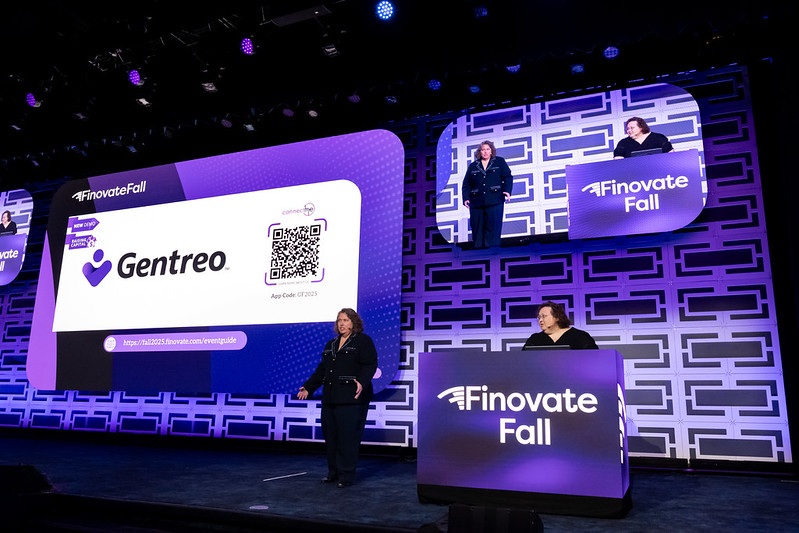
FinovateFall 2026 will be held at the Times Square Marriott Marquis in New York from Sept. 9—11. Tickets are available now. Save your spot. Book your room. And join us in New York for the most unique fintech event of the fall.
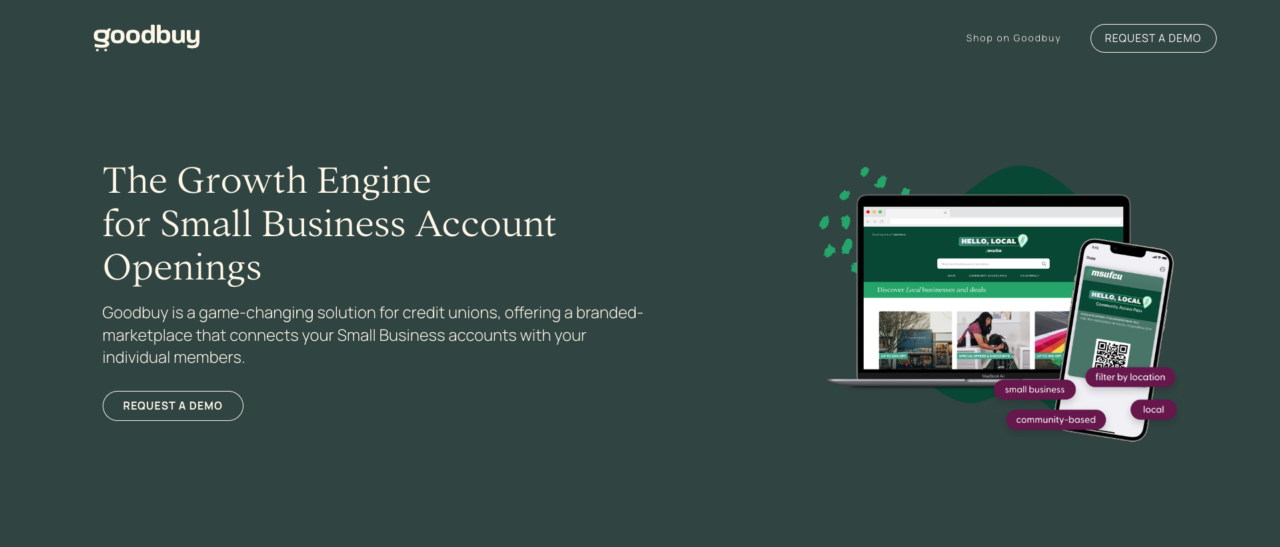
Goodbuy
Goodbuy transforms small-business engagement into a new growth channel, enabling financial institutions to drive account activation, deposits, and interchange through connected community commerce. Goodbuy was founded in 2021 and is headquartered in Boise, Idaho.
Goodbuy is a scholarship winner in our Female Founded/Owned category, which is available to fintechs with female founders or owners. Goodbuy will be represented at FinovateFall by co-founders Cara Oppenheimer (Chief Executive Officer) and Cary Telander Fortin (Chief Impact Officer).
FinZee AI
FinZee AI connects biometric data from wearable devices to real-time financial decision-making, stopping impulse buying before it happens. Founded in 2025, the company is based in Kapolei, Hawaii.
FinZee AI was one of the winners in the Social category, which is available to firms with socially conscious fintech solutions.
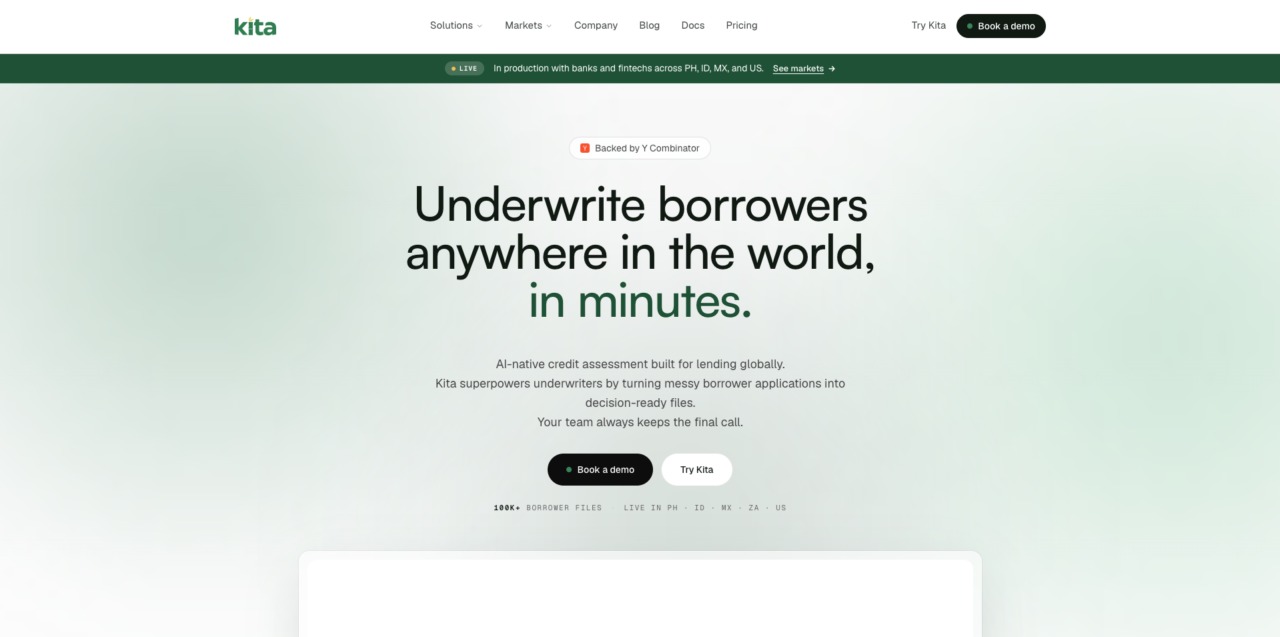
Kita Technologies
Kita is an AI-powered lending operations platform that transforms borrower documents into fraud-checked underwriting signals in minutes. Kita Technologies was founded in 2025 and is headquartered in San Francisco, California.
Kita Technologies is a winner in the Female Founded/Owned category, which is available to companies founded or owned by women.
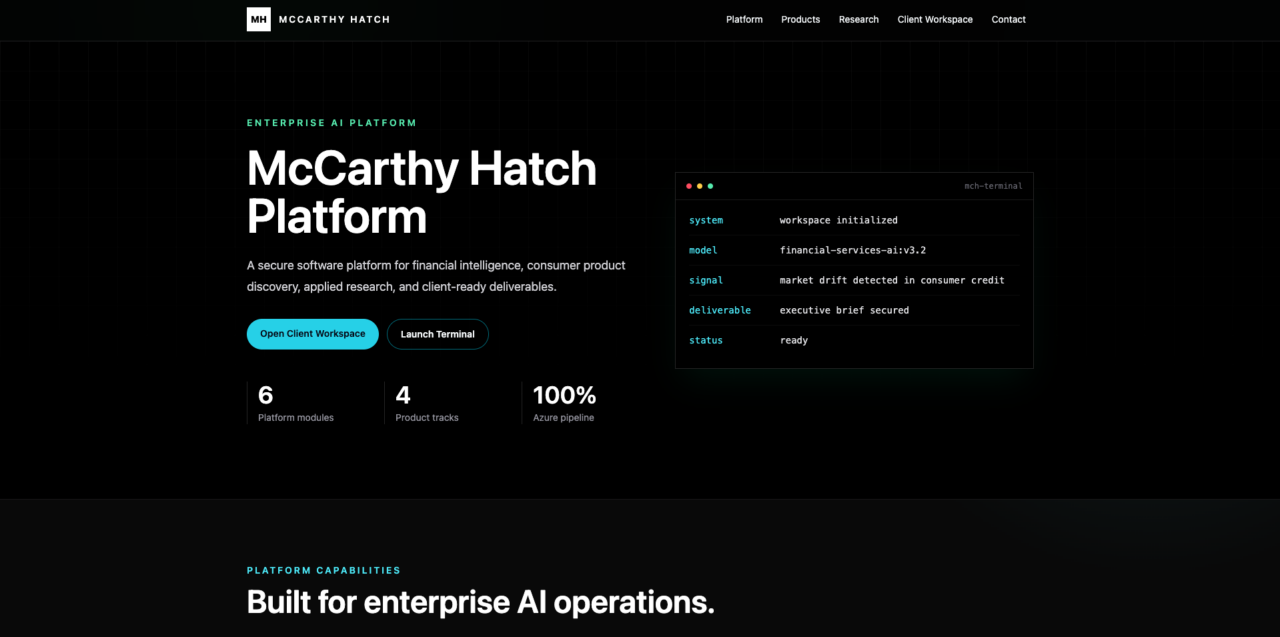
McCarthy Hatch
Headquartered in Los Angeles and founded in 2024, McCarthy Hatch is the company behind FSAi, an AI-powered analytics platform that detects systemic consumer harm patterns in financial services by analyzing customer complaints.
McCarthy Hatch is a scholarship winner in the Governance category, which is available to companies that emphasize responsible governance and leadership.
On Time Harvest
On Time Harvest is an AI-powered fintech platform that forecasts discretionary income up to five years in advance, delivers financial education and analysis, and builds responsible safeguards for BNPL. The company was founded in 2025 and is headquartered in Waldorf, Maryland.
On Time Harvest is a scholarship winner in our BIPOC Founded/Owned category. BIPOC refers to Black, Indigenous, and people of color.
RangersAI
RangersAI offers an AI-powered scam resilience platform that helps financial institutions empower consumers to avoid scams through real-time guidance, in-context education, and trusted digital interactions. RangersAI was founded in 2024 and is headquartered in Boca Raton, Florida.
RangersAI is a scholarship winner in our Social category, which is available to companies with socially conscious fintech solutions.
Basware has agreed to acquire payment fraud prevention company Trustpair, with the transaction expected to close later in 2026.
The acquisition will extend Basware’s invoice lifecycle assurance through payment, combining its AP automation capabilities with Trustpair’s AI-driven account validation and payment fraud prevention.
The deal reflects the convergence of AP automation, payments, and fraud prevention as AI-driven fraud increases demand for end-to-end transaction security.
Enterprise payment solutions company Basware announced it has agreed to acquire payment fraud prevention company Trustpair this week for an undisclosed amount. The transaction is expected to be completed later in 2026.
Basware, provider of AP automation, e-invoicing, and compliance tools, anticipates that Trustpair’s fraud prevention tools will enhance its invoice lifecycle management tools by delivering invoice lifecycle assurance that covers the entire transaction. Basware will use its tools to confirm that an invoice is legitimate and approved, while Trustpair will confirm that the payment reaches the intended supplier.
Trustpair was founded in 2017 to secure enterprise payments using its AI-driven risk intelligence. Today, the South Carolina-based company serves more than 600 organizations by automating manual account validation to serve as a centralized, strategic layer of payment security.
“Trustpair was built around a simple belief: approving the right invoice is not enough if the money ultimately reaches the wrong account,” said Trustpair Co-Founder and CEO Baptiste Collot. “By bringing our capabilities together, we see the opportunity to give finance teams stronger protection across the full journey, from supplier onboarding and invoice approval through payment. Trustpair will continue to operate with the same team, platform, and commitment to our customers and partners across the finance environments they already use. Basware’s reach and resources will help us accelerate beyond what we could have achieved alone.”
Once the acquisition is finalized, Trustpair will leverage Basware’s intelligence spanning 2.5 billion invoices and 20 million suppliers to strengthen its validation models and gain a faster route to a wider customer base.
Founded in 1985, Basware’s invoice lifecycle management platform offers governed autonomy, continuous compliance, financial integrity, and enterprise control. By governing the entire AP process end-to-end across every country, and every ERP, Basware helps enterprises automate accounts payable while maintaining the controls needed to ensure invoices are legitimate, compliant, and accurately processed. Basware counts more than 6,500 customers worldwide, including DHL, Heineken, and NBC Universal Media.
“AI may be the most powerful productivity tool of our generation,” said Basware CEO Jason Kurtz. “Unfortunately, it is also becoming one of the most powerful tools ever placed in the hands of criminals. A finance team can do everything right on the invoice and still send the money to the wrong bank account. Basware has spent more than 40 years protecting the invoice. Bringing Basware and Trustpair together extends that protection through the payment itself. Together, we will offer the first end-to-end invoice-to-payment assurance in the market, strengthening financial integrity and continuous compliance across the invoice lifecycle.”
As AI tools proliferate, AP automation tools are expanding to better manage financial risk across the transaction lifecycle. AI is making payment fraud increasingly sophisticated, which means that validating and approving an invoice is no longer sufficient to ensure a legitimate transaction. Embedding payment validation into AP workflows gives platforms like Basware an opportunity to move beyond automating financial processes to protecting the movement of money itself. For fintechs, the shift could further blur the lines between AP automation, payments, and fraud prevention as businesses look for platforms that can manage and secure a transaction from invoice through payment.
Fraud prevention and identity verification company Fideo Intelligence has launched its investigative intelligence platform Fideo Lens.
Fideo Lens enables fraud and financial crime teams to discover hidden relationships between identities, accounts, devices, and behaviors at a time when fraud attacks increasingly involve multiple connected entities and organizations.
Headquartered in Denver, Colorado, Fideo Intelligence made its Finovate debut at FinovateFall 2025 in New York.
Financial crime prevention specialist Fideo Intelligence has unveiled its investigative intelligence platform Fideo Lens. The new offering helps fraud and financial crime teams uncover hidden relationships between identities, accounts, devices, and behaviors, enabling them to better address the increasingly coordinated nature of fraud attacks.
Starting with a single identity signal, fraud investigators can use Fideo Lens to visualize and connect data associated with that identity and convert fragmented identity data into interactive investigative intelligence within minutes, reducing the time spent on manual searches across multiple systems. Fideo Lens gathers relevant entities, people, devices, identifiers, behaviors, and activity into one interface, making it easier to spot potential connections between individual signals. This accelerates the fraud investigation process while enabling teams to make more confident decisions.
“Fraud and financial crime rarely exist as isolated events anymore; they play out across networks of connected identities, devices, and organizations,” Fideo Intelligence CEO Chris Harrison said. “Most investigators still have to piece those relationships together manually. Fideo Lens helps investigative, fraud, and financial crime teams uncover hidden connections in minutes, so they can move faster on critical cases and disrupt financial crime networks to prevent losses or additional risk.”
Search-based fraud investigations can fail to identify the relationships within the coordinated network of aliases, shared devices, and interconnected accounts that increasingly underpin modern fraud and financial crime. As a result, fraud investigators have had to spend significant time piecing together fragmented data from multiple, disconnected systems in order to see the entire network. In contrast, Fideo Lens gives teams interactive relationship mapping, broad identity intelligence, faster entity resolution, stronger network analysis, explainable findings, and continuously refreshed intelligence to help investigators spot emerging relationships and changing risk patterns.
“Analysts and investigators should not have to spend most of their time jumping between disconnected systems,” Harrison added. “Fideo Lens turns fragmented identity data into a clear view of the people, accounts, and devices involved, helping teams investigate cases faster and improve fraud and recovery outcomes.”
Fideo Intelligence made its Finovate debut at FinovateFall 2025 in New York. At the conference, the Denver, Colorado-based company demonstrated Fideo Verify, its AI-powered identity verification and fraud prevention platform for banks, credit unions, fintechs, and financial platforms. Fideo Verify combines multiple identity verification strategies, such as synthetic ID detection, device analysis, and breach exposure, into a single API. Powered by Fideo Intelligence’s Identity Fraud Intelligence Network, Fideo Verify streamlines risk decisions, lowers operational costs, and continuously learns by analyzing dynamic data.
Founded in 2024, Fideo Intelligence screens more than 95 billion transactions a year. The firm is backed by Baird Capital, Blue Note Ventures, and Foundry Group.
FinovateFall 2026 will showcase more than 70 innovative fintech companies. Join us September 9–11 at New York’s Marriott Marquis Times Square for three days of cutting-edge fintech demos, expert insights, and high-impact networking.
Nayax plans to acquire smart parking technology provider IPS Group to expand its presence in parking and curb management.
The acquisition will combine IPS’ parking technology and 250,000-space footprint with Nayax’s payments infrastructure and global reach, creating new expansion and cross-sell opportunities.
The deal reflects Nayax’s “land and expand” M&A strategy and the broader convergence of payments and vertical software as payment providers move beyond transaction processing.
Global commerce, payments, and loyalty platform Nayaxannounced plans today to acquire smart parking technology provider IPS Group from Windjammer Capital Investors for an undisclosed amount.
Founded in 2000, IPS offers payment-enabled smart parking technology that processes millions of consumer payment transactions each year. The platform operates using physical infrastructure such as meters, combined with mobile and text-based payments, enforcement and permitting software, vehicle detection tools, and curb data analytics.
Nayax will tap IPS, which has two decades of experience building parking technology with an established base of more than 250,000 parking spaces. Nayax anticipates that its established reach across more than 120 countries will help IPS expand into new markets while giving its own customers access to a parking and curb management solution, adding cross-sell opportunities to Nayax’s existing offering. Nayax estimates that IPS will boost its addressable cashless opportunity to approximately $342 billion by 2029.
“Cities run some of the most demanding unattended commerce anywhere, with strict compliance requirements and infrastructure that must last a decade,” said Nayax CEO Yair Nechmad. “Together with IPS we can give cities a unified platform for the curb and run parking alongside EV charging.”
Nayax was founded in 2005 and offers cashless payment, IoT service, and management solutions for unattended retail stores. The Maryland-based company’s tools work best for high-frequency, low-value transactions for which Nayax provides end-to-end hardware, software, payments, and loyalty.
Acquisitions play a major role in Nayax’s growth strategy. In addition to today’s deal, the company has made 10 acquisitions over the past 21 years, following a “land and expand” playbook of acquiring established solution providers in specific verticals and integrating them with Nayax’s payments infrastructure. The strategy allows Nayax to leverage the acquired companies’ industry expertise and customer relationships while using its payments stack and global reach to scale their businesses into new markets.
“IPS fits perfectly into our M&A playbook,” said Nayax Chief Strategy Officer Aaron Greenberg. “We seek companies in verticals where payments and software work together, using our payment stack and infrastructure to take these businesses global. From hardware quality to payments strength, it is exactly the platform a combined Nayax-IPS represents.”
The deal shows how unique payments infrastructure can help organizations expand into specialized verticals. Rather than building industry-specific software and distribution from scratch, payments companies can acquire established vertical platforms and layer their existing payments capabilities onto them. The acquisition also reflects the continued convergence of payments and vertical software. As payments become increasingly embedded within industry-specific platforms, payment providers have an opportunity to move beyond transaction processing and own more of the technology their customers use to operate.
Digital payments and data security company Bluefinannounced it has partnered with Visa on a new card-present acceptance tool. The new offering combines Bluefin’s PCI-validated point-to-point encryption (P2PE) solution with Visa Acceptance Solutions to bring increased security to in-person payment acceptance.
The in-store payment acceptance tool offers merchants, software providers, and enterprises a unified approach to accepting payments by combining payment acceptance, PCI-validated security, tokenization, device lifecycle management, and enterprise payment infrastructure into a single solution. Bluefin will power the P2PE piece, while Visa’s Visa Acceptance Solutions is taking on the payment processing, tokenization, and global payment services elements.
“Enterprise organizations are no longer looking for individual payment technologies—they’re looking for infrastructure that enables secure commerce across every channel,” said Bluefin Founder and Chief Strategy Officer Ruston Miles. “Our collaboration with Visa Acceptance Solutions reflects a shared vision that secure payment acceptance should be delivered as an integrated platform rather than a collection of independent components.”
Bluefin was founded in 2007 to bring security to payments by developing technology to devalue sensitive data at the point of entry. Since then, the company has expanded to focus on broader data security infrastructure that protects sensitive data in motion across systems, platforms, and environments. Combining P2PE, vaultless tokenization, and orchestration powers Bluefin’s new model for securing transactions.
The new tool will bring Bluefin clients simplified deployment, centralized device management, developer APIs and SDKs, and reduced PCI compliance scope. While Bluefin is launching the payment acceptance tool with select Ingenico Lane series devices, the tool is capable of expanding to additional ecosystems.
“By combining Visa Acceptance Solutions with Bluefin’s card-present security infrastructure, we’re helping organizations simplify deployment, reduce complexity, and build a stronger foundation for the future of enterprise commerce,” added Miles.
Teaming up with Visa helps Bluefin consolidate traditional, fragmented technology stacks. Rather than separately integrating payment acceptance, processing, encryption, tokenization, and device management, it offers merchants the option to access those capabilities through a unified platform. This raises the bar from offering an individual piece of the payments stack to helping businesses abstract the complexity of managing payments across channels.
Bluefin works with more than 300 partners and 40,000 businesses and protects more than $350 billion in transactions annually. The Atlanta, Georgia-based company showcased its payment technology at FinDEVr 2014 under the name Bluefin Payment Systems.