This site is operated by a business or businesses owned by Informa PLC and all copyright resides with them. Informa PLC's registered office is 5 Howick Place, London SW1P 1WG. Registered in England and Wales. Number 8860726.
Finovate Blog
Tracking fintech, banking & financial services innovations since 1994
Payouts and treasury platform PayQuicker launched its 1099 tax reporting solution, powered by fellow Finovate alum Avalara.
The new offering helps reduce the complexity of 1099 filing while keeping companies compliant with the latest regulatory mandates.
New York-based PayQuicker made its Finovate debut at FinovateFall 2022. Avalara is an alum of Finovate’s developer conference, FinDEVr Silicon Valley 2015.
PayQuicker, a payouts and treasury platform that made its Finovate debut at FinovateFall 2022 in New York, has introduced its new 1099 tax reporting solution. Powered by agentic tax and compliance specialist—and fellow Finovate alum—Avalara, the new offering will help companies streamline and automate 1099 reporting while reducing both compliance risk and administrative burden.
“Businesses need reliable automated solutions to stay compliant without slowing down operations,” PayQuicker CFO Joe Bertalli said. “By partnering with Avalara, we’re able to provide our customers with a robust 1099 solution that reduces complexity, increases accuracy, and gives them confidence in their compliance processes.”
PayQuicker’s 1099 solution enables companies to collect W-9 and other W-series tax forms over the course of the year to help ensure accurate payee information at all times. PayQuicker’s solution also leverages real-time Taxpayer Identification Number (TIN) matching to validate data at the point of collection. This helps reduce the potential for costly backup withholding notices, penalties, and corrections at a time when regulatory requirements around tax reporting for businesses are becoming increasingly complex.
Powered by Avalara’s tax compliance technology, PayQuicker’s 1099 solution provides scalable, secure, and compliant tax reporting for businesses managing sizable numbers of payees. The solution facilitates the accurate and efficient generation, filing, and distribution of 1099 forms supported by automated federal and state filing, electronic delivery, and ongoing regulatory updates.
“PayQuicker is focused on making complex financial workflows easier for businesses,” Avalara General Manager for 1099 Reporting Queenie Lee said. “We’re excited to power their 1099 solution with Avalara’s compliance expertise, enabling customers to automate reporting and reduce risk while staying focused on growth.”
An alum of Finovate’s developer conference, FinDEVr Silicon Valley 2015, Avalara leverages an expansive library of tax content and industry integrations to serve more than 200,000 direct and indirect customers in more than 75 countries. Avalara’s purpose-built AI agents automate compliance processes from tax calculations and return filings to exemption certificate management and more. Avalara has helped companies achieve an 85% reduction in time spent managing tax returns and a 50% reduction in time spent on exemption certificate management. Scott McFarlane is Co-Founder and CEO.
Headquartered in Rochester, New York, PayQuicker made its Finovate debut at FinovateFall 2022. At the conference, PayQuicker demonstrated its Payouts OS solution which packages the company’s technology into an in-market payouts orchestration platform. Payouts OS leverages a single REST API that plugs into multiple banks and international payment rails to identify and facilitate the fastest, most cost-effective way for clients to make payouts to businesses and consumers around the world.
Embedded finance platform Array has been on a truly remarkable acquisition pace in recent weeks. The company, which won Best of Show in its Finovate debut at FinovateFall 2021 and again in its return to the Finovate stage for FinovateSpring 2022, acquired fellow Finovate alum—and fellow Best of Show winner—Penny Finance in late February. This move came just a few days after Array announced its acquisition of another Finovate alum and Best of Show winner, Chimney.
And just to show that Array’s appetites are not limited to Best of Show-winning Finovate alums, the company also announced its acquisition of paytech EarnUp less than a month ago.
What do these acquisitions mean for Array? Overall, these deals represent the company’s strategy to provide its financial institution partners with modular, embeddable tools and data that enable them to boost engagement, improve retention, and secure measurable value. Designed to complement the solutions currently offered by fintechs, financial institutions, and digital brands, Array’s embedded, invisible-by-design approach allows consumers to enjoy a wider range of financial solutions and services while still relying on the brands they know and trust.
Consider Penny Finance. Penny Finance is an online financial planning engine that enables credit unions and community banks to provide personalized education, resources, and services to their members and customers. Headquartered in Boston, Massachusetts, and founded in 2020 by CEO Crissi Cole, Penny Finance helps individuals and families pay off debt, begin investing, and build wealth—all within a unified, integrated solution. Array Founder and CEO Martin Toha said that acquiring Penny Finance will enable Array to serve consumers the same way that they experience financial challenges and responsibilities: “as part of a single, ongoing journey.”
“Penny Finance strengthens our ability to support that full picture,” Toha said, “enabling our partners to deliver more holistic, consumer-first financial experiences directly within the products people already use.”
The acquisition will empower Array to help its clients address a broader range of consumer needs and complements the company’s current credit, identity, and privacy offerings with solutions to help consumers enhance their financial wellness through better savings behavior and financial planning.
“Penny was built to give people confidence in how they spend, save, and plan—without judgment or complexity,” Penny Finance’s Cole said. “By joining Array, we can scale that mission and integrate financial education and planning tools into trusted experiences that already play a meaningful role in people’s financial lives.”
Array’s acquisition of Chimney will add the fintech’s modern financial calculators and home value tracking tools to its platform offerings. Founded in 2020 and based in Brooklyn, New York, Chimney helps more than 160 financial institutions in the US leverage real-time property data and predictive analytics to engage homeowners and grow loans. Chimney’s technology identifies high-propensity opportunities for home equity, refinancing, new mortgages, and more, enabling financial institutions to target the right customers and members at the right time with personalized offers delivered inside their banking apps and platforms. In his statement, Chimney CEO and Co-Founder Matthew Covi underscored this last point, highlighting the value of embedded finance in helping consumers get the resources they need while remaining engaged with the brands they trust.
“Traditional financial institutions are where the majority of Americans manage their finances,” Covi said. “By empowering these institutions with personalized, data-driven solutions that modernize the banking experience, we’ve realized our mission of helping millions of Americans live healthier financial lives.”
Lastly, EarnUp is a payments technology firm that helps consumers better manage debt and bills by aligning mortgage, loan, and bill payments with pay cycles. By enabling them to disaggregate large, inflexible monthly payments into smaller contributions aligned with their paychecks, EarnUp helps lower the amount of missed payments to creditors and financial stress for debtors. Headquartered in San Francisco, California, and founded in 2015, EarnUp has completed 50 million transactions with a cumulative value of $43 billion since inception. Brad Woodcox is CEO.
“EarnUp is a long-standing proven product in the home loan space, having supported millions of US mortgage borrowers through deep integrations with leading mortgage servicing platforms,” Toha said. “We hope to use this distribution and product to extend Array’s reach into the home loan payments space. This acquisition strengthens our ability to help financial services providers deliver more practical, consumer-centric experiences—especially for households managing tight margins and multiple debt obligations.”
Founded in 2020 and headquartered in New York City, Array most recently demoed its technology at FinovateSpring 2023. At the conference, the company demonstrated two of its latest financial solutions—HelloPrivacy (now Privacy Protect) and Subscription Manager—to help banks and other financial institutions generate noninterest income and boost engagement while providing customers with resources to help them stay safe online and save money. Privacy Protect helps defend users from identity theft and privacy risks by monitoring and removing personal information from the web. Subscription Manager helps users manage their subscriptions better, canceling unused subscriptions and negotiating lower rates on select subscriptions.
FinovateSpring 2026 will take place at The Sheraton San Diego on May 5-7. Register today using this link and save 20%.
Mastercard is acquiring stablecoin infrastructure provider BVNK for up to $1.8 billion to bridge fiat and on-chain payments within a single network.
The deal positions Mastercard to connect cards, bank rails, stablecoins, and tokenized deposits to create a unified, multi-rail payments ecosystem.
While competitor Visa relies on a partnership-led approach to stablecoin integration, Mastercard is seeking to own the infrastructure layer outright.
Mastercard is making a move to own the rails that bridge stablecoins and fiat this week. The payments giant is acquiring stablecoin infrastructure provider BVNK for up to $1.8 billion, including $300 million in contingent payments.
The announcement comes at a time when the current stablecoin market capitalization exceeds $316 billion, a figure that is up 2.5x from 2023. It also comes as users across the globe are increasingly open to holding stablecoins. In a recent survey of over 4,000 stablecoin and crypto holders, BVNK found that 56% of participants expressed plans to acquire more stablecoins within the next 12 months.
This increased utility of stablecoins is creating a need in the traditional financial space as users require a bridge between fiat and stablecoins. As a result, banks and fintechs need to offer their customers payment options enabled by stablecoins and tokenized deposits.
Mastercard anticipates that acquiring BVNK’s stablecoin infrastructure will allow it to become the bridge between fiat and stablecoins. The company will connect stablecoin rails to its own network to offer consumers the accessibility and interoperability they have come to expect in the traditional finance realm.
“We expect that most financial institutions and fintechs will in time provide digital currency services, be it with stablecoins or tokenized deposits. We want to support them and their customers with a best-in-class, highly compliant, interoperable offering that brings the benefits of tokenized money to the real world,” said Mastercard Chief Product Officer Jorn Lambert. “This acquisition reinforces what we have always done, using innovation and technology to power economies and empower people. Adding on-chain rails to our network will support speed and programmability for virtually every type of transaction.”
Mastercard isn’t the first traditional card network making a move to establish a foothold in the stablecoin space. Visa has formed partnerships with Circle and Bridge to support USDC payments and enable on-chain settlement flows. Mastercard, however, is taking things a step further. Instead of relying on a partnership-led approach, the network giant is acquiring the stablecoin infrastructure outright. Bringing the infrastructure in-house will allow Mastercard to connect traditional finance, on-chain assets, and enterprise payment flows within a single network.
BVNK was founded in 2021 and currently processes over $25 billion each year on behalf of enterprises and payment service providers. The UK-based company leverages stablecoins to enable businesses to move value instantly across borders and networks. Through its partnerships with global licensing bodies and Tier 1 banks, BVNK serves clients such as Worldpay, Deel, and dLocal.
“This partnership is about complementary strengths: Mastercard brings 200+ countries and territories, institutional trust and settlement rails. BVNK brings proven stablecoin infrastructure, deep expertise and an enterprise customer base,” said BVNK Co-founder and CEO Jesse Hemson-Struthers in a post on LinkedIn. “More trust attracts more users. More users attract more businesses. More businesses attract more developers. And suddenly, moving money on stablecoin rails becomes as routine as moving money on traditional rails—accessible to everyone.”
Once the acquisition is finalized later this year, Mastercard will be able to offer a single network to connect cards, bank rails, stablecoins, and tokenized deposits. The new, multi-rail approach will let customers choose the solutions that work best for them without tying them down to a single platform.
“This deal brings together complementary capabilities to define and deliver the future of money,” said Hemson-Struthers. “Together, we’re able to deliver an unprecedented infrastructure for digital currency-based financial services.”
Multi-rail payments infrastructure platform BVNK recently published a report on stablecoin utility that examines how consumers actually use stablecoins. The report found that consumers’ desire to obtain stablecoins is rising, and that stablecoins are becoming a fixture of consumers’ savings portfolios.
Published in partnership with YouGov, Coinbase, and Artemis, the report is the result of a survey of 4,658 crypto and stablecoin holders across 15 countries. Here are four major findings from the survey:
Stablecoin holdings increasing
Of the stablecoin holders surveyed, almost half (49%) increased their holdings within the past 12 months, while only 7% of people decreased their holdings. More than half (56%) of crypto or stablecoin holders expressed plans to acquire more stablecoins in the next 12 months. This shows that stablecoins are transitioning from a niche tool into a mainstream asset.
Crypto owners are diversifying
The report also surveyed crypto holders who do not yet own stablecoins. Among this subset of non-owners, 13% said that they intend to acquire stablecoins in the next 12 months. In low and middle income economies such as Africa, consumers showed a higher interest in acquiring stablecoins for the first time. In fact, in Africa in particular, 76% of respondents said that they plan to acquire stablecoins in the next 12 months. This is a reflection of the utility of stablecoins in lower income regions.
Stablecoins and crypto are becoming a core element of savings
The stablecoin and crypto holders surveyed reported allocating around one-third (34%) of their savings to crypto and stablecoins. Almost half (48%) of respondents allocate up to a quarter of their savings to stablecoins and crypto. This shows that many consumers are beginning to treat digital assets not as speculative, but as a meaningful component of their long-term savings strategies.
Stablecoin holders are relatively young
Not surprisingly, more than half (54%) of those surveyed who own stablecoins are aged 18 to 34 years old. Of the respondents in the older age bracket of 55+, only 8% said that they currently hold stablecoins, while 17% of people in that age range said that they plan to acquire crypto within the next 12 months. This shows that stablecoin adoption is being driven largely by younger consumers who are more comfortable incorporating new financial technologies into their everyday financial lives.
Overall, the findings suggest that stablecoins are evolving beyond their early role as a trading tool within crypto markets and are beginning to function as a practical financial instrument for everyday users. As access to digital wallets and crypto infrastructure improves, stablecoins are increasingly positioned to bridge traditional finance and digital assets by offering consumers a way to store value, move money globally, and participate in global markets with lower barriers than traditional finance.
Regtech Napier AI unveiled Insights AI, its new solution to help companies enhance their anti-money laundering (AML) screening processes.
The new offering will help financial crime compliance teams close key gaps in AML investigations by providing behavioral analytics and AI-enabled explanations of contributing activity.
Headquartered in London, Napier AI made its Finovate debut at FinovateEurope 2018.
AI-powered financial crime compliance solutions provider Napier AIannounced new functionality in its Transaction Monitoring solution that will help firms with their anti-money laundering (AML) screening. The new offering, Insights AI, provides behavioral analytics and natural language explanations for use in financial crime compliance, closing what Napier called “critical gaps” in anti-money laundering investigations.
The new functionality comes courtesy of an innovation partnership between Napier AI and the UK Financial Conduct Authority (FCA), with the company leveraging the FCA’s Supercharged Sandbox to test new models and strategies. The goal was to provide financial crime compliance teams with a tool that would surface clear, AI-enabled explanations of customer behavior beyond the initial alert. These insights would be available directly within transaction monitoring tasks, highlighting behavioral patterns and illuminating potential new or emerging risks during the investigation. This is because, for most compliance teams, the challenge is less total alert volume and more about investigation inefficiency. To this end, Insights AI identifies relevant behavioral patterns, explains contributing activity in context, reduces the amount of time spent on manual data analysis, and enables compliance teams to focus on more complex issues during the investigation process.
Napier Chief Data Scientist Janet Bastiman underscored the value of the relationship between the company and the FCA. “Participating in the FCA Supercharged Sandbox allowed us to design and run new approaches to testing AI models for anti-money laundering,” Bastiman said. “One of the biggest historical challenges in tackling complex money laundering typologies is the disconnected nature of the data required for pattern analysis along the complete lifecycle of customer behavior or transaction flows.”
Under the name “Project Theseus,” the technology was tested for pattern mining and fluid dynamics as part of the FCA Supercharged Sandbox Showcase. This involved the deployment of frequency-based AI algorithms on large-scale synthetic financial data sets to identify money laundering typologies more effectively than traditional rules-based systems—while using significantly less computing power. The tested AML transaction monitoring models now form part of the Napier AI Continuum platform and support the company’s newly announced Insights AI feature.
“The embedding of Insights AI into our Transaction Monitoring solution is all about ensuring the incredible data science behind the scenes is surfaced in a way that puts power into the hands of AML analysts, to make the best possible human-in-the-loop decisions for the alerts,” Napier AI Chief Product Officer Will Monk said. “We lead with a compliance-first approach to AI in AML by partnering closely with the FCA so we can ensure our product aligns with regulatory guidance and meets policy goals around reducing the impact of economic crime on the UK.”
Founded in 2015, Napier AI made its Finovate debut at FinovateEurope 2018 in London. At the conference, the company demonstrated how its customer screening and transaction monitoring enhancement software enables firms to enhance their AML and client screening processes. The company’s technology helps reduce false positives by up to 80% while significantly lowering operational risk and cost.
Napier AI began the year with the launch of MV Shield—Powered by Napier AI. The fruit of a partnership between Napier AI and banking technology provider Mutual Vision, MV Shield is a compliance-as-a-service (CaaS) solution built specifically for building societies and credit unions in the UK and Canada. MV Shield provides an alternative to standard AML systems, aligning its controls, reporting, and risk models to the specific needs of membership-based financial institutions.
Ramp is acquiring travel and expense startup Juno to expand its capabilities in managing complex travel spending, particularly for non-employees.
Integrating Juno’s platform will help Ramp coordinate booking, payments, reimbursements, and reconciliation for guest travel alongside employee expenses within a single platform.
The new capabilities will help Ramp compete with other business finance software tools like Brex.
Corporate card and expense management platform Ramp is buying Colorado-based Juno, a travel and expense management company. Financial terms of the deal were not disclosed.
Founded in 2024, Juno helps businesses coordinate complex travel and expenses. Organizations can book travel, reimburse out-of-pocket expenses, and reconcile travel payments quickly. Juno’s platform is particularly helpful for organizations that pay for travel for non-employees.
“We’ve spent the better part of a decade working on the guest travel problem,” said Devon Tivona, co-CEO and founder of Juno. “These aren’t anonymous business travelers. They’re candidates, customers, partners. The trip is part of the impression. Ramp has the platform, the customers, and the ambition. That’s why we’re here.”
Ramp will use Juno to expand its travel and expense capabilities, especially for companies that manage travel for contractors, partners, and other non-employees. Integrating Juno’s technology into its platform will allow Ramp to streamline the coordination, payment, and reconciliation of guest travel alongside employee expenses. These new capabilities give Ramp a more comprehensive travel solution that will help businesses manage a wider range of travel-related spending within a single financial operations platform.
“Guest travel is a hard problem. It’s messy, operationally heavy, and has real business consequences,” said Ramp co-founder and CTO Karim Atiyeh. “A bad candidate travel experience can cost you a hire. Juno built something strong in a category that matters. Our job now is to give them leverage and stay out of the way.”
Business finance software heated up earlier this decade, receiving hundreds of millions in VC investment during a time when the rest of fintech was in a funding downturn. To keep competitive, corporate card and expense platforms such as Ramp and Brex have increasingly added travel capabilities, while travel-focused companies like Navan have expanded into expense management. By adding guest travel capabilities through Juno, Ramp is positioning itself to manage an even broader category of corporate travel spending.
Ramp was founded in 2019 and has experienced notable growth, most recently fueled by a $300 million financing round that valued it at $32 billion. The company powers over $100 billion in purchases annually for its more than 50,000 customers, which range from family farms to space startups.
With St. Patrick’s Day at the beginning of the week and the first day of spring at the end, it feels as if we are truly leaving winter behind us. Cacti are blooming here in the desert southwest and the fintech news —from new offerings in wealth management to the latest innovations in agentic AI—is flowing. Be sure to check back here at Finovate’s Fintech Rundown all week long for updates.
Digital banking
BankDhofarlaunchesNeo Corporate Internet Banking (Neo CIB), its next-generation digital banking platform.
DNERO, a neobank that caters to Latino customers, readies for a March 24 launch.
Digital asset wealth management platform Abraannounces plans to go public via SPAC merger with New Providence Acquisition Corp at a valuation of $750 million.
Sokinlaunches stablecoin capabilities to provide hybrid finance platform unifying digital assets and fiat.
Agentic AI
Lithuanian fintech Chaseit.aiintroduces AI agents to automate loan servicing and call center communications.
Integrated financial management platform for freelancers and gig economy workers, Finom, launches its embedded interest account.
Iwocaintroduces free financial health resources, including its Credit Compass, for small businesses in the UK.
Lending and Credit
Experian launches its AI-powered Experian Virtual Assistant (EVA) to deliver real-time, personalized financial insights and recommendations on financial products such as credit cards, loans, and insurance.
Ocrolusaccelerates automated conditioning for mortgage lenders with full lifecycle management.
Back end technology
FMSI and Applipartner to help credit union branches drive member revenue.
Mexican neobank Ualá has tapped DriveWealth’s fractional investing infrastructure to launch “Acciones,” enabling Mexican customers to invest in US stocks.
The offering aims to expand investment access in Mexico, where only 4.4% of the population currently invests in financial instruments.
For DriveWealth, the partnership continues to expand the reach of its brokerage infrastructure across Latin America.
Latin American neobank Banco Ualá has selected digital trading and brokerage company DriveWealth for its new launch called Acciones (Stocks) that will enable Mexican consumes to invest in US equities.
Leveraging DriveWealth’s brokerage-as-service platform that allows for fractional investing, Ualá allows users to invest in corporate shares starting at $1.12 ($20 MXN), enabling Mexican investors to own shares of companies like Apple, Amazon, and Tesla.
This new accessibility is a big deal in Mexico, a region in which only 4.4% of the population currently invests in any financial instrument. This low participation rate is partly due to the perceived complexity of investing and the assumption that investing is only available to those with significant capital. However, thanks to DriveWealth’s fractional investing infrastructure, Ualá can now allow customers to purchase fractions of US equities. This not only lowers barriers-to-entry, but it also allows investors to build diversified portfolios with smaller amounts of capital.
For DriveWealth, the launch is evidence of global demand for investment access to new markets. By powering fractional US stock investing for Ualá in Mexico, the company continues to expand the reach of its brokerage infrastructure across Latin America.
“DriveWealth was built to democratize access to financial independence and expand access to financial markets through trusted, regulated brokerage infrastructure,” said DriveWealth CEO Naureen Hassan. “Partnering with Ualá allows us to bring US equities to a broader population of investors in Mexico through a secure, fractional investing experience. We’re committed to working together to offer innovative investment solutions to Ualá customers, and helping make investing simple and inclusive, while maintaining the highest standards of execution, custody, and investor protection.”
Ualá’s Acciones (Stocks) onboards users after they answer a series of questions to determine their risk profile and receive portfolio recommendations. Investors will have the choice of three portfolio options, including US stocks and ETFs. To make investing even more approachable, the neobank will not charge any account opening or transaction fees.
“With the launch of Acciones, we are opening the doors of the global market to millions of Mexicans who previously saw these opportunities as unattainable,” said Ualá Regional Director of Wealth Management Pablo Savoldelli. “Now, starting from 20 pesos and with just a couple of clicks, our clients will be able to protect their savings, obtain dividends, and participate in the growth of the world’s largest companies.”
Ualá’s move is an example of how digital banks are expanding beyond payments and into broader financial tools such as lending and wealth-building. As more neobanks seek to deepen customer relationships and increase engagement, offering investment access is a natural next step.
DriveWealth was founded in 2012 to allow third parties to enable access to US equities, fixed income, and other asset classes through scalable, compliant solutions via its suite of APIs. Last year, the New York-based company teamed up with Moment Technology to make fixed-income investing more accessible to a broader range of investors, and partnered with Walmart’s OnePay to power the neobank’s embedded investing tool.
This week’s edition of Finovate Global looks at recent fintech headlines from Scotland.
AutoRek Launches RegToolKit
Automated reconciliation and financial control solutions provider AutoRek has launched its AutoRek RegToolKit. The new offering will help financial services companies simplify, track, and demonstrate their compliance with complex regulations.
AutoRek RegToolKit maps client products and services against regulatory requirements to ensure that companies can become compliant as well as prove their compliance with regulatory authorities. The solution features an applicability matrix across regulatory requirements, business risks, and mitigating controls, providing a comprehensive overview for all legal entities and product lines and reducing the audit burden. AutoRek RegToolKit uses an in-built breach register to identify compliance breaches, assign ownership, and track the process through to remediation, avoiding reliance on both spreadsheets and manual audits. The new offering complements the company’s data management, reconciliation, and reporting platform providing a consolidated data, governance, and oversight solution.
“Firms are required to not only control their data, but also evidence that their processes align with regulatory rules,” AutoRek Chief Product, Technology, and Operations Officer Jim Sadler said. “RegToolKit takes the complexity out of compliance by mapping rules to controls, tracking non-conformity, and providing a complete audit trail. Combined with our reconciliation platform, it allows firms to achieve full end-to-end financial control and compliance.”
Founded in 1994, AutoRek made its Finovate debut at FinovateEurope 2023. At the conference, the Glasgow, Scotland-based regtech demonstrated how its intuitive, configurable dashboards help firms manage the pain points in the reconciliation process. The company’s machine learning-based technology monitors the performance of reconciliations, disaggregating and categorizing outstanding balances, highlighting escalation points, and more. AutoRek helps institutions transition away from spreadsheets and manual processes toward greater control and efficiency.
FreeAgent Integrates with Sodium Software, Active | UK
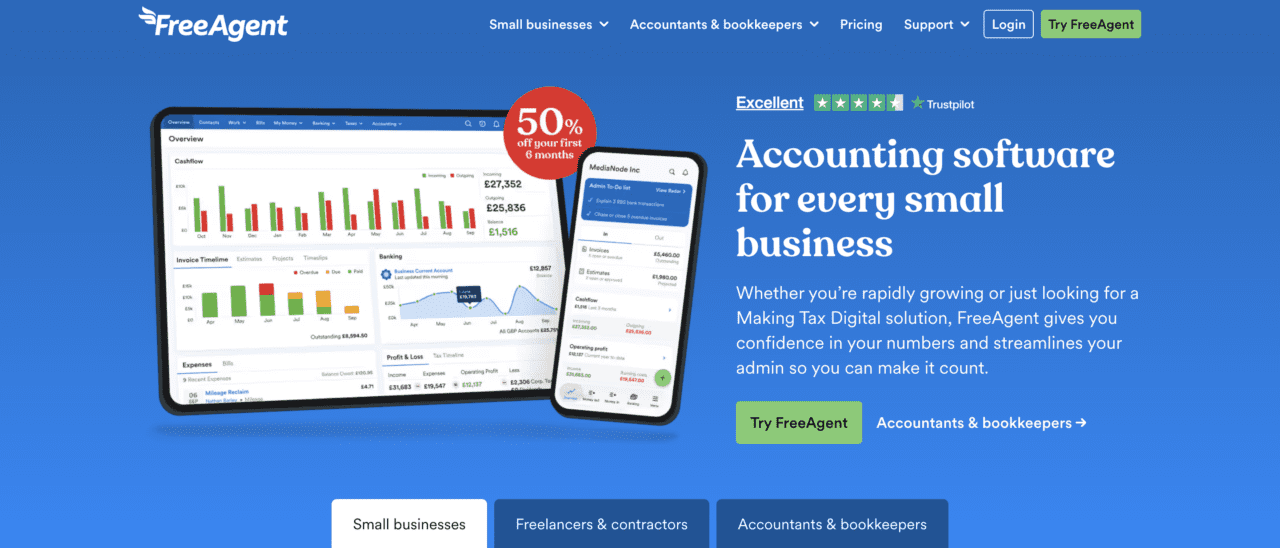
Edinburgh, Scotland-based fintech FreeAgent has announced a handful of integrations in recent days. First, the company reported that it had integrated with cloud-first workpapers and accounts platform Active | UK. Active works with core accounting systems to boost accuracy and standardize workflows. The partnership will enable users to automatically import data from FreeAgent into Active Workpapers, reducing the potential for human error and enabling faster, more consistent reporting.
Second, just this week FreeAgent reported that it has integrated with accounting practice management platform Sodium Software. The partnership is designed to help accounting professionals and teams in the UK streamline CRM, proposals, workflows, invoicing, and more. Connecting FreeAgent accounts to Sodium will enable accountants and teams to sync client data instantly and directly monitor the status of clients. In a LinkedIn post, FreeAgent added that further functionality, including automated billing and bookkeeping insights, is “coming soon.”
Founded in 2001, Active | UK is celebrating its 25th year as a technology partner for accounting firms. A division of Active by Business Australia, Active | UK helps companies standardize processes and workflows to ensure that all team members are working in the same way. Active | UK offers automated accounting workflows to seamlessly populate and sync data, and an intuitive Excel split pane that gives users greater control and transparency over figures and calculations.
Officially in public beta, Sodium Software was launched in late 2025 as a practice management platform for UK accountants. While seeing practice management as “the foundation,” the company has noted that its roadmap extends beyond this to include AML, payments, accounts production, and more. Sodium Software recently unveiled new features including unlimited custom fields, pricing tiers, and the ability to make both client and bulk updates.
FreeAgent made its Finovate debut at FinovateEurope 2013 in London. Founded in 2007, the company today has more than 200,000 small businesses, accountants, and bookkeepers using its accounting software
Insurtech Wrisk Acquires Atto, formerly DirectID
Here’s some M&A news from last month that slipped under our radar: Independent embedded insurtech platform for the automotive OEM sector Wrisk has acquired real-time financial intelligence platform Atto. Terms of the transaction were not disclosed.
Atto enables companies to make context-aware credit and risk decisions within live customer journeys. Leveraging open banking to securely access and analyze transaction-level data, Atto’s technology transforms it into actionable insights that can be embedded into regulated, enterprise-grade customer experiences. Wrisk, which partners with automotive OEMs to embed insurance directly into the consumer journey, will use Atto’s financial intelligence solution to offer greater flexibility in how financing and protection products are designed and delivered.
The acquisition will also enable Atto to take advantage of Wrisk’s OEM relationships, delivery capability, and regulated operating framework to deploy its capabilities across a broader range of markets and use cases.
“Atto has built a credible financial intelligence and credit scoring platform with real-world enterprise use,” Wrisk Chief Executive Officer Nimesh Patel said. “Joining Wrisk allows us to combine that intelligence with a delivery layer that serves brands and other partners at scale.”
Edinburgh, Scotland-based Atto rebranded from DirectID in 2024. DirectID was launched in 2016 as the flagship product of James Varga’s The ID Company (which itself was a rebrand of Varga’s miiCard, a digital verification company and Finovate alum founded in 2011).
“Joining Wrisk represents a natural next phase in Atto’s growth,” Atto Strategic Programme Advisor Rob Knight said. “We have proven the value of open banking-driven credit intelligence with enterprise clients, and Wrisk brings the regulated operating framework and delivery capability required to deploy that intelligence at scale. Together we can embed credit decisioning, affordability, and actionable insights directly into live finance and protection journeys.”
Here is our look at fintech innovation around the world.
Middle East and Northern Africa
We Are Tech Africa profiled Algerian fintech platform Gifty, which offers a single app for shopping, billpay, mobile top-ups, and digital gift cards.
MENA-based fintech Network International and ADCB Egypt went live with FICO Falcon Fraud Manager.
The Times of Israel looked at how momentum from 2025 will drive the Israeli fintech industry in 2026.
Central and Southern Asia
State Bank of India forged a strategic partnership with Japan’s MUFG to bolster financial collaboration between India and Japan.
Santander teamed up with Visa to test agentic payments in markets in Latin America.
DriveWealthannounced a partnership with Latin American neobank Banco Ualá to help it launch a new stock investing service for customers in Mexico.
Jamaica Observers profiled financial wellness app Quatta which goes live this month.
Asia-Pacific
Mizuho Financial Group choseFIS’Balance Sheet Manager to help it navigate new regulatory reporting requirements in Japan.
Indonesia-based digital credit unicorn Kredivo acquired Vietnamese digital bank Timo.
Mastercardannounced a collaboration between its money movement platform, Mastercard Move, and Bank of Shanghai.
Sub-Saharan Africa
UK-based international credit information and risk management service provider Creditinfo announced its entry into the Uganda market.
African Islamic neobank Nyla partnered with Mambu as it goes live in Ghana and readies for West African expansion.
Nigerian fintech Thrifto launched a platform to help digitize traditional group savings scheme such as Ajo and Esusu,
Central and Eastern Europe
Commerzbank and Berlin, Germany’s Hawkannounced a collaboration to leverage AI to optimize internal banking processes such as fighting money laundering.
Berlin-based AAZZURforged a partnership with Estonian electronic money institution Wallester.
Romanian P2P lending platform Fagura secured investment from Bravva Angels, named “FinTech of the Year” at 2026 Romanian Startup Awards.
Have you been keeping up with the conversations on the Finovate Podcast?
Podcast host and Finovate VP Greg Palmer has interviewed an interesting range of guests in the first few months of 2026. From Best of Show winners to venture capitalists to fintech founders, Palmer’s podcast guests provide great insights into some of the most compelling innovations and the most important trends in our industry. Below are some of the conversations Greg has hosted so far this year.
Greg Palmer interviews FinovateEurope Best of Show winner Tweezr on updating legacy systems through LLMs and AI.
In this podcast conversation Greg Palmer sits down with Matt Ober, Managing Partner at Social Leverage, for a perspective on fintech investment trends in 2026.
Finovate podcast host Greg Palmer interviews Joel Blake, OBE, founder and CEO of GFA Exchange on the challenge and reward of democratizing access to finance.
Squarespace is launching Squarespace Balance, a new financial account that lets merchants manage earnings, spending, and cash flow directly within Squarespace Payments.
Balance builds on Squarespace’s growing suite of financial tools that help entrepreneurs run and scale their businesses online.
Bringing business banking capabilities into its platform helps Squarespace compete with companies like Ramp and Shopify.
Website building and hosting platform Squarespaceunveiled its latest tool to help entrepreneurs run their businesses online. The New York-based company is debuting Squarespace Balance this week, a new account designed to help merchants manage business finances and earn rewards.
Balance sits within Squarespace Payments, the company’s payment solution that integrates with a business’ online store, allowing merchants to accept payments through Squarespace. With Balance, merchants can access funds within hours, earn rewards on their balances, and spend using their Squarespace Visa Commercial card. Balance offers a unified view of a business’ earnings, spending, and cash flow management on the same platform as the rest of the business.
“Squarespace Balance rounds out our suite of financial tools by offering a native financial account that helps merchants manage their business finances and earn rewards, all in one place,” said company SVP of Commercial Dan Chandre. “It reflects our belief that financial services should feel like a natural extension of running a business, not another system entrepreneurs have to manage.”
Because it brings banking capabilities in-house, Balance allows merchants to receive and spend their money in the same platform where they run their business, without needing external banking integrations. The move will help Squarespace compete with other software platforms that are embedding financial services directly into their products. Companies such as Ramp, Shopify, and Stripe have all expanded into financial accounts, corporate cards, and cash management tools that keep businesses operating inside their ecosystems.
Offering a native financial account alongside payments and financing tools like Squarespace Capital, Squarespace is positioning itself to capture more of the financial activity of its existing customers while simplifying financial management for small businesses that would otherwise rely on multiple providers.
Squarespace Balance is currently available to new users in the US and will be expanded to the company’s existing users in the coming months.
Squarespace launched Payments in 2023, and has since been focused on growing its financial tools available to support small businesses. As part of this expansion, the company launched Squarespace Capital in 2025 to offer merchants flexible financing to help them grow their business. Additionally, Squarespace offers tools such as Pay Links, which helps merchants accept payments via links; Tap to Pay, which allows merchants to accept in-person payments without additional hardware, as well as shipping tools, invoicing capabilities, and more.
Originally founded in 2003, Squarespace’s platform has helped millions of customers across more than 200 countries build and run their businesses online. In addition to payments capabilities, the company also offers websites, domains, marketing tools, and appointment scheduling.
Agentic AI infrastructure company Lyzr AI has raised $14.5 million in Series A+ funding. The round was led by Accenture and gives the company a valuation of $250 million.
This week’s investment follows Lyzr AI’s successful $8 million Series A round in October.
Headquartered in Jersey City, New Jersey, Lyzr AI made its Finovate debut at FinovateFall 2025 in New York.
Agentic AI infrastructure platform Lyzr AI has secured $14.5 million in a Series A+ round led by Accenture. The investment gives the Jersey City, New Jersey-based startup a valuation of $250 million, and comes less than a year after the company’s $8 million Series A round in October. In a statement on its LinkedIn page, Lyzr AI noted that the investment will help it further develop its “foundational technology platform to power the post-generative AI landscape.”
“Enterprise AI adoption is accelerating,” the company’s note continued. “But not the kind that lives in slide decks and conference rooms. The kind that passes 300-question technical audits. The kind that runs inside a customer’s own VPC. The kind that survives VAPT and red teaming before it ever touches production. That is the standard Lyzr was built for.”
Lyzr’s platform enables companies to build, design, and deploy AI agents that can complete tasks, interact with enterprise tools and data sources, and automate workflows including customer onboarding, loan servicing and origination, regulatory monitoring, claims processing, and more. With more than 100 production-ready AI agents available, Lyzr’s technology streamlines processes for banking, insurance, human resources, marketing, and sales, and is used by companies including AWS, Hitachi, NTT Data, and Nvidia.
“The true strength of Lyzr’s enterprise platform lies in the compounding value of our ecosystem,” the company wrote. “We have built an architecture designed to drive mutual growth and strategic alignment across the board, delivering measurable success for our customers, consulting partners, hyperscalers, and LLM providers alike.”
Founded in 2023, Lyzr made its Finovate debut at FinovateFall 2025 in New York. At the conference, the company demonstrated how its Lyzr Studio enables customers to build agents, knowledge graphs, responsible AI guardrails, and agent evaluation in a single location. The builder-focused platform offers businesses an open source framework with embedded Safe & Responsible AI guardrails.
Lyzr’s fundraising announcement comes just days after the company announced a strategic partnership with business AI transformation and enterprise integration firm Pronix Inc. The two companies will work together to help accelerate the adoption of agentic AI by businesses, combining Lyzr’s technology with Pronix’s expertise in digital transformation and modernization. Lyzr also recently announced that it is working with data infrastructure and agentic AI company GWC Data.AI, which joined Lyzr’s Partner Accelerator for Lyzr (PAL) program in late February.