This site is operated by a business or businesses owned by Informa PLC and all copyright resides with them. Informa PLC's registered office is 5 Howick Place, London SW1P 1WG. Registered in England and Wales. Number 8860726.
Finovate Blog
Tracking fintech, banking & financial services innovations since 1994
Backbase launched Conversational Banking, an agentic AI solution that allows banks to move beyond answering customer questions to executing banking tasks within predefined permissions and controls.
More than 10 banks are already using the solution, with one major South African bank increasing self-service containment from 20% to 70% across 22 million customer interactions.
The launch highlights a broader shift toward AI-powered execution in banking, raising questions about whether banks will prioritize cost savings or leverage AI to deliver more personalized customer experiences.
Engagement banking solutions provider Backbase is launchingConversational Banking this week to bring agentic AI into the customer and employee experiences.
The launch comes 18 months after Backbase unveiled its new AI-powered banking platform that sought to improve customer engagement with AI-powered self-service and real-time support. Conversational Banking, which runs on Backbase’s AI-native Banking OS, takes that a step further by allowing the AI agent to actually execute appropriate banking actions on the behalf of consumers and employees, given that they fall within pre-defined permissions, policies, and approvals as set by the bank.
The Conversational Banking tool works alongside existing digital banking stacks and allows customers to use natural language prompts to have their lost payment card blocked and replaced, check a payment, or progress a service request. By leveraging customer context, permissions, and connected banking systems, AI agents can carry out specific, permitted tasks on customers’ behalf. For requests that require further investigation or human judgment, employees can pick up where the agent left off by examining an overview of the work the agent has already completed.
“Digital banking put the bank in the customer’s pocket. The next step is to let customers say what they need done and have the bank’s agents act on it intelligently,” said Backbase Founder and CEO Jouk Pleiter. “That future has now arrived early: one where agents do the work, and banks stay in control. It completely changes both the customer experience and the economics of serving them.”
Backbase anticipates that by allowing AI agents to carry out tasks on behalf of consumers and employees, banks can scale and increase their service capacity. In fact, according to a report by McKinsey & Company, agentic AI could cut banks’ operating costs by 15% to 20%, as the automation frees up employee time for advice, exceptions, and complex needs.
Currently, 10+ banks have already started using Backbase’s new Conversational Banking and have reported positive feedback. One of the four largest South African banks has so far supported 22 million customer interactions, while improving self-service containment from 20% to 70%.
Backbase’s launch shows that banks are beginning to shift from AI-powered tools to AI-powered execution. Chatbots have historically been limited to providing information and directing customers to the appropriate resources. By handing tasks over to agentic AI, banks can automate the steps required to resolve customer requests. This transforms AI from a customer service tool into a functional layer of the banking experience. With its background in compliance, Backbase is in a great position to add reliable governance and permissions into the agentic process, addressing one of the key hurdles preventing banks from putting agentic AI into production.
The bigger question, however, is whether banks will use these agentic capabilities primarily to reduce operating costs or to meaningfully improve the customer experience. Automating routine service requests can certainly improve efficiency, but the longer-term opportunity may lie in using AI to deliver more proactive, personalized banking services.
This week’s edition of Finovate Global showcases recent fintech news from South Korea.
Gwangju Bank and Toss announce stablecoin QR payment PoC
Korea’s Gwangju Bank announced that it had successfully completed proof of concept (PoC) for stablecoin-based QR code payments in partnership with Seoul-based superapp Toss. The PoC linked the Gwangju Bank mobile app, the Toss app, and Toss Place payment terminals. Selecting stablecoin payment in the bank app opens the QR scanner in the Toss app, where the user can scan the QR code displayed on the merchant’s payment terminal to verify the payment amount and complete the transaction.
The demonstrated flow was designed to transfer stablecoins from the customer’s wallet to the merchant’s wallet. The payment result could then be verified in the Gwangju Bank app, completing the app-to-app payment process. The PoC used a virtual merchant, and no actual customer data or assets were involved.
The two entities added that they plan to streamline the process by reducing the number of steps customers must take. The bank and fintech are also discussing a second phase of testing involving actual merchants in the Jeonnam and Gwangju regions.
“The PoC conducted with Toss is significant in that it established a technological foundation to proactively respond to the digital asset payment environment and verified the user experience from a customer perspective,” Gwangju Bank Vice President Byun Mi-Kyung said.
Gwangju Bank is a regional South Korean financial institution and a subsidiary of JB Financial Group. Founded in 1968, the bank reported total assets of approximately KRW 34.4 trillion ($54 billion) at year-end 2025. It operates branches in Gwangju, Jeonnam, Seoul, Incheon, and Seongnam.
Founded in 2015 as a money transfer service, Toss has grown into one of Korea’s leading superapps with 30 million users. Toss offers an ecosystem of more than 100 financial management and e-commerce services, along with more than 10,000 mini apps through its Apps in Toss platform, which runs within the Toss app.
Canton Foundation forges strategic partnership with LG CNS
In a bid to expand institutional adoption of the Canton Network in Korea, the Canton Foundation has announced a strategic partnership with Seoul-based IT services provider and systems integrator LG CNS. Together, the Canton Foundation and LG CNS will develop technical capabilities to support Canton implementation as help build a broader technical partner ecosystem.
“Korea is a critical market for institutional adoption of Canton in Asia,” Canton Foundation Head of APAC Thomas Chou said. “This partnership is about building the market together, combining Canton’s growing institutional ecosystem with LG CNS’s deep technology capabilities and relationships across the Korean financial sector. Together, we aim to help institutions move from identifying opportunities to implementation, while building the broader technical ecosystem needed to support adoption at scale.”
The Canton Network is a public, permissionless blockchain designed specifically for institutional finance, while individual applications can define their own permission requirements. Announced in 2023, the network’s mainnet went live in July 2024. It was designed to balance blockchain transparency with the confidentiality required by regulated financial institutions and markets. Canton operates as a modular blockchain ecosystem in which participating institutions maintain their own ledgers while connecting with others via a shared synchronization layer. Canton’s “network of network” architecture enables real-time secure synchronization and settlement, atomic transactions that ensure that complex exchanges involving multiple parties are completed in full or not at all, and privacy for sensitive financial information.
The partnership between the Canton Foundation and LG CNS will focus on three areas: institutional market development, technical enablement and implementation, and technical partner ecosystem growth. LG CNS has been a major player in Korea’s blockchain-based financial industry since 2015. Beginning with the issuance of blockchain-based electronic securities, the company has built the infrastructure for the issuance, distribution, settlement, and trading of digital assets such as CBDCs, tokenized deposits, security tokens, and stablecoins, as well as digital wallets and KYC systems for financial institutions. LG CNS has also built and operated core systems for major commercial banks, insurers, credit card companies, and securities firms for more than 30 years.
“Financial institutions are increasingly moving from exploring blockchain technology toward practical implementation,” said LG CNS EVP and Head of Digital Business Division Hongkeun Kim. “Through our partnership with Canton Foundation, we look forward to combining LG CNS’s technology and implementation capabilities with the Canton ecosystem to develop meaningful opportunities with institutions in Korea. We also look forward to contributing our experience to the development of a broader technical partner ecosystem that can support institutional adoption over the long term.”
The Canton Foundation is the advocacy and expansion arm of the Canton Network. The organization is dedicated to expanding the network’s reach and promoting broader institutional adoption.
Korea Fintech Industry Association announces new anti-hacking strategy
In response to a series of suspected, AI-assisted cyberattacks and data leaks that struck at least seven major South Korea financial institutions in recent weeks, the Korea Fintech Industry Association brought fintech firms and electronic payment providers together this week to discuss the importance of coordinated data-sharing and early risk checks to enhance their defense against cyberattacks.
Kim Jong-hyun, chairman of the association, said recent cyber incidents should not be viewed as problems affecting individual companies alone, but as threats to public confidence in financial services as a whole. His remarks underscored the need for coordinated information-sharing and greater cooperation with regulators to strengthen security. The chairman also emphasized the importance of building systems that will enable teams to identify risks early and respond proactively.
The discussion also covered the Financial Supervisory Service’s (FSS) IT security self-inspection checklist, which the country’s Financial Services Commission has asked firms to use. The 12-point checklist addresses threat intelligence and blocklists, system abnormality detection, access controls and vulnerabilities, system hardening, and incident investigation.
Here is our look at fintech innovation around the world.
Central and Eastern Europe
Czech fintech Dateio secured its biggest contract to date thanks to a partnership with ING.
Bulgaria’s Fibank partnered with Bitpanda Enterprise to integrate crypto investing into its My Fibank app.
Poland’s mBank introduced BLIK Recurring Payments, the ninth bank in the country to offer the service.
Middle East and Northern Africa
Valley National Bank acquired Israeli fintech Bluevine for $340 million.
Diebold Nixdorfannounced that it will deploy cash recyclers for digital wallet and mobile payments company stc pay Bahrain.
US-based money transmitter Viamaericas has added Ethiopia and Morocco to its remittance network.
Central and Southern Asia
TBC Uzbekistan launched its first secured lending product for SMEs.
India’s Pine Labs introduced a unified payments platform for merchants in Singapore.
DK Bank to establish a subsidiary in the UAE, becoming the first Bhutanese bank to expand its financial services offering internationally.
Latin America and the Caribbean
Brazilian fintech Asaas raised $55.6 million in new funding to supports its payment, financial management, and credit tools for small businesses.
SoFi Tech Solutions (formerly Galileo) teamed up with Orbi and Mastercard to launch a crypto-linked card in Mexico.
Latvia’s Regula and Chile’s Bernini.ai announced a partnership to provide ID verification for AI agents.
Asia-Pacific
South Korea’s Gwangju Bank and fintech Toss successfully completed a proof of concept involving stablecoin payments using QR codes.
Vietnam’s MB Bank partnered with OceanBase to modernize its database infrastructure.
The Korea Fintech Industry Association announced new anti-hacking measures in the wake of series of recent cybersecurity incidents involving financial services companies.
Sub-Saharan Africa
Pan-African payments aggregator PawaPay secured a Payment Service Provider (PSP) license from the Bank of Mozambique.
South Africa’s WalletDoc launchedVisa Payment Passkeys for merchants in the country.
Pan-African neobank Mukuru introduced its new account and card in South Africa, in partnership with Bank Zero and Mastercard.
Know Your Business (KYB) platform Intrepid Fox has teamed up with KYB data and public register provider Topograph.
The partnership will combine Intrepid Fox’s KYB workflows with live company records from official registers for onboarding and ongoing reviews.
Intrepid Fox most recently demoed its technology at FinovateEurope 2025 in London.
UK-based Know Your Business (KYB) platform Intrepid Foxannounced a partnership with Topograph, a company that provides the data layer for B2B onboarding. The partnership is designed to close the information gaps that can develop after business customers are initially onboarded and keep databases up to date with information on a company’s status, ownership, address, and more. Intrepid Fox’s AI agents provide updated company information that can be compared with data that is already on file. The agents can determine whether follow-up is required and can create context to support human agents in their investigations.
The goal is to combine detection with action through a structured review that records the evidence, follow-up, and human decision-making. This enables compliance teams to focus on those changes that are most critical instead of having to manually review and refresh every company file.
“Monitoring tells you that something changed. A compliance team still needs to understand what changed, whether it matters to the relationship, and what evidence supports the next step,” Intrepid Fox CEO and Co-founder Roman Zilber said. “Working with Topograph helps us connect that signal to a review where context and human judgement remain visible.”
As vital as KYB processes are, they are only as reliable as the records they start with. By monitoring company records directly from their official registers, Topograph provides updated information that is live and traceable to its source. This approach avoids the problems of stale databases, manual searches, and compliance gaps. The company offers a single API that enables teams building onboarding and KYB flows to get live company data, beneficial ownership information, and official documents, while monitoring their systems for changes—all of which is normalized across markets and traceable back to the source. Headquartered in Paris, Topograph was founded in 2024.
“Compliance decisions are only as good as the data behind them,” Topograph CEO and Co-founder Pierre-Henri Janssens said. “That’s what guides our work at Topograph: we connect to more than 100 official registers ourselves, which lets us monitor company records in real time and trace each data point back to its source. Intrepid Fox builds on that foundation, so compliance teams can work through each change with the full context in front of them.”
Founded in 2024 and headquartered in London, Intrepid Fox made its Finovate debut at FinovateEurope 2024 and returned the following year for FinovateEurope 2025. The company leverages GenAI to power document collection and accelerate business customer onboarding for banks and fintechs. Intrepid Fox’s technology helps reduce follow-ups and the operational burden of KYC, while enriching collected data from online and open sources.
Intrepid Fox’s partnership news comes just a few weeks after the company announced an integration with real-time company data provider Kausate. Like Topograph, Kausate connects platforms directly to official registers to provide real-time access across European jurisdictions.
For much of the financial services industry, the conversation around AI has focused on creating efficiencies by automating processes, reducing costs, and replacing manual work. But banks may be overlooking AI’s biggest opportunity. Rather than focusing on what AI can eliminate, financial institutions may find greater value in using the technology to better understand their customers, anticipate their financial needs, and deliver personalized experiences that drive revenue.
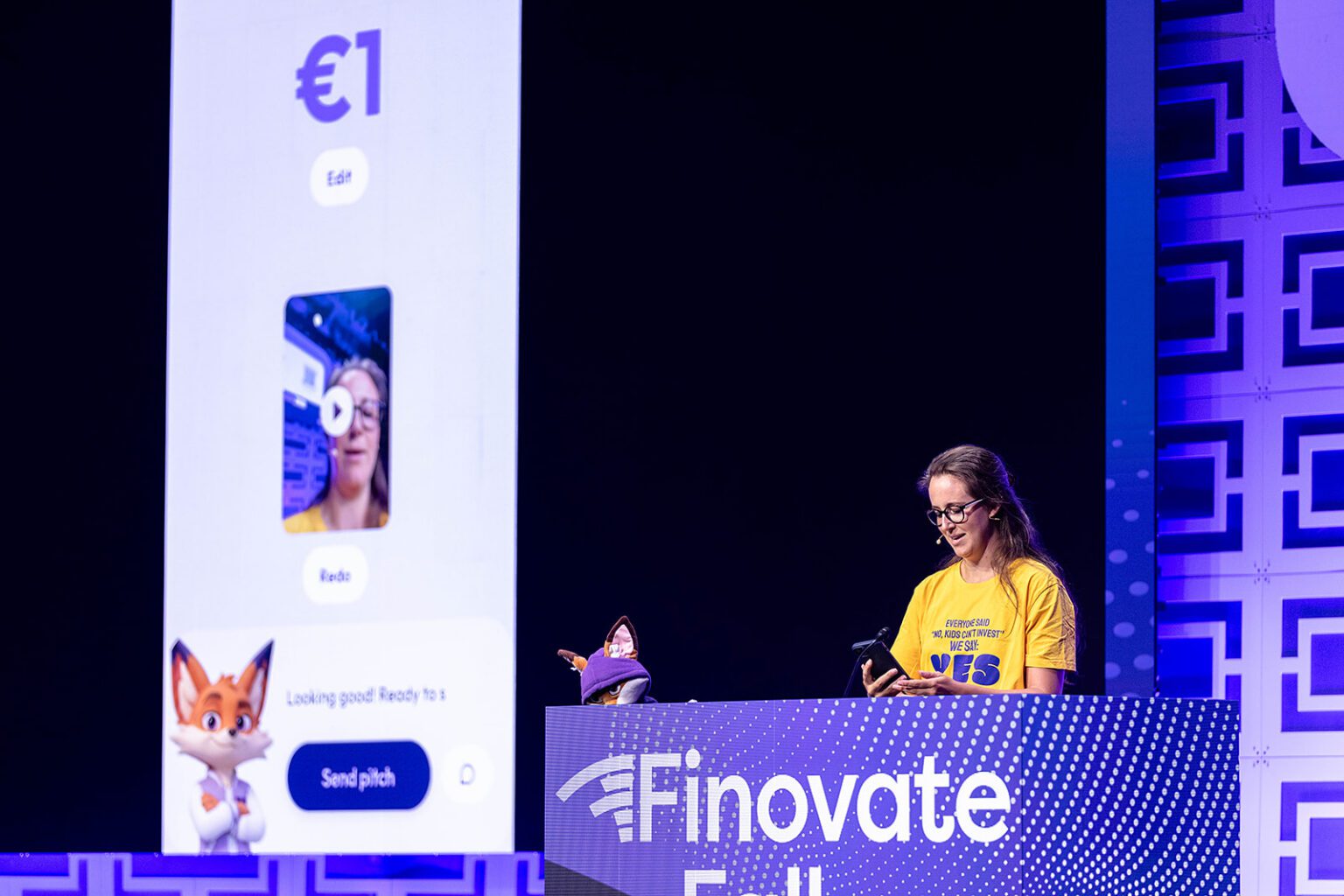
In this conversation from FinovateFall 2026 in New York, we speak with Oban MacTavish, Co-Founder and CEO of Spade, about why the industry’s enthusiasm for AI agents may be misplaced and how better transaction data can help banks unlock AI’s potential. MacTavish explains why traditional payment data isn’t built for modern intelligence tools and how financial institutions can use AI to recreate the personalized relationships customers once had with their local bankers, but at scale.
“I think most of their customers are looking for a better experience, and it’s one of the ways that we actually see the biggest opportunity for AI in financial services is helping them turn their data into revenue,” said MacTavish.
MacTavish is Co-Founder and CEO of Spade, a New York-based financial data and AI company he co-founded in 2021. Under his leadership, Spade has expanded its platform to help financial institutions make better use of payments data for fraud prevention, customer engagement, analytics, and AI-powered applications. MacTavish also participated in a fireside chat at FinovateFall 2026 on how AI is changing offers, cross-sell, and personalization.
Founded in 2021, Spade transforms raw transaction data into structured, actionable merchant intelligence. Its platform helps banks, fintechs, and other financial services companies identify merchants, enrich transaction records, and build more personalized financial products and experiences. Spade raised $40 million in Series B funding in March 2026, led by Oak HC/FT, to expand its data and AI capabilities.
UK-based open banking platform TrueLayer raised $27 million in a funding round led by CDP Venture Capital, bringing its total funding to $348.8 million.
TrueLayer is expanding beyond one-time pay-by-bank payments with recurring payment capabilities and its acquisition of BNPL provider in3, positioning itself to compete more directly with traditional card networks.
The investment reflects Europe’s push for greater financial sovereignty, supporting the development of European-owned payment infrastructure as pay-by-bank adoption grows across the region.
UK open banking platform TrueLayer has brought in $27 million in a funding round this week led by Italy-based CDP Venture Capital with additional contributions from existing and new investors. The investment adds to the $321.8 million already raised and brings TrueLayer’s total raised to $348.8 million.
“We started TrueLayer with a simple belief: Europe deserves payment infrastructure built in Europe. Having Italy back that belief means a great deal to us personally, especially to our talented team in Milan, who work hard every day to build the future of European payments,” said TrueLayer Co-Founder and CEO Francesco Simoneschi.
Founded in 2016, TrueLayer powers $150 billion each year in online pay-by-bank payments for more than 30 million consumers in 22 countries. The company provides the connectivity and commercial payment experience that make payment rails accessible to businesses. By cutting out the middlemen involved in the payments stack, TrueLayer’s pay-by-bank tools help merchants lower payment costs by up to 40%, increase average order value by 20%, and reduce fraud by eliminating the need for payment cards. Among TrueLayer’s competitors are Trustly, Visa-owned Tink, and Volt.
Earlier this year, TrueLayer announced support for recurring payments and acquired Dutch buy now, pay later (BNPL) provider in3. The move adds a financing component to an offering historically focused on immediate bank payments. These two developments show that TrueLayer is seeking to compete beyond the pay-by-bank space. The company is slowly shifting its focus to compete with card payments at ecommerce checkout, replace card-on-file for subscriptions and repeat purchases, support merchant refunds and instant disbursements, and offer purchase financing without depending on traditional card rails.
While pay-by-bank has seen limited growth in the US, its usage is growing in Europe. In July of this year, the UK’s open banking ecosystem reached two major milestones, reaching more than one billion open banking payments and 100 billion API calls recorded across the CMA9 banks since the launch of open banking started more than eight years ago.
As European policymakers and investors increasingly emphasize financial sovereignty, TrueLayer offers an opportunity to build an alternative to payment infrastructure dominated by US-based companies such as Visa and Mastercard. CDP Venture Capital’s investment underscores that ambition, positioning pay-by-bank as both a lower-cost payment option and a strategic component of Europe’s financial infrastructure.
“Europe needs payment infrastructure it owns and controls, and we are investing across the continent to help build it,” said Mario Branciforti of CDP Venture Capital. “TrueLayer is a clear example of what that looks like in practice, with a network already operating at scale in 22 countries.
All 72 demo videos from FinovateFall 2026 are now available for viewing—100% free. Whether you are looking to catch up on demos that you missed at the conference last month or just want to get another gander at a few of your favorite presentations, the demo videos for FinovateFall 2026 can now be viewed either at our Finovate blog video archive or at our FinovateTV channel on YouTube.
To whet your viewing appetite, consider starting your FinovateFall 2026 demo video watch-a-thon with these eight videos from the companies that took home Best of Show awards from the event.
Gusto unveiled three updates for its 23,000+ accounting firm customers: a rebuilt Gusto Pro, a multi-client Model Context Protocol (MCP), and an expanded Gusto Partner Program.
The new tools use AI to help accountants scale their practices, automating payroll preparation and reporting while allowing accountants to retain control over approvals and focus on higher-value advisory work.
The company’s multi-client MCP brings its payroll data into accountants’ preferred LLMs, signaling a shift in which financial software can remain the underlying system of record even when an AI assistant becomes the primary interface.
Payroll, benefits, and HR management solutions company Gusto is shipping three new updates to help its more than 23,000 accounting firm customers serve their small business clients. The California-based company is adding a rebuilt Gusto Pro, a new multi-client Model Context Protocol (MCP), and an expanded Partner Program.
The new capabilities let firms put AI agents to work on payroll prep while staying in control of approvals. Gusto aims to empower its accountant clients to better serve their own customers while scaling their practices.
Gusto Pro, the company’s accountant payroll software, has been updated to include new AI-assisted workflows, an AI assistant with visibility into multiple clients, automated reporting, and a simplified dashboard built to free up accountants from manual tasks. While the updated platform is now available to eligible clients, the company is planning to make the updates generally available later this year.
“Gusto Pro provides advisory forward-thinking insights and tools,” said Wyatt Kneaper, founder and CEO of The Lighthouse Group, an accounting firm based in Eureka, California. “When a client is engaged, we can surface insights based on Gusto Pro to say, hey, let’s have a conversation. What are your goals? What direction do you want to head in the next two to five years? There’s a huge door that potentially opens.”
Additionally, the company now offers accountants a multi-client MCP that brings Gusto’s business context directly into the accountant’s preferred LLM. Because the MCP is multi-client, accountants can use their LLM to ask questions across their book of business without having to log in multiple times or set up multiple different windows for conversations.
Finally, Gusto has upgraded its Partner Program to help accountants grow their firms and receive more revenue share when they serve more clients on Gusto.
The Gusto Partner Program incentivizes firms to grow their practices by offering rewards. When accountants serve more clients on Gusto, they receive more revenue share as well as increased strategic support to invest back into their firms. Gusto offers marketing support, development funds, access to a consultant network, and the use of AI agents to help firms win new clients and deepen advisory revenue.
These updates show that fintechs are responding to their clients’ interests in leveraging AI to better serve their end customers. In Gusto’s case, the fintech is using AI agents to take over more of the preparation itself, leaving accountants to review and approve the work and spend more time on higher-value advisory services. Additionally, the multi-client MCP allows accountants to access Gusto data and prepare payroll from the LLMs where they already work.
In the broader fintech context, the MCP connection may be the most interesting piece of today’s announcement, as it shows that Gusto is acknowledging that the primary interface for financial software isn’t necessarily its own platform but rather the customer’s LLM. Gusto will remain the system where payroll data lives and transactions ultimately take place, while accountants choose to interact with that data through their AI assistant.
Automotive aftermarket parts distributor LKQ Europe announced a partnership with Digital Adoption Platform company Whatfix.
LKQ Europe will deploy the company’s platform as part of an overhaul of its LKQ Academy’s learning management system for automotive professionals.
Headquartered in San Jose, California, and Bangalore, India, Whatfix made its Finovate debut at FinovateSpring 2026.
LKQ Europe, an automotive aftermarket parts distributor, has partnered with Whatfix to deploy the company’s Digital Adoption Platform and Product Analytics across its LKQ Academy.
A training program for automotive professionals, the Academy provides hundreds of e-learning courses, instructor-led training through 15 training centers, and certifications. The partnership with Whatfix is part of an initiative by the automotive parts company to transition its training operations to a more centralized learning management system. The platform supports 70,000 registered users—including mechanics, workshop owners, automotive technicians, and internal teams—across 13 European countries. Whatfix will deliver in-platform guidance to help them navigate the new learning system, find relevant coursework, and complete training tasks. Whatfix’s analytics tools will enable LKQ Europe to see where users are encountering difficulties, allowing the Academy to make ongoing improvements to the learning experience.
“As AI and software reshape every industry, organizations need learning experiences that are embedded directly into work, personalized to every user, and continuously optimized through real-time insights. That’s the shift we’re enabling with LKQ Europe,” Whatfix Co-Founder and CEO Vara Kumar said.
Whatfix’s Digital Adoption Platform combines digital adoption, analytics, simulation training, and intelligent agents to help companies secure value from their technology investments faster. The platform is powered by AI and ScreenSense and understands user context and intent to provide real-time guidance, automate support, identify friction points, and fuel continuous process optimization. The platform helps institutions accelerate technology adoption, boost productivity, enhance regulatory compliance, and deliver greater returns from both enterprise software and AI initiatives.
LKQ Europe plans to adopt additional Whatfix capabilities over time, introducing new training programs, communicating platform updates, and creating more personalized learning experiences for customers.
“Automotive professionals are expected to master technologies that are evolving faster than ever before,” said Jason Conway, European Product Manager, Training Platforms, LKQ Academy. “Success depends on making learning as accessible and intuitive as the work itself. LKQ Academy is a strategic investment in the future of our customers, and with Whatfix we’re creating a digital learning experience that empowers every user to learn with confidence while enabling us to continuously improve that experience over time.”
Headquartered in Zug, Switzerland, LKQ Europe is an automotive aftermarket parts distributor for cars, vans, and industrial vehicles across more than 18 countries in Europe, including Central and Eastern Europe, Italy, Scandinavia, the UK, and Ireland. A subsidiary of LKQ Corporation, LKQ Europe has approximately 25,000 employees and more than 900 branches. The firm supports more than 100,000 workshops through strong logistics, digital tools, and training via its LKQ Academy.
Founded in 2013, Whatfix made its Finovate debut at FinovateSpring 2026 in San Diego. At the conference, the company demonstrated its AI-native digital adoption platform. With more than 600 enterprises around the world using its technology—including more than 80 Fortune 500 companies—Whatfix has a global presence that extends to North America, the UK, Europe, Asia-Pacific, and Australia. Whatfix is backed by investors including Warburg Pincus, SoftBank Vision Fund 2, Dragoneer, Peak XV Partners, Eight Roads, and Cisco Investments.
Experian launched the Cashflow Data Bureau, a new FCRA-regulated consumer reporting agency that uses consumer-permissioned cash flow data to support lending decisions.
The new bureau will serve as the foundation for Experian’s broader cash flow ecosystem, combining bank account data with existing tools such as Cashflow Attributes and Cashflow Score.
The launch puts Experian into closer competition with Plaid and other cash flow underwriting providers as lenders increasingly use banking activity alongside traditional credit data to assess borrowers.
Data analytics and consumer credit reporting company Experian is launching a new consumer reporting agency (CRA) called the Experian Cashflow Data Bureau. The new CRA’s goal is to help banks leverage consumer-permissioned cash flow insights to support underwriting decisions.
The Experian Cashflow Data Bureau, which operates under the Fair Credit Reporting Act (FCRA), aims to help the nearly one-in-five consumers that lack access to credit or have damaged credit. Experian found that 60% of consumers who have either been denied credit or received less-than-favorable terms believe that the outcome of their application would have been different if the lender would have used cashflow underwriting, taking into account the borrower’s recent income and banking activity along with their credit history.
With the new Cashflow Data Bureau, Experian is creating an FCRA-regulated foundation for its broader cash flow decisioning ecosystem. The new platform leverages consumer-permissioned bank account data aggregation and report generation to help financial institutions bring cashflow insights into their existing decision-making process.
“We’ve spent decades building the trusted data, analytics, technology, and expertise financial institutions depend on every day,” said Experian North America CEO Jeff Softley. “With Experian Cashflow Data Bureau, we’re applying that experience to cash flow and making it easier for our clients to adopt these insights with confidence and at scale. By helping lenders understand a more complete picture of consumers’ financial lives, we can power more-informed decisions and ultimately help more consumers access the financial products and services they need, when they need them.”
The new Cashflow Data Bureau will serve as the foundation for Experian’s broader cash flow ecosystem, bringing together existing cash flow products such as Cashflow Attributes and Cashflow Score with capabilities for consumer consent, data aggregation, standardized reporting, analytics, and decisioning. The launch essentially brings cash flow data into a bureau-like framework, allowing lenders to incorporate consumer-permissioned banking activity into underwriting alongside traditional credit bureau data.
Cashflow underwriting is becoming increasingly popular in the lending sphere as it can help lenders better understand applicants’ day-to-day finances instead of just offering a snapshot in time. Experian’s analysis shows that the insights can help lenders increase approvals by up to 25% without adjusting their risk tolerance.
Today’s launch puts Experian into closer competition with open banking providers such as Plaid, which has expanded beyond account connectivity into FCRA-compliant consumer reports, cash flow analytics, and underwriting scores through its Plaid Check subsidiary. Interestingly, Experian also partners with Plaid to access consumer-permissioned cash flow data, making the two companies both partners and competitors in the space. Other competitors include Prism Data, Mastercard (Finicity), and Nova Credit.
Identity and location intelligence firm GBG has teamed up with behavioral and intent intelligence specialist Darwinium.
The partnership will enable businesses to know if the actions of a verified individual or AI agent are consistent with the legitimate intent of the customer.
Founded in 2021 and headquartered in San Francisco, California, Darwinium most recently demoed its technology at FinovateFall 2026.
A newly announced partnership between identity and location intelligence firm GBG and behavioral and intent intelligence specialist Darwinium will help businesses determine whether the actions of a verified person or AI agent remain consistent with legitimate intent during the customer journey.
Effective fraud prevention requires more than verifying identity or assessing risk at a specific moment. Even when identities are determined to be legitimate, the activity itself may still present a fraud risk. This includes instances in which scammers manipulate verified customers into acting on the fraudster’s behalf—a phenomenon that is likely to become worse as AI agents become more involved in conducting tasks and making transactions on behalf of customers. Darwinium’s technology continuously monitors and evaluates behavioral, device, and journey-level signals to identify when behavior is not consistent with either the customer’s intent or an authorized agent’s mandate. Combined with Darwinium’s intent intelligence, GBG will enable its more than 20,000 customers worldwide to spot changes in fraud risk across both human and agent activity throughout the customer journey.
“GBG has built an incredibly strong foundation of global identity and local intelligence. Darwinium complements that by adding the behavioral context around an identity,” Darwinium Chief Operating Officer Michael Rodriguez explained. “That combination becomes particularly powerful in the agentic era. Businesses need to distinguish a trusted customer using a trusted agent from fraudsters and malicious automation without simply blocking AI-driven traffic. Together, GBG and Darwinium create a much richer picture of trust and give businesses the confidence to embrace new forms of digital interaction without compromising security or customer experience.”
Publicly traded on the London Stock Exchange, GBG combines global identity data and location technology to help companies and their customers defend themselves against fraud and digital crime. GBG’s technology provides identity data verification, document authentication, biometric verification, and more, helping bolster business resilience and supporting responsible growth at scale for more than 20,000 customers around the world. Founded in 1989 and headquartered in Chester, GBG also announced this month a referral partnership with geolocation compliance platform GeoLocs, which will introduce its operator clients to GBG’s identity verification and fraud prevention capabilities.
“Identity remains fundamental to digital trust. As AI agents become an increasingly important part of the customer experience, businesses also need the context to understand what is happening after identity has been established,” GBG Chief Product & Technology Officer Gus Tomlinson said. “By bringing Darwinium’s behavioral and intent intelligence together with GBG’s identity and location capabilities, we can give customers a more complete view of trust across the journey. It allows us to combine what we know about an identity with how a human or agent is actually behaving, helping our customers make more informed fraud decisions while continuing to deliver fast, low-friction digital experiences.”
Founded in 2021 in San Francisco, California, Darwinium most recently demoed its technology at FinovateFall 2026. At the conference, the company showed how its platform reveals undeclared AI agents operating through the browser, which are often missed by point-in-time device, behavioral biometrics, and bot solutions. Darwinium’s technology probabilistically distinguishes humans from AI agents via agent-to-browser interaction signals that are hard for agents to suppress. This helps banks, credit unions, and other financial institutions determine when agents are fraudulently posing as customers while enabling genuine users to act unhindered.
FinovateSpring is returning May 3 through 5, 2027. And while we’re still months away from the spotlight shining on the demo stage, FinovateSpring 2027 is officially live. Registration is open, demo applications are being accepted, hotel bookings are available, and we’re already gearing up for three days of fintech innovation in Southern California.
New venue
New this year, we’ll be hosting FinovateSpring at the new Gaylord Pacific Resort & Convention Center in Chula Vista. The waterfront resort gives us more room to grow, along with plenty of outdoor space to take advantage of the Southern California weather.
The new location may be bigger and brighter, but the things that make FinovateSpring worth attending aren’t changing.
Who will be there
Finovate consistently brings together decision-makers from across the financial services ecosystem. More than 1,200 attendees joined us at FinovateSpring this year, including:
800+ senior decision-makers
50% from banks and other financial institutions
150+ community banks and credit unions
Representatives from all top 10 U.S. banks
That mix brings together the people building new technology with the financial institutions looking to put it to work.
The Finovate experience, amplified
The new venue will host the same core Finovate experience: on-stage keynotes and panel discussions, high-impact networking, and, of course, Finovate’s signature fintech demos.
More than 50 companies will take the stage for seven-minute, live demonstrations of their latest technology. Rather than hearing a pitch or clicking through product slides, attendees get to see the technology at work and quickly assess how emerging solutions could fit into their own organizations.
Beyond the demo stage, FinovateSpring will bring together financial services leaders and fintech innovators to explore what’s next for banking, payments, AI, fraud prevention, financial infrastructure, and more.
We’re just getting started
The FinovateSpring speaker lineup, demo companies, and agenda are still taking shape, and we’ll have much more to share in the coming months.
Registration is now open, with the lowest-priced tickets currently available. Groups of three or more can also take advantage of additional savings with our group rate.
What do banks and other financial institutions need to do in order to ensure that their investments in AI deliver as promised? Why has asking the hard questions and conducting thorough due diligence before implementation become critical to a successful AI deployment? What should banks expect from AI vendors and, importantly, what should banks expect from themselves to make these high-risk, high-reward partnerships work?
In this Finovate Podcast conversation, host Greg Palmer talks with Melissa Solis, CEO of Inbenta, to discuss how the conversation around AI adoption in financial services is evolving. Solis underscores how the focus has grown from pilot projects and explorations of “what’s possible” to demands for AI-powered solutions and services that are “real and effective.” Solis also candidly talks about the struggles many organizations have faced with failed deployments and vendors that did not meet expectations and shares her firm’s partnership experience with Scious, whose founder spent years looking for an AI solution that would meet their requirements for governance, transparency, and performance.
“This year (at FinovateFall) what I heard a lot of was ‘what’s real?’ People had gone out and signed up for PoCs, signed agreements, and deployed solutions, but they were coming back with really hard questions because, in many situations, it did not live up to what people had told them. So what I’ve started to hear people say is, ‘Hey, it didn’t work. We were told this and it wasn’t real. So what do you do?’ I feel this is a great place to be because, at first, people weren’t asking the hard questions. They just assumed what everybody said was true. And I think by having some hard knocks and going through some of those failed deployments or failed PoCs, it’s really pushed people to ask the hard questions.”
As Chief Executive Officer at Inbenta, Solis helps drive strategic growth, foster innovation, and empower teams to deliver impactful solutions. She leverages her expertise in executive management and new business development to collaborate with stakeholders to advance Inbenta’s mission and bolster its position in the market.
Inbenta is a global AI orchestration platform that allows banks and other financial institutions to deploy trusted, self-service AI solutions in days rather than months. Headquartered in Allen, Texas, and founded in 2005, Inbenta offers an enterprise AI platform, Encore, that provides financial services, e-commerce, and healthcare companies with 98%+ accuracy, near-zero hallucinations, full auditability, and more than 850 integrations to prevent vendor lock-in. Inbenta made its Finovate debut at FinovateFall 2026.