This site is operated by a business or businesses owned by Informa PLC and all copyright resides with them. Informa PLC's registered office is 5 Howick Place, London SW1P 1WG. Registered in England and Wales. Number 8860726.
Finovate Blog
Tracking fintech, banking & financial services innovations since 1994
Tomorrow is the final day of the third quarter of 2025, which means that Wednesday marks our entrance into October. Historically, fall has been the busiest season for fintech announcements, so we’re ready to keep up with all of the new developments. Here is some of the biggest news from this week so far. We’ll continue adding news to this post throughout the week, so stay tuned!
BaaS and embedded finance
Worldpaylaunches embedded lending, banking and card issuing for platforms partners.
Payments
Citi and Dandelion collaborate to transform cross-border payments and enable near-instant payments into digital wallets across the globe.
Swift to add blockchain-based ledger to its infrastructure stack.
Bolt launched its all-in-one SuperApp, combining digital banking, crypto trading, ecommerce, and peer-to-peer transfers in a single platform.
The company has partnered with Midland States Bank and Zero Hash for FDIC-insured banking services and crypto infrastructure under one roof.
The app has added agentic AI and dual-rail transactions give users seamless fiat and crypto payments, personalized shopping, and integrated rewards.
Identity and ecommerce fintech Boltlaunched its all-in-one app to bridge the gap between traditional finance (TradFi) and decentralized finance (DeFi). The new app offers users a singular way to shop, spend, save, earn, and invest.
Bolt is calling the app its SuperApp because it provides crypto trading, peer-to-peer transfers, digital banking capabilities, and ecommerce, with Midland States Bank providing FDIC-insured banking services and Zero Hash powering crypto custody and trading infrastructure.
“The future of money and commerce isn’t siloed—it’s seamless,” said Bolt Founder and CEO Ryan Breslow. “Today’s consumer shouldn’t have to juggle multiple apps for fiat, crypto, rewards, or shopping. Our SuperApp brings it all together in one secure, intuitive platform. By building rewards, banking and commerce directly into a single app, we’re creating not just another wallet, but a financial operating system for the modern consumer. Bolt is delivering the infrastructure to make this future real, scalable, and accessible to everyone.”
The app, which is launching out of beta today, offers a virtual and physical debit card with the ability to lock and unlock the card using the app. Users automatically earn rewards, including personalized rewards boosts that let users optimize earnings across everyday spending categories like restaurants, travel, groceries, transit, and fuel.
Crucially, in addition to debit and credit functionality, the app offers dual-rail transaction support for both fiat and crypto, including Bitcoin, Ethereum, Polygon, Solana, USDC, and more. Additionally, Bolt’s crypto trading is available on more than 40 major cryptocurrencies.
Bolt is leveraging agentic AI by introducing an AI agent that helps users search, compare, and products products based on personalized preferences, intent, and constraints. The new app offers integrated shopping and spending that brings commerce, payments, and tracking in a single experience.
Bolt was founded in 2014 and is headquartered in San Francisco, California. The company offers both retail and commercial payment tools, such as conversion and loyalty solutions for retailers and one-click checkout for more than 80 million shoppers.
Klarna’s debit card hit one million US sign-ups in just 11 weeks, reflecting strong consumer demand for flexible, seamless payment experiences.
The card’s growth highlights the success of Klarna’s integrated model that combines commerce, payments, and banking features.
Banks and fintechs should take note of Klarna’s playbook to meet customer expectations of unified ecosystems, modernized infrastructure, and agility.
BNPL leader Klarnarevealed today that its debit card reached one million US sign-ups in just 11 weeks. The news from Klarna is certainly a testament to the company itself, which has freshly gone public. The growth also sends deeper signals about evolving consumer behavior, fintech product strategy, and what banks should do to stay relevant.
As a recap, Klarna launched its debit card in the US on July 4 of this year. The fintech is seeing 13,000 new US users sign up for debit cards each day, reaching a peak of 50,000 sign-ups on September 23. The card, which is aimed at consumers seeking a wider variety of payment options and timing, is different from other fintech debit cards on the market, as it adds BNPL flexibility to help shoppers pay on their own terms, wherever they shop.
“The amazing response to our card in the US shows just how strong the demand is for a fairer, more transparent way to pay,” said Klarna CMO David Sandström. “With the Klarna Card, consumers get the best of both worlds: the simplicity of a debit card with the flexibility of credit.”
What Klarna is doing right
There’s no denying that these numbers are staggering. They also highlight key aspects about Klarna.
First, the numbers reflect an increase in demand for seamless payments experiences. With its single card able to offer a variety of payment options, Klarna’s debit card provides a single wallet experience with integrated financial tools rather than multiple, disjointed products. The rapid increase in cardholders suggests users prefer an integrated payment experience that offers multiple payment options.
The data is also an indication of how Klarna has achieved an optimal trifecta in the fintech world. The company already combines commerce, payments, and banking features, and its debit card extends the reach of each of these elements even further.
Crucially, reaching one million debit cardholders in 11 weeks requires KYC, underwriting, fraud prevention, compliance, and scaling techniques that all work in unison. Klarna has been able to balance each of these elements, proving that its critical infrastructure is able to stand up under stress.
What banks can learn
Given each of these elements contributing to Klarna’s success, it’s worth taking a deeper look at what banks and fintechs can learn from this growth.
First, they should take a look at their own ecosystem to ensure their cards, deposits, credit, and payments products work together in an integrated manner, and do not exist in isolated silos. They should also seek to modernize their underwriting, fraud, and decisioning engines to support their onboarding flows. Banks should also work to prioritize agility, product iteration, and scaling infrastructure. For firms seeking to grow, infrastructure upgrades are no longer optional.
Risks and caveats
While we can look to Klarna as an example of growth, it’s important to keep in mind that there are a few hidden factors to consider. The fintech’s rapid growth does not necessarily guarantee that its operations are profitable. Orchestrating interchange revenue, default risk, and customer acquisition costs is tricky, and the debit card issuance numbers don’t offer a full picture of profit. Additionally, as issuance numbers like these increase, so will regulatory scrutiny. Because of this, compliance overhead for consumer protection and disclosures may worsen as scale increases.
When it comes down to it, Klarna’s milestone shows that consumers want flexible, unified payments. It is a warning signal to banks that hesitate moving forward to modernize and integrate their product stack. Slow-moving players risk being reduced to back-end utilities.
Stablecoins may have saturated headlines earlier this year, but September has marked a turning point to the industry. This month has brought four large announcements in agentic payments, demonstrating that the technology has moved from fringe to forefront.
And while the announcements speak volumes about how quickly technology developments move in fintech, it also sends seven major signals to banks and fintechs.
A preferred protocol layer emerges
Earlier this week, agentic commerce platform Circuit & Chisel landed $19.2 million to launch ATXP, a web-wide protocol. The protocol will not only position Circuit & Chisel as an orchestrator of agentic commerce, but it will also help streamline workflows and enable businesses to operate faster and more efficiently by leveraging revenue-generating autonomous agents.
The launch and growth of ATXP show the industry’s movement toward a web-wide standard for agentic payments. It also highlights how payments are shifting from app-specific functions into a common infrastructure layer.
Big Tech wants to lead
Google and PayPal made headlines last week when they announced their partnership on agentic shopping, embedded payments, payments processing, and more. The two are positioning themselves at the forefront of agentic payments and commerce and are providing developers with tools to engage in the new era of digital commerce.
The partnership between Google and PayPal shows that Big Tech wants to be at the forefront in shaping how commerce and payments flow online in the future. This early movement is a warning to players that sit back on the sidelines and wait for others to move first. Slow-moving banks and fintechs risk being relegated to backend providers unless they strategically find their own niche in the space.
Crypto and Web3 join forces with platforms
Also last week, Google announced that it is leveraging the x402 protocol within its Agent Payments Protocol (AP2) to allow AI agents to pay each other using stablecoins on Coinbase. With the ability to handle payments on behalf of their end users, agents will now be able to complete certain tasks that previously required manual oversight, such as paying for data crawls, services, or microtasks.
The launch merges crypto protocols and mainstream platforms, and is a great example of how agentic payments won’t be limited to decentralized finance environments. Instead, we’ll see agentic payments within web browsers, search, and commerce platforms.
Credit has an agentic future
After landing strategic backing from Citi Ventures earlier this month, agentic AI-powered credit data and payments platform Spinwheel plans to fuel growth, expand its agentic AI platform, build out its data sets and add new products. Additionally, Citi Ventures will advise the company on banking-specific product use cases.
This funding shows backing for the idea that consumer credit and agentic payments will be integrated in the future. It shows the breadth of potential for agents to manage payments, debt repayment, refinancing, and credit optimization.
The shift to autonomous decisioning
All four of these announcements demonstrate how payments will move from static, user-initiated tasks to autonomous, rule-driven events. To stay current, banks and fintechs will need to embed decisioning logic, risk scoring, and compliance into their payment flows.
Regulators will take notice
While regulators don’t have a lot of time (or expertise), agentic payments are sure to get their attention. These announcements around autonomous money movement have raised concerns around AML, KYC, and consumer protection issues. Firms that build compliance into agentic systems will be one step ahead in winning not only consumer trust but also regulators’ approval.
The race for standards is on
Much like open finance, the world of agentic payments will desperately need to abide by an agreed upon set of standards. Because competing protocols and ecosystems could fragment adoption, the disorganization could not only disrupt the user experience, but it could also wreak havoc on creating a clean, regulated environment. Whichever parties are involved in driving standards for payment rail interoperability will take the role that SWIFT did in shaping payments rails in the 1970s.
The ultimate question is, who will lead and who will follow?
FIS has acquired Chicago-based Amount, adding the fintech’s digital banking and lending SaaS platform to its portfolio; terms of the deal were not disclosed.
The acquisition strengthens FIS’s digital banking strategy, enabling banks, lenders, and credit unions to streamline account origination, lending, deposits, cards, and fraud prevention.
Amount brings 158 employees and a fintech growth story marked by unicorn status, layoffs, and $313 million raised.
Fintech giant FIS has finalized the acquisition of digital banking and lending SaaS platform Amount. The financial terms of the deal were undisclosed.
“After years of successful partnership, we are thrilled to welcome Amount’s talented team and innovative capabilities to FIS,” said FIS CEO and President Stephanie Ferris.
Founded in 2019 and spun out of online lending company Avant a year later, Chicago-based Amount helps banks offer unified digital banking origination and decisioning experiences across lending, cards and deposits. The company’s solution offers embedded AI functionality to simplify the online account opening experience for banks, lenders and credit unions.
FIS anticipates that adding Amount will help it strategically expand its solutions portfolio. Specifically, the Florida-based company will leverage Amount to empower financial institutions to boost efficiency, streamline lending, improve customer service, simplify account opening while reducing fraud, and optimize credit card issuance and payments. The deal will offer FIS’ bank clients the ability to provide a more unified and seamless digital account opening process for the retail and commercial clients.
“Our strategy and investments have positioned FIS to lead the next generation of banking solutions, enabling financial institutions to thrive in today’s digital-first world with confidence, innovation and reliability. The Amount platform, integrated into FIS digital, core banking and card systems, will help FIS clients grow deposits, loans and card portfolios efficiently and securely,” added Ferris.
Established in 1968 and based in Florida, FIS serves 15,000 clients across the globe. The company’s product suite includes payment solutions, risk management services, and customer communication tools. Its technology supports the processing of $50 trillion in transactions annually and oversees assets totaling $16 trillion.
“Joining forces with FIS marks an exciting new chapter for Amount,” said Amount CEO Adam Hughes. “FIS provides global scale, robust infrastructure, and regulatory expertise that will allow us to strengthen our market offering and deliver seamless, innovative customer experiences and accelerate digital transformation. Becoming part of the FIS organization will create a unique asset and the industry’s most comprehensive digital banking platform.”
Logistically, all of Amount’s 158 employees have joined FIS and the fintech will maintain its headquarters in Chicago.
Today’s agreement comes after a roller coaster ride for Amount. After it began operating independently in 2020, the fintech went on to raise $81 million with a $1 billion valuation and later acquired small business lending platform Linear for $175 million. In June 2022, however, as fintech began to slump, Amount had to cut 18% of its workforce and later that year had to lay off another quarter of its workforce. The company picked things up again last year when it raised another $30 million, bringing its total raised to $313 million. The company’s updated valuation is unknown.
FIS’s move to acquire Amount is yet another example of how established fintechs are leveraging incumbents to meet demand for secure and seamless digital experiences. As competition heats up in the US and beyond, the acquisition will ultimately help FIS strengthen its leadership in end-to-end digital banking.
HSBC has onboarded Ant International as the first client to use its Tokenised Deposit Service (TDS) for cross-border payments.
TDS leverages distributed ledger technology to turn bank deposits into transferable tokens, enabling instant settlement, programmable payments, and 24/7 treasury operations.
The partnership signals the beginning of commercial acceptance for tokenized deposits as a regulated alternative to stablecoins.
UK-based global banking giant HSBCannounced this week that Ant Group’s digital finance leader Ant International, a global payments leader serving millions of merchants worldwide, has become the first client to use the bank’s Tokenised Deposit Service (TDS) for cross-border payments.
The news comes five months after HSBC initially launched TDS for corporate cash management in Hong Kong. TDS relies on distributed ledger technology (DLT) to instantly settle remittances and payments. The DLT allows HSBC’s clients to create digital records of their traditional, fiat deposits. While HSBC maintains the fiat deposits, each one of the digital records on the DLT is a token that can be transferred.
HSBC anticipates that TDS will set a new standard for liquidity management. In part, this is because, unlike stablecoins, which are issued by private companies or protocols, tokenized deposits remain liabilities of regulated banks, bringing blockchain efficiency into traditional finance.
HSBC aims to help its corporate clients leverage TDS to improve treasury management. The bank created a separate, secure platform to allow clients to transfer funds past cut-off times and around the clock, without having to wait for batch processing, with automated reconciliation, greater speed, enhanced security, and seamless integrations with treasury systems.
Tokenized deposits can also be used for programmable payments, a capability that allows payments to be triggered based on preset rules to streamline cashflow management.
For Ant International, leveraging TDS for cross-border transactions will help streamline treasury operations, enable around-the-clock settlement, and support its mission to deliver faster, more efficient financial services to its global partners.
Ant sees HSBC’s tokenized deposits as a way to scale its global treasury operations and complement its push into cross-border digital finance. “Our relationship has enabled us to work across different geographies and cover a wide range of global payment businesses,” said Ant International General Manager of Platform Tech Kelvin Li. “The Tokenised Deposit Service is one of the main means to enable us to do real-time payments globally and also enable us to achieve real-time treasury management on a global basis.”
HSBC’s rollout of tokenized deposits with Ant International may mark a change of how organizations think about corporate treasury. With programmable payments, 24/7 settlement, and global reach, tokenized deposits are moving from concept to reality. This is especially true in the commercial space, where tokenized deposits could soon become a standard feature of cross-border finance.
This year marks the year of the stablecoin, especially in the US. From the start of the year, we have watched as stablecoins evolved from a concept in trials overseas to a market force attracting billions in daily transaction volume, partnerships with major payment networks, active pilots among US banks, and a central focus of US financial regulation in the form of the GENIUS Act.
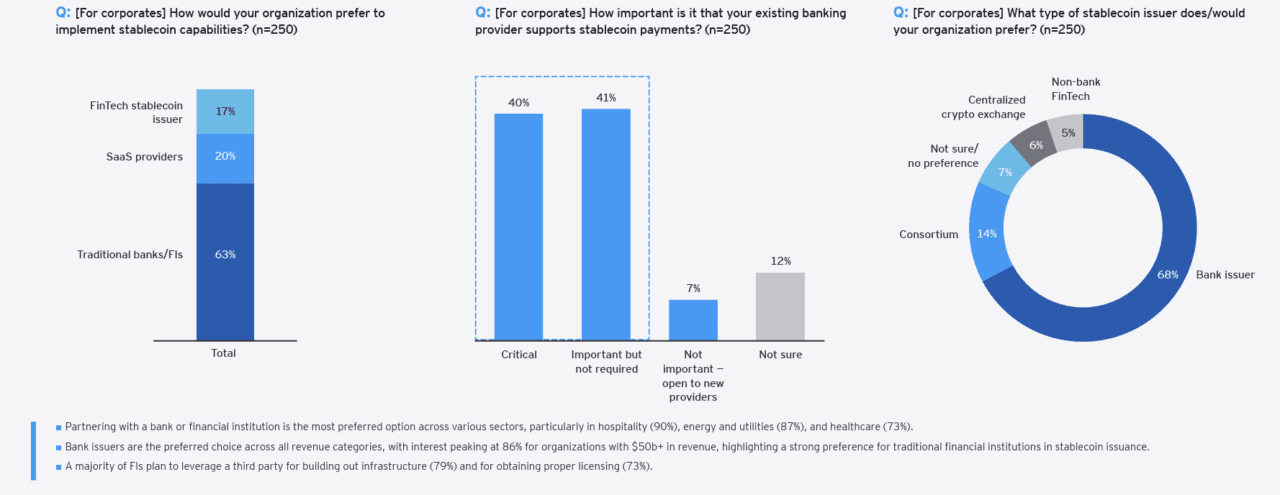
After the passage of the GENIUS Act in July, Ernst & Young’s (EY) strategy consulting services group EY-Parthenon surveyed more than 350 executives from financial and nonfinancial sectors about their views on stablecoins. Based on its findings, the firm generated a 31-page report that highlights adoption, usage, benefits, challenges, regulatory implications, and more. We’ve highlighted the report’s five major takeaways below.
Stablecoins are no longer fringe
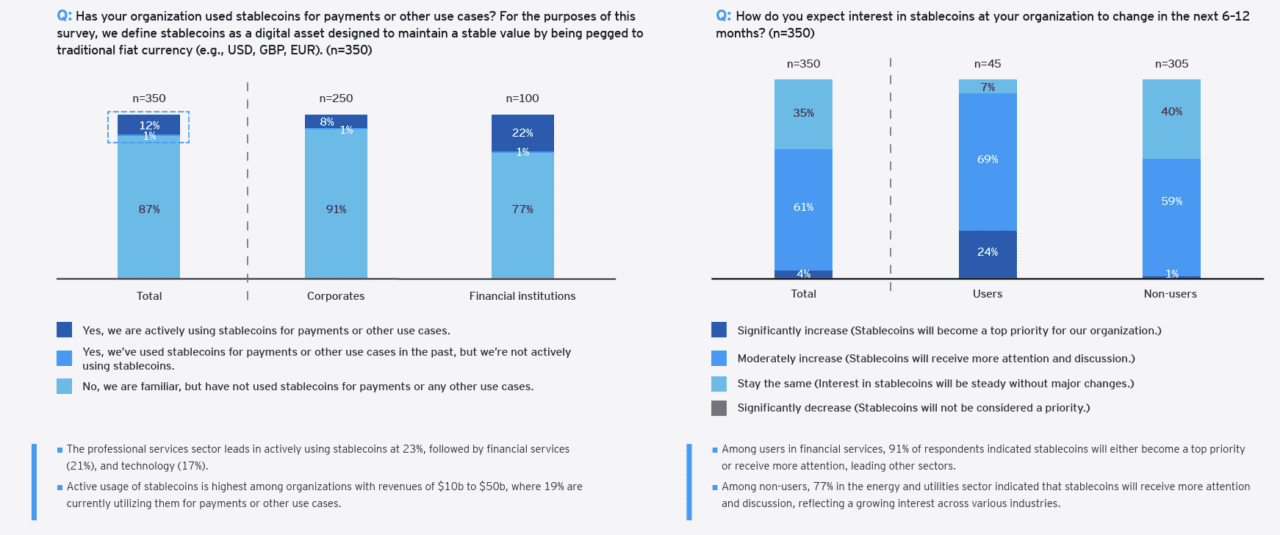
All of the 350 executives surveyed are aware of stablecoins. Of those, 13% have already used stablecoins and 65% expect interest in stablecoins to rise in the next 6 to 12 months.
The fact that 100% of executives surveyed are aware of stablecoins demonstrates how quickly stablecoins have moved into the mainstream. For banks and corporates, the conversation around stablecoins is no longer a question of “if,” but rather “how fast” adoption spreads and what role the organization should play. This shift from niche to norm shows that institutions that wait to make a move may miss out on shaping standards and capturing early market share.
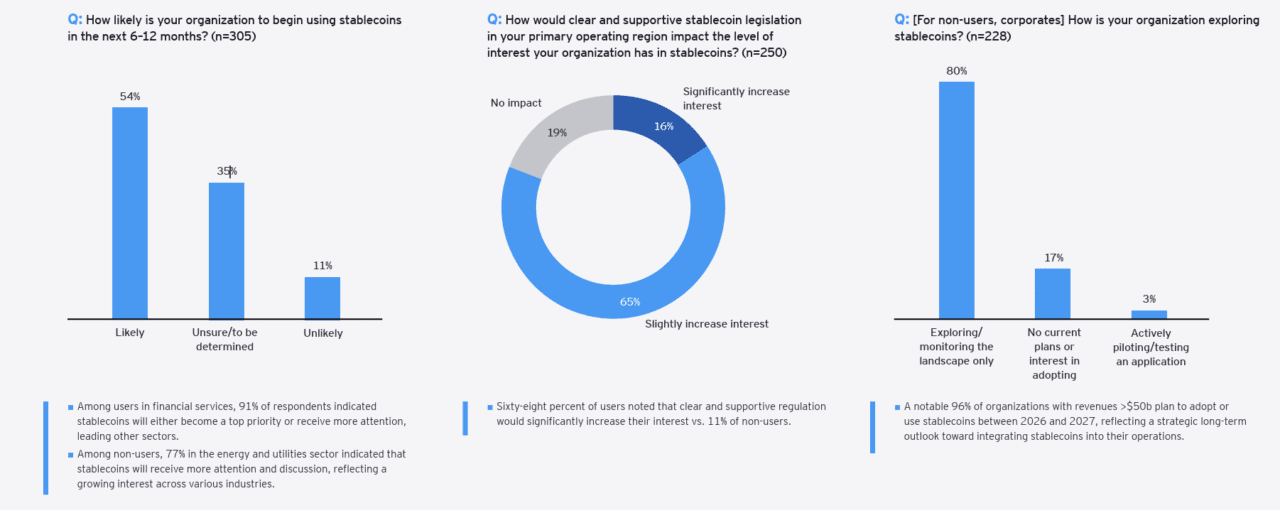
More than half, 54%, of financial institutions and corporates that are not using stablecoins expect to begin using them in the next 6 to 12 months. For 81% of participants surveyed, clear and supportive legislation increases their interest in stablecoins, either significantly or slightly.
With more than half of firms signaling plans to adopt stablecoins within a year, the market will likely see an acceleration in usage. For policymakers, this highlights the importance of regulatory clarity, given that it would directly boost adoption. For banks, it shows an opportunity to deepen their relevance by offering compliant, stablecoin-enabled services before competitors get there first.
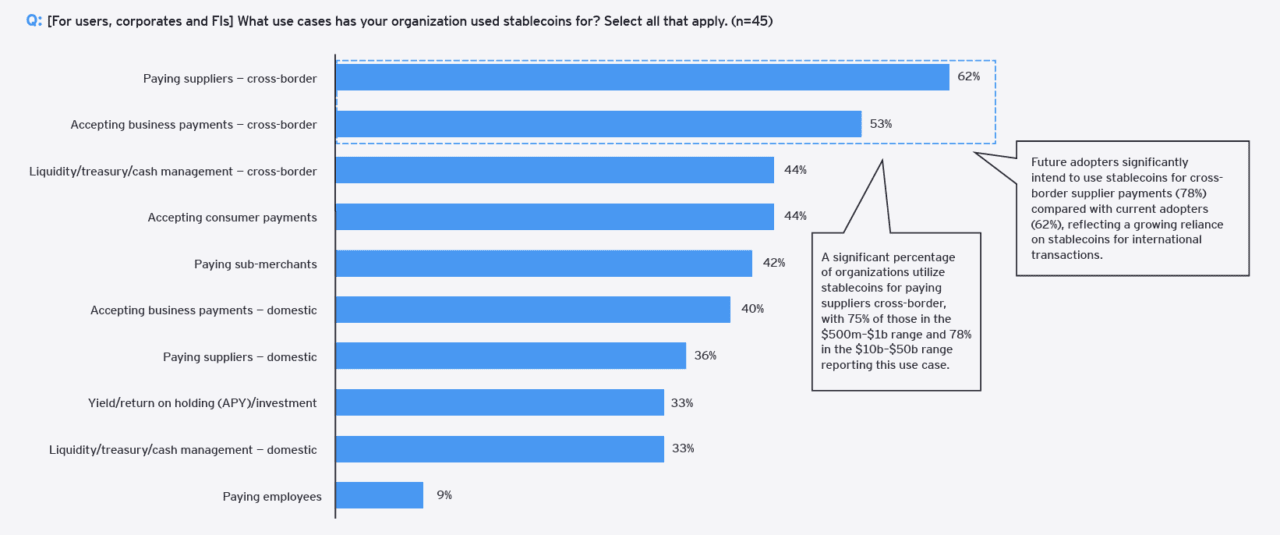
The survey asked about 10 different use cases. Of those ten, the top three use cases centered around cross-border payments.
This shows that stablecoins are tackling real, persistent pain points, especially in cross-border payments. Despite previous disruption by alternative players such as Wise, Remitly, and Revolut, international transfers remain slow and expensive. Stablecoins are a credible alternative that resonates with businesses and consumers. This focus could disrupt entrenched correspondent banking networks and give stablecoin adopters an edge in the lucrative field of cross-border payments.
Firms most interested in reducing cost and increasing payment speed
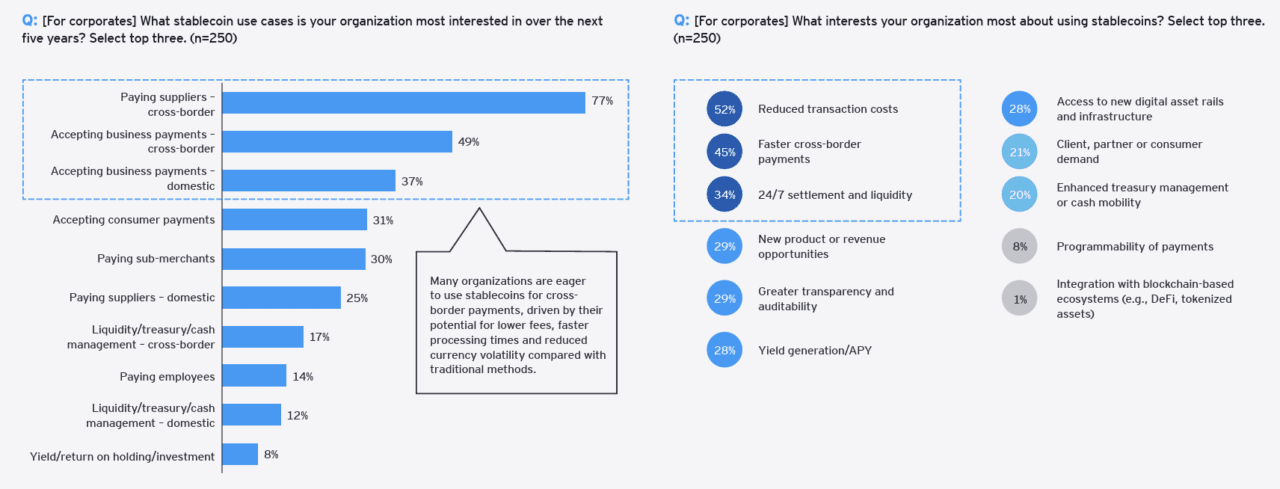
The most interesting use case is cross-border payments (77%), with interest largely driven by reduction in transaction costs and faster payments.
The overwhelming interest in cost savings and speed is a reminder that stablecoins will succeed or fail based on tangible value, not hype. For businesses, even modest reductions in cross-border fees can translate into significant savings at scale. Banks face the challenge of turning this efficiency into a competitive advantage, offering better pricing and faster settlement while managing risks.
The survey found that organizations are looking to their traditional banking partners for access to stablecoins, and that most financial institutions, 79%, plan to leverage a third party for stablecoin infrastructure.
The finding that most organizations plan to access stablecoins through existing banking partners is significant. It suggests that businesses want access to stablecoins without having to deal with the complexity that comes with the new payment rail. Instead of investing in-house to leverage the new technology, they’re looking to trusted intermediaries like banks to handle the heavy lifting of facilitating the infrastructure. For banks, this is both an opportunity and a warning. Institutions that move quickly to build reliable, third-party-powered stablecoin services can strengthen client relationships, while laggards risk being bypassed entirely.
Flybits has launched its Agentic Banking capability, using agentic AI to create “human-centered” banking journeys that guide customers through major life events.
The AI agents unify products like cards, loans, deposits, and insurance into seamless experiences, such as financing and maintaining a car.
Flybits is backed by strong venture funs and is supported by its research and development arm Flybits Labs, that partners with academic institutions and industry innovators to prototype future banking experiences.
Agentic AI-powered banking may still feel like a futuristic scenario, but customer experience platform Flybits is making it a reality. The company recently unveiled the launch of its Agentic Banking capability.
Flybits is leveraging agentic AI to create a new interface for banking that will help financial institutions provide “human-centered” experiences that guide their customers through life events. The new agents will help customers unify cards, loans, deposits and other banking activities into customer experiences that feel more connected.
The agents will, for example, be able to help customers during a car purchasing experience. When the customer uploads a photo of the vehicle they plan to purchase, the bank’s agent will help them calculate affordability, show them financing options, and help them compare insurance coverage with offering the customer contextual card benefits like savings on fuel service expenses. The agent streamlines the entire experience around the vehicle, saving them from having to open multiple apps for loans, cards, and insurance.
“This isn’t about another chatbot or rewards app,” said Flybits Founder and CEO Dr. Hossein Rahnama. “It’s about helping banks build intelligent agents that integrate their products and services into life-based journeys—delivering outcomes that resonate, while ensuring trust, compliance, and explainability.”
Flybits’ AI agents have a natural language interface, can be integrated across banks’ internal systems and their partners, and offer end-to-end auditability and transparency.
While the new agentic capabilities look very seamless, two challenges stand out. First, some consumers may hesitate to trust their bank with such a deep level of personal data sharing, especially when it includes lifestyle information. More importantly, banks will face an uphill battle convincing customers to use these tools in place of the platforms they already rely on, such as ChatGPT for advice, or Pinterest for planning life events. The technology is compelling, but driving adoption will require overcoming both trust and usability hurdles.
Flybits was founded in 2013 as a spin-off from a university research project. Today, the Toronto, Ontario, Canada-based company helps financial institutions leverage their data to create multidimensional customer experiences that ultimately drive loyalty and business results.
Backed by Point72 Ventures, Information Venture Partners, Bosch Ventures, and others, Flybits also has an applied R&D division, Flybits Labs, that partners with academic institutions and industry innovators to prototype future banking experiences such as Perspective-Aware AI, human-centered UX, and immersive design.
Walmart for Business has partnered with TreviPay to expand its Pay-by-Invoice program that gives eligible business customers 30-day credit terms for online and in-store purchases.
TreviPay’s AI-powered receivables technology enables faster dispute resolution, reduces errors, and improves conversion by automating underwriting and invoicing.
The program has launched with select Walmart Business customers and will expand in the coming months, aiming to capture growing demand in B2B retail payments.
Walmart for Business, an ecommerce site tailored to suit business needs, announced this week it has partnered with global transaction management company TreviPay this week.
Walmart has tapped TreviPay to launch the next phase of its Pay-by-Invoice program that enables eligible business customers to access a line of credit with a 30-day term for online and in-store purchases. The new program will be powered by TreviPay’s payments and accounts receivable automation technology.
TreviPay was founded in 1980 and helps business buyers across industries stop chasing payments. The company’s accounts receivable automation technology optimizes order-to-cash and integrates with all channels and ERPs. In 2020, TreviPay was acquired by Corsair Capital for an undisclosed amount. Today, TreviPay processes over $8 billion in global money movement.
TreviPay’s Pay-by-Invoice product leverages AI-enhanced underwriting and smart invoicing to deliver a guaranteed number of days of sales outstanding (DSO) and ultimately improve conversion. When compared to manually managing accounts receivable, Pay-by-Invoice speeds business growth, decreases errors, and reduces friction at the point of purchase.
“The biggest opportunity in retail now is in B2B. Companies that capture this valuable segment will win with flexible payment options that integrate directly into the buying experience and maintain efficiency and control for the buyer,” said TreviPay CEO Brandon Spear. “Pay-by-Invoice helps companies purchase and pay in a convenient, effortless way.”
At launch, Walmart Business’ Pay-by-Invoice offering is available to a select group of Walmart Business customers. The company plans to expand access to more customers in the coming months.
PayNearMe raises $50 million in Series E funding, bringing its total funding to $168 million since its founding in 2009.
The company is rebranding its platform as PayXM, signaling a shift from payment processing to Payment Experience Management.
The shift shows PayNearMe’s focus on the customer experience in which it aims to make payments seamless, strategic, and embedded across industries.
Payments innovator PayNearMe is raking in $50 million in Series E funding from Atlantic Vantage Point (AVP). The investment brings PayNearMe’s total raised to $168 million since it was founded in 2009.
The California-based company will use today’s funds to expand into new markets and fuel its product offerings. As part of this, PayNearMe is renaming its platform PayXM, recognizing its product evolution in what it calls Payment Experience Management. The company aims to use PayXM to enable businesses to manage the entire payment journey with a single platform and integration.
“PayNearMe has redefined what it means to deliver a modern payment experience. The company is uniquely positioned to solve challenges in a space long underserved and overlooked,” said AVP General Partner and Head of Growth Fund, North America Elizabeth de Saint-Aignan. “PayNearMe’s vision and proven execution are changing how non-commerce businesses approach payments, and we’re excited to support them in this next stage of growth.”
PayNearMe was founded in 2009 to enable unbanked individuals to transact online by paying with cash at brick-and-mortar retailers. Today, the California-based company offers payment processing, exception management, and diverse payment options for banks, toll companies, mortgage servicing companies, online gaming, auto lenders, and buy here pay here payment collectors.
The move from a pure payments processor to a Payment Experience Management provider reflects PayNearMe’s effort to position its payments offering as a strategic driver of customer experience, not just a back-office function.
“For too long, payments have been treated only as a cost of doing business,” said PayNearMe CEO Danny Shader. “We see improving payments as a powerful opportunity to help businesses differentiate, drive customer satisfaction, and improve business results. AVP’s funding will allow us to deliver the benefits of Payment Experience Management to more clients and in new markets.”
Today’s $50 million investment shows that investors see opportunity in rethinking payments not as plumbing, but as an experience. In launching PayXM, PayNearMe is betting that the next wave of fintech will come from embedding payments to make them invisible, seamless, and integrated into the customer experience.
Updated: This post previously stated that the renewed data sharing agreement does not cover account access for payments, which was incorrect. Plaid has clarified that the data sharing agreement covers all types of data sharing, including payments.
Late yesterday, JPMorgan Chase and Plaidannounced that they have mutually agreed to renew their data access agreement that dictates how Plaid is able to pull data on their shared customers from JPMC.
The renewed agreement’s most notable feature is a new pricing structure. Plaid will now pay JPMC to facilitate data access for its fintech clients. Aside from the financial terms, the deal also sets commitments from both sides to ensure consumers can access their data securely. Additionally, the firms have pledged joint investment in innovation and technology to make data sharing faster, safer, and more efficient.
Plaid’s take
Since JPMC initially signaled in July that it plans to charge aggregators to access consumer data, there have been many conversations on both sides of the debate regarding why or why not banks should charge for data access. Given the multiple stakeholders involved, including banks, fintechs, aggregators (like Plaid), and end consumers, there are multiple viewpoints on what charging for data access should look like.
As a central player in this debate, Plaid has a lot to lose (or win) depending on how fees are assessed. To that end, Plaid COO Eric Sager emphasized the firm’s willingness to collaborate with JPMC to preserve the consumer experience: “We have always believed consumers should have the right to access and share their own financial data, and JPMorganChase has been a partner in that effort,” said Sager. “This extended agreement ensures ongoing access for the millions of Chase customers who rely on Plaid every day to connect with the products and services they trust.”
To back up those assurances, Plaid outlined three key takeaways from the renewed agreement:
Continuity is guaranteed Plaid says existing JPMC customers can keep accessing fintech services without disruption.
No pricing changes for now Current contracts and customer fees remain unchanged.
Advocacy continues Plaid will keep pushing for consumer data rights in the CFPB’s 1033 rulemaking.
This agreement is likely to set a precedent in future cases with other large banks and aggregators, shaping not only how data is shared but also how payments are initiated and monetized. As more institutions move to formalize similar arrangements, the industry will be watching to see whether these pricing structures trickle down to smaller players and, ultimately, to consumers. With the CFPB’s 1033 rulemaking still in flux, JPMC and Plaid’s renewed deal may serve as both a template and a test case for the next phase of open banking in the US.
UK-based Starling Bank is bringing its SaaS banking platform, Engine, to North America with a $50 million investment, a new New York headquarters, and new leadership under Jody Bhagat.
With 4,000+ US banks and credit unions weighed down by legacy cores, Engine aims to deliver modular, API-based, cloud-native tech proven in Europe and Australia.
Starling’s move positions it not just as a digital bank, but as a banking technology competitor to legacy core providers.
UK-based Starling Bankannounced last week that it is bringing its digital banking platform, Engine by Starling, to North America. The move marks the next step in Starling’s transformation from a digital bank into a global technology provider.
Starling launched Engine in 2022 to take its technology stack that powered Starling’s own growth in the UK and package it as a SaaS solution for other financial institutions. Expanding into North America signals Starling’s ambition to compete in one of the world’s most crowded banking technology markets.
Behind the launch are both a new regional headquarters in New York and a new leader. Starling appointed former Personetics President of Global Banking Jody Bhagat to bring Engine into the new region.Bhagat now serves as President of North America for Engine by Starling, and has been tasked with building a team to bring Engine to North American financial institutions. The company sees the move as a natural addition, given the new market opportunities with the region’s 4,000+ mid-tier banks and credit unions.
“The North American market is highly competitive, and many banks and credit unions feel constrained by legacy technology,” said Bhagat. “Digital-forward financial institutions are seeking a partner that can deliver technology transformation that drives real business results. Tried and tested in Europe and Australia, Engine by Starling has strong proof points demonstrating how the platform helps banks better acquire and serve customers. I’m incredibly excited by the opportunity to bring Engine’s proven, cloud-based banking tech to North America. Progressive mid-tier banks and credit unions are seeking ways to operate more efficiently, to serve their customers digitally in a more intuitive way, and to innovate more rapidly. Engine’s distinctive platform and capabilities will enable them to do just that.”
Starling is fueling the move into North America by investing $50+ million in its North American footprint, including its New York office, local hires, employees brought in from Starling’s UK-based team, and a Toronto-based Canadian team.
The move into New York isn’t Starling’s only new office supporting Engine this month. The bank also opened offices in Dubai, UAE, and Sydney, Australia to work with the digital banking tool’s international clients and partners
Starling was founded in 2014 and launched Engine to bring Starling’s tech stack to financial institutions overseas. Engine provides SaaS banking technology to bring modern banking to banks around the world in a modular, API-based, cloud-native, and scalable way. In 2024, the company’s first customer, Salt Bank, became Romania’s first digital-native bank and has since captured 4% of the country’s banking market.
Starling’s push into North America highlights the rise of banks evolving into technology providers. By turning its in-house tech into a SaaS platform, Starling is positioning itself not just as a challenger bank, but as a challenger to the core banking vendors that dominate the US market. For mid-tier banks and credit unions struggling with legacy cores, the arrival of Engine creates both pressure and opportunity to modernize quickly.