Ping Identity Acquires Best of Show Winner Keyless

Ping Identity Acquires Best of Show Winner Keyless
  • Digital identity company Ping Identity has agreed to acquire UK-based biometric authentication firm Keyless. Terms of the acquisition were not disclosed.
  • Ping Identity will integrate Keyless’ Zero-Knowledge Biometrics technology into its platform to enable business to enhance their fraud prevention and user verification processes.
  • Ping Identity has been a Finovate alum since its appearance at FinovateEurope 2012. Keyless won Best of Show in its Finovate debut at FinovateEurope 2025.

Digital identity company Ping Identity has agreed to acquire UK-based biometric authentication specialist—and FinovateEurope 2025 Best of Show winner—Keyless. Terms of the acquisition have not been disclosed, and the transaction remains subject to customary closing conditions and regulatory approvals.

“In an era where trust is continuously tested, organizations must deliver digital experiences that are more secure, private, and effortless,” Ping Identity CEO and Founder Andre Durand said. “By joining forces with Keyless, we aim to make privacy-preserving authentication as simple as a glance—building greater confidence into every digital interaction.”

With its Zero-Knowledge Biometrics technology, Keyless separates itself from traditional biometric authentication solutions in a number of ways. Requiring a only single glance at the camera, Keyless’ technology verifies the user’s face and device against enrollment data, leveraging cryptographic techniques that prevent biometric data from being stored in a retrievable form. This prevents the data from being reconstructed and potentially linked back to the original image—whether on the device or in the cloud. Additionally, Keyless does not require a dedicated device, which makes the technology easier to deploy across a range of different environments and user groups.

The technology helps defend users against fraud techniques such as account takeover, providing instant biometric authentication and deepfake detection for frontline and mobile workers with sub-300ms performance benchmarks. Keyless also supports employees with passwordless multi-factor authentication and seamless single sign-on (SSO) for easier, stronger access. The technology is also designed to enhance readiness for a variety of international regulatory compliance standards for privacy including GDPR, CCPA, and PSD3.

“Trust lies at the heart of every digital relationship,” Keyless CEO and Co-Founder Andrea Carmignani said. “This acquisition will help to embed trust throughout the identity journey—from verification to authentication to authorization—and reflects our shared commitment to a more secure, seamless, and private world.”

Per the acquisition, Ping Identity will integrate Keyless’ privacy-preserving biometric authentication into its platform to enable businesses to enhance their fraud prevention and user verification processes without adding friction to the user experience. The acquisition also helps Ping Identity manifest its One Platform vision of providing verified trust across all identities, including customer identity and access management (CIAM) workforce, and B2B use cases. This vision also means delivering secure, passwordless access for frontline, shared terminal, and manufacturing environments.

Headquartered in Denver, Colorado and founded in 2003, Ping Identity first demonstrated its technology at FinovateEurope 2012. Today, the identity verification innovator boasts 99.99% uptime and more than three billion identities under management. The company’s acquisition announcement comes in the wake of a survey it conducted that indicated that while AI use is climbing rapidly, its impact on customer trust has been increasingly problematic. “AI and the rise of agents is compounding the attack on trust, making threats more persuasive and harder to detect, which raises the stakes for identity verification and protection,” Ping Identity VP of Consumer Segment Strategy Darryl Jones said.

Winning Best of Show in its FinovateEurope 2025, Keyless was founded in 2019 and is based in London. The company’s privacy-preserving biometric authentication technology has helped banks, fintechs, crypto platforms, and more reduce account takeover incidents, secure high-risk transactions, and boost operational efficiency. Keyless’ Zero-Knowledge Biometrics solution provides multi-factor authentication with a single glance at the camera, delivering results in 300 milliseconds without storing valuable biometric information.

Last month, Keyless announced that it had been named a “Luminary” in Acuity Market Intelligence’s Biometric Digital Identity Privacy and Compliance Prism Report. In September, Keyless was featured in Gartner’s Emerging Tech Impact Radar: Disinformation Security for its innovations in biometric continuous identity assurance.



Photo by cottonbro studio

Walmart’s OnePay Selects DriveWealth to Power Embedded Investing

Walmart’s OnePay Selects DriveWealth to Power Embedded Investing
  • Walmart’s OnePay digital banking platform is partnering with DriveWealth to launch OnePay Invest, giving users access to stock and ETF trading within their existing app.
  • Since acquiring fintechs Even and ONE, Walmart has built OnePay into a full-service app offering savings, credit-building, BNPL, and now investing.
  • Integrating DriveWealth’s brokerage-as-a-service APIs, OnePay lowers the barrier to entry for first-time investors and strengthens Walmart’s bid to become a one-stop financial hub for everyday consumers.

Digital trading and brokerage company DriveWealth scored a partnership this week with Walmart’s digital banking platform OnePay, which will leverage DriveWealth’s brokerage-as-a-service offering to launch OnePay Invest.

Walmart launched OnePay in January 2021 through a partnership with Ribbit Capital. In January 2022, Walmart expanded OnePay’s capabilities by acquiring two fintech platforms, Even and ONE, which helped Walmart create a more comprehensive financial services app. Since then, Walmart has been actively building up OnePay to compete with top fintech startups by adding features such as a high-yield savings account, credit-building tools, and BNPL capabilities.

DriveWealth will give OnePay users a new way to invest in stocks and ETFs. OnePay Invest will offer users access to trading tools within the same mobile app they already use to save, spend, and borrow.

“OnePay puts everyday money decisions in one place. By embedding DriveWealth’s investing technology directly into that experience, we are giving millions of Americans simple, reliable access to invest where they already save and spend,” said DriveWealth CEO Naureen Hassan. “This partnership moves our shared mission forward: make investing available to anyone, anywhere.”

Many OnePay customers may be new to investing, and embedding DriveWealth’s tools directly into the OnePay app lowers the barrier to entry. By enabling users to explore stock and ETF investing within the same platform they already use to manage savings, spending, and borrowing, OnePay creates a simple on-ramp to wealth building.

The move also helps OnePay differentiate itself from competitors such as Chime and Dave, which both cater to similar underbanked populations but have yet to integrate investing capabilities. In combining everyday money management with access to the markets, OnePay is positioning itself as an all-in-one financial hub for the mass-market consumer.

Today’s partnership isn’t Walmart’s first attempt this month to bolster the capabilities of OnePay. On October 3, the company announced plans to offer crypto trading and custody in its mobile app, allowing users to buy, hold, and trade Bitcoin and Ether. 

DriveWealth was founded in 2012 to allow third parties to enable access to US equities, fixed income, and other asset classes through scalable, compliant solutions via its suite of APIs. Earlier this year, the New York-based company teamed up with Moment Technology to make fixed-income investing more accessible to a broader range of investors.

Devexperts Unveils New AI-Powered Data Analysis Tool Acomotrade

Devexperts Unveils New AI-Powered Data Analysis Tool Acomotrade
  • Capital markets software developer Devexperts launched its latest AI-powered data analysis solution, Acomotrade, this week.
  • The new offering is designed to help online trading platforms better engage new users, most of whom rarely become the kind of active traders these platforms rely on.
  • Headquartered in Dublin, Ireland, and founded in 2002, Devexperts demonstrated its technology at our developers conference, FinDEVr Silicon Valley 2016.

For all the excitement experienced when markets are soaring toward new highs, life for brokerage companies can actually be more complicated. While trading volumes are climbing, the fact of the matter is that many of the new traders and investors who decide to start participating in the market often don’t end up sticking around very long at all. The average new user lifetime on a trading platform is less than six months—to say nothing of those traders who abandon the platform shortly after registering, never even placing their first trade. New traders rarely become the kind of active traders that online trading platforms crave, which complicates the acquisition cost equation and makes it hard for platforms to recoup their investment in new users.

The new offering from capital markets software developer Devexperts, Acomotrade, is designed to help online trading platforms better manage these challenges. An AI-powered data analysis solution, Acomotrade leverages insights into user behavior to help brokers improve the return on acquisition via better engagement and lower early user churn.

Acomotrade features personal instrument recommendations, analyzing trader activity and behavioral patterns to suggest tools like watchlists that match the individual trader’s habits and preferences. The solution also includes disengagement detection, leveraging large-scale behavioral data to detect signs of user disengagement. At this point, brokers can intervene with personalized communications or incentives before the user leaves the platform entirely.

Acomotrade also relies on user representation to group traders together based on characteristics such as risk appetite, trading style, and engagement duration. This helps brokers personalize their engagement with different user groups. All of these features are designed to help platforms better understand, communicate with, and support their newest users when they are most vulnerable to becoming disenchanted with the online trading experience.

“Acomotrade gives brokers a practical way to strengthen user engagement and retention, directly improving profitability without additional acquisition spend,” Devexperts Data Science Team Lead Ivan Kunyankin said. “It will initially be offered as an opt-in feature within the DXtrade platform and we look forward to seeing our clients benefit from the advanced insights and functionalities Acomotrade has to offer, as well as working with our clients to develop these further over time.”

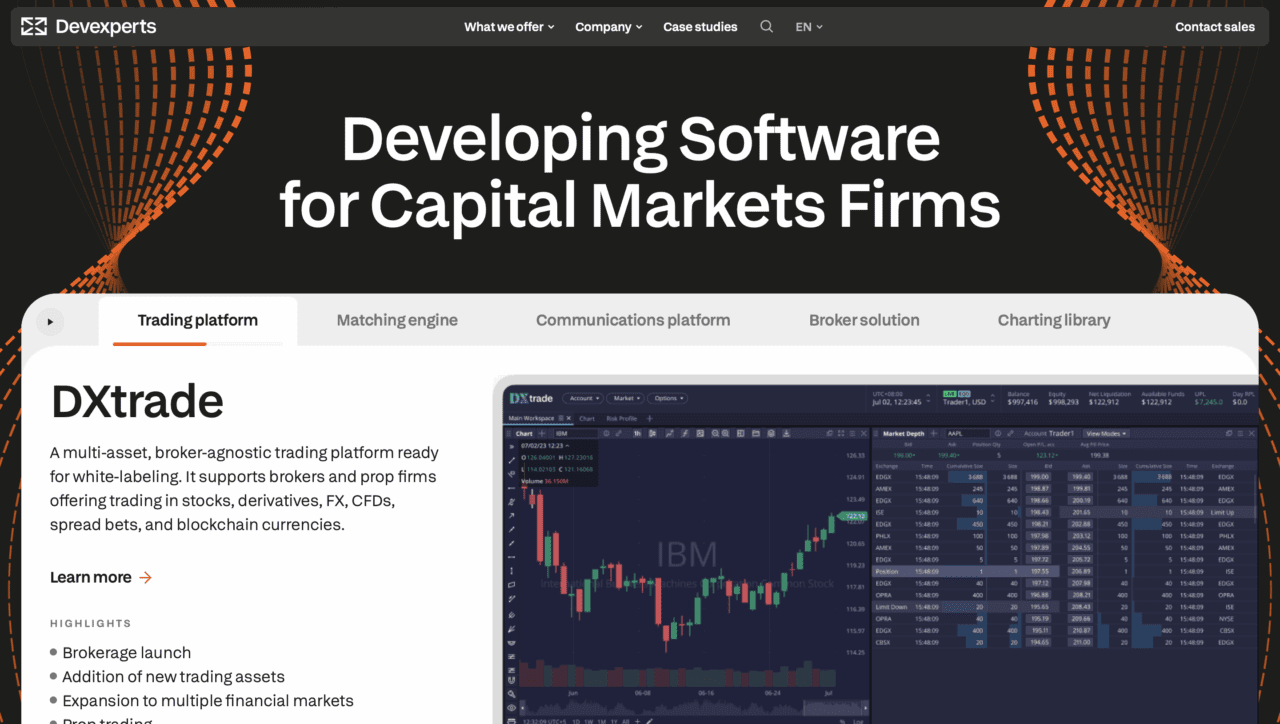
Dublin, Ireland-based Devexperts participated in our developers conference, FinDEVr Silicon Valley 2016. The company specializes in providing trading platforms and brokerage automation, complex software development products, and market data products. The company also provides consulting services for financial institutions, particularly in the areas of real-time transaction monitoring, trading automation, and risk management. Devexperts’ DXtrade platform is a multi-asset, broker-agnostic trading platform for brokers and prop firms that offer trading in stocks, derivatives, FX, CFDs, spread bets, and blockchain-based currencies. More than 20 million users rely on Devexperts’ technology every day. Nikolaj Mosejev is CEO.


Photo by Sophie Popplewell on Unsplash

Morgan Stanley Acquires Private Company Trading Platform EquityZen

Morgan Stanley Acquires Private Company Trading Platform EquityZen
  • Morgan Stanley has agreed to acquire private company trading platform EquityZen. Terms of the transaction were not immediately available.
  • The acquisition will help Morgan Stanley offer a full suite of solutions for its private company and wealth management clients, including cap table solutions, tender and liquidity programs, direct and co-investment opportunities, and secondary trading.
  • EquityZen made its Finovate debut at FinovateSpring 2016. The company is headquartered in New York.

One of the biggest challenges in the world of private company investing is dealing with the liquidity gap that can arise between private companies and their stakeholders when stakeholders seek access to cash before companies are ready to officially exit via public offering or acquisition. As more and more companies stay private longer, an opportunity has developed for innovators that can not only democratize access to private market investments, but can also serve the interests of employees seeking liquidity, companies requiring control over secondary transactions, and investors wanting access to high-growth private startups.

Tackling this challenge is EquityZen, a New York-based fintech founded in 2013 that made its Finovate debut at FinovateSpring 2016 in San Francisco. This week, we learned Morgan Stanley has announced its acquisition of the company, which offers a proprietary platform that facilitates secondary transactions in private firms, and works directly with shareholders and issuers to provide a seamless experience for buyers, sellers, and companies alike.

“This announcement comes at a critical time in the development of the private markets ecosystem,” Jed Finn, Head of Morgan Stanley Wealth Management, said. “The combination of EquityZen with Morgan Stanley will uniquely address client needs as companies stay private much longer, such as delivering liquidity solutions for their employees and early investors in a seamless yet controlled process of their own design. With EquityZen, we combine our cap table management solutions with a private shares marketplace to deliver end-to-end solutions to our private market company clients.”

EquityZen enables accredited investors to explore investment offerings on its platform, review offering documents, and conduct research before reserving investments in live offerings, or indicating their interest in upcoming offerings. Investors can execute documents and provide payment information in order to complete the investment via ACH or wire, and actively manage their investments and receive personalized updates on their companies in their portfolio. Investors receive investment proceeds in the form of cash or shares if the company exits successfully or simply if the investor requires liquidity.

The acquisition follows news of Morgan Stanley’s expanded partnership with private capital software platform Carta. Morgan Stanley noted that its acquisition of EquityZen will enhance its private markets ecosystem, and enable the firm to offer a range of services to private companies and their shareholders including cap table solutions, tender and liquidity programs, direct and co-investment opportunities, and secondary trading. Morgan Stanley will benefit from EquityZen’s issuer-aligned model, which will help it enhance its relationship with private companies and offer its wealth management customers greater access to private shares.

“Our entire mission has been to bring ‘private markets to the public’ and by integrating into Morgan Stanley, we will reach more investors and shareholders than ever before,” EquityZen CEO Atish Davda said. “When our category-leading technology and welcoming marketplace are matched with Morgan Stanley’s comprehensive suite of products, services, and offerings focused on the private markets, we can create a value proposition together for issuers, shareholders, and investors that is unrivaled in our space.”

EquityZen has 800,000 registered users. To date, the company has processed more than 49,000 transactions across 450+ private companies.


Photo by Pixabay

Thredd Taps LoanPro for New Credit Offering

Thredd Taps LoanPro for New Credit Offering

Digital payment solutions company Thredd has teamed up with lending and credit platform LoanPro this week. The UK-based company will leverage LoanPro’s credit platform to underpin its new suite of credit solutions, which will allow it to deliver full-stack embedded issuing and processing capabilities.

Thredd was founded in 2007 and offers real-time card issuing and processing capabilities to help clients personalize and differentiate their credit offerings. Integrating LoanPro’s composable credit infrastructure into its offerings will help Thredd expand further into the credit and lending space, enabling clients to launch and manage credit programs with greater flexibility and speed.

Commenting on the partnership, Thredd CEO Jim McCarthy emphasized the growing importance of credit-led innovation in embedded finance. “Credit-based value propositions drive not only more opportunities for both B2B and B2C verticals, but also generate more revenue for issuers, fintechs, and enterprises,” said McCarthy. “LoanPro’s platform solves much of the inherent complexity in providing truly differentiated credit, allowing us to offer our clients the tools to build sticky, profitable credit products, while maintaining compliance and operational efficiency.”

Founded in 2016, LoanPro has helped 600+ lenders launch 2,000 unique credit programs, upgrading their borrower, agent, and back-office operations. The Utah-based company’s composable architecture, built on a modern lending core, allows lenders to enhance their origination, servicing, payments, and collections operations.

LoanPro Co-Founder and CEO Rhett Roberts said that the partnership combines the strengths of both companies to accelerate how credit products are designed and deployed. “There is a massive opportunity to launch credit products in the U.S. and globally in a way that truly meets consumers and businesses where they are,” Roberts said. “The future of finance is personalized. Thredd brings together the entire ecosystem needed to launch revolving credit products, and with LoanPro’s modern, composable platform, clients can personalize and differentiate their offerings at scale in a way that drives share of wallet. We’re proud to support Thredd’s vision for global credit innovation.”

The partnership highlights how embedded finance providers are converging around full-stack, credit-enabled platforms. As banks, non-banks, and fintechs continue to embed lending and credit capabilities into their platforms, partnerships like this one blur the lines between payment processing, issuing, and credit management. Teaming up with LoanPro will place Thredd at the intersection of modern card issuing and next-generation credit infrastructure.

LoanPro has participated in our developers conference, FinDEVr 2021, and demoed its loan management system at FinovateSpring 2021.


Photo by Monstera Production

GoodData Brings Data Intelligence and Agentic AI to Financial Services

GoodData Brings Data Intelligence and Agentic AI to Financial Services
  • Data intelligence platform GoodData has unveiled a suite of finance-focused applications for its recently launched composable AI platform.
  • The company’s new offering combines its AI Lake, AI Hub, and AI Apps into a single platform that will give financial institutions the tools they need in order to build and deploy AI agents.
  • Founded in 2007 and headquartered in San Francisco, California, GoodData most recently demoed its technology at FinovateFall 2017 in New York.

The challenge of managing unstructured and unorganized data across multiple platforms—let alone turning that data into actionable insights—is a difficult one for financial institutions. And for those firms looking to take advantage of AI to add personalization, greater efficiency, and agility to their operations, these data management challenges are all the more acute.

Add to this the unique regulatory and data governance demands in financial services, including transparency and auditability, and it is clear to see why a growing number of fintechs are working to create solutions that enable firms to deploy trusted AI technologies at scale that feature built-in governance, including semantic grounding and compliance controls.

One such innovator is full-stack data intelligence platform GoodData, which has just launched a set of new finance-focused applications for its recently unveiled composable AI platform. The new offering combines GoodData’s AI Lake, AI Hub, and AI Apps into a single platform for enterprise data intelligence, giving financial institutions the tools they need to build and deploy AI agents.

GoodData’s platform will bring trusted automation to banks, insurers, and other financial institutions via embeddable, compliant, and auditable AI agents. The agents detect and investigate fraud in seconds, providing the kind of audit trails that regulators can rely on and keeping portfolios compliant in real-time. This makes the compiling, checking, and disclosure submission processes of regulatory reporting easier, while still maintaining the high standards for compliance, governance, and security that are required in financial services.

“Financial institutions face some of the world’s strictest data governance rules, and our goal is to make compliance simpler,” GoodData CEO Roman Stanek said. “This platform lets them innovate with AI while ensuring transparency, trust, and regulatory alignment, modernizing client experiences and improving risk management without compromise.”

GoodData’s layered platform features AI Lake, which transforms structured and unstructured financial data into a governed semantic layer, ensuring AI agents are grounded in accurate, compliant, and context-aware data to enhance decision-making. The platform also includes AI Hub, which delivers orchestration and governance with built-in guardrails, escalation paths, and compliance workflows; and AI Apps, embeddable agents, copilots, and automations that add personalization to client-facing applications and enhance back-office operations, including regulatory reporting and fraud detection.

Headquartered in San Francisco, California and founded in 2007, GoodData last demoed its technology at FinovateFall 2017. The company’s composable platform empowers businesses to turn data into insights and insights into action, and integrates into any data environment across public, private, on-premises, or hybrid cloud. GoodData leverages no-code interfaces, SDKs, and APIs to support the full data analytics lifecycle from data modeling to AI-powered insights. Today, more than 140,000 organizations and 3+ million users including Visa, Travelodge, and Twilio rely on GoodData’s technology.


Photo by Tae Fuller

Splitit’s New Partnership Helps Banks Compete on BNPL

Splitit’s New Partnership Helps Banks Compete on BNPL
  • Splitit and DXC Technology are partnering to bring AI-powered, card-linked installment payments to banks using DXC’s Hogan core banking platform, enabling personalized BNPL functionality directly from existing cards and accounts.
  • The collaboration will help banks reclaim BNPL market share by eliminating friction while giving institutions the flexibility to originate installment loans on their own books or through Splitit.
  • DXC’s bank clients will be able to embed installment capabilities within their own traditional banking infrastructure, helping them modernize, retain customer relationships, and compete on flexibility and user experience.

Georgia-based BNPL solutions provider Splitit announced it is collaborating with DXC Technology (DXC) to help banks compete on BNPL.

DXC Technology and Splitit have joined forces to bring card-linked installment payments to banks using DXC’s Hogan core banking platform. The integration enables banks to offer personalized, AI-powered installment plans at checkout or post-purchase, both online and in person, using cards and accounts customers already trust.

Hogan supports more than 300 million accounts across 40+ major banks with $5 trillion in deposits. By partnering with Splitit, banks can compete directly with BNPL providers while avoiding the friction of new account openings and serving customers who prefer to pay with debit. The collaboration aims to help banks reclaim market share lost to traditional BNPL players and deliver the flexibility today’s consumers expect.

“For decades, Hogan has been the backbone of the world’s largest banks. This partnership with Splitit shows how that foundation can now be used to create new revenue streams at the point of sale,” said DXC Global Head and General Manager of Financial Services Sandeep Bhanote. “By normalizing installment capabilities across existing accounts, we’re enabling issuers to modernize their offerings without replacing their core—and empowering consumers with flexible payments that use the cards they already trust.”

The benefits of the partnership extend beyond simply providing more payment options for end users. Banks will be able to deploy branded installment offers that appear natively at checkout or within the bank’s online banking portal. Additionally, partnering with Splitit will help DXC offer its bank clients the choice to originate the installments directly on their books or to have Splitit originate the installments.

“BNPL players have disintermediated banks by offering transactional lending at the merchant checkout. This partnership resets the playing field,” said Splitit CEO Nandan Sheth. “Together with DXC, we’re empowering banks to compete head-on with BNPL providers by bringing installments directly into existing bank accounts or issued debit cards. With DXC’s access to over 300 million bank accounts through its core banking platform, our joint technology gives financial institutions a seamless, low-lift way to automatically deliver installment functionality to existing customers. This innovation enables banks to maintain greater control of their customer relationships and attract new younger customers.”

Splitit was founded in 2012, went public in 2019, and went private again in 2023 after it was acquired by Motive Partners. The company seeks to simplify flexible payments, launching a partner program called the Agentic Commerce Partner Program earlier this month. The new initiative will allow autonomous shopping agents to make payments using card-linked installments.

While BNPL has fallen off the list of top trends in the past few years, its use has not dropped. The installment payment solution market is set to grow from $2.23 billion in 2024 to $3.44 billion by 2031, with 72% of merchants saying that they prefer card-linked installments for their simplicity and reach.

By embedding installment functionality into existing cards and core systems, DXC can help banks compete on flexibility without sacrificing customer relationships to third-party fintechs. As BNPL grows, the next wave of BNPL innovation isn’t about new entrants, but about how legacy infrastructure adapts to meet changing consumer expectations.


Photo by Nataliya Vaitkevich

Neural Defend and Zee News Launch Deepfake Verification System for News Media

Neural Defend and Zee News Launch Deepfake Verification System for News Media
  • Deepfake detection company Neural Defend and India’s Zee News have teamed up to launch the country’s first AI-powered, deepfake verification system for news media.
  • The partnership will enable Zee News consumers to upload suspicious videos, audio clips, or images and have Neural Defend’s technology determine within seconds whether or not the material has been artificially manipulated.
  • Founded in 2024 and headquartered in San Francisco, California, Neural Defend made its Finovate debut at FinovateEurope 2025 in London. Piyush Verma is CEO.

Deepfake detection specialist Neural Defend has teamed up with Mumbai-based Zee News to launch India’s first deepfake verification system for news media—powered by AI. The new solution empowers individuals with direct access to advanced verification technology, enabling them to authenticate videos, images, and audio files in real time.

“Our goal was to ensure deepfake detection is fast, accurate, and simple for every citizen,” ZMCL Chief Technology Officer Vijayant Kumar said. “By integrating Neural Defend’s advanced AI with Zee News’ platforms, we’ve created a solution that can detect even the most sophisticated manipulations within seconds. This is not only an innovation for today, but a future-proof safeguard for tomorrow’s information ecosystem.”

The partnership will enable individuals to upload suspicious videos, images, or audio clips and have Neural Defend’s technology analyze the files and confirm their authenticity—or identify the files as artificially manipulated—within seconds. At a time when the average viewer is struggling to differentiate increasingly sophisticated manipulated content, including video, from non-manipulated content, the collaboration between Neural Defend and Zee News gives media consumers new tools to help them “separate fact from fiction in an age where misinformation spreads fast,” said ZMCL Marketing Head Anindya Khare.

“While Gen Z and younger viewers are particularly vulnerable to being misled by fake videos and audio, this initiative ensures a safe and credible space for everyone,” Khare added. “For advertisers and partners, it creates the most reliable environment to engage with audiences—where advanced technology and authenticity come together. This is the future of brand-safe and responsible media.”

Mumbai-based Zee News is one of the leading Hindi news channels in India with more than 52 million viewers. The company is owned by Indian media conglomerate Essel Group and is the flagship channel of Zee Media Corporation. Zee News is publicly traded on the Bombay Stock Exchange (BSE) and the National Stock Exchange (NSE), and has a market capitalization of $75 million.

Founded in 2024 and headquartered in San Francisco, California, Neural Defend made its Finovate debut at FinovateEurope 2025 in London. At the conference, the company demonstrated its agentic AI-powered deepfake detection solution that can be integrated into any video, audio, or image verification platform to offer real-time identity verification to EKYC firms, verification companies, banks, payments service providers, fintechs, and more. Neural Defend’s technology leverages proprietary, multi-layered AI to spot even subtle alterations and manipulations with precision. The solution also boosts security for video and audio calls by instantly detecting and mitigating deepfakes in real time.


Photo by Mika Baumeister on Unsplash

Finzly’s Agentic Galaxy Offers Deployable AI Agents for Payments

Finzly’s Agentic Galaxy Offers Deployable AI Agents for Payments
  • Finzly launched Agentic Galaxy, a new addition to its Galaxy suite that embeds deployable AI agents into the core of payments and operations.
  • The platform’s built-in AI modules automate payment processing, enhance compliance through human-in-the-loop oversight, and reduce complexity by integrating intelligence natively rather than bolting it on.
  • Finzly’s move reflects the broader rise of agentic and generative AI, as financial institutions adopt the same kind of intelligent automation and personalization transforming consumer shopping experiences.

Banking-as-a-Service provider Finzly announced it is adding to its Galaxy suite. The North Carolina-based company is launching Agentic Galaxy to offer deployable AI agents that help banks bring ideas to market faster, simplify their operations, and deliver seamless customer experiences.

The new tool will leverage Finzly’s suite of specialized AI modules that offer payment processing intelligence, automate workflows, and enhance user experiences. Agentic Galaxy’s AI-powered agents help streamline operations and enable financial institutions to offer new services that integrate human-in-the-loop oversight, ensuring compliance. And because the AI agents are integrated into the product instead of being bolted on, there is less complexity and it is easier for firms to measure efficiency gains.

“Finzly’s approach to agentic AI goes beyond surface-level automation—it focuses on how intelligence can live deep within the core of payments and operations and enable new forms of modernization,” said Datos Insights Strategic Advisor, Commercial Banking & Payments Practice Gilles Ubaghs. “These are the kind of capabilities that help banks move from a defensive and reactive positioning to a more proactive form of continuous evolution.”

The AI agents can help complete tasks, resolve exceptions, and make informed decisions faster. “With agentic AI built into payments and operations,” explained Finzly Founder and CEO Booshan Rengachari, “banks can operate at speed with confidence, maintain strong governance, and focus on delivering exceptional customer experiences.”

The new tool is designed for firms looking to replace legacy systems. Agentic Galaxy offers an intelligent payment-processing core that supports multiple rails. The platform can also help non-banks in search of smarter, faster payment operations and virtual accounts.

Finzly’s flagship offering, Finzly OS, enables clients to launch a modern bank from scratch. The company’s API connects to all US payment rails, including Fed ACH, Fedwire, RTP, SWIFT, and FedNow. Founded in 2012 under the name SwapsTech, Finzly is a two-time Best of Show winner and has built its reputation on unifying payment systems and digital banking capabilities into a single, intelligent operating system for financial institutions.

This launch comes at a time when generative and agentic AI are reshaping how value is created across financial services. A recent report from Adobe for Business highlighted that traffic from Gen AI-powered tools to retail sites spiked by 4,700% year-over-year by July 2025, and that AI-driven visits are now far more engaged than traditional ones. Finzly’s new tool in its Agentic Galaxy suite aligns with this shift because it embeds AI agents into the payments and operations core, which enables banks and fintechs to act with the same agility and intention that consumer brands are exercising when they plug AI into discovery, recommendation, and checkout flows.


Photo by Pixabay

Plumery Unveils Cashback Management Capability to Help Banks Boost Engagement

Plumery Unveils Cashback Management Capability to Help Banks Boost Engagement
  • Netherlands-based digital banking experience platform Plumery introduced its Cashback Management capability this week.
  • The solution will help financial institutions build and launch their own cashback programs in weeks, providing real-time, personalized rewards that boost customer engagement and loyalty.
  • Founded in 2016, Plumery made its Finovate debut at FinovateEurope 2025 in London. Ben Goldin is Founder and CEO.

Digital banking experience platform Plumery launched its Cashback Management capability this week. The new offering will empower institutions to build and run personalized, real-time rewards in weeks. The cashback management capability helps firms boost engagement, NPS, and revenue.

Many financial institutions would like to offer cashback—insofar as cashback is one of the most universally recognized and appreciated loyalty schemes. Yet many legacy core systems are unable to provide it, leaving some institutions stuck with outdated rewards programs that lack both personalization and real-time responsiveness. To help institutions manage this challenge, Plumery’s Cashback Management enables them to launch modern cashback programs—from instant or scheduled credits to AI-driven reward groups—while maintaining control of compliance, costs, and the customer experience.

The new Cashback Management offering features ready-to-use cashback journeys for transaction processing, rules engine, settlement, customer user experience, and analytics. The technology’s AI module reviews purchase history and category preferences to create monthly cashback groups based on spending habits—all fully configurable to ensure regulatory compliance. And as a SaaS-first, API-driven solution, Plumery’s Cashback Management integrates with core infrastructures, card processors, and KYC/AML providers to ensure that institutions can modernize and enhance their rewards offerings over time.

“Financial institutions tell us they want to increase engagement with cashback and rewards but are blocked by legacy infrastructure,” Plumery Founder and CEO Ben Goldin said. “Our Cashback Management capability changes this. With pre-built APIs, configurable rules, and an AI personalization module all designed to be transparent, compliant, and under the institution’s full control, banks and other financial institutions can move from design to live cashback in weeks. That means stronger retention, higher spend per customer, and new revenue opportunities from merchant-funded offers—and without the vendor lock-in.”

Plumery’s Cashback Management news comes days after the company reported that it had been included as a Sample Vendor in the 2025 Gartner Market Guide for Digital Banking Platforms. Plumery also announced earlier this month that it was expanding its digital banking platform to support credit unions in Canada. The company partnered with Aequilibrium, a digital transformation consultancy and implementation services firm based in Vancouver, British Columbia, to help ensure that its platform meets the specific needs of Canadian credit union members.

“Canadian institutions have a rare opportunity to modernize on their own terms, rather than being tied to outdated systems,” Goldin said. “Our platform provides an immediate, future-ready option that puts control back in the hands of credit unions.”

Founded in 2016 and headquartered in the Netherlands, Plumery made its Finovate debut at FinovateEurope 2025 in London. At the conference, the company demonstrated its Super App Accelerator, which enables financial institutions to build and launch their own comprehensive Super App in weeks rather than years.

To learn more about Plumery, check out my interview with Ben Goldin from earlier this year.


Photo by Ethan Hu on Unsplash

Mambu Launches Composable Banking; Extends Partnership with Krom Bank

Mambu Launches Composable Banking; Extends Partnership with Krom Bank
  • SaaS cloud banking platform Mambu announced the launch of its composable banking approach for credit unions in North America.
  • The initiative will help credit unions move beyond monolithic, legacy systems and embrace a modern composable banking infrastructure that supports innovation.
  • Mambu also announced that it has extended its partnership with Indonesian digital bank Krom for five years.

SaaS cloud banking platform Mambu finds itself in the fintech headlines twice in a week’s time. The Europe-based fintech announced today the launch of its composable banking approach for North American-based credit unions. The initiative is designed to enable credit unions to evolve beyond legacy core systems, modernize their infrastructures, and provide their members with a more compelling digital experience. The launch news comes just days after Mambu announced that it was extending its partnership with Indonesian digital bank Krom (PT Krom Bank Indonesia).

An innovator in the field of composable banking—which relies on modular, interchangeable components rather than singular, monolithic systems—Mambu is looking to help credit unions transition from legacy systems and embrace a more modern infrastructure that promotes speed, offers flexibility, and supports innovation. In a statement, the company noted that its composable banking approach also facilitates new options when it comes to deployment, including speedboat deployment, dual core, and staged migrations. These deployment strategies enable credit unions to continue to innovate while maintaining control over the pace of the institution’s transformation.

“Credit unions are under immense pressure to keep pace with member expectations, all while operating on legacy systems that many feel hold them back,” Mambu VP of Credit Unions Amber Harsin said. “Composability is not a strategy of patching or layering complexity onto legacy systems to force integration; it’s about forging a clean, digital-first foundation that allows credit unions to scale, innovate, and serve their communities better.”

Mambu also recently announced that it has extended its partnership with Indonesian digital bank Krom (PT Krom Bank Indonesia) for five years. The collaboration between Mambu and Krom enabled the latter to launch its digital banking app in 2024.

“Mambu has proven to be a powerful partner from day one,” Krom Bank President Director Anton Hermawan said. “Our renewed partnership is a key step in Krom’s long-term strategy to build a scalable, innovative, and inclusive digital bank for Indonesians. With Mambu’s cloud-native core and the flexibility it provides, we’ve been able to launch high-impact products faster, stay compliant, and deliver a seamless experience to our customers.”

Krom’s relationship with Mambu goes back to the spring of 2022, when the digital bank selected the company as its core banking partner. Today, Krom Bank is one of the fastest-growing digital banks in Indonesia and has targeted both profitability and more than 20 million accounts on its books by 2030.

“Krom Bank is a standout example of what’s possible when bold vision meets modern technology,” Mambu Managing Director, Head of APAC Sales, David Becker said. “Its rapid growth and strong financial performance are a testament to how a cloud-native, composable core like Mambu can support scale and agility in even the most complex markets.”

Founded in 2011, Mambu most recently demoed its technology at FinovateEurope 2022 (in partnership with Persistent Systems). The European fintech has more than 260 customers around the world, 114 million end users, and its technology handles 200 million API calls per day. Fernando Zandona is CEO.


Photo by Mourizal Zativa on Unsplash

Copla Partners and Buck4Bug Combine Automated Compliance with Ethical Hacking

Copla Partners and Buck4Bug Combine Automated Compliance with Ethical Hacking
  • Lithuanian cybersecurity platform Copla has teamed up with Baltic-based bug bounty platform Buck4Bug.
  • The partnership will enable Copla clients to leverage Buck4Bug’s team of ethical hackers to identify cybersecurity vulnerabilities before attackers have the chance to exploit them.
  • Rebranding from CyberUpgrade earlier this year, Copla made its Finovate debut at FinovateEurope 2025 in London.

ICT security and compliance automation platform Copla announced a partnership with Baltic-based bug bounty platform Buck4Bug. The partnership will enable Copla customers to request and manage offensive testing directly inside the platform, launching scoped engagements for web, mobile, API, and cloud, or running continuous bounty programs.

“Real security isn’t just about controls, it’s about continuous proof,” Copla noted on its LinkedIn page announcing the partnership. “That’s why we’re partnering with Buck4Bug to bring together two powerful forces: automated compliance and monitoring from Copla and crowdsourced testing from a trusted network of ethical hackers. Together, we’re making it easier for companies to move beyond checklists and into real resilience.”

Buck4Bug combines deep manual expertise with focused tooling to discover security vulnerabilities that scanners often miss. The company connects organizations with ethical, “white hat” hackers to find and fix cybersecurity vulnerabilities before attackers do, validating and documenting each issue to ensure reproducible remediation. Courtesy of the newly announced partnership, Copla will convert Buck4Bug’s findings into action: prioritizing tasks, tracking fixes, scheduling retests, and providing evidence that enables teams to seamlessly move from discovery to demonstrable risk reduction.

“Modern security isn’t about snapshots, it’s about feedback loops,” Buck4Bug founder Paulius Šliavas said. “Together with Copla, we’re turning every pentest into actionable risk reduction and measurable compliance outcomes. Our hackers surface the hard-to-find issues; Copla makes sure fixes stick, risks trend down, and auditors see the story.”

Based in Vilnius, Lithuania, and founded in 2024, Buck4Bug offers bug bounty programs, penetration testing, and auction-based IT audits—all via a single platform. The company’s partnership news with Copla comes in the wake of Buck4Bug’s announcement that it has joined the Startup Lithuania Accelerator, powered by Plug and Play Tech Center, and launched its first public bug bounty program in collaboration with Fjord Bank.

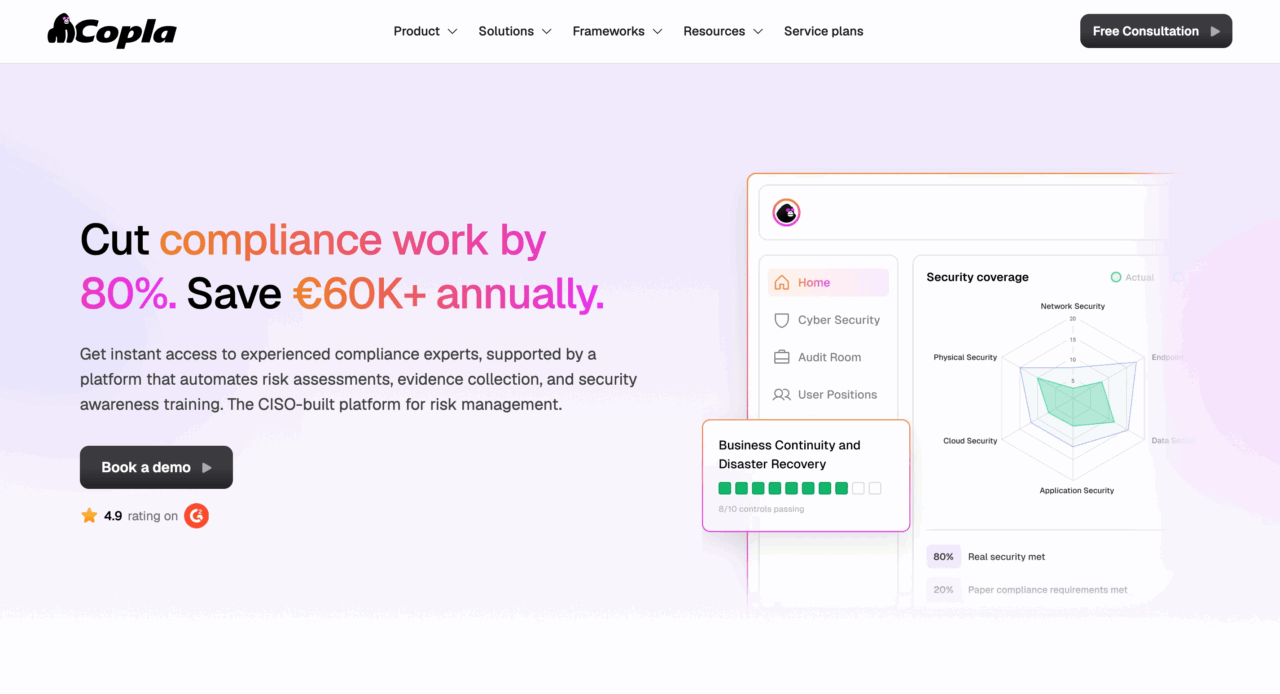
Founded in 2023 and headquartered in Vilnius, Lithuania, Copla made its Finovate debut at FinovateEurope 2025. At the conference, the company demonstrated its ICT security and compliance automation platform that provides a full cybersecurity and compliance department at a subscription cost. The platform combines CoreGuardian, which ensures compliance with frameworks such as DORA; an AI-powered co-pilot to provide real-time education, assessments, and alerts to boost accountability; and VendorGuard, which simplifies vendor management by handling risk assessments, incident planning, and prioritization.

Formerly known as CyberUpgrade, the company rebranded earlier this year in a move designed to reflect its evolution beyond cybersecurity.

“After years of growing, evolving, and helping organizations secure their digital environment, we’re stepping into an exciting new phase,” the company noted on its LinkedIn page. “We are now Copla—our new name, our new vision, and our next stage of evolution. Why Copla? Because we’re no longer just about cybersecurity. COmpliance PLAtform reflects everything we do today: empowering organizations to manage compliance, risk, and security with one intelligent platform. Same team. Bigger vision. A name that matches our mission.”


Photo by David Clode on Unsplash