Charity Bank Turns to Sandstone Technology to Power Mobile Savings App

Charity Bank Turns to Sandstone Technology to Power Mobile Savings App
  • Ethical, UK-based savings and loan Charity Bank announced a strategic partnership with digital banking solutions provider Sandstone Technology to power development of its mobile savings app.
  • Charity Bank and Sandstone Technology have been collaboration partners for more than a decade.
  • Headquartered in Sydney, Australia, Sandstone Technology made its Finovate debut at FinovateEurope 2012, and most recently demoed on the Finovate stage at FinovateEurope 2016.

Charity Bank has forged a strategic partnership with Sandstone Technology to power development of its new mobile savings app. The app will offer a variety of enhanced, self-service capabilities, feature robust security, and provide a suite of modern tools to help meet the needs of Charity Bank’s customers. The technology supports seamless updating, rapid product launches, and a consistent user experience. The app is expected to be available to Charity Bank customers in the spring of 2026.

“Partnering with Charity Bank on this initiative is both exciting and rewarding,” Sandstone Technology Chief Customer Officer Jennifer Harris said, “Mobile is now the channel of choice across all demographics, and this solution reflects the importance of delivering banking experiences that are intuitive, flexible, and future-ready. Our collaboration is built on trust and innovation, and this project showcases our shared vision for the next generation of digital banking.”

Charity Bank is an ethical savings and loan wholly owned by charitable foundations, trusts, and social purpose organizations. The institution uses savers’ deposits to provide loans to organizations in the UK that are working toward positive social change for individuals, communities, and the environment. Since 2002, Charity Bank has lent more than £600 million to charities and social enterprises across the UK.

Sandstone Technology is a long-time technology partner of Charity Bank, having collaborated for more than a decade. The current partnership to develop the institution’s mobile app represents the latest milestone in Charity Bank’s digital transformation journey designed to enhance the customer experience and make access to ethical banking available to more banking customers.

“We are thrilled to take this next step with Sandstone Technology,” Charity Bank Director of Operations and Savings Justin Hort said. “Launching a mobile app is a major milestone that reflects our commitment to evolving with our savers’ needs. We’re focused on delivering a seamless, modern and intuitive experience—and with Sandstone’s proven track record, we knew they were the right partner to bring this vision to life.”

Headquartered in Sydney, Australia and founded in 1996, Sandstone Technology made its Finovate debut at FinovateEurope 2012. The company, which offers solutions for loan origination, digital banking, and digital onboarding, most recently demoed on the Finovate stage at FinovateEurope 2016. Abhish Saha was appointed CEO in 2022 after previously serving as the Executive General Manager of the company’s Digital Banking & Elevate business unit. Saha replaced Michael Phillipou, who had been Sandstone Technology’s CEO since December 2020.

More recently, Sandstone Technology earned recognition for its partnership with UK-based Chetwood Bank, helping the institution deploy its digital savings platform that has contributed to a 39% increase in customers completing the application process and opening a savings account.


Photo by Mark Hansen on Unsplash

Bankjoy and InvestiFi Bring Investing Options to Community Banks and Credit Unions

Bankjoy and InvestiFi Bring Investing Options to Community Banks and Credit Unions
  • Digital banking platform Bankjoy has teamed up with digital investment solutions provider InvestiFi.
  • The partnership will enable customers and members of community banks and credit unions to invest in stocks, ETFs, and cryptocurrencies directly from their checking accounts.
  • Michigan-based Bankjoy most recently demoed its technology on the Finovate stage at FinovateFall 2023. InvestiFi made its Finovate debut as CryptoFi at FinovateFall 2022 and rebranded in 2024.

Digital banking platform Bankjoy has forged a strategic partnership with fellow Finovate alum InvestiFi, a provider of digital investment solutions. The partnership will enable community banks and credit unions that use Bankjoy’s digital banking platform to offer their customers and members the ability to invest in stocks, ETFs, and cryptocurrencies directly from their checking accounts.

The partnership comes as a growing number of fintechs are empowering smaller, more community-focused financial institutions to directly offer investment services. Last week we noted the partnership between two-time Finovate Best of Show winner Eko and Brooklyn Coop FCU as another example of fintech/financial institution partnerships designed to make it easier for customers and members to invest without having to leave the comfort and familiarity of their digital banking platforms.

“With deposit outflows to platforms like Robinhood accelerating, community banks and credit unions must meet members where they already are: inside their banking app,” Bankjoy COO and Co-Founder Weiwei Duncan said. “By embedding wealth management tools directly into digital banking, they not only keep members engaged with their own products, but also strengthen loyalty and competitiveness in a fast-changing market.”

The threat to credit unions and community banks from these new platforms is not just that their members and customers will use them for their investments; many of these platforms are looking to grow by adding banking services to their digital brokerage offering. Partnerships between fintechs like Bankjoy and InvestiFi are designed to discourage individuals from transferring both their investments and banking business to these new platforms. Additionally, the addition of new services like investing enables community banks and credit unions to attract new customers and members by serving as a single location where they can do both their banking and their investing.

“At InvestiFi, we continue to strive to support financial institutions with cutting-edge, in-house investing solutions,” InvestiFi CEO Kian Sarreshteh said. “Partnering with Bankjoy, a well-respected and trusted platform that supports banks and credit unions, allows us to extend our reach and help more financial institutions across the US, providing them with the tools they need to offer seamless digital investing experiences.”

As CryptoFi, InvestiFi made its Finovate debut at FinovateFall 2022. The company rebranded in 2024 to reflect its growth into a comprehensive self-directed investing suite for credit union members. More recently, InvestiFi has forged partnerships with community-based financial institutions such as West Virginia Central Federal Credit Union ($303 million in assets), Horizon Utah Federal Credit Union ($180 million in assets), Illiana Financial Credit Union ($278 million in assets) and Ocala Community Credit Union ($29 million in assets). InvestiFi also introduced new Chief Product Officer Patrick McNally in August of this year. McNally was formerly Director of Data & Analytics at digital wealth tools provider Exodus Movement.

Founded in 2015 and headquartered in Royal Oak, Michigan, Bankjoy most recently demoed its technology on the Finovate stage at FinovateFall 2023. At the conference, the company showed how its digital banking platform is helping neobank Panacea Financial provide financial services to medical professionals.

Last month, Bankjoy announced that it was expanding its partnership with account activation specialist Pinwheel. A collaboration partner since 2024, Pinwheel has now expanded the number of solutions available on the Bankjoy digital banking platform to include its Switch Kit. This offering combines Pinwheel’s Direct Deposit Switch solution with its Bill Switch feature, unveiled earlier this year, to help solve pain points in the account activation process for consumers.


Photo by Liza Summer

Splitit to Help AI Agents Pay in Installments

Splitit to Help AI Agents Pay in Installments
  • Splitit launched its Agentic Commerce Partner Program that enables AI agents to offer card-linked installment payment options directly within merchant checkout flows without requiring new lines of credit.
  • The program is designed to align with emerging standards like Google’s AP2 and OpenAI’s Agentic Commerce Protocol, ensuring interoperability as autonomous shopping ecosystems evolve.
  • As AI-driven commerce accelerates, Splitit aims to make flexible pay-later options a native part of agent-powered purchases starting with a pilot in the fourth quarter of this year.

Embedded BNPL solutions provider Splitit announced yesterday that it launched a partner program that will allow AI agents to take advantage of pay-later capabilities when making payments on behalf of their users.

Called the Agentic Commerce Partner Program, the new initiative will allow autonomous shopping agents to make payments using card-linked installments. AI agents that have registered with Splitit can request real-time installment options directly within the merchant’s checkout flow. The payments take place on existing payment rails using the users’ existing payment cards, and do not require new lines of credit.

While the agentic commerce landscape is still in its early days of development, Splitit built its Agentic Commerce Partner Program to align with emerging industry frameworks like Google’s AP2 and OpenAI’s Agentic Commerce Protocol to ensure flexibility and interoperability across future agent ecosystems.

“Agentic AI will fundamentally reshape how consumers and businesses buy,” said Splitit CTO Ran Landau. “Splitit’s mission is to ensure that seamless, transparent installments are built into this new paradigm from day one, not bolted on later. We look forward to partnering with leading merchants, platforms, networks, and banks in developing meaningful use cases that can be beneficial to shoppers and brands.”

Splitit’s new feature aims to keep up with the newest evolutions in agent-powered shopping. According to Adobe, 53% of consumers plan to use AI for product research and 40% plan to use AI for purchasing recommendations this holiday season, especially as shoppers are turning to Gen AI for deal-hunting, recommendations, and gift inspiration.

By embedding installment payment functionality directly into agentic commerce flows, Splitit is positioning itself at the cutting edge of autonomous shopping. As agentic ecosystems mature, the integration will allow merchants and platforms to offer more flexible, seamless payment options at the point of decision. Splitit’s Agentic Commerce pilot program will roll out in Q4.


Photo by Magda Ehlers

FIS Integrates Glia’s Customer Interaction Tech into its Digital One Banking Platform

FIS Integrates Glia’s Customer Interaction Tech into its Digital One Banking Platform
  • Global financial technology company FIS has announced a strategic partnership with AI-powered customer interactions platform Glia.
  • The partnership will integrate Glia’s multi-channel digital interaction solution into FIS’s Digital One online banking platform.
  • FIS made its first Finovate appearance at FinovateFall 2010. Glia is a 10-time, Finovate Best of Show award-winner.

FIS has forged a strategic partnership with AI-powered customer interactions platform Glia. The partnership will integrate Glia’s AI for All digital interaction solution into FIS’s Digital One online banking platform. The goal is to deliver superior experiences for banking customers via a combination of AI-enabled service and high-touch human support.

AI agents will be able to respond quickly to routine inquiries 24/7 while also intelligently routing more complex queries and issues to human agents. This will reduce resolution times and provide more personalized service that adapts instantly to customer needs. Embedding these AI capabilities directly into FIS’s digital banking infrastructure will empower financial institutions to modernize their customer service operations without disrupting current systems.

“By integrating Glia’s sophisticated AI and digital interaction capabilities into our Digital One platforms, we’re enabling banks and credit unions to reap the benefits of a virtual workforce and high-touch, personalized service,” FIS Head of Retail Digital & Open Banking Hashim Toussaint said. “This new technology aligns perfectly with our recently announced Banking Modernization Framework, where open banking serves as a cornerstone for institutions looking to transform their operations and customer experiences. It truly represents the future of banking—where intelligent automation meets human insight.”

Headquartered in Jacksonville, Florida, FIS made its Finovate debut at FinovateFall 2010. Today the fintech services and consulting firm works with 70% of the top 100 insurance firms, has more than $16 trillion in financial assets on its platforms, and serves 5,800+ clients across 150 countries. A member of the Fortune 500, FIS is a publicly traded company on the New York Stock Exchange (NYSE: FIS), and has a market cap of $35 billion.

The integration of Glia’s AI for All will enable FIS’s Digital One platform to provide a consistent, context-aware experience across channels—from mobile app to web platform to live agent. The platform will also deliver faster resolution times by triaging queries to separate the routine from the more complex. The integration will also provide 24/7 availability, with AI agents fielding account management questions, providing transaction support, and offering basic financial guidance beyond traditional banking hours.

“Financial institutions today face the dual challenge of meeting rising customer expectations while managing operational costs,” Glia CEO and Co-Founder Dan Michaeli said. “Adding Glia’s AI-powered platform to FIS’s digital online banking products creates a powerful solution that doesn’t force organizations to choose between efficiency and experience—they can have both.”

Having introduced itself to Finovate audiences as SaleMove in its Best of Show-winning debut at FinovateFall 2015, Glia has since become one of Finovate’s most decorated demoers, earning Best of Show honors a whopping ten times. Founded in 2012 and headquartered in New York, Glia offers an AI-powered, customer interactions solution for community banks and credit unions that delivers increases in digital branch loan dollars by more than 5x, boosts digital containment rates to 62%, and reduces abandonment rates by 12%.


Photo by Trevor Neely on Unsplash

Offset Labs Secures Pre-Seed Funding in Round Led by Archangel Ventures

Offset Labs Secures Pre-Seed Funding in Round Led by Archangel Ventures
  • AI defense startup Offset Labs has secured €600k ($804k) in pre-seed funding in a round led by Archangel Ventures and featuring participation from Amadeus Capital Partners and Seven Capital.
  • The funding takes the company’s total capital raised to more than $1.1 million, according to Crunchbase.
  • As Byne, the company made its Finovate debut earlier this year at FinovateEurope 2025 in London.

UK-Ukrainian AI defense venture Offset Labs, which rebranded from Byne earlier this year, has raised €600k ($804k) in pre-seed funding in a round led by Archangel Ventures. Amadeus Capital Partners and Seven Capital also participated in the investment. The funding takes Offset Labs total funding to more than $1.1 million, according to Crunchbase.

“This funding marks an important milestone in our mission: to build the first AI Lab creating frontier models specifically tailored to the needs of defence and national security customers,” the company noted on its LinkedIn page. “We believe that achieving this vision requires uniting talent, data, and computing infrastructure under one roof. Only with this integrated approach can we deliver the breakthrough—the ‘ChatGPT moment’—for mission-relevant AI and sustain a decisive qualitative offset in the decade ahead.”

With a team split between London and Kyiv, Offset Labs is a bi-national security laboratory that has designed and deployed AI models for signal and voice processing in operational environments. The investment is expected to accelerate the company’s development of what it refers to as a “decisive AI advantage” for NATO and its allies. As its name implies, Offset Labs is focused on the idea of an “offset” or strategic leap forward that provides one side a significant advantage in the balance of power.

The company believes that AI is the next likely area for an offset, but insists that in order for Western countries to make this happen, firms will have to embrace an integration of data, research, and talent at scale. This is where Offset Labs comes in, “to bring everything from data curation to research under one roof and unlock deep AI innovation for defense customers, ensuring Western leadership in this critical domain.”

As Byne, the company made its Finovate debut in February at FinovateEurope 2025. At the conference, the startup’s co-founder and CEO Borys Nadykto demonstrated how the technology enables users to create secure Large Language Model (LLM) agents for enterprise use. Designed to manage the tension between productivity gains and data security when using AI tools like ChatGPT, Byne’s technology empowers companies to host LLM applications within their secure perimeter (on-premise or private cloud) to ensure safe handling of sensitive data and integration with internal systems.

Headquartered in London, the company was founded as Byne in 2022 by Nadykto, Denys Budnyk, and Andrii Yakovyna. Byne announced its rebrand to Offset Labs earlier this year.


Photo by vackground.com on Unsplash

Payments Optimization Meets Fraud Prevention: Spreedly Acquires Dodgeball

Payments Optimization Meets Fraud Prevention: Spreedly Acquires Dodgeball
  • Payments optimization platform Spreedly has acquired fraud prevention company Dodgeball. Terms were not disclosed.
  • The acquisition will combine payments optimization and fraud prevention into a single platform.
  • Founded in 2008 and headquartered in North Carolina, Spreedly has been a Finovate alum since 2013.

Open payments platform Spreedly announced its acquisition of fraud orchestration company Dodgeball. Terms of the transaction were not disclosed. The acquisition combines payments optimization and fraud prevention in a single platform and helps bolster Spreedly’s strategy for both AI and open payments.

“For most merchants, payments and fraud aren’t separate challenges—they’re two sides of the same coin,” Spreedly CEO Justin Benson said. “You can’t optimize payments without addressing fraud, and you can’t fight fraud without understanding the payment flow. This acquisition brings these critical functions together, allowing us to deliver immense value to our customers and accelerate our vision for an AI-powered, open payments future.”

The acquisition is designed to give Spreedly’s customers additional reliability, as well as insights to help eliminate fraud and make more intelligent e-commerce decisions. The company noted that the acquisition will also enhance Spreedly’s workflow engine and help build the foundation for an AI-powered payments copilot. Post acquisition, the Dodgeball brand, as well as the Dodgeball team, will be integrated into Spreedly. This will not only enable Spreedly to maximize the benefit of Dodgeball’s expertise, but will also help ensure a smooth transition for customers with no service interruption and complete access to Spreedly’s global support and account management teams.

“We leapt at the opportunity to join forces with Spreedly, in order to help more merchants build best-of-breed fraud management solutions while still promoting growth,” Dodgeball CEO Adam Hiatt said. “The partnership will also help us provide much greater value to our existing customers. All of us at Dodgeball are excited to get started on integrating our offering with Spreedly’s.”

Most recently having demoing its technology on the Finovate stage at FinovateFall 2018 in New York, Spreedly has been a Finovate alum since 2013. The company, founded in 2008 and headquartered in Durham, North Carolina, counts major brands such as BMW, HBO Max, Priceline, The New York Times, and others among those that use its payments technology. Spreedly processes more than $50 billion in gross merchandise value (GMV) on behalf of more than 400 customers in 100+ countries.

Spreedly’s acquisition announcement came shortly before the company released its State of Checkout 2025 Survey, conducted by Talker Research on Spreedly’s behalf. The survey noted that many US executives remain concerned that AI could bring greater complexity to what they consider to be fragile checkout flows, leading to greater challenges and even financial losses.

“AI has incredible potential to transform payments,” Spreedly President Peter Dougherty said. “But executives in the survey also revealed they’re already paying a steep ‘engineering tax’—with as much as a quarter of their engineering teams dedicated to maintaining fragile checkout flows. AI should be layered thoughtfully to strengthen these payment systems, not replace them entirely and introduce new risks.”


Photo by Colin Rowley on Unsplash

Feedzai Raises $75 Million; Partners with ECB to Safeguard Digital Euro

Feedzai Raises $75 Million; Partners with ECB to Safeguard Digital Euro
  • Fraud and financial crime prevention platform Feedzai has secured $75 million in funding at a valuation of $2 billion.
  • The company also announced that the European Central Bank (ECB) has selected it as the first-ranked provider for fraud and risk management for the digital euro, slated to be launched by 2029.
  • Founded in 2011 and headquartered in Portugal, Feedzai made its Finovate debut at FinovateEurope 2014.

In a big start to the month of October, fraud and financial crime prevention platform Feedzai has announced both a major funding round and a deal with the European Central Bank (ECB) to safeguard the digital euro.

First up, the funding. Feedzai has secured $75 million in a round that featured participation from new institutional investors Lince Capital, Iberis Capital, and Explorer Investments, as well as existing investors Oxy Capital and Buenavista Equity Partners. The funding, which takes Feedzai’s total capital raised to more than $352 million according to Crunchbase, gives the Portugal-based fintech a valuation of $2 billion.

In a statement, Lince Capital CEO Vasco Pereira Coutinho praised Feedzai for its use of AI and the company’s “end-to-end approach to risk operations.” Coutinho also underscored Feedzai’s ability to “execute across multiple product lines while scaling globally.”

Feedzai CEO and Co-Founder Nuno Sebastião spoke to the strong pace of innovation in the fraud prevention space, and pointed to the importance of future-proofing financial crime fighting technology. “This new investment round enables us to continue driving innovation to defend against whatever comes next, so that every form of payment, even those yet to be imagined, can be trusted and adopted safely,” Sebastião said.

Second, the ECB deal. The same day that Feedzai announced its major funding, the company also reported that the European Central Bank (ECB) has selected it as the first-ranked tenderer in its framework agreement to provide the central fraud detection and prevention solution for the to-be-launched digital euro. The framework agreement outlines the providers for five different digital euro components and related services: alias lookup, risk and fraud management, app and software development kit, offline solutions, and secure exchange of payment information. Feedzai is one of two providers in the risk and fraud management component; Capgemini Deutschland is the designated second provider. Service requests, according to the framework, will be initially directed to first-rank providers with second-rank providers contacted only as needed.

The framework agreement for the risk and fraud management component for the digital euro has been valued at €79.1 million ($92.8 million), with a maximum value of €237.3 million ($277.3 million). For its part, Feedzai is partnering with subcontractor PwC to deliver a state-of-the-art central fraud detection and prevention mechanism that complies with EU security, privacy, and data protection standards.

“Being selected as the first-ranked tenderer in the framework agreement to secure the digital euro is both an honor and a responsibility,” Feedzai’s Sebastião said. “With tens of billions of transactions expected across the eurozone, success depends on AI that can adapt as quickly as fraud evolves. Our role is to provide the intelligence that keeps even the most sophisticated fraud out, ensuring trust in every digital euro transaction from day one.”

Founded in 2011 and headquartered in Lisbon, Portugal, Feedzai made its Finovate debut at FinovateEurope 2014. Today, the company defends 900 million people in 190 countries from fraud with an end-to-end financial crime prevention platform that features AI-native solutions. Over the past year, Feedzai has launched a number of key products including its Feedzai Orchestration and Feedzai IQ, which empower financial institutions to make better, faster risk assessments. Feedzai has also introduced the TRUST Framework to embed fairness, explainability, and security into every component of GenAI model development.

In April, Feedzai acquired data management platform and fellow Finovate alum DemystData in a deal valued at $157 million.


Photo by Vita Marija Murenaite on Unsplash

BILL Launches High-Yield Cash Account for SMBs

BILL Launches High-Yield Cash Account for SMBs
  • BILL has launched a high-yield Cash Account for its SMB clients, offering 3% returns with no fees or minimum balance requirements.
  • The account provides enterprise-grade features like FDIC insurance up to $200 million, next-day ACH payments, and integrated cash management tools.
  • With nearly 500K small business clients and $266 billion in processed payments, BILL aims to help SMBs grow funds and optimize cashflow.

Small business financial software provider BILL launched a cash account that will offer high-yield savings opportunities to its small-and-medium-sized business clients. The BILL Cash Account will help SMBs earn a higher yield on their idle cash.

The California-based company is launching the new account to help its nearly half a million small business clients use manage their money with higher returns and stronger cashflow.

“Idle cash sitting in low-or no-yield checking accounts not only costs businesses time and money—it costs them opportunity to grow,” said BILL EVP, GM of Payments and Financial Services Mary Kay Bowman. “With Cash Account, we’re bringing growing businesses the same enterprise-grade capabilities normally reserved for Fortune 500 companies—combining high APY on an operational account with fast speed, seamless software integration, and security all in one simple account.”

BILL’s new Cash Account offers enterprise-grade tools to help businesses grow their funds confidently, with FDIC insurance coverage of up to $200 million. The high-yield account pays 3% returns, which is 42 times the national average of 0.07%. Unlike many competitors, BILL doesn’t require businesses to hold a minimum amount of funds in their accounts and does not charge fees. Users also benefit from next-business-day ACH payments and cash management tools.

‍‍Founded in 2006, BILL helps its small business clients automate their financial operations and has processed $266 billion in payments volume. The company, which trades on the New York Stock Exchange under the ticker BILL, went public in 2019 and has a market capitalization of $5.54 billion.


Photo by Tima Miroshnichenko

Mastercard Launches Mastercard Commerce Media to Leverage Consumer Data

Mastercard Launches Mastercard Commerce Media to Leverage Consumer Data
  • Mastercard Commerce Media has launched to leverage consumer-permissioned transaction data, giving 25,000 advertiser partners smarter targeting and delivering up to 22x ROAS across industries like retail, travel, and dining.
  • Mastercard’s partnerships with Citi, American Airlines, Microsoft, and WPP will expand scale, reach, and brand integration.
  • Retail media networks are surging, with spending projected to hit nearly $100 billion by 2028. Chase Media Solutions, which launched in 2024, is an example of how financial institutions are monetizing first-party data to serve personalized offers.

Mastercard announced that it will begin leveraging consumer-permissioned data via its new digital media network, Mastercard Commerce Media. The new media network will give Mastercard’s 25,000 advertiser partners access to transaction data from the 500 million enrolled consumers in order to power smarter, personalized commerce.

Through Mastercard’s proprietary Offers platform, advertisers can deliver tailored campaigns, such as cashback, discounts, and incentives, to audiences defined by their business goals. Using insights from consumer-permissioned data, Mastercard identifies the right customers and delivers relevant advertising content. Consumers can then activate offers on their enrolled card and complete the purchase, with Mastercard directly attributing the transaction to the campaign.

Beyond traditional cashback, Mastercard Commerce Media helps publishers strengthen brand loyalty by enabling programs where consumers earn rewards in a brand’s own cash currency, giving shoppers more purchasing power and brands deeper engagement. Looking ahead, Mastercard plans to expand distribution to new channels and deepen integrations across its broader services portfolio beginning in 2026.

Mastercard processed more than 160 billion transactions in 2024, and its new media network will deliver proprietary insights from transactions like these processed by Mastercard. Mastercard Commerce Media currently delivers a return on ad spend (ROAS) of up to 22 times for advertisers across retail, travel, entertainment, dining, and more.

“We understand how to connect advertisers to consumers and consumers to the products, services and experiences they value,” said Mastercard Chief Services Officer Craig Vosburg. “Mastercard Commerce Media is a natural extension of the trusted connections we’re known for and the work we already do across our unique suite of services. That means we’re not just well-positioned to bring a full-scale commerce media network to life—we’re best-positioned.”

Mastercard Commerce Media is launching in partnership with  Citi, which will help the program grow faster, reach more users, and deliver more value. Mastercard already has ongoing ties with Citi, which will give Mastercard’s media network a head start in leveraging Citi’s infrastructure, customer base, and channels. Mastercard is also partnering with American Airlines, Microsoft, and WPP, which will help extend its footprint and connection to brands in the traditional media space.

As the use of consumer-permissioned data gains popularity across fintech subsectors, so too has the adoption of retail media networks. These networks allow institutions to monetize their first-party data by connecting brands with highly targeted audiences through trusted digital channels.

According to eMarketer, retail media networks will expand in the coming years. The firm estimates that retail media network spending will reach nearly $100 billion through 2028, reflecting both advertiser demand and consumer engagement with personalized content. An early trailblazer in the space is Chase Media Solutions, which launched in 2024 to leverage its transaction and cardholder data to serve personalized offers and marketing to its 80 million customers.


Photo by Collis

Larky and Tyfone Team Up to Enhance Account Holder Engagement for Financial Institutions

Larky and Tyfone Team Up to Enhance Account Holder Engagement for Financial Institutions
  • Account holder engagement specialist Larky has announced a strategic partnership with digital banking solutions provider Tyfone.
  • Courtesy of the partnership, Larky will integrate its nudge engagement platform into Tyfone’s nFinia digital banking solution.
  • Tyfone made its Finovate debut at FinovateSpring 2008. Larky first demonstrated its technology to Finovate audiences at FinovateFall 2014.

Proactive account holder engagement company Larky has inked a strategic partnership with digital banking solutions provider Tyfone this week. The agreement will integrate Larky’s nudge platform directly into Tyfone’s nFinia digital banking solution.

“At Tyfone, we believe that elegant user experiences are only the starting point,” Tyfone CEO Siva Narendra said. “What truly sets us apart is our commitment to innovation, collaboration, and execution. Partnering with Larky extends that commitment, helping our clients engage their customers and members in meaningful ways that strengthen relationships and deliver lasting value.”

Larky’s nudge platform provides real-time personalized notifications to enhance the ability of financial institutions to connect with their account holders. The solution enables financial institutions to increase deposits and new loans, and prevent fraud with tailored, turnkey push notifications. Financial institutions using nudge leverage data-driven and location-aware messaging to secure customer and member engagement rates that are seven to ten times higher than with traditional marketing channels.

Via a pre-built integration with Tyfone’s digital banking technology, Larky’s notification capabilities are seamlessly embedded, empowering banks and other financial institutions to bring additional value by way of the mobile channel that customers use and trust. Financial institutions will be able to choose from either a library of pre-built campaigns or deploy Larky’s AI-powered solutions to create messaging that is customized for their specific audiences. This messaging can help banks and other financial institutions to encourage debit card use, boost fraud prevention awareness, announce the launch of new solutions, and more.

“We’re thrilled to launch our partnership with Tyfone and bring our nudge platform to more community financial institutions,” Larky CEO Gregg Hammerman said. “Tyfone’s focus on meaningful digital relationships aligns perfectly with our mission to help account holders receive relevant, timely engagement where it matters most.”

Founded in 2012 and headquartered in Ann Arbor, Michigan, Larky made its Finovate debut at FinovateFall 2014. More recently, the company has forged partnerships with core banking solutions provider VisiFi, and began this year teaming up with data analytics and business intelligence solutions company for credit unions Trellance. Larky has raised more than $4.5 million in funding, according to Crunchbase, most recently securing an investment from Reseda Group in 2023.

Portland, Oregon-based Tyfone has been a Finovate alum since its debut at FinovateSpring 2008. The company’s nFinia digital banking platform offers account management, fund transfers, and billpay services, as well as payment solutions and personal finance management (PFM) tools. The platform also features Penni AI integration that delivers conversational banking capabilities including smart tools and intelligent, personalized support, 24/7.

Tyfone’s partnership news with fellow Finovate alum Larky comes just days after the company reported collaborating with another Finovate alum, BioCatch. Last month, the two companies announced a strategic partnership that integrated BioCatch’s Account Takeover Protection solution into Tyfone’s nFinia platform.

“Account takeover fraud is one of the most pervasive threats in digital banking,” BioCatch Senior Director of Global Integration Partners and Alliances Jay Whoriskey said. “By embedding our behavioral intelligence into Tyfone’s digital banking platform, community financial institutions gain real-time protection, identifying and stopping fraud before any money leaves the would-be-victim’s account without compromising the user experience.”

Founded in 2004, Tyfone has raised more than $38 million in funding, according to Crunchbase. This figure includes the company’s $25 million venture round in 2023.


Photo by Josh Herrington on Unsplash

Xaver Unveils AI Workforce for Financial Advisory that Assists, Advises, and Acts

Xaver Unveils AI Workforce for Financial Advisory that Assists, Advises, and Acts
  • Sales platform Xaver unveiled a range of new features that arm financial advisors with an Agentic AI workforce that “assists, advises, and acts.”
  • The new functionality reduces the number of hallucinations, features 24/7 call answering with AI-native advisors, and provides greater accuracy compared to popular Large Language Models (LLMs), the company said.
  • Founded in 2023, Xaver made its Finovate debut at FinovateEurope 2025 in London. Co-founder Max Bachem is CEO.

White-label, omnichannel sales platform Xaver has introduced a range of new features the company pledges will “open a new chapter for financial advisory with an AI workforce that doesn’t just assist, it advises, and acts.”

The new functionality includes three elements in particular that respond to key barriers that regulated businesses and organizations can face when looking to adopt AI-powered solutions. To start, Xaver has leveraged context engineering, a model-independent data ingestion layer, and multi-agent orchestration to reduce the number of hallucinations by 80%. This “safer by design” strategy makes the technology more appropriate for operation in high-risk, regulated environments with both auditability and human oversight.

Second, the company has shown through independent testing that its AI agents outperformed leading LLMs when it comes to regulated financial-advice accuracy. This is important insofar as companies in regulated industries have expressed concerns about AI being able to consistently achieve this level of accuracy. Third, Xaver has introduced 24/7 call answering with voice-native AI advisors who can resolve incoming questions, qualify interest into warm leads, and seamlessly transfer calls to a human agent, when appropriate.

“Powered by Xaver’s MCP-enabled investment infrastructure rails, our AI advisors do things no other AI can today,” the company noted on its LinkedIn page.

Pictured (left to right): Nigel Jankelson (COO) and Max Bachem (CEO & Co-Founder), Xaver

Xaver’s enhanced offering enables financial advisors to use the AI agents as “prep partners” to provide instant briefs, conduct prospect research, suggest next-best actions, and build both tailored playbooks and compliant document packs. The AI agents run in parallel to the client journey, “like a personal AI advisor at your side. Always on, cost-efficient, infinitely scalable,” the company explained. The new features also include the ability to conduct phone, email, and WhatsApp campaigns—including automated follow-ups—from first touch to booked meeting or sale.

Xaver made its Finovate debut at FinovateEurope 2025 in London. At the conference, the company demonstrated its sales platform that leverages specifically trained and compliant AI agents to handle a variety of tasks including financial analysis, data extraction, and the creation of personalized customer journeys. Fully ISO27001, GDPR, and EU AI Act-compliant, Xaver’s platform orchestrates multiple LLMs to deliver 24/7 AI-powered guidance via chat and voice. At the same time, the technology is able to introduce human advisors into the workflow as needed.

“This platform has four main components,” Xaver co-founder and CEO Max Bachem explained from the Finovate stage earlier this year. “First of all, we are providing AI-generated, tailored, personalized online journeys for each customer. Second, we have AI advisors who can compliantly advise customers and do conversational sales. But we have an omnichannel approach so, number three, we do seamless handovers from these digital channels … to your in-person financial advisor. And, number four, when you are with the in-person financial advisor, the AI is then acting as a co-pilot for that advisor.”

Bachem co-founded Xaver with Ole Breulmann (CPTO) in 2023. The company is headquartered in Cologne, Germany.


Photo by Adnan Omicevic on Unsplash

EnFi Unveils EnFi Grid, an AI-Powered Spreadsheet Intelligence for Lending Solution

EnFi Unveils EnFi Grid, an AI-Powered Spreadsheet Intelligence for Lending Solution
  • Lending platform EnFi has introduced EnFi Grid, its new AI-powered spreadsheet intelligence for lending solution.
  • The new offering brings full, AI-powered, spreadsheet functionality directly into the EnFi platform.
  • Headquartered in Boston, Massachusetts, and founded in 2024, EnFi made its Finovate debut at FinovateFall 2025.

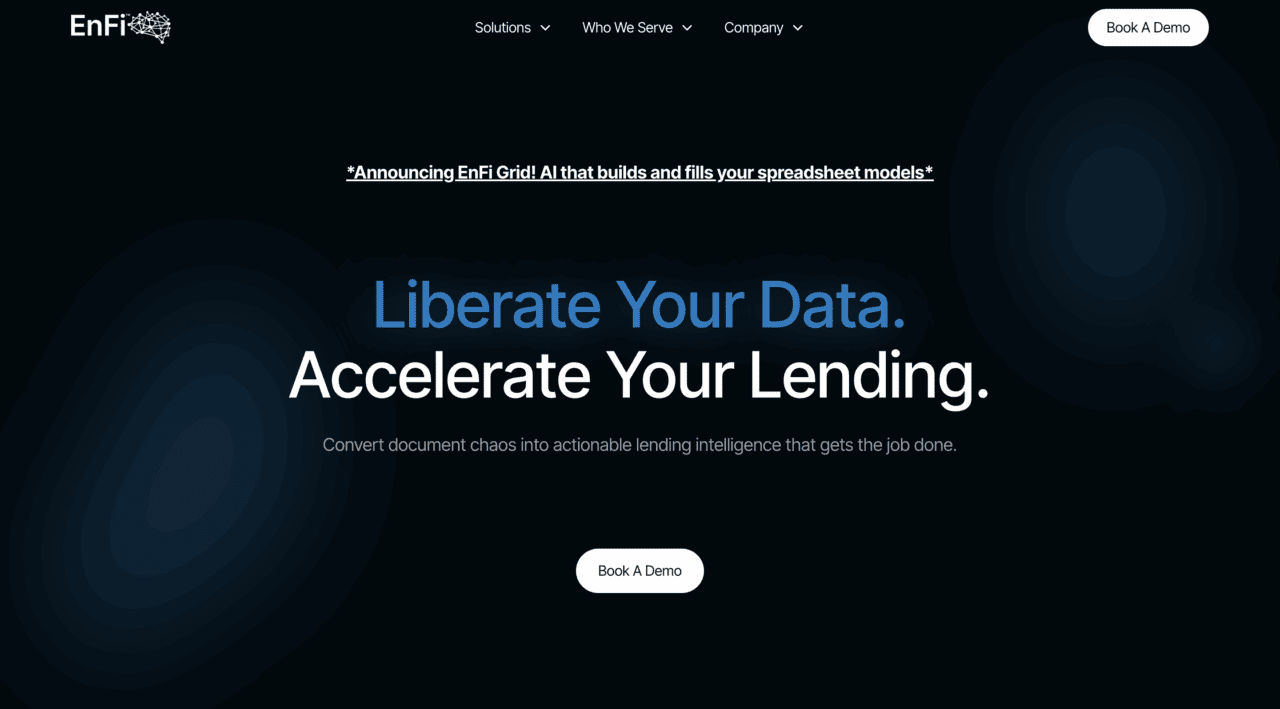
AI-native lending platform EnFi has launched its new AI-powered spreadsheet intelligence for lending solution, EnFi Grid. The company, which offers technology that automates commercial credit workflows for financial institutions and private lenders, reports that the new offering brings full spreadsheet functionality directly into the EnFi platform, assisted with AI.

“This is a major launch for Team EnFi,” the company noted on its LinkedIn page. “EnFi Grid lets commercial lenders work in the familiar spreadsheet interface and models they know and love while taking advantage of the power of EnFi’s purpose-built commercial lending AI to add a layer of intelligence and scale to their efforts.”

EnFi Grid enables users to upload existing spreadsheets or start from scratch from within the platform. Users can build custom financial models, stress tests, and projects, as well as collaborate with AI to complete scoring models and trackers. EnFi Grid has a complete range of spreadsheet features including formulas, charts, pivot tables, editing, and more. Lenders can use the technology, for example, to complete a credit scorecard with a borrower’s most recent financial data, or to build a cash flow projection for a given construction project.

“At times like this—quarter end—where the crush of production goals collides with reporting requirements in a sea of cells, imagine being able to deploy an army of EnFi Grid Agents to ingest, analyze, and update your spreadsheets in minutes,” the company wrote.

Founded in 2024, EnFi made its Finovate debut at FinovateFall 2025 in New York. At the conference, the Boston, Massachusetts-based fintech introduced its suite of agentic AI agents for data ingestion/extraction, automated spreading, and relationship management. The company also demoed orchestrations that combined agents into bigger automated workflows for deal screening, underwriting, and portfolio monitoring. Finally, EnFi showed how the platform can be tuned to provide customer-specific workflows for a variety of commercial credit types including CRE, C&I, SBA, and venture.

Named a “Startup to Watch in 2025” by the Boston Business Journal, EnFi began this year adding to its C-suite. The company hired its first chief revenue officer, Chris Aronis, a fintech executive with more than 20 years of experience, in January. Aronis has held leadership roles at Fiserv, Quovo, and Bottomline, and was chief revenue officer of business banking and lending for Numerated.

EnFi was co-founded by Joshua Summers (CEO), Scott Weller (CTO), and Michelle Hipwood (CFO). According to Crunchbase, the company has raised $7.5 million in funding courtesy of a June 2024 seed round led by Unusual Ventures.


Photo by Wonderlane on Unsplash