
5 Ways Mortgage Lending In 2030 Will Look Nothing Like It Does Today

5 Ways Mortgage Lending In 2030 Will Look Nothing Like It Does Today

The following is a blog post by mortgagetech veteran Caleb Skinner.

This year’s historically low interest rates are creating rare opportunities for homebuyers and mortgage refinance applicants — and, by extension, for the mortgage industry.

Unprecedented as the present economic situation is, though, it’s not unexpected. Indeed, it’s already old news.

What’s more interesting to real estate professionals, financial professionals, and fintech executives whose livelihoods depend on a vibrant real estate lending industry is how that industry looks two, three, or four business cycles out from the present.

Like It or Not, Big Changes Are Coming

Comforting as it is to imagine that business will continue as usual through the coming decade, all available evidence suggests that won’t happen. We need to gear up now for years of potentially wrenching change and prepare for a mortgage industry that, come 2030, bears little resemblance to today.

Here are five ways that lending will dramatically change in the next 10 years.

  1. (Virtually) touch-free origination

“Disruptive” originators like Quicken Loans’ Rocket Mortgage combine slick marketing with legitimate process improvements to insinuate that the mortgage application process of today is radically different than 15 years ago. Today’s buyers and refinancers shuffle less paper and enjoy a far better digital user experience. Still, the basic, labor-intensive workflow is about the same.

That’s not likely to be the case in 2030. We already see the contours of a (virtually) touch-free origination process that requires little if any person-to-person interaction. For example, platforms like Mortgage Cadence offer consolidated digital lending platforms for lending professionals. Meanwhile, “hybrid close” suites like SimpleNexus and automated borrower support tools like Capacity facilitate borrower self-service and reduce lender workloads.

For lenders, this makes for leaner, more productive origination; for applicants, a dramatic reduction in time, effort, and awkward phone calls.

  1. Appraisal as afterthought

For most lenders in most markets and submarkets, in-person appraisal is already strictly optional. Experts can easily compare comps and take the market’s temperature from afar.

If the early success of AI-powered valuation tools like Clear Capital holds, those experts won’t have much to do by 2030. That might be a good thing. Human appraisers bring their blind spots and built-in biases to their work, potentially putting their employers on the wrong side of borrower protection laws like the Fair Housing Act.

  1. In-person close: strictly optional

This is the year remote closings went mainstream. In the short term, the in-person close is likely to make a comeback as pandemic-era habits fade. But the fact that deals got done this year, and the market held up better than anyone expected in March, is a warning sign for anyone betting on in-person closings over the long term.

  1. Responsive, humane delinquency management

Presently, lenders’ and servicers’ risk management departments accept that a certain proportion of their loans will lapse into delinquency and that foreclosure is inevitable in many of these cases.

The first condition won’t change much by 2030, but the second can and probably will. AI-powered servicing solutions like Brace, which spots troubled loans early and keeps borrowers current, will help servicers identify looming delinquencies, jumpstart the workout process, and stop costly foreclosures before they happen. With widespread implementation, lender foreclosures could become less common by decade’s end.

  1. Remote work

Many of the office-based jobs that evaporated in the pandemic-induced shift to remote work earlier this year aren’t coming back — to the office, at least.

They still exist, just in dispersed form. In time, they’ll disperse further, as newly location-independent workers seek out lower-cost, higher-quality-of-life alternatives to expensive coastal hub cities threatened by climate change and income inequality. A 2020 study of the best places to work remotely identified clear competitive advantages for small and midsize cities in the Midwest and interior South, mainly due to low living costs and excellent Internet infrastructure. As the knowledge economy gains ground in places like Grand Rapids, Michigan, and Des Moines, Iowa, fintechs clustered in major U.S. metros will need to broaden their horizons and cast a wider net for talent.

Final Thoughts

This year taught us that trying to predict too far into the future is risky. We can’t say for certain how the world will look 10 months from now, let alone 10 years.

That said, no one disputes that an ambitious cohort of fintechs are revolutionizing the mortgage industry in real time. By 2030, homebuyers and homeowners will take for granted a host of new capabilities now in their infancy.

In-person appraisals and closings will be strictly optional. The entire origination process will involve few person-to-person conversations and take a matter of days, not weeks, for well-qualified borrowers. And the lender foreclosure process, at least in its current form, could be all but obsolete.

You read it here first.

Caleb Skinner worked in a mortgage lending company for 15 years. He is now a finance consultant.


Photo by Tomasz Frankowski on Unsplash

Linqto’s Pivot to Wealthtech

Linqto’s Pivot to Wealthtech

While many fintechs were working on digital transformation, Linqto was focused on complete transformation. That’s because the San Francisco-based company recently made a major pivot.

Linqto was founded in 2010 as a digital banking technology company that provided software-as-a-service to fintechs. Perhaps most notable during the company’s first few years of operation was the launch of its Otter API which, along with a partnership with LEVERAGE, powered Linqto’s App Store for Banks, a marketplace where banks could select from new apps to brand them as their own and launch them in app stores for their end customers to download.

“By working with Linqto, credit unions are still able to offer their traditional services, but now they can also pair those services with premium technology from branded apps, enhancing mobile strategies and changing their members’ mobile experience,” said LEVERAGE President and CEO Patrick La Pine when the deal was announced in 2016. “This brings a dramatic shift in the relationship members have with their credit union and their mobile devices.”

Fast forward two years and Linqto had raised $1.6 million in two funding rounds and transformed itself into an investment service with its Global Investor Platform. Key to this transition, the company acquired investment trading platform PrimaryMarkets for $33 million in December 2018.

“Linqto is acquiring PrimaryMarkets, an established global trading platform, to launch its platform as part of the Global Investor Platform,” said Linqto Founder and CEO Bill Sarris. “The Takeover will allow the establishment of an inclusive trading platform and the capability for the Linqto Platform to broaden our revenue model from a strictly SaaS model to a transaction-based model, whereby Linqto will share in commissions and broker fees realized by the Platform.”

PrimaryMarkets a global online marketplace that enables users to conduct secondary trading of existing securities and investments, manage secondary securities trading on behalf of companies, and assist unlisted companies in raising new funds.

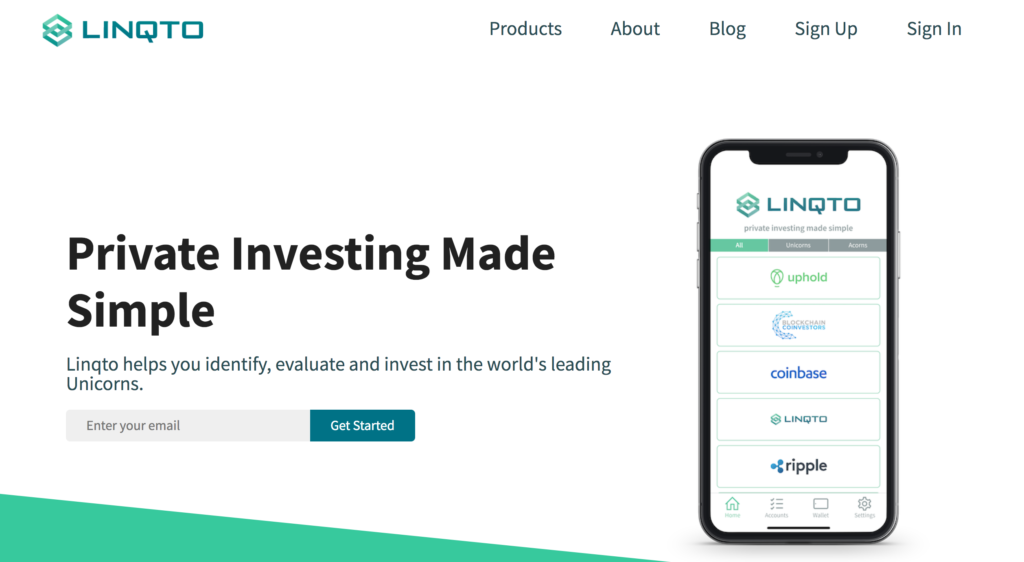
In February of this year, while the world’s attention was consumed with the threat of the then-epidemic-now-pandemic coronavirus, Linqto announced Equity in Unicorns, a new investing platform for private securities. Equity in Unicorns is designed to help accredited investors invest in the private market via a simple, quick, and relatively inexpensive platform.

“Small Accredited Investors now have the opportunity to participate in the growth and superior returns of private markets, as large institutional investors have done over the past 30 years,” said Sarris. “Private investing made simple.”

Since its pivot, Linqto now counts more than 100,000 accredited investors in its global network. Currently, Linqto allows these users to invest in a range of pre-IPO startups, including Upgrade, Uphold, Ripple, SoFi, Blockchain Coinvestors, Kraken, and even in its own company.

Linqto was slated to debut its new platform at FinovateSpring earlier this year. However– thanks to COVID– the conference, along with Linqto’s demo, will be featured at FinovateWest on November 23 through 25.


Photo by Filip Mroz on Unsplash

Bitpanda Raises $52 Million in Round Led by Peter Thiel’s Valar Ventures

Bitpanda Raises $52 Million in Round Led by Peter Thiel’s Valar Ventures

Digital asset platform Bitpanda announced a round of venture funding today. The $52 million Series A round marks the largest Series A round in Europe so far this year.

The round was led by Valar Ventures, a VC firm backed by Peter Thiel. Today’s investment, combined with Bitpanda’s $51 million ICO last year and undisclosed venture round last year, brings its total funding to over $103 million.

As part of the agreement, Andrew McCormack and James Fitzgerald from Valar Ventures will join Bitpanda’s board. “With their extensive track record in growing digital champions like PayPal in its early years and supporting Peter Thiel during its IPO and eventual sale to eBay in 2002, we are more than confident in the choice,” Bitpanda CEO and Co-founder Eric Demuth said.

The company will use the funds to promote geographical expansion. Specifically, after its successful launches in France, Spain, and Turkey this year, Bitpanda plans to expand to more European countries before year-end.

The investment will also be used to “bring the Bitpanda platform and all our services to a new level.” The company has already slated new products for launch, including a new stock trading tool which will launch in 2021.

Much of Bitpanda’s focus is on financial empowerment and the democratization of investment. “Bitpanda will become an investment platform for asset classes for everyone,” Demuth said. “We will provide education, empower our users to take their future into their own hands and remove all those barriers that prevent people from taking part.”

Founded in 2014, Bitpanda has seen significant growth this year, boosting its client base to more than 1.3 million. Additionally, the company has brought on more than 70 new employees this year and plans to boost its total workforce to more than 300 by the end of this year.


Photo by billow926 on Unsplash

Finicity Launches Open-Banking- Friendly Underwriting Tools

Finicity Launches Open-Banking- Friendly Underwriting Tools

Finicity is unveiling a new tool set this week. The new solution, Finicity Lend, promises to accelerate lenders’ decisioning processes by tapping into the power of open banking.

The tools will help lenders with the credit decisioning process by enabling prospective borrowers to permission their data to be used during underwriting. Ultimately, Finicity anticipates the consumer-provided data will offer lenders data in real-time and lead to more accurate decisions.

“Our new Finicity Lend integrated solution set will complement the current credit rating system while leveraging the tremendous advantages of open banking to create an industry standard for assessing a borrower’s ability to manage a loan going forward,” said Finicity CEO and Co-founder Steve Smith. “Real-time, permissioned data from multiple financial accounts is the lifeblood of our secure open banking platform, and empowers consumers to make better financial decisions, to mitigate risk for lenders and can increase overall financial inclusion.”

Along with the data permissioning aspect of Finicity Lend, the toolset offers a host of other capabilities. Among those are Cash Flow Analytics, CRA Data Services, and Payroll Data, which leverage the data intelligence layer of the company’s open banking platform.

Cash Flow Analytics uses an automated process to look at an applicant’s financial account data to glean insights about their cash flow. Finicity has positioned itself as a Consumer Reporting Agency (CRA) to ensure that the consumer-permissioned data meets the legal requirements of the Fair Credit Reporting Act. The move also places more control in the hands of the customer by offering them the ability to review, dispute, and correct any inaccurate information. Finally, the company has added ADP as a payroll data source to enhance its ability to verify income and employment details (with the prospective borrower’s permission, of course).

Placing the consumer in control of their data is one of the core principles of the open banking initiative. Finicity has always been a proponent of open banking. The company is a founding member of the Financial Data Exchange (FDX), an organization that helps establish industry standards for open banking in North America.

Earlier this year Finicity agreed to be acquired by Mastercard for $825 million. The deal has yet to be finalized.


Photo by Felix Mittermeier from Pexels

FIS and The Clearing House Help Bring Real Time Payments to Small Banks

FIS and The Clearing House Help Bring Real Time Payments to Small Banks

Financial services company FIS announced this week it has partnered with The Clearing House (TCH) in an effort to bring real-time payment processing and settlement to small-to-mid-sized banks and credit unions.

FIS will help its core banking system clients quickly and cheaply connect to TCH’s RTP network, a payments infrastructure that enables instant payments settlement and immediate availability of funds for banks participating in the network.

“As a long-time partner with The Clearing House, we are excited to see the RTP network continue to grow and to be working with banks across the United States to take advantage of the speed, power and scalability of real-time payments,” said FIS EVP, Head of Financial Institutions Payment Solutions Royal Cole. “We’ve designed our new managed service to ease the process of connecting to this emerging platform for small-to-mid-sized banks and credit unions that lack the resources of their larger competitors.”

Among FIS bank clients already participating in TCH’s RTP network are St. Louis, Missouri-based First Bank; and Nano Banc, a relationship-based bank headquartered in Irvine, California.

FIS was founded in 1968 and made major news headlines last year when it acquired Worldpay for $34 billion.

The Clearing House launched its RTP scheme in 2017. Today the RTP network’s real-time payment capabilities are accessible to banks that hold 70% of U.S. demand deposit accounts (DDAs). The network currently reaches over half of all U.S. DDAs.


Photo by Alistair MacRobert on Unsplash

Blend Expands with More Consumer Banking Tools

Blend Expands with More Consumer Banking Tools

Digital lending platform Blend announced this week it is moving beyond the realm of mortgagetech, broadening its focus to a wider array of consumer banking tools.

The San Francisco-based company now offers a new set of configuration capabilities that help banks dynamically respond to changing consumer needs by going to market faster with new products. New capabilities include out-of-the-box offerings for credit cards, personal loans, auto and specialty vehicle loans, home equity, and deposit accounts. Three of those products– personal loans, credit cards, and specialty vehicles– are new for Blend.

This news comes shortly after the company closed a $75 million round of funding, boosting its valuation to $1.7 billion.

“We want to enable banks and financial institutions to be there as trusted advisors for every financial milestone and to keep up with constantly changing consumer expectations and market dynamics. Blend will help lenders deliver the right product at the right time and with no friction,” said Nima Ghamsari, co-founder and CEO of Blend. “With our unified platform, our partners are able to accelerate digital innovation across every line of business.”

Blend’s no-code platform provides banks with a component library, product templates, no-code drag-and-drop workflows, integrated data services, and control over design elements. The added capabilities will help banks meet the needs of their consumers– from opening a new account to applying for a loan.

The out-of-the-box nature of Blend’s products was key for M&T Bank, which needed a quick-to-market solution for the SBA’s Paycheck Protection Program. “We needed to help them process more loans in a few hours… than we had done in a full year,” said Chris Kay, executive vice president of Consumer Banking, Business Banking and Marketing. “By partnering with Blend, we were able to move quickly and be there for our customers when they needed it the most — spinning up a new digital product to process these loans in just 72 hours. Thanks in large part to Blend’s platform, 100 percent of our customers were able to receive the essential funds that could help their businesses survive.”

Blend’s Digital Lending Platform is used by M&T Bank, Wells Fargo, U.S. Bank, and 250+ other financial services companies. Founded in 2012, the company helps these banks process more than $3.5 billion in mortgages and consumer loans each day.


Photo by BENCE BOROS on Unsplash

Update: Yandex-Tinkoff Deal Falls Through

Update: Yandex-Tinkoff Deal Falls Through

Here’s an update to last month’s news we reported stating Yandex had agreed to buy Tinkoff Bank for $5.5 billion. The deal has fallen through today because the parties failed to agree to the terms of the takeover.

Tinkoff parent company TCS Group told Reuters it is responsible for disrupting the deal. “Today I decided to break the possible deal with Yandex,” said TCS Founder Oleg Tinkov. “Tinkoff is not for sale, neither to Yandex, nor MTS.”

Our original reporting is below.

Yandex Agrees to Buy Tinkoff Bank for $5.5 Billion

Yandex has agreed to purchase Tinkoff for $5.5 billion. This is a pretty big deal, not necessarily because of the size of the transaction, but because of the players involved.

Yandex is essentially the Google of Russia– it is a tech giant in the region. And Tinkoff Bank is the world’s largest digital bank in terms of customers, boasting more than 10 million clients.

“The parties have come to an agreement in principle on a transaction that would consist of cash and share consideration worth approximately $5.48 billion or $27.64 per Tinkoff share,” Yandex said. The purchase amount, which will be paid out in a combination of cash and Yandex shares, is an 8% premium of Tinkoff’s share price as of September 21.

Today’s deal comes shortly after Yandex announced plans to halt its partnership with Sberbank, a traditional bank with 14,000 branch locations across Russia and more than $465 billion in assets under management.

Yandex is best known as a Russia-based search engine. The company has since expanded, however, launching taxi and e-commerce subsidiaries, Yandex.Taxi and Yandex.Market, respectively.

Tinkoff is a cloud-based bank that offers a range of financial and lifestyle services, including credit products, current accounts, business services, investment and insurance products, travel tools, and loyalty programs. The bank is Russia’s second-largest credit card issuer with 13.2% market share. Tinkoff is listed on the London Stock Exchange and has a market capitalization of $5.5 billion.

The deal is expected to increase competition with state-owned Sberbank, which also operates ride-sharing and e-commerce offerings. The transaction, which has yet to be finalized, is subject to due diligence and a formal offer.


Photo by Ignat Kushanrev on Unsplash

Have the Bots Failed Us?

Have the Bots Failed Us?

I’ve been busy catching up on all of the discussions that took place at FinovateFall last week (if you are on our attendee list, you can do the same), and a panel conversation on AI and bots stood out to me.

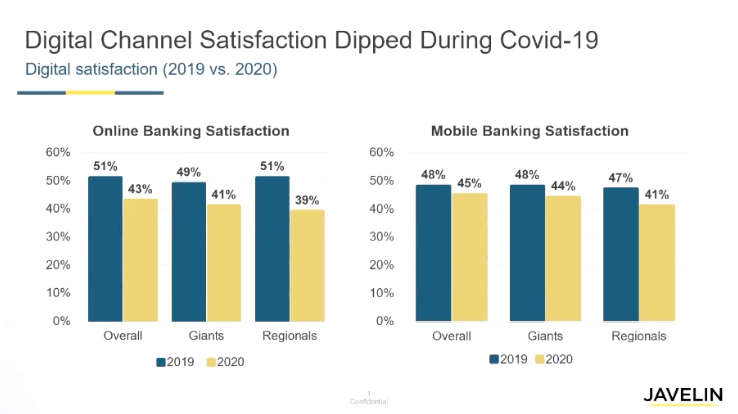
Leading the panel was Emmett Higdon, Director of Digital Banking at Javelin Strategy & Research, who shared the following graph:

Higdon explained that because branches were closed and call centers were overwhelmed, banks were pushing consumers to solve their issue or receive an answer to their question via digital channels. While this worked for some consumers, it frustrated others who were less digitally native or needed a more customized answer. To mitigate frustration, some banks turned to chatbots to create a hybridized approach that offered a high-tech, low-touch customer service experience.

Given the data from Higdon’s graph, it is apparent that some firms’ bots failed– they were ill equipped to handle the influx into their digital channels. Others, however, leveraged data, as well as their prior experience with their digital channels, to create a digital banking experience tailored to each customer.

Mallika Daswani VP of Digital Channels-Online and Mobile Banking at TD Bank said her firm leveraged the bank’s virtual assistant in the company’s mobile app. This tool could answer simple queries and alleviate burden from the call center, which was then able to focus on high-value activity such as conducting video calls with customers. This combination of assisted service and full service helped meet customer needs at scale.

Alexandra Mack, Solutions & Customer Marketing at Zendesk, noted that sending proactive messages to consumers can be crucial during this time. However, she noted it is important to avoid blasting a customer base with intrusive, ubiquitous messaging. Financial services companies can leverage AI to analyze customer information and direct them to self-service solutions.

The group also discussed improvements, specifically, meeting customer expectations and implementing sentiment analysis. The customer expects that the bank not only knows information about the customer, but also has details about the customer’s previous interactions, even if it occurred with a bot or in a different channel. Additionally, implementing sentiment analysis, which uses AI to sense consumer frustration and route them to the appropriate person to mitigate frustration, can vastly improve the customer experience.

When discussing customer communications and personal information, it’s impossible to leave data security out of the conversation. It can be difficult to protect consumer information (and remain compliant) when consumers switch channels or move from website-to-website. However, frustration can arise when consumers are required to authenticate multiple times. To eliminate this, banks can use voice biometrics in the background to create more efficient re-authentication and reduce wait times.

Automation can solve problems, but it takes effort to get to that point. It not requires applying new technologies but also implementing consumer data. In the end, a hybridized digital offering requires a multi-pronged approach with the entire bank on board.


Photo by Ashkan Forouzani on Unsplash

Virgin Money Goes Live on Experian’s Pre-Qualification Platform

Virgin Money Goes Live on Experian’s Pre-Qualification Platform

Virgin Money announced today it has become the latest brand to join Experian’s pre-qualification platform.

The deal means that Virgin Money will now appear on Experian’s panel of lenders that are aggregated on lending websites and advisor platforms to help prospective borrowers check their eligibility and make informed decisions on their home purchase.

“Going through a lengthy mortgage application just to be turned down can be frustrating for everyone involved, not least the buyer who has found their dream home,” said Lisa Fretwell, Managing Director of Data Services, at Experian UK&I. “By checking eligibility at the beginning of the journey, potential customers can see which mortgages they are likely to be accepted for based on their financial circumstances, while at the same time avoiding damage to their credit score.”

Ultimately, Experian’s solution offers an automated decision based on credit history. If the system accepts the borrower, they will see details of the maximum amount they can borrow.

Borrowers can find Virgin Money’s mortgage products on pre-qualification platforms including Mortgage Gym, New Homes Group, Mojo Mortgages, Property Pal Mortgages and Iress Xplan Mortgage.

Experian offers a range of tools to help lenders make more informed decisions more efficiently in a way that safely leverages consumer data. Among these tools is Experian Lift, which the company launched last year. Experian Lift is a suite of credit score products that combines traditional credit, alternative credit, and trended data to provide a holistic picture of consumer creditworthiness.

Tools like these are especially useful in today’s economic environment, when uncertainty persists throughout many areas of consumers’ lives.


Photo by Aquiles Carattino on Unsplash

Touchless UI in Insurance

Touchless UI in Insurance

This is a guest post written by KV Dipu, President & Head of Operations, Communities & Customer Service at Bajaj Allianz General Insurance Company.


COVID-19 has forced organizations to embark on new journeys in various customer facing domains and the fintech/financial services sector is no exception. Since it has become imperative for organizations to consider the health and safety of customers and employees, touchless technologies are gaining traction across the spectrum to avoid physical contact. While touchless technologies are not new – smart homes, smart health, augmented and virtual reality games, smart cars, etc. are all part of our lives – they have gained a new lease of life and are now being adopted at scale.

There are numerous ways in which human communication occurs; we connect with gestures, speech, and touch along with the choice to switch amongst them seamlessly. However, the human-computer interaction is different and complicated. Touchless UI is a classic approach to control and speak with your gadget without typing or touching the screen to carry out a task. In the “Home insurance” segment, where IoT devices are used for safety along with insurance to cover during theft or burglary, the gestures control becomes an essential tool to protect from intruders. The gesture recognition system can differentiate between people and can avoid unauthorized access. However, it relies on various lighting conditions as the cameras require a desirable ambience.

Gesture vs. voice commands

Gesture recognition uses computer vision; voice recognition uses natural language processing and does not depend on lights or cameras, which add to the cost. On the contrary, gesture recognition beats voice recognition because of its natural character. This is a key factor for the implementation of voice recognition technologies into several fintech products, making the process more efficient and inexpensive. Since users do not need to go through a steep learning curve, the need of change management is eliminated to a great extent.

Typically, the development of such innovations is not without challenges. Incorporation of such gestures requires deep study of human gestures and feature engineering them while developing deep learning algorithms. Error rates, false positives, and false negatives must be eliminated to attain six sigma status. Advanced Driver Assistance Systems (ADAS) in insurance plays a major role in the third-party claims of commercial vehicles. The gestures are not restricted to hand or finger movements; eye gestures help in understanding driver behavior while driving. It helps in deriving a driver score based on the eye movements that helps data scientists analyze whether the driver is drowsy, drunk, or distracted. Consequently, the driver score is used by underwriters to arrive at a premium based on the driver score.

UI design principles

The standard design principles for touchless UI are classified into three categories: action, navigation, and transform gestures.

  • Action gestures: Action gestures involve those related to tapping, long press and swiping that help interact with elements of GUI and access additional functionality.
  • Navigation gestures: Navigation gestures involve actions related to scrolling, dragging, swiping, and pinching that enable users to flip through a product with ease.
  • Transform gestures: Transform gestures involve actions related to compound gestures, pick up and move, and double tap that enable users to zoom into and out of content, reorder content, rotate graphics et al.

Interaction principles are changing by the day as human gestures keep evolving to keep pace with the new behavior brought in by millennials. Data scientists need to consider these changes while doing feature engineering. They also need to curate data sets accordingly as these data sets will eventually lead to the training for ML/DL algorithms.

Whilst the technology evolves, two aspects of customer experience need to be taken into consideration:

  • Ease of understanding: Gestures must be in line with the ones widely known and address gaps in existing ones. Cultural nuances (for instance, a gesture in country A can mean something radically different from the same gesture in country B) need to be taken into account.
  • Realistic responses: Latency is annoying and people switch products/services if the responses are not real time. Traditional authentication with user IDs and passwords/OTPs is not something users expect in the new era of banking and insurance. Gestures and voice commands enhance the customer experience by quick logins and payments. However, for certain aspects of banking, an extra layer of security is applied and the value of transactions is restricted to avoid risk.

    By 2025, 72% of the people across the globe are expected to have smartphones. As touchless UI/UX gains traction, we are in for the new normal – M2M (man to machine) interactions, human communication morphing from voice into gestures, design at the core of customer experience, amongst others, and, most importantly, healthy and happy human beings!

KV Dipu is President & Head of Operations, Communities & Customer Service, spearheading digital transformation, leveraging start-ups from fintech/insuretech globally, at Bajaj Allianz General Insurance Company (a joint venture of Allianz, the world’s leading insurer, and Bajaj Finserv & ranked #8 amongst the global top 100 digital insurers).


Photo by Laura Barbato on Unsplash

FinovateFall 2020’s Final Day: Collaboration, Mobile Security, and Fintech’s Bright Future

FinovateFall 2020’s Final Day: Collaboration, Mobile Security, and Fintech’s Bright Future

The morning’s first panel, Strategic Partnerships and Collaboration Between Banks and Fintechs, brought insight into what large banks look for when it comes to partnering with a fintech. The top suggestions for fintechs looking to make themselves more appealing to banks included offering scalability and using industry standards for things like data sharing.

Google’s Mike Burr took the stage next to deliver the keynote: Redefining the Approach to Mobile Security in FinTech (and why it works). Burr considered the root concern that banks struggle with when it comes to protecting Android devices. He examined the top ways data becomes exposed and how to get the tools to ensure data security for compliance needs.

The afternoon breakout stages tackled issues on topics across payments, future technology, wealthtech, and banking. These recorded panels, along with all of the content on the main stage, are available in the On Demand section of the event platform through next week so be sure to catch what you may have missed there.

Our afternoon panel, Latin America – The Future of Fintech, and the Dawn of a New Opportunity, considered the range of opportunities in Latin American markets. The group discussed that the region’s diversity makes it ripe for investors and explained how entrepreneurs are reinventing financial services at a local level.

Closing out FinovateFall 2020 was Neri Tollardo, Head of International Relations and Partnerships at Tinkoff, who spoke on how fintechs can remain profitable in a COVID-19 era. Tollardo’s address offered a ray of hope for banks and fintechs. He expressed that the path to profitability is not mutually exclusive of growth. His points of advice included embedding profitability in the culture and the organizational structure, understanding their business, investing in good talent, and searching out verticals that generate returns.

I’d like to extend a huge thank you to everyone who participated in the event, from our demo companies, to our speakers, panelists, and–of course– to our audience. We wouldn’t be here without you!


Photo by McKayla Crump on Unsplash

More Fuel for the BNPL Fire: Affirm Raises $500 Million

More Fuel for the BNPL Fire: Affirm Raises $500 Million

In a series G round, buy-now, pay-later company (BNPL) Affirm brought in $500 million, bringing the company’s total raised to $1.3 billion.

Leading the round were Durable Capital Partners LP and existing investor GIC. Other returning investors Lightspeed Venture Partners, Wellington Management Company, Baillie Gifford, Spark Capital, Founders Fund, and Fidelity Management & Research Company LLC also contributed.

Affirm Founder and CEO Max Levchin referred to the new round as a “vote of confidence” that will help the company advance its mission “to build honest financial products that improve lives.”

Along with the funding announcement, Affirm also unveiled an interest-free and fee-free bi-weekly payment product for transactions over $50. The new product aims to help Affirm’s tools compete with credit cards. “Affirm is now an even more attractive payment option for everyday wants and needs,” Levchin added. “We can also now better support merchants who offer smaller ticket items and bring their customers a more transparent, flexible way to pay.”

Affirm’s BNPL tools reach 6.5 million shoppers across the U.S. and Canada. The company has 6,000+ merchant partners in the U.S., including brands such as Walmart, Peloton, Oscar de la Renta, Audi, and Expedia.

Affirm’s funding comes days after Klarna unveiled its $650 million raise, which brought its total funding to $1.4 billion and boosted its valuation to $10.6 billion.


Photo by Ricardo Gomez Angel on Unsplash