This site is operated by a business or businesses owned by Informa PLC and all copyright resides with them. Informa PLC's registered office is 5 Howick Place, London SW1P 1WG. Registered in England and Wales. Number 8860726.
Finovate Blog
Tracking fintech, banking & financial services innovations since 1994
“What mmob does is solve the pain points on two sides of an ecosystem. On one side for third party product providers and service providers, we integrate all of their products and services onto our network. Then we also make that seamlessly accessible through to larger distribution channels so their products and services can be integrated natively.”
“(Identity verification) is very challenging, especially when you look at it as a global problem. Every region, every geography has a little bit of a twist. People may not have consistent addresses in some countries, or may not have a track record with a financial institution or a utility compared to some other places. So identity verification is very, very difficult and made much more complicated if you operate in a lot of countries or incorporate a lot of data sources.”
“We are an AI company focused on analyzing billions of articles and messages from the web in real -time using a technology called Natural Language Processing (NLP). We basically process text data and we derive insights that are consumed by financial professionals and corporates. We have the ability to screen an enormous, 20 billion articles and messages and to detect things like environmental, social, and governance risks; early warnings; analyzing competitors; measuring sentiment on companies and on concept.”
“Finshape is a new brand in the digital banking market. It has come about with the merger of two companies: BSC (Banking Software Company) and W.UP. With the combined force of these two companies, Finshape now has about 700 people with a hundred banking clients across the globe as clients and partners across four continents. We’re very proud to have built this digital powerhouse and we’re looking to do a lot more in shaping the future of digital banking.”
Stay tuned for more videos from Greg Palmer and the Finovate Podcast’s Conversations with Best of Show winners.
Another year begins – and so does the latest round of podcasts hosted by one of fintech’s favorite conversationalists, Finovate VP Greg Palmer!
In his most recent discussions on the Finovate Podcast, Palmer has talked about the challenge of inclusivity when it comes to lending in financial services, as well as the hurdles innovative companies face when trying to turn inspiration into reality and promise into winning, marketable products that delight and engage customers. And with the new year just getting underway, the Finovate Podcast also took stock of some of the major trends in fintech in 2021 with an eye toward seeing how they will be resolved here in 2022.
Host Greg Palmer talks with Pinwheel co-founder and CEO Kurt Lin about the problem of inaccessibility and credit invisibility in our financial system and what Pinwheel is doing to innovate in the lending space. Episode 118.
“What we do at Pinwheel is pretty straightforward: we look at all the different income sources that exist – whether it be payroll systems, gig platforms, or future of work platforms like Etsy or ebay – and we combine it into a platform and make it really easy for anyone to connect their income account or their payroll account to any app for the purpose of sharing that data or to do things like update direct deposits.”
Steven Ramirez, CEO, Beyond the Arc
Host Greg Palmer sits down with Beyond the Arc CEO Steven Ramirez to discuss predictions for 2022, cryptocurrencies, fintech super apps, the Buy Now Pay Later revolution, and more. Episode 117.
“There is huge hype and excitement about crypto which is, of course, leading to greater adoption. More people are finding on-ramps to crypto and some of them are super simple. If you look at Coinbase or Paypal, they really could not make it any easier to acquire your first cryptocurrencies. However, there is a lot behind that initial purchase about how you actually use cryptocurrency and some real sticking points that I think are going to be nasty surprises for consumers.”
Alex Castro, CEO, M Corp
Host Greg Palmer and Alex Castro, CEO of M Corp and author of Measure, Execute, Win, investigate the challenge of navigating the “execution gap” by strategically examining the space between strategy and results. Episode 116.
“We’ve seen over the last 10 years a great surge in innovation and ideas that can really help grow industries and companies. All too often those ideas fall to the wayside during the execution process, and that gap between idea or strategy and execution still remains the largest roadblock for these great ideas to get to market. We’ve analyzed that issue and we have some very deliberate methods and products to help resolve that gap so that more ideas can be more successful.”
Miss an episode of the Finovate Podcast during the holiday rush? No need to fear; the Finovate blog has got your back.
From insights into the rise of embedded finance and prospects for “technosocialism” to discussions with innovators in the field of personal finance and roboadvisory, the Finovate Podcast is your one-stop-shop for fascinating, in-depth conversations between Finovate VP Greg Palmer and fintech’s finest analysts and entrepreneurs. Today we’re sharing some end-of-year episodes of the podcast that might have slipped beneath your radar as 2021 drew to a close.
Chris Karageuzian, CEO and Co-founder, Help With My Loan. Host Greg Palmer and Chris Karageuzian talk about how the Finovate newcomer is making the lending process more pleasant for borrowers.
“I was in the industry for 20+ years so I felt the frustration – that’s why I left and created this company. (There’s a) lack of technology and fragmented software – you have to use almost seven to ten pieces of software just to deal with one file. That’s really not productive in my opinion. We closely work with banks right now. We have 300+ banks signed up in our database and in our software. So deals get automated and matched and we are within an earshot of every deal.”
Vivek Krishnamurthy, Principal, Commerce Ventures. Host Greg Palmer sits down with Vivek Krishnamurthy for a conversation on “embedded finance” and an overview of the field’s opportunities and pitfalls.
“There’s a split between the infrastructure layers that enable third parties to launch financial services products. And then there are the instances in which financial services products are launched inside of other ecosystems. We think that latter aspect, that latter space of being able to turn on a financial services product in the customer journey inside of a non-financial services ecosystem, that’s what we think about as ’embedded finance.'”
Ned Phillips, Founder and CEO, and Mike Larsen, Head of Sales, Bambu. Host Greg Palmer talks about the challenges facing the automated investment business with Ned Phillips and Mike Larsen of Best of Show winning roboadvisor Bambu.
“We are a B2B wealthtech. So what does that mean? We design, build, and deploy those roboadvisor, savings and investment apps for financial institutions. So if a financial institution wants its own Betterment or its own Wealthfront, they come to us for the tech and we build it. And at Finovate, we built one on stage in seven minutes!”
Will Graylin, Chairman and CEO, OV Loop; CEO, Indigo Technologies. Host Greg Palmer chats with serial entrepreneur Will Graylin about contactless payment adoption, super apps, and the future of mobile payments.
“Why haven’t we adopted (contactless payments) in much more mass given that Apple Pay has been out for over seven years, and Samsung Pay has been out for six years, and Google Pay has been out there for seven years – eight years now? Why haven’t we adopted en masse? (Our situation is) unlike China’s WeChat/WeChat Pay/AliPay. For those solutions, they are adopted to the order of about 83% of all consumer transactions, whereas we’re still in single digits in the United States. Why?”
Brett King, Author, The Rise of Technosocialism; Founder of Moven. Host Greg Palmer and Brett King talk about King’s latest book, The Rise of Technosocialism: How Inequality, AI, and Climate Will Usher in a New World.
“When you think about why it is that we haven’t been able to tackle (climate change) and get agreement on this, part of the core problem is that we tend to be quite short-term focused in our planning as a species. We’re focused on the next quarter, the next year, in terms of financial reporting, or maybe the next two years or four years in terms of political cycles. But when it comes to planning out things for 20 years in our future or 30 years in our future, the big problem is we just ask ‘who’s going to pay for it?'”
Lindsay Holden, Co-founder and CEO, Long Game. Host Greg Palmer discusses loyalty, education, Millennials, and gamification with Lindsay Holden, founder of FinovateFall Best of Show winner, Long Game.
“Long Game is a mobile game. It’s an app that sits on top of your bank account and rewards customers for learning about financial literacy and for positive financial behaviors like saving. For banks, we are helping them have a branded experience that’s super-fun for customers, they can acquire new customers with us, and also increase their customer LTV through promoting their products, increasing savings, and increasing direct deposits.”
Greg Palmer, VP at Finovate, takes five minutes with Chris Karageuzian, CEO & Co-Founder of Help with My Loan, to explore some of the pain points that still exist for both customers and bankers when it comes to getting loans approved, and how Help with My Loan is cutting through the noise and coming to the rescue.
The latest round of Finovate Podcasts features four of the companies that won Best of Show awards at FinovateFall in September. A common theme in the conversations with most of these firms is the importance of customer engagement at a time in rapid digital adoption.
Below is a small sample of what Finovate VP and program host Greg Palmer and his guests are talking about. For more, be sure to check in for new episodes of the Finovate podcast every week.
“We often joke internally that we’re not your parent’s PwC and, as a collective customer transformation team, we’re constantly challenging ourselves to be more provocative in the way that we engage with technology, the experiences that we drive for our clients, and the insights that we deliver.”
“From a Horizn standpoint, we are absolutely focused on helping financial institutions to be able to achieve three key objectives: the first one is overachieving their digital growth goals, the second is successfully supporting mergers and new platform launches, and then the third component is driving mass adoption of new innovation and capabilities.”
“We’ve been doing this since 1994 through IC Banking, our digital channel platform that’s already implemented in more than 40 banks in Latin America and the Caribbean. We are helping people love their banks because we give them superior experiences with our digital channels. Today banks need to build loyalty through digital engagement. That’s why you need as a bank to have customers that love going to your application and your bank.”
“How fast could a mortgage be? At some point in the future, you’ll be able to get a mortgage in a couple of days. It’s harder to say when than to say what but, in theory, if you could process all of the information, and it’s all there available, you should be able to get a mortgage in a couple of days versus a month or more – what it takes today.”
Hot on the heels of its 100th Episode, the Finovate Podcast has churned out a quintet of fascinating conversations with fintech’s most innovative and insightful entrepreneurs and investors.
If you’ve not yet caught up with the latest from Finovate VP and program host Greg Palmer, then here’s a sample of what’s waiting for you over at the Finovate Podcast.
“Rather than doing a lot of things, rather than investing in pre-existing businesses of first-time entrepreneurs, and then having a high tolerance for companies going under, we actually do very few things: we start them in partnership with experienced executives and we have a business model that’s actually geared toward making sure everything works.”
“We’ve been in business for over ten years and have advised on countless transactions across the market in the U.S. and Europe. We are essentially the advisor of choice to growth and venture funds that are looking to catalyze their own fundraises or secondary transactions on their funds or assets.”
“Our approach to the world is investing in a small number of transformative businesses each year, and making large concentrated bets on those companies. And what we mean by transformative is companies that can transform the industries they are operating in: finding the next generation of Googles out there, companies like Stripe, like UiPath, like Crowdstrike …”
“A lot of this inherent bias in financial services and traditional financial institutions doesn’t come from a bad place or any bad intention. If you think about financial institutions like banks and credit unions and a lot of these traditional places … it comes the fact that they need to minimize risk and make sure that their checking accounts, their loans aren’t subject to fraud or default. As a result of that, they have to use a lot of older heuristics like FICO.”
“We help small businesses get paid directly through their financial institution and, when we do that, we help financial institutions stay ahead of the competition – competition both being traditional banks that they are competing with, and then also the emerging rise of digital-first entities like Square, PayPal, QuickBooks and others that are aggressively targeting the small business space.”
It seems like only yesterday when Finovate VP and host of the Finovate Podcast Greg Palmer was introducing his first guest (Jim Bruene, founder of Finovate, by the way). Nearly two years later, having sat down with fintech innovators and influencers from Jim Marous and Louise Beaumont to Brett King and Tosin Agbabiaka – Palmer is celebrating the 100th episode of the Finovate Podcast.
In this centennial edition, Palmer discusses the Three Gold Rules of Fintech that he has learned from his years in the industry and the conversations he’s had – both on-air and at our Finovate conferences – with professionals from every corner of the fintech and financial services ecosystem.
Launched in 2019, the Finovate Podcast began as a way to continue and extend the conversation beyond the live demoes and insightful observations of our fintech conferences. In the months and years since, the program has grown into one of the key forums for fintech’s most visionary entrepreneurs and thought leaders to discuss the most important trends in our industry – from the rise of challengers and neobanks to the growing emphasis on financial inclusion and bringing banking to underserved communities around the world.
Check out the 100th episode of the Finovate Podcast featuring the Three Golden Rules of Fintech – and then visit the Podcast archives for hours of great conversation and valuable insights into trends driving one of the fastest growing fields in technology today.
This week, Finovate Podcast host Greg Palmer talked about the ways that fintechs can help homebuyers – and lenders – deal with the painpoints of the mortgage process. His guest, David Jegen, is a Managing Partner with F Prime Capital, one of the largest VC funds in the world that invests primarily in technology and health care.
Asked why the mortgage process is so painful, Jegen points to the fragmentation of the market as a large part of the problem. “One bank gives you the mortgage. Another bank buys the mortgage,” Jegen explained. “You have another servicer. And somewhere in between you’ve got real estate brokers, title agents, notaries, lawyers, and so forth.” All of this adds up to greater complexity and more cost.
Find out how Jegen thinks fintech is helping alleviate these problems and why the future of the mortgage market could be a bright one if the industry embraces change.
Finovate Best of Show winner Dreams made its Finovate Podcast debut in June. The company, headquartered in Stockholm, Sweden, leverages cognitive and behavioral science to help banks better engage their customers.
Greg Palmer talked with Lucia Hegenbartova, Chief Commercial Officer with Dreams on how humans make financial decisions and how Dreams’ financial wellbeing platform is an example of how banks can increase digital engagement and pursue a “future-proof stance” on social responsibility and sustainability at the same time.
“We take the bank’s existing financial products and we frame them in a way that takes into account how the human brain works and the role that emotion plays in human decision-making,” Hegenbartova explained. “(That) allows us to effectively help people to develop healthier financial habits, which is crucial to eliminating the barriers to engagement that are, more often than not, rooted in anxiety and lack of confidence.”
To this end, Dreams’ product suite includes variety of modules such as a Savings Booster debt management product and an Investing module – all of which are easily embeddable into mobile banking apps on top of existing functionality and can be used individually or in combination.
One of the most interesting intersections in finance is the nexus between financial technology and agriculture. In many places around the globe, many of those who can benefit the most from advances in technology – including fintech – are the farmers who are undoubtedly among the most essential workers in the world.
In this episode of the Finovate Podcast, Greg Palmer talks with David Davies, founder and CEO of AgUnity. The company leverages the blockchain and smartphone technology to help build trust and efficient digital supply chains from farmers to consumers. AgUnity helps solve key issues for underbanked agricultural workers and farmers including the lack of digital identities, a lack of trust in local financial and governmental systems, money safety, data reliability, and more.
“We take low-cost smartphones, phones that cost about $50, and we transform them into a relevant and useful tools for the very lowest income farmers in the world in places like Papua New Guinea and Ethiopia,” Davies said. Most of these farmers AgUnity works with have never owned a phone, he explained, have relatively low literacy and are often in very remote locations. So the phones are redesigned to be relevant to their experience in terms of both interface and off-line functionality. AgUnity also provides the farmers with a digital identity and records transactions for them on the blockchain.
This helps build trust and cooperation between small groups of farmers and enables them to interact with buyers and suppliers more effectively and efficiently. Learn more about AgUnity and its unique contribution to fintech innovation and the cause of financial inclusion.
Just over a month ago, Greg Palmer talked about the “democratization of payments” with Sesie Bonsi, CEO and founder of Finovate alum Bleu. Founded in 2014 and headquartered in Los Angeles, California, Bleu enables merchants to accept contactless payments using their smartphone or mobile device. The company’s wireless payment network supports a patented mobile transaction process that uses Bluetooth-based low energy beacons to communicate payment data between customers and merchants.
In this conversation, Bonsi and Palmer take on the challenge and opportunity of cryptocurrencies, looking specifically at how digital assets can serve as a source of wealth accumulation for marginalized groups.
“Something I tell a lot of people is that the single most important thing you can be doing for wealth creation right now is entering into the cryptocurrency space and getting involved and doing your research and buying crypto,” Bonsi said. He puts cryptocurrencies in the same category as land, oil and gas, mineral resources in that they all derive their value largely from their scarcity, and notes that acquiring finite resources traditionally been a successful strategy for wealth accumulation.
“From those assets,” Bonsi said, “they become collateral and from that collateral you can lend against it to buy real estate, or to open up a business, or to invest in stock, and thereby have assets to pass down for future generations.”
Last week, the podcast hosted Matthew Covi, co-founder and CEO of Signal Intent. A Best of Show winner in its Finovate debut this spring, Signal Intent builds financial calculators for banks, credit unions, and other financial services companies.
These solutions, designed for the digital age, help companies enhance the customer experience they offer with what Covi called “modern, digital tools that will help them compete in today’s landscape.”
“Calculators are a tool that exist on nine out of ten banking websites,” he explained. “But the options that exist really haven’t kept up with the times.”
In this conversation, Covi explains how financial services companies can leverage Signal Intent’s next generation calculators to gain valuable insights into customer preferences, and to use those insights to further enhance the customer experience.
Building a fintech company that lasts was the theme of Danny Shader’s conversation on the Finovate Podcast earlier this month. Shader is the founder and CEO of PayNearMe, a payments experience management firm that enables businesses to boost customer engagement, improve efficiency and drive payment costs lower.
Headquartered in Silicon Valley, PayNearMe made its Finovate debut more than a decade ago at FinovateFall in New York.
In the years since, PayNearMe has grown into a leading payments innovator, processing billons of dollars a year in all payment types ranging from ACH, cards, and cash, to mobile-first options like Google Pay and Apple Pay.
In this podcast, Shader talked about what he’s learned as a successful fintech CEO and why every startup needs to be prepared to re-envision, if not re-invent, itself in order to succeed in the long-term.
“I know of almost no hugely successful startup – with the possible exception of maybe Facebook – that ended up doing what it set out to do,” he said. “Your first business ideaI think of as a prop and its the excuse that lets you interact with customers.”
For more from the Finovate podcast, check out last month’s May lineup featuring:
Jeff Horvath of DigiPli on regulatory risk and the changing compliance landscape. Is showing you’re trying good enough?
Jonathan Bell of Red Compass Labs on the fight against human trafficking and slavery in fintech, and the role banks and innovators have to play.
Peter Hazlehurst of Synctera on building a true partnership model for fintech and creating a community banking experience.
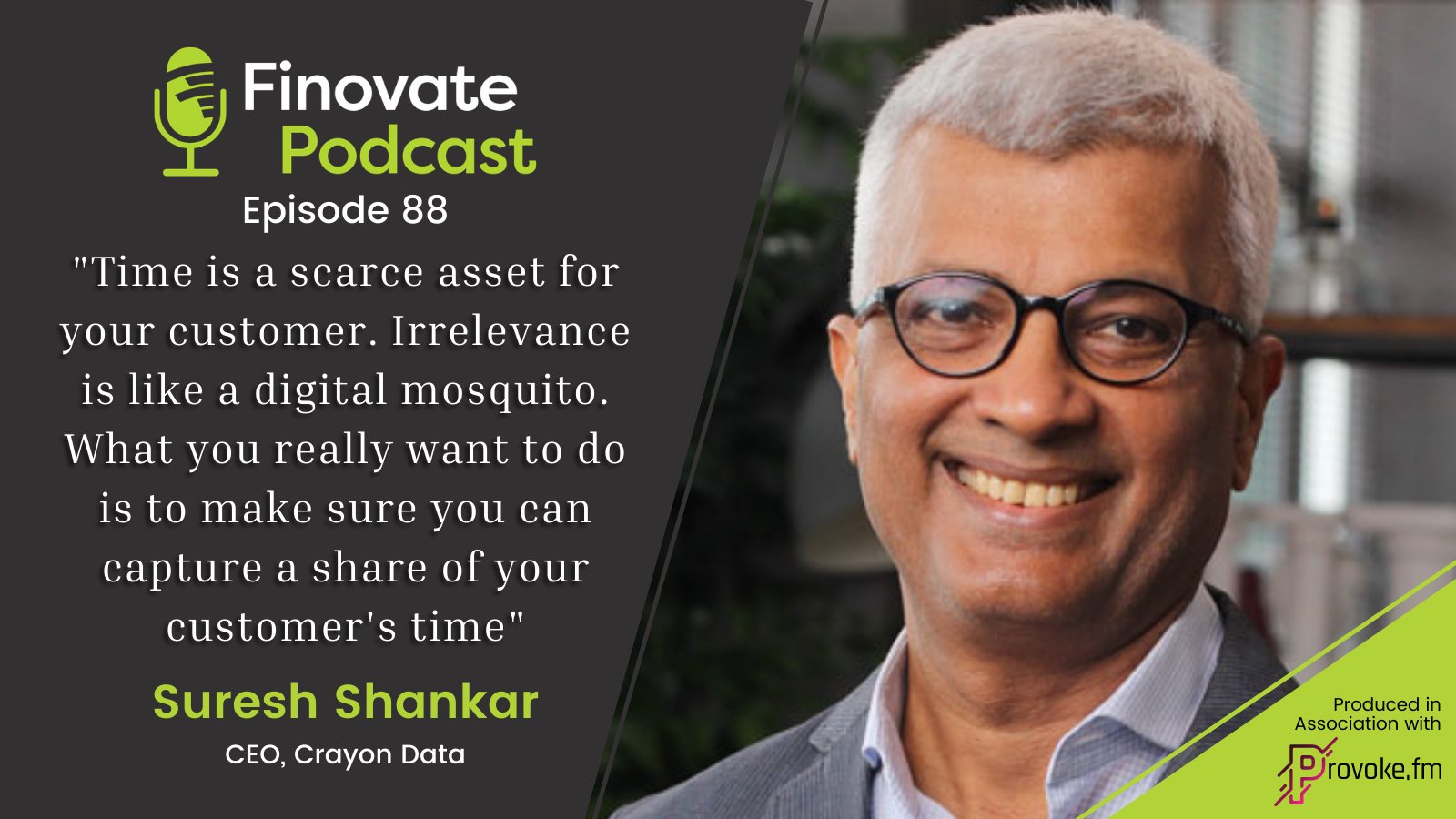
Of all the trends accelerated by the global pandemic, enhancing customer engagement may be both the most critical and the most enduring as we transition toward a post-COVID world. In the latest edition of his Finovate Podcast, host Greg Palmer talks with Crayon Data founder and CEO Suresh Shankar about his takeaways from 2020 and what he expects from fintechs and their customers in 2021.
Shankar founded Crayon Data, a big data/AI startup, in 2012. The Singapore-based company helps businesses succeed by leveraging enterprise data to create digital-first customer experiences. Crayon’s flagship platform, maya.ai, enables businesses to boost revenues, reach inactive customers, and cut down on time and effort on low-ROI marketing campaigns – all by delivering highly relevant, highly personalized digital experiences to customers without compromising privacy. Crayon Data made its Finovate debut at FinovateEurope last year.
The Finovate Podcast is also a great source for 30,000 ft high observations on both the fintech landscape as well as the broader terrain of technological innovation. Greg Palmer’s recent conversation with futurist Nancy Giordano delves into what she calls the “Productivity Revolution” and its implications for fintech and financial services.
“There was a way we approached building the industrial era of the 20th century and prior that now no longer holds up and we have to have a really different way of thinking as we move into the future. ‘Leadering’ (the title of her new book) is the contrast to ‘leadership’. It’s a verb that’s dynamic and inclusive and caring and allows us to build the future that we really want to build … It sounds lofty, but it’s actually pretty practical.”
A guest lecturer at Singularity University, a ten-year TEDx curator, founder of Play Big Inc. consultancy, and one of the premier female futurists in the world, Giordano consistently underscores the role of the individual in times of rapid change and disruption. Her new book, Leadering: The Ways Visionary Leaders Play Bigger, connects the rise of innovative technologies with changing societal expectations to give individuals insight into what it takes to create human-centered solutions and long-term value.
For more from the Finovate podcast, check out our podcast archives.
A new year brings a new roster of guests to the Finovate Podcast. Hosted by Finovate VP of Strategy Greg Palmer, the Finovate Podcast showcases the latest in fintech thought leadership, with innovators, analysts, bankers, and entrepreneurs sharing their insights into the future of fintech today.
From the Fintech in Extraordinary Times series documenting fintech’s response to COVID-19 to discussions on future tech and financial inclusion, the Finovate Podcast is a great way to get up to speed on the conversations in fintech that count.
Check out Greg’s guests from 2021 so far. And be sure to catch the show every week.
Raul Rodiguez, Managing Director, Innovation Accelerator, Charles Schwab – Lessons on what it takes to build and foster a culture of innovation at a large-scale financial institution. LinkedIn
Mark Goldberg, Partner, Index Ventures – Data privacy is going to be a massive concern for fintechs and banks in the next few years. Mark Goldberg of Index Ventures shares his thoughts on how privacy will evolve, and what banks and fintechs need to do now to prepare. LinkedIn
Srinivas Njay, Founder and CEO, Interface.ai – Finovate Best of Show winner Interface.ai joins us to talk through turning your call center from a cost center into a revenue generator, and how financial institutions can go about picking the right organizations to partner with. LinkedIn
Bhavin Turakhia, Co-founder and CEO, Zeta – FinovateWest Best of Show winner Zeta Technologies talks about the influence of neobanks and the future of banking. LinkedIn
Jim Van Dyke, CEO, Breach Clarity – FinovateWest Best of Show winner Breach Clarity talks about the aftermath of data breaches, creating individualized responses, and helping consumers safeguard their identities. LinkedIn
With a global pandemic reshaping the way we live and work, Finovate VP Greg Palmer and his Finovate Podcast turned to two of our industry’s most insightful observers this week to help put the current challenges to fintech in context.
Ron Shevlin, Managing Director of Fintech Research at Cornerstone Advisors, is one of the world’s top fintech influencers. Author of the book Smarter Bank and a columnist for Forbes, he has provided keynotes and moderated panels at industry events including FinovateFall.
On the challenges facing business leaders during the COVID crisis
We’re wrestling, all of us, with three major concerns: our physical health, our mental health, and our financial health. And if you’re an executive at a fintech company, a bank, a credit union, whatever it might be, you’re wrestling with those things in multiple dimensions: your personal physical, financial, and mental health; your family’s physical, financial, and mental health, your employees’ three areas of health and your customers’. You add that up and it’s pretty daunting …
Alyson Clarke is a Principal Analyst with Forrester Research. Among our Analyst All-Stars at FinovateFall 2019 last year, she is a specialist in digital business transformation, creating digital and customer “obsessed” cultures, and digital strategy and innovation.
On how a likely post-COVID-19 recession will affect fintechs and financial services firms
I think we’re clearly going to see fintech funding slow – especially for new or less established startups. In fact, I think it will slow across the board from VCs to corporate funding. I think that will be some of the downside for the fintechs.
In terms of financial services and banks, they’re going to do what they naturally do and that’s focus on cost-cutting and making the operations more efficient. Sadly, some of that focus will be on automation and things like that for the sake of reducing headcount. The problem with that is that they really need to be focused on productivity, not just cost-cutting, because (managing) recessions is about preparing for the upturn.
IdentityMind Global Acquired by Acuant – The deal offers Acuant access to IdentityMind’s digital identity product, a SaaS platform that builds, maintains, and analyzes digital identities and helps companies perform risk-based authentication, regulatory identification, and detect and prevent synthetic and stolen identities.
Vymo Offers Work From Home for Sales Professionals – Vymo, the company whose intelligent sales assistant makes life easier for on-the-go sales pros, has unveiled a new enhancement to help sales teams at this time when customer engagement is even more challenging.
Azimo Partners with Siam Commercial Bank – SCB clients will benefit from Azimo’s digital money transfer program that uses RippleNet, a blockchain-based money transfer service. Using RippleNet, Azimo will be able to instantly deliver payments from Europe to SCB client accounts.
CRIF to Acquire Strands – The union will bring Strands’ personal financial management and business financial management solutions to CRIF’s client base that includes 6,300 banks, 55,000 businesses, and 310,000 consumers across 50 countries.
EVO Payments Raises $150 Million to Help Manage COVID-19 Crisis – Merchant acquirer EVO Payments, the parent company of EVO Snap, has secured $150 million in cash to help fortify the company’s balance sheet, retire debt, and provide funding for future investment opportunities during the COVID-19 crisis.
How Lending-as-a-Service Can Impact Small Businesses in Need – One of the brutal facts of the COVID-19 outbreak is that it will be difficult for small businesses to survive. The self-distancing and shelter-in-place orders, while temporary, are taxing for already cash-strapped merchants.