This site is operated by a business or businesses owned by Informa PLC and all copyright resides with them. Informa PLC's registered office is 5 Howick Place, London SW1P 1WG. Registered in England and Wales. Number 8860726.
Finovate Blog
Tracking fintech, banking & financial services innovations since 1994
We recently commemorated Asian American and Pacific Islander Heritage Month with a feature highlighting the Asian American and Pacific Islander fintech innovators that introduced their companies to our FinovateSpring 2026 audience.
Today, as part of our continued commemoration, we turn our attention—and our thanks—to the Asian American and Pacific Islander mainstage speakers and panelists who shared their insights and experiences with us at last week’s event in San Diego.
Theodora Lau is the founder of boutique consulting firm, Unconventional Ventures. She is a public speaker, an advisor, the author of Banking on (Artificial) Intelligence (2025), and co-author of The Metaverse Economy (2023) and Beyond Good (2021). Lau also hosts One Vision, a podcast on fintech and innovation.
At FinovateSpring this year, Lau participated in a number of executive briefings and power panels on AI in financial services.
Kristie Han, Principal, Canapi Ventures
Kristie Han is a Principal at Canapi Ventures, a venture capital firm investing in early to growth-stage software and fintech companies. Han brings a decade of experience investing in AI and software companies and leading Series B to pre-IPO opportunities across AI apps.
At FinovateSpring, Han participated in our power panel on the role of collaboration and co-creation in bank-fintech partnerships.
Kevin Lee, Chief Technology Officer & Key Pursuits Leader, NICE
Kevin Lee serves as Chief Technology Officer and Key Pursuits Leader at NICE, where he leads the company’s technology vision and its most strategic customer engagements by aligning platform capabilities, AI strategy, and architectural vision to deliver differentiated outcomes.
At FinovateSpring this year, he delivered a special address on AI agents in financial services.
Huyen Tran, VP of Innovations, U.S. Bank, and Founder, Elys Ventures
Huyen is a fintech product and strategy leader at U.S. Bank and founder of Elys Ventures, with two decades of experience building and scaling global digital platforms and financial services solutions. She is the founder of Elys Ventures, through which she invests in early-stage fintech and health tech companies with a product-driven investment approach.
This year at FinovateSpring, she participated in our Women in Fintech Briefing: How Can We All Make Sure We Are Moving the Needle?
Huong Tran, Founder and Managing Partner, 6igma Ventures
Huong Tran is the Founder & Managing Partner of 6igma Ventures, an early-stage venture fund focused on fintech infrastructure and applied AI platforms bridging Asia and the United States. She founded 6igma Ventures to connect high-growth Asian markets with the US technology ecosystem, investing in structural opportunities shaping the next generation of financial and technology infrastructure.
At FinovateSpring, Tran participated in our Impact+ Investor Power Panel for fintech startups.
Sherry Wu, Chief Technology Officer, University of Michigan Credit Union
Sherry Wu is the Chief Technology Officer (CTO) at the University of Michigan Credit Union (UMCU), where she aligns IT strategy with the credit union’s mission. With over 25 years of experience in IT leadership at IBM, Ford, and HPE, Wu also served on the board of People Driven CU and currently advises Algebrik AI and CU 2.0.
At FinovateSpring, she participated in our power panels on AI and how credit unions can thrive without big bank budgets.
Gary Fan, Chief Operating Officer, RBB
Gary Fan is the Chief Operating Officer of RBB, a publicly traded bank with over $4 billion in assets. As COO, Gary leads enterprise-wide growth initiatives, digital transformation, product and service innovation, and strategic M&A activity. He is also responsible for optimizing cross-functional operations and driving continuous business model evolution to stay ahead in a rapidly changing financial landscape.
This year at FinovateSpring, Fan participated in our panel discussion on the current challenges and opportunities facing community banks.
How can we recognize AI as a tool for expanding human abilities and enhancing creativity rather than merely a way for corporations to eliminate jobs? What does it mean when some AI experts suggest that AI, instead of replacing human activity, will enable us to use our unique skills as human beings in different, more sophisticated ways?
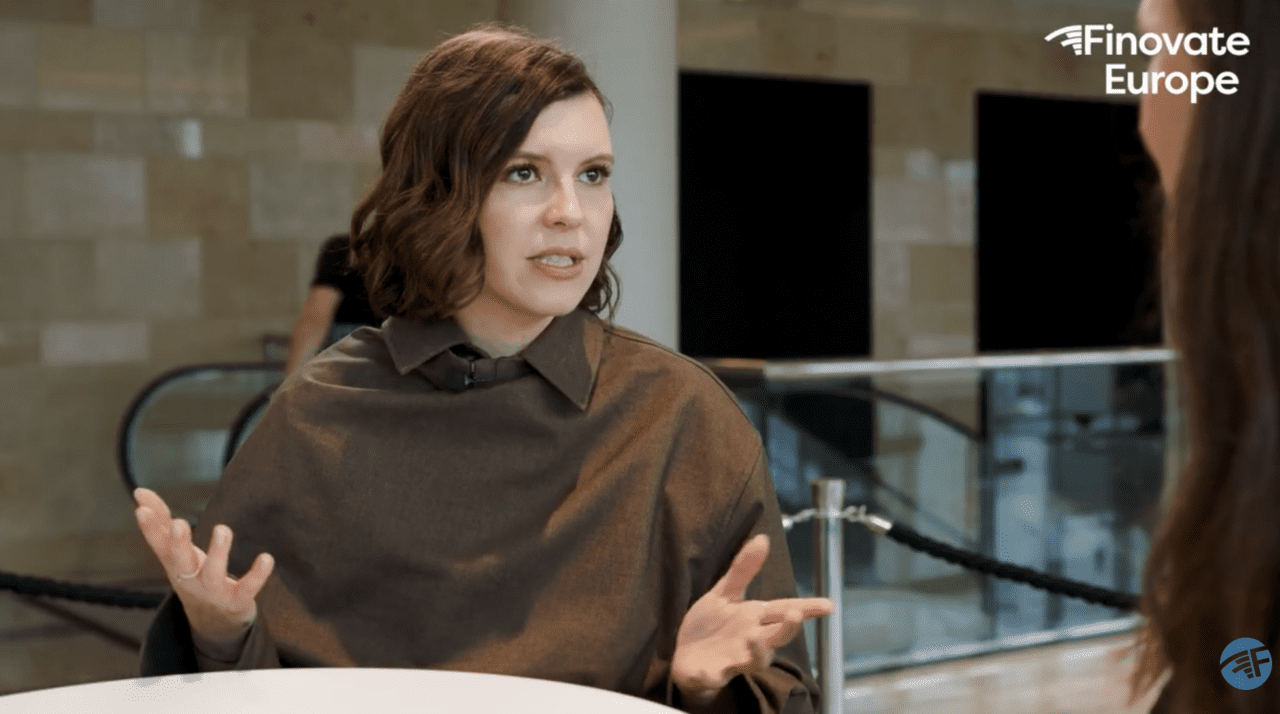
Finovate Senior Research Analyst Julie Muhn interviewed Georgia Lewis Anderson, Co-founder and AI consultant with Lantyn, and a leading expert on artificial intelligence, to discuss these and other questions about the state of AI in 2026. Following her keynote address at FinovateEurope earlier this year, Anderson discussed the rapid evolution of AI, the idea of AI as a “cognitive prosthetic,” and how this concept can be used to enhance rather than replace human ability and creativity.
“If air travel had evolved at the same rate as large language models, then we would be able to get from London to New York in 15 seconds. So if you’re feeling overwhelmed with AI, it’s not a surprise. I’ve worked in AI since 2016, way before GenAI, before the ChatGPT moment, and I’m still catching up every day. I think anyone who says they know everything about AI is lying, so I just want to quell and soothe the fears. Our skills are going to be used differently. I think we’re all quite worried AI is going to replace us, but I think actually it’s about using our skills in a different way.”
Georgia Lewis Anderson is a leading AI consultant and prompt engineering specialist whose career spans crafting Cortana’s British personality at Microsoft and launching Google Assistant in the UK. More recently, she contributed to Meta’s large language model (LLM), Llama 3. She regularly delivers talks at high-profile events such as Ogilvy’s Behavioural Science Festival, where she shares insights on the intersection of AI, human behavior, and marketing.
Lantyn was launched in 2025 to help people explore artificial intelligence in a more relatable, engaging way, regardless of background or technical experience. The London-based company offers AI cheat sheets on how, when, and where to use AI, and features podcasts in which the team creates AI tools and products, and then shares their experiences with viewers.
AI is making a major impact on all aspects of banking, fintech, and financial services, and the world of investing is no exception. From helping investors better understand the volumes of financial, economic, and market data available to them to creating more personalized investment strategies, AI is empowering average retail investors to make smarter decisions and take greater control over their financial futures.
At FinovateEurope 2026 in London this year, I sat down with Nitzan Nachum, Chief Revenue Officer at BridgeWise to talk about the company’s mission to make investing more accessible to a greater range of investors. We also discussed the key role AI is currently playing in helping investors find the information they need and ensure it is accurate and from trusted sources.
“When BridgeWise was founded, it was about filling the gap of financial information asymmetry in the market. For years, for decades, information has been owned only by professionals or by people that are really early adopters of technology and know how to find the right information. But for many, and for most retail investors, most of them couldn’t find information about their portfolios except through the news or through a professional such as their relationship manager or wealth advisor …
We wanted to make this (information) accessible to everyone, so that everyone would have the same information when they are in the process of decision-making about whether they want to invest in a certain stock, fund, or any financial asset.”
Chief Revenue Officer at BridgeWise, Nitzan Nachum has more than eight years of experience leading fintech growth and revenue operations. With degrees from Tel Aviv University, Nachum has demonstrated expertise in global sales, international expansion, and go-to-market strategy across multiple markets.
BridgeWise is a technological research company that leverages AI-based analysis and large language models (LLMs) to offer comprehensive insights into global stocks. The company’s solutions are designed to bridge the knowledge gap in the investment world to empower investors of all types to become “super investors.” Integrated into brokerage platforms and the infrastructures of other financial institutions, BridgeWise provides instant fundamental analysis of stocks around the world, as well as bespoke investment strategies, to enable millions of investors to make informed investment decisions.
Headquartered in New York and founded in 2019. BridgeWise recently published its inaugural State of AI for Wealth report. The report is a comprehensive review of international sentiment towards using AI for investment information and surveyed 2,100 individuals across 19 countries.
Bringing more personalized financial products and services to consumers is one of the great promises of enabling technologies like AI. It is also increasingly recognized as one of the best ways for banks, credit unions, and other financial services providers to differentiate their offerings from rivals—including those from Big Tech and Big Retail.
At FinovateEurope 2026 earlier this year, I spoke with Gregor Bierent, CEO of NF Innova, about how the company helps traditional banks embrace digital transformation through their innovative platform, FinTense. In our conversation, Bierent discussed the power of FinTense’s digital banking score, the importance of micro-personalization, and how AI-driven solutions can enhance customer experience and boost banking efficiency.
“We see that there is more and more drive and demand for banking to become more unique (and personalized). No matter which bank you’re working with, banking for private individuals or for the small and microenterprises, what we see is that user experience needs to be individual … Your banking needs are different from mine. You like different colors. You have different ways of finding something, of clicking and navigating. This is where personalization—or micropersonalization—kicks in.”
Gregor Bierent is a veteran C-level executive with a track record of growing and improving business in the international information technology and services industry. With a background in consulting, digital strategy, and enterprise software, Bierent has a demonstrated history in providing strong leadership and driving both revenue and profitability. He joined NF Innova as CEO in 2021.
NF Innova, a Noventiq company, helps banks achieve their digital transformation objectives. The firm’s FinTense digital banking platform enables incumbent banks to enhance customer engagement across all digital touchpoints, automate customer-facing processes, and adopt other innovations to better compete with fintechs and challenger banks. The company recently demonstrated its technology at FinovateEurope 2024, presenting its personalized banking experience module. Founded in 2015, NF Innova is headquartered in Belgrade, Serbia.
As the push into AI continues, many banks are still struggling to modernize their digital foundations without simply recreating their existing platforms. For institutions operating across multiple markets, that challenge becomes even more complex, as firms need to balance local autonomy with the need for standardization, speed, and scalability.
In a recent conversation with Vanja Tokic of Raiffeisen Bank International, Tokic explained that the real work of transformation is happening in how banks rethink processes, align teams, and prepare their data and systems for what comes next. He also talked about what it takes to actually get started.
“There is still a lot of overhype on the GenAI topic. Banks and people in general are underestimating what it takes to put those things into real processes, into real production… It looks really simple when you start prompting, but when you actually have to do it in a regulated environment, then it’s really difficult to get it done.”
Tokic serves as Head of Digital Channels and Conversational AI and previously led retail digital transformation strategy at Raiffeisen Bank International. With more than two decades of experience in digital banking, he focuses on translating high-level strategy into execution by aligning teams across markets, driving adoption of reusable platforms, and building what he describes as a “digital bank with a human touch.”
Raiffeisen Bank International is an Austria-based banking group that operates across Central and Eastern Europe, serving millions of customers through a network of subsidiary banks. The organization functions as both a central institution for the Raiffeisen Banking Group and a holding company for its international operations, offering retail and corporate banking services across the region.
The agentic banking future brings a lot of uncertainty. While some experts predict the user interface will be visual, others imagine a screen-free, voice-based user experience.
At FinovateEurope 2026, we sat down with Dimitri Masin, CEO of Gradient Labs, to discuss the evolution from mobile-first banking to agentic banking, as well as how banks should think about the build vs. buy decision in the age of AI.
Masin contends that while banks have spent the last decade perfecting digital interfaces, a major operational challenge still remains: the complexity of customer operations.
“Even though fintechs have created amazing apps, the second half of the problem remains unsolved. These companies still require gigantic human organizations to power those accounts… and that’s the source of many bad customer experiences today,” said Masin.
According to Masin, we are now entering a second major transformation in banking in which AI agents can take on complex, nuanced workflows that traditional automation couldn’t handle.
“With traditional automation, you just can’t automate many of the things banks need to do—they require judgment and nuance…. Now, with advances in AI, you can automate those messy processes that were only doable by humans before,” he added.
Dimitri Masin has spent more than a decade in fintech and banking, including early experience at Monzo, where he helped scale customer operations. His work focuses on applying AI to automate complex financial workflows and improve operational efficiency.
Founded in 2023, London-based Gradient Labs enables banks to embed AI agents directly into their systems to automate customer operations and complex workflows. By moving beyond rule-based automation, the company helps financial institutions reduce operational burden, improve customer experience, and prepare for an AI-first future.
Have you been keeping up with the conversations on the Finovate Podcast?
Podcast host and Finovate VP Greg Palmer has interviewed an interesting range of guests in the first few months of 2026. From Best of Show winners to venture capitalists to fintech founders, Palmer’s podcast guests provide great insights into some of the most compelling innovations and the most important trends in our industry. Below are some of the conversations Greg has hosted so far this year.
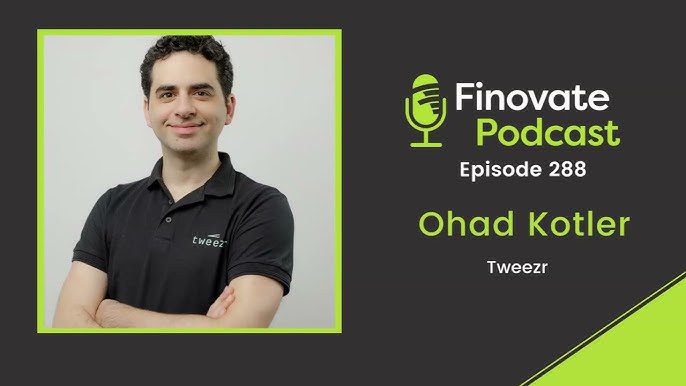
Greg Palmer interviews FinovateEurope Best of Show winner Tweezr on updating legacy systems through LLMs and AI.
In this podcast conversation Greg Palmer sits down with Matt Ober, Managing Partner at Social Leverage, for a perspective on fintech investment trends in 2026.
Finovate podcast host Greg Palmer interviews Joel Blake, OBE, founder and CEO of GFA Exchange on the challenge and reward of democratizing access to finance.
As FinovateEurope returns to London on February 10 and 11, the spotlight on the second day of the conference shifts from demos to deep discussion. On February 11, FinovateEurope’s Industry Stages run in parallel with one another, giving attendees the opportunity to dive into strategic conversations shaping financial services in 2026.
This year’s event features five Industry Stages: Artificial Intelligence; Banking, Regulation & Risk; Customer Experience; Lending; and Payments. Each stage is designed to offer banking and fintech leaders more than just theory. The sessions focus on what’s working in practice, what’s breaking under the pressure of new technology and regulations, and what institutions need to rethink about their current operations.
Artificial Intelligence: from pilots to production
The AI stage will feature discussions on one of the biggest challenges facing financial institutions today: moving beyond experimentation. The sessions will explore lessons learned from early AI agent pilots, governance frameworks to combat “shadow AI”, and how banks can scale AI responsibly. Highlights include a keynote from Richard Davies, CEO of Allica Bank, who will speak about the realities of implementing AI in production. The stage will also host panels tackling ROI, data readiness, and responsible AI as a competitive necessity.
Customer Experience: personalization without losing the human touch
On the Customer Experience stage, the conversation moves past buzzwords to focus on execution. Sessions will examine how open data enables hyper-personalization, why mindset can be the biggest challenge, and how banks can retain empathy while scaling. A standout power panel brings together leaders from J.P. Morgan, Invesco, and PolyAI to explore what banks can learn from other industries as customer expectations are being reset by the evolution of enabling technologies.
Payments: instant, intelligent, and under threat
Payments are quickly evolving across the globe, especially with new regulations such as PSD3 and new capabilities and enabling technologies such as instant payments, stablecoins, and cross-border modernization. Panels will focus on how data-centricity and AI can unlock growth while strengthening security, especially as fraud losses and cyber threats keep rising.
Banking, regulation & risk: resilience in a volatile world
Regulatory pressure and operational resilience will be the center of the conversation on this stage, where discussions will span DORA, dispute management, and the risks embedded in cloud and AI adoption. These sessions are especially relevant for banks navigating complex vendor ecosystems while being asked to do more, faster, and with greater accountability.
Lending: capturing the embedded opportunity
The Lending stage will look at how banks can reclaim growth by meeting unmet needs, especially in small business and embedded lending. Panelists will explore how AI is reshaping credit decisioning, how regulation is evolving, and where incumbents can realistically compete with fintech challengers.
Together, these five Industry Stages on February 11 will offer a concentrated look at the decisions that will define banking’s next chapter. If you register for FinovateEurope before January 30, you can still save £300.
FinovateEurope 2026 is only weeks away—but there’s still time to grab your ticket and save your spot. Be sure to visit our registration page today and take advantage of early bird savings!
We recently kicked off our FinovateEurope 2026 Sneak Peek series to help you get to know this year’s demoing companies. Today, we’re sharing a look at the content side of things: starting with four keynote addresses—two for Tuesday and two for Wednesday—that you won’t want to miss.
From the impact of geopolitics on financial decision-making to the rise of agentic AI to the possibilities of open banking and open finance, these FinovateEurope keynotes will explain how the most significant trends in fintech and financial services are impacting bankers and financial services professionals—and will share insights on how to make the most of these exciting new developments and innovations.
The Global Economic Outlook & the Escalation of Geopolitical Risk and the Impact on Banks and their Customers
Manas Chawla, Founder and Chief Executive of London Politica, is a political risk expert who has advised heads of state, UN agencies, and a range of Fortune 500 companies on how to navigate geopolitical risk and volatility. Chawla is also the Director of the Oxbridge Diplomatic Academy.
London Politica is the world’s largest political risk advisory for social impact. Founded in 2020, the organization leverages a global network of more than 300 experts to provide locally grounded insight with a global perspective.
Catch Chawla’s presentation at 10:20 am on Tuesday, 10 February!
AI-First Banking—Why Agentic AI is Truly a New Frontier in Banking
Alpesh Doshi, Managing Partner at Redcliffe Capital, will discuss how banks can harness agentic AI to reimagine a range of business process. With a focus on delivering real value for both customers and banks, Doshi’s keynote address will help bankers understand how they should be thinking about a Brave New World in which bots are the customers.
Redcliffe Capital specializes in investing and building companies that help enterprises and entrepreneurs leverage innovation in technology such as digital transformation, data, and artificial intelligence.
Catch Doshi’s presentation at 3:50 pm on Tuesday, 10 February!
Finding a Commercial Model for Open Banking in Europe—What is the State of the Market & Where Have We Seen Real Success Stories for Retail Customers & Corporates?
Taner Akcok, Head of Global API Banking, Deutsche Bank AG, is a serial entrepreneur, intrapreneur, and investor. With two exits on his resume and a spot on the Forbes 30 Under 30 roster in Europe, Akcok has extensive experience with API platforms, open banking, banking-as-a-service (BaaS), embedded finance, and contextual banking.
Germany’s Deutsche Bank is the country’s leading financial institution. Founded in 1870 to support emerging German businesses, Deutsche Bank today includes investing, corporate, and retail banking among its core services along with asset and wealth management. The institution operates in more than 70 countries and trades publicly on the Frankfurt and New York Stock Exchanges.
Catch Akcok’s presentation at 2:30 pm on Wednesday, 11 February!
Open Data Will Enable Hyper-Personalization—How Do You Do It & What Do Customers Actually Want?
Jurgen Vandenbroucke, Director at everyoneINVESTED, has more than two decades of experience in financial services. He combines expertise in financial engineering, behavioral finance, and digital innovation to transform the way people think about investing. With a PhD in Applied Economics, Vandenbroucke’s mission is to make investing easy, personal, valuable, and reliable.
everyoneINVESTED empowers financial institutions around the world to boost digital investment engagement via solutions based in behavioral science, regulatory compliance, and user-centric design. The company is the WealthTech spin-off of KBC Group and is a recognized WealthTech 100 company.
Catch Vandenbroucke’s presentation at 3:10 pm on Wednesday, 11 February!
CES is known for flashy gadgets and fun consumer technology. For most banks, CES is not a must-attend event because it does not focus on fintech and banking. There is, however, still value in attending the show, as emerging technologies can signal how customer expectations and new operating models are evolving.
U.S. Bank understands this and sent two executives, Don Relyea, Chief Innovation Officer, and Todder Moning, Head of R&D, Innovation, on a “Future Safari” to check out what’s new, what’s next, and what’s possible when it comes to implementing technologies.
After they returned to the office last week, we interviewed Relyea and Moning to unpack what CES 2026 revealed from a banker’s perspective. From embedded AI and robotics to agentic commerce and cross-industry convergence, they highlight new trends, unpack which were overhyped, and explain what bank leaders should be paying attention to over the next 12 to 24 months.
From a banker’s perspective, what signals did CES send this year about where technology investment is actually heading—and which trends felt more operationally real than hype?
Don Relyea and Todder Moning: Well, it’s safe to say the technology investment is increasing across the board. We love taking Future Safaris™ to CES because it is a great way to get ideas and see and follow emerging trends across many spaces that will allow us to improve the customer experience as well as integrate with other new tech innovations.
Trends that stuck out to our team this year include:
Everywhere Intelligence – Embedded in Everything: Artificial intelligence is no longer a standalone category—it’s being woven into devices large and small, at the edge (on-device) and in the cloud, turning ordinary products into smart, context-aware companions. In terms of potential financial implications, personalized financial assistants that understand behavior, spending patterns, and context could dramatically improve user experience and trust in the future. However, increased reliance on AI raises privacy, bias, and regulatory concerns—especially as financial decisions become automated.
Digital Health/Wellness/Longevity Tech: Tech that senses, analyzes, and predicts health was signposted at CES 2025 and carries into 2026 with smarter biofeedback devices. We see healthcare as connected to financial services and even have a saying: “healthcare is wealth care.” Money is emotional and has impacts on people, their families, and businesses, both good and bad, and helping to reach better wealth care outcomes (financial outcomes) positively impacts people’s health and wellness.
The convergence of AI, wearables, brain interfaces, and other age-tech are going to extend life. There is an opportunity for banks to weave that into a more holistic planning process for our clients. We also saw numerous wearables and other AI-based innovations that monitor various metrics and values to inform you about health risks or concerns. This is relevant because there is a strong correlation between physical health and financial health. These innovations could also help catch costly medical problems before they occur, saving people money and stress. For example, transaction metrics could flag early signs of dementia or an eldercare abuse issue.
Robots for industrial and home use: The resurgence of robotics was the most visible trend at CES this year. “Embodied AI” or what some call “Physical AI” are catchier names for intelligent robotics. We’re seeing tons of AI and far more robotics this year than in prior years, and as the two domains merge more deeply, a wave of AI-enabled, more general purpose, and often more human-like robotics solutions are emerging.
Robots, humanoid, non-humanoid, and robotic exoskeletons that you wear are graduating from controlled environments to unstructured, real-world contexts—folding laundry, navigating homes, manufacturing or even autonomous vehicles.
Looking ahead: CES shows a shift from gadget splendor to system-wide integration—everything is connected and intelligent. AI, robotics and immersive interfaces are converging—not just making things “smart” but connecting behaviors, identities and environments.
As CES showcased advances in consumer hardware, AI assistants, and connected devices, what new expectations do you think customers will bring back to their financial institutions?
Relyea and Moning: You’re hitting on two of the five themes about why we like to take Future Safaris and why CES is one of the best—what we call lateral and longitudinal. At CES, we’re able to see many industries and domains in a concentrated amount of time. Taking the lateral view, we see what and how numerous industries use similar technologies to do something. This is a great way to collect and curate direct or indirect ways that you can do metaphorically similar things in your future, industry and domain of interest.
On the longitudinal view, if you’re in a place and time where lots of technologies, developments, or business models are present, it’s a great opportunity to gauge how each technology, development, or business model is changing over time. This was the bank’s 15th year at CES, which allows us to gauge how each technology or development is changing over time. Are robots getting better and more useful, or are they developing slowly (or worse, stalled and in decline)? Is AI advancing and if so, in what places and ways? Is a touted technology delivering against the hype, or is it prancing around with no real innovation use. In Texas, we call the latter “big hat, no cattle.”
The big idea is that technology, design, and experiences are erasing the barriers and boundaries between industries. If one comes to expect what’s possible to do in one industry, business, or product, they will likely come to expect that for other industries and businesses. That’s the kind of meta-trending we try to find and then apply to what that means for banks and financial services going forward.
Customer interactions continue to become increasingly digital and increasingly enabled by AI and sensors, and U.S. Bank is at the leading edge of visioning where tech is headed and what our customers need from us—as we provide the technology and guidance that make their financial lives simpler and more convenient. We’re proud to have one of the longest running dedicated innovation practices in banking today.
AI being embedded in everything is going to raise the bar for consumer expectations of what good is. This year AI was not front and center at CES, it was embedded and improving the automation of consumer devices in subtle and easy to use and easy to access ways. Think rings, pins, and business card form factors that you can talk to (that may or may not connect to other devices or the cloud) and ask them to transcribe, translate, make PowerPoints, fill out forms, manage calendars, and many other things. This is going to raise the expectations of customers that more should be done for them.
Did you notice fintech concepts like embedded finance, identity, or real-time payments showing up inside non-financial technology at CES?
Relyea and Moning: Yes, we saw things like an AI-enabled oven that helps you grocery shop for ingredients.
We saw several biometric payment checkout interfaces. These were easy to use and set up and could be integrated into anything requiring identity and payments pretty easily.
We saw biometric technology using keyboard behavior that could help flag a significant behavior change in an employee (for example), who is either under duress or as a disgruntled employee could make poor decisions impacting the business. Another example we saw is asset-tracking technology that could be used off-grid, to say track trucks, railcars, mining equipment, etc.
For the majority of bank leaders who didn’t attend CES, what is one emerging theme from the show that you think will impact financial services over the next 12 to 24 months, and why?
Relyea and Moning: I’d say the embedding of AI into devices and what has started happening in agentic commerce. Devices of all sorts are showing signs of becoming commerce orchestrators and agents for customers—and it’s a short jump from there to having devices become a type of customer. Many of the things we see at CES come with subscriptions—for instance, the longevity mirror I used came with an annual subscription for you and your family to use its AI data and models. You can imagine that many of these monthly or annual subscriptions we might have in the future. Are you going to manage all of those, or will the device manage it for you with limited spending capabilities you provide it?
Tell us about the coolest non-banking use of technology you saw at CES?
Relyea and Moning: I think the exoskeletons were really cool. Don was able to wear the leg ones that helped him climb stairs much easier and faster. I was able to wear one on my back and hips that helped me to pick up a heavy item with ease. I also liked the sustainable printed battery that was paper thin. It could be embedded into most anything and power airtags in things like your passport carrier, purse, wallet, that kind of thing. And when you throw it away, it is completely compostable.
And we always love the autonomous mobility work that the big agricultural and construction/mining brands show—autonomous combines with autonomous hoppers that keep pace with the combine, and AI-assisted and autonomous Bobcats and construction excavators. It just shows how autonomous mobility is happening, even if its pace is slower than was originally expected at the beginning of the decade.
In our latest interview from FinovateFall 2025, Beyond the Arc CEO Steven Ramirez talks with Shruti Patel, EVP and Business CPO at US Bank, about the institution’s approach to supporting small- and mid-market businesses. The two discuss the emergence of new digital capabilities, embedded payroll and account payable solutions, as well as the role of customer experience in shaping product design.
“We are super focused on our small businesses. They are looking for very simple banking products: an easy-to-use, best-in-class operating, savings, or money market account. They’re looking for a great rewards card. And then, last but not least, small dollar loans. We excel in our small business access loans. We are number four nationally and very close in California, as well. When it comes to their lending needs, when it comes to their banking needs, we’re very much focused on how can we make the life of a small business really, really easy.”
Joining US Bank in 2023, Patel has brought leadership experience from across fintech, banking, and payments. Previously head of global partnerships and monetization at Shopify—and before that head of embedded payments and partnerships at JPMorgan Chase—Patel today oversees services for US Bank’s small business and mid-market customers across money movement and credit card solutions, as well as the bank’s full suite of digital capabilities.
With nearly 1.4 million business customers representing up to $25 million in revenue, US Bank serves its clients at every business life stage—from starting a business to managing a growing company to selling a successful venture. US Bank provides a comprehensive and integrated suite of banking and payments solutions delivered both digitally and via its trusted banking partners.
As the macroeconomic landscape changes and startup valuations adjust, financial services companies face new questions about where to spend their funds. Both investors and founders find themselves asking questions about what future funding will look like, which fintech niches are the most promising, and how startups can thrive with tighter funding restrictions.
At FinovateFall 2025 in New York, Citi’s Senior Vice President of Strategic Investments, Mary Joseph, shared her perspective on these trends with William Mills, CEO of The William Mills Agency. During the conversation, Joseph shared her outlook on current funding dynamics, sector leadership, and what founders should consider as they build resiliency and relevance into their businesses.
I think there was a time when companies could raise and raise and raise and spend and spend and spend, and the view was that, you know, at some point in the future, investors would be able to recoup that investment, right? Because the IPO market was hot, we were seeing more mergers and acquisitions. That’s not the case now, right? So we need to see companies that are really strong in terms of what they’re offering to the market.
Mary Joseph leads Citi’s global investments in fintech and B2B SaaS startups, focusing on opportunities that enhance Treasury and Trade Solutions and broaden the bank’s technology ecosystem. Before her current role, she worked within Citi’s Investment Banking fintech M&A advisory team and also served as a venture investor at GreenHouse Capital, where she focused on early-stage fintech innovation across Africa and the Middle East. She holds an MBA from The Wharton School and a BA from Columbia University.
Citi is a strategic player in fintech investment. Through its strategic investments arm, Citi aims to partner with companies that complement its core banking and corporate finance services, while also helping startups gain access to enterprise scale and regulated banking capabilities.