Go.AI, a provider of on-premises (on-prem), examiner-ready AI infrastructure for regulated industries, unveiled its latest solution this week: the Go1 MAX. Billed as the most powerful appliance in the Go1 product line, the Go1 MAX serves up to 8,000 concurrent users from a single appliance at a fixed price with unlimited usage and tokens.

The solution is designed for researchers, data scientists, engineers, and large enterprises—including banks, hospitals, and insurance companies—that train, fine-tune, and serve AI at scale. With the Go1 MAX, teams can train and serve on the same appliance without GPU queuing or cloud quotas. The system is air-gap ready with no API exposure.
“Regulated organizations want AI they can own and audit, and the largest teams need real capacity to run it,” Go.AI Co-Founder and CEO David Moscatelli said. “The Go1 MAX gives a bank or a hospital with thousands of users the ability to use cutting-edge AI and on-box fine-tuning in one appliance, without data leaving their environment.”
We recently caught up with David Moscatelli to talk about the company’s innovative work in on-prem AI infrastructure and what it takes to make private AI practical for companies in regulated industries.
Go Abacus is now Go.AI. Why the change and what does it mean for the company?
David Moscatelli: Go.AI is a clearer expression of what we build and the opportunity we see ahead. Our focus is helping organizations put AI to work within an environment they control. The new name makes that focus immediately recognizable, while “Go” captures the action we want to enable: moving from interest in AI to practical implementation.
It also brings our hardware and software together under a more cohesive identity. The Go1 family provides private AI infrastructure, while Go.OS provides the software foundation, and our applications help teams connect their information and use it in everyday work. We want customers to understand that these are parts of one connected offering, rather than isolated products.
This is a brand evolution, not a departure from our underlying business. Go Abacus Corporation remains the company behind the Go.AI brand. What changes is how clearly we communicate our purpose: making private AI practical for organizations that need control over their data, their deployment, and their costs.
For people who are still unfamiliar with the company, what problem does Go.AI solve and for whom?
Moscatelli: Many organizations want the productivity benefits of AI, but adopting it is not as simple as giving employees access to a public chatbot. They need to consider sensitive information, existing systems, implementation requirements, and the cost of expanding usage.
Go.AI addresses that challenge by bringing private AI infrastructure and usable software together. The Go1 family provides on-premises hardware, and Go.OS supplies the software foundation. Our console gives teams a workspace for connecting documents and data sources, building AI agents and workflows, and reviewing their activity. The goal is to help organizations use their own information to carry out business tasks, not simply experiment with a model. We provide an audit trail and evidence package that regulated institutions can hand over to an examiner, helping them to achieve compliance 365 days a year.
For financial institutions, that means creating a practical path to AI while retaining greater control over where sensitive work happens. Our client work includes everyone from large banks to healthcare providers and beyond.
Ultimately, we serve organizations that want AI to become a useful operational capability, but cannot treat data control or implementation as an afterthought.
How does Go.AI solve this problem better than other companies?
Moscatelli: Unlike public cloud AI providers or multi-tenant assistants that process data externally and expose organizations to variable cloud costs and security vulnerabilities, Go.AI deploys directly on the client’s own on-premises infrastructure. Key differentiators include:
- Zero Data Retention & Egress: Data never leaves the client’s environment and is never sent out for training, inference, or storage.
- Full Audit Lineage: Every model decision is logged, timestamped, and traceable by design, making it immediately ready for examiner review.
- Fixed-Cost, Unlimited Usage: There is no unpredictable, variable per-token cloud billing that spikes with organizational growth.
- Rapid Deployment: The Go1™ hardware and Go.OS software stack can deploy in under 24 hours, serving up to 2,000 users in under 15 minutes.
What is driving the growth of the on-premises AI market?
Moscatelli: Growth in the on-premises AI market is primarily driven by heightened security concerns, regulatory tightening, and the operational risks associated with public cloud infrastructure. Incidents like public cloud AI outages (such as major cloud LLM downtime windows) highlight the vulnerabilities of relying entirely on external uptime. Furthermore, organizations are increasingly aware of permission sprawl, data privacy risks, and strict examiner scrutiny regarding AI recordkeeping and audit trails. Compliance-minded institutions require absolute data sovereignty, predictable infrastructure economics, and immutable audit logs, capabilities that public cloud solutions struggle to provide out-of-the-box.
You’ve noted that fixed-cost AI infrastructure is changing the economics of AI adoption for smaller financial institutions. Can you elaborate on this? Are these institutions recognizing this opportunity?
Moscatelli: With usage-based AI, success can create a budgeting challenge: more employees use it, more workflows depend on it, and the consumption bill grows. That can make an institution cautious about expanding adoption, even when it sees useful applications.
A fixed-price model changes that calculation. Go.AI’s positioning is unlimited token usage at one fixed price. Instead of evaluating every additional interaction as another token charge, an institution can focus more directly on which workflows create value.
That is particularly relevant for smaller institutions, where budgeting discipline matters and internal technology resources may be limited. It can make the conversation less about rationing AI usage and more about selecting useful applications, preparing the right information, and helping employees adopt them.
Fixed-cost does not mean unlimited computing capacity or zero operating costs. It means removing per-token metering as a barrier to using the deployed system.
Can you tell us about a favorite implementation or deployment of your technology? Or a particularly valuable partnership experience? What made it special?
Moscatelli: Standout deployment milestones for Go.AI involve partnering with financial institutions and credit unions seeking to modernize operations without undertaking disruptive core system overhauls. Our work with community banks and credit unions to deploy private AI assistants for document analysis, loan processing, and compliance workflows stands out because it directly solves legacy friction. What makes these implementations special is seeing regulated institutions successfully harness advanced AI capabilities while maintaining absolute data control and examiner defensibility.
You most recently demoed at FinovateFall this year. How was the experience?
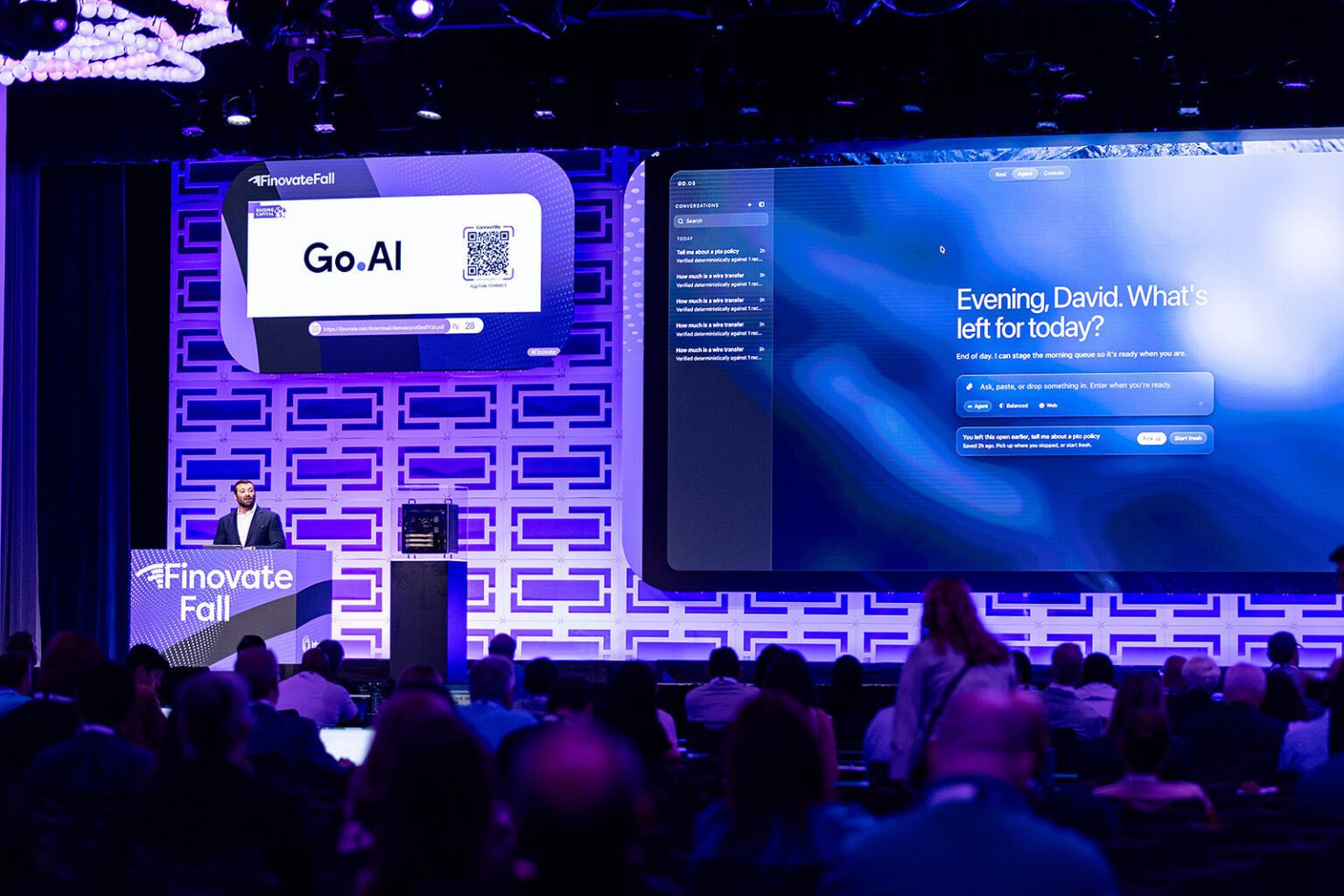
Moscatelli: The FinovateFall 2026 experience was exceptional. Demoing on Day 1 (September 9) provided a powerful stage to showcase our new hardware and software solutions alongside our official company rebrand to Go.AI. Compared with previous Finovate events, people are increasingly aware of what on-prem AI is, which is a real shift. It’s moving from curiosity to awareness and implementation.
What are your goals for Go.AI over the balance of 2026 and into next year?
Moscatelli: Looking across the balance of 2026 and into next year, Go.AI’s key strategic goals include:
- Team & R&D Expansion: Expanding our engineering talent pool and accelerating the development of Go.OS and our proprietary hardware line.
- Market Scaling: Expanding our go-to-market footprint beyond our core regulated financial services base into the broader universe of compliance-minded organizations (such as healthcare, insurance, and government).
- Education & Thought Leadership: Investing heavily in client advisory, training initiatives, expanded marketing campaigns, and dedicated podcast series designed to counter fear-based AI narratives and build robust enterprise buyer confidence.