SmartMoney just published its annual stock broker rankings (Note: currently the 2003 survey is posted, the 2004 should be there shortly).
There are now two categories of discount brokers: Premium and Basic. THere was little movement in the premium category year over year other than Vanguard droping from second to sixth and E*Trade making its inagural entry at number 2. Last year it was ninth in the basic category.
The best premium discount brokers:
____2004_________2003
1. Fidelity……….Fidelity
2. E*Trade………Vanguard
3. Schwab……….Schwab
4. USAA………….Quick & Reilly
5. T. Rowe Price..USAA
6. Vanguard…….T. Rowe Price
The basic category was more interesting with OptionsXpress coming out of nowhere to take the number one spot. SmartMoney’s comment, “nearly flawless.”
_____2004____________2003
1. OptionsXpress…….TD Waterhouse
2. Muriel Siebert……..Muriel Siebert
3. TD Waterhouse……Bidwell
4. Ameritrade…………ScottTrade
5. HarrisDirect………..HarrisDirect
6. FirstTrade…………..BrownCo
7. ScottTrade………….FirstTrade
8. Wall Street Access…Ameritrade
9. BrownCo…………….E*Trade (moved to premium)
10. WallStreet*E………Wells Fargo (moved to premium)
Widespread Misuse of Gartner Online Banking Fraud Estimates
By now you’ve probably seen the MSNBC report by Bob Sullivan entitled, Survey: 2 million bank accounts robbed, followed by the subhead, Criminals taking advantage of online banking, Gartner says. The MSNBC article seems to say that 2 million U.S. consumers lost money from their checking accounts due to online banking.
In fact, here is what Gartner actually says in its report:
“Illegal access to checking accounts is the fastest-growing type of consumer fraud, and may
be proliferating through online channels.” (italics are mine)
The report goes on to say that most consumers do not know how they theft occured, only 17% believed that their info was stolen off the Internet, another 10% reported their wallet was stolen, and only 5% recall giving up personal info to phishers.
Gartner also says that 70% of the online consumers reporting losses also report that they banked or paid bills online, “which exposes their (codes) to the Internet.” However, what they don’t say is that close to 70% of ALL online consumers are banking or paying bills online, so it doesn’t look like there is strong correlation between the two.
Finally, let’s not neglect the sample size. It looks staggering in the headlines to say that 2 million people were robbed. But my back-of-the-envelope calculations show that the multi-million number was extrapolated from fewer than 75 respondents reporting a recent unauthorized checking account withdrawal (from Gartner’s survey of 5000 online adults). I’ll let the market research experts debate the exact reliability of Gartner’s extrapolation, but one should be wary.
As bad as the MSNBC article looks for the online banking industry, the NBC Nightly News with Tom Brokaw got even more carried away. They took an even bigger number, 4.5 million, which Gartner said is the number of people who have ever had an unauthorized checking account withdrawal, and mistakenly said that all those people were robbed via online banking. Here is the exact synopsis of the TV feature from the MSNBC website:
“An estimated 4.5 million Americans have had money stolen from their Internet bank accounts.
NBC’s Bob Hager reports.”
This is a great example of a respectable piece of research taken out of context which then begins to have a life of its own as other news media echo the original piece. Hopefully, someone will dig a little deeper and set the record straight. Since I was quoted in the original Sullivan story, before I had seen the actual Gartner research, I will be contacting him to urge a followup.
Just to show that not everyone takes the 2 million number at face value, a story posted today at NBC affiliate WEEK-TV quotes Peoples Bank (Bloomington/Normal, IL) CEO, Ed Vogelsinger as saying that despite having 20% of their base using online banking, so far no one has reported any Internet banking fraud. Way to go Ed.
We urge our readers to take appropriate steps through their PR channels to set the record straight. At a minimum be prepared to rebut the MSNBC numbers if approached by the media. Feel free to send any reporter our way.
Contact: Jim Bruene, Editor, Online Banking Report, at 206-517-5021 or email [email protected].
Reference: “Banks Must Act Urgently to Stop Account Hijackers,” by Avivah Litan, Gartner
Phishers Target the Royal Bank
Phishers struck another blow to the banking system when they demonstrated that they no longer need rely on random blanket emailing blasts. Case in point: within 24 hours of a real systems glitch at Royal Bank, the email thieves sent a massive fraudulent email playing off the legitimate systems outage.
One can only hope that this particular theft didn’t enrich the thieves. Otherwise you have a situation where there is an incentive for a thief to create havoc with a bank’s systems and then cash in through a well-timed phishing fraud.
Read more on the prevention of phishing at Online Banking Report (subscription required).
Washington Mutual Small Business Resource Center
Although not as robust as Barclays, Washington Mutual is
the only top-10 U.S. bank with prominently targeting startups. Through its
partnership with StartupNation, the bank has posted several articles on
its website, and also sends users to a cobranded
www.StartupNation.com
website to sign on for more tools and resources including webinars, resources,
and coaching. We don’t know the terms of the relationship, so we can’t judge the
cost effectiveness. However, we definitely like how WAMU is positioning itself
as a supporter of
small business.

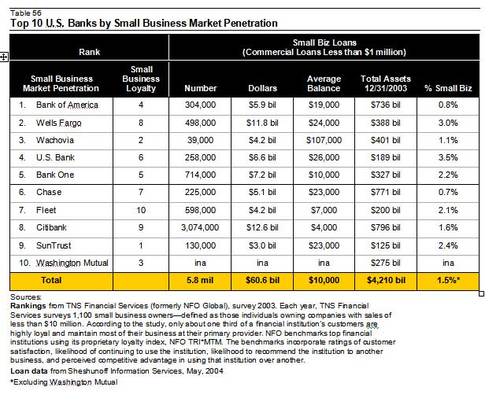
Top 10 Financial Services Providers by Small Business Market Penetration
In the 2002 study of small business, TNS (formerly NFO Global Financial
Services) looked at which banks had the largest share of small businesses
relationships and which were ranked highest by small business clients.
SunTrust ranked highest in customer loyalty, followed by Wachovia
and Washington Mutual.
1. Bank of America

Pros:
· Three levels of business online banking: online banking with
bill pay, Business Connect for multi-users with varied levels of
access, and Bank of America Direct to manage all business finances
online.
· Good comparison chart of the three choices
· Resource center with informative articles on starting a
business and other topics
· Protect against online fraud link
Cons:
· Must scroll down to see all choices
· Hard-to-read small blue font for most links
· No separate URL or bookmark helper
2. Wells Fargo
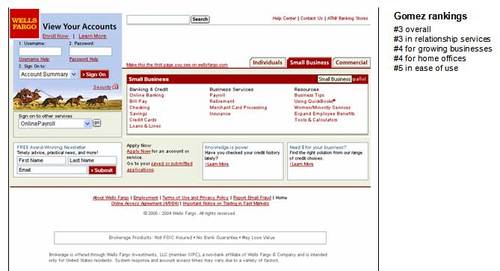
Pros:
· Small business tab
· Excellent navigation and design, all viewable on a single
screen without needing to scroll.
· Clients can view personal and business accounts from a single
sign-on
· Single page, informative Small Business Newsletter
· Customers and non-customers can enter email address to signup
for newsletter
· Relevant and useful tips on product pages
· Product comparison pages as well as best product for your
business quiz
· Push a button to switch from English to Spanish and back again
· Link to Make this your first page at WellsFargo.com
Cons:
· No link to Security on the main page
· Not using liquid layout, so homepage appears small and
off-center at higher resolutions
3. Wachovia
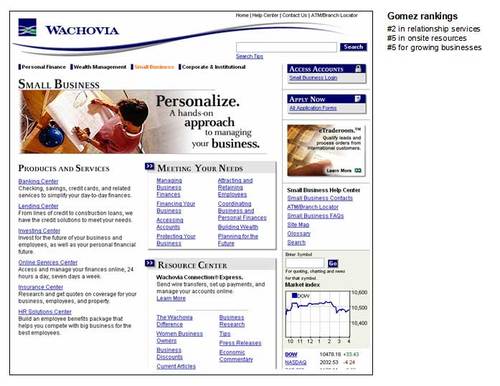
Pros:
· Small business is one of the four main navigation
choices on the top
· Copy and headlines are solutions-oriented, e.g., Meeting
Your Needs, Resource Center
· Excellent navigation and layout on a single page
· Separate small business FAQs
· Relevant products and services packaged into “centers”:
Banking Center, Lending Center, Investing Center, Online Services Center,
Insurance Center, and HR Solutions Center
Cons:
· Must scroll to see information on bottom of screen
· No link to Security
4. U. S. Bank
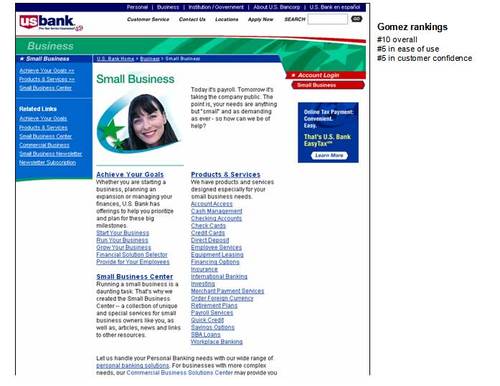
Pros
· All major links are contained on a single page without
scrolling
· The no-frills style is easy to read
· Two solutions-oriented sections: Achieve Your Goals and
Small Business Center
· Separate Small Business login
· Link to Newsletter subscription
Cons
· Layout and design could be improved
· No link to Security
5. Bank One
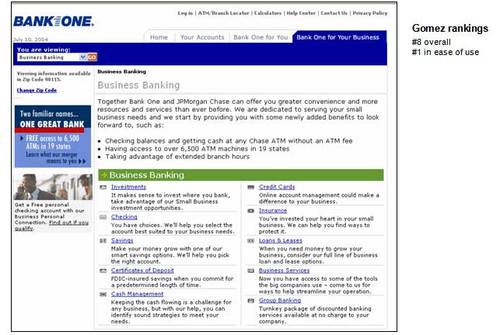
Pros
· Product-oriented layout makes it easy to find specific products
· Small link to Security on bottom (not visible on
screenshot)
Cons
· There is no small business section, in fact the term is
not used in any header, although it is mentioned in the opening paragraph;
choices are Business Banking and Commercial, that defies
industry conventions and could cause lost business
· No solutions-oriented areas or resources section
· Copy is cliché-ridden and not benefits oriented;
for example under Insurance:
“You’ve invested your heart in your small business.
We can help you find ways to protect it.”
6. Chase
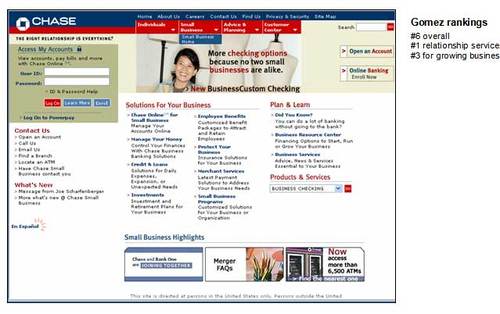
Pros
· Small business is one of the four primary navigation
choices on the top
· Excellent design and layout that fits on one page without
scrolling
· Solutions-oriented sections: Plan and Learn,
Solutions, and Business Stages
· Link on left to Have Chase Small Business contact you
· Privacy & Security link on top
· Prominent Open an Account and Online Banking: Enroll
Now boxes in upper right
· Liquid layout
Cons
· No quick navigation or separate URL for the small business
page, you have to click on the Small Business section on the home
page, then move your cursor down the cascading menu to the Small Business
Home, it only takes a few seconds but it’s still unnecessary extra
effort
7. Fleet
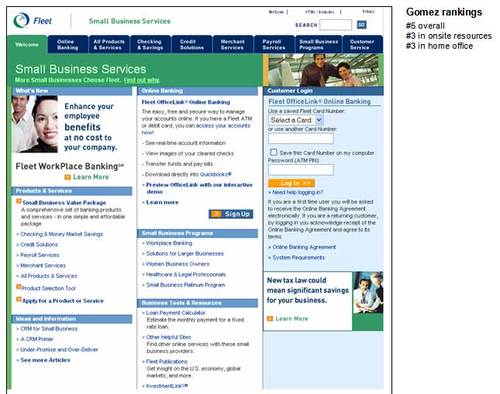
Pros
· Separate URL
http://www.smallbiz.fleet.com/
· Tabs across the top help users find important subjects
· Link to Small Business Value Package (Note: Fleet also
offers a Small Business Platinum Program with a dedicated
relationship manager, faster funds availability, and priority phone service
· Solutions-oriented areas: Ideas and Information,
Business Tools & Resources
Cons
· Layout and design is a bit overwhelming
8. Citibank
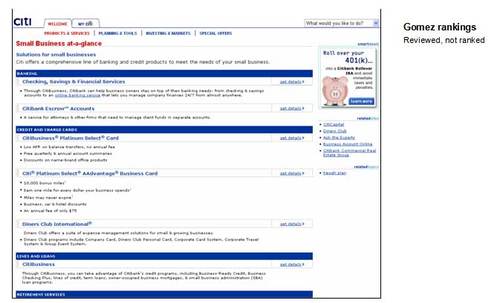
Pros
· Using the drop-down menu you can navigate directly to relevant
business unit pages; the AAdvantage Business Card main page for
example is very well done
Cons
· Poor navigation off the home page: The only way to navigate to
the small business section is to use the drop-down menu on the right;
and because it doesn’t have a Go button, it took us 30 seconds before
we figured out you have to cursor down to Small Business at-a-glance
(screenshot above) in order to move to the small business section
· Poor navigation within the small business section: The four
main choices at the top of the page (Products, Planning, Investing,
and Special Offers) are NOT related to small business, they take you
back to consumer
http://www.citibank.com/ pages, and if you don’t use your back
button, you have to go through the full navigation routine to get back to
small business
· Must scroll down to see all the choices
· Main banking link (Checking, Savings, & Financial Services)
as well as the Online banking link cause a pop-up screen to load
which is dominated by an outdated self-promotion for online personal banking
with 2001 testimonial from Forbes magazine
9. SunTrust
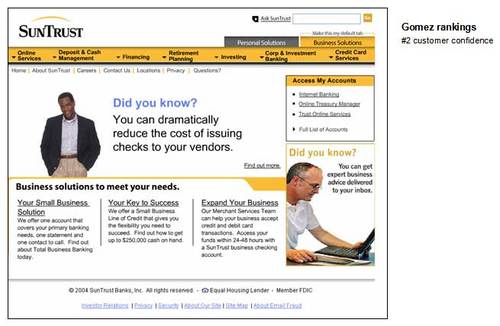
Pros
· Small Business Resource Center is a good area, although
it’s buried under the Online Services tab in the Business
Solutions area
· View only option for online banking, no money movement
allowed
· Ask SunTrust search box in upper right is handy, but it
doesn’t distinguish whether user in searching from business or personal
pages
Cons
· The top navigation bar is a mine field of cascading menus that
launch when the mouse travels over them, an out-of-date and annoying method
for primary navigation
· No dedicated Small Business homepage, other than the
Small Business Resource Center mentioned above and a mid-page link to
Your Small Business Solution which leads to a curious page entitled
Benefits that talks about Total Business Banking, but it’s not
clear if it’s geared to small businesses or not.
· Unclear and vastly different navigation/organization in the
various areas devoted to small business (e.g., Small Business Resource
Center)
10. Washington Mutual
Pros
· Link to content from StartupNation in upper-left corner; the
only bank in top 10 with headline targeting startups (see back page for more
information)
· Good online banking demo with audio highlights
· All the information shows on a single page without scrolling
· Liquid layout
Cons
· No link to Security
· Copy and headlines could be more solutions-oriented
· Layout is a bit sparse for a bank
Innovators in Small Business Online Delivery
Innovators in small business online delivery
|
Table 55 Watchfire/Gomez Small Business Scorecard
Source: Watchfire, 6/04 <gomezpro.watchfire.com> |
Our first report on small business banking was produced in the fall of 1997
(OBR 29).
At that time, few banks were specifically targeting small businesses. Then,
a Yahoo search for “small business” and “banking” yielded only 19
results compared to 2.5 million today. In the late 1990s, most banks were
still busy building out their consumer interfaces. Even as recently as 2001
(OBR 70/71), we found few major innovations to report on. Our
favorite small business banking service was OneCore
http://www.onecore.com/ which was
shuttered shortly thereafter, at least as a direct provider.
Today much has changed. Everywhere you look, banks are innovating to
serve the small business market more effectively. According to
Watchfire’s GomezPro unit the best small business banking sites
are Bank of America and National City, tied for first place in
its year-end 2003 scorecard (see Table 55, right).
Other online innovators in the small business market:
- Barclays Bank (London; $800 billion) uses its
website to target startup businesses with a broad array of support
services that many startups would find essential, including a free
business checking account for the first year. It’s so impressive, we’ve
given it our second Best of the Web award this year
(see next page). - PNC Bank (Pittsburgh, PA; $70 billion) and
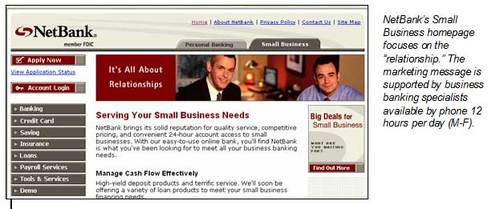
NetBank have both announced plans to offer remote check deposits,
something most U.S. banks will support within a few years. One of the
last reasons to visit the branch will be eliminated when clients can
feed paper checks into a scanner instantly depositing the cash into
their account and storing the image into their online banking archive
This service is a shoo-in for an OBR Best of the Web once it goes
live. - NetBank (Alpharetta, GA; $4.1 billion) which
launched a new small business initiative a year ago, has attracted 1,600
businesses with $38 million in deposits ($24,000 average deposit). If it
keeps to the announced third-quarter launch, NetBank may be the first
bank to offer remote paper check scanning
Barclays provides valuable services for startups
Why do the U.K. banks do a better job serving small businesses online
compared to their U.S. counterparts?1 Perhaps U.S. banks are
underestimating the value of services targeted directly to small business
owners. Or maybe they’ve found it too difficult because business owners
won’t bother switching bank accounts to save a few bucks a month. That’s why
it makes so much sense for Barclays Bank to focus on startups
at its business website <business.barclays.co.uk>. After all, if you
succeed in being a startup’s first bank, you have the inside track to retain
its business over time.
Barclays business homepage (see below) is dominated by a shaded
area asking the important question, Starting a business? Even though
the vast majority of visitors already have a business and a banking
relationship with Barclays, those most likely shopping for services are
startups. The bank also offers Pain relief in a box, a proprietary
business management and accounting program targeted for tiny businesses or
startups that haven’t settled on an accounting software system.
1Two out of three of our Best of Web winners for small
businesses are headquartered in the U.K.


Barclays’ small business Starter Accounts consist of the following
features and benefits:
- Current account (checking) with an overdraft facility; free
for the first 12 months, 18 if you also maintain personal accounts at
Barclays - Savings account
- Loans, subject to credit approval of course
- Insurance
- 45-minute free consultation with a business/marketing
consultant - 45-minute free consultation with an accountant
- 30-minute free consultation with an attorney
NetBank and PNC to offer remote deposits
According to recent press reports, both NetBank (American Banker,
May 20) with 1,600 small business clients and PNC Bank (Wall Street
Journal, June 8) with 200,000, will launch remote deposit service for their
business customers. Although details of the yet-to-be-launched services are
sketchy, it is expected that business customers will be able to scan paper
checks into a remote device that transmits images to the bank for immediate
deposit. PNC estimates the scanners will rent for $15 to $25 per month. No word
on pricing from NetBank. The NetBank service is expected in late third quarter
and PNC expects to roll-out by yearend. Alogent
http://www.alogent.com/ is the
technology provider for NetBank.
Benefits for small business owners:
1. Saves time/money: Frees business owners from the daily/weekly
trek to the branch, something 80% of online self-employed households reported
doing during the past 30 days according to Javelin Strategy
2. Improves cash flow: Checks can be deposited immediately rather
than collecting dust waiting for the owner’s next trip to the branch
3. Streamlines record keeping:
i. the original check can be filed as a paper receipt if desired
ii. a back-up electronic image is stored at the bank if questions arrive
4. Improves customer service: Check images can be quickly retrieved
and emailed if
a dispute arises
5. Saves storage space/cost: Paper checks can be destroyed much
sooner, eliminating storage and security issues
6. Improves management control: Owners can spot-check deposit
activity by looking at actual check images, rather than staff-entered accounting
entries
Speaking as both as a small business owner and an industry analyst, this is a
great service and a strong candidate for a Best of the Web award once it
becomes operational.
Small Business Case Studies: Putting it all Together
Case Study: Financial product usage at one small business
Microbusinesses typically purchase a hodgepodge of
services culled from both retail and commercial banking product lines. For
example, at our own small business, we purchase 16 financial products evenly
split between consumer and business products (see Table 52, below).
Nine are sourced from banks, six are from non-banks, and one is a combined
effort. Overall, we spend $6,700 annually in fees, interest paid, and
interest foregone (for checking). But the internal costs for managing our
billings, payments, and banking, are more than three times as much, an
estimated $24,000 per year. We would gladly outsource these to a
high-quality and VERY trustworthy third party, preferably someone with a
regulatory and fiduciary responsibility to safeguard our information and
assets, like a bank.
Table 52
Financial Products & Services Used by One Small Business
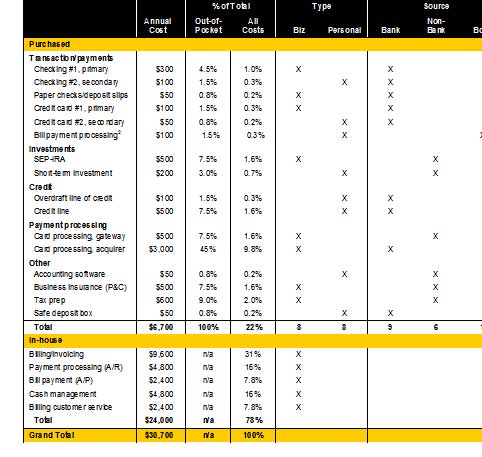
Source: Online Banking Report, 6/04 1Fees and net
interest foregone (deposits) or paid (loans) assuming 2% cost of funds
2Purchased through US Bank, but processed by CheckFree and user
interface by Microsoft Money
Package accounts targeted to business segments
Most banks offer small business bundles that include checking and
other basic transaction services. However, we believe the online platform
can be used to assemble more valuable offerings targeted to small businesses
with various financial management needs. Table 53 (below) shows ways
that the small business market could be segmented. Table 54 (p 53)
outlines major feature that could be included in package accounts targeted
to the financial management needs of the small business.
Table 53
Potential Business Segments to Target

Virtual financial management packages
Most banks offer small business account bundles that include checking
and other basic transaction. We believe that there is a significant
opportunity to expand into hosted financial and customer management systems
with monthly fees of $100 or more. Following are the pros and cons of moving
into the financial management arena:
Pros
- Profitable, incremental fee income
- Publicity and image enhancement from being the first in
your market to integrate banking functionality into an overall Web-based
small business management suite - Product differentiation and an impressive unique
selling proposition - Positive word-of-mouth within the local business
community - Powerful retention tool
- Potential for licensing to other financial
institutions
Cons
- Weak/uncertain demandd: Until recently, small
businesses have been slow to adopt new banking technology. It may take
several years of marketing, sales, and training before you begin to see
a payback. - Development costss: Building a robust, highly secure
new system will be pricey; you will probably want to partner with an
accounting software developer that already has code for the basic
functionality. - Uncertain ongoing servicing costss: Being on the
bleeding edge has its risks; it will be difficult to predict ongoing
costs for system maintenance, software development, and customer
support. - Lack of employee confidence: Financial institution
front-line personnel have been known to steer clear of discussing small
business and/or online banking subjects due to uncertainty with their
operation, cost, and overall value.
Table 54
Features of Virtual Accounting Package Accounts
*Approximate monthly subscription price; additional transaction fees
would apply for certain services.
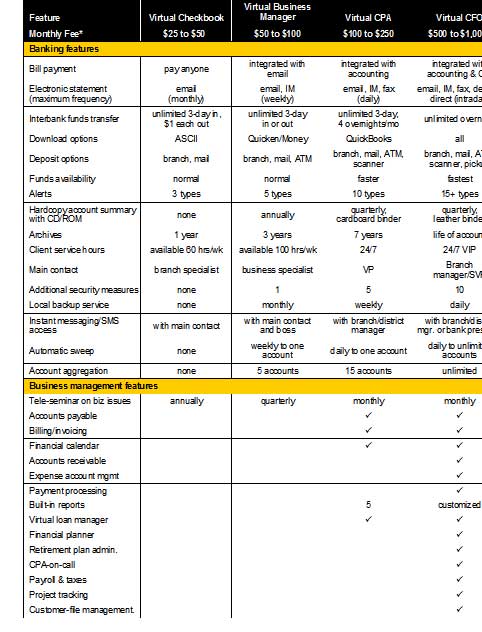
Package Account Descriptions
Virtual Business Manager
Description: A secure place for small businesses to set up an
online home base, similar to corporate intranets. Possible names: virtual
office, virtual desk, virtual briefcase, or personal intranet. It could also
be marketed to the estimated 39 million U.S. households with a home office.
Functionality: For a financial institution, the key to making it
work is tight integration with banking and financial matters. A further
emphasis on local content/links could keep you ahead of the competition.
Banking and financial management feature are listed in Table 54 (previous
page), including:
- Financial calendar/datebook/reminder service
integrated with bill payment - Virtual safe deposit service that automatically
stores financial and other files in secure, encrypted, off-site back-up
files not accessible by anyone but the owner (not even bank personnel);
can be retrieved on CD for disaster recovery - Virtual receptionist that tells visitors how to get
in touch with someone at your business - Company message boards for internal users
- Company blogs for external users
- Ability to post documents to the Web, which can be
shared with everyone or just authorized employees and/or customers
Virtual CPAA
Description: As its name implies, the Virtual CPA provides
extensive accounts-receivable and accounts-payable services from a Web
interface.
Functionality: In addition to the Virtual Business Manager
features listed above and the banking/financial management features listed
in Table 54, the VirtualCPA could also provide the following features
(for more ideas, see the features built into Intuit’s QuickBooks
http://www.quickbooks.com/
- Billing statements and invoicing via email, fax, or
snail mail; includes reminders, and confirmations - Online, cash-based accounting functions including
data entry, categorizing, and basic report generation - Bill-payment/accounts-payable monitoring functions,
such as email notification when payment transactions are awaiting
authorization by business owner; email flags when payment transactions
don’t clear in a reasonable time - Autopay function that pays certain bills
automatically each month when preauthorized by the client - Virtual credit card terminal with integrated email
and accounting - Lock-box service for paper check processing with full
integration to client’s accounting system - Option to share selected information with outside
advisors, such as a CPA
Virtual CFOO
Description: This top-of-the-line service has it all. Just as in
the real world, the Virtual CFO takes the raw data and puts it into a
broader perspective that allows a business to be more profitable.
Functionality: The following features could be added to those
already offered in the Virtual CPA and Virtual Business Manager
modules:
- Online payroll with paper or direct-deposit paychecks
and electronic tax payments - Online federal and state tax return preparation and
filing - Full-fledged, double-entry online accounting
- Complete disaster-recovery services including a
redundant data center – an area in which banks’ inherent in-house
expertise could be turned into a profit center - Complete Web-based customer file management and
communications including:
– invoicing/billing with Web integration, e.g., bill presentmentt
– payment services/inquiry via the Web
– email/fax/voice messages automatically confirming payment - Access to a CPA-on-calll for accounting and tax
questions; advice could be delivered publicly on your Web, privately
through confidential conversations, or both. - Automatic excess funds allocation to minimize
interest expense and/or maximize interest income. For added value, the
funds “sweep” could go to investment and loan accounts at any financial
institution (not just yours). - E-commerce services for hosting secure transactions
- Accounts-receivable management that automatically
notifies the business owner and/or customers when accounts are past due;
includes linkages to a virtual payment window - Bank-branded virtual payment windoww, which clients
can display on their website to increase end-user confidence in paying
by credit card or electronic check (ACH); includes integrated messaging
confirming orders. - Extensive management reporting easily customizable
using drop-down menus; for example, revenue reports by customer,
accounts receivable aging, quarterly P&L; and so on. - Mail-merge capabilities that work across any medium,
email, fax, page, voice message, or snail mail; option to outsource
snail mail services to a mail house; includes label-printing utility. - Retirement plan administration including Web views
for participants - Project tracking module integrated with reminders and
other Virtual Officee services - Employee-expense reporting, cash advances and
reimbursement services - The ability to issue/reload prepaid credit
cards for customer rebates, expense account cash advances, and so on..
Recommended Online Products and Services for Micro Businesses
Small business attitudes are changing as online banking services become
easier to navigate and more useful. While it currently seems impossible to
eliminate the dependence on the branch for physical deposits, with the
widespread adoption of check imaging and electronic payments, most
non-cash-oriented businesses will be able to bank remotely. Both PNC Bank
and NetBank have announced plans to equip their business customers
with paper check scanners that will allow the remote deposit of paper
checks.
But even the best website and product offering cannot substitute entirely
for the human touch. Every business should have a contact available by
phone, email, or instant message. Small business owners should be treated
like private banking clients.
Recommended online products and services
In theory, small and micro businesses represent one of the most
lucrative, and relatively untapped, sources of incremental business. The
reality is that businesses are difficult to reach unless you are competing
for their loan business. A product offering optimized for business will
differ somewhat from one built for consumers. The following sections detail
potential online features for various microbusiness products.

A. Transaction accounts: checking & cards
While the overall banking relationship may revolve around the
commercial loan, online banking is all about the transaction account(s),
e.g., checking and credit card accounts. Smaller businesses often track
their financial progress through their bank accounts, using them as a proxy
for sales, cash flow, and profits. Business users are also more likely than
consumers to value advanced features such as downloads, reporting, alerts,
and multiple authorization levels. Some of the more promising features:
- Custom data delivery: Periodic summaries of account
activity whenever (daily, weekly, monthly) and wherever (text email, HTML
email, or fax) the client chooses - Long-term archives: If
Google can provide 1GB of
storage for users of its FREE email service, banks should be able to provide
unlimited archives for a fee
Table 27
Checking & Savings Account Deposit Options
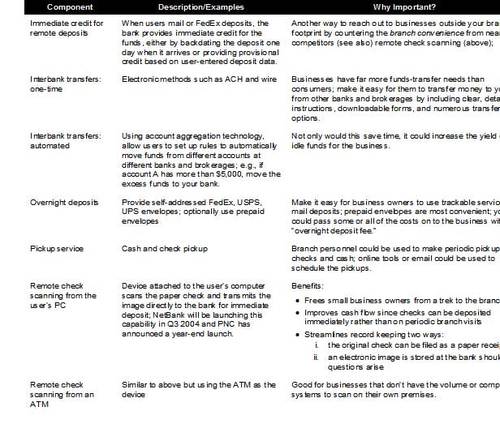
Table 28
Online Features for Transaction Accounts: Data Display, Storage, and
Value Adds

Table 29
Event Triggered Alerts & Authorization Messages to Support
Transaction Accounts

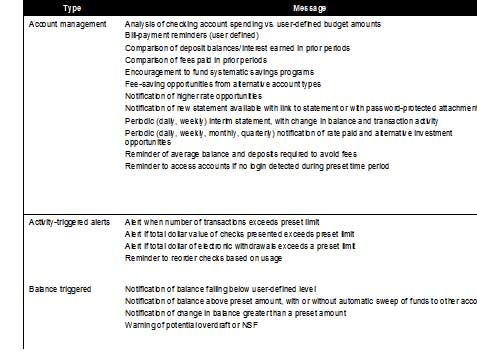
Table 30
Balance, Activity, & Account Management Messages for Transaction
Accounts
B. Payment and billing services
Next to statement information, epayment services are the second most
important drivers to the adoption of online banking by small businesses. And
unlike data access, epayments have the potential to become profit centers
and/or a significant source of online differentiation. Most businesses make
far more payments than consumers, so the importance of electronic
alternatives is magnified. On the other hand, existing businesses already
have a system for payment and billing, so it may be difficult to convert
them to a new one that requires changes in internal procedures or software.
Your best opportunities may be in less systematic services (i.e.
one-offs) such as electronic transfers between a business’s accounts at
other financial institution (account-to-account transfers) and the
occasional rush payment.
Table 31
Online Features for Billing, Payment Processing, & Funds Transfer
Services

Table 32
Online Features for Payment and Accounts Payable Services

Table 33
E-messaging to Support Epayments and Ebilling

C. Credit and loan accounts
Every small business relationship should include a credit component. It’s
the lifeblood of business, and a profitable product for financial
institutions. However, many banks have been reluctant to make commercial
loans to the microbusiness market. Average loan sizes, which are dwarfed by
typical commercial loans, make the effort seem fruitless. Yet profit margins
on the small business segment can be higher. Microbusinesses often use
personal credit, primarily credit cards and home equity secured loans, to
finance their businesses.
We believe every creditworthy microbusiness customer should
have a package of three or four credit lines with your financial
institution: an overdraft line of credit (connected to checking), a home
equity line of credit secured by their personal real estate (if applicable),
a business line of credit, and a business credit card. Even if the total
commitment is no more than $10,000 initially, it will make the business
owner feel like a valued customer; and each line can grow larger over time.
Table 34 contains a number of ways to use the online channel to
strengthen credit relationships with small businesses. Some of the more
important tactics:
- Loan/line Hybrid: A flexible financing vehicle that
includes an integrated line of credit and the ability to take out fixed
loans from the overall credit line. - Startup Center: Information, tools, and resources geared
towards startup businesses.
Table 34
Online Features for Lending and Credit
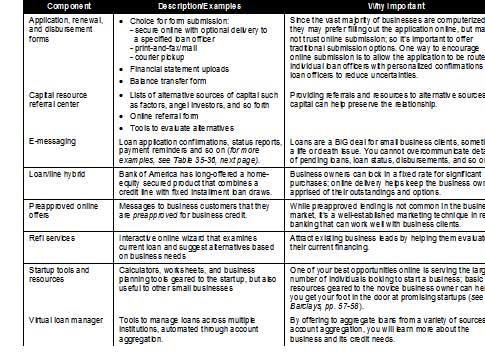
Table 35
Triggered Alerts for Credit and Loans
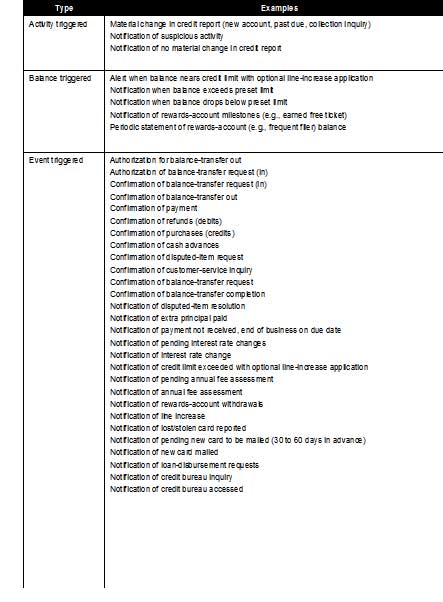
Table 36
Account Management Messages for Credit and Loans
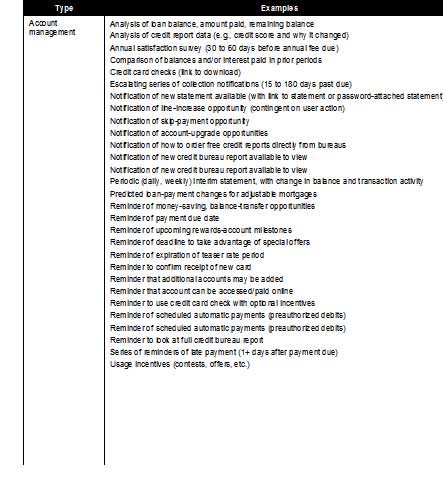
Table 37
Example: Potential Annual Credit Product Revenue from a Microbusiness1

Source: Online Banking Report, 6/04
1Example for illustration purposes only, not based on actual
research results
Table 38
Example: Potential Annual Credit Product Revenue from a Larger Small
Business1
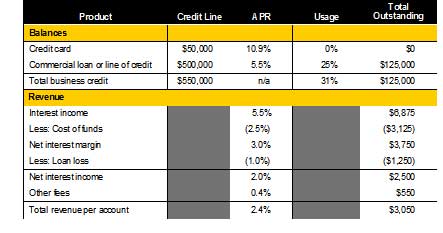
Source: Online Banking Report, 6/04
1Example for illustration purposes only, not based on actual
research result
D. Deposit and investment accounts
The online component of deposit and investment accounts is far less
important than for transaction and payment services. However, a robust
online offering can boost deposit-gathering initiatives and improve
retention. Key online components are listed below: Refer to the
Checking/Transaction section for more ideas.
Table 39
Online Features for Investment and Deposit Products
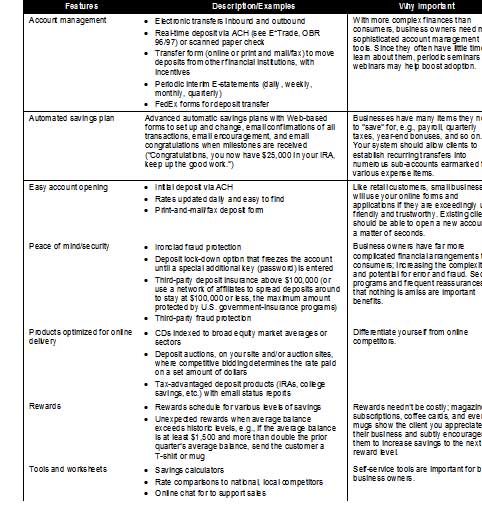
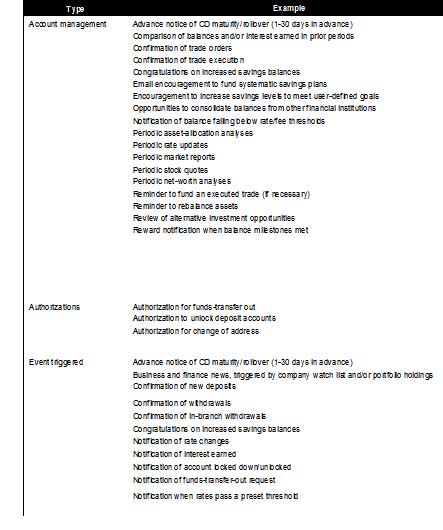
Table 40
E-messaging for Deposits and Investments
E. Financial management & accounting
Although automated accounting and financial management services offer the
biggest potential payback to small business owners, they are challenging to
deliver. However, working through third parties, financial institutions of
all sizes can help cement banking relationships with financial management
services such as:
- Visible and easy-to-use data downloading services
- Tools to make annual financial updates and tax prep simpler
- Online wrap accounts that handle all financial and accounting
needs for an annual fee, see the section on the Virtual CFO, CPA, and
Business Manager
Eventually, it won’t be enough to simply offer robust cash management and
online balance reporting to your business clients. Using the Web as a
platform to build industry- and customer-specific service offerings, we
expect a proliferation of specialized small business services during the
next few years. For example, several years ago QuickBooks opened its
code to developers
http://www.developer.intuit.com/ spawning numerous niche services
built on the small business accounting program. Check out the QuickBooks
Solutions Marketplace
http://www.marketplace.intuit.com/

As the economy continues to improve, big banks will aggressively court
small and mid-size businesses with creative financial management via
Web-based services. These innovations will help counteract the perception
that community banks provide better service. In turn, community banks will
fight back with online offerings that enhance personal service
delivered to local businesses. Luckily, vendor offerings will make even the
most complicated Web-based service affordable to the smaller financial
institution.
Intuit has already built impressive software-to-bank linkages for
QuickBooks and Quicken customers. To some extent, the shrink-wrapped
software is a Trojan horse, positioning Intuit-controlled links to its
partner banks right on the desktops of your best clients. You can fight back
by incorporating billing, accounting, and financial management functions on
your website using account aggregation, instant messaging, and “push”
publishing technologies. Although, it will take time, we think smaller
businesses will be very receptive to financial and management services
running on encrypted, secure, and trusted servers controlled by the bank..
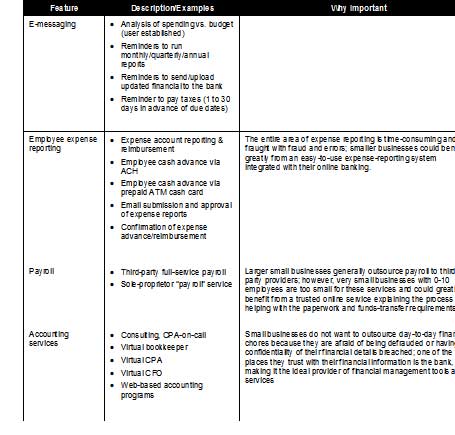
Table 41
Online Features for Financial Management
F. Service & client relations
Online services and other automation tools can be used to help
relationship managers service and cross-sell to small business clients. Used
judiciously, these tools can improve the perception of personalized service,
even while they improve the productivity of the relationship managers by
allowing him or her to handle a larger portfolio. Key components include (see
Table 42 below for more):
- Library of recommended preformatted emails that relationship
managers can easily customize and send to clients - Private-banking-like service that treats small business owners
like VIPs - Instant messaging for more private/secure connection between
the client and their business banking officer
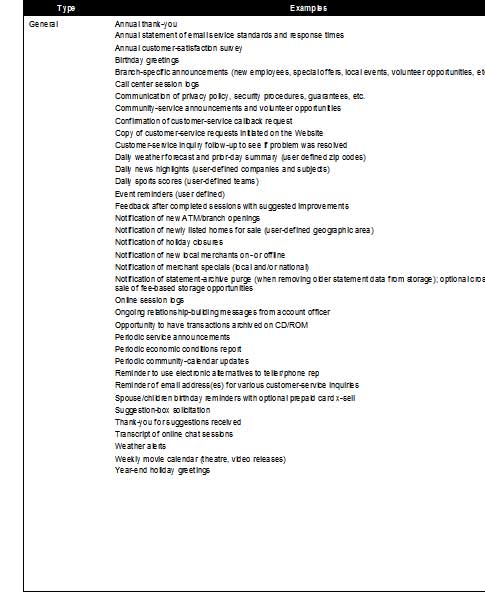
Table 42
Online Features for Self-Service
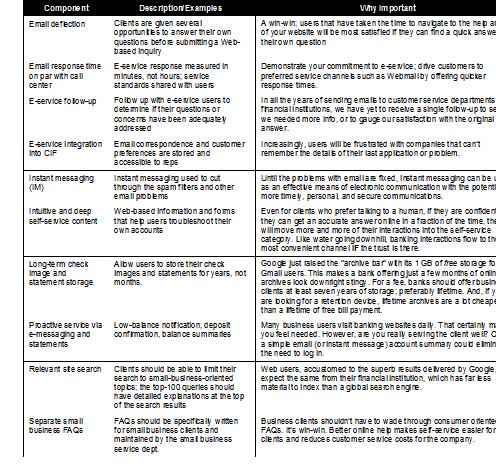
Table 43
Online Features for Client Relations
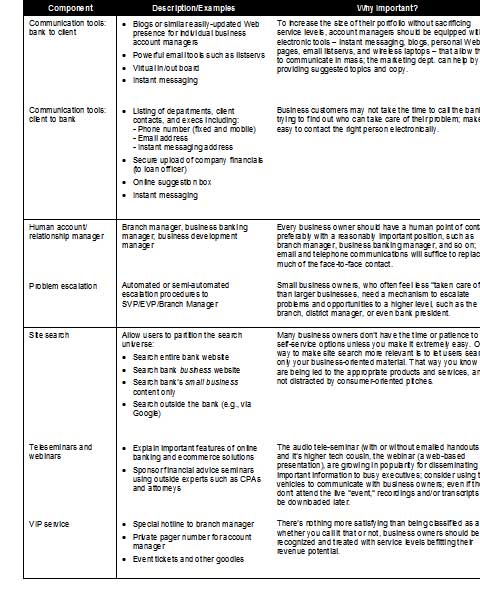
Table 44
General E-messaging to Support Client Relationship Management
G. Security and privacy
Although business users may understand the tradeoff between convenience
and risk, the stakes are much higher. A breached small business bank account
could cause thousands of dollars of lost productivity and sales, in addition
to any funds that disappear. In addition, larger small businesses are always
up against the threat of insider theft and fraud. So business owners need,
expect, and will pay for more sophisticated security controls. For example:
- Additional authentication and/or authorization for outbound
funds transfers or payments - Token- or SMS-based authorization to access the account’s
master level where new payees can be added, permissions can be granted, and
so on - Frequent email messages tracking online account access and
alerting the business owner to any suspicious or out-of-character usage,
e.g., login from an IP address in Liberia - Comprehensive assurances and guarantees that accounts will not
be compromised
Table 45
Online Features for Security & Privacy
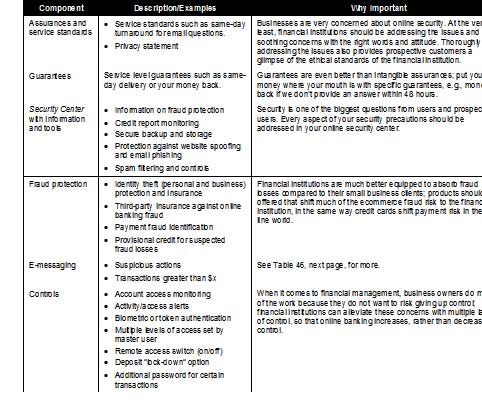
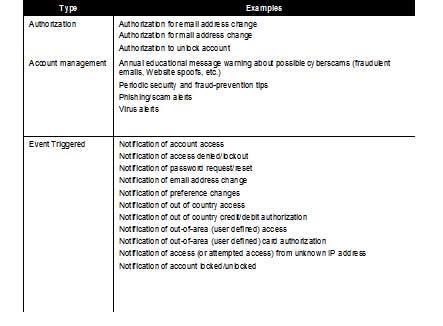
Table 46
E-messaging to Support Security & Privacy
H. General website content/features
As branches are gradually replaced by websites as the place where most
banking business is conducted, your online presence will become a critical
part of your overall brand image. Branches will still have a role, but it
will be limited to account openings, cash deposits, and the occasional visit
to the safe deposit box. Websites catering to small businesses will become
far more sophisticated, yet highly customizable and easier to use. Important
features include:
- Resources and discounted banking packages for start-up
businesses - Separate URL that business clients can enter to skip the
consumer section
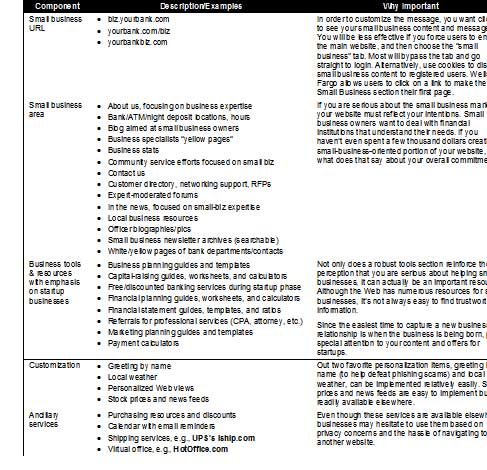
Table 47
General Website Features to Support Small Business
I. Insurance
Compared to consumers, small businesses buy a lot of insurance compared
to consumers. While banks may not be “top of mind” when it comes to
supplying insurance, financial institutions can use their online presence to
change that perception.
Table 48
Online Features for Insurance
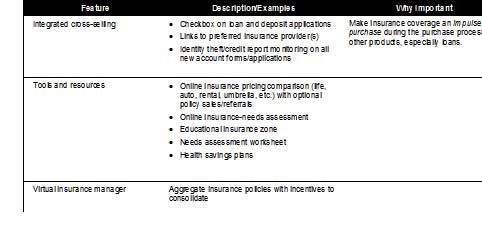
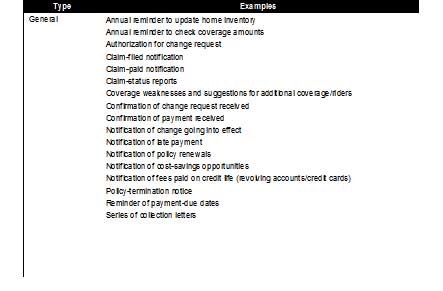
Table 49
E-messaging to Support Insurance
J. Online sales and marketing
Even though microbusinesses are difficult to reach through traditional
direct marketing, we believe they will readily seek you out if you provide
credit and payment solutions targeted specifically to them, especially when
in startup mode.
It’s important to make sure everyone, especially the line staff,
understands that microbusinesses are to be actively courted, not avoided.
Typically, bankers roll their eyes and trot out horror stories about past
“nightmares” with flaky microbusinesses. Staff must be educated to the
facts: Microbusinesses can be risky, but with proper pricing and risk
management, the segment provides an excellent source of incremental profits.
In sales efforts, leverage the cachet of the branch manager. A single
telephone call or visit with the local branch manager could be enough to
land an entire microbusiness account. This all-important relationship with a
human must be nurtured after the initial sale. Email, instant messaging, and
other electronic tools can be effective in keeping the communication
channels open.
Some other effective ways to increase your share of the microbusiness
market:
- Uncover microbusinesses within your own retail customer base by
looking for random and fluctuating deposit activity. - Develop Web content
that caters directly to the small business segments you are targeting, such
as- – Part-time businesses
- – Self-employed (including full-time sales) or 1-person business
- – Micro employers with fewer than 5 employees
- Use professional copywriters familiar with small business
terminology to create website copy, including FAQs. - Give business bankers “ownership” of the business part of your
Web site to make sure it is up-to-date and speaks to the target markets. - Enlist business owners to evaluate your website and other
marketing material
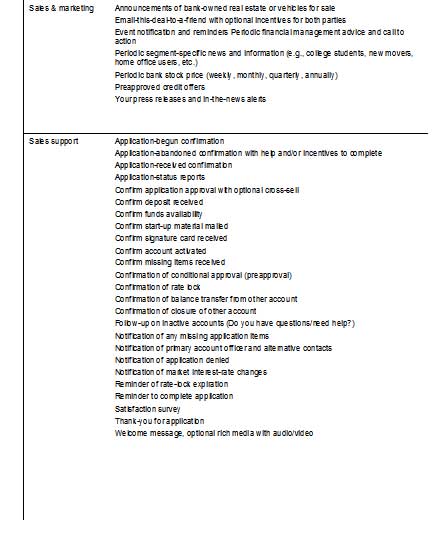
Table 50
Online Marketing & Sales Tactics for Small Business Acquisition and
Retention

Table 51
E-messaging to Support Small Business Sales & Marketing
Small Business Online Banking Usage
Online banking usage
Up until a few years ago, small business usage of online banking trailed
consumer adoption. In late 2000, 13% of small and microbusinesses used
online banking compared to 16% of consumers . Three years later, online banking penetration is similar to that of
consumers, an estimated 30% overall. At the largest small businesses, those
with sales between $5 and $10 million, usage is now more than 40%, double
the rate three years earlier.
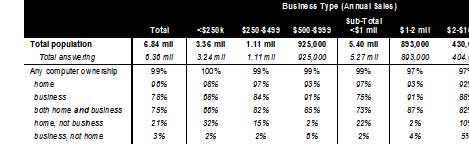
It’s likely we’ll see continued rapid growth for a few more years. Almost
all (99%) small businesses are computerized, either at the business or at
the owner’s home, or both (see Table 18, above) and more than 75% are
using their personal computers for financial activity (see Table 21, next
page). It’s only a matter of time before the majority of small
businesses bank online. Looking at the 7.3 million small and microbusinesses
universe, we predict that we’ll pass the 50% penetration point within four
years. However, we may reach that point much sooner. One researcher,
Synergistics Research, is already saying that online banking usage
has passed the 50% mark in the $100,000- to $10-million segment, with the
largest small businesses
($5 to $10 million) topping out at 75% penetration.

Table 21
Small business online and PC financial services usage,
2002

Source: NFO Financial Services Group SOHO/Small Business Owner 2002
Online and Channel Use
Reasons for not banking online are typical, with security and
inconvenience (compared to current methods) the most-cited reasons (see
Table 22, below). Only 8% mentioned it was too expensive and only 5%
said they didn’t have the necessary equipment (presumably convenient online
access).
Table 22
Reasons for not conducting either business banking or
investing online

Source: NFO Financial Services Group SOHO/Small Business Owner 2002
Online and Channel Use
Table 23
Online banking, billing, payment and other online activities
Q. Does your company use the Internet …?

Source: NFO Financial Services Group SOHO/Small Business Owner 2002
Online and Channel Use, April 2003
Table 24
Cash Management Usage
Q. Please indicate if the service is
used?
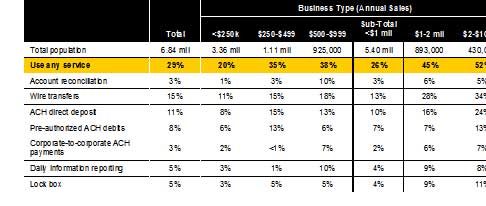
Source: NFO Financial Services Group SOHO/Small Business Owner 2002
Online and Channel Use, April 2003
Advisor usage
While small businesses still turn to their banker for loan
advice, only 17% use a banker for cash management advice, and just 4% for
retirement planning (see Table 25, below). Because small businesses are
skeptical of bankers’ expertise in non-traditional areas, banking organizations
must first explain why they are selling the product, and why the bank’s solution
is superior to more traditional sources. It may be advantageous to partner with
brand names that are more closely associated with the non-traditional product,
e.g., Safeco for business insurance.
Regardless of the channel the customer chooses to get
information and make transactions, a human is usually needed to close the sale.
In a recent Synergistics Research survey of 600 small businesses, only 7% had
opened bank accounts remotely (see Table 26, below). The sales process
can be assisted by email and phone with a branch manager, business banking
officer, or a special small business liaison.

Small Business Loyalty & Growth Potential
Small business loyalty
One consistent trait across all small businesses: loyalty.
Once you land one, it takes significant upheaval, such as a new commercial
loan relationship, before they make a move. NFO research indicates that 81%
of small businesses use the same bank for personal and business services.
And in a survey of Barlow Research clients, about 60% said they kept their
personal and business accounts at the same bank. Evidently, it’s just not
worth the entrepreneur’s time and energy to shop banks, unless they are in
the midst of raising capital. That’s why we believe it is vitally important
to establish a credit relationship with every small business customer
regardless of size.
However, high loyalty is not necessarily the same as high
satisfaction. According to NFO, in 2003 57% of small businesses are very
or extremely satisfied with their primary financial institution, up
from 50% in 2002. This is a mediocre score overall. And with the advent of
the online channel, it is easier than ever to shop around. And since only
22% of small business customers report being actively courted for their
deposits and investments, incumbent financial institution may be vulnerable.
Typically it has been the interaction between the business
owner and the commercial loan officer that has maintained, or sunk, the
relationship. Though personal relationships are still the primary factor,
electronic communications and online services are becoming important side
benefits. The savvy loan or banking officer can use email, instant
messaging, and a Web presence to supplement and extend the face-to-face
relationship. Staying in touch, asking for feedback, and identifying new
needs can all be done through frequent electronic communications.
Growth potential
|
Table 17 Accounting Method by Small Business Type
Source: Online Banking Report, 5/04 |
The small and microbusiness market holds much promise for financial
institutions looking to grow revenues and profits. Smaller businesses, which
are almost 100% computerized (Table 18, next page), are particularly
well-suited for online delivery; however, since most lack dedicated
resources to handle banking matters, they can be reluctant to change
existing processes and procedures. Even though your bank’s latest online
feature may draw an enthusiastic response in focus groups, expect slow
adoption by small business clients. They are simply too busy to pay
attention to incremental banking improvements.
While banks and other financial providers have long coveted the small
business market, most have found it difficult to provide the high-touch
services needed by business owners at prices that a smaller business can
afford. However, we believe small business online banking offers a new
paradigm. Automated online tools and electronic communications such as
instant messaging and webinars, allow banks to deliver customized products
at affordable price points, both for the smallest home-office-based sole
proprietor as well as companies with hundreds of employees.
Table 18
Small business PC ownership
Source: NFO Financial Services Group SOHO/Small Business Owner 2002 Online
and Channel Use
The Forecast Growth New Small Business Online Banking
Looking at the entire universe (including self-employed and contractors),
for 2004 we project growth of 2 million new small business online banking
users, a slight decline from the 2.5 million who came online in 2003. And
the rate of growth, due to the higher base, will slow to 17% from
2003’s 28% (see Table 9, below).
Table 9
Forecast of U.S. Small, Microbusiness, and Self-Employed Online
Banking Usage
includes broadest definition of small business
users, population estimated at 23 million

Source: Online Banking Report projections based on industry data (+/-
30%), 3/04;
% OLB = percent of total population that is actively banking and/or paying
bills online (activity within past 6 months)
Table 10
OBR Forecast: Small Business Use of Online Banking
businesses with annual revenues from $50,000 to $10 million, not
including self-employed/contractors

Sources: 1998 to 2002 estimates, TNS Financial Services Small Business
Market Track, April ’03; (1) 1995 to 1997 and 2003 to 2013: Online
Banking Report estimates plus or minus 33%
The opportunity at your financial institution
For a rough approximation of the small business potential in
your market, use the national average business-to-consumer penetration. For
example, there are approximately 90 million U.S. households with bank
accounts. Therefore about 25% (23/90) are business owners. About 8% (7.3/90)
own businesses that are relatively easy to find via identifiable business
phone lines, D&B reports, compiled lists and so on. The difference, about 16
million, are harder-to-find self-employed and contractors.
Table 11
Estimating the Number of Microbusinesses in Your Market
Number of banking households in your market
(fill in)
Multiply by the percentage of all households that are microbusinesses
x 8% or 25%*
Approximate number of microbusinesses in your market
= _____
Source: Online Banking Report, 6/04 *Depends on whether you are looking
at all businesses including self-employed/contractors, or just the
larger small and microbusiness segment
Total market size of balance-driven banking products
Looking at just the 1.2 million larger small businesses with
revenues from $1 million to $10 million (not including
self-employed/contractors), TNS Financial estimates total business deposits
of $240 billion and the total loans and lines of $160 billion for a total of
$400 billion. In addition, we estimated the microbusiness segment ($50k to
$1 million) has another $240 billion in deposits and loans. In addition, NFO
estimates that small- and microbusiness owners have another $1.6 trillion of
deposit and loan balances in their personal accounts, for a total of $2.2
trillion. Assuming a 200 basis point (2%) spread on the balances, the sector
is generating about $44 billion in net interest revenues, an average of
$6,000 per business/owner.
But, this only accounts the money paid out to financial
services companies. It ignores the significant internal and often hidden
costs associated with financial management: accounting, bookkeeping,
payroll, treasury, and so on. With the Web, banks have an opportunity to
compete not just for the traditional financial products, but also for the
entire financial operations of the business.
Table 12
Deposit and Loan Balances and Net Interest Margin from Small-and
Microbusinesses
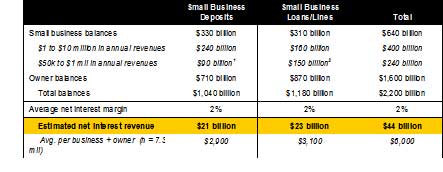
Source: Small business ($1 to $10 million) segment and owner balances
from TNS Financial Services Group 2003 Small Business Studies, 4/03;
Microbusiness balances and average net interest margin are estimates from
Online Banking Report, accuracy estimated at plus 100%, minus 50%
1OBR estimate of $15,000 per microbusiness, n =
6.0 million
2OBR estimate of $25,000 per microbusiness, n =
6.0 million
Table 13
Small Business Assets by Type, Numbers and Balances

Source: Balances from TNS Financial Services Group (formerly NFO World
Group) 2003 Small Business Studies, 4/03
Table 14
Small Business Liabilities by Type, Numbers and Balances

Source: Balances from TNS Financial Services Group (formerly NFO World
Group) 2003 Small Business Studies, 4/03
Table 15
Misc. Product Usage

Source: Balances from TNS Financial Services Group (formerly NFO World
Group) 2003 Small Business Studies, 4/03
Table 16
Financial Products Purchased for Personal Use1 by Small
Business Owners
Warning: Small sample sizes of respondents with large balances may distort
the numbers.

Source: Balances from TNS Financial Services (formerly NFO World Group/PSI
Global) 2002 SOHO and
Small Business Owner Studies, 4/02; number of small and microbusinesses from
NFO’s 2003 Small Business Study, 4/03
Total population (N) = 7.3 million U.S. small and microbusinesses, not
including self-employed/contractors, OBR estimate +/- 20%
Does not include the value of the owner’s business, commercial real estate
investments, stock options, and other misc. categories
1Products used personally, not for the business
2Total market = (% using) x (average balance) x (7.3 million micro
and small business owners)
3Total balances only, does not include auto leases or insurance
4Across all business owners, users and non-users
5Net worth = personal assets less personal liabilities, does not
include net value of business or non-residential real estate holdings
6Total personal assets less value of residential real estate, does
not include net value of business or non-residential real estate
Barclays Small Business Banking
Q. When is a business most likely to open a new bank account?
A. When they are first starting out.
Recognizing that the best time to get their foot in the door at a business is before the doors even open, Barclays Bank (UK), addresses the issue front and center on its small business banking home page Barclays Small Business Banking : Small Business.
The company offers a number of startup service including complimentary consultations with business advisors and fee-free checking accounts (18 months if you also bank personally at Barclays, 12 months otherwise).